
“He left very specific instructions for you.” The lawyer held the thick cream-colored envelope toward my eighteen-year-old son.
For several seconds, Noah did not move. Neither did I. We were standing near the back of a quiet funeral chapel surrounded by people dressed in black, the scent of lilies hanging heavily in the air.
At the front of the room, Mr. Vance’s adult son and daughter were accepting condolences from relatives.
Neither of them seemed to notice the lawyer approaching us.
Noah finally looked at me.

“Mom?”
His voice was barely above a whisper.
I had no idea what to tell him.
“Take it,” I said softly.
The lawyer gave him a reassuring nod.
“Your neighbor wanted you to receive this immediately after the service.”
Noah slowly reached out.
The envelope looked strangely heavy in his hands.
That was the moment I realized that four years of Saturday mornings might have meant far more to an elderly man across the street than either of us had ever understood.
But to explain what happened next, I need to go back to the summer when Noah was fourteen.
Raising my son alone had never been part of my plan.
His father left before Noah was born.
There was no dramatic goodbye.
No final argument.
No promise that he would eventually come back.
He simply decided fatherhood was not something he wanted.
I remember sitting at my kitchen table seven months pregnant, staring at a message on my phone that contained only a few sentences.
“I’m sorry. I can’t do this. You’ll be better without me.”
That was it.
For years, I carried anger about those words.
Not because he had left me.
Eventually, I got over that.
What hurt was knowing my son would grow up wondering why someone who helped create him had decided he was optional.
I worked as a receptionist at a small dental office during the week and cleaned two office buildings several evenings a week.
Money was usually tight.
We were never starving, but there were months when one unexpected car repair could wipe out everything I had managed to save.
We lived in a modest two-bedroom house on a quiet street where most of the homes had been built in the 1960s.
The neighborhood was not fancy.
There were cracked sidewalks, enormous maple trees, old wooden fences, basketball hoops leaning over driveways, and neighbors who mostly knew each other by first name.
Our house sat directly across from Mr. Vance’s.
His full name was Harold Vance.
When Noah was younger, we barely knew him.
Mr. Vance lived with his wife, Margaret, and they kept mostly to themselves.
Margaret was friendly whenever we crossed paths.
She grew roses near their front walkway and sometimes gave Noah homemade oatmeal cookies when he was little.
Mr. Vance was different.
He was polite but reserved.
He was the kind of man who would lift two fingers from the steering wheel in greeting rather than wave.
He rarely attended neighborhood gatherings.
He never stayed outside talking longer than necessary.
But Margaret seemed to understand him perfectly.
Whenever Mr. Vance became too quiet, she would simply smile and say, “Harold has used up his words for the day.”
Then, when Noah was eleven, Margaret passed away.
She had been ill for months, although few people in the neighborhood had realized how serious it was.
Afterward, Mr. Vance changed.
His curtains stayed closed more often.
The flower beds Margaret had cared for began filling with weeds.
His porch light, which had once come on every evening, sometimes remained dark for days.
He stopped driving as much.
Neighbors occasionally brought food.
People asked whether he needed anything.
Mr. Vance almost always gave the same response.
“I’m managing.”
Then he would close the door.
Over time, people stopped asking.
Life continued.
Families moved.
Children grew up.
Cars came and went.
And Mr. Vance remained inside the same fading green house across the street.
Noah noticed him more than I did.
That was one of the things about my son.
He noticed people.
Not the loud people everyone noticed.
The quiet ones.
The lonely ones.
The person sitting alone at lunch.
The elderly cashier struggling to lift a heavy box.
The new student standing beside a classroom door pretending not to be nervous.
Noah rarely talked about these things.
He simply reacted.
When he was nine, I discovered he had been giving part of his lunch to another boy whose mother had lost her job.
When he was twelve, he spent three weeks helping a classmate practice reading after school because other students laughed when the boy stumbled over words.
Once, I asked where he learned to care so much about people.
He shrugged.
“I don’t know.”
I smiled.
“That isn’t an answer.”
He thought for a moment.
“Maybe because being ignored probably feels worse than people think.”
That sentence stayed with me.
The summer Noah turned fourteen was brutally hot.
By July, everyone’s lawns had started turning brown around the edges.
One Saturday morning, I was standing in our kitchen drinking coffee when Noah suddenly appeared at the back door.
“Can I use the mower?”
I glanced outside.
Our lawn did need cutting.
“Sure.”
He pulled on an old baseball cap and disappeared into the garage.
Twenty minutes later, I heard the mower.
But the sound was coming from across the street.
I walked to the window.
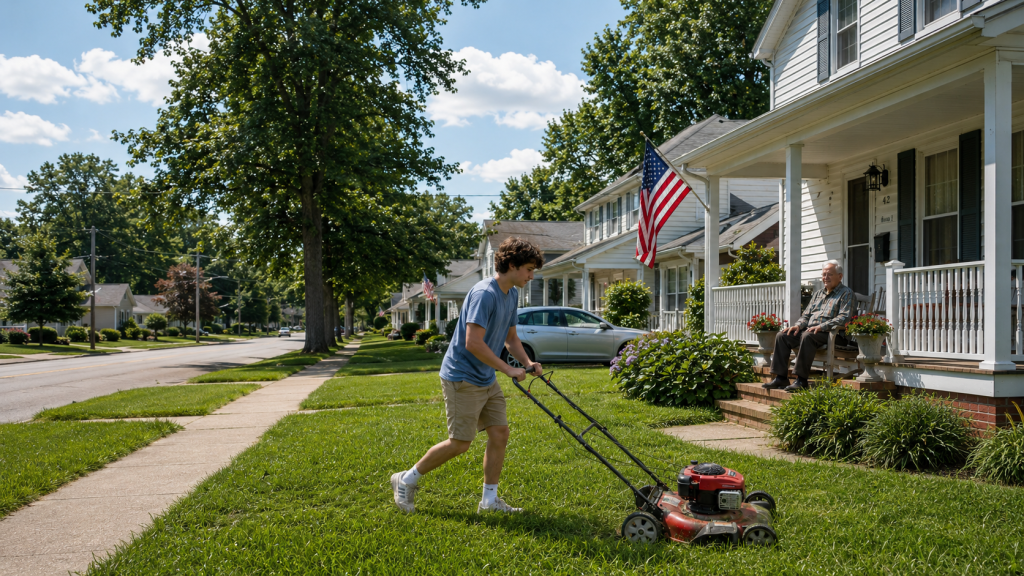
Noah was mowing Mr. Vance’s front lawn.
The grass was badly overgrown.
It had probably not been cut for nearly a month.
I watched him make slow lines from one side of the yard to the other.
Mr. Vance appeared on the porch.
He was thinner than I remembered.
He leaned heavily against the railing and stared at Noah.
For a moment, I expected him to tell my son to stop.
Instead, he lowered himself into an old metal chair.
He sat there quietly watching.
When Noah finished, he pushed the mower toward the sidewalk.
Mr. Vance raised his hand.
Noah stopped.
They spoke briefly.
When my son returned home, he was sweaty and covered in grass clippings.
“What was that about?” I asked.
Noah grabbed a bottle of water from the refrigerator.
“Mr. Vance’s lawn.”
“I noticed.”
He opened the bottle.
“I saw him trying to push his mower yesterday.”
“What happened?”
“He only made it halfway down the driveway before he had to sit down.”
Noah took a drink.
“So I did it.”
“Did he ask you?”
“No.”
“Did you ask him?”
“No.”
I laughed.
“So you just marched across the street and started mowing?”
“Pretty much.”
“What did he say?”
Noah looked thoughtful.
“He asked how much I wanted.”
“And?”
“I told him nothing.”
I leaned against the kitchen counter.
“Nothing?”
“He didn’t ask to get old.”
There was something so simple about the way Noah said it that I did not know how to respond.
That afternoon, I walked across the street.
Mr. Vance was on his porch.
I wanted to make sure Noah had not overstepped.
“Mr. Vance?”
He looked up.
“Afternoon.”
“I hope Noah didn’t bother you this morning.”
His expression changed slightly.
“He told you?”
“I heard the mower.”
For several seconds, he said nothing.
Then he looked toward his newly cut lawn.
“Your boy refused twenty dollars.”
“That sounds like Noah.”
“I told him work deserves payment.”
“He probably told you he wasn’t working.”
Mr. Vance looked almost amused.
“He did.”
I smiled.
“If he becomes annoying, send him home.”
The old man shook his head.
“He wasn’t annoying.”
Then, after a pause, he added quietly, “Tell him thank you.”
I did.
The following Saturday, Noah crossed the street again.
And the Saturday after that.
At first, I assumed it was temporary.
Maybe Mr. Vance would hire someone.
Maybe his health would improve.
Maybe one of his children would start handling the lawn.
But none of that happened.
Every Saturday morning around nine, Noah pushed our mower across the street.
During the summer, he mowed.
In autumn, he raked leaves.
During winter, whenever snow fell, Noah shoveled Mr. Vance’s walkway before doing ours.
When spring came, he cleared sticks from the yard.
Mr. Vance never became particularly talkative.
But he began waiting for Noah.
Every Saturday, the old metal chair appeared in the same place on the porch.
Mr. Vance would sit there with a cup of coffee and watch my son work.
Their conversations were usually short.
“How’s school?”
“Fine.”
“Baseball?”
“Practice Tuesday.”
“Your mother working today?”
“Yeah.”
Sometimes the exchange was barely more than a few sentences.
Yet something gradually changed between them.
One Saturday, Noah came home carrying an old wooden toolbox.
I stared at it.
“What is that?”
“Mr. Vance gave it to me.”
“Why?”
Noah set it on the kitchen table.
“He said every young man should know how to fix something without watching a video first.”
Inside were old hand tools: screwdrivers, pliers, a hammer, two wrenches, and a folding ruler.
The wooden box was scratched and stained from decades of use.
On the lid, someone had burned the letters H.V.
“Did you try to refuse it?” I asked.
“Three times.”
“And?”
“He told me refusing four times would be disrespectful.”
I laughed.
“That sounds like him.”
After that, Saturdays sometimes extended beyond lawn work.
Mr. Vance showed Noah how to sharpen mower blades.
He taught him how to replace a leaking faucet washer.
He explained why old hardwood furniture should never be sanded carelessly.
He taught him how to check oil properly and how to jump-start a car.
Noah absorbed everything.
I began seeing a side of Mr. Vance I had never known existed.
He had spent more than thirty years working as a machinist before retiring.
He had served in the Army when he was young.
He loved baseball.
He hated television news.
He could identify almost every classic car by engine sound.
Most importantly, he missed Margaret terribly.
The first time he mentioned her to Noah, my son came home unusually quiet.
“What happened?” I asked.
He hesitated.
“Mr. Vance showed me his wife’s garden.”
The garden was mostly weeds by then.
“He said she used to spend hours out there.”
Noah looked toward the window.
“He said after she died, he couldn’t touch it.”
“Why?”
“He said changing anything felt like admitting she wasn’t coming back.”
I felt a lump in my throat.
The following spring, without telling Mr. Vance beforehand, Noah bought two small rose bushes with money he had saved from working at a grocery store.
He planted them near the old garden.
When Mr. Vance saw them, he became angry.
At least that was what Noah thought.
The old man stared at the roses for almost a minute.
Then he went inside without saying anything.
Noah came home looking devastated.
“I messed up.”
“You were trying to do something kind.”
“I should have asked.”
An hour later, there was a knock at our door.
Mr. Vance stood outside.
He looked uncomfortable.
“Is Noah home?”
My son appeared behind me.
Mr. Vance looked directly at him.
“Those roses.”
Noah immediately said, “I’m sorry.”
Mr. Vance shook his head.
“No.”
His voice cracked.
He cleared his throat.
“Margaret liked red ones.”
Noah had planted red roses.
The old man looked away.
“How did you know?”
“I remembered the pictures in your hallway.”
Mr. Vance stared at him.
Then something happened I had never seen before.
He placed one hand on Noah’s shoulder.
“Thank you.”
He turned and walked home.
That evening, the porch light across the street stayed on until nearly midnight.
Years passed quietly like that.
Noah grew taller.
His voice deepened.
He learned to drive.
The child pushing a mower across the street became a young man.
Mr. Vance grew slower.
By the time Noah was sixteen, the old man needed a cane.
By seventeen, he rarely left the porch.
I worried about him.
“Do his children visit?” I asked Noah once.
“Sometimes.”
I had seen them occasionally.
His son, Robert, lived several hours away and worked in commercial construction.
His daughter, Diane, lived in another state.
They visited on holidays and sometimes during the summer.
From what I could tell, they loved their father.
They simply had lives far away.
Mr. Vance never criticized them.
Whenever Noah asked, he defended them.
“My kids have their own families. That’s how it should be.”
Still, loneliness does not disappear simply because you understand the reason for it.
One Saturday during Noah’s junior year, Mr. Vance was not sitting outside when Noah arrived.
My son knocked on the door.
No answer.
He tried again.
Still nothing.
Noah came running back across the street.
“Mom, something’s wrong.”
We called Mr. Vance’s son and then emergency services.
Paramedics found him on the bedroom floor.
He had fallen during the night and could not get up.
He had been lying there for almost ten hours.
The doctors said Noah may have saved his life simply by noticing that the porch chair was empty.
Mr. Vance spent more than a week in the hospital.
When he returned home, Robert stayed with him for several days.
I finally met Robert properly.
He was probably in his early fifties, with his father’s serious expression.
One afternoon, he knocked on our door.
“You’re Noah’s mother?”
“Yes.”
He held out his hand.
“I’m Robert Vance.”
“Nice to meet you.”
He glanced toward our driveway where Noah was washing my car.
“My dad told me what your son did.”
“He only checked on him.”
“He checked because he noticed.”
Robert’s voice became quieter.
“That matters.”
Then he looked directly at me.
“My father isn’t easy.”
I smiled gently.
“I’ve noticed.”
Robert almost laughed.
“He’s always been stubborn. My sister and I have tried to convince him to move closer to one of us.”
“He refuses?”
“Every time.”
Robert shook his head.
“He says leaving that house would feel like leaving Mom.”
I understood.
“Maybe he isn’t ready.”
“He’ll never be ready.”
Robert looked across the street.
“I worry about him constantly.”
Then he said something I would remember later.
“I’m glad your boy is nearby.”
Noah never treated Mr. Vance like an obligation.
Even after he got his first part-time job, he arranged his schedule around Saturday mornings.
When baseball practice changed, he mowed earlier.
When he started dating a girl named Emily, she learned quickly that Saturdays before noon belonged to Mr. Vance.
Once, Emily jokingly asked, “Who is more important, me or the lawn?”
Noah answered without hesitation.
“The lawn.”
She laughed so hard she nearly dropped her phone.
Eventually, even she started helping.
One autumn morning, I looked outside and saw Noah and Emily raking leaves while Mr. Vance sat on the porch supervising like a foreman.
For the first time in years, I heard him laugh loudly enough to carry across the street.
That sound stayed with me.
The summer before Noah’s senior year, Mr. Vance gave him driving lessons in his old truck.
The truck was a dark blue Ford that had probably been old before Noah was born.