 Reading Time: 39 minutes
My Son Suspended Me From the Company I Built. By Morning, He Learned His Father Had Left One Final Order.
The first thing I heard after my son suspended me from my own company was laughter. Not loud laughter. hat might have been easier. It was the small, nervous kind.
The kind that escaped from people before they could stop it.
The kind that said everyone in the room understood they were witnessing something humiliating, but no one was brave enough to decide whether they were allowed to call it cruel.
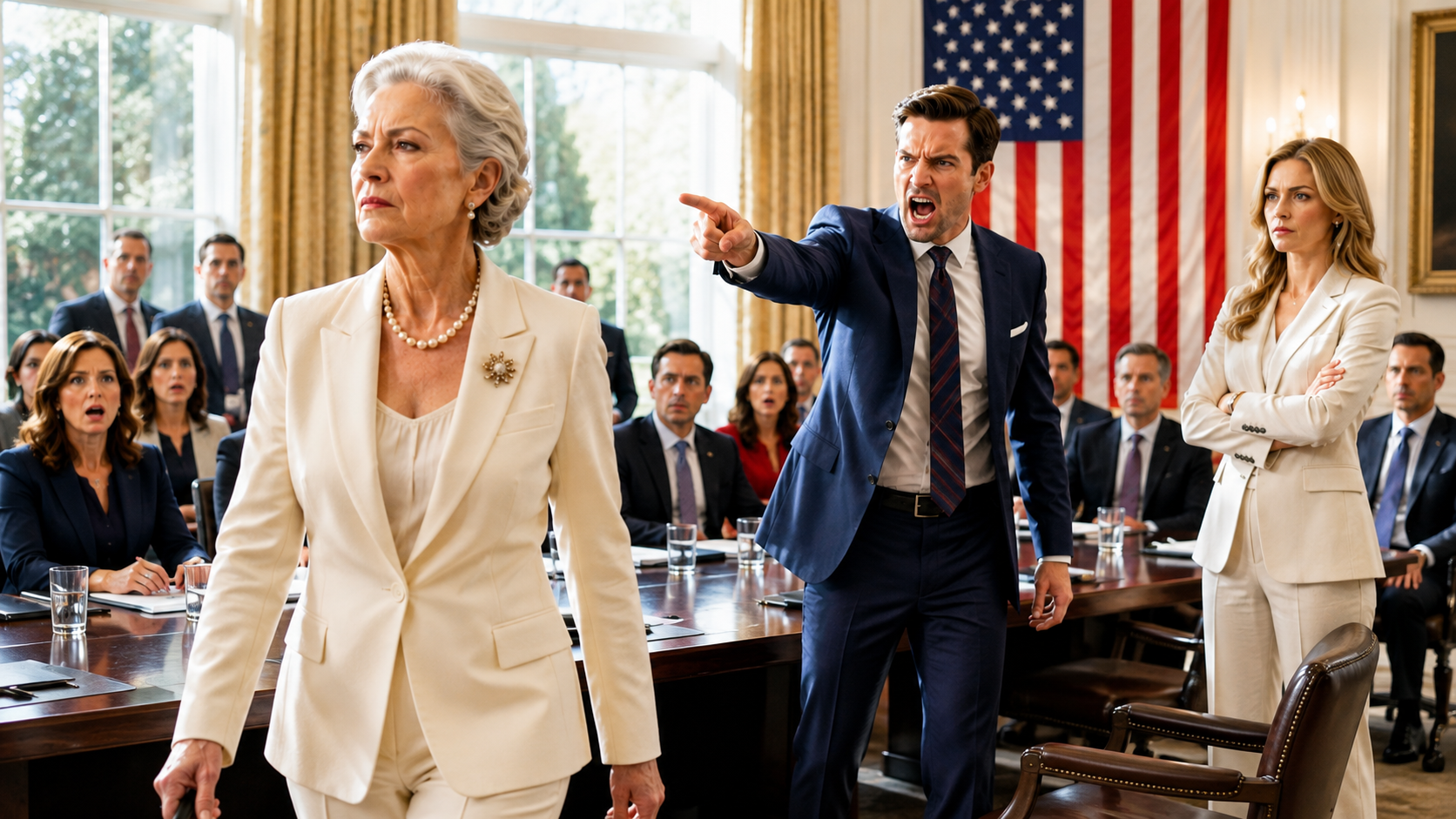
Forty people sat around the long walnut conference table.
Some had worked for me for twenty years.
A few had known my husband before my son was old enough to tie his own shoes.
Others were young architects whose portfolios I had reviewed, whose promotions I had approved, whose babies I had sent gifts to when they were born.
And now all of them were staring at me.
Or trying very hard not to.
My son Daniel stood at the head of the table.
His face was red.
His jaw was tight.
Beside him stood his wife, Natalie, wearing an ivory designer jacket that probably cost more than my first drafting table.
Her arms were folded.
Her lips held the faintest smile.
Daniel looked at me and repeated the sentence as though I had somehow failed to understand it the first time.
“You are suspended from executive duties until you apologize to Natalie.”
For several seconds, I heard nothing except the air conditioner humming above us.
Then somebody shifted in a chair.
A pen rolled across the table.
Natalie’s smile widened.
Only slightly.
But I saw it.
I had spent more than three decades designing buildings and managing people.
I had learned to notice tiny things.
A contractor looking away before admitting a mistake.
A client tapping a finger against a contract when preparing to lie.
A junior architect inhaling sharply before presenting an idea she was afraid everyone would hate.
And the smug little lift at the corner of Natalie’s mouth told me everything.
This was not an argument that had gotten out of control.
This was a performance.
They had planned this.
Perhaps not every word.
Perhaps not every detail.
But they had wanted witnesses.
They wanted me embarrassed in public.
They wanted me angry.
They wanted Eleanor Solis, sixty-five years old, founder of Solis Architecture, widow of David Solis, to lose control in front of the people whose respect had taken me thirty-two years to earn.
So I did the one thing they had not prepared for.
I closed my leather portfolio.
Slowly.
The click of the brass clasp sounded surprisingly loud.
I slipped my phone into my handbag.
Then I stood.
Daniel frowned.
“Mom?”
I looked directly at him.
“Fine.”
His expression changed.
For the first time that morning, the certainty disappeared from his face.
“What?”
“I said fine.”
“You’re agreeing?”
“I heard you.”
He glanced at Natalie.
Natalie stared back at him.
I picked up my purse.
No shouting.
No tears.
No speech about everything I had sacrificed.
No reminder that the company name above the elevators was my last name too.
I simply walked toward the conference-room doors.
When I reached them, I paused.
Not because I had anything left to say.
Because for one stupid second, some primitive part of me still expected my son to call me back.
Mom.
Wait.
I’m sorry.
We went too far.
Something.
Anything.
He didn’t.
The glass door closed behind me.
I walked down the hallway past the drafting rooms, the materials library, and the framed photographs of our completed buildings.
Behind me, Natalie whispered something.
Then Daniel answered.
I couldn’t make out the words.
But I heard them laugh.
That was the moment something inside me changed.
Not shattered.
People always describe betrayal that way.
A heart breaking.
A world collapsing.
A soul cracking open.
But what happened to me was quieter.
Something became still.
For months, perhaps years, I had been trying to save my relationship with my son while pretending I was protecting the company.
That morning, walking toward the elevators, I finally understood that those were no longer the same thing.
Daniel thought I was leaving Solis Architecture.
He had no idea I was finally walking toward it.
My name is Eleanor Solis.
I am sixty-five years old.
Thirty-two years before my son ordered me out of my own company, Solis Architecture was two people, one secondhand drafting table, three pencils, a borrowed fax machine, and a kitchen so small David and I had to move the sugar bowl whenever we wanted to unroll a blueprint.
We lived in a rented apartment above a laundromat.
The pipes rattled every time someone downstairs started a washing machine.
Our kitchen table was our conference room.
Our living room was our studio.
An ironing board became an emergency drafting surface whenever both of us needed the table.
David could look at an empty parcel of land and see something magnificent.
He would stand there with his hands in his pockets, staring at weeds and broken concrete, and say things like:
“The lobby should open toward the western light.”
Or:
“If we rotate the building six degrees, the upper offices will catch the river.”
I used to laugh.
“There is no building, David.”
“There will be.”
That was him.
He saw possibility before reality caught up.
I was different.
I saw invoices.
Permit deadlines.
Payroll.
Insurance.
Contract clauses.
I knew which clients paid late.
Which contractors needed to be called twice.
Which city officials hated incomplete forms.
Which banks smiled at young architects and then rejected their loan applications.
David dreamed.
I made sure his dreams survived contact with the real world.
He used to tell people that I was the reason Solis Architecture existed.
I used to tell them he was exaggerating.
He wasn’t.
Neither of us could have built it alone.
When Daniel was born, the company was barely three years old.
We could not afford a nanny.
We could barely afford ourselves.
His bassinet sat beside my drafting desk.
More than once, I negotiated contracts with a phone pressed between my shoulder and ear while rocking him with one foot.
Once, during a meeting with a developer, Daniel started screaming so loudly that I had to excuse myself.
I carried him into the bathroom, sat on the closed toilet lid, and cried with him.
I was exhausted.
I had slept maybe four hours in two days.
Our bank account was nearly empty.
David was working across town.
And I remember looking down at Daniel’s little red face and whispering:
“One day, you’re going to think all of this just appeared.”
He stopped crying for half a second.
Then started again.
I laughed through my tears.
“Exactly. You won’t believe me.”
Some months we paid our employees before ourselves.
During one recession, we went without salaries for six weeks.
I sold a bracelet my grandmother had given me because payroll was due on Friday and we were twelve thousand dollars short.
David found out six months later.
He was furious.
Not because I had sold it.
Because I hadn’t told him.
“We are supposed to drown together,” he said.
“I wasn’t drowning.”
“You sold your grandmother’s bracelet.”
“I was swimming creatively.”
He stared at me.
Then he laughed.
That was our marriage.
We argued.
We worked.
We failed.
We recovered.
We buried friends.
We raised a child.
We built something.
And slowly, the company grew.
A small medical office became a school project.
The school project became an apartment complex.
The apartment complex led to a hotel.
By the time Daniel was eighteen, Solis Architecture occupied two floors of a downtown office tower.
By then, our name meant something.
Not celebrity.
Not glamour.
Trust.
If a client hired Solis Architecture, they knew the drawings would be accurate.
The budget would be honest.
The deadlines would matter.
And if we made a mistake, we admitted it before someone else had to discover it.
That reputation took decades.
Daniel grew up inside it.
He did homework in the conference room.
He ate pizza with interns during late-night deadlines.
He came with us to building openings.
He knew employees by first name.
Everyone adored him.
He was David’s son.
My son.
The future, people called him.
Perhaps we told him that too often.
At twenty-five, he earned a graduate degree we paid for entirely.
At thirty, he joined the company full-time.
At thirty-five, he had an executive office.
I remember the morning his name was added to the leadership page on our website.
Daniel Solis.
Vice President of Development.
David stood behind me looking at the screen.
“You proud?” I asked.
He nodded.
“Terrified.”
I laughed.
“Why?”
“Because giving your child power is different from giving your child love.”
At the time, I thought he was being philosophical.
David occasionally became philosophical after two glasses of wine.
I kissed his cheek.
“He’ll be fine.”
David looked at our son’s photograph on the screen.
“I hope so.”
Five years later, David died.
Suddenly.
A Thursday afternoon.
No warning.
No long illness.
No time to prepare.
He had been working late on preliminary plans for a civic center.
At 4:17 p.m., he sent me a text.
Do you want Thai tonight?
At 4:31, a junior architect found him collapsed beside his desk.
At 4:39, the ambulance arrived.
At 5:12, I was standing under fluorescent hospital lights while a doctor explained that my husband of thirty-seven years was gone.
For weeks afterward, I kept rereading his last message.
Do you want Thai tonight?
Such an ordinary sentence.
That was the cruelty of it.
A lifetime ended in the middle of dinner plans.
I buried him the following Friday.
Daniel stood beside me at the cemetery.
Rain soaked the shoulders of his black coat.
When the workers began lowering David’s coffin, Daniel reached for my hand.
“Mom,” he whispered, “I’ll help you protect everything Dad built.”
I turned toward him.
His eyes were swollen from crying.
For one moment, he looked seven years old again.
I squeezed his hand.
“We’ll protect it together.”
I believed him.
Perhaps that was the most expensive mistake I ever made.
The Monday after the funeral, I returned to work.
People called that strength.
It wasn’t.
It was necessity.
Grief does not make payroll.
Grief does not answer clients.
It does not renegotiate contracts.
It does not protect forty employees whose mortgages and children and medical insurance depend on a company continuing to function.
So I went back.
For months, I cried in David’s office before meetings.
Then washed my face and walked out.
I kept his coffee mug on the shelf.
His yellow pencils remained in the top drawer.
The civic center drawings stayed exactly where he had left them.
I could not bring myself to touch them.
But the company survived.
More than survived.
Over the next four years, our revenue nearly doubled.
We won three major design awards.
We landed the largest private commercial project in company history.
And because I loved Daniel, and because I believed David would have wanted him to feel that the company belonged to his future too, I transferred twenty-five percent ownership to him.
I kept seventy-five percent.
Daniel hugged me after we signed the papers.
“You won’t regret this.”
I smiled.
“I know.”
Looking back, I sometimes wonder whether David would have stopped me.
As it turned out, he already had.
I just didn’t know it yet.
Natalie entered our lives quietly.
That was her talent.
She never walked into a room like an enemy.
She arrived like perfume.
Pleasant.
Polished.
Easy to underestimate.
Then, gradually, impossible to ignore.
Daniel met her at a development conference.
She called herself a corporate image strategist.
She was elegant, quick, persuasive, and extraordinarily good at making Daniel feel important.
The first time he brought her to dinner, she complimented the house six times.
The seventh thing she said was:
“It must be strange living in a place with so much history.”
I smiled.
“I like history.”
She touched the antique sideboard behind her.
“I usually prefer a cleaner aesthetic.”
A harmless sentence.
That was Natalie’s specialty.
Little sentences that sounded innocent until you replayed them later.
That evening, I gave her my mother’s pearl necklace.
I had been saving it for Daniel’s wife.
Natalie rolled the pearls between two fingers and smiled.
“How vintage.”
Not beautiful.
Not meaningful.
Vintage.
I ignored it.
For two years, I ignored many things.
The paintings David had chosen disappeared from the company reception area.
At first Natalie said they were being cleaned.
They never came back.
Then the furniture changed.
Then the logo.
Then the brochures.
Then came the consultants.
One was Natalie’s former college roommate.
Another was a man who had once worked with her at an advertising agency.
There was a branding specialist.
A social-media director.
An executive presence coach.
A corporate culture consultant.
A strategic storytelling advisor.
I still do not know what that last one actually did.
I only know he billed us four hundred dollars an hour.
Whenever I questioned the expenses, Daniel leaned back in his chair with a patient smile.
“Mom, companies evolve.”
“I know.”
“You built something great.”
“Thank you.”
“But you have to loosen your grip.”
That became his favorite phrase.
Loosen your grip.
On the company whose first payroll had come from my personal credit card.
On the reputation David and I built year by year.
On my own authority.
Then Natalie began attending design meetings.
At first she sat quietly.
Then she started commenting.
Then interrupting.
Eventually, she began leading discussions.
“She understands presentation,” Daniel told me.
“We design buildings, Daniel.”
“And clients buy stories.”
“They also expect the building not to collapse.”
He laughed.
“You always do that.”
“Do what?”
“Make everything sound ridiculous if it wasn’t your idea.”
That accusation hurt more than I admitted.
I began questioning myself.
Maybe I was old-fashioned.
Maybe I was resisting change.
Maybe grief had made me cling too tightly to how David and I used to do things.
Parents can become remarkably creative when inventing excuses for their children.
One afternoon, my assistant of fourteen years entered my office carrying a notebook.
Susan rarely looked nervous.
That day she did.
“Mrs. Solis?”
“What is it?”
“Natalie told me I report directly to her now.”
I stared at her.
“Excuse me?”
“She said it’s part of the restructuring.”
“Did Daniel approve that?”
Susan hesitated.
Then nodded.
I stood.
“Thank you.”
I walked directly into Daniel’s office.
He was typing.
“Daniel.”
“One second.”
“No.”
He looked up.
“You reassigned my assistant?”
He exhaled.
“Temporarily.”
“Without telling me?”
“Mom, please.”
“I’m asking a question.”
“And I’m telling you it’s part of restructuring.”
“Restructuring what?”
“The executive workflow.”
“My assistant works for me.”
He leaned back.
“This is exactly the problem.”
“What problem?”
“You treat every change like an attack.”
“You removed my assistant without asking.”
“You don’t need permission for everything.”
“I own seventy-five percent of this company.”
His eyes changed.
Only for a second.
But I saw it.
Resentment.
Then he smiled.
“See? That.”
“What?”
“You always have to remind everyone.”
I stood very still.
“I remind you when you behave as though you’ve forgotten.”
He looked away.
I left.
That should have been the day I understood.
It wasn’t.
Parents can see betrayal almost anywhere except inside their own children.
Everything finally broke during a twenty-million-dollar client presentation.
The project was enormous.
A luxury mixed-use complex with offices, residential towers, restaurants, and public space.
Winning it would secure years of work.
Natalie insisted on leading the presentation.
I was invited to observe.
That was the word she used.
Observe.
I had designed buildings before Natalie had learned to read.
But I sat in the back.
I told myself I was showing flexibility.
The presentation began well.
Market analysis.
Brand narrative.
Community impact.
Then the primary rendering appeared on the screen.
My stomach tightened.
I knew that building.
Not ours.
Someone else’s.
The proportions.
The façade pattern.
The dramatic offset terraces.
The structural rhythm.
I had seen it in an international design journal.
A celebrated tower in Dubai.
Maybe Natalie was using it as reference material.
I waited for the citation.
Nothing.
She smiled at the client.
“This is an original concept developed exclusively by our team.”
My skin went cold.
I stood.
“This presentation needs to stop.”
The room froze.
Natalie turned.
“What?”
I looked at the clients.
“I apologize, but we cannot continue presenting this image as original work.”
Daniel’s face hardened.
“Mom.”
I ignored him.
“That design is substantially similar to an existing completed project in Dubai. Presenting it as original exposes this company and the client to serious legal and reputational risk.”
One of the client representatives slowly closed his notebook.
Natalie’s face went white.
“Eleanor, perhaps we can discuss—”
“No.”
Daniel stood.
“Mom, sit down.”
I looked at my son.
“No.”
The meeting ended ten minutes later.
We lost the client.
The instant the door closed behind them, Natalie spun toward me.
“You did that deliberately.”
“I prevented a potential lawsuit.”
“You humiliated me.”
“You presented someone else’s design as ours.”
“I did not steal anything.”
“Then explain it.”
Her hands shook.
“You could have spoken to me privately.”
“After you told the client it was original?”
“You wanted me to fail.”
“No, Natalie. I wanted this company not to become famous for plagiarism.”
Her expression hardened.
Then she said the sentence that changed everything.
“This company does not need some bitter old woman surviving on her dead husband’s reputation.”
The room went silent.
Absolutely silent.
I looked at her.
But strangely, it was not Natalie I wanted to hear from.
It was Daniel.
My son.
David’s son.
I waited.
Daniel stared at the carpet.
For one second.
Two.
Three.
Finally he muttered:
“Natalie, that was too far.”
That was all.
Too far.
Not:
Don’t speak to my mother that way.
Not:
Don’t ever use my father’s death as an insult.
Not:
She built this company.
Just:
Too far.
Something inside me became perfectly still.
I picked up my folder.
Then I looked at Natalie.
“You are right about one thing.”
She blinked.
“What?”
“This company does not need someone surviving on David’s reputation.”
Then I turned toward Daniel.
“And tomorrow we are going to find out exactly who that is.”
I walked out.
That evening I went home, poured a glass of wine, and did not drink it.
I sat alone in the study where David and I used to argue over tax documents.
For the first hour, I simply stared at the safe.
David had managed most of our estate planning.
I knew the basics.
I owned seventy-five percent.
Daniel owned twenty-five.
Our attorney, Marcus Bell, handled the rest.
After David died, grief made paperwork feel obscene.
I signed what Marcus told me required signatures.
I filed documents.
I attended meetings.
But I had never carefully reread every partnership agreement.
That night, I did.
Page by page.
Clause by clause.
At 1:17 in the morning, I found Section Fourteen.
I read it once.
Then again.
Then a third time.
Any partner whose conduct materially endangered the financial, legal, or reputational interests of Solis Architecture could be removed from executive authority by majority vote.
I controlled seventy-five percent.
My hands began to shake.
Not because I was afraid.
Because I finally understood the difference between what Daniel had convinced me I could do and what I could actually do.
At 1:43 a.m., I called Marcus.
He answered on the fourth ring.
“Eleanor?”
“I’m sorry.”
“What happened?”
“I need you tomorrow.”
A pause.
Then:
“Is this about Daniel?”
I froze.
“How did you know?”
Marcus was quiet.
Too quiet.
“Come to my office at seven.”
“What aren’t you telling me?”
“Seven, Eleanor.”
I barely slept.
By six-thirty, I was dressed.
At seven, Marcus opened his office door.
He looked exhausted.
Three document boxes sat on the floor behind him.
I stopped.
“What are those?”
“Things I hoped we’d never need.”
That sentence stayed with me.
By noon, my dining room looked like a crime scene made entirely of paper.
Unauthorized consulting contracts.
Reimbursement accounts.
Invoices approved outside normal procedures.
Insurance modifications.
Vendor agreements.
Email chains.
And then Marcus found something called N.L. Strategic Holdings.
“What is that?” I asked.
He turned the document toward me.
The registered owner was Natalie Lauren Solis.
My daughter-in-law.
Payments from our company totaled fifty-three thousand dollars.
My stomach turned.
“For what?”
Marcus examined the invoices.
“Brand consulting.”
“We already pay her.”
“Yes.”
“Does this company have employees?”
“Apparently not.”
“Office?”
“No.”
“Website?”
“No.”
“Work product?”
He shook his head.
“Not that I can find.”
I stood and walked toward the window.
The city looked bright and ordinary.
People crossed sidewalks.
Cars stopped at lights.
Somebody pushed a stroller.
I remember thinking how insulting it was that the world could look normal while your family was disintegrating.
Marcus spoke behind me.
“There’s more.”
Of course there was.
He handed me a stack of printed emails.
Most were between Daniel and Natalie.
One subject line read:
TRANSITION PLAN.
I began reading.
Natalie had written:
We need to retire the old woman before she realizes how much authority she’s already lost.
My eyes stopped.
The old woman.
I read Daniel’s response.
Just keep pushing. Eventually she’ll explode in front of people. Then we’ll have what we need.
I read it twice.
Then a third time.
My son.
My own son.
They had not simply grown tired of me.
They had been provoking me deliberately.
Setting me up.
Constructing a version of me they could show to attorneys, doctors, board members, perhaps even a judge.
Emotional.
Unstable.
Difficult.
Old.
Marcus gently removed the page from my hands.
“Eleanor.”
“What else?”
He hesitated.
“What else?”
There were emails about competency assessments.
Medical evaluations.
Forced retirement.
Possible guardianship concerns.
I felt the room tilt.
“They wanted to say I was mentally unfit.”
“Yes.”
“Could they?”
“Not easily.”
“Then why try?”
Marcus stared at the papers.
Finally he reached into another folder and pulled out a draft acquisition proposal.
A competitor had offered thirty-eight million dollars for Solis Architecture.
I looked at the number.
Then at Daniel’s name.
If he obtained enough executive authority, he could push the sale.
And if the sale closed, his twenty-five percent would make him wealthy beyond anything he had ever earned.
My throat tightened.
“He was going to sell it.”
Marcus said nothing.
“He was going to sell his father’s company.”
“Our company,” Marcus corrected gently.
I looked toward the framed photograph of David on the shelf.
For years, everyone had done that.
David’s company.
David’s vision.
David’s legacy.
Even me.
Perhaps that was one reason Daniel had grown to resent us both.
I touched the edge of the acquisition proposal.
Marcus said quietly:
“He’s still your son.”
I looked at him.
“No.”
Marcus frowned.
I continued.
“Tonight he can be my son.”
I tapped the papers.
“Tomorrow morning he is my business partner.”
At six the next morning, I entered Solis Architecture.
The lobby lights were still dim.
I wore a pearl-gray suit.
David used to say the color made me look dangerous.
I wore the diamond earrings he had given me for our twentieth anniversary.
Then I walked into his old office.
For five years, I had left it almost untouched.
That morning, I opened the blinds.
Removed the dust cover from his chair.
Placed my handbag on the desk.
And moved in.
By seven, every executive password had been changed.
Daniel’s access to company bank accounts was frozen.
All signature privileges were suspended.
Every payment connected to Natalie or her consultants required legal review.
By seven-thirty, two security officers stood near the elevators.
At seven-forty-five, Daniel and Natalie arrived.
They were laughing.
At seven-fifty-one, I heard Daniel shouting.
“What the hell do you mean my access is restricted?”
I stepped into the hallway.
“Good morning.”
Daniel turned.
“Mom?”
His eyes moved past me to David’s office.
“What are you doing in there?”
“Working.”
Natalie’s expression tightened.
Then Marcus stepped out behind me.
Daniel looked at him.
Then at security.
“What is this?”
Marcus opened a folder.
“Daniel, your mother did not simply leave yesterday.”
He turned a page.
“She withdrew your delegated executive authority.”
Daniel laughed.
“You can’t suspend me.”
“I don’t need to,” I said.
Marcus continued.
“Your executive authority has been revoked under Section Fourteen of the partnership agreement.”
Daniel stared at me.
“You can’t do that.”
“I own seventy-five percent.”
“You gave me twenty-five.”
“Yes.”
“You can’t take it back because we had an argument.”
“I haven’t taken anything back.”
“Then what is this?”
“I am protecting the company.”
“From what?”
I looked directly at him.
“You.”
His face changed.
Natalie stepped forward.
“This is ridiculous.”
Marcus placed documents on the conference table.
Unauthorized contracts.
Financial transfers.
The acquisition proposal.
Emails.
Daniel’s anger disappeared for half a second.
Then he recovered.
“You went through my private messages?”
“Company communications belong to the company,” Marcus said.
Daniel looked at me.
“You’re destroying this family because Natalie hurt your feelings.”
I almost smiled.
“No, Daniel. I’m protecting forty employees because you endangered their livelihoods.”
Natalie glanced at the financial documents.
Then stopped.
Her face changed.
Marcus slid forward the paperwork for N.L. Strategic Holdings.
Daniel saw it.
So did Natalie.
He turned toward her.
“What did you send from your company?”
Natalie blinked.
“My company?”
“N.L. Strategic.”
She stared.
Then looked at Marcus.
“I don’t own anything called N.L. Strategic Holdings.”
Daniel’s head snapped toward her.
“Stop.”
Her confusion deepened.
“I’m serious.”
Marcus studied her.
“The company is registered under your full legal name.”
“I never registered it.”
“You approved invoices.”
“No, I didn’t.”
Daniel stepped closer.
“Natalie.”
Something in his tone changed.
A warning.
She heard it too.
So did I.
Natalie slowly backed away from him.
“Daniel… what did you do?”
The hallway outside the conference room had gone silent.
Employees were gathering beyond the glass walls.
Daniel lowered his voice.
“You’re really going to pretend you didn’t know?”
Natalie’s face went pale.
She pulled out her phone.
Her hands began to tremble.
“I thought the documents you gave me were branding approvals.”
Daniel reached toward the phone.
She stepped back.
“Give me that.”
Marcus moved between them.
“Do not touch her.”
Natalie started scrolling.
Fast.
Her breathing became shallow.
Then she stopped.
“Oh my God.”
She held the phone toward Marcus.
“I kept everything.”
Daniel lunged.
One security officer caught him by the arm.
“Give me the phone!”
Natalie recoiled.
For the first time since I had met her, every layer of polish disappeared.
She began crying.
Not elegantly.
Not strategically.
She looked terrified.
Marcus took the phone.
“What am I looking at?”
“Messages,” Natalie whispered.
“From whom?”
She looked at Daniel.
“My husband.”
Daniel shouted:
“She’s lying.”
Marcus read silently.
Then his expression hardened.
He looked at me.
“Eleanor.”
“What?”
“I think we’ve misunderstood the fifty-three thousand dollars.”
The truth came apart slowly.
Then all at once.
Daniel had created N.L. Strategic Holdings.
He had used Natalie’s legal information.
Opened the bank account.
Authorized payments.
Routed money through multiple accounts.
Natalie had signed two documents without properly reading them.
Careless.
Irresponsible.
Foolish.
But she had not created the scheme.
Daniel had.
Natalie sank into a chair.
“You told me those were marketing authorizations.”
Daniel said nothing.
She stared at him.
“You used my name.”
“Natalie—”
“You put a company in my name.”
“I can explain.”
She laughed once.
A broken sound.
“You can explain?”
Then Marcus found another message.
Apparently Daniel had forgotten Natalie still had it.
He handed the phone back to her.
Her eyes moved across the screen.
The color drained from her face.
The message from Daniel read:
Once the sale closes, I’ll take care of the divorce. She won’t know what hit her.
Natalie’s entire body went still.
She looked at Daniel.
“You were going to leave me?”
He rubbed his forehead.
“Natalie, this isn’t—”
“You used my identity.”
“Natalie.”
“You put stolen money through a company in my name.”
“I said I can explain.”
“And after the sale you were going to divorce me?”
His silence answered.
She slapped him.
The sound cracked through the room.
No one moved.
Daniel turned toward me.
“This is your fault.”
For the first time that morning, I laughed.
Actually laughed.
“My fault?”
“You never trusted me.”
“I gave you twenty-five percent of everything your father and I built.”
“You never treated me like Dad!”
The room went silent again.
There it was.
Not money.
Not Natalie.
Not even the company.
The wound underneath all of it.
David.
Daniel’s face twisted.
“He always thought you were smarter.”
I stared at him.
“He respected you more.”
“Your father loved you.”
“He respected you.”
“That was not a competition.”
“It was to me!”
His fist struck the table.
“You have no idea what it was like growing up as David Solis’s son.”
My voice softened.
“Then tell me.”
“Everyone loved him.”
“Yes.”
“Everyone admired you.”
I said nothing.
“Do you know what people said to me my entire life?”
He laughed bitterly.
“Your father designed this.”
“Your mother saved that project.”
“Your parents built this company.”
“Your father was a genius.”
“Your mother never forgets anything.”
“Do you know what people said about me?”
His voice cracked.
“Daniel has potential.”
Something inside my chest tightened.
He continued.
“I was always potential.”
“Daniel—”
“Never enough.”
I looked at my son.
For the first time that morning, I saw the frightened boy buried inside the arrogant man.
It would have been easier if he had only been greedy.
Greed I could understand.
This was grief mixed with envy.
Love mixed with resentment.
A child who had spent forty years measuring himself against parents who had never realized he thought he was competing.
“I wanted one thing that was mine,” he said.
“So you decided to steal ours?”
His eyes dropped.
That was answer enough.
Marcus quietly lifted a folder from his briefcase.
Then he removed a sealed envelope.
Old paper.
David’s handwriting.
My heart stopped.
Across the front was one word.
Eleanor.
I recognized every curve.
Every letter.
“What is that?”
Marcus looked at me with an expression I could not read.
“Something David left.”
My voice came out barely above a whisper.
“For five years?”
“Yes.”
“Why?”
“He gave me specific instructions.”
Daniel laughed bitterly.
“Of course he did.”
Marcus turned toward him.
“What does that mean?”
“Even dead, Dad needs to control the room.”
Marcus stared at him.
Then said:
“Yes.”
Daniel’s bitter smile disappeared.
Marcus handed me the envelope.
“David instructed me not to deliver this unless a specific condition occurred.”
My fingers trembled around the paper.
“What condition?”
Marcus looked directly at Daniel.
“If Daniel ever attempted to remove you from executive control or force a sale of Solis Architecture.”
Nobody spoke.
Not one person.
Only the hum of the air-conditioning remained.
I looked at Marcus.
“He expected this?”
“Not exactly.”
“What does that mean?”
“He feared the possibility.”
I looked down at the envelope.
For a moment I could not open it.
Five years.
Five years without David’s voice.
Without his hand reaching across the bed.
Without him leaving coffee beside my drawings.
Without him complaining that I used too much garlic.
And suddenly I was holding words he had written knowing I might someday need them.
I tore the envelope carefully.
Inside was a letter.
And another document.
I unfolded the letter first.
Ellie,
My breath caught.
No one had called me Ellie since he died.
If you are reading this, something I prayed would never happen has happened.
I swallowed.
Daniel has tried to take control from you.
My vision blurred.
Daniel stepped closer.
I continued reading.
Before you blame yourself, you need to know that I saw signs years ago. I hoped I was wrong. Maybe I still am. Maybe the boy we raised will become the man I know he can be. But love is not a business control, and hope is not a succession plan.
I closed my eyes.
That sounded exactly like David.
Practical even while breaking my heart.
The second document was thick.
Daniel frowned.
“What is that?”
Marcus answered.
“The original instrument authorizing the transfer of Daniel’s ownership interest.”
Daniel shook his head.
“I know what it says.”
Marcus looked at him.
“No. You know what the summary says.”
He opened the document to the final pages.
“When David authorized Eleanor to transfer twenty-five percent to you, he attached a protective condition.”
Daniel stared at him.
“What condition?”
Marcus read slowly.
“Any deliberate attempt by the beneficiary to remove Eleanor Solis from executive authority, compel the sale of the company against her controlling interest, or materially undermine her governance rights shall trigger compulsory redemption of all transferred shares.”
Daniel’s face emptied.
“What does that mean?”
I looked at Marcus.
He answered me, not Daniel.
“It means Daniel’s twenty-five percent is subject to mandatory buyback.”
Daniel shook his head.
“No.”
Marcus continued.
“At the original transfer value.”
Daniel’s voice cracked.
“What original value?”
Then I remembered.
For estate-planning purposes, the initial ownership grant had been recorded at a nominal amount before later valuation adjustments.
Marcus looked directly at Daniel.
“One dollar.”
Nobody moved.
Daniel gave a strange laugh.
“No.”
Marcus placed the document in front of him.
“You can read it yourself.”
“This is insane.”
“Page twelve.”
“I never agreed to that.”
“Your signature is at the bottom.”
Daniel flipped pages.
His movements became more frantic.
Then he stopped.
There it was.
His name.
His signature.
His date.
He had signed without reading the entire agreement.
The same arrogance that had led Natalie to sign papers without understanding them had now destroyed him.
Daniel looked at me.
“You knew?”
I shook my head.
“No.”
“You expect me to believe that?”
“I had forgotten the clause existed.”
“You set me up.”
“No.”
“Dad set me up.”
“No,” Marcus said quietly.
“Your father protected the company.”
Daniel pushed the agreement away.
“This is theft.”
“You attempted to sell a company you did not control,” Marcus said. “You diverted funds. You planned to manufacture grounds for removing the majority owner. The redemption clause exists specifically for conduct like this.”
Daniel looked at me.
“Mom.”
I had not finished David’s letter.
I lowered my eyes to the page.
Ellie, if the clause has been triggered, do not give the shares back.
My throat closed.
Of course.
He knew me.
I know what you will tell yourself.
Tears filled my eyes.
You will remember Daniel at three years old asleep on your chest. You will remember his first day of school. You will remember the fever when he was eight and how we took turns sitting beside the bathtub because he was too weak to stand. You will remember teaching him to drive. You will remember his wedding.
A tear dropped onto the paper.
You will tell yourself he is our son.
I covered my mouth.
He is.
I could barely breathe.
But Solis Architecture is not only ours. It belongs, in part, to everyone who gave years of their lives helping us build it. To Susan, who stayed through two recessions. To Robert, who slept in the office during the courthouse deadline. To every young architect who chose our company because they trusted our name.
People were crying now.
Quietly.
Even Marcus looked away.
Then came David’s final instruction.
If Daniel triggers the redemption, transfer the redeemed shares into the employee ownership trust.
I stopped.
Read it again.
Employee ownership trust.
Daniel stared at me.
“No.”
Marcus nodded.
“David established the trust before he died.”
“You knew about this?” Daniel demanded.
“I drafted it.”
“For how long?”
“Five years.”
“And you never told me?”
“You were not entitled to know unless the clause was triggered.”
Daniel turned toward me.
“Mom, no.”
I looked around the room.
At Susan.
At Robert.
At people who had stayed after David died because they trusted me to keep the company alive.
At people Daniel had treated as pieces on a board while trying to crown himself king.
David did not want Daniel’s shares returned to me.
He wanted them given to the employees.
The people who had helped us build everything.
Daniel sank into a chair.
“Mom.”
For the first time that morning, he sounded young.
Small.
Almost like the little boy who used to call me from his bedroom after nightmares.
“Please.”
That one word nearly destroyed me.
Nearly.
I walked toward him.
His eyes were wet.
“I’m your son.”
“Yes.”
“You can’t do this to me.”
I knelt so we were eye level.
“Yesterday you suspended me in front of forty employees.”
“I was angry.”
“No.”
He looked at me.
“You were confident.”
His face fell.
“You believed I had nowhere to go.”
“I didn’t—”
“You believed humiliating me would make me surrender.”
He began crying.
I had not seen Daniel cry since David’s funeral.
Part of me wanted to pull him against me.
That instinct did not disappear simply because he had betrayed me.
That is the terrible thing about being a mother.
Love does not always obey evidence.
I reached up and touched his cheek.
For one second, he closed his eyes.
“You forgot something your father never did,” I whispered.
“What?”
“This company was never our throne.”
I stood.
“It was our responsibility.”
Then I turned toward Marcus.
My voice shook.
But it did not break.
“Execute the buyback.”
Daniel closed his eyes.
No police arrived that morning.
I could have called them.
Marcus advised waiting until forensic accountants completed their review.
Natalie cooperated.
Partly because she was terrified.
Partly because she was furious with Daniel.
Probably partly because she wanted to save herself.
She admitted deliberately insulting me.
Admitted she and Daniel had discussed provoking me into public arguments.
Admitted she believed I should retire.
Admitted she had mocked my age and grief because Daniel convinced her I was standing between them and a thirty-eight-million-dollar sale.
None of that made her innocent.
But guilt comes in degrees.
And Daniel’s was deeper than any of us knew.
Three weeks later, Marcus arrived in my office with the forensic report.
He closed the door.
I knew from his face that the news was bad.
“How much?”
He sat.
“Almost six hundred thousand.”
For a moment, I said nothing.
The fifty-three thousand dollars routed through N.L. Strategic had only been one branch.
Daniel had diverted money through layered consulting contracts, false reimbursements, inflated vendor payments, and internal accounts.
Over eighteen months, nearly six hundred thousand dollars had disappeared.
His plan had been simple.
Take enough money to prepare a new life.
Push me out.
Gain authority.
Sell the company.
Collect millions.
Divorce Natalie.
Move to California.
Start again.
And the copied Dubai design?
That contained one final cruelty.
Natalie had not copied it.
Daniel had.
Digital records showed that Natalie’s original presentation file contained a legitimate design created by our junior team.
The night before the client meeting, Daniel replaced the primary rendering with a near-copy of the Dubai building.
He wanted me to recognize it.
He wanted me to interrupt.
He wanted witnesses.
Afterward, he intended to use the confrontation as evidence that I was disruptive, emotional, impossible to manage, perhaps even cognitively unstable.
Natalie genuinely had not known.
She believed her team had updated the presentation overnight.
When Marcus explained this, I sat in David’s office for almost an hour.
I kept staring at the empty chair across from my desk.
“My son wanted me to think I was losing my mind.”
Marcus said nothing.
“He knew I would recognize the building.”
“Yes.”
“He knew I would stop the presentation.”
“Yes.”
“And then he would use that against me.”
Marcus nodded.
I closed my eyes.
My son had not become that person in a single morning.
He had been walking toward him for years.
And I had loved him too much to see the distance growing.
Six months later, Daniel pleaded guilty to financial crimes under an agreement that spared our company and employees the spectacle of a long public trial.
He received prison time.
The day of sentencing, I sat in the back of the courtroom.
Daniel looked thinner.
Older.
He turned once and saw me.
I did not smile.
I did not look away.
When the judge asked whether he wished to speak, Daniel stood.
He apologized to the company.
To the employees.
To Natalie.
Then he looked toward me.
“My mother built something I thought I deserved because I was born into it.”
His voice shook.
“I confused inheritance with achievement.”
I pressed my lips together.
“I thought respect was something my parents owed me.”
He looked down.
“I know now it’s something I destroyed.”
The judge continued.
The sentence was handed down.
And then my son was taken away.
There is no triumph in watching your child walk through a courtroom door in handcuffs.
Anyone who tells you otherwise has never loved a child who disappointed them.
I did not feel victorious.
I felt ancient.
I went home and cried on the kitchen floor.
Not for the man Daniel had become.
For the boy he had been.
Natalie filed for divorce.
A month later, Marcus brought me a small velvet box.
Inside were my mother’s pearls.
No note.
I ran the necklace through my fingers.
For years I had associated those pearls with Natalie’s insult.
Very vintage.
Now I remembered my mother wearing them while teaching me how to sew a button.
I put them back into the safe.
Not because I hated Natalie.
Because I wanted the necklace to belong to my mother again.
Solis Architecture survived.
More than survived.
The employee ownership trust changed the atmosphere inside the company in ways I had not anticipated.
Twenty-five percent of Solis Architecture now belonged to the people who had helped create it.
The first annual trust meeting was awkward.
Most employees seemed unsure whether they were allowed to be excited.
I stood before them in the same conference room where Daniel had suspended me.
I looked around the table.
“I need all of you to understand something.”
Everyone became quiet.
“This is not charity.”
A few people exchanged glances.
“It is not compensation for what happened.”
I placed my hands on the table.
“It is ownership.”
Susan began crying.
I continued.
“David believed that people protect differently when they know part of what they are protecting belongs to them.”
Robert smiled.
“So congratulations.”
I looked around.
“You are officially much more annoying shareholders.”
The room laughed.
Real laughter this time.
Warm.
Relieved.
Alive.
Revenue increased.
Turnover dropped.
Young architects started proposing ideas more boldly.
Senior employees started mentoring more intentionally.
People asked different questions.
Not simply:
What does management want?
But:
What is good for the company we own together?
And something in me changed too.
For thirty-two years, I had carried Solis Architecture like a fragile object.
Then David died, and I gripped it even tighter.
Daniel accused me of refusing to let go.
He was wrong about many things.
But not entirely about that.
I had been holding on.
To David.
To our habits.
To our furniture.
To the way the office looked when he was alive.
To the belief that changing anything meant losing him again.
After the employee trust began, I finally replaced the carpet in David’s office.
It sounds ridiculous.
But I cried when they pulled the old carpet up.
Susan found me standing in the hallway watching workers roll it away.
“You okay?”
“No.”
She waited.
Then I laughed.
“But I think I will be.”
The civic center David had been designing when he died was revived by the city.
Five years after his death, Solis Architecture won the project.
I almost declined.
The drawings felt too personal.
Then one of our youngest architects, Maya Chen, came into my office.
“I know Mr. Solis started the original concept.”
“Yes.”
“And I know you might want to preserve everything.”
I raised an eyebrow.
“But?”
She swallowed.
“But buildings are supposed to become real.”
I looked at her for a long time.
Then I smiled.
“You’re brave.”
“I’m terrified.”
“Good architects usually are.”
We redesigned the project carefully.
Not as a shrine.
As a continuation.
On opening day, I stood outside beneath a clear October sky.
The building rose behind me in glass, limestone, and warm bronze.
David would have loved the western light.
Near the entrance stood a small plaque.
DAVID SOLIS CIVIC CENTER
Below the name were four words I had chosen.
Built for those who stay.
Marcus stood beside me.
“You think he’d approve?”
I studied the plaque.
“He’d complain about the font.”
Marcus laughed.
And for the first time in years, I could almost hear David laughing too.
Then Marcus reached into his jacket.
He held out an envelope.
My stomach tightened.
“Please tell me my husband did not leave another secret instruction.”
Marcus smiled.
“No.”
“What is it?”
“A letter from Daniel.”
My hand remained at my side.
Daniel had already sent three letters from prison.
I had not opened them.
The first envelope sat in my desk drawer.
Then the second.
Then the third.
I did not throw them away.
But I could not read them either.
Forgiveness is not a switch.
Sometimes it is simply a door you stop locking even though you are not ready to open it.
“This one is different,” Marcus said.
“How?”
“No legal requests.”
I looked at him.
“No money.”
I took it.
“No request for shares.”
I stared at Daniel’s handwriting.
Finally I opened it.
One page.
No excuses.
No accusations.
No mention of Natalie.
No attempt to blame grief, pressure, insecurity, or childhood.
Just words.
Mom,
I spent my whole life believing Dad loved you more because he trusted you more.
I stopped.
My eyes burned.
I continued.
I understand now that trust was something you earned every day.
I thought owning part of the company would make me equal to both of you.
Instead, I proved I was not ready to own anything.
My throat tightened.
At the bottom was one final sentence.
I don’t want my shares back. I want to become someone Dad wouldn’t need a clause to protect you from.
I folded the letter.
For several seconds, I could not speak.
Marcus looked toward the crowd gathering near the entrance.
“Are you going to answer?”
“Someday.”
He nodded.
I slipped the letter into my purse.
Marcus walked toward the ceremony.
I remained near the plaque.
That was when an elderly man approached.
For a moment, I did not recognize him.
Then I did.
“Thomas?”
Thomas Reed smiled.
He had been David’s first accountant.
Nearly eighty now.
His shoulders curved with age, but his eyes looked exactly as I remembered.
“Mrs. Solis.”
“Please. Eleanor.”
He held out his hand.
“I’ve wanted to tell you something for a long time.”
My heart tightened.
“About David?”
“Yes.”
Of course.
It was always about David.
Thomas looked toward the civic center.
Then back at me.
“David didn’t write that shareholder clause.”
I stared at him.
“What?”
“The one that protected you from being removed.”
“I know Marcus probably drafted the final legal language.”
Thomas shook his head.
“No. I mean the original idea wasn’t David’s.”
“Then whose was it?”
Thomas smiled.
“Yours.”
I laughed.
“That’s impossible.”
“No.”
“I would remember.”
“You were thirty-five. Daniel was little. The company was preparing for its first significant financing round.”
Something flickered in my memory.
Conference papers.
Cheap coffee.
David arguing with a banker.
Thomas continued.
“You had read about another architecture firm where the founder died and his adult children forced the widow out.”
I remembered.
Slowly.
The widow had lost everything.
Not because she had no role in the company.
Because the ownership documents gave the children enough power to remove her.
I remembered being furious.
Thomas smiled.
“You came into my office with four handwritten pages.”
I closed my eyes.
A younger version of myself appeared.
Thirty years younger.
Hair darker.
Hands steadier.
Daniel waiting with a babysitter.
David annoyed because I had delayed dinner to discuss partnership clauses.
“You told us,” Thomas said, “‘If either David or I dies, our child should never have the power to erase the surviving spouse from what we built together.’”
I stared at him.
Over the years, the language had evolved.
David strengthened it.
Marcus modernized it.
Additional conditions were added.
But the principle had been mine.
I had simply forgotten.
Thomas gently touched the bronze plaque.
“David used to say the smartest thing he ever did was listen when you were certain about something.”
I looked toward the building.
For months, I had told myself David had saved me from beyond the grave.
In a way, he had.
He preserved the documents.
He created the trigger.
He left the letter.
He established the employee trust.
But the final truth was stranger.
Thirty years earlier, a younger version of Eleanor Solis had protected the woman standing there now.
Before Daniel became resentful.
Before Natalie entered our family.
Before David died.
Before I understood how dangerous love could become when mixed with money and power.
I had written my own rescue without knowing I would ever need it.
And suddenly David’s letter made more sense.
He had not created the weapon.
He had simply made sure I remembered where I had left it.
I laughed.
Then cried.
Thomas squeezed my hand.
“You all right?”
“Yes.”
And for once, I meant it.
That afternoon, after the civic-center ceremony ended, Marcus and I returned to the office.
The final trust documents waited on my desk.
Daniel’s redeemed twenty-five-percent interest was ready for permanent transfer.
Marcus placed a pen beside the signature page.
He did not rush me.
I stared at the line.
Eleanor Solis.
For most of my life, that signature had meant responsibility.
Loan applications.
Payroll authorizations.
Architectural contracts.
Daniel’s school forms.
Medical documents.
David’s estate papers.
The morning Daniel suspended me, he believed he was taking that authority away.
Now the same signature would finish what he had accidentally begun.
Marcus watched me.
“Second thoughts?”
I thought of Daniel at three years old.
At eighteen.
At his wedding.
In the courtroom.
I thought about his letter.
I thought about the sentence:
I want to become someone Dad wouldn’t need a clause to protect you from.
My heart hurt.
It probably always would.
But pain and uncertainty are not the same.
“No,” I said.
Marcus nodded.
I signed.
Eleanor Solis.
Twenty-five percent of Solis Architecture permanently passed into the employee trust.
The pen made a small scratching sound across the paper.
That was all.
No thunder.
No music.
No dramatic finality.
Just ink.
I set down the pen.
For years, Daniel had accused me of holding on too tightly.
Maybe he was partly right.
I held onto contracts.
Held onto the company.
Held onto old furniture.
Held onto David’s office.
Held onto grief as though releasing any part of it meant admitting he was truly gone.
But the one thing I finally released was the belief that loving someone meant allowing them to destroy what you built.
Forgiveness and authority are not the same thing.
You can forgive a person without returning the keys.
You can love someone without restoring the power they abused.
You can miss the child they were while protecting yourself from the adult they became.
Motherhood does not mean handing your child a match and quietly watching him burn down your house.
Outside the office windows, the late afternoon sun turned the city gold.
Employees were still gathered near the civic center.
Some carried champagne glasses.
Some posed for photographs.
Maya was explaining part of the façade design to a group of students.
Susan stood beside Robert laughing at something.
Marcus closed the folder.
“So what happens now?”
I looked at him.
“With Daniel?”
“With you.”
No one had asked me that in years.
After David died, everyone asked what would happen to the company.
When Daniel betrayed me, everyone asked what would happen to him.
What would happen to Natalie.
What would happen to the trust.
What would happen to Solis Architecture.
But almost nobody asked what would happen to Eleanor.
I looked toward David’s old drafting pencils.
Then toward the new civic center visible through the glass.
“I think I’m going to work less.”
Marcus raised an eyebrow.
“Define less.”
“Maybe only fifty hours a week.”
He laughed.
“I’m serious.”
“That is why I’m laughing.”
I smiled.
“I might travel.”
“You hate traveling.”
“I hate airports.”
“There is usually an airport involved.”
“Not always.”
He shook his head.
Then his expression softened.
“You should answer Daniel eventually.”
I looked down at the letter inside my purse.
“I know.”
“When you’re ready.”
“Yes.”
He left.
I remained alone.
For a while, I sat at David’s desk.
Then I opened the drawer where he used to keep pencils.
One yellow pencil remained.
I picked it up.
The wood was worn near the middle where his fingers used to rest.
I smiled.
“You really were dramatic,” I whispered.
The office, naturally, did not answer.
That night I went home and took Daniel’s first three letters from the drawer.
I placed them on the dining table.
For almost an hour, I simply looked at them.
Then I opened the first.
He was angry.
Defensive.
Still blaming Natalie.
Still blaming David.
Still blaming me.
I opened the second.
Less anger.
More confusion.
He wrote about prison.
About how quickly people stopped calling.
About realizing how many friendships had actually been business relationships.
The third letter was shorter.
He apologized to Susan by name.
To Robert.
To the junior architects whose work he had claimed as his own during presentations.
And then there was the fourth letter I had already read.
The one without excuses.
I placed all four beside each other.
Four versions of my son.
Angry.
Afraid.
Ashamed.
Perhaps changing.
Perhaps not.
I went to the study.
Took out paper.
Sat down.
And wrote:
Daniel,
Then stopped.
What could I say?
That I forgave him?
I wasn’t sure I did.
That I loved him?
Yes.
Unfortunately, painfully, permanently.
That everything would be fine?
It wouldn’t.
Some things cannot be repaired into their original shape.
But perhaps that does not mean they cannot become something else.
I tried again.
Daniel,
I received your letters.
I stared at the sentence.
Then continued.
I have spent months wondering whether answering you would mean forgiving what you did. I have realized those are separate things.
My hand shook slightly.
I love you.
I stopped again.
Tears blurred the page.
Then I wrote:
I do not trust you.
That was the hardest sentence.
Maybe harder than signing away his shares.
Trust can return, but I cannot promise that it will. It cannot be demanded because I am your mother, and it cannot be inherited because David was your father.
I breathed.
If you truly want to become someone your father would be proud of, do not do it for him.
Do it because you have to live with yourself long after both of us are gone.
I signed:
Mom.
Not Eleanor.
Not Mrs. Solis.
Mom.
I mailed it the next morning.
Daniel answered two weeks later.
I did not rush to open the envelope.
But I did open it.
That was progress.
Years passed.
Not many.
Enough.
Daniel served his sentence.
During that time, he completed accounting courses.
Not architecture.
Accounting.
When I asked why, he wrote:
Because I spent years pretending numbers were someone else’s responsibility. I think I should understand the things I abused.
We wrote occasionally.
Never like before.
Perhaps because before had included too many lies.
After his release, he did not ask to return to Solis Architecture.
He moved into a small apartment.
Found work with a nonprofit helping formerly incarcerated people understand employment contracts and basic finances.
I learned about that from Marcus, not Daniel.
Apparently Daniel had not wanted me to think he was performing redemption for my approval.
That mattered to me.
A year after his release, I agreed to have coffee with him.
Neutral place.
Saturday morning.
He arrived early.
He looked older.
There were lines around his eyes.
His clothes were simple.
No expensive watch.
No tailored suit.
For several seconds, neither of us knew what to do.
Then he said:
“Hi, Mom.”
My throat tightened.
“Hello, Daniel.”
We sat.
He ordered coffee.
I ordered tea.
At first we discussed ordinary things.
Weather.
Traffic.
The civic center.
Then silence settled.
Daniel looked down at his hands.
“I’m not going to ask you to forgive me.”
I said nothing.
“I used to think apologizing was supposed to make the other person give you something.”
He gave a small, embarrassed smile.
“Forgiveness. Another chance. Access.”
He rubbed his thumb against the side of the cup.
“I think that’s why none of my apologies worked.”
I watched him.
“What do you think now?”
“That an apology is information.”
“Information?”
“Yes.”
“It tells you I know what I did.”
He looked at me.
“But it doesn’t create a debt.”
Something in my chest loosened.
Only slightly.
He continued.
“I hated Dad.”
I inhaled.
Daniel quickly added:
“Not all the time.”
He looked embarrassed.
“I loved him. But I hated what I thought he represented.”
“What was that?”
“Everything I wasn’t.”
I folded my hands.
“He made mistakes.”
“I know that now.”
“He doubted himself.”
“I didn’t know.”
“He once forgot to submit a permit application and blamed the copier for two days.”
Daniel laughed.
A real laugh.
It sounded like David.
That nearly broke me.
I smiled despite myself.
“He also nearly bankrupted us during the first recession because he refused to fire anyone.”
Daniel looked surprised.
“He never told me.”
“Parents edit themselves for children.”
“Maybe that was the problem.”
I nodded slowly.
“Maybe.”
He stared into his coffee.
“I thought you and Dad were giants.”
“We were exhausted people with a fax machine.”
He smiled.
Then his eyes filled.
“I wish I had known that.”
“So do I.”
We sat quietly.
Finally Daniel asked:
“Do you think Dad knew I would become what I became?”
“No.”
He looked at me.
“He feared what resentment might make you capable of.”
“That sounds worse.”
“It isn’t.”
“How?”
“Because fear leaves room for choice.”
He looked away.
“And I chose badly.”
“Yes.”
I did not soften it.
For once, he did not ask me to.
When we left the café, he hesitated on the sidewalk.
“Can I hug you?”
For several seconds, I could not move.
Then I nodded.
Daniel wrapped his arms around me.
He smelled like coffee and laundry detergent.
Not expensive cologne.
Not the company.
Not David.
Just Daniel.
My son.
I hugged him back.
Not because everything was repaired.
Not because the past had disappeared.
But because some relationships do not return.
They begin again.
Years after the morning Daniel suspended me, people still occasionally asked why I did not give him another role in Solis Architecture.
“He changed,” they said.
Maybe he did.
I hoped so.
But redemption does not require restoration.
That was another lesson I learned late.
A person may become worthy of love again without becoming worthy of the same authority.
Daniel never returned to the company.
He attended public events occasionally.
Always as my guest.
Never as an executive.
Never as an owner.
The first time he came back after prison was for Solis Architecture’s fortieth anniversary.
He stood in the lobby staring at the employee ownership wall.
Hundreds of names had been engraved there.
People who had worked with us over four decades.
David’s name.
Mine.
Susan’s.
Robert’s.
Daniel’s name was there too.
Not as an owner.
As someone who had contributed years of work before everything went wrong.
He touched the engraved letters.
“I didn’t expect you to keep me on here.”
“You worked here.”
“I hurt the company.”
“Both can be true.”
He looked at me.
I think that sentence stayed with him.
Both can be true.
That is another thing age teaches you.
People want simple stories.
Victim.
Villain.
Good child.
Bad mother.
Faithful employee.
Greedy heir.
But life rarely cooperates.
Natalie was cruel to me.
She was also manipulated by my son.
Daniel loved his father.
He also resented him.
I loved Daniel.
I also removed his power.
David protected me.
But he also failed to tell our son how frightened and imperfect he sometimes felt.
And I built a company while sometimes neglecting the emotional life unfolding inside my own house.
Responsibility does not always mean guilt.
But honesty requires seeing the entire picture.
At seventy-one, I finally stepped down from daily executive management.
The announcement terrified everyone more than I expected.
Susan stared at me.
“You’re retiring?”
“Partially.”
“What does that mean?”
“It means I plan to interfere strategically.”
She laughed.
I remained chairwoman.
The day-to-day company passed to a leadership team chosen by the employees and board.
No dynasty.
No Solis heir.
No throne.
Exactly as David should have wanted.
Exactly as I had wanted before I forgot.
On my last full day in the office, I stood alone in the conference room.
The same room where Daniel had once told me I was suspended.
The table had been refinished.
The chairs were different.
The walls displayed new projects.
For years I had thought I would always remember the humiliation of that morning.
But standing there, I realized the memory no longer hurt in the same way.
It had become a door.
Something terrible had pushed me through it.
But on the other side, I had found parts of myself I had misplaced while being David’s wife, Daniel’s mother, and the company’s protector.
I walked toward the window.
Below me, the city moved.
Buildings we had designed stood in every direction.
A library.
Two apartment towers.
A hotel.
A school.
The civic center.
People lived inside our work.
Argued inside it.
Fell in love.
Lost jobs.
Raised children.
Received terrible phone calls.
Celebrated birthdays.
Sat beside hospital beds.
Architecture had always seemed permanent to me.
But buildings are really containers for temporary lives.
Maybe families are too.
We build them.
Maintain them.
Repair them.
Sometimes a wall fails.
Sometimes the foundation shifts.
Sometimes a room must be closed forever.
And sometimes the only way to save a structure is to stop pretending every damaged piece can remain where it was.
Before leaving, I went to David’s old office one final time.
My office now.
I opened the drawer.
The yellow pencil was still there.
I had never sharpened it.
I took it with me.
At home, I placed it beside Daniel’s letters.
Then I sat on the porch as evening settled over the yard.
My phone buzzed.
A message from Daniel.
Saw the retirement announcement. Does “partially retired” mean you’ll still email everyone at 5:30 a.m.?
I smiled.
Then typed:
Of course. I’m retired, not dead.
Three dots appeared.
His response came.
Dad would approve.
I looked up at the sky.
For years, everything had been measured against David.
Would David approve?
Would David understand?
Would David be proud?
I loved him enough to finally stop asking.
So I typed:
I approve. That’s enough.
Daniel did not answer immediately.
Then:
Good.
I set the phone down.
The sun disappeared behind the trees.
Somewhere nearby, a child laughed.
I thought of myself at thirty-five, drafting a clause because I was furious about a widow I had never met being pushed out of her own company.
That younger woman had no idea what was coming.
She did not know she would lose her husband suddenly.
Did not know her son would one day try to remove her.
Did not know she would sit in a courtroom watching him receive a prison sentence.
Did not know she would eventually hug him again outside a coffee shop.
She simply knew one thing:
No one should be erased from what they helped build.
Thirty years later, that conviction saved me.
Not revenge.
Not wealth.
Not David reaching from beyond the grave.
A boundary.
Written down.
Protected.
Remembered.
That may be the least romantic form of love.
It may also be one of the strongest.
Because love without boundaries can become permission.
Trust without accountability can become opportunity.
And family without consequences can become the perfect hiding place for betrayal.
I loved my son when he was innocent.
I loved him when he was arrogant.
I loved him when he betrayed me.
I loved him when I signed away his ownership.
I loved him when he went to prison.
And years later, when he finally learned that rebuilding a life is harder than inheriting one, I loved him then too.
But I never gave him his shares back.
That mattered.
Because forgiveness is not forgetting.
Healing is not returning everything to the way it was.
And love is not surrender.
Sometimes love is a hand held in a hospital.
Sometimes it is a grandmother’s bracelet sold to make payroll.
Sometimes it is a husband writing a letter his wife might never need.
Sometimes it is a mother touching her grown son’s cheek before taking away the power he used to hurt others.
And sometimes love is simply saying:
I want you in my life.
But you cannot have the keys again.
The company sign still reads:
SOLIS ARCHITECTURE.
For years, people assumed the name belonged to David.
Then they assumed it belonged to Daniel because he was the son.
For a while, even I treated it like something I was merely preserving.
I understand differently now.
Solis was never one person.
It was David.
It was me.
It was Susan staying through recessions.
Robert sleeping at the office before deadlines.
Young architects challenging old ideas.
Employees becoming owners.
Clients trusting us.
Mistakes admitted.
Buildings finished.
Promises kept.
Daniel once believed ownership would make the company his.
He eventually learned what David and I had spent our lives learning.
Ownership is not the same as belonging.
And inheritance is not the same as deserving.
The morning Daniel suspended me, he thought he had finally won.
He thought age had made me weak.
He thought grief had made me sentimental.
He thought being my son guaranteed I would eventually protect him from every consequence.
He thought the woman leaving that conference room was defeated.
He could not have been more wrong.
I was not leaving because I had lost my company.
I was leaving because, for the first time in years, I was ready to protect it without confusing that duty with protecting him.
The following morning, he discovered David’s final order.
But years later, I understood the deeper truth.
David had not saved me.
Not entirely.
He had trusted me.
Trusted the clause I had written decades earlier.
Trusted the strength I had forgotten.
Trusted that when the moment came, I would choose responsibility over guilt.
And he was right.
I once thought the greatest thing David left me was Solis Architecture.
Then I thought it was his letter.
Now I know better.
The greatest thing he left me was the reminder that I had always been capable of standing without him.
That knowledge came late.
But not too late.
On the day I retired, I visited the David Solis Civic Center alone.
It was raining.
Softly.
The plaza was nearly empty.
I stood beneath the covered entrance and touched the bronze plaque.
Built for those who stay.
For years, I thought those words were about David.
Then about the employees.
That afternoon, I realized they were also about me.
I stayed.
Through poverty.
Through success.
Through marriage.
Through grief.
Through betrayal.
Through the terrifying moment when my own son became someone I no longer recognized.
I stayed long enough to learn that staying does not always mean keeping people exactly where they were.
Sometimes staying means protecting what matters while allowing everything else to change.
I touched David’s name one final time.
Then turned toward the glass doors.
Inside, people moved through the building carrying coffee, briefcases, backpacks, umbrellas.
Living ordinary lives inside something David once saw only as lines on paper.
I smiled.
“He’d complain about the font,” I whispered.
And somewhere inside my memory, he laughed.
Then I stepped away from the plaque.
Not as David’s widow.
Not as Daniel’s mother.
Not as the bitter old woman Natalie once accused me of becoming.
Not even primarily as the founder of Solis Architecture.
I walked into the rain simply as Eleanor.
A woman who had loved deeply.
Lost painfully.
Trusted unwisely.
Acted decisively.
Forgiven carefully.
And finally understood that strength is not measured by how much you are willing to endure for the people you love.
Sometimes it is measured by what you finally refuse to let them destroy.
Thirty-two years earlier, I had helped build a company.
Five years after David’s death, I fought to save it.
But the most important thing I saved was not the company.
It was my name.
My judgment.
My authority.
My future.
Myself.
And that, in the end, was the legacy no one could inherit from me.
Because I had earned it.
One decision at a time.
One signature at a time.
One boundary at a time.
I stepped through the rain toward my car.
Behind me, the civic center doors opened.
Ahead of me was a life that no longer belonged to David’s memory, Daniel’s mistakes, or Solis Architecture’s future.
For the first time in decades, it belonged completely to me.
And I was finally ready to live it.
THE END! THANK YOU FOR READING!❤️