 Reading Time: 36 minutes
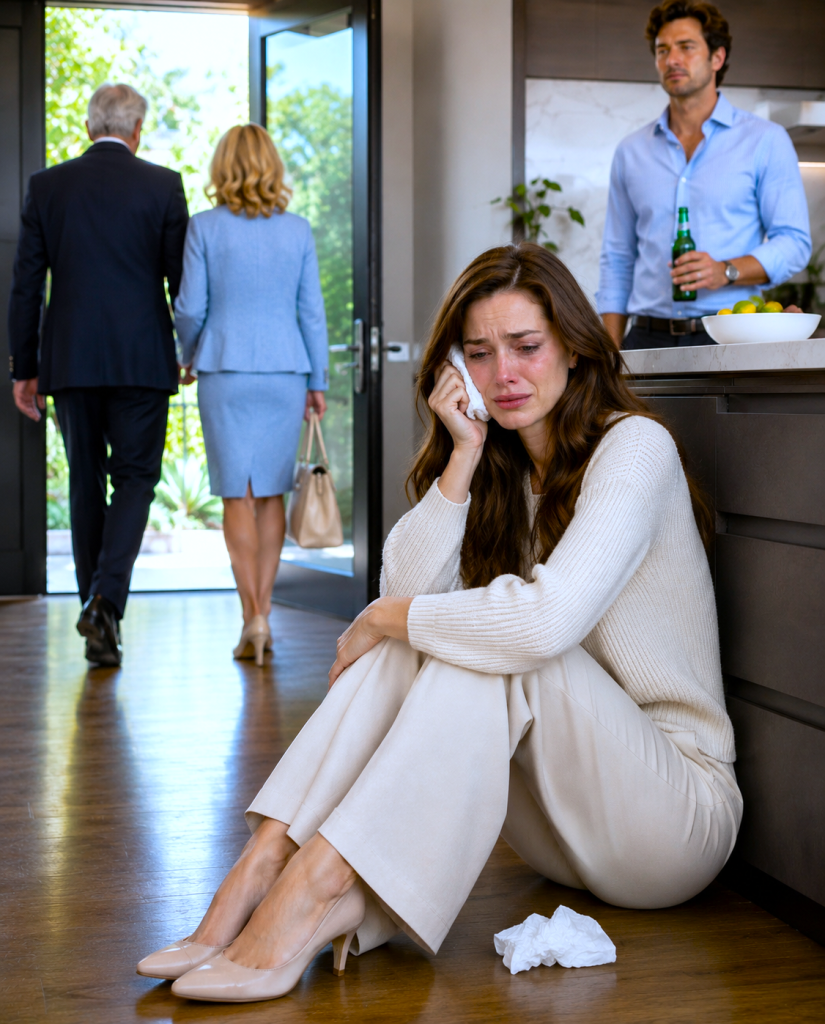
THE LOCK “Nobody leaves this house until you explain what you’re doing.”
Brandon spoke slowly, using the precise, controlled tone he always adopted seconds before losing control. Samantha held her phone firmly at eye level and kept the camera focused on him.
“We are recording everything,” she said. “And the footage is being saved remotely.”
For several seconds, Brandon stared at her.
Then he laughed.
It was not the loud, careless laugh he had used after my parents left. This one was quieter and less certain.
“You think I’m scared of a phone?”
“No,” Samantha replied. “But you should probably be concerned about what’s inside this folder.”
She lifted the thick black folder from my bed.
Brandon’s eyes moved toward it.
I saw the change immediately.
His shoulders stiffened.
The rage was still there, but now something else had entered the room.
Calculation.
For five years, I had watched him calculate everything.
How loudly he could insult me without the neighbors hearing.
How much money he could transfer before I questioned it.
How long he needed to apologize before I stopped sleeping in the spare room.
How many flowers it took to make a bruise feel like a misunderstanding.
How often he could tell me that nobody else would ever put up with me before I started believing it.
But Brandon had never calculated what would happen if I stopped protecting him.
That was what frightened him.
Not Samantha.
Not the phones.
Not the divorce papers.
The evidence.
He pointed toward the folder.
“What is that?”
I took a breath.
“My life for the last four years.”
His jaw tightened.
“Don’t be dramatic.”
There it was.
His favorite weapon.
Not his hands.
Not his shouting.
That sentence.
Don’t be dramatic.
Every insult became humor.
Every threat became frustration.
Every missing dollar became a misunderstanding.
Every bruise became an accident.
Every tear became proof that I was unstable.
But something inside me had changed.
Perhaps it had changed the moment my father saw my bruised face and decided marriage mattered more than his daughter.
Perhaps it had changed when my mother quietly placed chicken soup in my refrigerator because feeding me was easier than defending me.
Perhaps it had changed months earlier, when Samantha looked across a coffee-shop table and said, “Chloe, if you ever decide you’re ready, I will believe you the first time.”
Whatever the moment had been, the woman standing in that bedroom was no longer trying to convince Brandon of anything.
“I’m not explaining myself to you,” I said.
His smile disappeared.
He stepped closer.
Samantha immediately moved between us.
“Back up.”
Brandon looked at her as though he couldn’t believe she had spoken to him that way.
“This is my house.”
“Actually,” I said, “both our names are on the lease.”
He turned toward me.
“You think that matters?”
“It matters more than you think.”
He looked at the suitcases again.
“You’re not taking anything.”
“I’m taking my clothes, my personal documents, my laptop, and the things I owned before we married.”
“You’re taking nothing.”
Samantha spoke calmly.
“Brandon, unlock the door.”
He folded his arms.
“No.”
“Unlock it.”
“No.”
Samantha lowered her phone slightly.
“Okay.”
She touched the screen.
“What are you doing?” he asked.
“Sending the message.”
My heart started beating faster.
That message was part of the plan.
If Brandon attempted to stop us from leaving, Samantha would send a single prewritten text.
The recipient was waiting two blocks away.
Brandon didn’t know that.
For four months, we had prepared for almost every possibility.
Not because Samantha was paranoid.
Because she had volunteered at a women’s legal advocacy center during graduate school, and one of the first things she had told me was that leaving could be the most unpredictable moment.
“You don’t announce the plan,” she had said. “You prepare quietly. Documents. Money. Transportation. Somewhere safe. People who know where you are.”
At first, I had hated hearing her talk like that.
It made everything sound too serious.
I had spent years convincing myself my marriage wasn’t serious enough to require an escape plan.
Brandon had never put me in the hospital.
He had never broken a bone.
He apologized afterward.
He worked.
He sometimes cooked dinner.
He remembered our anniversary.
He bought my mother flowers every Christmas.
Surely monsters didn’t do those things.
It took me a long time to understand that I had been asking the wrong question.
I didn’t need to decide whether Brandon was a monster.
I only needed to decide whether I was safe.
I wasn’t.
Samantha placed the phone back at eye level.
“Last chance,” she said. “Unlock the door.”
Brandon looked at me.
“You called the police?”
I said nothing.
His face hardened.
“You called the cops on your own husband?”
Still, I said nothing.
Then he pointed at me.
“You’re going to regret humiliating me like this.”
The sentence hung in the room.
Samantha’s phone captured every word.
Before she could answer, there was a knock at the apartment door.
Three sharp knocks.
Brandon froze.
Then came a voice from the hallway.
“Police.”
His face changed.
It was astonishing how quickly anger became innocence.
He straightened his shoulders.
Ran one hand through his hair.
Lowered his voice.
And looked at me.
“Chloe,” he whispered, “don’t do this.”
I stared at him.
Five years earlier, that whisper would have destroyed me.
Three years earlier, I would have apologized.
A year earlier, I might have begged Samantha to leave before answering the door.
That night, I simply said:
“Unlock it.”
He didn’t move.
The officer knocked again.
“Minneapolis Police. Open the door.”
Brandon looked toward Samantha.
Then me.
Finally, he turned the lock.
And for the first time in years, the sound of a door unlocking felt like freedom.
THE OFFICERS AT THE DOOR
Two officers stood in the hallway.
Behind them was another woman.
Her name was Lena Morales.
She worked with the advocacy organization Samantha had contacted when we began preparing my exit.
Lena wasn’t a police officer.
She wasn’t my attorney.
She was simply someone who understood what frightened people often needed when they finally decided to leave.
A witness.
A calm voice.
A plan.
The older officer looked at Samantha first.
“Who called?”
“I did.”
“Is everyone safe right now?”
Before I could answer, Brandon stepped forward.
“This is ridiculous. My wife and I had an argument, and her friend is trying to turn it into something it isn’t.”
The officer held up one hand.
“I’ll speak with everyone separately.”
“There’s nothing to speak about.”
“Sir, step over here.”
“I pay rent here.”
“I understand that. Step over here, please.”
Brandon’s face flushed.
He hated being instructed.
Especially in his own home.
Especially in front of me.
But he obeyed.
The second officer came toward Samantha and me.
His eyes briefly settled on my face.
“What happened?”
My mouth opened.
Nothing came out.
It surprised me.
I had rehearsed the sentence.
Dozens of times.
Samantha and I had practiced what I would say if police ever came.
My husband struck me.
My husband prevented me from leaving.
My husband has threatened me before.
Simple sentences.
Facts.
But when the moment arrived, shame climbed into my throat.
I heard my father’s voice.
It’s between husband and wife.
I heard my mother’s silence.
I heard Brandon laughing.
Even your own parents don’t want to get involved with you.
The officer waited.
He didn’t rush me.
Lena stepped closer but didn’t touch me.
Finally, I pointed toward my face.
“My husband did this.”
The sentence was barely louder than a whisper.
But I had said it.
The officer nodded.
“When?”
“About an hour ago.”
“Was anyone else here?”
“No.”
“Did anything happen afterward?”
“He stopped me from leaving.”
“How?”
“He locked the bedroom door and said nobody was leaving.”
“Did he threaten you?”
“He said I would regret humiliating him.”
The officer glanced at Samantha.
“Do you have that recorded?”
“Yes.”
“Don’t delete anything.”
“I won’t.”
Brandon’s voice suddenly rose from the living room.
“She’s lying!”
The older officer responded firmly.
“Sir, stay where you are.”
“You need to hear my side!”
“We will.”
“You’re treating me like some criminal because she’s upset.”
I closed my eyes.
There it was again.
Upset.
Not injured.
Not frightened.
Not trapped.
Upset.
The officer beside me asked whether I wanted medical attention.
I said no.
Then I changed my mind.
“Yes.”
The word surprised even me.
I had spent years saying no to help because I thought accepting help required me to prove that I deserved it.
That night I decided being hurt was enough.
An ambulance wasn’t necessary, but the officer recommended that I have the injury documented medically.
Lena said she could take me to an urgent-care clinic after we left.
Then the officer asked about the folder.
Samantha placed it carefully on the bed.
Inside were copies.
Never originals.
That had been Lena’s advice.
Bank records.
Screenshots.
Photographs.
Threatening messages.
A timeline I had written over four months.
Dates.
Places.
What happened.
Whether anyone had witnessed the aftermath.
Whether I had sought medical treatment.
For years, I had thought keeping records was somehow dishonest.
As if love required forgetting.
As if marriage required erasing history every morning.
Brandon had counted on that.
Every argument started at zero because he insisted nothing before it mattered.
The folder proved otherwise.
The officer slowly flipped through several pages.
His expression became more serious.
“How long has this been happening?”
I looked down.
“Years.”
Brandon shouted from the other room.
“Oh, come on!”
The older officer ordered him to remain quiet.
Then came the moment I had dreaded most.
The officer asked:
“Do you want to leave tonight?”
I looked at Samantha.
She didn’t answer for me.
Lena didn’t answer for me.
Nobody told me what a good wife should do.
Nobody told me to think about appearances.
Nobody told me marriage was difficult.
Nobody told me to forgive him because he was stressed.
They waited for my decision.
“Yes,” I said.
The officer nodded.
“Then let’s make sure you leave safely.”
WALKING OUT
I had imagined leaving Brandon many times.
In some versions, I screamed everything I had held inside.
In others, I threw my wedding ring at him.
Sometimes he cried and begged.
Sometimes my parents arrived and finally defended me.
Sometimes the neighbors came into the hallway and saw who he really was.
Reality was quieter.
Samantha carried one suitcase.
I carried the other.
Lena took the backpack containing my documents.
The officers remained inside while we moved my belongings.
Brandon stood near the kitchen.
He didn’t apologize.
Not then.
He watched me with an expression I knew well.
Cold.
Controlled.
Calculating.
When I reached the doorway, he finally spoke.
“You walk out that door and we are finished.”
I stopped.
For five years, that threat had kept me inside.
Finished.
The word had terrified me.
I had built my adult life around a marriage.
We shared bills.
Furniture.
Friends.
Holiday traditions.
A Netflix account.
A favorite Thai restaurant.
We knew each other’s coffee orders.
His mother called me on my birthday.
My cousins called him family.
Ending a marriage didn’t feel like ending one relationship.
It felt like tearing apart an entire structure.
But as I stood in that doorway, I understood something.
We had already been finished.
I had simply been the last person willing to admit it.
I turned toward him.
“Yes,” I said.
His eyebrows moved slightly.
I don’t think he expected agreement.
“Yes, Brandon. We are.”
Then I walked out.
The hallway seemed brighter than usual.
The elevator arrived almost immediately.
When the doors closed, I saw Samantha watching me.
“What?”
“You’re breathing.”
I hadn’t noticed I was holding my breath.
I inhaled.
Slowly.
Then again.
When the elevator reached the lobby, my knees started shaking.
By the time we reached Samantha’s car, I could barely stand.
She opened the passenger door.
I sat down.
And then, for the first time that evening, I cried.
Not because I missed him.
Not because I regretted leaving.
I cried because I had spent years believing courage would feel powerful.
It didn’t.
It felt terrifying.
It felt like shaking hands and swollen eyes and a suitcase thrown into the back seat.
It felt like not knowing what tomorrow looked like.
It felt like understanding that the life you were returning to no longer existed.
Samantha sat beside me.
She didn’t tell me everything would be fine.
She didn’t promise it would be easy.
She simply said:
“You did it.”
I wiped my face.
“No. We did.”
She shook her head.
“I helped. You did it.”
That distinction mattered.
It would take me months to understand how much.
THE APARTMENT THAT BRANDON DIDN’T KNOW ABOUT
The apartment Samantha had rented for me was actually a small furnished studio in a building owned by one of her aunt’s longtime friends.
Nothing luxurious.
One bedroom.
A narrow kitchen.
A beige couch.
A small dining table beneath a window overlooking a parking lot.
But Brandon didn’t know the address.
That made it beautiful.
When Samantha opened the door, I stood in the entrance for nearly a minute.
“This is mine?”
“For the next three months,” she said. “After that, we figure things out.”
I walked inside.
On the kitchen counter was a small box containing toiletries.
Toothpaste.
Soap.
A toothbrush.
Shampoo.
Beside it was a handwritten note from Samantha.
WELCOME HOME, EVEN IF IT’S TEMPORARY.
I started crying again.
Samantha laughed gently.
“You’re going to dehydrate at this rate.”
I laughed too.
It was the first time I had laughed without immediately checking Brandon’s face to see whether I was laughing too loudly.
We went to urgent care.
A doctor documented the bruise and the cut on my lip.
I gave permission for photographs.
The doctor asked whether I felt safe going home.
I said:
“I’m not going home.”
The sentence hurt.
But it also felt true.
Afterward, Samantha drove me back to the studio.
At 1:17 in the morning, my phone began vibrating.
Brandon.
I ignored it.
Another call.
Then another.
Then messages.
CHLOE ANSWER ME.
YOU’VE MADE YOUR POINT.
COME HOME.
WE NEED TO TALK LIKE ADULTS.
SAMANTHA IS POISONING YOU AGAINST ME.
I KNOW YOU’RE READING THIS.
DON’T DESTROY OUR MARRIAGE OVER ONE MISTAKE.
One mistake.
I stared at those words.
Then another message arrived.
I LOVE YOU.
That one nearly broke me.
Not because I believed it.
Because a part of me still wanted to.
Samantha must have seen my expression.
“Block him.”
“I can’t.”
“Yes, you can.”
“What if he needs to contact me about the apartment? The divorce? Bills?”
“Then he contacts your lawyer.”
“I don’t have a lawyer.”
“You will tomorrow.”
I looked at her.
“You really planned everything.”
“No,” she said. “You did. I just kept reminding you that you were allowed to.”
I blocked Brandon’s number.
For the first time since leaving, my phone became silent.
And silence, I discovered, could sound different depending on where you were.
In our apartment, silence had been dangerous.
Silence meant Brandon was angry.
Silence meant I needed to guess what I had done.
In that tiny studio, silence meant nobody was coming through the door.
I slept for eleven hours.
THE MORNING AFTER
When I woke, sunlight was pouring through unfamiliar curtains.
For several seconds, I didn’t know where I was.
Then everything returned at once.
The bruise.
My parents.
The police.
The suitcase.
Brandon’s locked bedroom door.
The divorce papers.
I reached for my phone.
Seventeen missed calls from unfamiliar numbers.
His brother.
His mother.
Two coworkers.
A friend of his from college.
Then my mother.
Three times.
I stared at her name.
I didn’t call back.
At 10:43, another message appeared.
Mom:
PLEASE CALL ME. YOUR FATHER AND I ARE WORRIED.
I actually laughed.
Worried.
They had seen my bruised face less than fourteen hours earlier.
My father had told me not to involve them.
My mother had unpacked groceries.
Now they were worried.
I put the phone down.
At noon, Samantha arrived with coffee and a woman named Rachel Bennett.
Rachel was a family-law attorney.
She was in her late forties, with short gray-blond hair and the kind of calm voice that made difficult things sound manageable.
She didn’t begin by asking why I had stayed.
That mattered.
Instead she said:
“Tell me what you want your life to look like six months from now.”
Nobody had asked me that in years.
I didn’t know how to answer.
Finally, I said:
“I want to stop being afraid when I hear someone unlock a door.”
Rachel nodded.
“Good. Then we work backward from there.”
For the next two hours, we discussed the protective-order application, financial accounts, documentation, housing, divorce proceedings, and communication.
Rachel explained what evidence might be relevant and what might not.
She warned me not to expect dramatic courtroom moments like television.
Real legal processes were paperwork, dates, patience, and consistency.
“Evidence helps,” she said. “But your goal isn’t to create a movie ending. Your goal is to establish safety, financial clarity, and legal separation.”
I liked her immediately.
Before leaving, she looked at the bruise on my face.
“One more thing.”
“What?”
“You are probably going to feel guilty.”
I almost laughed.
“I already do.”
“Good people often mistake guilt for proof they’ve done something wrong. It isn’t. Sometimes guilt is simply what happens when you stop doing what everyone expects from you.”
I wrote those words down after she left.
They would become important later.
MY PARENTS CAME TO FIND ME
Three days passed.
I did not go to work.
My manager knew only that I was handling an urgent personal matter.
Fortunately, I had enough sick leave to take a week.
Samantha stayed nearby.
Rachel filed the necessary paperwork.
Brandon was instructed to communicate through legal channels.
And then my parents found out where Samantha lived.
They appeared outside her townhouse on Thursday morning.
I wasn’t there.
Samantha called me.
“Your parents are here.”
My stomach tightened.
“What do they want?”
“To see you.”
“No.”
“You want me to tell them that?”
I stared out the studio window.
Part of me wanted to hide forever.
Another part of me wanted them to see what they had done.
Not to punish them.
To stop carrying their shame for them.
“I’ll come.”
Samantha tried to persuade me to wait.
I didn’t.
Forty minutes later, I walked into her living room.
My mother stood immediately.
“Oh, Chloe.”
She rushed toward me.
I stepped back.
She stopped.
My father remained seated.
He looked older than he had three days earlier.
My mother’s eyes filled with tears when she saw the bruise had darkened.
“We heard the police came.”
I said nothing.
“Brandon’s mother called us,” she continued. “She said you’re filing for divorce.”
“Yes.”
My father finally spoke.
“You should have talked to us first.”
I stared at him.
“About what?”
“Before doing something this permanent.”
Something inside me became very still.
“Permanent?”
“Divorce isn’t something you rush into because you had one bad argument.”
Samantha shifted beside the kitchen entrance, but I lifted one hand.
I wanted to answer.
I needed to.
“He hit me.”
My father looked uncomfortable.
“I know.”
“He hit me, Dad.”
“I saw your face.”
“And you left.”
My mother began crying.
“Chloe, please.”
I looked at her.
“You left too.”
She covered her mouth.
My father stood.
“We didn’t know what to do.”
“Yes, you did.”
“That’s not fair.”
“It’s completely fair. I opened the door with a bruise under my eye. You knew exactly what happened.”
“We didn’t witness anything.”
“You needed to witness him hitting me?”
“That’s not what I’m saying.”
“Then what are you saying?”
He looked away.
And suddenly I understood.
My father wasn’t confused.
He was embarrassed.
There was a difference.
He had spent his entire life believing family problems belonged behind closed doors.
Marriage was private.
Good wives kept households together.
Good husbands paid bills.
Parents didn’t interfere.
Divorce was failure.
He had inherited those rules from his parents and carried them unquestioned into my life.
Maybe understanding that helped explain him.
It did not excuse him.
My mother whispered:
“We thought if we interfered, you might blame us later.”
I looked at her.
“So you decided it was safer to leave me there?”
Her face collapsed.
“No.”
“That’s what you did.”
“I was afraid.”
“So was I.”
The room went silent.
My father rubbed both hands over his face.
Then he said something I will never forget.
“I thought you would call if it was really serious.”
I stared at him.
“I had a bruise on my face.”
He closed his eyes.
“That was the call.”
For a long time nobody spoke.
My father sat down.
And the man I had believed incapable of crying began to cry.
Not dramatically.
Not loudly.
He simply covered his eyes.
“I failed you.”
My chest tightened.
I had imagined hearing those words.
I had imagined they would heal something.
They didn’t.
Not immediately.
Sometimes an apology is important.
Sometimes it arrives after damage has already changed the shape of a relationship.
My mother reached toward me again.
This time I allowed her to take my hand.
“I’m sorry,” she whispered.
I nodded.
But I did not say it was okay.
Because it wasn’t.
Forgiveness would come later.
Trust would require work.
And I was finally learning that love did not obligate me to erase consequences.
BRANDON’S VERSION OF EVENTS
Meanwhile, Brandon had begun telling everyone his story.
According to him, I was having an emotional breakdown.
Samantha had manipulated me.
The bruise was exaggerated.
The divorce had been planned because I wanted money.
The gambling was occasional.
I had always been “difficult.”
He told one mutual friend that I had struck him first.
He told another that I had fallen against the bathroom counter.
He told his mother that I was trying to destroy his career.
Within a week, three people contacted me asking whether I was “sure” divorce was necessary.
I didn’t respond.
Then one friend, Megan, called.
Megan had known both of us for nearly seven years.
She and her husband had eaten Thanksgiving dinner at our apartment twice.
“Chloe,” she said, “I’m not asking you to explain anything.”
I waited.
“I just need you to know that Brandon called us.”
“Okay.”
“He said you were unstable.”
My stomach tightened.
Megan continued.
“I didn’t believe him.”
I sat down.
“Why?”
There was a long pause.
“Because I’ve seen him humiliate you.”
I closed my eyes.
She told me about a dinner six months earlier when Brandon joked in front of everyone that I was “too stupid with money” to manage our finances.
I remembered.
Everyone laughed.
Including me.
Another time, Megan had watched him grab my wrist beneath the table when he thought I had interrupted him.
She had noticed the way I immediately became quiet.
“I should have asked you,” she said.
“You didn’t know.”
“I knew enough to ask.”
Her honesty hurt.
But unlike my parents, Megan wasn’t defending herself.
“I’m sorry.”
I thanked her.
Then she told me something that eventually became extremely important.
Two years earlier, during a weekend trip to Duluth, Brandon had become drunk and bragged to Megan’s husband about using my credit information to open a line of credit.
Megan had assumed I knew.
I didn’t.
The next morning, I called Rachel.
Within days, we requested full credit reports.
What we found changed the financial side of the divorce.
THE DEBT I DIDN’T KNOW EXISTED
There were two accounts I recognized.
One I didn’t.
A personal credit line.
Twenty-eight thousand dollars.
Opened eighteen months earlier.
The application contained my information.
My income.
My Social Security number.
My employer.
But I had never opened it.
My hands went cold when Rachel showed me the report.
“Could Brandon have accessed this information?”
“Yes.”
“Do you remember signing anything?”
“No.”
“Any electronic authorization?”
“No.”
I felt sick.
The gambling transfers were only part of the story.
Brandon had been moving money, borrowing money, and apparently using information connected to me to keep himself afloat.
Rachel explained that financial misconduct could require separate legal investigation.
She referred me to someone who handled identity-related financial disputes.
Again, she warned me not to jump to conclusions before documentation was complete.
So we documented.
And documented.
And documented.
That became the pattern of my new life.
For years, Brandon had survived on confusion.
Now we used records.
Statements.
Dates.
Applications.
Emails.
Signatures.
He hated paperwork because paperwork didn’t care how charming he was.
Numbers didn’t care whether he smiled.
A signed application couldn’t be embarrassed into silence.
Neither could bank records.
THE FIRST COURT HEARING
The protective-order hearing took place several weeks after I left.
I barely slept the night before.
Rachel had prepared me.
She had explained that I might be asked difficult questions.
She told me to answer only what was asked.
Don’t argue.
Don’t exaggerate.
Don’t guess.
If you don’t remember, say you don’t remember.
If something is true, say it plainly.
Brandon arrived in a navy suit.
I had seen that suit at weddings.
Funerals.
Company dinners.
He looked respectable.
That frightened me more than seeing him angry.
People expected danger to look dangerous.
Brandon looked like a man who might help carry groceries upstairs.
He sat beside his attorney.
He did not look at me at first.
Then our eyes met.
He smiled.
Just slightly.
The old message.
Nobody will believe you.
My hands began shaking.
Rachel leaned closer.
“Look at me.”
I did.
“You don’t have to convince him.”
That steadied me.
The hearing was not dramatic.
No screaming.
No surprise witness bursting through the door.
Just questions.
Documents.
Statements.
The recording Samantha had made became relevant.
So did photographs and medical documentation.
When Brandon’s attorney suggested that our conflict had simply been “a mutually heated marital disagreement,” Rachel asked whether preventing someone from leaving a locked room was part of an ordinary disagreement.
Brandon claimed he had locked the door because he wanted privacy.
Then part of the recording was addressed.
“Nobody leaves this house until you explain what you are doing.”
His own voice.
Calm.
Clear.
Unmistakable.
For years, he had taught me that words could be twisted afterward.
That day, I learned recordings don’t forget tone.
The judge issued temporary protections and set conditions regarding communication.
I walked out of the courthouse with trembling legs.
Brandon followed several yards behind with his attorney.
He didn’t speak to me.
He didn’t need to.
His face said enough.
He had lost control of the story.
And men like Brandon often fear that more than consequences themselves.
THE APOLOGY PHASE
Three days after the hearing, a letter arrived through Rachel’s office.
It was from Brandon.
Four pages.
Handwritten.
He apologized.
He said he had started counseling.
He admitted gambling had become a problem.
He said losing me had forced him to confront himself.
He described childhood wounds I had heard about many times.
His father had been distant.
His mother had protected him too much.
He had always felt pressure to succeed.
He had used gambling to cope with stress.
He claimed he barely remembered striking me.
He said it had been the worst moment of his life.
Near the end he wrote:
I know I don’t deserve another chance, but marriage is supposed to survive our worst mistakes.
I read that sentence repeatedly.
Then I cried for nearly an hour.
Not because I wanted him back.
Because that letter contained everything I had waited years to hear.
Responsibility.
Regret.
Recognition.
Had he written it two years earlier, I might have returned.
Had he written it six months earlier, I might have postponed leaving.
Had he written it the morning after the first time he grabbed me hard enough to leave fingerprints, I might have believed our marriage could still be saved.
Timing matters.
An apology offered only after consequences arrive can still be sincere.
But sincerity does not erase safety.
I showed the letter to my therapist.
Yes, I had started therapy.
Her name was Dr. Helen Ward.
She was sixty-two and had the unnerving ability to let silence last until I finally said what I was avoiding.
“What do you feel when you read it?” she asked.
“Sad.”
“For him?”
“For everything.”
“What does everything mean?”
I looked down at the letter.
“The marriage I thought we could have had.”
She nodded.
“That’s different from wanting the marriage you actually had.”
I began crying again.
There was so much grief in leaving.
People rarely talk about that part.
You can know you need to leave and still grieve.
You can miss someone and still understand they were harmful to you.
You can remember Christmas mornings and road trips and terrible jokes and lazy Sundays.
You can love memories without returning to the person attached to them.
Healing was not learning to hate Brandon.
Healing was learning I did not need hatred to justify leaving.
MY MOTHER BEGAN SHOWING UP
My parents did something unexpected.
They stopped asking me to forgive them.
Instead, they began trying to change.
My mother called before visiting.
If I didn’t answer, she didn’t arrive anyway.
The first time she came to the studio, she brought no food.
That made me smile.
She noticed.
“What?”
“No soup?”
Her face turned red.
Then she laughed through tears.
“I thought maybe I’ve used soup to avoid difficult conversations long enough.”
We sat at the small kitchen table.
For nearly two hours, my mother told me things about her own marriage I had never known.
My father had never hit her.
But early in their marriage, he had shouted.
Controlled money.
Made decisions without consulting her.
Her own mother had told her:
Men are like that. Don’t embarrass your husband by telling people.
So she learned silence.
By the time I was born, my father had matured.
Their marriage became kinder.
But my mother never unlearned the rule.
Private pain stayed private.
“When I saw your face,” she said, “I knew exactly what had happened.”
I swallowed.
“Then why did you look away?”
“Because if I admitted what I knew, I would have had to do something. And I was afraid your father would tell me not to interfere.”
I stared at her.
“Mom, you were sixty-one years old.”
“I know.”
“You were still afraid of being told you were interfering?”
She nodded.
That answer changed how I understood generations.
Fear can be inherited even when circumstances change.
My mother had passed silence to me without realizing she was passing anything at all.
She had taught me to be agreeable.
To keep problems inside the family.
To never “make a scene.”
To avoid embarrassing a man in public.
None of those lessons sounded dangerous at the time.
Combined, they had nearly convinced me that protecting Brandon’s reputation was more important than protecting myself.
My mother reached across the table.
“I am sorry for what I taught you.”
That apology mattered more than the first.
Because she understood what she was apologizing for.
MY FATHER TOOK LONGER
My father struggled.
He loved me.
I no longer doubted that.
But loving someone and knowing how to support them are different abilities.
At first, he tried to fix things with money.
He offered to pay legal fees.
I said no.
He offered to cover six months of rent.
I said no.
He offered to replace my car because Brandon and I had shared one.
Again, no.
Finally, one Saturday morning, he arrived with two cups of coffee.
“Can we talk?”
I let him in.
He sat on the couch.
For nearly ten minutes, he said nothing.
Then:
“When you were little, you broke your arm falling off your bicycle.”
I remembered.
I was eight.
My father had carried me into the emergency room.
“I wanted to punch the pavement,” he said. “That’s how angry I was that something had hurt you.”
I waited.
“When I saw your face that Sunday, I felt the same thing.”
“Then why didn’t you protect me?”
“Because the pavement wasn’t your husband.”
I stared at him.
He continued.
“I thought marriage changed the rules. I thought if I stepped in, I was disrespecting your choices.”
“You weren’t respecting my choice. You were protecting yourself from making one.”
He nodded.
“I know that now.”
My father looked down at his hands.
“I spent thirty-seven years telling myself a good father teaches his children to handle their own lives. I didn’t understand there are moments when stepping back becomes abandonment.”
The word landed hard.
Abandonment.
He had named it.
I sat beside him.
“I needed you.”
“I know.”
“I kept waiting for you to say, ‘Come with us.’”
He began crying.
“I should have.”
“Yes.”
“I should have.”
That morning, I hugged my father.
But I did not let the hug become an eraser.
We talked afterward.
Again and again.
That became the difference.
My family stopped treating forgiveness like a finish line.
We began treating trust like construction.
Slow.
Intentional.
Visible.
THE DIVORCE BECAME UGLY
Brandon’s apology phase lasted approximately six weeks.
Then financial discovery began.
The kindness disappeared.
He disputed several accounts.
Claimed purchases were marital expenses.
Accused me of hiding money.
Argued that Samantha had influenced financial decisions.
His attorney requested extensive records.
Rachel requested the same.
The twenty-eight-thousand-dollar credit line became a major issue.
Then another account surfaced.
Twelve thousand dollars.
Then unpaid taxes connected to gambling winnings he had failed to disclose properly.
I remember sitting inside Rachel’s conference room staring at spreadsheets.
“How did I not know?”
She looked at me.
“Because deception is designed to remain hidden.”
“I handled our budget.”
“You handled the budget you knew existed.”
That sentence removed another layer of shame.
I had spent months replaying everything.
How did I miss it?
Why didn’t I leave sooner?
Why did I believe him?
Why didn’t I check?
Questions like those can sound responsible.
Sometimes they are simply another way of blaming ourselves for someone else’s decisions.
I could learn from what happened without making myself responsible for creating it.
The forensic review of our finances took months.
In the end, enough documentation existed to separate several questionable debts and transactions from ordinary marital spending.
Not everything went my way.
Real life rarely delivers perfect victories.
Some money was simply gone.
Some debts became expensive disputes.
Some legal fees were painful.
There was no magical check restoring every dollar.
But there was accountability.
And for the first time, Brandon could not make the financial chaos disappear by telling me I was overreacting.
HE LOST HIS JOB — BUT NOT BECAUSE OF ME
About five months after I left, Brandon lost his job.
His mother blamed me.
She called my father because she could no longer contact me directly.
“She has destroyed his life,” she said.
My father surprised everyone.
Including himself.
“No,” he replied. “Brandon is dealing with the consequences of Brandon’s decisions.”
When Dad told me later, I almost smiled.
“What happened to ‘between husband and wife’?”
He winced.
“I deserved that.”
Yes.
He did.
But Brandon had not actually lost his job because of the divorce.
His employer discovered irregularities involving work hours and company expenses unrelated to me.
Apparently, several “client meetings” had occurred at casinos.
A company card had covered meals and hotel charges that violated policy.
Whether those things would have been discovered without the financial chaos surrounding our separation, I don’t know.
But I did not call his employer.
I did not expose him online.
I did not contact coworkers.
I had once imagined revenge.
During the worst nights, I pictured sending every photograph and threatening message to everyone he knew.
I wanted people to see.
But Rachel gave me advice early in the process.
“Protect your case before protecting your pride.”
So I stayed quiet.
Brandon eventually exposed himself.
That became another lesson.
You don’t always need to destroy someone who has harmed you.
Sometimes you only need to stop shielding them from the consequences they have spent years creating.
SAMANTHA’S SECRET
One evening, nearly six months after I left, Samantha and I were eating pizza at my studio.
By then, I had started thinking about moving somewhere permanent.
I was laughing more.
Sleeping better.
The bruise had disappeared months earlier.
But sometimes, when a door slammed unexpectedly, my whole body still reacted before my mind understood there was no danger.
Healing was strange like that.
You could feel completely fine at noon and terrified by a cupboard door at 12:05.
Samantha watched me fold a slice of pizza.
“You know, I almost didn’t answer your text that night.”
I looked up.
“What?”
“I saw ‘I’m ready,’ and I froze.”
“Why?”
She put down her drink.
“Because I was scared.”
“You?”
“Yes, me.”
I laughed.
“Samantha, you walked into my apartment holding a folder like a federal prosecutor.”
“I was terrified.”
“You didn’t look terrified.”
“That’s because I practiced in the car.”
I stared.
She smiled.
Then her eyes filled with tears.
“My older sister was in a relationship like yours.”
I knew Samantha had a sister named Julia.
I had met her only twice because she lived in Oregon.
“I didn’t know.”
“We don’t talk about it much.”
Samantha explained that Julia’s former partner had controlled her finances and isolated her from friends.
There had been no police intervention until late in the relationship.
Julia eventually left.
But Samantha had spent years regretting how long she believed Julia’s excuses.
“I kept telling myself she would leave when she was ready,” Samantha said. “Which was true. But I also used it as an excuse not to tell her that I saw what was happening.”
She looked at me.
“So when you finally told me about Brandon, I promised myself I wouldn’t look away again.”
I reached across the table.
“You saved me.”
She shook her head.
“No. Remember what I told you.”
“I know. I did it.”
“Yes.”
“But I didn’t do it alone.”
She smiled.
“That’s allowed too.”
THE DIVORCE SETTLEMENT
Eleven months after the night I left, our divorce was finalized.
There was no dramatic final confrontation.
No packed courtroom.
No shocked relatives.
Just signatures.
Lawyers.
A judge.
Paper.
The marriage that had occupied five years of my life ended on fewer pages than I expected.
The financial settlement reflected the records and disputes that had been investigated.
Certain debts were assigned accordingly.
Shared assets were divided.
The apartment lease had already ended.
My personal financial information had been separated and protected.
There were continuing consequences regarding disputed credit matters that took additional time to resolve.
Most importantly, I walked out legally disconnected from Brandon.
Outside the courthouse, Rachel handed me a copy of the final paperwork.
“How do you feel?”
I looked at the document.
“Hungry.”
She laughed.
“That’s a first.”
“I thought I’d feel different.”
“How?”
“I don’t know. Free.”
“And you don’t?”
I considered it.
“I think I’ve been getting free for eleven months. Today is just paperwork.”
Rachel smiled.
“Exactly.”
Samantha was waiting across the street.
So were my parents.
I had not asked them to come.
But this time they had asked whether I wanted them there.
I said yes.
My mother hugged me.
My father squeezed my shoulder.
Nobody celebrated the divorce itself.
There was too much grief mixed into the moment for celebration.
Instead, we went to lunch.
At one point, Dad raised his glass.
“To Chloe.”
I groaned.
“Please don’t make a speech.”
“I’m absolutely making a speech.”
Mom laughed.
Dad looked at me.
“To my daughter, who taught her father that protecting someone isn’t the same as controlling them, and respecting someone’s choices doesn’t mean abandoning them when they’re hurt.”
My eyes filled.
He continued.
“And to second chances. Not the kind where we return to people who hurt us. The kind where we become better people after realizing we failed someone we love.”
We touched glasses.
For once, my family was not pretending nothing had happened.
That was how I knew we were healing.
THE LAST TIME I SAW BRANDON
I believed the courthouse would be the last time I ever saw Brandon.
It wasn’t.
About four months after the divorce, I was leaving a bookstore in St. Paul when I saw him standing near the entrance.
My heart reacted first.
Fast heartbeat.
Cold hands.
Tight chest.
Then my mind caught up.
He looked different.
Thinner.
Older.
He had grown a beard.
For a moment, neither of us moved.
Then he said:
“Chloe.”
I kept several feet between us.
“Brandon.”
He looked toward the street.
“I’m not following you.”
“I didn’t say you were.”
“I come here sometimes.”
I nodded.
He shoved both hands into his jacket pockets.
“I heard you moved.”
I said nothing.
He smiled sadly.
“Still careful.”
“Yes.”
The answer appeared to hurt him.
Good.
Not because I wanted him hurt.
Because I was no longer going to soften truth to protect his feelings.
He glanced at my face.
There was no bruise anymore.
“I think about that night every day.”
I waited.
“I’m sorry.”
I had heard those words before.
This time they sounded different.
Maybe because he wasn’t asking for anything.
Maybe because he had finally understood an apology did not purchase access.
“I’m in a program,” he said. “For the gambling.”
“I hope it helps.”
“I haven’t placed a bet in nine months.”
“That’s good.”
“And therapy.”
I nodded.
He looked at me.
“Do you hate me?”
The question surprised me.
“No.”
His expression changed.
I continued.
“I hated you for a while.”
He looked down.
“But hate kept you in my life. I don’t want that anymore.”
“I understand.”
“I hope you become someone who never does to another woman what you did to me.”
His eyes filled with tears.
“I will.”
I almost corrected him.
Promises were easy.
But it wasn’t my job anymore.
So I simply said:
“I hope so.”
I started walking away.
“Chloe?”
I stopped.
“Was there ever a chance?”
I knew exactly what he meant.
A chance to save the marriage.
A chance if he had changed earlier.
A chance if the gambling stopped.
A chance if the violence never happened again.
For months, I had wondered the same thing.
I turned around.
“There were hundreds of chances.”
He stared at me.
“Every time I told you I was scared of you was a chance. Every time I asked you to stop gambling was a chance. Every time you apologized and promised it wouldn’t happen again was a chance. Every morning after you hurt me was a chance.”
He lowered his eyes.
“The night I left wasn’t the first chance you lost, Brandon.”
I paused.
“It was the last.”
Then I walked away.
He didn’t follow.
BUILDING A LIFE THAT WASN’T AN ESCAPE
For a long time, my new life was defined by what it didn’t contain.
No Brandon.
No screaming.
No gambling withdrawals.
No checking the volume of the television before asking a question.
No hiding purchases because he might accuse me of wasting money.
No pretending bruises came from cabinet doors.
But eventually, absence wasn’t enough.
I wanted a life built around something other than survival.
I moved into a one-bedroom apartment near a park.
The first thing I bought was a yellow chair.
It was ridiculous.
Too bright.
Too expensive.
Brandon would have hated it.
That was initially why I wanted it.
Then I stopped.
I realized I didn’t want to decorate my life in opposition to him either.
So I sat in the chair at the furniture store.
It was comfortable.
I liked the color.
I bought it because I liked it.
That felt even better.
I changed jobs the following year.
Not because Brandon knew where I worked.
Not because I was running.
I had been offered a supervisory position at another company with better hours and better pay.
The old Chloe would have worried about whether she was qualified.
The new Chloe still worried.
She just applied anyway.
I got the position.
My first morning, I sat in my car outside the office and laughed.
I remembered Brandon telling me:
“You’d fall apart without me.”
I had not fallen apart.
But I had learned something important.
I had also been wrong when I imagined leaving would immediately turn me into an invincible woman.
I did fall apart sometimes.
I had panic attacks.
I cried in grocery stores.
I forgot appointments.
I once drove forty minutes before realizing I was heading toward my old apartment out of habit.
Strength wasn’t never falling apart.
Strength was learning that falling apart didn’t require returning to the person who broke you down.
MY PARENTS CHANGED TOO
A year after the divorce, my parents did something I never expected.
They began volunteering with a community organization that supported families dealing with domestic abuse.
At first, I hated the idea.
It felt performative.
Like they were trying to turn my pain into their redemption story.
I told them that.
My father nodded.
“If you want us to stop, we will.”
That response made me reconsider.
“Why are you doing it?”
Dad looked embarrassed.
“Because I keep thinking about how many fathers might say what I said.”
My mother added:
“And how many mothers might look away.”
They didn’t become experts.
They didn’t give speeches about my marriage.
They never shared my story without permission.
Mostly, they helped organize donation drives, transportation assistance, and temporary household supplies.
My father became particularly serious about talking to men his age.
He once told me:
“A lot of us were taught that staying out of a married daughter’s life is respect. We need to learn the difference between privacy and danger.”
That sentence eventually healed something in me.
Not because it changed the past.
Because he had allowed the past to change him.
BRANDON’S MOTHER
Of everyone involved, Brandon’s mother, Denise, took the longest to acknowledge what happened.
For months, I was the villain.
I had abandoned her son.
Destroyed his reputation.
Taken advantage of one bad night.
Allowed Samantha to “brainwash” me.
Then, nearly two years after the divorce, I received a letter.
Not from Brandon.
From Denise.
It was short.
Chloe,
You do not owe me an answer.
I believed what I wanted to believe because the truth required me to admit I raised a son capable of harming someone he said he loved.
I blamed you because blaming you hurt less.
Brandon has finally told me more about the marriage.
I am ashamed of some things I said about you.
I am especially ashamed that I taught him, by defending him, that consequences were cruelty.
I am sorry.
Denise.
I read it twice.
Then I put it in a drawer.
I didn’t respond.
Not every apology requires reconciliation.
That is another thing I learned.
Forgiveness can exist without renewed access.
Some doors are allowed to remain closed.
THREE YEARS LATER
Three years after the night I sent Samantha the message “I’m ready,” we sat together on the balcony of my apartment.
The yellow chair was still inside.
My parents were coming for dinner.
Dad had learned to make lasagna.
Poorly.
Mom was bringing salad.
Samantha had recently become engaged.
Life had become beautifully ordinary.
I was dating someone too.
His name was Eric.
We had met through friends.
He was kind.
Not perfect.
Kind.
At first, kindness made me suspicious.
The first time we disagreed, I became so quiet that he stopped mid-sentence.
“What happened?”
“Nothing.”
“You look scared.”
“I’m fine.”
He sat on the opposite end of the couch.
“I’m not going to keep arguing if you’re afraid.”
That made me cry.
Eric thought he had done something wrong.
It took twenty minutes to explain that he hadn’t.
I had simply forgotten disagreements could end without punishment.
Dating after Brandon forced me to confront things I had mistaken for normal.
I didn’t need permission to see friends.
I didn’t have to provide receipts.
Nobody needed my phone password.
A partner could be disappointed without becoming threatening.
Someone could apologize without adding “but you made me.”
Eric once asked why I thanked him every time he did something basic, like giving me space when I asked for it.
“Because I’m still learning what basic looks like,” I said.
He didn’t try to become my rescuer.
That may have been what I loved most.
THE MESSAGE THAT STARTED EVERYTHING
On the third anniversary of leaving, Samantha sent me a screenshot.
It was the original message.
I’M READY.
Three years earlier, those two words had terrified me.
Now they looked small.
Almost ordinary.
I called her.
“Why did you save that?”
“I save everything.”
“You’re terrifying.”
“I know.”
Then she became quiet.
“Do you ever think about what would have happened if you hadn’t sent it?”
“Yes.”
I did.
For a long time, I had imagined alternate lives.
Maybe Brandon would have apologized the next morning.
Maybe we would have stayed together another year.
Maybe he would have stopped gambling temporarily.
Maybe we would have had children.
That possibility frightened me most.
We had talked about children often.
I used to think a baby might soften him.
Now I understood how unfair that thought had been.
Children are not medicine for broken marriages.
They are not responsibilities we give adults hoping responsibility will transform them.
I was grateful I had left before bringing a child into our cycle.
But I stopped spending much time thinking about the life I escaped.
The life I had was demanding enough.
And far more interesting.
WHEN SOMEONE ASKED WHY I STAYED
Years later, at a work dinner, a colleague was discussing a news story involving domestic abuse.
She shook her head.
“I just don’t understand why anyone stays.”
The table became quiet.
Nobody there knew much about my past.
For a second, I considered saying nothing.
The old training returned.
Don’t make things uncomfortable.
Don’t reveal private matters.
Don’t make a scene.
Then I remembered what silence had cost me.
So I said:
“I stayed.”
Everyone looked at me.
My colleague turned pale.
“I’m sorry. I didn’t mean—”
“It’s okay.”
I kept my voice calm.
“I used to ask myself the same question.”
She looked down.
I continued.
“You don’t wake up one morning in a terrible relationship and decide to stay forever. Usually it happens slowly. A cruel joke becomes normal. Then yelling. Then controlling money. Then an apology. Then another incident. By the time something happens that outsiders recognize as unacceptable, you’ve spent years being taught not to trust your own judgment.”
Nobody spoke.
“I didn’t stay because I enjoyed being hurt. I stayed because hope can become a trap when someone keeps promising tomorrow will be different.”
My colleague’s eyes filled.
“Thank you for telling me.”
I nodded.
That night, I understood something else.
My story no longer embarrassed me.
It belonged to me.
Brandon no longer controlled how it was told.
THE FOLDER
I still have the black folder.
Not all of it.
Most original records were eventually stored properly or discarded when they were no longer needed.
But I kept the folder itself.
It sits on the top shelf of my closet.
For a while, I thought I would burn it after the divorce.
Samantha suggested a bonfire.
My therapist suggested I wait before deciding.
I’m glad I did.
The folder no longer represents Brandon.
It represents preparation.
It represents the version of me who was terrified but still took photographs.
The version who opened a separate bank account.
The version who copied documents.
The version who told Samantha the truth.
The version who rented an apartment before she had courage to sleep there.
The version who filled out a protective-order application and left it unsigned for weeks.
I once thought that woman was weak because she needed four months to leave.
Now I know she was building a bridge while standing inside a burning house.
Of course it took time.
MY FATHER’S FINAL APOLOGY
Five years after the divorce, my father and I were sitting on my parents’ porch.
He was seventy.
His hair had gone almost completely white.
We were watching Mom argue with a squirrel that kept raiding her bird feeder.
Dad suddenly said:
“I still think about that Sunday.”
I looked at him.
“So do I.”
“I wish I could change what I said.”
“I know.”
He nodded.
“Do you forgive me?”
Years earlier, that question might have made me angry.
Now it felt different.
“Yes.”
His eyes filled.
“But Dad?”
“What?”
“I forgave you because you changed. Not because what happened stopped mattering.”
He nodded slowly.
“That makes sense.”
“I need you to know the difference.”
“I do.”
He reached for my hand.
Then he smiled sadly.
“You became stronger than I raised you to be.”
I shook my head.
“No.”
“What?”
“I don’t think strength works like that.”
He waited.
“You and Mom gave me plenty of good things too. Education. Stability. Love. I just had to unlearn some things.”
Dad laughed.
“Your mother says the same thing about me.”
“That sounds right.”
We sat quietly.
Then he said:
“For what it’s worth, if I ever see a bruise like that on someone I love again, I know exactly what I’ll say.”
“What?”
He looked at me.
“Get your coat. You’re coming with me.”
I smiled.
“That would have been nice.”
“I know.”
He squeezed my hand.
“I know.”
THE THING PEOPLE GET WRONG ABOUT JUSTICE
People sometimes ask whether Brandon got what he deserved.
I never know how to answer.
They want something dramatic.
Prison.
Public disgrace.
Total financial ruin.
They want justice to look like a movie.
Real justice looked different in my life.
Justice was the police officer taking my statement seriously.
Justice was medical documentation that could not be laughed away.
Justice was Samantha standing between me and a locked door.
Justice was Rachel turning chaos into organized evidence.
Justice was separating financial responsibility through proper legal processes.
Justice was my father learning that silence was not neutrality.
Justice was my mother finally looking directly at pain instead of unpacking groceries around it.
Justice was sleeping with my phone on silent.
Justice was buying a yellow chair.
Justice was learning how to disagree without fear.
Justice was walking past a man I once loved and understanding I no longer needed him to admit everything for me to know what happened.
Brandon experienced consequences.
Some legal.
Some financial.
Some professional.
Some personal.
But his suffering was never the foundation of my recovery.
That would have left him too much power.
My justice was getting my life back.
WHAT HAPPENED TO BRANDON?
I heard occasional updates through mutual acquaintances.
He continued treatment for gambling addiction.
He eventually found another job.
His relationship with his mother improved after what friends described as “a very difficult couple of years.”
He did not remarry immediately.
Later, I heard he was dating someone.
For about five minutes, fear flooded through me.
Should I warn her?
Should I contact her?
Was silence wrong?
I spoke with my therapist and with Samantha.
Ultimately, I decided not to enter a stranger’s life based on information I could not contextualize years later, unless I became aware of an immediate safety issue.
That decision was difficult.
But it also taught me that healing meant accepting I could not control Brandon’s future.
His responsibility belonged to him.
Mine belonged to me.
I sincerely hoped he had changed.
Not for his sake alone.
For anyone who ever trusted him afterward.
THE NIGHT MY MOTHER FINALLY SAID THE RIGHT THING
Perhaps the clearest evidence that my family had changed came six years after my divorce.
A younger cousin named Anna arrived at my parents’ house unexpectedly.
She had been crying.
Her boyfriend had shoved her during an argument.
No serious injury.
No police report.
No dramatic evidence.
Just fear.
My mother called me afterward and told me what happened.
“What did you say?” I asked.
Mom was quiet for a second.
Then:
“I told her, ‘You can stay here. You don’t need to decide your whole future tonight. But you do not have to go somewhere you feel unsafe.’”
I closed my eyes.
“And Dad?”
“He’s making up the guest room.”
I cried after hanging up.
Not because Anna had been hurt.
Although that saddened me.
I cried because a cycle had changed.
Years earlier, my mother had looked away.
Now she looked directly at someone who was afraid and made space for her.
My father once said marriage was private.
Now he prepared a safe room without asking whether a relationship deserved another chance.
That was what healing across generations looked like.
Not pretending the past never happened.
Making sure it didn’t happen the same way again.
THE REAL ENDING
Today, when I think about that Sunday evening, I don’t remember Brandon’s hand first.
I remember my parents walking out.
For years, that was the deepest wound.
The people who raised me saw evidence that I was hurting and chose comfort over confrontation.
I thought their silence proved something about me.
That I was too difficult.
Too embarrassing.
Too responsible for my own situation.
It didn’t.
Their silence revealed their limitations.
Brandon’s violence revealed his choices.
Neither defined my worth.
And the text message I sent afterward was not the moment I became strong.
That is important.
I had been strong for years.
I had gone to work after sleepless nights.
I had paid bills.
I had hidden fear behind polite smiles.
I had kept friendships alive despite Brandon’s attempts to isolate me.
I had documented what was happening even while doubting myself.
What changed that night was not the amount of strength I possessed.
I finally used some of it on my own behalf.
“I’m ready.”
Two words.
That was all.
No speech.
No grand plan announced at the door.
No dramatic declaration.
Just two words sent to one person who had promised to believe me.
Thirty minutes later, Samantha knocked.
She arrived carrying a backpack, a folder, and keys.
At the time, I thought the folder was the most important thing she brought.
It wasn’t.
The evidence mattered.
The keys mattered.
The recordings mattered.
But what changed my life was the fact that when Samantha looked at my bruised face, she did not look away.
She saw me.
She believed me.
And then, slowly, I learned to do the same for myself.
EPILOGUE — SEVEN YEARS LATER
Seven years after leaving Brandon, I married again.
I almost didn’t.
Eric proposed on a rainy Thursday evening while we were making dinner.
There was no restaurant.
No photographer.
No hidden family waiting nearby.
He dropped a wooden spoon into a pot of tomato sauce, reached into his pocket, and said:
“I had a better plan, but apparently I’m terrible at waiting.”
Then he got down on one knee.
I stared at him.
And started crying.
Poor Eric panicked.
“Is that good crying?”
“I don’t know.”
“That sounds concerning.”
I laughed.
Then I said yes.
But before the wedding, I made one request.
I wanted premarital counseling.
Not because anything was wrong.
Because I had learned love should be discussed before problems become emergencies.
We talked about money.
Privacy.
Conflict.
Children.
Career plans.
Family boundaries.
Debt.
Expectations.
What happens when one of us is angry.
What happens when one of us needs space.
What behaviors are unacceptable regardless of emotion.
The counselor once asked:
“What does safety mean inside a marriage?”
Years earlier, I would not have understood the question.
Now I did.
Safety meant being able to say no.
Safety meant being able to disagree.
Safety meant money wasn’t used as control.
Safety meant privacy existed without secrecy.
Safety meant nobody needed fear to maintain order.
Safety meant apologies came with change.
My parents attended the wedding.
So did Samantha, who stood beside me as my maid of honor.
Before the ceremony, she handed me a tiny envelope.
Inside was a photocopy of my old text.
I’M READY.
Underneath she had written:
YOU WERE.
I cried so hard my makeup artist threatened to leave.
Before Dad walked me down the aisle, he stopped near the doorway.
“You sure?”
I looked at him.
Seven years earlier, he had believed supporting me meant staying out of my marriage.
Now he understood support included respecting my right to choose.
“Yes.”
He smiled.
“Then let’s go.”
Halfway down the aisle, he whispered:
“And if you change your mind, we turn around.”
I laughed.
“Dad.”
“I’m serious.”
“I know.”
That may have been the greatest gift he ever gave me.
Not walking me toward another husband.
Reminding me I could always walk away.
THE FINAL LESSON
People love stories where justice arrives in exactly thirty minutes.
A powerful relative knocks on the door.
A lawyer exposes everything.
A police officer immediately understands.
The cruel person loses everything.
The victim walks away completely healed.
My life was not like that.
Samantha did arrive thirty minutes after my message.
She did carry a folder.
The police did come.
Brandon did stop smiling when he realized how much evidence existed.
But that was not the ending.
It was the beginning.
Leaving took one night.
Untangling my life took years.
I had to relearn money.
Trust.
Sleep.
Family.
Anger.
Love.
Boundaries.
Even simple things like choosing dinner without asking what someone else wanted first.
There were days I felt powerful.
There were days I missed the version of Brandon who had once danced with me in our first apartment because the radio played our favorite song.
Both could be true.
Healing did not require rewriting every memory as terrible.
It required seeing the whole picture clearly.
Some memories were beautiful.
Some were frightening.
Some apologies were sincere.
Some promises were broken.
Some love was real.
And none of that made the harm acceptable.
That is what took me longest to understand.
You do not need to prove every moment was bad before you are allowed to leave.
You do not need unanimous family approval.
You do not need the person hurting you to agree that you are being hurt.
You do not need a perfect plan.
Sometimes you need one safe person.
One prepared bag.
One truthful sentence.
One unlocked door.
And sometimes the bravest message you will ever send contains only two words.
I’m ready.
For years, I thought my story was about the night my husband hit me.
It wasn’t.
It was about the night everyone expected me to remain silent…
and I finally chose not to.
THE END
MORAL OF THE STORY
Silence does not keep a family together when someone is being harmed; it only protects the person causing the harm. Real love does not ask us to hide fear, accept cruelty, or sacrifice our safety to preserve appearances. Chloe’s greatest victory was not watching Brandon face consequences—it was learning that she deserved a life where she could speak, choose, disagree, and live without fear. And her parents’ redemption came not from saying they were sorry, but from allowing their failure to change how they treated the next person who needed help. Sometimes justice begins with evidence and a locked door being opened. Healing begins when someone believes you—and eventually, when you learn to believe yourself.