 Reading Time: 43 minutes
His face tightened. That answer told me enough. While Alejandro had been celebrating my signature, my attorney, Naomi Pierce, had already been working from the documents I emailed her before surgery.
Every credit line attached to my private accounts had been terminated. Every automatic transfer had been canceled. And access to the downtown condo—owned entirely by my trust—was already being legally revoked.
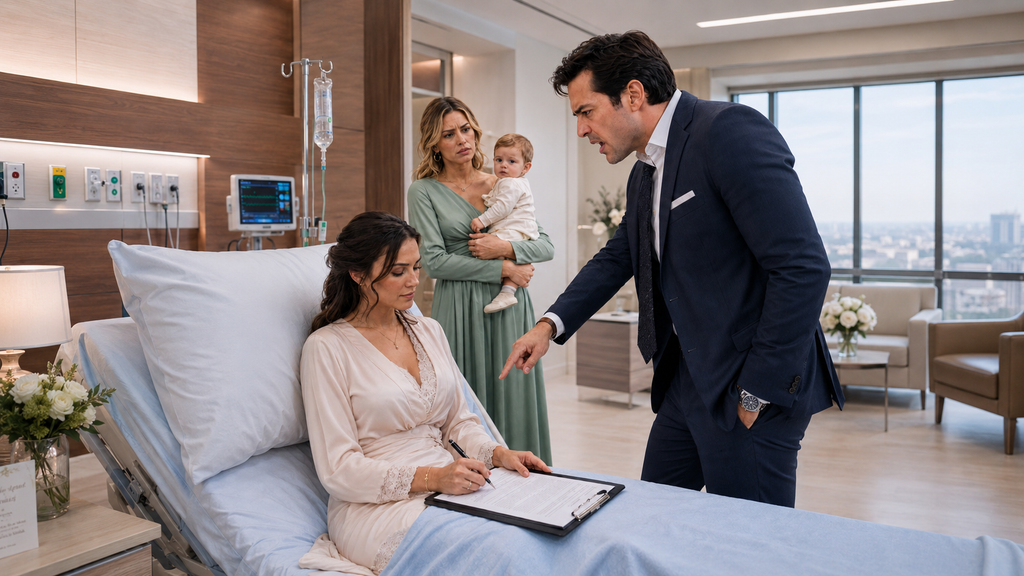
Alejandro stared at me as though I had suddenly become a stranger.
“You can’t do this,” he said. “We’re married.”
I held his gaze.
“Not for much longer.”
Then I added quietly,
“Remember?”
I pointed toward the chair beside my hospital bed.
Alejandro followed my hand.
And froze.
Naomi was sitting there.
He had been so focused on me that he hadn’t even noticed her.
She rose calmly, adjusted the folder in her hands, and stepped toward him.
“Mr. Vance.”
Her voice was professional.
Cold.
Controlled.
She opened the folder and handed him several pages.
“Your wife’s signature yesterday does not grant you ownership of her separate property.”
Alejandro’s eyes moved rapidly across the first page.
Naomi continued.
“In fact, your decision to initiate divorce proceedings has made the accounting process considerably easier.”
His expression changed.
Slowly at first.
Then completely.
The confidence disappeared from his face.
Naomi had uncovered years of transfers from my accounts into businesses controlled by Alejandro.
Payments he had repeatedly described to me as temporary investments.
Emergency cash injections.
Short-term business loans.
Money that would supposedly be returned within weeks.
It never was.
The total was more than six hundred thousand dollars.
Alejandro’s hands began to tremble.
“I can explain.”
His voice was barely a whisper.
I leaned back against the hospital pillow.
My head was still wrapped in bandages.
My body still hurt from surgery.
But for the first time in years, I felt strangely clear.
“I’m sure you can.”
He looked at me as though he wanted to say something else.
Nothing came out.
That afternoon, Claudia called me seventeen times.
Seventeen.
I watched her name appear on my phone again and again.
I ignored every attempt.
I had no interest in hearing excuses from the woman who had apparently been sleeping with my husband while smiling across dinner tables at me.
But at 6:14 p.m., Claudia stopped calling.
Instead, she sent me a message.
I almost deleted it without reading.
Then I saw the first sentence.
My thumb froze above the screen.
Camila, Alejandro lied to you.
Another message appeared immediately.
The baby isn’t the secret you should be worried about.
My heartbeat quickened.
Then the final sentence appeared.
Ask him about Sofia.
I stared at the name.
Sofia.
I read it once.
Then twice.
Then again.
Something cold moved through my chest.
The hospital room suddenly felt too quiet.
Naomi was standing near the window reviewing paperwork when the door opened.
Alejandro walked back inside carrying two cups of coffee.
He stopped when he saw my expression.
I slowly lifted my phone.
Turned the screen toward him.
And asked one question.
“Who is Sofia?”
The color drained from his face.
Not gradually.
Instantly.
The coffee cup in his hand shook.
A few drops spilled onto the floor.
For fifteen years, I had watched Alejandro lie.
About business.
About money.
About where he had been.
About Claudia.
I knew every version of his dishonest face.
The defensive one.
The angry one.
The charming one.
The offended one.
But this was different.
For the first time in fifteen years, my husband looked genuinely terrified.
He placed the coffee on the counter.
Then slowly sank into the chair beside my bed.
Neither Naomi nor I spoke.
Finally, Alejandro looked down at his hands.
“She’s my daughter.”
For a second, I thought I had misunderstood him.
My chest tightened.
“What?”
He swallowed.
“Sofia is my daughter.”
The room seemed to tilt beneath me.
I gripped the edge of the blanket.
“How old?”
Alejandro closed his eyes.
When he answered, his voice was barely above a whisper.
“Nine.”
Nine.
The word hit harder than everything else.
Nine years old.
Which meant that somewhere in the middle of our marriage, while I was planning anniversaries and defending him to friends and believing every excuse he gave me, Alejandro had fathered a child.
I stared at him.
“Claudia’s daughter?”
He hesitated.
That hesitation was enough.
“No,” I whispered.
Alejandro said nothing.
Then Naomi quietly walked toward the bed.
She was holding something.
A photograph.
Without saying a word, she placed it on the hospital table in front of me.
I looked down.
Alejandro was standing in the photograph beside a little girl.
She had dark curls.
Large brown eyes.
And one hand wrapped around Alejandro’s finger.
She looked happy.
Comfortable.
Like a child standing beside a father she had known her entire life.
But it wasn’t the little girl who made my blood turn cold.
It was the woman standing behind her.
Sofia’s mother.
I knew that face.
I had known it for years.
I had hugged her.
Trusted her.
Invited her into my home.
And suddenly, every betrayal I thought I understood became something much darker.
Because Sofia’s mother wasn’t Claudia.
It was someone I had never once thought I needed to fear.
PART 3: THE MEMORY HE WAS COUNTING ON ME TO LOSE
“Her name is Sofia.”
Alejandro’s voice was barely audible.
For several seconds, the hospital room seemed to disappear around me.
The machines.
The antiseptic smell.
The faint pressure behind my eyes from the surgery.
Naomi standing beside the window with the photograph in her hand.
Everything blurred except the little girl staring back at me from that glossy piece of paper.
She had dark hair.
Large brown eyes.
A shy smile.
Alejandro’s smile.
And beside her stood a woman I had once trusted almost as much as Claudia.
Elena Castillo.
My former friend.
My former college roommate.
The woman who had stood beside me at my wedding.
The woman who had hugged me after my first failed fertility treatment and whispered that some people were simply meant to become mothers in different ways.
The woman who had mysteriously drifted out of my life nine years earlier.
I stared at the photograph.
Then at my husband.
“Nine?”
Alejandro swallowed.
“Yes.”
I felt something cold move through my chest.
Not rage.
Not yet.
Something worse.
Understanding.
Nine years.
Suddenly, hundreds of tiny memories began rearranging themselves inside my mind.
Elena canceling dinner plans.
Alejandro traveling for “business.”
Unexplained hotel receipts.
Weekends in Indianapolis.
A Christmas when Alejandro disappeared for almost six hours because one of his clients supposedly had an emergency.
Elena moving away without saying goodbye properly.
Her social media accounts suddenly becoming private.
Alejandro insisting she had always been “too dramatic” and that I should stop reaching out.
Nine years of little moments I had dismissed because marriage required trust.
Nine years of trusting the wrong people.
I looked down at the photograph again.
“Is Elena Sofia’s mother?”
Alejandro nodded.
Naomi said nothing.
She didn’t need to.
I could hear my own heartbeat.
“You slept with Elena?”
“Yes.”
“While we were married?”
Another nod.
“How long?”
He rubbed both hands across his face.
“Camila—”
“How long?”
“About two years.”
I stared at him.
“Two years?”
“It wasn’t constant.”
I almost laughed.
It was such a ridiculous distinction.
As if betrayal became less disgusting if it happened on Tuesdays instead of every day.
As if cheating became respectable when scheduled carefully.
“And she got pregnant.”
“Yes.”
“And you knew Sofia was yours.”
“Yes.”
“And Elena knew you were married.”
“Yes.”
Every answer landed with almost no emotion in his voice.
That was the horrifying part.
Fifteen years together.
Nine years of lies.
And he answered like we were reviewing receipts.
I looked at Naomi.
“Why did Claudia tell me?”
Alejandro’s head snapped toward me.
“You talked to Claudia?”
“She contacted me.”
“What did she say?”
I ignored his question.
“Naomi?”
Naomi stepped closer.
“Claudia emailed me about twenty minutes ago.”
Alejandro stood so quickly that the chair scraped violently across the floor.
“What?”
Naomi didn’t flinch.
“She sent documents.”
“What documents?”
“Photographs. Messages. Bank statements. Copies of hotel reservations. Several screenshots from conversations between you and her.”
His face changed.
That was the first moment I saw genuine panic.
Not embarrassment.
Not regret.
Fear.
“What conversations?”
Naomi’s expression remained perfectly calm.
“The conversations in which you repeatedly assured Claudia that Mrs. Vance’s surgery might cause significant memory impairment.”
My stomach tightened.
Alejandro stopped moving.
Naomi continued.
“You also told her that if Camila signed the divorce agreement before surgery, she might wake up confused enough that you could persuade her she had agreed to additional financial terms.”
I stared at him.
He looked away.
Something inside me broke.
Until that moment, some tiny, foolish part of me had still been trying to understand him as the man I had once loved.
A selfish man.
A cheating man.
A greedy man.
But still a man I had shared fifteen Christmas mornings with.
A man who had once slept in an uncomfortable plastic chair beside my hospital bed when I had pneumonia.
A man who had once driven three hours through a snowstorm because my father had been admitted to the emergency room.
A man who had kissed me at forty and told me I was more beautiful than the twenty-nine-year-old woman he had married.
I had been searching for that man inside the person standing in front of me.
Naomi’s words finally killed him.
“You thought I would forget?”
Alejandro turned toward me.
“No.”
Naomi opened the folder.
“I have the message.”
He glared at her.
“Those are private conversations.”
Naomi raised one eyebrow.
“They were voluntarily provided by the recipient.”
I looked at him.
“Read it.”
“Camila—”
“Read it.”
Naomi glanced at me.
Then she read.
“‘The neurologist said memory problems are possible. By the time she wakes up, she might not remember half of what I tell her today. I just need the signature before surgery. Afterward, we can handle the rest.’”
Silence.
I stared at Alejandro.
He opened his mouth.
Nothing came out.
Another message followed.
Naomi’s voice became softer.
“‘If the surgery goes badly, everything becomes easier anyway.’”
I closed my eyes.
That one hurt.
It hurt more than Claudia.
More than Elena.
More than Sofia.
More than the stolen money.
Because I remembered the night before surgery.
Alejandro had come home late.
I had been sitting at the kitchen island unable to sleep.
I was terrified.
Not ordinary fear.
The kind of fear that makes you notice everything.
The sound of the refrigerator humming.
The headlights passing across the ceiling.
The way your own fingers look when you wonder whether tomorrow they will still obey you.
I had looked at my husband and said, “What if I don’t wake up?”
He had kissed my forehead.
He had actually kissed me.
“Don’t talk like that,” he’d whispered.
“You’re going to be fine.”
I had believed him.
While he was already calculating what would become easier if I died.
I opened my eyes.
Alejandro had started crying.
Real tears.
I felt nothing.
“Please,” he whispered. “I know this looks horrible.”
Naomi actually turned her face toward the window for a moment.
I think even she couldn’t believe that sentence.
I looked at him.
“It doesn’t look horrible.”
He took one hopeful step toward me.
“It is horrible.”
He stopped.
I continued.
“You cheated on me with one of my closest friends.”
“Camila—”
“You fathered a child with her.”
“I know.”
“You hid your daughter for nine years.”
“Yes.”
“You started sleeping with Claudia.”
He lowered his eyes.
“You fathered another child.”
Silence.
“You stole money from me.”
“I didn’t steal—”
“Six hundred thousand dollars.”
“I was going to replace it.”
I laughed.
That hurt my head, so I stopped.
Naomi immediately moved closer.
“Easy.”
I pressed my fingers against my temple.
Alejandro reached toward me.
“Don’t touch me.”
His hand froze in midair.
I had never spoken to him like that before.
He slowly lowered it.
Then I asked the question that mattered most.
“Does Sofia know?”
Alejandro looked confused.
“Know what?”
“That you’re her father.”
He hesitated.
“Yes.”
My throat tightened.
“How long?”
“Since she was five.”
Four years.
A little girl had known my husband as her father for four years.
While I thought he was traveling.
While I thought he was working late.
While I defended him to friends when he missed birthdays.
While I sat alone in fertility clinics.
While he told me we should “accept that children weren’t meant for us.”
I looked at the photograph.
Sofia was wearing a red winter coat.
Alejandro had one hand resting on her shoulder.
She looked happy.
None of this was her fault.
That mattered.
I looked at Naomi.
“Make sure nothing we do hurts that child.”
Alejandro blinked.
Naomi nodded.
“Of course.”
Alejandro stared at me.
“You’d really protect her?”
I turned slowly toward him.
“She’s nine years old.”
He said nothing.
“She didn’t betray me.”
That shut him up.
I handed the photograph back to Naomi.
“Elena is responsible for her choices. Claudia is responsible for hers. You are responsible for yours.”
My voice trembled.
“But your children are innocent.”
For the first time that morning, Alejandro looked ashamed.
I wish I could tell you that seeing shame on his face satisfied me.
It didn’t.
Shame was too small.
Nine years was too large.
Naomi returned the photograph to her folder.
“There’s something else.”
Alejandro immediately looked at her.
I almost didn’t want to ask.
But I had learned enough about betrayal to understand one rule.
When someone says there is something else, there is always something else.
“What?”
Naomi placed a second folder on my blanket.
“This arrived from the forensic accountant at 7:40 this morning.”
Alejandro went pale.
I noticed.
Naomi noticed too.
She opened it.
“The six hundred thousand dollars we discussed earlier was only money transferred directly from your personal accounts.”
I stared at her.
“What does that mean?”
“It means there are additional transactions.”
Alejandro spoke quickly.
“You don’t understand how business financing works.”
Naomi ignored him.
“Approximately eleven months ago, a company called AV Meridian Holdings applied for a commercial loan.”
My eyes moved toward Alejandro.
AV.
Alejandro Vance.
He began shaking his head.
“It never closed.”
Naomi looked at him.
“That is not relevant.”
Then she turned to me.
“The application listed one of your father’s commercial properties as collateral.”
My entire body went still.
“What property?”
“The Fulton Street building.”
I couldn’t speak.
The Fulton Street building had been my father’s first major property.
He bought it when I was seven.
Back then, it was an ugly brick warehouse surrounded by cracked pavement and weeds.
Everyone told him he was crazy.
He renovated it slowly.
One floor at a time.
I spent childhood Saturdays sitting on paint buckets eating sandwiches while Dad argued with contractors.
Years later, it became a successful mixed-use building.
He refused to sell it.
Not when developers offered three times what he paid.
Not when the neighborhood exploded in value.
He once told me, “Some things are investments, Cami. Some things are history.”
When he died, Fulton Street passed into my trust.
I had never mortgaged it.
Never leveraged it.
Never even considered using it as collateral.
I looked at Alejandro.
“You tried to borrow against Fulton Street?”
“It was a business opportunity.”
“You don’t own Fulton Street.”
“I knew the trust could support—”
“You don’t own it.”
“We were married.”
“You still didn’t own it.”
He rubbed his forehead.
“It was going to generate eight percent annually.”
Naomi spoke.
“The documents claim Mr. Vance was authorized to pledge the property.”
My stomach dropped.
I looked at her.
“Authorized by whom?”
Naomi turned a page around.
My signature was at the bottom.
I stared.
It looked like mine.
Very close.
But it wasn’t.
Alejandro backed toward the door.
I whispered, “You forged my signature.”
“No.”
Naomi replied before he could continue.
“The notary listed on the document has already confirmed she did not notarize this signature.”
Alejandro said nothing.
“The notary stamp appears to have been digitally reproduced.”
His face was completely drained of color now.
I looked at the document again.
There were moments in life when anger became so large that it passed through fire and turned into ice.
I had reached that point.
“You forged my signature.”
He looked at me.
“The deal never funded.”
“That isn’t an answer.”
“I was desperate.”
“For what?”
“My company was struggling.”
“What company?”
He stared at me.
“The consulting business.”
“The company that bought you the watch?”
Silence.
“The company that paid for Claudia’s apartment?”
His jaw tightened.
“The company that paid Elena?”
He looked away.
Naomi turned another page.
I didn’t even need her to speak.
I knew.
“Oh my God.”
Alejandro approached the bed.
“Camila, listen to me.”
“No.”
“Please.”
“No.”
“You have to understand. I was trying to build something of my own.”
“You were trying to steal my father’s building.”
“I wasn’t stealing it!”
His voice rose.
A nurse appeared almost immediately at the doorway.
“Is everything okay?”
Naomi turned.
“We’re fine. He’ll be leaving shortly.”
The nurse looked at Alejandro.
Then at me.
“Mrs. Vance?”
I nodded.
“I’m okay.”
She didn’t look convinced.
“I’ll be outside.”
“Thank you.”
After she left, Alejandro lowered his voice.
“I spent fifteen years living in your shadow.”
There it was.
The truth.
Not love.
Not remorse.
Resentment.
“You think that was easy?” he continued.
“Every restaurant, people knew your family. Every charity event, people introduced me as Camila Vance’s husband. Your father never respected me.”
“My father gave you three hundred thousand dollars to start your first company.”
“He treated it like charity.”
“You never repaid him.”
“I was going to.”
“You filed bankruptcy.”
“The market collapsed.”
“You started another company.”
“I was rebuilding.”
“With my money.”
“We were married.”
I stared at him.
He kept returning to those words like marriage was a bank account he had been issued access to.
“We were married.”
As though vows were ownership papers.
As though loving me entitled him to everything my father built.
As though sleeping beside me gave him the right to counterfeit my name.
I looked toward Naomi.
“Please make the appropriate referrals regarding the forged documents.”
Alejandro’s eyes widened.
“What does that mean?”
Naomi answered calmly.
“It means we preserve the evidence and allow the relevant institutions and authorities to determine whether fraud occurred.”
His mouth opened.
“Camila.”
I looked at him.
He stepped forward.
“You would have me arrested?”
I almost smiled.
“You were comfortable with me dying.”
He flinched.
“That’s not fair.”
“Fair?”
My voice cracked.
“You stood beside my hospital bed two hours before brain surgery and asked me to make your life easier in case I died.”
“I was scared.”
“You were wearing a new suit.”
His mouth closed.
“You had lunch reservations.”
He looked down.
“You told another woman that my possible memory loss would make things easier.”
“I didn’t mean it that way.”
“You wrote it.”
“I was under pressure.”
“You forged my signature.”
“Camila—”
“You stole from me.”
“It wasn’t—”
“You built two secret families while I spent years believing I was the reason our marriage never had children.”
That sentence finally broke through him.
His shoulders dropped.
For a moment, I saw something raw in his face.
“Camila…”
“No.”
My eyes filled with tears.
I hated that.
I had been so calm.
But suddenly I remembered a clinic.
A little white room.
A doctor saying the treatment had failed again.
I remembered sitting in our car afterward.
Alejandro had held my hand.
I had cried so hard I couldn’t breathe.
“I’m sorry,” I had whispered.
He had pulled me against his chest.
“You have nothing to apologize for.”
All that time, Sofia was already alive.
His daughter.
He had gone from comforting me about infertility to visiting his child with another woman.
That kind of cruelty was almost impossible to understand.
“You watched me blame myself.”
His face crumpled.
“I didn’t know what to say.”
“The truth.”
“I couldn’t.”
“You could.”
“I would have lost you.”
I stared at him.
“You lost me anyway.”
He began crying again.
This time I turned away.
“Naomi.”
“Yes?”
“I’m tired.”
She understood.
She walked to the door and opened it.
“Alejandro, you need to leave.”
He didn’t move.
“Camila, please.”
I stared through the hospital window at the Chicago skyline.
Gray buildings.
Clouds.
Traffic far below.
Life continuing as though mine had not just split in half.
“Please,” he repeated.
I didn’t turn around.
“You should go.”
He remained there another moment.
Then I heard the door close.
I finally cried.
Not politely.
Not silently.
I covered my face and cried until my ribs hurt.
Naomi sat beside me.
She didn’t tell me to be strong.
She didn’t tell me I was better off.
She simply sat there.
Sometimes that is the kindest thing another human being can do.
After a while, I whispered, “How could I not know?”
Naomi handed me a tissue.
“People who lie for years become very skilled at it.”
“I feel stupid.”
“You trusted your husband.”
“That feels stupid now.”
“It wasn’t.”
I looked at her.
She continued.
“Trust is not stupidity, Camila. Misusing someone’s trust is.”
I cried harder.
Because I needed someone to say that.
For six months, I had fought a tumor inside my head.
Now I was discovering another sickness had been living in my marriage for almost a decade.
And somehow, I had survived both.
I was discharged four days later.
Alejandro was not there.
My sister, Mariana, came instead.
She had flown from Seattle the moment I finally told her what had happened.
Mariana had never liked Alejandro.
For fifteen years, she had been careful about saying it.
Now she was no longer careful.
“He asked you to sign divorce papers before brain surgery?”
“Yes.”
“He said it would make marrying Claudia easier if you died?”
“Basically.”
“And then we discovered another child?”
“Yes.”
“And forged loan documents?”
“Yes.”
She loaded my overnight bag into her car.
Then stood on the sidewalk outside the hospital with both hands on her hips.
“I would like five uninterrupted minutes with him.”
Despite everything, I laughed.
The laughter hurt my incision.
I touched the side of my head.
“Please don’t make me laugh.”
“I’m serious.”
“I know.”
“Five minutes.”
“You’re five-foot-three.”
“I’m motivated.”
That was the first time since surgery that I felt something close to normal.
Then we drove home.
Except home wasn’t the condo.
Not anymore.
Naomi had advised me to recover at another property until the legal situation stabilized.
So Mariana drove me to my father’s old house in Lake Forest.
I hadn’t stayed there overnight since he died.
Walking inside nearly destroyed me.
His books were still in the library.
His old chessboard remained beside the window.
A faded photograph of me at age twelve sat on the piano.
Dad had been gone three years.
I had never missed him more.
That first night, I sat in his leather chair wrapped in a blanket.
Mariana brought me tea.
“Thinking about Dad?”
I nodded.
“He knew.”
“What?”
“That something was wrong with Alejandro.”
She sat across from me.
“Dad never trusted him.”
“I thought Dad was being controlling.”
“He probably was.”
I smiled faintly.
“He was.”
“But he was also right.”
I stared into my tea.
“Do you remember what he said before he died?”
Mariana asked.
I nodded.
“Don’t let love turn into permission.”
She looked surprised.
“You remember that?”
“I remember everything.”
That sentence sat between us.
I remember everything.
The surgeons had warned me before the operation.
Short-term confusion was possible.
Memory problems were possible.
Speech difficulty.
Personality changes.
Seizures.
So many possibilities.
Alejandro had looked at those risks and seen opportunity.
But my memory survived.
Not perfectly.
Recovery took time.
Some mornings I misplaced words.
Sometimes fatigue hit without warning.
Sometimes bright lights made my head pound.
But I remembered my life.
I remembered my father.
I remembered my marriage.
And most importantly, I remembered myself.
Two days later, Claudia appeared at the gate.
I was sitting in Dad’s library when the security intercom buzzed.
Mariana checked the monitor.
Her expression changed instantly.
“You have got to be kidding me.”
“Who?”
She turned the screen.
Claudia.
My best friend since high school.
The woman who had helped choose my wedding dress.
The woman who had been in the waiting room when my mother died.
The woman who had brought soup to my house after my tumor diagnosis.
The woman who had been sleeping with my husband.
She stood outside the gate wearing sunglasses and holding a diaper bag.
She was alone.
No baby.
I stared at her image.
Mariana crossed her arms.
“I’m calling security.”
“No.”
Her head snapped toward me.
“Camila.”
“I want to hear what she says.”
“You just had brain surgery.”
“I know.”
“She had a baby with your husband.”
“I definitely know.”
“You don’t owe her a conversation.”
“No.”
I looked at the monitor.
“But I owe myself one.”
Ten minutes later, Claudia sat across from me in my father’s library.
She looked terrible.
Not glamorous.
Not triumphant.
Terrible.
Her hair was tied back carelessly.
Her eyes were swollen.
She kept twisting her fingers together.
For years, Claudia had been the friend who never looked nervous.
She could walk into any room like she owned the air.
That woman had disappeared.
“Thank you for letting me in,” she whispered.
“I haven’t decided whether I’m glad I did.”
She nodded.
“I understand.”
“No, Claudia.”
I looked directly at her.
“You don’t.”
Her eyes filled.
I felt no pity.
Not yet.
“Start talking.”
She inhaled slowly.
“Alejandro told me you two had been emotionally separated for years.”
I stared at her.
“You were in my kitchen three months ago.”
She closed her eyes.
“I know.”
“You watched us make dinner together.”
“I know.”
“You brought me flowers on our anniversary.”
Tears rolled down her face.
“I know.”
“So don’t insult me.”
“I’m not trying to.”
“Yes, you are.”
My voice remained quiet.
“You’re trying to give me a version that allows you to live with yourself.”
She looked down.
“That isn’t the truth.”
“The truth is that you wanted my husband.”
Her mouth trembled.
“Yes.”
There it was.
At least one honest sentence.
“How long?”
“Three years.”
I felt sick.
Three years.
Not one mistake.
Not one drunken night.
Not one moment of weakness.
A relationship.
“You became pregnant intentionally?”
She hesitated.
That was enough.
“Claudia.”
“Yes.”
I leaned back against the chair.
“Did Alejandro want the baby?”
“He said he did.”
“Before you got pregnant?”
Another hesitation.
“Yes.”
I closed my eyes.
The room tilted slightly.
Mariana stepped forward.
“Camila?”
“I’m fine.”
Claudia started crying harder.
“I thought he was going to leave you.”
I opened my eyes.
“You knew I had a brain tumor.”
“Yes.”
“You knew I was terrified.”
“Yes.”
“You held me while I cried.”
“Yes.”
“And then you went home and slept with him.”
She covered her mouth.
“Yes.”
I let the silence punish her.
Finally, she whispered, “I hate myself for it.”
“That sounds exhausting.”
She looked at me.
“I deserve that.”
“This isn’t about what you deserve.”
I leaned forward carefully.
“You did not come here to apologize.”
Her expression changed.
I had known Claudia for twenty-seven years.
I could still read her.
“You came because Alejandro lied to you too.”
She looked away.
“Tell me.”
“He said Sofia was Elena’s daughter from someone else.”
I waited.
“I found out the truth after my son was born.”
“How?”
“I saw a transfer on his phone.”
“What transfer?”
“Tuition.”
My stomach tightened.
“He pays Sofia’s private school.”
“With whose money?”
She looked at me.
We both knew.
Mine.
Claudia lowered her voice.
“I confronted him. He admitted Sofia was his daughter.”
“And?”
“He said Elena was ancient history.”
“Apparently so ancient he was still paying her bills.”
Claudia flinched.
“He said he had no relationship with her anymore.”
“Do you believe him?”
“No.”
That surprised me.
“Why?”
She opened her bag and removed an envelope.
“I found these.”
Inside were printed screenshots.
Messages.
Photographs.
Receipts.
Alejandro and Elena had continued seeing each other.
Not constantly.
But recently.
Very recently.
One hotel receipt was from five months ago.
Another was from eight weeks ago.
Two weeks after Claudia gave birth to Alejandro’s son.
I looked at her.
“He cheated on you with the woman he cheated on me with.”
Claudia’s face collapsed.
I felt something I hadn’t expected.
Not sympathy.
Something closer to disbelief at the absurdity.
“You thought you were different.”
She cried silently.
“Yes.”
“You thought a man who betrayed his wife with you would become loyal to you.”
She nodded.
“Yes.”
“Why?”
“I don’t know.”
I did.
Because every person who participates in an affair believes they are the exception.
The special one.
The love powerful enough to rewrite someone’s character.
Claudia had mistaken being chosen temporarily for being valued permanently.
But that was her lesson.
Not mine.
I placed the papers on the table.
“Why did you send the messages to Naomi?”
“Because Alejandro was planning something.”
“What?”
She reached into her bag again.
This time she removed a small digital recorder.
My stomach tightened.
“What is that?”
“I recorded him.”
“Why?”
“Because after Sofia, I stopped trusting him.”
Almost funny.
Almost.
She pushed the device across the desk.
“I think you should hear it.”
Mariana looked at me.
“You don’t have to.”
I stared at the recorder.
“Yes, I do.”
Claudia pressed play.
Alejandro’s voice filled my father’s library.
“I need her signature before surgery.”
Claudia answered.
“What if she refuses?”
“She won’t.”
“How do you know?”
“She’s scared. She’ll do anything to keep things calm before they operate.”
My hands went cold.
Then Claudia’s recorded voice asked:
“And after?”
Alejandro laughed softly.
“Best case? She comes through with some memory problems and we renegotiate.”
“What if she remembers?”
“She won’t have the energy to fight.”
I shut my eyes.
The recording continued.
“And if she dies?”
A pause.
Then my husband answered.
“Then we stop pretending this is complicated.”
Mariana reached forward and stopped the recording.
“That’s enough.”
I sat perfectly still.
Claudia whispered, “I’m sorry.”
I looked at her.
“You listened to that and stayed with him.”
She started crying again.
“I had a newborn.”
“That isn’t an answer.”
“I was scared.”
“So was I.”
She nodded.
“I know.”
“No.”
My voice shook now.
“You don’t know.”
I stood slowly.
Mariana immediately moved beside me.
I steadied myself against Dad’s desk.
“I was scared that I would die.”
Claudia lowered her eyes.
“I was scared that I would wake up unable to recognize my own sister.”
Tears ran down my cheeks.
“I was scared I would forget my father’s voice.”
Claudia covered her face.
“I was scared I would wake up and have to learn how to walk again.”
My chest hurt.
“And while I was scared of losing my life, you two were discussing how useful it might be if I lost my memory.”
Claudia sobbed.
“I am so sorry.”
I stared at her.
Twenty-seven years of friendship.
Gone.
“You should leave.”
She stood.
“Camila—”
“No.”
She wiped her face.
“I don’t expect forgiveness.”
“Good.”
She flinched.
“I’ll cooperate with Naomi.”
“That’s between you and Naomi.”
“And the baby—”
I stopped her.
“Your son is innocent.”
She began crying again.
“I know.”
“So raise him better than the man who fathered him.”
She stared at me.
I continued.
“Teach him that love doesn’t mean ownership.”
Her lips trembled.
“Teach him that someone else’s trust is not something you exploit.”
She nodded.
“And teach him never to become the kind of man who sees another person’s vulnerability as an opportunity.”
Claudia whispered, “I will.”
I looked toward the door.
“That’s all I have to say.”
She left.
I never saw her as my best friend again.
Some relationships end with screaming.
Some end with broken dishes.
Ours ended with a quiet door closing in my father’s house.
And somehow that silence felt more permanent than anger.
The next shock came from Elena.
Three days later, Naomi called.
“Are you resting?”
“I’m sitting down.”
“That wasn’t my question.”
I smiled despite myself.
“Yes, Naomi. I’m resting.”
“Good. Because Elena Castillo contacted my office.”
My smile vanished.
“What does she want?”
“To speak with you.”
“No.”
“I expected that.”
“Then why are you telling me?”
“Because she has information.”
Of course she did.
Everyone suddenly had information.
My marriage had become an archaeological dig.
Every time we removed one layer, another skeleton appeared.
“What information?”
“About the money.”
I stared out the library window.
“What money?”
“She claims Alejandro used your accounts to support her and Sofia without telling her where the funds came from.”
I closed my eyes.
“How much?”
“We’re still calculating.”
“Naomi.”
“At least two hundred and eighty thousand dollars over nine years.”
I gripped the phone.
School tuition.
Rent.
Medical bills.
Vacations.
Birthday gifts.
My money.
I had financed my husband’s secret daughter without knowing she existed.
The cruelty almost became impressive in its scale.
“Did Elena know he was using my money?”
“She says no.”
“Do you believe her?”
“I believe documents.”
That was why I liked Naomi.
“So what do the documents say?”
“They say many payments came through one of Alejandro’s business entities rather than directly from you. She may genuinely have believed the funds were his.”
I rubbed my forehead.
“And she wants to meet?”
“Yes.”
“Without Sofia.”
“Yes.”
I almost refused.
Then I thought about the photograph.
A little girl in a red coat.
Nine years old.
One day, Sofia would be old enough to learn how she entered this story.
I did not want my anger to become part of her inheritance.
“Fine.”
We met at Naomi’s office.
Elena looked older than I remembered.
Not old.
Just tired.
The last time I had seen her, she had been thirty-six and beautiful in an effortless way.
Now she was forty-five, like me.
There were faint lines around her eyes.
Her dark hair had silver strands near the temples.
When I entered, she stood.
“Camila.”
I stopped several feet away.
“Elena.”
Her eyes moved to the scar hidden beneath my hair.
“How are you feeling?”
“Don’t.”
She swallowed.
“Right.”
We sat.
Naomi remained in the room.
I had requested it.
Elena clasped her hands.
“I don’t know where to begin.”
“Nine years ago seems appropriate.”
She closed her eyes briefly.
Then she began.
The affair had started after a charity gala.
Alejandro told her we were struggling.
That part was true.
I had just experienced another failed fertility procedure.
I was grieving.
Alejandro was angry.
I thought his anger was grief.
Apparently he had been angry at me.
Elena and Alejandro drank after the event.
One night became several months.
Several months became almost two years.
Then Elena became pregnant.
“When I told him,” she whispered, “he panicked.”
I laughed bitterly.
“He told me you planned the baby.”
Her eyes widened.
“No.”
Interesting.
One more lie.
“He begged me not to tell you.”
“And you agreed.”
“Yes.”
“Why?”
“Because I was ashamed.”
I stared at her.
“You were ashamed after sleeping with my husband for two years?”
She lowered her head.
“Yes.”
“Convenient timing.”
“I know.”
“You stood beside me at my wedding.”
“I know.”
“You knew what having a child meant to me.”
Tears appeared.
“I know.”
I hated those two words.
Everyone knew.
Nobody stopped.
“I moved away because I couldn’t face you.”
“You could have told me.”
“Yes.”
“You chose not to.”
“Yes.”
“And Alejandro supported Sofia.”
“Yes.”
“How often did he see her?”
“Every month.”
I felt the room constrict.
“Every month?”
“Sometimes twice.”
I thought of all his trips.
The client dinners.
The conferences.
The emergency meetings.
“He told Sofia he traveled for work.”
Elena nodded.
“He told her he lived in Chicago because his company was there.”
“She knew he was married?”
“Not when she was little.”
“And now?”
Elena hesitated.
“She knows.”
“To me?”
“Yes.”
I swallowed.
“What does she think about me?”
That question surprised everyone.
Especially Elena.
“She thinks you don’t know about her.”
“That’s true.”
“She asked once whether you would hate her if you found out.”
My eyes immediately filled.
“No.”
Elena started crying.
I shook my head.
“No.”
My voice broke.
“Make sure she knows that.”
Elena covered her mouth.
“Please.”
I wiped my eyes.
“She is not responsible for what you did.”
“I know.”
“She is not responsible for what Alejandro did.”
“I know.”
“She should never carry that.”
Elena nodded rapidly.
“She won’t.”
I looked down.
For one terrible second, I imagined being nine years old and wondering whether your existence had hurt someone.
No child deserved that.
I composed myself.
“Now tell me about the money.”
Elena reached into her bag.
She produced nine years of records.
Not literally every piece.
But enough.
Alejandro had transferred money through companies.
Paid Sofia’s school.
Bought Elena a townhouse.
Covered vacations.
Funded an investment account.
He had created an entire second life.
A suburban version of fatherhood.
Soccer games.
Birthday parties.
School plays.
All while telling me he was too emotionally exhausted to continue fertility treatments.
Then Elena said something that changed everything again.
“Three years ago, he asked me to sign something.”
Naomi leaned forward.
“What?”
“A business document.”
“What kind?”
“I didn’t understand it.”
“Do you have a copy?”
Elena nodded.
Alejandro had told her the document would create a long-term education fund for Sofia.
It didn’t.
Naomi read it twice.
Then looked at me.
“What?”
She didn’t answer immediately.
“What?”
“Elena appears to have been listed as a minority partner in AV Meridian Holdings.”
Elena looked confused.
“I’m what?”
Naomi continued scanning.
“And this document appears to authorize the company to receive proceeds from the proposed Fulton Street loan.”
I stared at Elena.
Her face went white.
“I never knew that.”
Naomi turned another page.
“Your signature appears authentic.”
“It is.”
“Did Alejandro explain that this was connected to a commercial loan?”
“No.”
“Did he explain that property belonging to Camila’s trust would be pledged as collateral?”
“No!”
She looked at me desperately.
“Camila, I swear.”
I held up one hand.
“I don’t know what I believe yet.”
She fell silent.
Naomi continued.
“This matters.”
“Why?”
“Because it establishes a pattern.”
The money suddenly became more than stolen transfers.
Alejandro had been preparing something larger.
Much larger.
Naomi called the forensic accountant.
Then another attorney.
Then the trust’s corporate counsel.
By that evening, the pieces were becoming clear.
Alejandro’s consulting companies were drowning.
He owed millions.
Not hundreds of thousands.
Millions.
He had hidden personal guarantees.
Private loans.
Unpaid taxes.
Investor obligations.
And he had planned to use Fulton Street to rescue everything.
The proposed loan was for $4.8 million.
The building was worth far more.
If the loan had closed and his businesses failed, the lender could have pursued the collateral.
My father’s building.
Our history.
My inheritance.
Alejandro had risked it all to save a company he had built largely to prove he didn’t need my family’s money.
Using my family’s money.
That irony might have been funny if it had not been criminal.
The deal failed because the lender’s final title review discovered inconsistencies in the trust documentation.
Alejandro never told me.
He simply tried again through another financial institution.
That application was still pending.
Until Naomi notified them.
It was immediately frozen.
When Alejandro learned, he called me thirty-four times.
I didn’t answer.
Then came the text messages.
Camila, we need to discuss this rationally.
You don’t understand the consequences.
Employees could lose their jobs.
My parents could lose everything.
You are acting emotionally.
That one almost made me throw the phone across the room.
I had a four-inch incision in my skull.
My husband had cheated with two friends.
He had two secret children.
He had stolen hundreds of thousands of dollars.
He had forged my signature.
He had attempted to risk a building my father spent forty years creating.
But apparently I was being emotional.
I forwarded every message to Naomi.
Then I blocked him.
A week after my surgery, Alejandro came to my father’s house.
He couldn’t enter the gate.
So he stood outside.
For forty minutes.
Security called me twice.
Finally, I went to the monitor.
He looked terrible.
No tailored suit.
No expensive watch.
No polished confidence.
Jeans.
Wrinkled shirt.
Unshaven.
I pressed the intercom.
“What do you want?”
He looked toward the camera.
“Camila.”
“What?”
“Please let me in.”
“No.”
“I need to talk to you.”
“You have lawyers.”
“I don’t want lawyers.”
“That makes one of us.”
He closed his eyes.
“Everything is falling apart.”
I said nothing.
“My accounts are frozen.”
Silence.
“My investors are threatening lawsuits.”
Silence.
“My parents’ workshop lost the monthly payment.”
I finally answered.
“That payment came from me.”
“I know.”
“No. You knew it came from an account you could access. I don’t think you ever understood that it came from me.”
He stared at the camera.
“Claudia left.”
I almost laughed.
“Is that supposed to affect me?”
“She took the baby.”
“That is what mothers often do when they move.”
“Camila.”
“What?”
“I have nothing.”
There it was.
He actually said it.
I thought about our wedding.
He had stood in front of everyone we loved and promised to build a life with me.
Apparently, he had believed I was the life.
The house.
The cards.
The accounts.
The properties.
The status.
The introductions.
The safety.
Remove those things and suddenly he had “nothing.”
I leaned toward the intercom.
“You have two children.”
He stared.
“You have parents.”
His mouth tightened.
“You have your health.”
Silence.
“You have whatever remains of your company.”
Silence.
“And you have the consequences of every decision you made.”
He put both hands against the gate.
“I love you.”
For the first time, I became angry.
Truly angry.
My whole body shook.
“No.”
He looked startled.
“You do not get to use that word now.”
“I do love you.”
“No.”
“I made mistakes.”
“Mistakes?”
I stared at the screen.
“A mistake is forgetting an anniversary.”
He looked down.
“A mistake is losing your wedding ring.”
Tears filled my eyes.
“A mistake is saying something cruel during an argument and wishing you could take it back.”
He started crying.
“You maintained a secret daughter for nine years.”
“I love Sofia.”
“I hope you do.”
“I do.”
“You cheated with Claudia for three years.”
“I know.”
“You fathered another child.”
“Yes.”
“You stole from me.”
“I was desperate.”
“You forged my name.”
He squeezed his eyes shut.
“You discussed my brain surgery like it was a business opportunity.”
His shoulders shook.
“I was terrified.”
“So was I!”
My voice echoed through the speaker.
He looked up.
I had never screamed at him before.
“You were terrified of losing money!”
I could barely breathe.
“I was terrified of losing myself!”
He sobbed.
I continued.
“You were worried about red tape.”
My hands trembled.
“I was wondering whether I would remember my father.”
He covered his face.
“You were planning lunch.”
I touched the scar hidden beneath my hair.
“I was wondering whether I would wake up.”
Silence.
I wiped my tears.
Then my voice became quiet again.
“You didn’t love me, Alejandro.”
He shook his head.
“That’s not true.”
“You loved what being married to me gave you.”
“No.”
“You loved access.”
“No.”
“You loved security.”
“That’s not—”
“You loved being able to fail without consequences because I could always absorb the cost.”
He stared at me.
“And when I became sick, you looked at my vulnerability and saw an exit strategy.”
He could no longer argue.
I took one slow breath.
“The saddest part is that I would have helped you.”
His eyes lifted.
“If your company was struggling and you had told me the truth, I would have helped you.”
He started crying harder.
“If you had come to me nine years ago and told me about Sofia…”
My voice cracked.
“I don’t know what I would have done.”
I swallowed.
“But at least you would have given me the dignity of making my own decision.”
He whispered, “I was afraid you would leave.”
“You made that decision for me.”
He pressed his forehead against the gate.
“Please.”
I stared at him for a long time.
Then I said the last thing I ever needed to say to him as his wife.
“You were counting on my surgery to erase my memory.”
He looked at me.
“But the surgery removed the tumor.”
I wiped my face.
“It didn’t remove my self-respect.”
I released the intercom button.
Then I called security.
Alejandro was escorted away from the gate.
I watched until he disappeared.
I never let him inside again.
The divorce became ugly.
Not because I wanted it to.
Because Alejandro did.
The agreement I signed before surgery became one of the strangest parts.
He had been so eager to get my signature because he believed it protected him.
Instead, the agreement contained terms his own attorney had prepared assuming he would quickly marry Claudia.
It confirmed that each party retained separate property.
It waived any claim he might otherwise try to make against certain trust-held assets.
And because he rushed the process, he had not properly considered how much of his lifestyle depended on assets that were never his.
When his new legal team realized what he had signed, they tried to challenge portions of it.
Naomi was ready.
Alejandro claimed he had been emotionally distressed.
Naomi produced his messages joking about lunch after I signed.
He claimed he misunderstood the financial consequences.
Naomi produced emails between him and his original attorney discussing those exact consequences.
He claimed I had hidden marital assets.
Naomi produced fifteen years of tax filings, disclosures, and trust documents.
Then came the forensic accounting.
That was devastating.
Transfers to Claudia.
Transfers to Elena.
Tuition.
Hotels.
Jewelry.
Vehicles.
Business loans.
Vacations.
Payments to his parents.
A luxury watch purchased three days after one of my procedures.
A five-figure necklace Claudia wore while sitting beside me at a charity dinner.
I remembered complimenting it.
She had smiled.
“Gift.”
I hadn’t asked from whom.
Now I knew.
Indirectly, from me.
But the most serious issue remained the forged loan documents.
The lender referred the matter for investigation.
So did the trust.
I wasn’t involved in deciding whether Alejandro would face criminal charges.
That was important to me.
I did not want revenge confused with justice.
I gave the records to the appropriate people.
Then I stepped away.
What happened next came from his actions.
Not mine.
Three months after my surgery, Alejandro was formally charged in connection with fraudulent financial documents and misrepresentation related to the attempted commercial loan.
His lawyers immediately insisted he would fight everything.
He lasted seven months.
Then another former business partner provided emails.
The emails showed Alejandro knew he lacked authority to pledge the property.
They also showed he had instructed an employee to alter supporting documents.
That employee cooperated.
The case changed.
So did Alejandro’s posture.
Eventually, he accepted a plea agreement involving financial fraud offenses.
He avoided the worst possible outcome, but not consequences.
There was restitution.
Probationary restrictions later.
Loss of professional licenses connected to some of his business activities.
His companies collapsed.
Investors sued.
The luxury car disappeared.
The condo was never his, so that disappeared too.
The cards were gone.
The watches were sold.
The suits stopped mattering.
His parents called me once.
His mother, Teresa, had always been kind to me.
That call was difficult.
“Camila,” she said, crying, “we didn’t know.”
“I believe you.”
“Alejandro told us the money came from his business.”
“I know.”
“We never would have accepted it.”
“I know.”
She became quiet.
Then she whispered, “I am ashamed.”
“You don’t need to be ashamed of what your son did.”
“He is my son.”
“Yes.”
“And I love him.”
“I know.”
“But loving someone doesn’t make what they did right.”
That sentence stayed with me.
Loving someone doesn’t make what they did right.
For years, I had confused those things.
Love had made me explain away Alejandro’s insecurity.
Love had made me cover his failed businesses.
Love had made me ignore questions because asking them might embarrass him.
Love had made me smaller so he could feel larger.
That was not love’s fault.
It was mine for misunderstanding what love required.
Love requires kindness.
Not blindness.
Claudia moved to Wisconsin to live near her sister.
Alejandro was legally required to support their son.
She occasionally communicated with Naomi about evidence.
I never spoke to her privately again.
One year later, she mailed me a letter.
I almost threw it away.
Instead, I read it once.
She apologized.
Not dramatically.
Not with excuses.
She wrote that becoming a mother had forced her to confront the kind of person she had been willing to become.
She said she had spent years convincing herself that Alejandro and I were already emotionally finished because that story allowed her to sleep at night.
She admitted she had lied to herself.
Then she wrote something I did not expect.
You were my friend for twenty-seven years, and I traded that for a man who was lying to both of us. Losing him hurt my pride. Losing you changed the way I see myself.
I folded the letter.
I didn’t answer.
Forgiveness is strange.
People often imagine it as reconciliation.
It isn’t always.
Sometimes forgiveness is simply deciding that another person no longer deserves space inside your anger.
I eventually forgave Claudia.
From very far away.
Elena was different.
I didn’t forgive her quickly.
Maybe I still haven’t completely.
But Sofia complicated everything.
Not because Elena used her.
She didn’t.
Actually, Elena tried very hard not to.
Six months after the divorce proceedings began, I received a small envelope at Naomi’s office.
It was addressed in a child’s handwriting.
CAMILA VANCE.
Inside was a drawing.
A building.
Red brick.
Lots of windows.
A little girl standing outside.
At the bottom, Sofia had written:
My mom says this building belonged to your dad. I’m sorry my dad tried to take it. I hope you aren’t mad at me.
I cried for nearly an hour.
A nine-year-old child had apologized for something grown adults did.
That broke my heart.
I called Elena immediately.
She answered nervously.
“Camila?”
“Why does Sofia think I’m angry with her?”
Silence.
“I don’t know.”
“She sent me a drawing.”
Elena inhaled sharply.
“I didn’t know she mailed it.”
“She apologized.”
“Oh God.”
“Elena.”
“I’m sorry.”
“No.”
My voice softened.
“Fix this.”
“I will.”
“Today.”
“I promise.”
“That little girl should never apologize to me for being alive.”
Elena started crying.
“I know.”
“Make her understand that.”
“I will.”
I hung up.
Then I did something I had not planned.
I wrote Sofia back.
Not about Alejandro.
Not about betrayal.
Not about adults.
I told her about Fulton Street.
I told her my father bought the building when I was seven.
I told her I used to eat peanut butter sandwiches on the floor while he renovated it.
I told her he believed old buildings deserved second chances.
At the bottom I wrote:
You never need to apologize to me for anything your father did. Children are not responsible for their parents’ choices. I hope you grow up knowing that.
I mailed it.
That was the beginning and the end of our direct communication for a long time.
I wanted boundaries.
She deserved peace.
I deserved distance.
Both could exist.
My recovery took nearly a year.
People hear “successful brain surgery” and imagine a finish line.
It isn’t.
Surviving surgery was the beginning.
There were headaches.
Scans.
Medication changes.
Physical therapy.
Days when my brain felt wrapped in cotton.
Days when I could work for six hours.
Days when brushing my hair exhausted me.
And there was fear.
Every scan.
Every strange sensation.
Every forgotten name.
I would wonder:
Is it back?
Did they miss something?
Am I losing something?
Mariana stayed with me for three months.
Then she returned to Seattle after forcing me to promise I would hire help.
I did.
For once, I let people take care of me.
That was harder than I expected.
I had spent my life being useful.
Daughter.
Wife.
Employer.
Friend.
Problem solver.
Financial safety net.
Being cared for felt unnatural.
But healing taught me something else.
Receiving help is not weakness.
Sometimes it is trust practiced correctly.
Six months after surgery, I returned to Fulton Street.
I had avoided it.
Too many emotions.
Dad.
Alejandro.
The forged documents.
The possibility that the building could have been taken.
But one cold November morning, I drove there alone.
The neighborhood had changed since childhood.
Coffee shops.
Glass apartments.
Cyclists.
Restaurants with menus I could barely pronounce.
But the old red brick building remained.
I parked across the street.
For several minutes, I simply looked at it.
Then I went inside.
The lobby smelled faintly like polished wood and coffee.
A security guard recognized me.
“Ms. Vance?”
“Yes.”
He smiled.
“Welcome back.”
Those two words nearly undid me.
Welcome back.
I took the elevator to the roof.
The city stretched in every direction.
Cold sunlight reflected off windows.
Cars moved below like tiny pieces on a board.
I remembered standing there with Dad when I was twenty-five.
He had been considering selling.
I asked him why he changed his mind.
He said, “Because I realized I was making the decision while I was tired.”
I laughed.
“What does that have to do with anything?”
“Never make a permanent decision just because you’re temporarily exhausted.”
At forty-five, standing on that rooftop after brain surgery and divorce, I finally understood him.
Alejandro expected exhaustion to make me surrender.
He thought fear would make me easy to control.
He thought illness would make me weak.
For a few hours, he was right about one thing.
I had been terrified.
But terrified is not the same as powerless.
I placed one hand against the cold brick wall.
“We kept it, Dad.”
The wind carried my words away.
I smiled through tears.
“We kept it.”
The divorce became final fourteen months after my surgery.
There was no dramatic courtroom victory.
No judge slammed a gavel and delivered a speech.
Real life is usually quieter.
Naomi called.
“It’s done.”
I was standing in my kitchen.
Not the condo.
I had sold that.
Too many memories.
I had purchased a smaller house near the lake.
Warm.
Bright.
Mine.
I sat down at the kitchen table.
“Done?”
“Done.”
I stared at the sunlight on the floor.
After fifteen years, my marriage ended with one word.
Done.
“How do you feel?” Naomi asked.
I thought about it.
“Sad.”
She was quiet.
“Relieved.”
Another pause.
“And embarrassed that I’m sad.”
“Don’t be.”
“I should hate him.”
“You can hate what someone did and still grieve who you thought they were.”
That became another sentence I carried.
I thanked her.
Then hung up.
I poured a glass of wine.
My doctor had finally cleared me for an occasional one.
I walked outside.
The lake was blue-gray beneath the afternoon sky.
For fifteen minutes, I let myself grieve.
Not Alejandro as he truly was.
The marriage I believed existed.
The children I thought we might have.
The old age I had imagined.
The vacations we would never take.
The anniversaries we would never celebrate.
The man I thought would hold my hand through cancer.
Grief doesn’t care whether something was real.
It also mourns what you believed.
So I cried.
Then I finished my wine.
Went inside.
And made dinner for one.
It tasted wonderful.
Alejandro wrote me after the divorce.
A physical letter.
No email.
No text.
Six pages.
He apologized for everything.
Elena.
Claudia.
Sofia.
The baby.
The money.
The forged documents.
The hospital.
The messages.
He wrote that losing everything had forced him to understand how much of his identity had been built around appearing successful.
He said he had resented my wealth because it reminded him of his own failures.
He said that resentment became entitlement.
Entitlement became secrecy.
Secrecy became betrayal.
Betrayal became a life he could no longer control.
Then he wrote:
The worst thing I did was not cheating. It was convincing myself that your love meant you would always absorb the cost of my choices.
I read that sentence twice.
He was right.
Then came the part I expected.
I still love you.
I stopped reading for a moment.
Old Camila would have cried.
Old Camila might have searched the letter for proof that the man she loved still existed.
New Camila simply continued.
I know I have no right to ask you for anything. I hope one day you can remember me as more than the worst things I did.
I folded the letter.
That was the only request I could never promise.
Because memory does not work that way.
People are not one thing.
Alejandro was the man who brought me soup when I had the flu.
He was also the man who forged my signature.
He was the man who danced barefoot with me in our first apartment.
He was also the man who fathered children with other women while I blamed myself for infertility.
He was the man who once stayed awake all night when my father was dying.
He was also the man who considered my possible death administratively convenient.
Both versions existed.
That was difficult.
But adulthood often means accepting that contradictions can occupy the same person.
I did not need to erase the good memories.
I simply stopped using them to excuse the bad ones.
I put Alejandro’s letter into a box.
I never replied.
Two years after the surgery, I had my final major follow-up scan.
I hated scan days.
Hospitals had become complicated places for me.
They represented survival.
And betrayal.
I sat in the waiting room wearing a blue sweater.
Mariana had flown in again.
“You didn’t have to come.”
“Yes, I did.”
“You have a job.”
“I told them my sister’s brain was being photographed.”
I laughed.
“That sounds alarming.”
“It got the day off.”
The scan took less than an hour.
The waiting afterward felt longer than the original surgery.
Finally, my neurosurgeon entered.
He smiled.
“Everything looks excellent.”
I exhaled.
“No recurrence?”
“No evidence of recurrence.”
Mariana grabbed my hand.
I started crying.
The doctor smiled.
“You’re doing very well, Camila.”
Afterward, we walked outside.
Chicago was bright and cold.
People hurried along the sidewalk.
Somewhere a siren sounded.
A bus hissed at the curb.
Ordinary life.
Beautiful ordinary life.
Mariana hugged me.
“You’re okay.”
I looked back at the hospital.
Two years earlier, Alejandro had walked into one of those rooms with divorce papers.
He believed he was preparing for my disappearance.
Instead, that hospital became the place where I returned to myself.
“I am,” I said.
And for the first time, I truly believed it.
That spring, I created a foundation through part of my father’s trust.
Not because of Alejandro.
Because of the women I met during treatment.
Women who delayed surgery because they were afraid of losing their jobs.
Women who stayed with abusive partners because illness made financial independence impossible.
Women signing medical forms while worrying who would pay rent.
Women fighting for their lives while someone else controlled the money.
The foundation offered emergency financial assistance and legal referrals for patients facing serious neurological illness.
I named it after my mother.
Dad would have liked that.
At the opening event, I stood behind a podium.
Two hundred people sat in the ballroom.
I had given speeches before.
Business events.
Charity galas.
Real estate conferences.
But this felt different.
My hands shook.
I looked at the audience.
Then I told them the truth.
Not every detail.
Some things belonged only to me.
But enough.
“Two hours before brain surgery,” I said, “someone I trusted assumed fear would make me surrender control of my life.”
The room became quiet.
“I almost believed fear meant weakness.”
I looked toward Mariana in the front row.
She was already crying.
“But fear and weakness are not the same thing.”
I continued.
“Sometimes courage is dramatic.”
“Sometimes it’s running into a burning building.”
“Sometimes it’s standing in front of a courtroom.”
“And sometimes courage is very quiet.”
I thought about the hospital bed.
My trembling hand.
The IV.
Alejandro walking away.
“Sometimes courage is sending one email.”
“Canceling one card.”
“Calling one lawyer.”
“Saying one word.”
“No.”
The room remained silent.
I smiled.
“I survived because of surgeons.”
I touched the side of my head.
“But I rebuilt because people helped me remember something illness and betrayal had made me forget.”
I paused.
“My life still belonged to me.”
People stood.
The applause surprised me.
I looked down because I couldn’t stop crying.
Later, an older woman approached.
She had undergone surgery for an aneurysm.
Her husband had emptied their joint savings while she recovered.
She squeezed my hand.
“I thought I was stupid for trusting him.”
I immediately remembered Naomi.
So I gave the woman the same gift Naomi had given me.
“Trust isn’t stupidity.”
Her eyes filled.
“Misusing someone’s trust is.”
She hugged me.
And in that moment, I understood why I had survived more than one kind of surgery.
Sometimes your worst chapter becomes the language you use to help someone else survive theirs.
I saw Sofia again when she was twelve.
Not intentionally.
Elena brought her to a foundation fundraiser.
She had asked first.
I almost said no.
Then I realized I was no longer afraid of the past.
So I said yes.
Sofia was taller now.
Still dark-haired.
Still had Alejandro’s eyes.
She approached me nervously.
“Hi.”
“Hi.”
“You probably don’t remember me.”
I smiled.
“I remember your drawing.”
Her face brightened.
“You do?”
“Of course.”
She looked embarrassed.
“I was little.”
“You were nine.”
“That feels little.”
“It is.”
She smiled.
Then grew serious.
“My mom told me more.”
I glanced toward Elena.
She stood several feet away.
Watching.
Not interfering.
I looked back at Sofia.
“How are you doing?”
She shrugged.
“Okay.”
Then she whispered, “Dad made a lot of mistakes.”
“Yes.”
“He says he’s sorry.”
“I’m glad he tells you that.”
She studied my face.
“You hate him?”
Children ask questions adults avoid.
I thought carefully.
“No.”
She looked surprised.
“I was angry with him for a long time.”
“Are you still?”
“Sometimes.”
She nodded.
That answer made sense to her.
Then I said, “But your relationship with your father belongs to you.”
She looked at me.
“You don’t have to choose sides for me.”
Her shoulders relaxed.
“He loves me.”
“I believe that.”
“He wasn’t good to you.”
“No.”
She looked down.
“How can someone be good to one person and bad to another?”
There it was.
The question I had spent years answering.
I crouched slightly so we were closer to eye level.
“People are complicated.”
She waited.
“Someone can love you and still make terrible choices.”
Her eyes filled.
“Loving them doesn’t mean you have to pretend those choices were okay.”
She nodded slowly.
“And being disappointed in them doesn’t mean you stop loving them.”
One tear rolled down her cheek.
I handed her a tissue.
“That’s hard.”
“Yes.”
“Does it get easier?”
I smiled sadly.
“It gets clearer.”
She hugged me.
I froze.
Only for a second.
Then I hugged her back.
Not because she was Alejandro’s daughter.
Not because Elena deserved forgiveness.
Because she was a child who had been born into a web of adult decisions and somehow remained gentle.
When she stepped away, she smiled.
“Mom says your dad’s building is still there.”
“It is.”
“I want to see it someday.”
“You should.”
She hesitated.
“Could you show me?”
I glanced at Elena.
Her eyes filled.
Then I looked at Sofia.
“Yes.”
And months later, I did.
I showed a twelve-year-old girl the brick building her father once tried to use without permission.
But I didn’t tell the story as a crime story.
I told her about my father.
The paint buckets.
The sandwiches.
The broken windows.
The first tenant.
The rooftop.
At the end, Sofia ran her fingers across the brick.
“Your dad really loved this place.”
“Yes.”
“Why?”
I smiled.
“Because he built something that lasted.”
She looked at me.
I realized then that I had too.
As for Alejandro, his life did not end.
That matters.
Revenge stories often pretend the villain disappears into ruin forever.
Real life is rarely that clean.
Alejandro lost his companies.
He lost money.
He lost status.
He faced legal consequences.
He moved into a modest apartment.
He eventually found work with a smaller firm after restrictions eased.
He paid child support.
He saw Sofia.
He saw his son.
According to Elena, he became a better father after everything collapsed.
I hope that is true.
Not for him.
For the children.
Years later, at Sofia’s fifteenth birthday party, Elena sent me a photograph.
Alejandro stood behind his daughter.
Older.
Thinner.
No designer suit.
No expensive watch.
Just a father beside his child.
I looked at the picture for several seconds.
Then closed the message.
I felt nothing sharp.
No rage.
No longing.
Just distance.
That was when I knew I had healed.
Healing is not when you forget.
Healing is when remembering no longer controls your pulse.
On the fifth anniversary of my surgery, I returned to the hospital.
Not as a patient.
The foundation had funded a new neurological patient support program.
A plaque was being placed outside a consultation room.
Mariana stood beside me.
Naomi came too.
So did my neurosurgeon.
Someone asked me to say a few words.
I hadn’t prepared anything.
So I stood in the same hospital where my marriage had ended and spoke from memory.
“My husband once believed memory loss would solve his problems.”
People laughed softly.
I smiled.
“I suppose life has a sense of humor.”
Then I became serious.
“I spent years thinking survival meant keeping everything.”
“My marriage.”
“My plans.”
“My image of the future.”
“My certainty.”
“But survival sometimes requires losing things.”
I looked around the room.
“I lost a tumor.”
A few people smiled.
“I lost a marriage.”
Silence.
“I lost two friendships.”
I paused.
“I lost the illusion that love automatically makes someone safe.”
Then I smiled.
“But I found my sister again.”
Mariana covered her face.
“I found purpose.”
“I found boundaries.”
“I found a life that did not require me to shrink so someone else could feel important.”
My voice began trembling.
“And I found something I thought surgery might take from me.”
I touched my temple.
“My memory.”
I looked through the glass doors toward the hallway where patients and families moved past.
“But the most important thing I remembered wasn’t a name.”
“It wasn’t a date.”
“It wasn’t a password.”
I smiled.
“It was who I was before someone convinced me that loving them meant abandoning myself.”
Nobody moved.
“That is the memory I hope everyone keeps.”
I stepped away from the podium.
Mariana hugged me first.
Then Naomi.
Later, after everyone left, I walked alone through the hospital.
Eventually, I found myself outside the wing where I had undergone surgery.
I stopped.
Five years earlier, I had been lying in a hospital bed here.
Scared.
Exhausted.
IV taped to my wrist.
My husband had placed divorce papers on my blanket and told me to sign before they opened my skull.
He thought he was ending my story.
He thought if I died, he would inherit convenience.
If I lived but forgot, he would inherit confusion.
If I survived weak, he would inherit control.
He had calculated every possibility.
Except one.
Me.
He never calculated what would happen if I woke up remembering everything.
He never calculated what would happen if the frightened woman in that hospital bed discovered she was still capable of saying no.
He never calculated what would happen when the credit cards stopped working.
When the transfers stopped.
When lawyers started asking questions.
When accountants followed the money.
When forged signatures reached people who understood exactly what they meant.
When Claudia realized she wasn’t special.
When Elena stopped protecting the secret.
When his carefully separated lies collided with each other.
Most of all, he never calculated what would happen when I stopped protecting him from the consequences of being himself.
I stood beside the window.
Chicago glittered beneath me.
For a moment, I thought about calling Dad.
The instinct still came sometimes.
Five years.
And occasionally I would experience something and think:
I need to tell Dad.
Then I remembered.
Maybe that is another kind of memory.
Love outliving the person who gave it to you.
I touched the window.
“You were right,” I whispered.
Don’t let love turn into permission.
I finally understood.
Love did not require permission to betray me.
Love did not require permission to lie.
Love did not require permission to steal.
And love certainly did not require me to remain available while someone destroyed me.
I walked away from the window.
Toward the elevator.
Toward my life.
People sometimes ask whether I regret signing those divorce papers before surgery.
The answer is no.
Not because the agreement was perfect.
Not because signing while terrified was wise.
But because Alejandro handed me those papers believing they represented his freedom.
He never understood they represented mine.
The moment my pen touched that page, something changed.
He thought I had surrendered.
Actually, I had stopped negotiating with the truth.
The surgery removed the tumor.
The divorce removed the lie.
The investigation removed the illusion that Alejandro’s success belonged to him alone.
And time removed the part of me that still needed him to understand what he had done.
That last part was important.
For years, I wanted him to understand.
Really understand.
I wanted him to feel the exact weight of what I felt.
I wanted him to comprehend the terror of lying beneath fluorescent hospital lights and wondering whether you will survive while the person you love calculates how your death might simplify his paperwork.
But eventually, I stopped needing that.
His understanding was not necessary for my healing.
His regret was not medicine.
His apology was not justice.
My life could continue without his comprehension.
That realization was freedom.
Today, I am fifty.
My hair grew back around the scar.
You can barely see it unless I show you.
Sometimes I do.
Not because I’m ashamed.
Because scars are strange little records.
They remember what the rest of us try to forget.
The foundation has helped hundreds of patients.
Fulton Street is still standing.
Mariana calls too often.
I pretend to complain.
Naomi is still my attorney and somehow became one of my closest friends.
Elena and I are not friends.
That chapter cannot be rewritten.
But we can stand in the same room now.
We can speak respectfully.
Sometimes that is enough.
Claudia and I never rebuilt anything.
I genuinely hope she became a better person.
I simply did not need to be present for it.
Sofia is sixteen.
Brilliant.
Loves architecture.
Last year, she told me she wants to study historic preservation.
When I asked why, she smiled.
“Old buildings deserve second chances.”
I had to turn away because I started crying.
Dad would have loved her answer.
Alejandro’s son is seven.
I have never met him.
That is okay.
Not every connection needs to become a relationship.
Alejandro and I have not spoken directly in almost four years.
That is also okay.
Sometimes the healthiest ending is not reconciliation.
It is silence without hatred.
Distance without obsession.
Memory without pain.
And yes.
I remember.
I remember the suit Alejandro wore into my hospital room.
Navy blue.
I remember the smell of his cologne.
I remember the leather portfolio.
I remember my hand shaking around the pen.
I remember the heart monitor accelerating when he mentioned Claudia.
I remember his face when he told me she had given him the family I supposedly couldn’t.
I remember the operating room lights.
I remember counting backward.
I remember waking up.
I remember the surgeon smiling.
I remember Alejandro storming into my room the next morning because his cards stopped working.
I remember the expression on his face when Naomi stood from the chair.
I remember Claudia’s message.
Ask him about Sofia.
I remember the photograph.
The red coat.
The brown eyes.
The little girl who had done nothing wrong.
I remember the forged signature.
The Fulton Street documents.
The gate.
The divorce.
The scans.
The headaches.
The nights I cried alone.
The mornings I woke up relieved to still be here.
I remember everything that matters.
Alejandro had been counting on my memory failing him.
Instead, his own memory eventually became his punishment.
Because he had to remember what he once had.
A wife who loved him.
A family that supported him.
Financial security most people spend their entire lives trying to create.
A home.
Trust.
Respect.
A second chance.
Then another.
Then another.
He threw all of it away because he thought there would always be more.
More money.
More women.
More excuses.
More chances.
He was wrong.
Some doors close once.
And stay closed.
The morning of my fiftieth birthday, I woke before sunrise.
I made coffee and walked onto the terrace overlooking the lake.
The sky was slowly becoming pink.
No party yet.
No guests.
No noise.
Just me.
Five years earlier, I had wondered whether I would see another birthday.
Now I was fifty.
I closed my eyes and listened to the water.
Then my phone buzzed.
Mariana.
Of course.
I answered.
“Happy birthday, old woman!”
“You’re older than me.”
“Details.”
I laughed.
“Are you coming tonight?”
“Obviously.”
“With twenty-seven people I didn’t invite?”
“Possibly.”
“I hate you.”
“You love me.”
I smiled.
“Yes.”
That word felt safe again.
Love.
Not because love had changed.
Because I had.
After we hung up, I remained outside.
Sunlight spread across the lake.
I thought about the woman I had been at forty-five.
Terrified.
Sick.
Betrayed.
Still trying to make everything easier for everyone around her.
I wished I could sit beside her.
I wished I could take her trembling hand.
I wished I could tell her what happened next.
Not every detail.
Just enough.
I would tell her:
You wake up.
You remember.
The tumor is gone.
The husband eventually becomes an ex-husband.
The money gets complicated, but you survive it.
The building stays yours.
Your sister shows up.
Your lawyer becomes family.
The children are okay.
The people who betrayed you eventually face themselves.
Some apologize.
Some disappear.
You stop needing either.
You will cry more than you think you can survive.
Then one morning, you will realize you haven’t cried about him in months.
You will laugh again.
Really laugh.
You will buy a house because you like the windows.
You will sleep diagonally across the bed.
You will travel alone.
You will order dessert without wondering whether anyone else wants one.
You will learn that loneliness and solitude are not the same thing.
You will discover that peace feels strange at first when you spent years managing another person’s chaos.
Then peace becomes addictive.
You will look at your scar and feel gratitude instead of fear.
And one day, on your fiftieth birthday, you will stand beside the lake and realize something extraordinary.
You didn’t merely survive the surgery.
You survived the life you were living before it.
Maybe that was the real operation.
Not the seven hours in the surgical theater.
Maybe the deeper surgery happened afterward.
Cutting away lies.
Removing betrayal.
Separating love from obligation.
Taking out the parts of my life that had become malignant.
The difference was that no surgeon could do that for me.
I had to do it myself.
One boundary at a time.
One signature at a time.
One goodbye at a time.
I raised my coffee toward the sunrise.
“To remembering.”
The words disappeared into the morning air.
I smiled.
Then I went inside to begin the first day of the rest of my life.
Because Alejandro had been right about one thing.
Brain surgery can change a person.
It changed me.
Just not in the way he was hoping.
He thought I might wake up and forget what he had done.
Instead, I woke up and finally remembered what I deserved.
And that was the one thing he should have been afraid of all along.
THE END! THANK YOU FOR READING!❤️