 Reading Time: 36 minutes
The sentence that ended my marriage wasn’t screamed. It wasn’t delivered in a courtroom. It wasn’t whispered during an affair. There were no shattered glasses.
No dramatic confession. No suitcase waiting beside the front door. My wife said it casually while sipping iced coffee in our hallway.
Three words.
“Not my problem.”
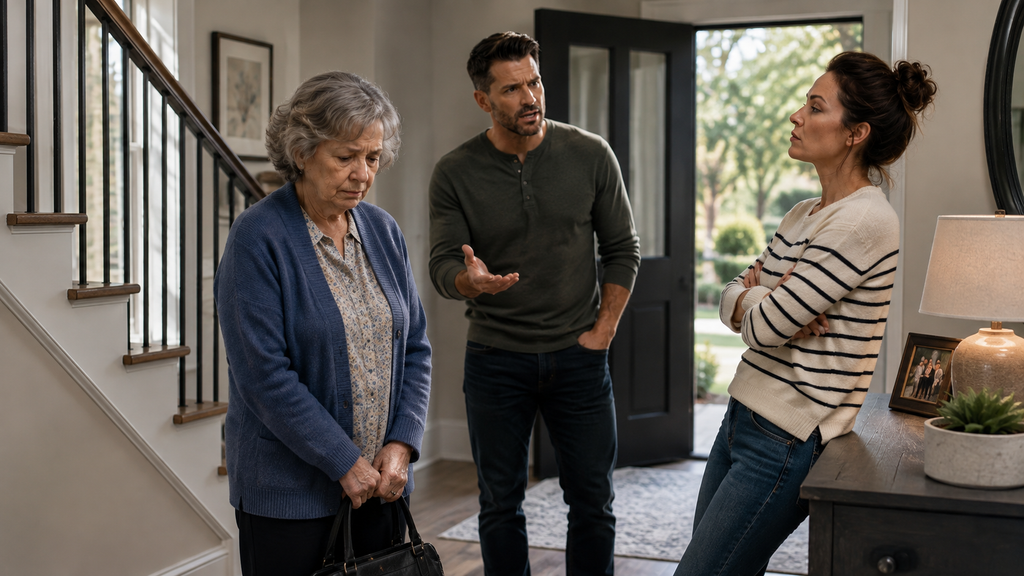
My eighty-two-year-old mother stood barely five feet away.
She was wearing her best blue cardigan.
Her silver hair had been carefully curled.
A small hospital bag hung from both hands.
And for one terrible second, I watched my mother look down at herself as though becoming old had somehow made her an inconvenience.
That was the moment something inside me finally broke.
Not loudly.
Not dramatically.
Cleanly.
Forever.
My name is David Cole.
At the time, I had been married to Vanessa for fifteen years.
Fifteen years.
That number matters.
Because when a marriage lasts that long, you become incredibly talented at explaining away things you should never have tolerated in the first place.
You call selfishness stress.
You call cruelty bluntness.
You call contempt exhaustion.
You call emotional distance independence.
And when someone repeatedly hurts the people you love, you convince yourself that if everyone were simply a little more patient, a little more understanding, a little less sensitive, then everything would eventually become peaceful again.
That was what I had done with Vanessa.
For years.
I had defended her so often that eventually I stopped realizing I was defending her.
It simply became the natural rhythm of our marriage.
Vanessa didn’t mean it that way.
Vanessa had a difficult childhood.
Vanessa was under pressure at the boutique.
Vanessa wasn’t naturally affectionate.
Vanessa needed space.
Vanessa didn’t understand my mother.
Vanessa didn’t like hospitals.
There was always a reason.
There was always another excuse.
Until that Tuesday morning.
Mom had a specialist appointment at 9:40.
We had waited nearly three months for it.
She had been undergoing treatment for a serious blood disorder, and although her condition had stabilized somewhat, her doctors were still watching several troubling markers.
The appointment would determine whether her current medication was working.
It would determine whether she needed a stronger treatment.
It would determine what the next few months of her life looked like.
My car was in the repair shop.
Vanessa’s SUV was in the driveway.
Technically, it wasn’t even Vanessa’s SUV.
I had purchased it.
I paid the insurance.
I covered maintenance.
I had spent three Saturdays repairing damage caused because Vanessa ignored two warning lights until the vehicle nearly overheated.
None of that mattered.
It was simply the easiest vehicle available.
I had assumed Vanessa would drive Mom.
Or at least let me take the SUV myself.
I should have known better.
Vanessa stood near the front door wearing black yoga pants, spotless white sneakers, and sunglasses pushed into her dark hair.
A designer purse rested against her hip.
An iced coffee was in her hand.
She looked ready for brunch.
Mom looked ready to discover whether the medicine keeping her alive was still working.
I glanced at the clock.
“Vanessa, we have to leave in ten minutes.”
She looked at me.
“For what?”
I thought she was joking.
“Mom’s appointment.”
She took another sip of coffee.
“Oh.”
The indifference in that single syllable made me hesitate.
“Can I have the SUV keys?”
Vanessa tilted her head.
“No.”
I stared at her.
“What?”
“I’m using it.”
“For what?”
“Brunch.”
Mom immediately touched my sleeve.
“David, it’s all right.”
“No, Mom.”
Vanessa sighed.
That sigh.
I still remember it.
Not angry.
Not frustrated.
Just irritated.
Like the two of us had become obstacles standing between her and a mimosa.
“I’ve had this brunch planned for two weeks.”
“And Mom has had this appointment scheduled for three months.”
“So call an Uber.”
“She gets dizzy after blood draws.”
“Then go with her.”
“That’s exactly what I’m trying to do.”
Vanessa’s mouth tightened.
“You always do this.”
“Do what?”
“You make your mother’s problems my problems.”
Mom lowered her eyes.
I felt heat rise behind my face.
“Vanessa.”
“What?”
“She is standing right here.”
“I know.”
That answer hurt worse than if Vanessa had claimed she hadn’t realized Mom could hear.
She knew.
She simply didn’t care.
I stepped closer.
“You know how important this appointment is.”
“And I told you I have plans.”
“I’m asking to use a vehicle that I paid for.”
Vanessa laughed once.
“Here we go.”
“Here we go where?”
“The guilt trip.”
“There is no guilt trip.”
“There always is when Margaret needs something.”
Mom took a small step backward.
“I can reschedule.”
I turned toward her.
“No.”
“David—”
“No, Mom.”
Her hands tightened around the little hospital bag.
She had been awake since five that morning.
When I came downstairs at six, the kitchen light was already on.
Mom had made coffee.
She had packed her medication list.
Her insurance documents.
A phone charger.
A paperback novel she probably wouldn’t read.
A bottle of water.
Two tissues folded into a little square.
And because she was my mother, there was a piece of homemade banana bread wrapped carefully in foil on the counter.
For Vanessa.
Months earlier, Vanessa had casually said she liked Mom’s banana bread.
Mom remembered.
That was the kind of person she was.
She remembered the tiny preferences of people who barely remembered her dignity.
Vanessa hadn’t even looked at it.
Instead, she glanced at her phone.
“My reservation is at nine-thirty.”
I said quietly, “And Mom’s specialist is at nine-forty.”
Vanessa shrugged.
“Then one of you needs to figure something out.”
The hallway went still.
I looked at her.
“What did you just say?”
She frowned.
“David, don’t start.”
“No. Say it again.”
She rolled her eyes.
“I said your mother is not my problem.”
Silence.
Absolute silence.
Mom looked down.
Not at Vanessa.
At herself.
Like somehow she had caused this.
Like she had become too old.
Too sick.
Too dependent.
Too much.
That expression on my mother’s face did something no argument had ever managed to do.
It stripped away fifteen years of excuses.
I suddenly saw Vanessa without explanations.
Without history.
Without the memories of our first apartment.
Without our wedding photographs.
Without vacations.
Without anniversaries.
Without the stories I had told myself.
I saw a forty-four-year-old woman looking at an eighty-two-year-old woman who had treated her with kindness for fifteen years and declaring that helping her reach a potentially life-changing medical appointment was beneath her concern.
I nodded.
“Okay.”
Vanessa blinked.
“What?”
“Okay.”
My calmness confused her.
She had expected an argument.
She had expected me to raise my voice.
She had expected me to remind her that Mom had once quietly covered three months of our mortgage when Vanessa’s boutique almost failed.
She probably expected me to mention the money Mom had given us for our wedding.
Or the Christmas Vanessa’s own mother refused to visit and Mom stayed up until midnight cooking Vanessa’s favorite meal.
Or the afternoon Vanessa had outpatient surgery and Mom sat in the waiting room for six hours because I was stuck at work.
I said none of it.
I simply pulled out my phone.
I called our neighbor.
Mr. Bellamy lived two houses down.
He was seventy, retired, and had spent thirty-seven years working as a paramedic.
He answered almost immediately.
“David?”
“Sorry to bother you. Mom needs a ride to the hospital. My car’s in the shop.”
There was no hesitation.
“I’ll be there in two minutes.”
That was all.
No questions.
No complaints.
No reminder that Mom wasn’t his responsibility.
Just:
I’ll be there.
I hung up.
Vanessa gave a short laugh.
“Dramatic.”
Mom squeezed my arm.
“I don’t want to cause trouble.”
I looked directly into her eyes.
“You didn’t.”
Behind us, Vanessa grabbed her purse.
“Lock up when you leave.”
She opened the front door.
Then, as though she hadn’t already done enough, she turned around.
“And David?”
I looked at her.
“Don’t use my card for hospital parking again.”
Mom flinched.
Just slightly.
I saw it.
Vanessa either didn’t notice or didn’t care.
The door closed.
And for the first time in fifteen years, I allowed myself to think something clearly.
Vanessa didn’t dislike inconvenience.
She disliked my mother.
Mr. Bellamy arrived exactly two minutes later.
He was wearing an old Navy baseball cap and carrying the kind of practical kindness that never needed attention.
He immediately took Mom’s hospital bag.
“Hospital?”
Mom looked embarrassed.
“I’m so sorry to bother you.”
Mr. Bellamy smiled.
“Margaret, I once transported a man who tried to fistfight an ambulance because he believed it had stolen his shoes.”
Mom stared at him.
Then laughed.
“You’re teasing me.”
“I wish I were.”
She laughed again.
It was the first real laugh I had heard from her all morning.
And strangely, hearing it nearly made me cry.
Because I realized how much tension she had been carrying.
How carefully she had been shrinking herself inside my home.
That bothered me more than I could explain.
At the hospital, things went better than expected.
Mom’s specialist reviewed her latest tests.
Her numbers were stable.
Not cured.
Not perfect.
But stable.
After months of anxiety, the word felt almost miraculous.
The doctor adjusted one medication and scheduled another follow-up.
Then she looked at Mom and said something simple.
“You need less stress.”
Mom glanced at me.
I knew what she was thinking.
So did she.
On the way out, Mr. Bellamy offered to get coffee while Mom and I waited near the pharmacy.
We sat beneath fluorescent lights.
Mom was unusually quiet.
She kept opening and closing her purse.
Finally, she whispered:
“David.”
“Yeah?”
“I think Harold needs to review the trust.”
I turned toward her.
Harold Stein had been my parents’ attorney for more than thirty years.
He had handled my father’s estate.
He had prepared their wills.
After Dad died, Harold helped Mom organize everything.
Her house.
Her savings.
Investments.
Insurance policies.
The family trust.
“Why?”
Mom reached into her purse.
She pulled out a folded bank statement.
Several lines had been highlighted yellow.
Three transfers immediately caught my attention.
$2,400.
$3,100.
$1,850.
All of them connected to a business account.
A familiar business account.
Vanessa’s boutique.
I looked at Mom.
“When did you approve these?”
She didn’t answer.
“Mom?”
Her fingers trembled.
“I didn’t.”
I felt something cold move through my stomach.
“What do you mean?”
“I noticed the first one last month.”
“And?”
“I thought maybe I had forgotten something.”
“Forgotten what?”
“A loan.”
“You don’t loan Vanessa money.”
“I know.”
My voice became quieter.
“How many transfers are there?”
“I don’t know.”
“Did you ask her?”
Mom looked toward the floor.
“No.”
“Why?”
Her answer broke something in me all over again.
“Because I didn’t want to cause trouble in your marriage.”
I closed my eyes.
My mother had been protecting my marriage.
From my wife.
Even while my wife might have been stealing from her.
I took the statement.
“Harold sees this today.”
Mom nodded.
Then she said softly:
“After this morning, I think he should see everything.”
I looked at her.
“What does that mean?”
She opened her mouth.
Then stopped.
“Nothing.”
“Mom.”
“I’m tired.”
I knew she was hiding something.
I just didn’t yet understand that almost everyone in my life was hiding something.
The next morning, Vanessa called thirty-eight times before lunch.
I didn’t answer.
I was sitting in Harold Stein’s office with Mom.
Harold was seventy-three, sharp-minded, silver-haired, and normally impossible to rattle.
That morning, he looked rattled.
His assistant had spent hours pulling eighteen months of Mom’s account history.
Harold placed a thick folder on the conference table.
“The three highlighted transfers are not the real problem.”
I looked at him.
“How bad?”
He removed his glasses.
“Approximately forty-seven thousand dollars.”
Mom’s face drained.
I felt heat shoot into my chest.
“All to Vanessa?”
“Either directly to accounts connected to her boutique or through intermediary accounts associated with the business.”
Mom whispered, “Forty-seven thousand?”
Harold nodded.
My phone vibrated.
Missed call thirty-four.
I turned it facedown.
Harold continued.
“Several transfers were initiated through online banking.”
Mom frowned.
“I don’t use online banking.”
“I know.”
“So someone logged in as her?” I asked.
“Yes.”
“With her credentials?”
“Yes.”
My phone vibrated again.
Thirty-five.
Thirty-six.
Thirty-seven.
Then thirty-eight.
Harold watched it.
“There’s something else.”
He opened another folder.
Before he could explain, my phone began ringing again.
Call thirty-nine.
Harold looked at me.
“Answer it.”
I did.
“Hello?”
Vanessa was crying.
Not elegant crying.
Not the kind of controlled tears she sometimes used during arguments.
She sounded terrified.
“David, what did you do?”
“I didn’t do anything.”
“My business account is frozen!”
Mom looked at me.
Harold didn’t move.
“Everything is frozen,” Vanessa continued. “Payroll. Vendor payments. The reserve account. Everything!”
I asked:
“Why would your business account be frozen?”
Silence.
Then:
“You know why.”
The entire room changed.
I gripped the phone tighter.
“No, Vanessa.”
“David—”
“I want you to tell me.”
“You don’t understand.”
“Then explain.”
“I was going to put it back.”
Mom closed her eyes.
I felt sick.
“How much?”
“Please.”
“How much?”
“It wasn’t stealing.”
My mother’s eyes opened.
There was something in them I hadn’t seen before.
Anger.
Not fear.
Not embarrassment.
Not sadness.
Anger.
I said:
“You took money from an eighty-two-year-old woman without permission.”
“She has plenty!”
The words came out so fast that Vanessa couldn’t stop them.
Mom heard every syllable.
The room went silent.
Vanessa must have realized what she had said.
“Oh God.”
Mom held out her hand.
“Give me the phone.”
I hesitated.
Her hand remained steady.
I passed it to her.
“Vanessa.”
Immediately, Vanessa’s voice changed.
“Margaret, please. Please, I can explain.”
Mom’s expression was unreadable.
“Harold found something else.”
Silence.
Vanessa stopped crying.
Mom looked directly at Harold.
“And I think you already know what it is.”
The call disconnected.
Vanessa had hung up.
Harold leaned back.
“That reaction concerns me.”
I stared at him.
“What did you find?”
He slid a document across the table.
It appeared to be a notarized amendment to Mom’s trust.
I read it once.
Then again.
According to the amendment, when Mom died, nearly sixty percent of her estate would go not to me…
but to Vanessa.
My mouth went dry.
“That’s impossible.”
Harold nodded.
“It is.”
“What?”
“This document is fraudulent.”
Mom stared at him.
“How do you know?”
He pointed to the notary stamp.
“The notary named here died eleven months before this document was supposedly signed.”
I stood.
My chair nearly tipped over.
“Someone forged Mom’s trust?”
“Yes.”
“And it names Vanessa.”
“Yes.”
I looked at Mom.
She was suddenly staring at the table.
At the time, I interpreted that as shock.
Later, I would understand it differently.
Harold said:
“We need to contact authorities.”
My phone buzzed.
A message from Vanessa.
PLEASE COME HOME.
Another followed.
I CAN EXPLAIN EVERYTHING.
Then:
DO NOT CALL THE POLICE UNTIL YOU HEAR ME.
Harold read it over my shoulder.
Then he reached for his phone.
Two detectives were already waiting when I arrived home that afternoon.
Vanessa wasn’t there.
Neither was the SUV.
Harold insisted Mom remain with Mr. Bellamy.
I walked through my house as though I had entered a museum dedicated to somebody else’s marriage.
Our wedding photograph hung above the fireplace.
Vanessa laughing.
Me looking at her as though I had won the universe.
Fifteen years.
Fifteen years of birthdays.
Fifteen Christmas mornings.
Fifteen anniversaries.
Fifteen years of ordinary afternoons that suddenly felt contaminated by questions.
Detective Elena Ramirez interviewed me at our dining table.
She had a calm voice and the unnerving ability to remain silent long enough that people filled the silence themselves.
“Did Vanessa ever handle Margaret’s finances?”
“No.”
“Did she know your mother’s banking password?”
“I don’t think so.”
“Could she access your mother’s house?”
“Yes.”
“How?”
“Mom gave both of us spare keys years ago.”
“Did Vanessa know a trust existed?”
I hesitated.
“Yes.”
Three years earlier, after Dad died, Vanessa had been present when Mom mentioned it.
Vanessa had laughed.
“Guess David won the lottery.”
Mom hadn’t laughed.
I remembered that now.
Ramirez asked:
“Was your wife having financial trouble?”
“Her boutique struggled occasionally.”
“How badly?”
“I thought it was improving.”
Ramirez studied me.
“People don’t always steal from relatives because they’re broke.”
“What does that mean?”
“Sometimes money is only evidence that another problem exists.”
Before I could ask what she meant, headlights swept across the front windows.
Vanessa had returned.
It was 8:17 p.m.
She entered carrying no purse.
No phone.
No keys.
Her makeup was streaked.
When she saw the detectives, she stopped.
“You called them.”
I stood.
“You stole forty-seven thousand dollars from my mother.”
She started crying again.
“I know.”
“You know?”
“I did it.”
Detective Ramirez spoke carefully.
“Mrs. Cole, you may want legal counsel before continuing.”
Vanessa ignored her.
She looked at me.
Only me.
“I took the money.”
“You forged Mom’s signature too?”
“No.”
“Vanessa.”
“I didn’t.”
“The amendment gives you sixty percent of her estate.”
“I know.”
“So you expect me to believe that has nothing to do with you?”
“Yes.”
I laughed.
It sounded ugly even to me.
“Why would I believe a single word you say?”
“Because I didn’t know about that document.”
“You knew the trust existed.”
“I knew there was a trust. I did not know someone amended it.”
“Then who forged it?”
Vanessa stared at me.
Her answer came quietly.
“Ask your mother.”
Something flashed through me.
“What?”
“Ask Margaret.”
“About what?”
“March fourteenth.”
Detective Ramirez looked up.
“What happened on March fourteenth?”
Vanessa shook her head.
“I don’t know.”
“Then why mention it?”
“Because that’s when everything changed.”
I stepped closer.
“What does that mean?”
Vanessa’s face twisted.
“She knows.”
“Knows what?”
“Ask her where she was.”
I almost moved toward Vanessa before Ramirez stepped between us.
“Enough.”
Vanessa covered her mouth.
“David, please. Just ask her.”
Mom was asleep at Mr. Bellamy’s house when I arrived.
I almost waited until morning.
I should have.
But by then, patience felt impossible.
I sat beside her on the guest-room bed.
“Mom.”
She stirred.
“David?”
“Where were you on March fourteenth?”
Everything changed.
Only for half a second.
But I saw it.
Her eyes widened.
Her breath caught.
“Why?”
“Vanessa told me to ask.”
Mom turned away.
“David, you’re tired.”
“Where were you?”
Silence.
“Mom.”
Finally:
“With Harold.”
I froze.
“What?”
“I met Harold that afternoon.”
“About the trust?”
“Yes.”
I stood.
“But Harold said the amendment was forged.”
“It was.”
“Then why were you meeting him?”
Mom stared down at her hands.
“Mom.”
Tears filled her eyes.
“I was trying to protect you.”
My stomach tightened.
“From Vanessa?”
She shook her head.
“From the truth.”
Harold arrived before seven the next morning.
So did Detective Ramirez.
Mr. Bellamy made coffee nobody drank.
We sat around his dining table.
Mom looked fragile.
Harold looked exhausted.
He began:
“I need to clarify something.”
I crossed my arms.
“The amendment wasn’t created by Vanessa.”
My entire body went still.
“Then who created it?”
Harold looked toward Mom.
Mom lowered her eyes.
“No,” I whispered.
She began crying.
“Mom?”
“I did.”
I stared at her.
“You what?”
“I created it.”
“You forged your own trust?”
“Yes.”
“Why?”
“To make it look like Vanessa had done it.”
I took two steps backward.
“What?”
“I’m sorry.”
Detective Ramirez leaned forward.
“Mrs. Cole, you understand what you’re admitting?”
“Yes.”
I could barely breathe.
“You tried to frame my wife?”
“No.”
Mom looked up quickly.
“Not for the money. She did take the money.”
“That makes this better?”
“No.”
“Then explain!”
“I needed you to look!”
“At what?”
“At everything!”
“You could have told me!”
“You wouldn’t have believed me!”
Her voice cracked through the room.
And I stopped.
Because buried beneath my rage was a terrible realization.
She might have been right.
For years, Mom had watched me defend Vanessa.
Every insult.
Every careless remark.
Every selfish choice.
Every subtle cruelty.
I had explained them all away.
Maybe Mom had believed she needed something impossible to ignore.
But forging a document?
Creating evidence?
Framing someone?
It was madness.
“Why?” I asked again.
Mom’s shoulders shook.
“Because Vanessa isn’t the person I was trying to expose.”
I stared at her.
“What?”
Mom reached into her purse.
She removed an old envelope.
The paper was yellowed with age.
My name was written across the front.
In my father’s handwriting.
FOR DAVID.
My hands went cold.
“Where did you get that?”
“Your father left it with Harold.”
Harold spoke quietly.
“He instructed me to give it to you if certain conditions were ever met.”
“What conditions?”
Mom answered.
“If money started disappearing from family accounts.”
I opened the envelope.
Inside was a letter.
I recognized Dad’s handwriting immediately.
The first line forced me to sit down.
David,
If you are reading this, then the mistake I made twenty-seven years ago has finally come back.
I looked up.
“What mistake?”
Mom was already crying.
I continued.
Dad wrote about a hardware business he once owned with a man named Richard Vale.
They had been partners.
Dad handled operations.
Richard managed the financial side.
Then money began disappearing.
At first, it was small.
Then larger.
Eventually, Dad discovered Richard had stolen hundreds of thousands of dollars.
He could have gone to the police.
He didn’t.
Instead, he allowed Richard to quietly repay part of the money.
I looked at Mom.
“Why?”
Her lips trembled.
“Because Richard was family.”
I frowned.
“Whose family?”
Nobody answered.
I kept reading.
Richard had a daughter.
A little girl Dad had known since birth.
After Richard disappeared, that daughter changed her surname.
Years later, she met me.
My eyes reached the name.
Vanessa.
I stopped breathing.
“No.”
Mom cried harder.
“No.”
I looked at Harold.
He said nothing.
“My wife is Richard Vale’s daughter?”
“Yes,” Mom whispered.
“She knew?”
“I don’t think she knew about the theft.”
“Then how did she access your accounts?”
Detective Ramirez interrupted.
“She didn’t do this alone.”
She placed a photograph on the table.
Security footage.
Vanessa stood outside Mom’s bank beside a tall, gray-haired man.
I didn’t recognize him.
Mom did.
The blood disappeared from her face.
“That’s impossible.”
Harold stood so fast his chair scraped backward.
“No.”
I looked between them.
“Who is he?”
Harold answered.
“Richard Vale.”
I stared at him.
“Vanessa’s father?”
“Yes.”
“But he’s dead.”
Mom whispered:
“He’s supposed to be.”
Richard Vale had supposedly died twenty-three years earlier.
There had been a funeral.
A death certificate.
An urn.
Vanessa had grieved him.
Except there had never been a body.
Over the next forty-eight hours, investigators uncovered pieces of a story so twisted I sometimes wondered whether I had stopped sleeping and entered a nightmare.
Richard had staged his own death.
He had spent more than two decades living under different identities.
Six months earlier, he contacted Vanessa.
At first, she believed it was a scam.
Then he proved who he was.
He told her my father had cheated him.
He claimed my family’s money was really his.
He claimed my mother had benefited from his ruin.
He showed Vanessa documents.
Some genuine.
Some forged.
He told her that taking money from Mom wasn’t theft.
It was repayment.
And Vanessa believed him.
Or wanted to.
The boutique was struggling.
Debt was mounting.
She was desperate.
And greed becomes much easier to justify when someone gives it the language of justice.
Vanessa photographed documents at Mom’s house.
She collected account information.
She gave Richard what he needed.
Richard initiated many of the transfers.
Vanessa received forty-seven thousand dollars.
But the total amount stolen wasn’t forty-seven thousand.
It was six hundred and twelve thousand dollars.
Richard kept most of it.
Twenty-seven years after stealing from my father, he had returned to steal from my mother.
Again.
But even that wasn’t the worst discovery.
Police arrested Richard in a motel outside Philadelphia.
Inside his room, they found passports.
Burner phones.
Bank statements.
Fake identification.
Boxes of old records.
And a recent photograph of Mom.
On the back, written in black ink:
MARCH 14.
SHE KNOWS.
The date Vanessa had mentioned.
The day Mom met Harold.
I asked Mom what it meant.
For hours, she refused to answer.
Finally, she whispered:
“Richard called me that morning.”
I stared at her.
“He threatened you?”
“No.”
“What did he want?”
“To tell me he was back.”
“Why?”
“He wanted money.”
“More money?”
Mom closed her eyes.
“And he told me something about your father.”
“What?”
Her hands started trembling.
“He said your father knew he was alive.”
I laughed.
There was no humor in it.
“That’s impossible.”
Harold didn’t react.
I turned toward him.
“Harold?”
His face crumpled slightly.
“Your father helped Richard disappear.”
The room stopped.
Dad hadn’t merely protected Richard from prosecution.
He had helped him stage his death.
My father.
The man I remembered as almost painfully honorable.
The man who returned shopping carts in empty parking lots.
The man who once drove twenty miles to return a cashier’s accidental extra change.
He had helped a thief disappear.
“Why?”
Mom broke down.
“Because Richard threatened to tell you.”
“Tell me what?”
She shook her head.
“Mom.”
“I couldn’t lose you.”
“Lose me?”
My voice cracked.
“What are you talking about?”
Harold looked away.
And Mom finally said the secret that had been buried longer than the theft.
Longer than Richard’s disappearance.
Longer than my marriage.
“Richard Vale wasn’t only Vanessa’s father.”
My body went numb.
“No.”
Mom looked at me.
“He was yours too.”
Nothing moved.
Nothing existed.
“No.”
She nodded through tears.
“I’m sorry.”
“No.”
“David—”
“No.”
The word kept coming because my brain had lost the ability to create anything else.
Dad had raised me.
Dad taught me to ride a bicycle.
Dad coached my Little League team.
Dad sat with me after my first heartbreak.
Dad helped me buy my first house.
Dad stood beside me on my wedding day.
Dad held my son for ten minutes before we lost him at birth.
He was my father.
He was my father.
But biologically?
Richard Vale was.
Mom explained through sobs.
She had known Richard years before marrying Dad.
During a temporary separation early in their relationship, she and Richard had been together once.
She became pregnant.
Dad found out.
He chose to raise me.
Richard agreed to stay away.
Years later, when Richard began stealing from their business, Dad discovered everything.
He threatened Richard with prison.
Richard threatened him with the truth.
My paternity.
Dad panicked.
He convinced Richard to disappear.
He helped create the false death.
And then he buried the secret.
I thought I had reached the bottom.
I hadn’t.
I looked at Mom.
Then at Harold.
Then something inside my mind connected.
Vanessa.
Richard Vale’s daughter.
Me.
Richard Vale’s son.
My stomach twisted violently.
“No.”
Mom covered her face.
I stood so suddenly the chair fell backward.
“No.”
Harold moved toward me.
“David.”
I stumbled away.
“No.”
Vanessa was my biological half-sister.
For fifteen years, I had unknowingly been married to my half-sister.
Mr. Bellamy caught me before I collapsed.
Some truths hurt.
Others divide your life into two separate countries.
Before.
And after.
Everything that followed became a blur of DNA tests, police interviews, attorneys, therapists, court filings, and sleepless nights.
The DNA results confirmed it.
Richard Vale was my biological father.
Richard Vale was Vanessa’s biological father.
Vanessa and I were half-siblings.
When Vanessa learned, she vomited.
Then she didn’t speak for almost an entire day.
Whatever rage I had felt toward her tangled itself into something more complicated.
She had stolen from Mom.
That was her choice.
She had treated Mom cruelly.
That was her choice too.
But our marriage?
That horror belonged to neither of us.
Neither of us knew.
There was no child between us.
Years earlier, we had lost a baby late in pregnancy.
At the time, it had nearly destroyed us.
After the DNA results, Vanessa called me from her lawyer’s office and sobbed for twenty straight minutes.
Neither of us said what we were both thinking.
Eventually, she whispered:
“Maybe losing him spared him something.”
I closed my eyes.
“Don’t.”
“I’m sorry.”
“Don’t make his life into punishment.”
Silence.
“He was our son,” I said.
“I know.”
“He mattered.”
“I know.”
“Whatever we discovered now doesn’t erase him.”
Vanessa began crying harder.
Neither of us spoke again for a long time.
That was one of the strangest lessons of the entire nightmare.
A truth discovered later can redefine the past.
But it doesn’t always erase the love that existed before you knew it.
Vanessa pleaded guilty to financial exploitation and identity-related offenses.
She cooperated fully.
She helped investigators locate accounts.
She surrendered passwords.
She gave testimony against Richard.
She returned what remained of the money she had received.
Because of her cooperation, her sentence was significantly reduced.
Richard wasn’t so fortunate.
Authorities connected him to decades of fraud under several identities.
False documents.
Stolen funds.
Identity crimes.
Financial schemes.
He had lied to everyone.
To Vanessa.
To Mom.
To Dad.
To me.
He would likely die in prison.
Mom withdrew the false trust amendment and admitted creating it.
She faced consequences too.
Her age and health mattered.
So did her cooperation.
But none of that erased what she had done.
That was one of the hardest things for me to accept.
Mom loved me.
And Mom had committed a terrible act because she believed love gave her permission to control what I discovered and when I discovered it.
Dad loved me too.
Dad had built a lie large enough to swallow decades.
Harold had kept secrets because he believed loyalty demanded silence.
Vanessa stole because she believed resentment justified repayment.
Richard manipulated everyone because greed had long ago replaced whatever conscience he once possessed.
Everyone had a reason.
That didn’t make them right.
Sometimes the most dangerous lies are not told out of hatred.
They’re told by people convinced they are protecting someone.
Six months later, Vanessa and I sat across from each other in a lawyer’s office.
Our marriage had been legally dissolved.
Not merely ended emotionally.
Dissolved.
She looked different.
No designer purse.
No immaculate hair.
No practiced confidence.
She looked exhausted.
Human.
Small.
She slid an envelope across the table.
“What’s this?” I asked.
“My portion of the recovered money.”
“I don’t want it.”
“It belongs to Margaret.”
I looked at her.
Vanessa’s eyes filled.
“I know saying sorry is useless.”
I said nothing.
She continued.
“I was horrible to her before Richard ever came back.”
She caught herself after saying the name.
For a moment, she looked ashamed even to refer to him as her father.
“I was jealous.”
“Of Mom?”
She nodded.
“Why?”
Vanessa looked toward the window.
“My mother spent my whole childhood telling me I was difficult.”
Her voice softened.
“A burden.”
I didn’t interrupt.
“She acted like loving me required sacrifice.”
Vanessa swallowed.
“Then I met Margaret.”
I frowned.
“She remembered your favorite food.”
“She remembered everybody’s favorite food.”
“No. David.”
Vanessa looked at me.
“She looked at you as though you mattered every time you entered a room.”
Her voice cracked.
“I had never had that.”
I felt my anger shift.
Not disappear.
Shift.
“I watched you call her every Sunday.”
Vanessa wiped her cheek.
“I watched her ask whether you were sleeping enough. Whether you were eating. Whether work was stressful.”
She laughed bitterly.
“I hated it.”
“Why?”
“Because I wanted someone to love me like that.”
The answer landed quietly.
It excused nothing.
Absolutely nothing.
Pain can explain cruelty.
It does not erase responsibility.
But for the first time in years, I understood part of Vanessa I had never bothered to examine.
She hadn’t only resented my mother.
She had envied what Mom represented.
Safe love.
Reliable love.
Love without punishment attached.
She pushed the envelope closer.
“I can’t undo what I did.”
“No.”
“I know.”
She stood.
At the doorway, she stopped.
“David?”
I looked at her.
“I’m glad Margaret’s treatment worked.”
That was all.
She walked away.
For the first time since I had met Vanessa, I realized our last conversation might also be the most truthful one we had ever shared.
Mom moved in with me the following spring.
Not because she needed full-time care.
Her numbers remained stable.
She could still live independently.
Still drive short distances.
Still argue with grocery cashiers about coupons.
Still insist she could carry bags that were obviously too heavy.
She moved in because after everything we had survived, both of us understood that independence could become another excuse for wasting time.
One Sunday morning, I came downstairs and smelled banana bread.
I stopped in the kitchen doorway.
Mom glanced over.
“What?”
I smiled.
“Nothing.”
She narrowed her eyes.
“You’re staring.”
“Just remembering.”
She knew exactly what I meant.
For a moment, sadness moved across her face.
Then she lifted the loaf.
“Want the end piece?”
“You know I do.”
She cut it.
I poured coffee.
We sat at the kitchen table while morning light spilled across the backyard.
For a while, neither of us spoke.
Then Mom whispered:
“I’m sorry I lied to you.”
I watched steam rise from my coffee.
“I know.”
“I thought the truth would destroy your life.”
I looked at her.
“It did.”
She flinched.
I reached across the table.
“But lying nearly destroyed more.”
Tears filled her eyes.
“I know.”
I squeezed her hand.
“Dad was still my father.”
“Yes.”
“And Richard isn’t.”
“But biologically—”
“I don’t care.”
I shook my head.
“Being somebody’s father is more than DNA.”
Mom smiled through tears.
“Your father would have liked hearing that.”
“I hope so.”
Silence settled around us.
Not uncomfortable silence.
Peaceful silence.
For the first time in nearly a year, my life felt quiet.
Not repaired.
Not normal.
But honest.
Maybe honest was better.
Then the doorbell rang.
Mom frowned.
“You expecting someone?”
“No.”
I walked toward the front door.
For one absurd second, I remembered that morning a year earlier.
Mom holding her hospital bag.
Vanessa holding her iced coffee.
Three words.
Not my problem.
I opened the door.
A young woman stood on the porch.
Maybe twenty-six.
Dark hair.
Brown eyes.
Nervous expression.
She held an old photograph against her chest.
“David Cole?”
“Yes?”
“My name is Rachel.”
“Okay.”
She swallowed.
“I’m sorry to show up like this.”
“Do I know you?”
“No.”
She extended the photograph.
A younger Richard Vale stood beside a woman I had never seen.
Rachel’s hand trembled.
“Richard Vale was my father too.”
The world seemed to tilt again.
“What?”
“And before he was arrested, he mailed me something.”
She reached into her bag.
A sealed envelope.
My name was written across the front.
DAVID DESERVES THE REAL TRUTH.
Mom appeared behind me.
I heard her breath catch.
Then her coffee mug slipped from her hand.
It hit the hardwood and shattered.
I turned.
Mom had gone completely white.
“Mom?”
Her eyes remained fixed on the envelope.
Then she whispered:
“David… Richard wasn’t the one who started this.”
For several seconds, nobody moved.
Rachel stood awkwardly on the porch.
Mom stared at the envelope.
I felt the old panic returning.
That physical sensation I had come to recognize over the previous year.
The tightening throat.
The heavy chest.
The certainty that another piece of my life was about to be rewritten.
I looked at Mom.
“What does that mean?”
She shook her head.
“Not here.”
“Mom.”
“Please.”
I almost laughed.
The word please had become dangerous in our family.
Please wait.
Please don’t ask.
Please understand.
Please let me protect you.
Every please had hidden another secret.
I looked at Rachel.
“Come inside.”
Mom closed her eyes.
Rachel stepped into the hallway.
I gestured toward the living room.
We sat.
Mom remained standing.
“Sit down,” I said.
“I’m fine.”
“You just dropped a mug.”
“I’m fine.”
“Mom.”
Eventually she sat.
Rachel placed the envelope on the coffee table.
Nobody touched it.
I looked at her.
“How did you find me?”
“My mother died eight months ago.”
“I’m sorry.”
“Thank you.”
Rachel looked toward the envelope.
“After she died, I found documents in a safety deposit box.”
“What kind?”
“Letters. Photographs. Some records.”
“From Richard?”
“Some.”
She hesitated.
“And some from your father.”
I stared at her.
“My father?”
She nodded.
“Thomas Cole.”
Mom covered her mouth.
I turned.
“You knew Rachel’s mother?”
Mom didn’t answer.
That was answer enough.
Rachel pulled another photograph from her bag.
She placed it beside the envelope.
Dad.
Young.
Probably thirty.
Standing next to the same woman from the photograph with Richard.
Dad wasn’t smiling.
Neither was the woman.
Behind them stood a building I recognized from old family photographs.
The first Cole-Vale Hardware store.
Rachel said:
“My mother’s name was Eleanor Mercer.”
Mom whispered:
“Ellie.”
Rachel looked at her.
“You knew her.”
“Yes.”
“How?”
Mom stared at the photograph.
“She worked for Richard and Thomas.”
“My father said she was an accountant.”
“She was.”
Rachel looked at me.
“My mother knew everything.”
“Everything about what?”
“The missing money.”
A slow chill moved through me.
“I thought Richard stole it.”
Rachel’s eyes met mine.
“That’s what everyone believed.”
Mom whispered:
“David.”
I looked at her.
“Is she telling the truth?”
Mom began crying.
And suddenly I understood the sentence she had said at the door.
Richard wasn’t the one who started this.
He had stolen money.
He had manipulated Vanessa.
He had committed crimes.
But the original theft?
The story Dad had written?
Maybe that wasn’t the beginning.
Rachel reached for the envelope.
“Richard sent this to me three days before he was arrested.”
“Why didn’t you bring it sooner?”
“I didn’t know whether to believe him.”
She looked embarrassed.
“And then I saw news about the case. Your name was mentioned. Vanessa’s too.”
She took a breath.
“I opened the letter meant for me first.”
“What did it say?”
“That my mother kept proof.”
“Proof of what?”
Rachel looked toward Mom.
“Maybe you should ask her.”
I almost shouted.
“No.”
Both women flinched.
I stood.
“I am done asking people who have spent their lives giving me half-truths.”
I pointed toward the envelope.
“If something is inside that envelope, we open it now.”
Mom whispered:
“David.”
“No.”
My voice trembled.
“No more protecting me.”
She lowered her eyes.
“No more deciding what I can survive.”
I looked at Rachel.
“Open it.”
Rachel handed me the envelope.
I broke the seal.
Inside were photocopies of old ledgers.
A handwritten letter from Richard.
And one photograph.
The photograph showed my father.
Mom.
Richard.
Eleanor.
All four standing outside the hardware store.
On the back, written in Dad’s handwriting:
THE FOUR OF US KNOW.
I unfolded Richard’s letter.
David,
Your father told you I stole from him.
That is true.
But he did not tell you what I discovered before I stole.
My heart pounded.
I kept reading.
Cole-Vale Hardware had not begun as Dad’s business.
Or Richard’s.
It had been financed almost entirely by Eleanor Mercer.
Rachel’s mother.
She had inherited money from her parents.
She invested it.
On paper, however, the ownership was structured differently.
Why?
Because Eleanor’s first husband was abusive.
She was trying to divorce him.
She feared he would claim the business.
So the shares were temporarily placed under Dad and Richard’s names.
The arrangement was supposed to be corrected later.
It never was.
I looked up.
“Mom?”
She nodded slowly.
“It’s true.”
Rachel’s eyes filled.
“My mother built that company?”
“She funded it,” Mom whispered. “Your father and Richard built the stores. But without Ellie’s money, there would have been nothing.”
“What happened?”
Mom stared at her hands.
“Greed.”
One word.
Simple.
Enough.
Dad and Richard had both begun treating the business as theirs.
Eleanor protested.
Richard accused Dad of manipulating the books.
Dad accused Richard of stealing.
Richard did steal.
But not initially from Dad.
He stole money he believed belonged to Eleanor.
He transferred funds into accounts he said he intended to return to her.
Then he started keeping some.
Justifying it.
Taking more.
Dad discovered him.
The partnership collapsed.
But the ugliest part came afterward.
“Dad knew Eleanor owned part of it?” I asked.
“Yes.”
“Did he repay her?”
Mom cried harder.
“No.”
Rachel’s face tightened.
“Why not?”
Mom looked at her.
“Because your mother disappeared.”
Rachel stared.
“She didn’t disappear.”
“To us, she did.”
“She moved to Baltimore.”
“We didn’t know.”
“She wrote letters.”
Mom closed her eyes.
“I know.”
Rachel went pale.
“What?”
I felt my stomach drop.
“Mom.”
She looked at me.
“Thomas received them.”
“Dad?”
“Yes.”
“And?”
“He burned most of them.”
Rachel stood.
“No.”
“I’m sorry.”
“My mother spent the rest of her life believing they never arrived.”
Mom began sobbing.
“She deserved better.”
Rachel looked ready to leave.
I understood.
I also understood that if she walked out now, the truth would fracture into pieces again.
“Rachel.”
She stopped.
“Please stay.”
She looked at me.
I said:
“We finish it.”
Mom covered her face.
And we did.
Eleanor had invested nearly eighty percent of the startup capital for Cole-Vale Hardware.
The early agreement promised her a one-third ownership stake once her divorce ended.
Her divorce did end.
But the shares were never transferred.
Dad delayed.
Richard delayed.
Both men benefited.
Eleanor eventually threatened legal action.
Then she discovered she was pregnant.
Richard was the father.
Rachel.
Richard wanted Eleanor to leave with him.
Dad wanted the business protected.
Mom wanted everything hidden.
Everyone had motivations.
Everyone made selfish choices.
Eleanor eventually left.
Richard began stealing.
Dad discovered it.
Richard threatened to expose everything.
Not only my paternity.
Eleanor’s ownership.
The false corporate structure.
The hidden transfers.
All of it.
Dad helped Richard fake his death because exposing Richard would also expose Dad.
That was the truth.
Dad hadn’t protected Richard solely because he loved me.
He had protected himself.
That realization hurt more than learning Richard was my biological father.
Because Dad had been the moral center of my childhood.
And now I had to accept the truth that good people can do terrible things.
Loving fathers can be dishonest businessmen.
Kind husbands can be cowards.
People do not arrive in our lives divided neatly into heroes and villains.
Dad loved me.
That was true.
Dad cheated Eleanor.
That was also true.
One truth did not erase the other.
But neither could I use one to excuse the other.
Rachel began crying quietly.
“My mother died thinking nobody cared.”
Mom looked at her.
“I cared.”
Rachel’s face hardened.
“Then why didn’t you find her?”
Mom’s answer came almost silently.
“Because finding her would have forced us to admit what we did.”
There it was.
The most truthful sentence Mom had spoken all morning.
Not fear.
Not confusion.
Not protection.
Cowardice.
Rachel wiped her face.
Mom continued.
“I was young.”
“That isn’t enough.”
“I know.”
“I had to sell her house after she died.”
Mom closed her eyes.
“She deserved money from the business.”
“Yes.”
“She deserved recognition.”
“Yes.”
“She deserved an apology while she was alive.”
Mom broke.
“Yes.”
Rachel stood again.
This time, she walked toward the window.
I gave her space.
After several minutes, she turned toward me.
“There’s more.”
Of course there was.
There was always more.
“What?”
“My mother kept the original partnership agreement.”
Mom looked up sharply.
“What?”
Rachel reached into her bag.
Not the original itself.
A notarized copy.
The agreement clearly listed Eleanor’s investment.
Her intended ownership stake.
Her rights.
Her contribution.
I read it slowly.
Then I understood something.
“What happened to the company?”
Mom frowned.
“Your father sold most of it years ago.”
“For how much?”
She gave me the amount.
My mouth went dry.
A significant portion of Mom’s current trust could be traced back to proceeds from the sale.
Money that, morally and perhaps legally, Eleanor should have shared.
Rachel seemed to understand what I was thinking.
“I didn’t come for money.”
“That doesn’t matter.”
“It matters to me.”
“No.”
I put the agreement down.
“If your mother was owed something, we figure it out.”
“David.”
I looked at Mom.
“No.”
She lowered her eyes.
“This isn’t another secret.”
I turned to Rachel.
“We take it to attorneys.”
She shook her head.
“I don’t want to destroy you.”
I almost laughed.
“You didn’t.”
“Your mother—”
I looked at Mom.
“Whatever consequences exist, they belong to the people who created them.”
Mom nodded.
For once, she didn’t argue.
Harold came over that afternoon.
When he saw the agreement, he sat silently for nearly five minutes.
Then he whispered:
“I wondered.”
I looked at him.
“You knew?”
“No.”
“Don’t do that.”
“I suspected Eleanor had invested money. Thomas never gave me the original corporate documents.”
“Did you know she was owed ownership?”
“No.”
“Would you swear to that?”
He looked me directly in the eye.
“Yes.”
I believed him.
Mostly because Harold no longer seemed interested in protecting anyone.
We spent months reconstructing everything.
Old bank records.
Corporate filings.
Sale documents.
Letters.
Tax records.
Archived statements.
Enough survived to establish a credible picture.
Eleanor had been cheated.
Maybe not in the clean, cinematic way people imagine fraud.
There had been no single night where Dad emptied an account and disappeared.
The truth was messier.
Delays.
Informal promises.
Unrecorded contributions.
Assets titled under the wrong names.
Greed gradually replacing fairness.
And eventually, deliberate concealment.
Dad had benefited.
So had Mom.
So had I, indirectly.
That mattered.
Rachel never demanded money.
Not once.
She repeatedly said:
“I didn’t come here for that.”
And every time, I answered:
“I know.”
Because she didn’t have to demand something for it to be owed.
Eventually, after months of mediation and legal work, Mom voluntarily restructured a substantial portion of the remaining trust.
A portion went to Rachel.
Not as hush money.
Not charity.
Restitution.
We also created a small educational foundation in Eleanor Mercer’s name using proceeds tied to the original hardware business.
Mom insisted on it.
Rachel resisted at first.
Then she agreed under one condition.
“No lies in the history.”
So we told the truth.
The foundation’s public history didn’t portray Dad as a monster or Richard as a misunderstood hero.
It simply stated that Eleanor Mercer had provided the capital that helped launch the original business and that her contribution had gone unrecognized for decades.
Her name finally appeared where it should have appeared from the beginning.
When the plaque was installed, Rachel touched it with two fingers.
Then she cried.
Mom stood several feet away.
She didn’t ask for forgiveness.
That mattered.
She simply said:
“I wish your mother could see this.”
Rachel looked at her.
“So do I.”
Then, after a long silence, she added:
“But I’m glad someone finally did it.”
I visited Richard once.
Only once.
He was thinner than I remembered from the security photograph.
Prison had stripped him of the mystery he had carried in my imagination.
Behind glass, he looked less like the man who had destroyed our lives and more like exactly what he was.
An old man.
A selfish one.
A manipulative one.
A criminal.
But still just a man.
He picked up the telephone.
I did too.
For several seconds, neither of us spoke.
Then he smiled faintly.
“You look like your mother.”
I felt nothing.
Not anger.
Not curiosity.
Nothing.
“You’re not my father.”
His smile disappeared.
“Biology says otherwise.”
“Biology isn’t enough.”
“Thomas put that in your head?”
“No.”
I leaned closer to the glass.
“You did.”
Richard frowned.
“You taught me exactly what makes someone not a father.”
He laughed once.
“You came all this way for that?”
“No.”
“Then why?”
“I wanted to see whether you were sorry.”
His eyes changed.
Only slightly.
“And?”
“Are you?”
He leaned back.
“For what?”
That was my answer.
I stood.
Richard quickly moved forward.
“David.”
I stopped.
“I did love your mother.”
I turned around.
He continued.
“In my way.”
I shook my head.
“That sentence has excused enough damage in this family.”
His face hardened.
“You think Thomas was better?”
“No.”
That surprised him.
“I think he loved me.”
“He lied to you.”
“Yes.”
“He cheated Eleanor.”
“Yes.”
“He helped me disappear.”
“Yes.”
Richard stared at me.
“Then why do you still call him your father?”
I looked at the man whose DNA lived inside me.
“Because fatherhood isn’t a prize awarded to the least guilty man.”
Richard had no answer.
I put down the phone.
And I never saw him again.
Two years passed.
Life did something I once thought impossible.
It became ordinary again.
Not the old ordinary.
A new one.
Mom’s health remained stable.
She slowed down.
Walked more carefully.
Rested more often.
But she still baked banana bread.
Still complained about television commercials.
Still hid cash in birthday cards even though I was in my forties.
Rachel became part of our lives gradually.
Neither of us knew exactly what to call each other at first.
Half-sister felt technical.
Stranger felt inaccurate.
Family felt too fast.
So we didn’t force it.
We had coffee.
Then dinner.
Then holidays.
She brought photographs of Eleanor.
I showed her photographs of Dad.
Sometimes we sat together looking at pictures of people who had hurt each other before either of us understood enough to hate them.
Rachel once asked:
“Do you ever wish you had never learned any of this?”
I thought about it.
“Yes.”
She smiled sadly.
“Me too.”
Then I added:
“But I’m still glad I know.”
“Why?”
“Because a peaceful lie isn’t always peace.”
She nodded.
“I think my mother would have liked you.”
“I wish I could’ve met her.”
“She would’ve interrogated you about everything.”
I laughed.
“Then she definitely would’ve gotten along with Mom.”
Rachel smiled.
It was strange.
The person who arrived carrying another catastrophe eventually became one of the few people who understood my life without explanation.
Vanessa wrote me one letter each year.
The first was an apology.
The second was shorter.
The third simply said:
I hope Margaret is well.
I never answered.
Not because I hated Vanessa.
Eventually, hatred required more energy than I wanted to give the past.
I didn’t answer because some relationships do not need another chapter.
Forgiveness, I learned, does not always mean reconciliation.
Sometimes forgiveness means being able to remember someone without wishing to punish them.
Sometimes it means putting down the argument you keep having with a person who isn’t even in the room.
Sometimes it means accepting that another human being can regret hurting you without earning access to your life again.
I hoped Vanessa built something better with whatever remained of hers.
But I did not need to watch.
On Mom’s eighty-fifth birthday, we had dinner in my backyard.
Nothing extravagant.
Rachel came.
Mr. Bellamy came.
Harold came.
A few neighbors.
A small cake.
Mom wore the same blue cardigan she had worn the morning everything began.
I noticed immediately.
“You kept that?”
She looked down.
“Of course.”
“I thought you’d burn it.”
She smiled.
“Cardigan didn’t do anything wrong.”
I laughed.
Later, after everyone left, Mom and I remained outside.
The night was warm.
Fireflies moved through the yard.
She looked tired but happy.
“David?”
“Yeah?”
“Do you hate me?”
The question caught me completely off guard.
I turned toward her.
“No.”
“Sometimes I think you should.”
“I was angry.”
“I know.”
“I’m still angry about some things.”
“I know.”
“But no.”
I took her hand.
“I don’t hate you.”
Tears filled her eyes.
“I made so many mistakes trying to keep you.”
“I know.”
“I was terrified you’d find out Richard was your biological father and stop loving Thomas.”
I looked toward the dark yard.
“That could never have happened.”
“I understand that now.”
“You should have trusted me.”
“Yes.”
“You should have trusted Dad too.”
She nodded.
“Yes.”
“And Dad should have trusted that the truth didn’t make him less my father.”
Her fingers tightened around mine.
“Yes.”
I smiled faintly.
“That’s the tragedy, Mom.”
“What?”
“Everyone kept lying because they were afraid truth would destroy love.”
She looked at me.
“And?”
“It was the lying that nearly did.”
Mom began crying.
I pulled her against my shoulder.
She felt smaller than she once had.
For most of my life, my mother had seemed permanent.
Parents often do.
Then one day, you realize their hands have become thinner.
Their footsteps slower.
Their voice softer.
And suddenly time becomes visible.
Mom whispered:
“I’m sorry.”
I kissed the top of her head.
“I know.”
For once, that was enough.
Mom died eighteen months later.
Peacefully.
At home.
I was sitting beside her.
Rachel was on the other side.
The morning sun was coming through the curtains.
There were no hospital alarms.
No strangers rushing in.
No frantic voices.
Mom had been fading for several days.
She knew.
So did we.
That morning, she opened her eyes and looked at me.
“David?”
“I’m here.”
She smiled.
“Did you eat?”
I laughed through tears.
Of course.
Even dying, she wanted to know whether I had eaten.
“Yes.”
“You’re lying.”
Rachel laughed softly.
I shook my head.
“Probably.”
Mom smiled.
Then she looked at Rachel.
“Your mother deserved better.”
Rachel took her hand.
“I know.”
“I hope she knows I’m sorry.”
Rachel’s eyes filled.
“I think she does.”
Mom looked back at me.
“Your father loved you.”
“I know.”
“And so do I.”
“I know.”
“You were never a mistake.”
That sentence broke me.
I lowered my forehead to her hand.
“I love you, Mom.”
She touched my hair.
For a moment, I was six years old again.
Then ten.
Then seventeen.
Then forty-five.
All ages at once.
She whispered:
“You were always my best thing.”
Those were the last clear words she ever spoke.
She died three hours later.
After the funeral, I returned to the house alone.
I walked into the kitchen.
Everything was exactly where Mom had left it.
Her mug.
Her reading glasses.
Her cardigan hanging on the chair.
In the freezer were six individually wrapped slices of banana bread.
Each had a little piece of tape.
David.
Rachel.
Bellamy.
Harold.
Two were blank.
I sat at the table and cried harder than I had cried in years.
Grief is strange.
You survive scandals.
Courtrooms.
DNA tests.
Betrayal.
You survive learning that the people you trusted kept impossible secrets.
And then a handwritten label on frozen banana bread destroys you.
Rachel came over later.
She sat beside me.
Neither of us spoke for a while.
Finally, she looked at the freezer bag.
“Mine says Rachel.”
“Yeah.”
“She spelled my name correctly.”
“Mom never forgot names.”
Rachel smiled through tears.
“She remembered what kind of tea I liked too.”
“That sounds like her.”
Rachel leaned against me.
And in that moment, I thought about Vanessa.
About what she had said years earlier.
The jealousy.
The ache of seeing someone loved safely when you had never received that kind of love yourself.
For the first time, I fully understood.
Mom’s greatest gift wasn’t money.
It wasn’t the trust.
It wasn’t the house.
It wasn’t anything listed in an estate document.
Her greatest gift was the certainty that when she looked at you, you mattered.
That kind of love leaves a mark too.
Not every inheritance is financial.
A month after Mom died, I visited her grave.
Dad was buried beside her.
For years, I had wondered how I would feel standing between their names after everything I learned.
I brought flowers.
I sat on the grass.
“Dad,” I said.
The word came naturally.
That answered something.
“You were an idiot.”
I laughed softly.
Wind moved through the trees.
“You should’ve told me.”
Silence.
“I would have been angry.”
I looked at his name.
“But I still would’ve loved you.”
That was the part he never understood.
Neither did Mom.
They believed truth was dangerous because they believed love was fragile.
But real love is not the absence of disappointment.
It is what survives after disappointment arrives.
I placed flowers between their stones.
Then I stood.
As I turned to leave, I thought about the first sentence that had started everything.
Not my problem.
Three words.
Cruel words.
But strangely, they had opened the door to everything our family had buried.
If Vanessa had driven Mom to the hospital that morning, maybe Mom would have stayed quiet.
Maybe the missing money would have continued.
Maybe Richard would have stolen more.
Maybe the trust would never have been reviewed.
Maybe Dad’s letter would remain unopened.
Maybe Rachel would never find us.
Maybe Eleanor’s name would remain erased.
Maybe all of us would have carried beautiful lies to our graves.
I used to think that morning destroyed my life.
I don’t anymore.
It destroyed the version of my life built on secrets.
There is a difference.
Years later, people sometimes ask whether I regret everything that happened.
The dissolution.
The scandal.
The money.
The humiliation.
The discovery about Vanessa.
The truth about Dad.
The truth about Richard.
Mom’s confession.
Rachel.
Eleanor.
All of it.
The answer is complicated.
Would I choose that pain?
No.
Would I choose the lies instead?
No.
Because I learned something I wish my family had understood decades earlier.
Truth does not guarantee happiness.
Sometimes truth destroys marriages.
Sometimes it changes the way you see your parents.
Sometimes it forces you to return money you believed belonged to you.
Sometimes it reveals that people you admired were deeply flawed.
Sometimes it gives you a sister when you never knew you had one.
Sometimes it turns a villain into something more complicated.
Sometimes it turns a hero into a human being.
Truth can be brutal.
But lies charge interest.
And eventually, someone pays.
Dad paid.
Mom paid.
Vanessa paid.
Rachel paid for things she never did.
Eleanor paid most of all.
I paid too.
But at least the debt finally stopped growing.
Today, there are two photographs on my mantel.
The first is one everyone expects.
Mom and Dad.
Their wedding anniversary.
Mom laughing.
Dad looking at her.
Imperfect people.
Real people.
My parents.
The second photograph surprises visitors.
It shows Rachel and me standing beside the Eleanor Mercer Foundation plaque.
She has one arm around my shoulder.
I’m holding a small loaf of banana bread.
Mom insisted we bring it for the ceremony.
She said Eleanor had apparently loved banana bread too.
Maybe that was coincidence.
Maybe families repeat themselves in strange little ways.
When people ask who Rachel is, I don’t explain the entire story anymore.
I simply say:
“My sister.”
That is enough.
Because family, I learned, is not merely blood.
It isn’t merely marriage.
It isn’t merely paperwork.
Family is responsibility.
Family is truth.
Family is the person who answers when you call.
The person who shows up when you are frightened.
The person who holds your hospital bag without treating you like an inconvenience.
The person who admits when they were wrong.
The person who stays when the truth becomes ugly.
And sometimes family is someone you meet far too late, carrying an envelope that changes everything.
There is one final memory I return to more often than any other.
Not the police.
Not the DNA results.
Not Richard behind prison glass.
Not the courtroom.
Not Mom’s confession.
Not Vanessa crying across a lawyer’s table.
It is that first morning.
Mom is standing in the hallway.
Blue cardigan.
Hospital bag.
Vanessa has just walked out.
Mom looks at me.
“I don’t want to cause trouble.”
And in my memory, I answer differently.
More clearly than I did then.
I tell her:
“You were never the trouble.”
Because she wasn’t.
Getting old wasn’t the trouble.
Getting sick wasn’t the trouble.
Needing someone wasn’t the trouble.
The trouble was all the years we confused love with obligation.
All the years we believed protecting people meant hiding things from them.
All the years we let fear make choices honesty should have made.
I wish I could return to that hallway for five minutes.
I would take Mom’s hospital bag.
I would wrap my arms around her.
I would tell her she didn’t need to apologize for needing me.
And then I would say something I understand now better than I did that morning.
You are my problem.
Not in the cruel sense.
In the beautiful one.
Your pain matters to me.
Your fear matters to me.
Your life matters to me.
When you love someone, their suffering never becomes an inconvenience to be assigned to somebody else.
It becomes something you carry together.
That is what Vanessa didn’t understand that morning.
It is what my father failed to understand when he buried the truth.
It is what Mom forgot when she tried to protect me with another lie.
It is what Richard never understood at all.
And it is what I will never forget.
Because one Tuesday morning, my wife looked at an eighty-two-year-old woman holding a hospital bag and said:
“Not my problem.”
By the next morning, thirty-eight missed calls had begun unraveling fifteen years of marriage.
Within days, I learned my wife had stolen from my mother.
I discovered a forged trust.
A dead man who wasn’t dead.
A father who wasn’t my biological father.
A biological father I wished had remained a stranger.
A wife who turned out to share my blood.
A mother whose love had become tangled with deception.
A business built partly on stolen recognition.
And eventually, a sister standing on my porch carrying the final piece of a story everyone else had tried to bury.
Those revelations destroyed the life I thought I had.
But they gave me something I had never truly possessed before.
The truth.
Painful.
Messy.
Uncomfortable.
Incomplete in places.
But mine.
And now, when I remember Mom sitting at my kitchen table, sliding me the end piece of banana bread and pretending she hadn’t deliberately saved it for me, I no longer think first about everything she hid.
I think about everything she gave.
I think about the last morning we spent together.
I think about her asking whether I had eaten.
I think about her calling me her best thing.
And I understand something my entire family learned far too late.
Love cannot make the truth unnecessary.
But truth can make love honest.
And honest love—
even when it arrives after betrayal,
even when it survives disappointment,
even when it has to rebuild itself from ashes—
is the only kind worth keeping.
THE END! THANK YOU FOR READING!❤️