 Reading Time: 50 minutes
“I apologize for the delay, sweetheart,” Harrison said. His deep, steady voice carried effortlessly through the silent chapel. “Our daughter insisted on stopping to pick out her grandfather’s favorite white lilies on the way here.”
Every head in the room turned. Our two-year-old daughter, Clara, looked up at me with bright blue eyes, a soft giggle escaping her lips as she stretched both tiny arms in my direction.
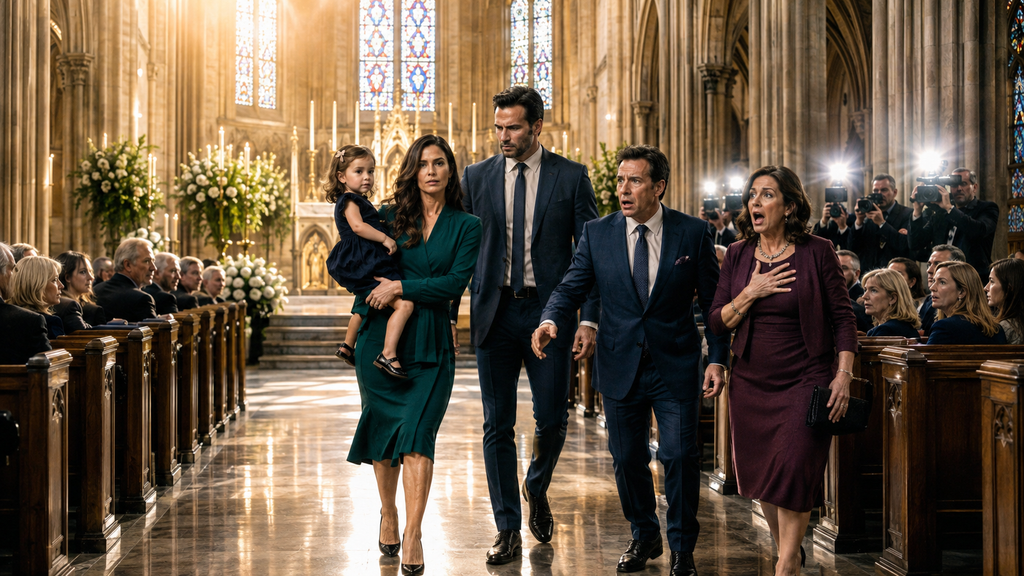
“Mommy!”
Her little voice echoed through the chapel.
“I brought flowers for Grandpa!”
Something inside my chest tightened.
I reached for her immediately, lifting her into my arms and pressing a long kiss against her warm cheek.
Clara wrapped her small arms around my neck and rested her head against my shoulder, still clutching several white lilies between her fingers.
For one brief second, the cruelty of the morning disappeared.
Then I heard Julian.
His breathing had become sharp and uneven.
Almost desperate.
I turned toward him.
His face had gone completely pale.
His eyes darted wildly between Harrison, Clara, and me as though his mind simply could not accept what was standing directly in front of him.
“M-Mr. Sterling…”
Julian’s voice trembled so violently that he barely sounded like the arrogant man who had been mocking me only moments earlier.
“This…”
He swallowed.
“This has to be some kind of mistake.”
Nobody spoke.
Julian pointed toward me with a shaking hand.
“Evelyn is just an ordinary corporate accountant!”
A few people in the chapel exchanged uncomfortable glances.
Julian continued, panic rising in his voice.
“She’s not…”
His eyes widened.
“She can’t possibly be your wife!”
Harrison slowly turned toward him.
The warmth that had been in his expression when he looked at Clara vanished instantly.
What replaced it was something colder.
Controlled.
Powerful.
Unforgiving.
“You are addressing Evelyn Sterling,” Harrison said calmly.
Julian froze.
Harrison took one deliberate step forward.
“My wife.”
The words landed like a hammer.
Vanessa’s mouth fell open.
Several relatives gasped.
But Harrison wasn’t finished.
“Evelyn Sterling is the majority managing partner of the Sterling-Vance Global Fund.”
The silence deepened.
“She is also the chief executive officer and controlling shareholder of her late father’s industrial conglomerate.”
Vanessa made a strangled sound.
Her fingers suddenly tightened around Julian’s arm as if it were the only thing keeping her upright.
“Wait…”
Her voice came out barely above a whisper.
Then her eyes widened with horror.
“Evelyn owns the industrial conglomerate?”
Harrison looked at her.
Vanessa’s face drained of color.
“But…”
She struggled to breathe.
“Our company’s multimillion-dollar distribution agreement was signed with that firm.”
I said nothing.
I simply held Clara closer.
That was when Vanessa finally understood.
The woman she had spent the morning humiliating…
The woman Julian had repeatedly dismissed as insignificant…
The woman they had treated like an embarrassment at her own father’s funeral…
Controlled one of the most important contracts keeping their company alive.
Harrison’s expression did not change.
“Yes,” he said.
One word.
Calm.
Final.
Vanessa stumbled backward half a step.
Julian caught her arm.
Then Harrison continued.
“And that distribution agreement contains a strict executive character, conduct, and ethics clause.”
Julian stopped breathing for a moment.
I watched the realization slowly spread across his face.
Harrison reached inside his suit jacket.
He removed a thin black folder.
Julian stared at it.
His arrogance was gone now.
Completely.
In its place was fear.
Pure fear.
“My wife and I,” Harrison said, “have spent the last seventy-two hours reviewing your company’s internal financial records.”
Julian’s lips parted.
Harrison opened the folder.
“Fraudulent billing.”
Julian flinched.
“Unauthorized diversion of commercial equipment.”
Vanessa covered her mouth.
“Falsified transportation invoices.”
Julian shook his head.
“No…”
Harrison continued as though he hadn’t heard him.
“Undisclosed related-party payments.”
Another page turned.
“And multiple transactions that appear to have been deliberately concealed from your board and business partners.”
Julian’s face collapsed.
The arrogant smirk he had worn only minutes earlier had disappeared so completely that it was almost impossible to believe it had ever been there.
Now he looked terrified.
Not embarrassed.
Not angry.
Terrified.
Because for the first time that morning, Julian finally understood who he had been insulting.
And more importantly…
He understood exactly how much power the woman he had called ordinary actually held over his future.
PART 3 — THE WOMAN THEY THOUGHT HAD NOTHING
Julian’s arrogant smirk was entirely gone.
In its place was something I had never seen on his face before.
Fear.
Real fear.
The kind no expensive suit, rehearsed confidence, or carefully cultivated social status could hide.
His mouth opened, but for several seconds, nothing came out.
Around us, the cathedral remained so quiet that I could hear Clara softly crinkling the paper around the white lilies she had carried inside.
Vanessa clutched Julian’s sleeve.
“What fraudulent billing records?” she whispered.
Harrison’s expression didn’t change.
He reached into the inside pocket of his charcoal jacket and removed a slim black folder.
Julian stared at it as though it were a weapon.
Perhaps to him, it was.
Harrison opened the folder.
“Fourteen months ago,” he said calmly, “Vance Meridian Logistics began billing Evelyn’s manufacturing group for freight routes that were never completed.”
Julian swallowed.
“That’s impossible.”
“No,” Harrison replied. “It was quite possible. You did it repeatedly.”
A murmur spread through the executives standing nearby.
Harrison continued.
“Your company billed for commercial equipment transfers between Pennsylvania, Ohio, and New York. Several shipments were reported as delivered even though the receiving plants had no record of them.”
Julian shook his head rapidly.
“That has to be an accounting mistake.”
I almost laughed.
Seven years earlier, he had told me I was too obsessed with spreadsheets to be a proper wife.
Now he desperately wanted the spreadsheets to be wrong.
They weren’t.
Harrison turned a page.
“Then there are the fuel surcharges charged twice.”
Another page.
“The subcontracting payments made to companies registered to people connected to your board.”
Another.
“And commercial machinery valued at more than eleven million dollars that temporarily disappeared from verified transit records before appearing at privately owned warehouses.”
Vanessa’s face drained of color.
She looked at Julian.
“You told me those warehouses were part of an expansion.”
Julian ignored her.
“Harrison, listen to me.”
His voice cracked.
Not Mr. Sterling anymore.
Harrison.
As if they were equals.
As if familiarity might save him.
Harrison’s eyes hardened.
“You will address me properly.”
Julian lowered his gaze.
“Mr. Sterling.”
I felt Clara move against my shoulder.
She had no understanding of contracts or fraud.
She only knew that she was in a large quiet room filled with sad flowers and unfamiliar people.
Her tiny fingers curled around the collar of my black suit.
“Mommy?”
I immediately turned my attention to her.
“Yes, sweetheart?”
“Can Grandpa smell the flowers?”
My throat tightened.
Everything happening around me disappeared for one painful second.
My father.
The casket.
The lilies.
The years we had lost.
The things we had repaired before it was too late.
I kissed Clara’s forehead.
“I think he would have loved them.”
She smiled.
Then she whispered, “I miss Grandpa.”
My eyes burned.
“So do I.”
Harrison’s hand rested gently at the base of my back.
He knew.
He always knew when I was trying too hard not to break.
He leaned closer.
“You don’t have to handle this now,” he whispered.
I looked toward the casket.
My father had spent the final months of his life telling me the same thing in different ways.
Stop carrying everyone.
Stop believing silence is strength.
Stop confusing survival with peace.
For years, I had assumed walking away from Julian and Vanessa meant I had completely healed.
I hadn’t.
I had rebuilt myself.
That was different.
Healing came later.
Slowly.
Unexpectedly.
With Harrison.
With Clara.
With my father.
With the realization that revenge was not the same thing as justice.
I looked back at Julian.
“No,” I said quietly. “I want this finished.”
Harrison gave a small nod.
That was one of the many reasons I loved him.
He never fought my battles for me unless I asked.
He stood beside me while I fought them myself.
Julian straightened his shoulders.
He seemed to remember that hundreds of important people were watching.
He adjusted his jacket.
“This is completely inappropriate,” he said, trying desperately to regain authority. “We are standing at a funeral.”
I stared at him.
“You approached me.”
He froze.
“You came to my father’s memorial service,” I continued, “walked across a cathedral filled with his friends, employees, and business partners, and decided that humiliating me would entertain you.”
Vanessa looked away.
I stepped closer.
“You wanted an audience, Julian.”
My voice remained calm.
“Now you have one.”
Someone behind him inhaled sharply.
Julian’s face reddened.
“I was joking.”
“No,” I said.
“You were celebrating.”
His eyes flickered.
I remembered that expression.
Seven years ago, I would have interpreted it differently.
I would have wondered whether I had been too sensitive.
Whether I had misunderstood.
Whether I had somehow deserved what he did.
Time gives certain memories sharper edges.
Now I recognized that look for what it was.
Calculation.
He was searching for the correct version of events.
One that made him innocent.
One that made me unreasonable.
One that made everyone forget what they had just witnessed.
Vanessa stepped forward.
“This is ridiculous,” she snapped. “Whatever business problem exists has nothing to do with me.”
I turned toward her.
“No?”
She lifted her chin.
“No.”
“You’re chief financial officer of Vance Meridian.”
Her confidence flickered.
“Only formally.”
Several people nearby exchanged glances.
I almost felt embarrassed for her.
Almost.
“You signed the quarterly certifications,” I said.
She blinked.
“What certifications?”
“The statements confirming that the freight invoices submitted to our companies accurately represented completed commercial services.”
Vanessa’s lips parted.
“I sign hundreds of documents.”
“That is not a defense.”
“I didn’t know.”
“You signed your name underneath a sentence stating that you personally certified the information.”
Julian turned toward her sharply.
“Stop talking.”
Vanessa whipped around.
“Don’t tell me to stop talking!”
“Vanessa.”
“You told me everything had been reviewed!”
“It was.”
“By who?”
“Enough.”
“No!”
Her voice echoed through the cathedral.
Several guests turned fully toward them.
Vanessa lowered her voice, but the panic remained.
“You said the audits were clean.”
Julian’s jaw clenched.
“They were internal audits.”
Harrison looked almost bored.
“Conducted by a consulting company owned by your former college roommate.”
Julian stared at him.
For the first time, even Vanessa seemed to understand the scale of what had been uncovered.
She took a shaky step backward.
Her heel struck the designer handbag she had dropped moments earlier.
She nearly stumbled.
I watched her steady herself against the pew.
Seven years ago, Vanessa had stood inside my bridal suite with my engagement ring on her finger.
She had smiled while telling me that Julian needed a real woman.
I remembered every detail.
The champagne-colored bridesmaid dress she had originally intended to wear.
The perfume.
The way sunlight had reflected off the engagement ring that had been mine only minutes earlier.
The casual cruelty in her voice.
I had wondered how someone raised beneath the same roof as me could enjoy another person’s humiliation so completely.
But grief teaches you strange things.
So does age.
Vanessa had never actually wanted Julian.
Not at first.
She wanted what she believed winning him represented.
Proof that she was more desirable.
More feminine.
More valuable.
More loved.
My stepmother had spent years comparing us.
Vanessa was beautiful.
I was serious.
Vanessa was spontaneous.
I was responsible.
Vanessa attracted attention.
I earned trust.
And somehow, every difference had been turned into a competition I never agreed to enter.
By stealing Julian, she believed she had won the ultimate prize.
The problem with living your life as a competition is that eventually, you have to keep proving you’re ahead.
The jewelry becomes larger.
The vacations become more expensive.
The house has to impress strangers.
The marriage has to appear perfect.
The children have to attend the best schools.
Every photograph becomes evidence.
Every dinner becomes a performance.
Every other woman becomes a threat.
I had stopped competing seven years ago.
Vanessa never had.
Now she looked exhausted.
Not just frightened.
Exhausted.
And for the first time, I saw what her victory had cost her.
Julian pointed at Harrison’s folder.
“You cannot make accusations like this without proof.”
Harrison closed it.
“We already provided the evidence to federal investigators.”
Julian’s face went blank.
Vanessa made a sound somewhere between a gasp and a sob.
“What?”
Harrison didn’t repeat himself.
He didn’t need to.
Julian stared at him.
Then at me.
“You reported us?”
I looked directly into his eyes.
“My legal department reported irregularities uncovered during a contract review.”
“You knew what would happen.”
“Yes.”
“You could have called me.”
“I could have.”
His expression twisted.
“You could have warned me.”
I almost admired the entitlement.
“Why would I warn you?”
“We have history.”
The words hit differently than he intended.
I remembered four years of history.
Four years of supporting him.
Four years of believing him.
Four years of transferring money from my savings when payroll was tight at his startup.
Four years of nights when he came home after midnight and told me investors needed entertaining.
Four years of convincing myself his growing emotional distance was stress.
Four years of making excuses for a man who eventually replaced my name on our wedding program twenty-four hours before I was supposed to walk down the aisle.
“Yes,” I said. “We do.”
His face softened slightly, as if he believed he had found the correct path.
He stepped closer.
“Evelyn, whatever happened between us was years ago.”
“I know.”
“Then you understand.”
“I understand exactly.”
I shifted Clara higher on my hip.
“You taught me something very important.”
Julian waited.
“You taught me that history does not create entitlement.”
His face hardened again.
“You don’t get access to someone forever just because they once loved you.”
Silence.
“You don’t get advance warning because I once trusted you.”
I took another breath.
“And you certainly don’t get immunity from the consequences of your business decisions because seven years ago I almost became your wife.”
A few feet away, one of my father’s oldest board members lowered his head, hiding what looked suspiciously like a smile.
Julian noticed.
His humiliation deepened.
He leaned closer to me.
“This is revenge.”
“No.”
“It obviously is.”
“If I wanted revenge, Julian, I would have gone looking for you years ago.”
“You expect me to believe this is a coincidence?”
“I expect you to understand that your company became a vendor to businesses controlled by my family.”
His mouth opened.
I continued before he could interrupt.
“You spent years telling people that Evelyn Hart disappeared after you left her.”
I smiled faintly.
“The truth is that I became busy.”
That was the simplest version.
I became very busy.
Three months after the canceled wedding, my father suffered his first major health crisis.
Not the illness that eventually killed him.
That came later.
But a cardiac event severe enough to put him in intensive care.
For years, our relationship had been complicated.
My father loved me.
I knew that.
But love alone doesn’t erase mistakes.
After my mother died when I was twelve, he remarried too quickly.
Vanessa’s mother, Celeste, moved into our home with a fourteen-year-old daughter who immediately learned exactly how to earn my father’s sympathy.
Celeste rarely insulted me directly.
She was too intelligent for that.
Instead, she created comparisons.
“Vanessa has such an easy warmth.”
“Evelyn has always been rather intense.”
“Vanessa knows how to enjoy life.”
“Evelyn gets that seriousness from you.”
My father laughed.
Not cruelly.
Carelessly.
That distinction matters to the person laughing.
Not always to the child listening.
I became the dependable daughter.
The one who never caused trouble.
The one who earned scholarships.
The one who joined the company after graduate school.
The one who understood production forecasts, acquisition models, labor negotiations, and debt structures.
Vanessa became the daughter who needed rescuing.
By twenty-five, she had changed careers three times.
By twenty-seven, my father had paid off two of her credit cards.
By twenty-nine, he had bought her an apartment after she announced that renting was “emotionally draining.”
I resented it.
But I rarely said anything.
Being responsible had become my identity.
Then Julian happened.
My father never liked him.
That was another truth I had refused to see.
The day I told my father that Julian had left me for Vanessa, he did not say, “I warned you.”
He sat beside me in his hospital room and cried.
Actually cried.
I had only seen my father cry twice before.
At my mother’s funeral.
And when I graduated from college.
“I failed you,” he whispered.
I didn’t understand.
“Dad—”
“I saw what was happening in this family.”
His voice broke.
“I saw Celeste compare you girls. I saw Vanessa compete with you. And because you were strong, I assumed you could handle it.”
He closed his eyes.
“That was cowardice disguised as confidence in you.”
I remember staring at him.
He reached for my hand.
“I rewarded the child who demanded attention and relied on the child who never asked for it.”
Those words changed something inside me.
Not immediately.
Healing rarely happens in one conversation.
But they opened a door.
When my father recovered, he changed.
Not dramatically.
Not theatrically.
Consistently.
He stopped rescuing Vanessa financially.
He amended company governance.
He placed me on the executive committee.
He insisted that I stop doing invisible work while less qualified men presented my analysis as their own.
And for the first time in my adult life, my father began asking me a question no one in our family had ever asked before.
“What do you want?”
At first, I didn’t know how to answer.
Then I learned.
I wanted independence.
I wanted authority equal to my responsibility.
I wanted to build something that belonged to me.
And eventually, through a joint investment project, I met Harrison Sterling.
Not at a gala.
Not at a private island.
Not through some cinematic accident.
We met because he disagreed with me about freight automation.
Aggressively.
Our first conversation lasted forty-eight minutes.
We spent thirty-five of those minutes arguing.
He thought one of our manufacturing divisions was wasting capital maintaining an outdated distribution network.
I thought his proposal underestimated the labor consequences and regulatory exposure of restructuring too quickly.
He called my model conservative.
I called his projection irresponsible.
He stared at me across the conference table.
I stared back.
Afterward, one of my colleagues whispered, “Do you know who you just argued with?”
Of course I knew.
Everyone knew Harrison Sterling.
His firm controlled investments across technology, transportation, medicine, energy, commercial property, and industrial manufacturing.
Financial magazines estimated his net worth at numbers so ridiculous they hardly sounded real.
But inside that conference room, he was simply a man presenting assumptions I believed were wrong.
Three days later, flowers appeared in my office.
Not roses.
White tulips.
Attached to them was a note.
You were right about the regulatory timeline.
Still wrong about the automation.
Dinner?
I declined.
He sent no second bouquet.
No grand gesture.
No pressure.
At the next meeting, he treated me exactly as professionally as before.
Six weeks later, I asked him to dinner.
When I reminded him of that years afterward, he would grin.
“You made me wait six weeks.”
“You survived.”
“Barely.”
We dated quietly.
Very quietly.
Not because Harrison was ashamed of me.
The opposite.
He understood what it was like to have strangers consume pieces of your private life.
He had spent twenty years watching headlines turn every dinner companion into a potential bride and every disagreement into a corporate war.
I had already lived through one relationship where appearances mattered more than truth.
Neither of us needed another audience.
We married three years later in my father’s garden.
Twenty-eight guests.
No magazines.
No photographers except an old family friend.
My father walked me down a short aisle beneath maple trees.
Halfway to Harrison, he squeezed my hand.
“I’m proud of you.”
I smiled.
“You already said that.”
“I know.”
He swallowed.
“I should have said it more when you were younger.”
I almost cried before reaching the altar.
Clara was born eighteen months later.
My father became unbearable.
In the best possible way.
The man who once scheduled meetings during Christmas Eve because he claimed holidays were inefficient suddenly canceled board calls because Clara wanted to show him how she could stack wooden blocks.
He bought her ridiculous gifts.
I returned half of them.
He bought more.
When she learned to say “Grandpa,” he replayed the video so often that his assistant threatened to hide his phone.
Then the illness came.
Slowly.
Quietly.
Cancer.
We fought it.
My father fought harder than anyone.
For two years, there were treatments.
Remissions.
Setbacks.
Hope.
Bad scans.
Good mornings.
Terrible nights.
And eventually, one afternoon while Harrison was reading financial reports beside the hospital window and Clara was asleep against my chest, my father asked everyone else to leave.
I knew.
You always know.
The room became quiet after Harrison carried Clara into the hallway.
My father looked thinner than I had ever seen him.
His hands trembled.
But his eyes were clear.
“Evelyn.”
“I’m here.”
“There’s something I need you to promise.”
I sat beside him.
“What?”
“Don’t let my death drag you backward.”
I frowned.
He took my hand.
“People will come after the estate.”
“Dad—”
“They will.”
He gave a tired smile.
“I’ve spent fifty years around wealthy people. Death turns grief into arithmetic.”
I looked away.
He squeezed my fingers.
“Vanessa will come.”
My chest tightened.
“She hasn’t visited you in eight months.”
“I know.”
There was no anger in his voice.
That somehow hurt more.
After he stopped financing Vanessa’s lifestyle, she became increasingly distant.
Then, when my father amended his trust years earlier, removing several automatic distributions and converting them into conditional provisions, she had practically disappeared.
She sent birthday messages.
Christmas baskets.
Occasional photographs of her children.
But she rarely came.
My father knew why.
“She’ll believe she deserves half,” he said.
I didn’t answer.
“She doesn’t.”
“Dad.”
“Listen.”
His voice strengthened.
“I have provided generously for her children because they are innocent. Their education is protected. Their medical needs are protected. They will have trusts when they become adults.”
He paused.
“But Vanessa receives no ownership in Hartwell Industrial.”
I stared at him.
Hartwell Industrial had been our family business for three generations.
I had expected control.
Not complete ownership.
My father looked at me.
“You built half of what the company is today.”
“Not half.”
He smiled weakly.
“Still arguing percentages.”
I laughed through tears.
“There she is,” he whispered.
Then his smile faded.
“Evelyn, your mother would be proud.”
That broke me.
I lowered my head against his hand.
For several minutes, neither of us spoke.
Finally, he said, “There’s something else.”
“What?”
“I’m sorry.”
I closed my eyes.
“You already apologized.”
“Not enough.”
“You changed.”
“I tried.”
“That matters more.”
He looked toward the door.
“Harrison loves you.”
“Yes.”
“I was prepared to hate him.”
A wet laugh escaped me.
“I know.”
“I researched him for three months.”
“I also know.”
“He has an irritatingly clean record.”
I laughed harder.
My father smiled.
“And Clara…”
His face softened completely.
“That little girl saved the final years of my life.”
“She loves you.”
“I know.”
He stared at me for a long moment.
Then he whispered, “You got your family, sweetheart.”
I couldn’t speak.
“You spent so many years believing people leaving meant something was wrong with you.”
My tears fell freely now.
My father shook his head.
“It never did.”
Those were among the last coherent words he ever said to me.
Three days later, he died.
And now, standing inside the cathedral where his funeral was being held, listening to Julian accuse me of revenge, all I could think about was my father’s final warning.
Don’t let my death drag you backward.
So I wouldn’t.
Julian pointed toward me.
“You think because you married Harrison Sterling you can destroy people?”
Harrison moved slightly.
I touched his arm.
He stopped.
This answer was mine.
“I did not marry Harrison for power.”
Julian laughed bitterly.
“Of course not.”
I looked at him with something dangerously close to pity.
“That’s the difference between us.”
He frowned.
“You still think everyone chooses relationships the way you do.”
His face darkened.
I continued.
“You chose Vanessa because you believed she made you look successful.”
Vanessa flinched.
“You wanted charm. Beauty. Social access. Someone impressed by everything you said.”
Julian’s eyes narrowed.
“And Vanessa chose you because taking you from me made her feel like she had won.”
“Shut up,” Vanessa whispered.
I turned toward her.
“I’m not insulting you.”
“You’re enjoying this.”
“No.”
I meant it.
There was no joy in that moment.
Satisfaction, perhaps.
Relief.
But not joy.
This was my father’s funeral.
I would have traded every revelation, every contract, every dollar, and every moment of their humiliation for one more afternoon with him.
“I wish none of this were happening today,” I said.
Vanessa scoffed.
“Then stop it.”
“You started it.”
“I came to my stepfather’s funeral.”
“You came to ask about his estate.”
Her eyes widened.
That landed.
Several guests looked toward her.
Vanessa shook her head.
“That isn’t true.”
“You called his attorney four hours after his death.”
Her lips parted.
Julian looked at her.
“You did what?”
She ignored him.
“How do you know that?”
“Because Martin told me.”
My father’s attorney, Martin Ellis, stood three pews away.
He stepped forward.
Seventy years old.
Silver hair.
Dark suit.
The same leather briefcase he had carried for as long as I could remember.
Vanessa stared at him.
Martin’s expression was polite.
“I informed Mrs. Sterling because she is executor of your stepfather’s estate.”
Vanessa’s eyes widened.
“Executor?”
“Yes.”
“But I’m family.”
“So is she.”
“I’m his daughter.”
“Stepdaughter,” Martin corrected.
Vanessa visibly recoiled.
For years, she had insisted no distinction existed when it benefited her.
Now the legal distinction mattered.
Martin continued.
“Your children are beneficiaries of protected educational trusts established by Mr. Hartwell.”
Vanessa’s voice dropped.
“And me?”
Martin glanced at me.
Then back at her.
“Your inheritance will be formally explained at the reading.”
“When?”
“Tomorrow.”
“I want to know now.”
“This is neither the place nor the time.”
Vanessa’s breathing quickened.
“You already told Evelyn.”
“She is executor.”
“That’s favoritism.”
Martin’s eyebrows lifted.
I almost smiled.
Even at thirty-nine, Vanessa could turn inheritance law into sibling rivalry.
Julian grabbed her elbow.
“We’re leaving.”
She jerked away.
“No.”
His voice dropped.
“We need lawyers.”
“Why?”
He stared at her.
“Vanessa.”
She looked around.
For the first time, perhaps she truly saw the room.
The executives.
The board members.
The attorneys.
The cameras outside.
The people who had spent years greeting Julian because he was useful.
The people now studying him as a liability.
Her gaze returned to Harrison.
“You’re canceling our contract?”
Harrison answered calmly.
“The contract was suspended this morning pending investigation.”
Julian closed his eyes.
That single sentence did what all the accusations hadn’t.
It destroyed whatever denial remained.
Vance Meridian relied heavily on our distribution network.
Without our contracts, they could survive.
Perhaps.
Without Harrison’s conglomerate’s newly acquired shipping divisions?
Probably not.
Especially once lenders learned about the investigation.
Julian opened his eyes.
“You can’t suspend without notice.”
“Our agreement allows immediate suspension when documented fraud threatens regulated shipments.”
“You planned this.”
“The investigation began six weeks ago.”
Julian looked at me.
My expression must have told him something.
His face changed.
“Six weeks?”
“Yes.”
“You knew before your father died?”
“Yes.”
“And you never contacted me.”
“No.”
He actually looked wounded.
The absurdity of it almost took my breath away.
“You really hate me that much.”
I shook my head.
“No, Julian.”
And finally, I said the sentence I should have understood seven years earlier.
“I don’t hate you at all.”
His face went still.
“Hating you would require far more space in my life than you occupy.”
No one spoke.
His eyes flickered.
I continued softly.
“For years, you probably imagined I was somewhere mourning the life you took from me.”
His jaw tightened.
“But you didn’t take my life.”
I looked at Harrison.
Then at Clara.
“You removed yourself from it.”
My daughter smiled at me without understanding.
My heart softened.
“I survived.”
I looked at Julian again.
“Then I built something better.”
He seemed physically smaller somehow.
Seven years ago, his approval had felt enormous.
Now I couldn’t understand how I had ever allowed one man’s opinion to determine my worth.
Vanessa bent down suddenly, grabbing her handbag.
Her hands shook so badly that she fumbled with the clasp.
She pulled out her phone.
“Who are you calling?” Julian demanded.
“Our attorney.”
“Not here.”
She ignored him.
“Vanessa.”
“Don’t tell me what to do!”
Her voice cracked.
One of the cathedral ushers stepped closer.
Harrison’s security officers remained still.
They didn’t need to move.
Julian lowered his voice.
“We are leaving.”
“I need to know what’s happening.”
“So do I.”
“You said the company was fine.”
“It is.”
“Then why are you panicking?”
“I’m not panicking.”
“You look like you’re going to faint!”
“Both of you.”
My voice stopped them.
They turned.
“This is my father’s funeral.”
The anger came then.
Not loud.
Not uncontrolled.
Something deeper.
“You have already taken enough from today.”
Vanessa’s expression shifted.
For one second, I saw the girl she had once been.
Fourteen years old.
Nervous inside a new house.
Desperate for belonging.
Before comparison turned us into opponents.
Before adulthood hardened our insecurities into weapons.
I wondered what would have happened if our parents had handled things differently.
If Celeste had encouraged us to become sisters instead of measuring us against each other.
If my father had noticed sooner.
If I had confronted Vanessa years before resentment became permanent.
Maybe nothing would have changed.
Maybe everything would have.
But some alternate version of our childhood no longer mattered.
We were grown women.
Our choices belonged to us now.
Vanessa looked toward my father’s casket.
Her face changed.
“I did care about him,” she whispered.
I said nothing.
“I know you don’t believe me.”
“I believe you cared about him.”
Her eyes met mine.
“I also believe you punished him when he stopped giving you money.”
She flinched.
“That’s unfair.”
“Is it?”
“You don’t know what happened.”
“He called you.”
“I was busy.”
“For eight months?”
Tears gathered in her eyes.
“Evelyn—”
“He asked to see the children.”
Her lower lip trembled.
I hadn’t planned to say this.
But grief had stripped away my interest in protecting people from truths they had created themselves.
“He asked me whether he had done something wrong.”
Vanessa stared at me.
“He thought your children were angry with him.”
Her face crumpled.
I continued.
“He didn’t understand why you stopped bringing them.”
“I…”
“You were angry about the trust.”
“I was angry because he treated me like I was irresponsible.”
“You were irresponsible.”
Vanessa’s tears spilled.
“You always thought you were better than me.”
“No.”
“Yes!”
Her voice rose.
“You always walked around like you were smarter.”
“I was quiet.”
“You judged me.”
“I envied you.”
That stopped her.
Vanessa blinked.
“What?”
“When we were younger, I envied you.”
She stared.
I smiled sadly.
“You could walk into a room and people noticed.”
Her lips parted.
“You made friends easily. Dad forgave you quickly. Your mother defended everything you did.”
I looked down.
“I thought life was easier for you.”
Vanessa whispered, “It was easier for you.”
A strange silence settled between us.
Maybe that had always been the tragedy.
Each of us believed the other had received the better life.
“You were brilliant,” she said bitterly.
“Dad trusted you with everything.”
“Because I never gave him another choice.”
“You got the company.”
“I worked there for seventeen years.”
“You got Harrison Sterling.”
“Harrison is not a prize I won.”
Her face twisted.
“You know what I mean.”
“No, Vanessa. I don’t.”
My voice softened.
“And that thinking is exactly what destroyed us.”
She looked at me.
“You saw Julian as something to win.”
Her eyes dropped.
“You saw Dad’s money as proof of who he loved more.”
I swallowed.
“And maybe I saw being needed as proof that I mattered.”
Neither of us moved.
For the first time in years, the hostility between us felt tired.
Old.
Smaller than the grief surrounding us.
Vanessa wiped one tear angrily from her cheek.
“I didn’t know he asked for the kids.”
“Yes, you did.”
Her face collapsed.
There it was.
Truth.
She knew.
She had ignored him.
She covered her mouth.
“I thought…”
She couldn’t finish.
I knew what she had thought.
There would be more time.
There is always supposed to be more time.
Until there isn’t.
Vanessa turned toward the casket.
Her shoulders shook.
Julian looked uncomfortable.
Not grieving.
Annoyed.
He touched her arm.
“Vanessa, we need to leave.”
She pulled away.
“I want to say goodbye.”
“We have serious things to handle.”
She looked at him.
“My father just died.”
“Stepfather.”
The word left Julian’s mouth carelessly.
Vanessa froze.
He realized his mistake immediately.
“Vanessa, I didn’t mean—”
She slapped him.
The sound cracked through the cathedral.
Several people gasped.
Julian staggered sideways.
His face turned bright red.
“Have you lost your mind?”
Vanessa stared at him.
Something in her expression had shattered.
“No.”
Her voice trembled.
“I think I finally found it.”
Julian looked around, humiliated.
“Not here.”
“You slept with me while you were engaged to my sister.”
My stomach tightened.
He stared at her.
“Vanessa.”
“You told me she was cold.”
“Stop.”
“You told me she cared more about money than people.”
“Enough.”
“You told me you loved me.”
“I did.”
“Did?”
The word hung there.
Julian went silent.
Vanessa laughed once.
A terrible, broken sound.
“That’s what I thought.”
She wiped her face.
“I spent seven years proving I was happier than her.”
Her gaze came to me.
“I bought things we couldn’t afford because I wanted her to hear about them.”
Julian hissed, “Shut up.”
“I posted every vacation.”
“Vanessa.”
“I made sure mutual friends knew about every anniversary gift.”
Her tears came faster.
“And she wasn’t even watching.”
I didn’t answer.
Because it was true.
I hadn’t followed her accounts.
I hadn’t asked mutual friends for updates.
I hadn’t checked photographs.
After the first year, I barely knew where they lived.
Vanessa laughed again.
“All that time…”
She looked at Harrison.
At Clara.
Then at me.
“You weren’t losing.”
“No one was playing except you.”
Her eyes closed.
That sentence seemed to hurt more than anything else.
Julian grabbed her arm harder.
“We’re leaving now.”
She pulled free.
“Don’t touch me.”
“We need to handle the company.”
“You handle it.”
“You’re CFO.”
“You just told me to stop talking because apparently I know nothing about my own job.”
He lowered his voice.
“Think carefully.”
“No.”
“You signed documents.”
Vanessa stared.
Something changed in her face.
“What are you saying?”
Julian didn’t answer.
She stepped closer.
“What are you saying?”
His silence answered for him.
Vanessa’s expression turned from grief to terror.
“You’re going to blame me.”
“Don’t be ridiculous.”
“Oh my God.”
“I said don’t be ridiculous.”
“You put things in front of me to sign.”
“You were CFO.”
“You told me they were routine.”
“You should have read them.”
Her entire body went still.
Julian realized what he had just admitted.
Harrison’s expression sharpened.
So did mine.
Vanessa whispered, “You knew.”
Julian said nothing.
“You knew something was wrong.”
“Vanessa—”
“You knew.”
“This is not the place.”
She laughed bitterly.
“You keep saying that because you don’t want witnesses.”
“Lower your voice.”
“No.”
She stepped away.
“For seven years, I defended you.”
Julian rolled his eyes.
“Not now.”
“I defended you to everyone.”
“Congratulations.”
She stared at him.
There are moments when a marriage doesn’t end with papers.
It ends with recognition.
I watched recognition enter Vanessa’s eyes.
She finally saw Julian without the competition.
Without the wedding photograph.
Without the house.
Without the diamond.
Without the story she had spent years telling herself.
And apparently, she did not like what remained.
She looked down at the five-carat ring on her hand.
The same hand that had worn mine seven years earlier.
Slowly, Vanessa twisted it off.
Julian’s eyes narrowed.
“What are you doing?”
She stared at the diamond.
Then at him.
“I thought this meant I won.”
I felt something ache inside me.
Vanessa placed the ring in Julian’s palm.
“No.”
She closed his fingers around it.
“It just meant I married you.”
Then she walked toward my father’s casket.
Alone.
Julian stood in the aisle holding the ring.
Nobody moved to comfort him.
Finally, he looked at Harrison.
“If you destroy my company, thousands of people lose jobs.”
Harrison’s expression remained calm.
“A responsible executive would have considered those employees before committing fraud.”
“I didn’t steal anything.”
“Then investigators will establish that.”
“You’ve already decided I’m guilty.”
“I reviewed evidence.”
“You want the company.”
Harrison gave a faint, humorless smile.
“If I wanted your company, Mr. Vance, I could have purchased it when it was worth something.”
Julian flinched.
Even I almost winced.
Harrison continued.
“Our concern is preserving legitimate freight operations while separating them from whatever misconduct occurred in your executive office.”
“What does that mean?”
“It means my group is prepared to support continuity arrangements for your drivers, warehouse staff, dispatchers, and other nonexecutive employees if Vance Meridian becomes insolvent.”
Julian stared at him.
“You’re taking my company.”
“No.”
Harrison’s voice remained even.
“Your employees are not responsible for your decisions.”
For the first time, a hint of anger entered his expression.
“I will not allow working families to lose paychecks simply because men in expensive offices believed rules were optional.”
Julian went pale.
That was the difference between power and cruelty.
Cruelty destroys everyone to punish one person.
Power knows where to stop.
Julian looked at me.
“Tell him not to do this.”
“No.”
“Evelyn.”
“You wanted me out of your life seven years ago.”
His jaw tightened.
“I’m respecting your decision.”
Then I turned away.
Not dramatically.
Not to make a point.
Because my daughter was getting sleepy.
Because my husband was beside me.
Because my father was dead.
Because there were people in that cathedral I actually loved.
And Julian Vance had already received more of my attention than he deserved.
The memorial began twenty minutes later.
Julian left before the first hymn.
Vanessa stayed.
She sat alone in the last row.
I saw her only once during the service.
When my father’s photograph appeared on the screen above the altar, she covered her mouth and cried.
I didn’t go to her.
Neither did I ask her to leave.
Some grief has to happen privately, even inside a crowded room.
Clara sat between Harrison and me.
She lasted eleven minutes before becoming restless.
Then she climbed into Harrison’s lap and began quietly playing with his cuff links.
My father would have laughed.
I delivered the eulogy.
I had written six pages.
I used none of them.
Standing at the lectern, I looked at my father’s casket and forgot every prepared sentence.
So I told the truth.
“My father believed everything could be solved with work.”
A soft laugh moved through the cathedral.
“He worked constantly. He expected everyone around him to work constantly. And for most of my childhood, I thought his office was another member of our family.”
More laughter.
I smiled through tears.
“But toward the end of his life, he learned something that I wish neither of us had taken so long to understand.”
I looked at Clara.
“Time is not something we earn later.”
The cathedral grew still.
“We tell ourselves we will visit when business slows down.”
My voice faltered.
“We will apologize when anger fades.”
“We will call tomorrow.”
“We will forgive next year.”
“We will say what matters when the moment is better.”
I looked down.
“My father and I lost years that way.”
Silence.
“But we were lucky.”
I swallowed.
“We found our way back before there were no days left.”
My eyes found Vanessa in the back row.
She was crying openly.
I didn’t look away.
“So if my father could leave one final lesson behind, I think it would be this.”
I gripped the lectern.
“Do not confuse having more time with being promised more time.”
Somewhere near the front, my father’s longtime assistant began crying.
I continued.
“He was not a perfect man.”
My voice softened.
“He made mistakes.”
“I made mistakes.”
“But toward the end, we stopped keeping score.”
I smiled through my tears.
“And that gave me back my father.”
When I returned to my seat, Harrison stood.
He pulled me against his chest.
I buried my face there for only a moment.
Just enough.
Then Clara reached for me.
“Mommy sad?”
“Yes.”
She touched my cheek with both hands.
“Grandpa loves you.”
A sob escaped me.
Children sometimes say ordinary things at exactly the wrong moment.
Or exactly the right one.
I kissed her tiny palm.
“I know.”
The next morning, my father’s will was read at Martin Ellis’s law office overlooking Central Park.
I almost canceled.
I had slept less than three hours.
But my father had wanted everything handled promptly.
So at ten o’clock, Harrison and I entered the conference room together.
Vanessa was already there.
She looked completely different from the woman who had entered the cathedral the day before.
No dramatic jewelry.
No designer handbag.
No full makeup.
She wore a plain black dress and looked as though she hadn’t slept either.
Julian was not with her.
Instead, an attorney sat beside her.
Martin looked at me.
“Shall we begin?”
I nodded.
The will itself was straightforward.
My father left charitable donations to several medical foundations.
Bonuses and retirement grants to longtime employees.
Personal gifts to friends.
His home in Connecticut went into a family trust.
His antique car collection was donated to a museum, except for one old Jaguar he left to Harrison.
Harrison actually blinked at that.
I smiled.
My father had loved that car almost as much as he loved arguing with Harrison.
Then Martin reached the company.
“To my daughter, Evelyn Hartwell Sterling, I leave all voting shares and remaining beneficial ownership of Hartwell Industrial Group not previously transferred into the Sterling-Hartwell Family Partnership.”
Vanessa stared at the table.
I already knew.
Still, hearing it aloud felt heavy.
This was not winning.
It was responsibility.
My father had spent fifty years building that company.
Thousands of employees depended on decisions I would now make.
Martin continued.
“To Vanessa Caldwell Vance, I leave the sum of two hundred and fifty thousand dollars.”
Vanessa’s attorney shifted.
Vanessa didn’t.
There was a condition.
Of course there was.
“The funds shall not be distributed directly, but held within a temporary trust subject to satisfaction of outstanding obligations owed to me.”
Vanessa finally looked up.
“What obligations?”
Martin opened another document.
“Your stepfather maintained records of personal loans issued to you over fourteen years.”
Her face turned pale.
“Loans?”
“Yes.”
“They were gifts.”
“Some were. Others were documented as loans.”
“How much?”
Martin paused.
“Approximately one million eight hundred and seventy thousand dollars.”
Vanessa laughed.
Not because anything was funny.
“That’s impossible.”
Martin slid a file toward her attorney.
“Supporting records are included.”
Her attorney opened it.
Vanessa stared.
“The apartment?”
“Loan.”
“The money for Julian’s first expansion?”
“Loan.”
“My credit cards?”
“Some payments were gifts. Others were loans.”
“The Hamptons house deposit?”
Martin nodded.
Vanessa closed her eyes.
“What happens?”
“The two-hundred-and-fifty-thousand-dollar inheritance is offset against the outstanding balance.”
“So I get nothing?”
“You remain indebted to the estate.”
Her face went white.
Her attorney leaned closer, whispering something.
I already knew what Martin was about to say.
My father had not intended to collect the remaining debt.
Not exactly.
Martin continued.
“However, Mr. Hartwell included a forgiveness provision.”
Vanessa looked up sharply.
“What?”
“If you permanently waive any contest against the will, the remaining personal debt owed to the estate will be forgiven.”
She stared at him.
Her attorney stopped writing.
Martin folded his hands.
“Your stepfather anticipated that litigation could damage Hartwell Industrial, reduce employee confidence, and create years of unnecessary family conflict.”
Vanessa’s lips trembled.
“So he bribed me not to contest.”
“No.”
Martin’s voice was surprisingly gentle.
“He gave you a way to walk away debt-free.”
She looked at me.
I didn’t speak.
Her eyes filled.
“He knew I would fight.”
Martin was silent for a moment.
Then he said, “He hoped you wouldn’t.”
That hurt her.
I saw it.
Martin opened a final folder.
“There are also trusts for your children.”
Vanessa straightened.
“What trusts?”
“Each child has an educational and medical trust valued at three million dollars.”
Her mouth fell open.
“Each?”
“Yes.”
Her eyes immediately filled with tears.
Martin continued.
“The funds cannot be accessed by either parent except for approved expenses related directly to the beneficiaries.”
Vanessa nodded slowly.
“College?”
“Covered.”
“Medical care?”
“Covered.”
“Graduate school?”
“Within reasonable limits.”
She covered her face.
I looked away.
My father had been angry.
Disappointed.
But he had never punished the children.
Martin slid a sealed envelope across the table.
“This is for you.”
Vanessa stared at it.
“What is it?”
“A letter.”
“From him?”
“Yes.”
She reached for it slowly.
Her hands trembled.
“Do I read it here?”
“That is your choice.”
Vanessa held the envelope against her chest.
Then she looked toward me.
“Did you know?”
“About the trusts?”
“Yes.”
“Yes.”
“And you didn’t try to stop them?”
I frowned.
“They’re your children.”
Something in her face broke again.
She stared down.
“I thought you hated me.”
“I hated what you did.”
She looked up.
“That’s different.”
Vanessa whispered, “Is it?”
“Yes.”
I meant that too.
Hatred simplifies people.
Life rarely does.
Vanessa had betrayed me.
Mocked me.
Competed with me.
Abandoned my father when he needed her.
Those things were true.
She was also a woman who had spent much of her life confusing attention with love and money with security.
Understanding that did not erase responsibility.
But responsibility didn’t require hatred.
The conference room door suddenly opened.
Julian walked in.
His attorney followed.
Martin stood.
“This is a private estate meeting.”
“I’m Vanessa’s husband.”
Vanessa’s entire body stiffened.
Her attorney spoke.
“My client did not authorize Mr. Vance to attend.”
Julian stared at her.
“Your client?”
Vanessa didn’t look at him.
Julian laughed.
“This is unbelievable.”
Martin remained calm.
“You need to leave.”
“No.”
Harrison stood.
Julian stopped.
For a moment, neither man spoke.
Then Harrison said quietly, “You heard him.”
Julian’s anger broke through.
“My company is collapsing.”
Harrison’s gaze remained flat.
“That sounds like a matter for your attorneys.”
“Our lenders froze two credit facilities this morning.”
“Again, a matter for your attorneys.”
“Three clients suspended contracts.”
“You should probably speak to your attorneys.”
Julian’s face reddened.
“You caused this.”
“No.”
Harrison stepped closer.
“Your records caused this.”
Julian looked at me.
“You’re enjoying it.”
I was too tired for this.
“My father’s will is being read.”
“I don’t care about the will.”
Vanessa turned.
“I do.”
Julian stared at her.
She placed the sealed letter on the table.
“My father left something for my children.”
“Good.”
Her expression changed.
That one careless word exposed everything.
Good.
Not relief.
Not gratitude.
Not curiosity.
Good.
As though the trusts were assets he could calculate.
Vanessa’s voice grew cold.
“You’re not touching it.”
Julian frowned.
“What?”
“The children’s trusts.”
“I never said—”
“You were about to ask how much.”
He hesitated.
Too long.
Vanessa laughed sadly.
“I know you.”
“You’re being emotional.”
“My father died yesterday.”
“Your stepfather.”
Everyone went silent.
Again.
Julian apparently learned nothing.
Vanessa stood.
“My attorney filed divorce papers this morning.”
Julian’s face went blank.
I stared at her.
Even Harrison looked mildly surprised.
Julian laughed.
“You’re joking.”
“No.”
“You can’t divorce me now.”
Vanessa’s eyebrows lifted.
“Watch me.”
“We are in the middle of a federal investigation.”
“Yes.”
“You’re CFO.”
“Yes.”
“You think leaving changes anything?”
“No.”
She picked up the folder of loan documents.
“But I am done protecting you.”
Julian’s expression changed.
“What does that mean?”
Vanessa looked at her attorney.
“My client has voluntarily arranged an interview with investigators,” the attorney said.
Julian took a step backward.
“You did what?”
Vanessa finally faced him completely.
“I’m going to tell them everything.”
“You don’t know anything.”
“Then you have nothing to worry about.”
“You signed documents.”
“I know.”
“You participated.”
“I signed what you gave me.”
“You benefited.”
“So did you.”
His voice dropped.
“Think about our children.”
“I am.”
“Think about what happens to them if their parents go to prison.”
Vanessa flinched.
Her attorney intervened.
“That’s enough.”
Julian ignored him.
“You’re going to destroy this family because Evelyn embarrassed you at a funeral?”
Vanessa stared at him.
“No.”
Her voice was quiet.
“You destroyed this family years ago.”
He laughed bitterly.
“Oh, don’t pretend you’re innocent.”
“I’m not.”
That stopped him.
Vanessa’s shoulders dropped.
“I slept with my sister’s fiancé.”
Her eyes came to me.
“I humiliated her.”
She swallowed.
“I married a man I knew could betray someone who loved him because I was arrogant enough to believe he would never do the same thing to me.”
Julian’s jaw tightened.
Vanessa continued.
“I helped spend money I should have questioned.”
“I signed documents I should have read.”
“I ignored my father because I was angry.”
Her voice broke.
“I have done plenty.”
She wiped her eyes.
“But I’m done lying about it.”
Julian looked around.
He had no argument against someone who had stopped defending herself.
He pointed at me.
“She’s manipulating you.”
Vanessa looked almost amused.
“Evelyn hasn’t spoken to me privately in seven years.”
“She wants you against me.”
“No.”
Vanessa shook her head.
“She doesn’t care enough about you to want that.”
Julian looked as though she had slapped him again.
I almost felt sorry for him.
Almost.
Martin opened the conference room door.
“Mr. Vance.”
Julian stood still.
Harrison didn’t move.
Finally, Julian looked at Vanessa.
“You come home tonight, or don’t come home at all.”
She stared at him.
“You still think that scares me.”
Then she sat back down.
Julian left.
The door closed behind him.
No one spoke for several seconds.
Then Vanessa opened my father’s letter.
She read silently.
Her face crumpled after the second paragraph.
By the end, tears were dripping onto the paper.
She pressed the letter to her chest.
I wanted to know what he had written.
I didn’t ask.
That belonged to them.
After the meeting, Vanessa approached me near the elevator.
Harrison had stepped away to answer a call.
We stood alone.
She looked exhausted.
“I’m going to cooperate with investigators.”
“I heard.”
“My attorney thinks I might still face charges.”
I nodded.
“If I broke the law, I’ll deal with it.”
I studied her.
Seven years ago, she would have blamed everyone else.
Maybe losing everything had finally left her with nowhere to hide.
She looked down.
“I read Dad’s letter.”
I waited.
“He said he forgave me.”
Her voice broke.
“He said he hoped one day I would forgive myself enough to stop proving things to people.”
I closed my eyes briefly.
That sounded exactly like him.
Vanessa looked at me.
“He apologized for comparing us.”
“I’m glad.”
“He said you never asked him to cut me out.”
“I hadn’t.”
“I thought you did.”
“I know.”
She swallowed.
“I hated you for years for things you never did.”
“Yes.”
No comforting lie.
No easy forgiveness.
She deserved honesty.
Vanessa nodded.
“I’m sorry.”
The words were quiet.
Simple.
No justification followed.
She looked at me.
“I know saying it doesn’t fix anything.”
“No.”
“I know we’ll probably never be sisters.”
I thought about that.
“I don’t know what we’ll be.”
Her eyes filled again.
“But I don’t want to hate you anymore.”
I exhaled.
“I stopped hating you years ago.”
She gave a broken smile.
“Of course you did.”
The elevator arrived.
She stepped inside.
Then turned.
“Evelyn?”
“Yes?”
“The day before your wedding…”
My chest tightened.
She swallowed.
“I knew you had paid Julian’s rent when he started the company.”
I said nothing.
“I knew you cashed out investments to help him.”
She looked ashamed.
“I knew he was still sleeping with you when he started seeing me.”
My stomach turned.
Not because the information was new.
I had eventually guessed most of it.
But hearing it confirmed reopened an old scar.
Vanessa continued.
“I told myself he loved me more.”
Her voice shook.
“But really, I think I needed him to choose me in front of you.”
I nodded once.
“I know.”
“I’m sorry.”
The elevator doors started closing.
Before they did, I said, “I believe you.”
Her eyes widened.
Then the doors shut.
Forgiveness did not arrive that day.
But something else did.
The possibility of it.
The Vance Meridian investigation became public forty-eight hours later.
It happened exactly the way corporate disasters always happen.
Slowly for months.
Then all at once.
A financial newspaper published an article reporting suspicious freight billing and a federal inquiry.
Within hours, two lenders demanded clarification.
A major insurance carrier suspended coverage on certain shipments.
Three board members resigned.
By evening, Vance Meridian’s bonds had collapsed.
The next morning, reporters were outside Julian’s headquarters.
Harrison and I refused every interview.
This wasn’t entertainment.
There were employees involved.
Families.
Drivers.
Warehouse workers.
Dispatch teams.
People who had nothing to do with executive fraud.
Our companies created an emergency operational agreement allowing legitimate freight routes to continue under independent oversight.
Within two weeks, nearly eighty percent of nonexecutive employees had transitioned into protected contracts.
Julian called me eleven times.
I answered none.
He emailed.
I forwarded every message to counsel.
Then he did something desperate.
He came to our home.
Not the Manhattan penthouse newspapers associated with Harrison.
Our actual home.
A quieter property north of the city.
Clara was in the backyard drawing chalk circles on the stone terrace when security called.
“Mrs. Sterling, Julian Vance is at the main gate.”
My entire body went cold.
Harrison was in London.
For half a second, the old instinct returned.
Fear.
Then anger.
“What does he want?”
“He says he needs ten minutes.”
“No.”
There was a pause.
“He says it concerns Ms. Vance.”
Vanessa.
I looked toward Clara.
She was wearing yellow rain boots even though the sun was shining.
My daughter had recently decided all outdoor activities required boots.
I smiled despite myself.
“Tell him communication goes through counsel.”
“Yes, ma’am.”
I ended the call.
Three minutes later, my phone rang again.
A number I didn’t recognize.
I answered.
“Hello?”
“Evelyn.”
Julian.
I almost hung up.
“Do not call this number again.”
“Please.”
The word surprised me.
Julian never said please.
Not unless he wanted something.
“You have thirty seconds.”
“Vanessa gave investigators everything.”
“That was her decision.”
“She had files.”
“Yes.”
“She kept emails.”
“Yes.”
“She recorded me.”
I frowned.
“That’s between you and your attorneys.”
“They’re building a case.”
“I assume that is what investigators do.”
“Evelyn.”
His voice cracked.
“I could go to prison.”
I looked at my daughter.
She was crouched near a flower bed now, intensely studying a ladybug.
Seven years ago, hearing fear in Julian’s voice would have destroyed me.
Now I felt strangely detached.
“You should speak to your lawyer.”
“I need you to tell them you don’t want charges.”
“That is not how federal investigations work.”
“You started this.”
“No.”
“Your audit started it.”
“Your conduct started it.”
He went silent.
Then something ugly entered his voice.
“You think you’re better than me.”
I sighed.
“Goodbye, Julian.”
“Wait.”
I should have ended the call.
Instead, I waited.
His next words came quietly.
“Were you ever actually hurt?”
I frowned.
“What?”
“When I left.”
I almost laughed.
“What kind of question is that?”
“You walked away like you didn’t care.”
My chest tightened.
So that was it.
After seven years, Julian still needed to know whether he had mattered.
Whether he had broken me.
Perhaps that was the final piece of power he believed he owned.
“Yes,” I said.
He went silent.
“I was devastated.”
My voice remained calm.
“I couldn’t eat properly for weeks.”
“I barely slept.”
“I canceled meetings because I would start crying in elevators.”
“I packed my wedding dress into a box and couldn’t open the closet where I stored it for almost a year.”
Julian said nothing.
I continued.
“I questioned everything about myself.”
“Was I too serious?”
“Too ambitious?”
“Too cold?”
“Had I failed as a woman because you wanted someone else?”
My eyes burned.
“That is what you did to me.”
His breathing changed.
“For months, I believed your betrayal proved something about my worth.”
I wiped one tear from my cheek.
“Then eventually, I realized it proved something about your character.”
Silence.
“And once I understood that, I started getting better.”
He whispered, “I did love you.”
“No.”
He inhaled sharply.
“You don’t get to rewrite that.”
“I’m not.”
“You loved what I did for you.”
“That’s not true.”
“I made your life easier.”
“You believed in me.”
“Yes.”
“I believed you were someone you were not.”
“That doesn’t mean I never loved you.”
Maybe he was right.
Maybe in his own limited way, Julian had loved me.
But by then, the distinction no longer mattered.
“Perhaps you did.”
He was silent.
I continued.
“But love that requires betrayal, humiliation, and deception is not a love I want.”
Then Julian said something I never expected.
“I’m sorry.”
My hand tightened around the phone.
Seven years too late.
At the wrong moment.
Motivated by consequences.
Still, the words existed.
“I’m sorry for how I did it.”
I looked at Clara.
She had spotted me watching and was waving wildly.
I waved back.
Julian continued.
“I was insecure around you.”
I blinked.
“You were smarter than me.”
“That’s not—”
“You were.”
He laughed bitterly.
“You understood business better.”
“You had your father’s respect.”
“You never needed people to tell you that you belonged in a room.”
He paused.
“Vanessa made me feel impressive.”
The honesty startled me.
“She laughed at my jokes.”
“She told me every idea was brilliant.”
“She looked at me like I was already the man I wanted people to think I was.”
I said nothing.
“You looked at the numbers.”
“Yes.”
“You told me when something was stupid.”
“Also yes.”
A small laugh came through the phone.
For one strange second, I remembered the young man I had loved.
Before ambition curdled into arrogance.
Before admiration became more important than integrity.
Before we destroyed whatever good had existed between us.
Julian sighed.
“I convinced myself you didn’t respect me.”
“I did.”
“I know that now.”
His voice became quieter.
“You respected me enough to tell me the truth.”
There was nothing I could say.
“I’m sorry, Evelyn.”
I closed my eyes.
Then I gave him the only thing I was willing to give.
“I accept your apology.”
His breathing stopped for half a second.
“But I cannot help you avoid the consequences.”
“I know.”
“I will not interfere with investigators.”
“I know.”
“And you cannot come to my home.”
“I understand.”
I almost ended the call.
Then Julian whispered, “Are you happy?”
I looked through the glass doors.
Clara was pressing both palms against the window now, leaving tiny prints.
I smiled.
“Yes.”
There was a long silence.
“Good.”
For the first time, I believed he meant it.
Then the line went dead.
I never spoke to Julian privately again.
Eight months later, Julian Vance pleaded guilty to conspiracy to commit wire fraud, falsification of commercial records, and several related financial crimes.
The government never accused him of stealing every dollar initially suspected.
The final case was narrower.
More precise.
But devastating enough.
He received a federal prison sentence.
Several executives received lesser sentences or probation.
Vanessa avoided prison.
Her cooperation mattered.
So did evidence showing that while she had recklessly signed certifications, Julian and two other executives had intentionally concealed key information from her.
She pleaded guilty to a misdemeanor reporting offense, paid a substantial fine, resigned from corporate management, and completed hundreds of hours of community service.
For the first time since she was twenty-two, Vanessa had no luxury job title.
No wealthy husband.
No father financing mistakes.
No five-carat ring.
She rented a modest townhouse in Westchester.
Her children remained in the same schools because my father’s trust covered their tuition.
At first, I heard about her through Martin.
Then through my nephews.
Then, eventually, directly.
One afternoon, nearly a year after my father’s funeral, I received a message.
Can Clara come to Noah’s birthday party?
I stared at it for several minutes.
Harrison found me sitting in the kitchen.
He kissed the top of my head.
“What happened?”
I handed him the phone.
He read it.
Then placed it back down.
“What do you want to do?”
“I don’t know.”
“Then don’t decide because you think you should.”
I looked at him.
“What would you do?”
He pulled out the chair opposite me.
“This isn’t my wound.”
That was another Harrison answer.
Never controlling.
Never evasive.
Just respectful.
I looked at the message again.
My nephew Noah was turning nine.
He had done nothing wrong.
Neither had his younger sister, Sophie.
My father had loved them.
I typed slowly.
Yes. What time?
Vanessa responded almost immediately.
Thank you.
Then another message came.
You can stay too.
No pressure.
I smiled faintly.
We went.
The party was at a public park.
Not a country club.
Not a rented yacht.
Not a luxury hotel ballroom.
A park.
There were balloons tied to picnic tables.
Pizza.
A grocery-store cake.
Children running across grass.
Vanessa wore jeans.
Actual jeans.
I almost didn’t recognize her.
She laughed when she saw my expression.
“What?”
“Nothing.”
“You’ve never seen me without a stylist?”
“Something like that.”
For a second, we both stood awkwardly.
Then Clara ran toward Noah.
The children solved what adults couldn’t.
Within thirty seconds, they were chasing bubbles.
Vanessa handed me a bottle of water.
“Thanks.”
We sat on a bench.
For several minutes, neither of us spoke.
Then Vanessa said, “I got a job.”
I turned.
“Doing what?”
“Office manager for a nonprofit.”
That surprised me.
She smiled.
“I make less in a year than I used to spend on handbags.”
“How terrible.”
She laughed.
A genuine laugh.
I hadn’t heard one from her in years.
“It’s actually okay.”
“Okay?”
“I’m good at it.”
I raised an eyebrow.
“I organize events.”
“I handle donors.”
“I fix everyone’s scheduling disasters.”
She looked almost embarrassed.
“I like being useful.”
I smiled.
“That feeling can become addictive.”
“You would know.”
“Yes.”
We watched the children.
After a while, Vanessa grew serious.
“I visit Dad’s grave every Sunday.”
I looked at her.
“I talk to him.”
My throat tightened.
“What do you say?”
“That he was right about almost everything.”
I laughed softly.
“He’d enjoy hearing that.”
“I know.”
She picked at the label on her water bottle.
“And I tell him I’m sorry.”
I nodded.
Vanessa looked at me.
“Do you ever think we could have been close?”
“Yes.”
Her eyes widened.
I hadn’t hesitated.
“I think about it sometimes.”
“So do I.”
She stared ahead.
“I wasted a lot of years.”
“We both did.”
“You less than me.”
“This isn’t a competition anymore.”
She smiled sadly.
“No.”
Then Clara came running toward us.
“Aunt Nessa!”
Vanessa froze.
So did I.
No one had taught her that.
Clara had heard Noah say Aunt Vanessa and apparently shortened it herself.
Vanessa crouched.
“Yes?”
Clara held out a smashed cupcake.
“For you.”
Vanessa took it like someone had handed her a diamond.
“Thank you.”
Clara hugged her.
Vanessa’s eyes closed.
When she opened them, they were wet.
She looked at me over Clara’s shoulder.
I said nothing.
Some moments need no commentary.
Two years after my father’s death, Hartwell Industrial opened a new advanced manufacturing facility outside Buffalo.
We named the employee training center after him.
Not the executive building.
My father would have complained.
Then secretly loved it.
Thousands of employees attended the opening.
Harrison stood near the front with Clara, who was now four and had developed strong opinions about everything from socks to macroeconomic policy.
Mostly socks.
When I stepped onto the stage, she yelled, “THAT’S MY MOMMY!”
Everyone laughed.
I covered my face.
Harrison looked delighted.
I delivered my speech.
Not about inheritance.
Not about legacy.
About work.
The people who built things.
The engineers.
Machinists.
Technicians.
Drivers.
Managers.
The employees whose names rarely appeared in headlines but whose hands made every headline possible.
When I finished, there was applause.
I stepped down.
Clara ran into my arms.
“Mommy, you talked forever.”
“Thank you for the review.”
“You’re welcome.”
Harrison kissed my cheek.
“She’s right.”
I elbowed him.
He laughed.
Then an older employee approached.
His name was Samuel Ortiz.
He had worked for my father for thirty-eight years.
He carried a small envelope.
“Your dad asked me to give you this when the new facility opened.”
My breath caught.
“What?”
“He gave it to me before he got really sick.”
Samuel smiled.
“He said you’d probably open three factories before I remembered.”
I took the envelope.
My father’s handwriting was on the front.
Evelyn.
I couldn’t open it immediately.
I walked behind the stage.
Harrison followed but remained several feet away.
Giving me privacy.
I opened the envelope.
The letter was short.
Sweetheart,
If Samuel actually remembers to give you this, I assume you built the new facility.
I told you that you would.
You argued with me.
You were wrong.
Please take one moment today to look around and understand something.
None of this happened because I left you a company.
It happened because long before you owned it, people trusted you to lead it.
There is a difference between inheritance and legacy.
Inheritance is what someone gives you.
Legacy is what you become responsible for.
Do better than I did.
Go home earlier.
Take vacations.
Listen when Harrison tells you to stop checking email.
Buy Clara something ridiculous occasionally.
And remember that no company, no amount of money, and no reputation will ever love you back.
People will.
Let them.
Dad.
I read it twice.
Then a third time.
By the end, I was crying so hard I couldn’t pretend otherwise.
Harrison approached quietly.
I handed him the letter.
He read it.
A smile tugged at his mouth.
“I particularly appreciate the email instruction.”
“Of course you do.”
“And the vacation instruction.”
“Don’t push it.”
He folded the letter carefully.
Then he looked at me.
“He was right.”
“About what?”
Harrison touched my cheek.
“People trust you.”
My throat tightened.
I leaned into his hand.
Years earlier, Julian had told me I was rigid.
Too ambitious.
Too obsessed with work.
For a long time, I had reacted by proving I could be even stronger.
But strength without softness becomes another prison.
My father had learned that late.
So had I.
I looked toward the crowd.
Clara was trying to climb onto a chair while one of Harrison’s security officers politely negotiated with her.
I laughed.
“Apparently not everyone trusts my leadership.”
Harrison glanced over.
“Our daughter is conducting a hostile takeover.”
“She gets that from you.”
“Obviously from you.”
We walked back together.
Three years after the funeral, I turned forty-two.
Harrison planned a small birthday dinner.
He claimed it would be small.
Harrison’s definition of small meant thirty-five people and a chef whose restaurant required reservations six months in advance.
I complained.
He ignored me.
Vanessa came.
So did Noah and Sophie.
By then, she and I spoke perhaps once a week.
Sometimes about the children.
Sometimes about our father.
Sometimes about absolutely nothing.
We were not the sisters we might have been.
That version of us was gone.
But we were building something new.
Not from innocence.
From honesty.
There were boundaries.
There were painful conversations.
There were moments when old resentment reappeared.
But there was effort.
And effort mattered.
After dinner, Vanessa followed me onto the terrace.
Manhattan glowed in the distance.
She handed me a small box.
“I already told you no expensive gifts.”
“It isn’t expensive.”
I opened it.
Inside was my old engagement ring.
The ring Julian had removed from my bridal suite seven years earlier.
The ring he had put on Vanessa’s finger.
I stared at it.
My stomach twisted.
“How do you have this?”
“When Julian went to prison, his lawyer returned some personal property.”
Her voice softened.
“He kept it.”
“Why?”
“I don’t know.”
She looked embarrassed.
“I found it inside a safe-deposit envelope.”
I held the ring between my fingers.
For years, I had imagined it as a symbol of humiliation.
Now it looked strangely ordinary.
Metal.
Stone.
Nothing more.
Vanessa swallowed.
“I thought you should decide what happens to it.”
I turned it in my palm.
The diamond caught the city lights.
Then I laughed.
“What?”
“I used to think this ring represented the life I lost.”
Vanessa looked down.
“I’m sorry.”
I closed my fingers around it.
“But that life would have been terrible.”
She looked at me.
I smiled.
“Can you imagine?”
To my surprise, Vanessa started laughing.
Soon we were both laughing.
Not politely.
Not carefully.
Actually laughing.
Harrison opened the terrace door.
He looked between us.
“Should I be concerned?”
“Yes,” I said.
“Deeply.”
He eyed the ring in my hand.
“What is that?”
“My old engagement ring.”
His eyebrows lifted.
Vanessa immediately said, “This is not how it looks.”
Harrison stared at us.
Then he laughed.
“What are you going to do with it?”
I thought for a moment.
“Sell it.”
Vanessa blinked.
“Really?”
“Yes.”
“And?”
I looked at her.
“Donate the money.”
“To where?”
I already knew.
“The cancer center that treated Dad.”
Vanessa’s eyes filled.
She nodded.
“He’d like that.”
“He’d complain that diamonds have terrible resale value.”
She laughed through tears.
“Yes.”
“He absolutely would.”
We sold the ring.
The proceeds funded patient transportation grants for families who couldn’t afford repeated travel for cancer treatments.
A small plaque went up inside the program office.
It did not contain Julian’s name.
It did not contain mine.
It simply read:
IN MEMORY OF THOMAS HARTWELL
FOR THE TIME FAMILIES DESERVE TOGETHER.
That was enough.
Five years after the cathedral confrontation, I received a letter from Julian.
Not an email.
A handwritten letter.
By then, he had served much of his sentence and was eligible for release within the year.
I almost threw it away.
Instead, I opened it.
Evelyn,
I’ve rewritten this letter enough times that I’m probably making the same mistake I always made—trying to control how I’m perceived.
So I’ll keep it simple.
You were right.
Not about everything.
I’m still arrogant enough to say that.
But about the things that mattered.
I spent most of my life wanting people to admire me instead of becoming someone worth admiring.
I wanted money because I thought it would make me important.
I wanted Vanessa because being chosen by her made me feel desirable.
I wanted to defeat you because your competence reminded me of everything I was afraid I wasn’t.
When you helped me start the company, I should have been grateful.
Instead, I resented needing you.
I’m sorry.
I have no expectation that you respond.
I hope Harrison is good to you.
I hope your daughter grows up knowing what loyalty looks like.
And I hope someday when you remember me, I’m no longer the worst day of your life.
Julian.
I read it once.
Then placed it inside a drawer.
I never responded.
Not every apology requires reconciliation.
Not every person from your past deserves a place in your future.
But I did forgive him.
Quietly.
Not for Julian.
For myself.
And when I remembered the bridal suite after that, I no longer saw myself as the abandoned thirty-two-year-old woman carrying luggage through a hotel lobby while workers dismantled decorations for a wedding that would never happen.
I saw something else.
A doorway.
I just hadn’t known it yet.
The most painful ending of my life had also been an entrance.
On the sixth anniversary of my father’s death, Clara and I visited his grave.
She was eight.
Too old to believe every star in the sky was Grandpa checking on us.
Young enough to occasionally pretend.
She placed white lilies beneath his name.
The same flowers she had carried into the cathedral years earlier.
“Mom?”
“Yes?”
“Was Grandpa rich?”
I laughed.
“Very.”
“Richer than Dad?”
I glanced at Harrison, who was standing several feet away pretending not to listen.
“No.”
Harrison smiled smugly.
I rolled my eyes.
Clara whispered, “Dad says money questions are rude.”
“Your father is correct.”
“But he also says pretending money doesn’t matter is something only rich people say.”
I turned slowly toward Harrison.
He looked innocent.
I sighed.
“He said that?”
“Yep.”
I made a mental note to discuss age-appropriate economics with my husband.
Clara looked at my father’s headstone.
“Did Grandpa give you the company?”
“Yes.”
“So that’s why you’re the boss?”
I crouched beside her.
“No.”
She frowned.
“He gave me ownership.”
“What’s the difference?”
I thought about my father’s letter.
Inheritance is what someone gives you.
Legacy is what you become responsible for.
“Being an owner means something belongs to you.”
Clara nodded.
“Being a leader means people trust you with something.”
She thought about that.
“Which is better?”
“Trust.”
“Why?”
“Because money can buy ownership.”
I touched her nose.
“But it can’t buy trust.”
She smiled.
Then she looked toward the grave.
“Was Grandpa a good leader?”
I swallowed.
“Yes.”
I looked at his name carved into stone.
“And he kept getting better.”
Clara placed her hand on the headstone.
“Hi, Grandpa.”
My eyes burned.
She whispered, “Mommy still works too much.”
Harrison coughed suspiciously behind us.
I turned.
“Really?”
Clara nodded solemnly.
“Dad said you got that from Grandpa.”
“Harrison.”
He raised both hands.
“I said no such thing.”
Clara gasped.
“Yes, you did!”
“Traitor.”
She ran toward him laughing.
Harrison scooped her into his arms.
I watched them.
My husband.
My daughter.
My life.
Years ago, Julian had stood inside my father’s funeral and mocked me.
Thirty-nine.
Alone.
Childless.
Still bitter?
He had believed those words could wound me because they were built around the values he understood.
Marriage as status.
Children as proof.
Money as victory.
Being chosen as worth.
But the truth was simpler.
I had spent years learning that no relationship could give me value I did not already possess.
Harrison did not rescue me.
Clara did not complete me.
My father’s company did not prove me.
They enriched a life I had already rebuilt with my own hands.
That distinction mattered.
Harrison walked over carrying Clara.
“Ready?”
I looked at my father’s grave.
“One minute.”
He nodded.
Then stepped away.
I crouched beside the lilies.
“Hi, Dad.”
The wind moved gently through the cemetery trees.
“I’m doing what you said.”
My voice shook.
“Mostly.”
I smiled.
“I go home earlier.”
“Sometimes.”
“I took a vacation without checking email for almost two whole days.”
“That should count.”
A tear slipped down my cheek.
“Vanessa is okay.”
“She misses you.”
“We all do.”
I touched the cold stone.
“And Clara remembers you.”
My throat tightened.
“I know you were afraid she wouldn’t.”
I closed my eyes.
“She does.”
For a while, I simply sat there.
No dramatic sign came from the sky.
No sudden ray of sunlight.
No impossible miracle.
Just wind.
Lilies.
Memory.
And love.
Maybe that is what grief becomes when enough time passes.
Not an open wound.
A room inside you.
A room you can enter without being destroyed.
I stood.
“I love you.”
Then I joined my family.
That evening, we had dinner at home.
Nothing extravagant.
Pasta.
Bread.
A salad Clara refused to eat because lettuce had apparently become offensive overnight.
Vanessa and her children joined us.
Halfway through dinner, Sophie asked how her mother and I had become sisters.
Vanessa and I looked at each other.
“That is a complicated story,” I said.
“Very complicated,” Vanessa agreed.
Noah grinned.
“Mom says you hated each other.”
Vanessa nearly choked on her water.
“Thank you, Noah.”
“What?”
I laughed.
“We didn’t always get along.”
Clara looked scandalized.
“But you’re sisters.”
Vanessa met my eyes.
“Yes.”
Her voice softened.
“We forgot that for a while.”
Sophie frowned.
“How do you forget somebody’s your sister?”
Vanessa thought about it.
“You start caring more about being right than being kind.”
I looked at her.
That answer surprised me.
Sophie considered it.
“That’s dumb.”
We all laughed.
“Yes,” Vanessa said.
“It was.”
After dinner, the children disappeared upstairs.
Harrison opened wine.
Vanessa sat beside me near the fireplace.
“You know what’s strange?” she said.
“What?”
“I used to think this was what I wanted.”
I looked around our home.
“This?”
“The giant house.”
I laughed.
“It is not giant.”
She stared at me.
“Your pantry has a chandelier.”
“That was Harrison.”
From across the room, Harrison protested.
“It was already there.”
Vanessa laughed.
“I meant all of it.”
Her expression grew thoughtful.
“The rich husband.”
“The important family.”
“The company.”
“The life people envy.”
I looked at her.
“And?”
“I don’t want it anymore.”
I smiled.
“What do you want?”
She thought.
“A quiet house.”
“My kids healthy.”
“Work I don’t hate.”
She laughed softly.
“Maybe someone kind eventually.”
“That sounds reasonable.”
“I used to think reasonable was boring.”
“Boring is underrated.”
Harrison lifted his glass.
“Strongly agree.”
Vanessa looked at him.
“You’re a billionaire.”
“I’m a very boring billionaire.”
I laughed.
“That is categorically false.”
Clara screamed upstairs.
Something crashed.
Harrison sighed.
“See?”
Vanessa smiled.
Then she looked at me.
“Are you happy?”
The question took me back years.
Julian had once asked me the same thing.
But it felt completely different coming from her.
I looked around.
At Harrison.
At the ceiling beneath which children were apparently destroying furniture.
At photographs of my father.
At a life that contained grief and love in equal measure.
“Yes.”
Vanessa nodded.
“Me too.”
I raised an eyebrow.
“Really?”
She smiled.
“Not all the time.”
“No one is.”
“But enough.”
Enough.
That word stayed with me.
Maybe that was what happiness actually was.
Not perfection.
Not victory.
Not being richer.
Prettier.
More admired.
More desired.
Not proving that the people who hurt you made a mistake.
Just enough peace that you stop measuring your life against theirs.
Enough love that you stop begging for love from people unwilling to give it properly.
Enough self-respect that you can walk away without needing the person who hurt you to understand what they lost.
Enough courage to forgive without pretending nothing happened.
Enough wisdom to know that some broken relationships can be rebuilt differently.
And enough gratitude to recognize a good life while you are still living it.
Years earlier, on what should have been the night before my wedding, I had walked alone through the lobby of the St. Regis carrying two suitcases.
I remembered seeing another bride near the elevator.
She was laughing with her bridesmaids.
For a moment, I hated her.
Not personally.
I hated that somewhere in the world, another woman’s wedding was still happening.
Outside, rain had started.
I stood beneath the hotel awning while taxis passed.
My engagement ring was gone.
My stepsister was pregnant.
My fiancé was marrying her.
And I was thirty-two years old, convinced the best part of my life had just been stolen.
I called my father.
He answered from the hospital.
“Evelyn?”
I couldn’t speak.
He immediately knew.
“Where are you?”
“The hotel.”
“I’m sending a car.”
“No.”
“Evelyn.”
“I need to walk.”
“In the rain?”
“Yes.”
He was silent.
Then he said something I barely registered at the time.
“All right.”
“What?”
“Walk.”
His voice softened.
“But keep going.”
I did.
That night, I thought he meant keep walking until I reached somewhere dry.
Years later, I finally understood.
Keep going.
Through betrayal.
Through humiliation.
Through grief.
Through anger.
Through the years when everyone else appears to be ahead.
Through funerals.
Through apologies.
Through beginnings disguised as endings.
Just keep going.
Because sometimes the person who leaves you believes they have destroyed your future.
Sometimes the family member who humiliates you believes they have defined your worth.
Sometimes people look at your empty hands and assume you have nothing.
They do not know what you are building.
They do not know who you will become.
They do not know which doors will open after they close theirs.
And most importantly…
They do not know that losing them may eventually become the greatest mercy life ever gave you.
At thirty-two, I believed Julian Vance had ruined my wedding.
At thirty-nine, he believed he could humiliate me at my father’s funeral.
By forty-five, I understood something neither version of me had known.
Julian was never the most important character in my story.
Neither was Vanessa.
Neither was Harrison.
Neither was my father.
They mattered.
Deeply.
But my life belonged to me.
I was not the woman who got abandoned.
I was not the woman who married a billionaire.
I was not the daughter who inherited an empire.
I was not the sister who finally won.
I was Evelyn.
A daughter who learned to forgive her father while there was still time.
A mother raising a little girl to know that love never requires shrinking herself.
A wife loved by a man who stood beside me rather than in front of me.
A sister slowly rebuilding something once destroyed by jealousy.
A leader learning that responsibility mattered more than ownership.
And a woman who finally understood that the most powerful revenge was never making someone regret losing you.
It was building a life so deeply your own that their regret became irrelevant.
One evening years later, Clara found the old wedding photograph album in a storage cabinet.
Not photographs from my wedding to Harrison.
The unused planning album from my wedding to Julian.
She carried it into my study.
“Mommy?”
I looked up from my laptop.
“What’s that?”
She opened it.
“You had another wedding?”
I smiled.
“Almost.”
Her eyes widened.
“With who?”
“A man I knew a long time ago.”
“Before Daddy?”
“Yes.”
“Did he die?”
I laughed.
“No.”
“Then why didn’t you marry him?”
I closed my laptop.
That question deserved attention.
“He chose someone else.”
Clara frowned immediately.
“He was dumb.”
I burst out laughing.
“Clara.”
“What?”
“You can’t call people dumb.”
“You said I should tell the truth.”
“Not like that.”
She climbed onto my lap.
“Were you sad?”
“Very.”
“How sad?”
I thought.
“Like when something you thought would last forever suddenly disappears.”
She leaned against me.
“Did Grandpa help?”
“Yes.”
“Did Daddy?”
“I hadn’t met Daddy yet.”
She gasped.
“Daddy didn’t exist?”
“He existed.”
She considered this.
“You just didn’t know him.”
“Exactly.”
Clara looked down at the wedding album.
Then at me.
“So when you were sad, Daddy was already somewhere?”
“Yes.”
“Doing billionaire stuff?”
I laughed.
“Probably arguing with someone about an investment.”
She nodded wisely.
“And you didn’t know.”
“No.”
Clara smiled.
“That’s funny.”
“What is?”
“You thought everything was over.”
Her small finger tapped the old photograph.
“But you hadn’t even met Daddy yet.”
I went still.
Children.
Again.
Ordinary words.
Extraordinary timing.
I kissed the top of her head.
“No,” I whispered.
“I hadn’t.”
She closed the album.
“Can I draw in this?”
“No.”
“Why?”
“Because it’s old.”
“You don’t like the wedding.”
“That doesn’t mean you can destroy photographs.”
She sighed dramatically.
“Fine.”
Then she climbed off my lap and ran away.
I sat there alone.
Her words remained.
You thought everything was over.
But you hadn’t even met Daddy yet.
I looked at the old photograph.
Thirty-two-year-old Evelyn smiled beside Julian in a hotel ballroom while a wedding planner held fabric samples.
I remembered that woman.
She looked confident.
But she had no idea what was coming.
No idea about the betrayal.
No idea about Harrison.
No idea about Clara.
No idea she would someday run Hartwell Industrial.
No idea she would reconcile with her father.
No idea she would bury him.
No idea she would survive that either.
No idea her stepsister would one day sit at her dinner table laughing.
No idea how large life could become after what felt like its ending.
I touched the photograph.
For years, I had wanted to go back and warn her.
Now I wanted to tell her something else.
You are going to be okay.
Not immediately.
Not easily.
But eventually.
And the life waiting for you will not look anything like the one you are begging to keep.
Thank God.
I closed the album.
Then I went upstairs.
Harrison was helping Clara build a cardboard castle in the living room.
He looked up.
“There you are.”
I smiled.
“There I am.”
Clara waved a paper crown.
“Mommy! You’re queen!”
I laughed.
“No, thank you.”
“You have to be.”
“Why?”
“Daddy’s the dragon.”
Harrison stared at her.
“I was told I was king.”
“You got demoted.”
I covered my mouth.
Harrison looked personally betrayed.
“By my own daughter.”
Clara handed me the crown.
I placed it on my head.
“Apparently, I’m in charge.”
Harrison smiled.
“You usually are.”
I sat beside them on the carpet.
Outside, rain began tapping against the windows.
For a second, I remembered another rainy night.
A hotel awning.
Two suitcases.
A broken engagement.
A woman convinced she had nothing.
I wished I could reach backward through time.
Not to change anything.
Not anymore.
I would simply stand beside her.
And while she cried, I would point toward the dark street ahead and tell her:
Walk.
Keep going.
You cannot see it yet.
But somewhere beyond tonight, your father is waiting to become the man you needed him to be.
Somewhere, Harrison Sterling is arguing over investment projections and has no idea he will someday fall in love with you.
Somewhere in the future, a little girl named Clara will call you Mommy.
Somewhere, the company you helped build is waiting for your leadership.
Somewhere, forgiveness is waiting.
Peace is waiting.
A life bigger than this pain is waiting.
Just keep going.
And maybe that is the ending.
Not Julian’s prison sentence.
Not Vanessa losing her fortune.
Not Harrison walking through the cathedral doors while everyone stared.
Not the inheritance.
Not the contracts.
Not even the moment Julian realized the woman he abandoned had become more powerful than he ever imagined.
Those moments were dramatic.
But they were never the true victory.
The true victory came years later.
A rainy evening.
A cardboard castle.
My daughter laughing.
My husband pretending to breathe fire across the living-room carpet.
My stepsister texting me a photograph of my father’s lilies blooming beside her porch.
Ordinary things.
Beautiful things.
The kind of things arrogance overlooks because they cannot be measured in dollars.
I looked around the room.
No cameras.
No cathedral.
No people gasping.
No one watching me win.
And for the first time, I understood completely.
This was winning.
Not being envied.
Being at peace.
Not making someone regret leaving.
Being grateful they did.
Not proving I could have more.
Finally knowing I had enough.
I leaned against Harrison’s shoulder.
He kissed my hair.
Clara climbed into my lap.
Rain continued against the windows.
And somewhere inside me, the thirty-two-year-old woman who once walked away from her ruined wedding finally stopped walking.
She was home.
THE END! THANK YOU FOR READING!❤️