 Reading Time: 40 minutes
Another contraction tightened through me, harder than the last. I pressed my palm against the porch floor and tried to breathe. Nathan should have been there.
He should have been running through the house looking for the hospital bag that had been sitting beside our bedroom dresser for almost two weeks.
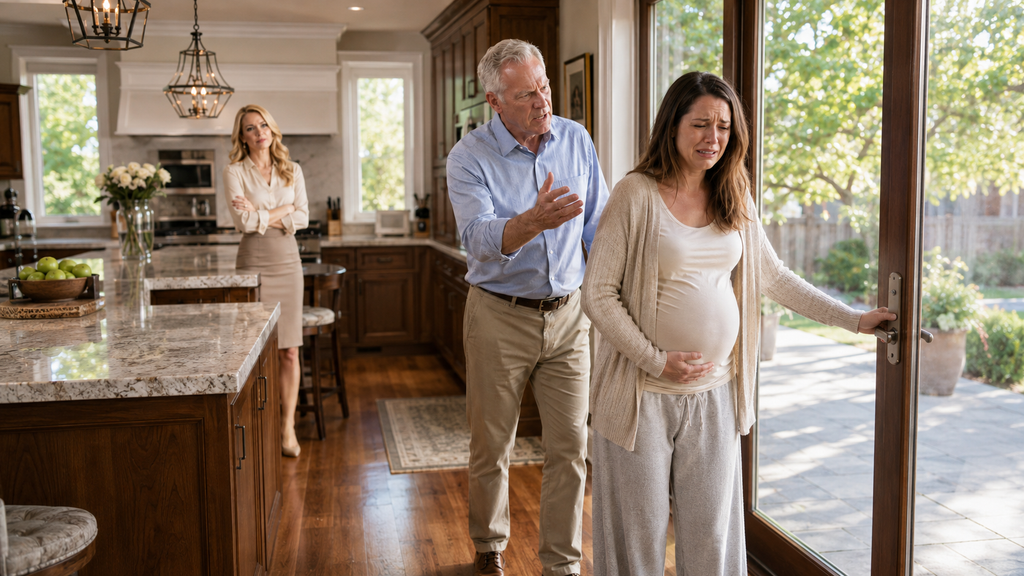
He should have been asking me whether the contractions were five minutes apart or ten, even though we had practiced timing them at least three times.
He should have been beside me.
Instead, my father was standing inside my house shouting into his phone.
“What do you mean the accounts are frozen?”
I looked through the open doorway.
Richard had gone pale.
The confidence he had carried into my kitchen twenty minutes earlier had disappeared so quickly that, for a moment, I almost wondered whether I had imagined it.
He turned toward Nathan’s desk.
“What fraud investigation?”
Bianca took one small step away from him.
“Richard?”
He raised a hand toward her without looking.
“Not now.”
Another voice crackled from his phone, too faint for me to understand.
Richard’s expression changed again.
First anger.
Then disbelief.
Then something I had almost never seen on my father’s face.
Fear.
“No,” he said.
He listened.
“You don’t understand. My daughter authorized me.”
Samantha’s voice came through my phone.
“Did you hear that?”
“Yes.”
“Good.”
I swallowed.
A siren was getting louder.
My stomach tightened again.
“Samantha…”
“I’m here.”
“What exactly did Nathan do?”
There was a brief pause.
Then she answered carefully.
“He prepared for the possibility that someone might try to take advantage of you after his death.”
The words hurt more than I expected.
Nathan had known.
Not that he would die.
Not that my father would come three weeks later and drag me out of my own home.
But Nathan had known my family.
He had watched Richard borrow money and forget to repay it.
He had watched him criticize every decision I made.
He had watched him appear whenever something valuable was involved and disappear whenever I needed kindness instead.
Nathan had never told me what to do about my father.
That was one of the reasons I loved him.
He simply watched.
Remembered.
Prepared.
“Samantha,” I whispered, “what did he know?”
“He knew enough.”
Inside, Richard slammed one of Nathan’s desk drawers shut.
“You can’t freeze my personal accounts!”
Bianca stared at him.
“Your personal accounts?”
Richard walked toward the window.
“I said not now.”
She did not move.
“What personal accounts?”
Another contraction started before Richard could answer.
This one stole my breath completely.
I bent forward.
My phone almost slipped from my hand.
“Elena?”
Samantha’s voice sharpened.
“I’m okay.”
“No, you are not okay. Do not minimize this.”
Her words struck something inside me.
Maybe because I had spent most of my life doing exactly that.
Minimizing.
My father didn’t insult me.
He was just blunt.
He didn’t control me.
He was protective.
He didn’t manipulate me.
He was stressed.
He didn’t use me.
Family helped family.
He didn’t hurt me.
I was too sensitive.
Nathan had been the first person who heard those explanations and quietly asked me one question.
“Would you accept that treatment from anyone who wasn’t related to you?”
At the time, I had laughed.
Then I cried.
Because the answer was no.
A paramedic truck turned onto our street.
Red lights flashed across the neighboring houses.
Richard saw them through the front window.
His eyes snapped toward me.
“You called an ambulance?”
I stared at him.
“My water broke.”
“Do you have any idea what you’ve done?”
I almost laughed.
Even then.
Even with me sitting eight months pregnant on the porch after he had physically forced me from my home.
My father still believed the emergency was happening to him.
“You pushed me,” I said.
“I moved you out of the doorway.”
“You grabbed me.”
“You were hysterical.”
“I told you to leave.”
“This house is part of Nathan’s estate!”
“No, it isn’t.”
The words came from behind me.
I turned.
Samantha Reed was hurrying up the walkway.
I had never been so relieved to see another human being in my life.
She wore dark trousers, a cream blouse, and the expression of a woman who had abandoned whatever she was doing the second she received my call.
A leather folder was tucked under one arm.
Her phone was still in her hand.
Two paramedics were directly behind her.
Richard came toward the doorway.
“Samantha.”
She stepped between him and me without hesitation.
“Stay inside.”
“This is a family matter.”
“No,” Samantha said.
“It became a criminal matter when you allegedly forged your daughter’s authorization.”
Bianca’s mouth fell open.
“What?”
Richard stared at her.
“Go upstairs.”
She laughed once.
It was not a happy sound.
“Go upstairs?”
“Bianca.”
“What did you forge?”
“Nothing.”
Samantha looked at the paramedics.
“She’s thirty-four weeks pregnant. Her water broke after being physically removed from the residence.”
The taller paramedic crouched beside me immediately.
“Ma’am, I’m Daniel. What’s your name?”
“Elena.”
“How far apart are the contractions?”
“I don’t know.”
“Any bleeding?”
“No.”
“Any dizziness?”
“A little.”
He looked toward his partner.
“Let’s get her onto the stretcher.”
Richard stepped onto the porch.
“I’m her father. I’ll ride with her.”
“No.”
The answer left my mouth before I could think about it.
Everyone stopped.
Even Richard.
I had said no to him before.
But usually quietly.
Usually with explanations.
Usually followed by apologies.
That no was different.
It did not ask permission.
Richard’s face hardened.
“Elena, don’t be ridiculous.”
“I don’t want you near me.”
“I’m your father.”
“You threw me out of my own house while I was pregnant.”
“I was trying to stop you from making an irrational financial decision.”
“I told you to leave.”
“You don’t understand what Nathan left behind.”
Samantha looked directly at him.
“I understand it.”
Richard turned toward her.
Something passed between them.
Recognition.
And I suddenly realized Samantha knew more than she had told me.
A lot more.
The paramedics helped me onto the stretcher.
As they secured the straps, a police cruiser stopped at the curb.
Then another.
Richard’s shoulders stiffened.
Bianca backed farther into the house.
One of the officers approached.
“Who called?”
“I did,” I said.
The officer looked at me, then at Richard.
Before I could explain, Samantha raised her hand.
“I’m her attorney.”
Richard snapped, “Estate attorney.”
Samantha didn’t blink.
“I represented her husband’s estate. I now represent Elena with respect to the attempted transfer and suspected fraudulent documents.”
The officer pulled out a notebook.
“Attempted transfer?”
Samantha opened her leather folder.
“I can provide documentation.”
Richard stepped toward her.
“You have no business sharing private estate information.”
Samantha looked at him.
“I didn’t say whose privacy I was concerned about.”
That shut him up.
For three seconds.
Then Richard’s phone rang again.
He stared at the screen.
He didn’t answer.
Bianca did.
“Who is it?”
“Nothing.”
She looked at the screen over his shoulder.
“Why is First Empire Bank calling you?”
Richard shoved the phone into his pocket.
“Bianca, go upstairs.”
Her face changed.
She folded her arms.
“No.”
The first real crack appeared between them right there in my doorway.
I would later learn that it mattered.
A lot.
But at that moment, another contraction rolled through me.
I grabbed the stretcher rail.
Daniel leaned closer.
“Breathe with me.”
I tried.
The street blurred.
For one terrifying second, all I could think was that Nathan and I were supposed to do this together.
We had painted the nursery together.
We had argued about whether the crib should go beneath the window.
He had insisted it shouldn’t because of the draft.
I had told him he was being ridiculous.
He had spent two hours researching infant room temperature recommendations just to prove he was right.
That was Nathan.
He prepared.
He researched.
He worried.
He loved through details.
And now the biggest moment of our lives was happening without him.
I started crying.
Not loudly.
Just suddenly.
Daniel thought the contraction was hurting me.
“It’s okay. We’re moving.”
But it wasn’t the pain.
It was grief.
“I want my husband,” I whispered.
The paramedic’s expression softened.
He did not give me one of those terrible sympathetic sentences people had been giving me for three weeks.
He did not tell me Nathan was in a better place.
He did not tell me everything happened for a reason.
He simply squeezed my shoulder.
“I know.”
And somehow that was easier.
They lifted the stretcher.
Richard came down the steps.
“Elena!”
One of the police officers blocked him.
“Sir, stay here.”
“That’s my daughter.”
“She said she does not want you accompanying her.”
Richard pointed toward me.
“She’s emotional. Her husband just died.”
The officer’s expression became cold.
“She’s still allowed to decide who rides with her.”
Richard looked at me.
“Elena, tell them.”
I met his eyes.
“No.”
His jaw clenched.
“Do not do this.”
For the first time in my entire life, I heard the sentence for what it really was.
Not concern.
Not advice.
A threat wrapped in four words.
Do what I want, or there will be consequences.
I had spent thirty-two years trying to avoid those consequences.
That morning, something in me finally broke free.
Maybe it was grief.
Maybe it was becoming a mother.
Maybe it was the sight of Nathan’s papers scattered across the floor.
Whatever it was, I looked at my father and said the sentence I should have said years earlier.
“You don’t get to decide what I do anymore.”
His face went still.
The paramedics rolled me toward the ambulance.
Behind us, Samantha remained with the officers.
As the doors closed, I caught one final glimpse of Richard standing in the yard.
For once, nobody was listening to him.
Nobody was obeying him.
And nobody looked afraid.
Except him.
The ambulance ride to the hospital lasted twelve minutes.
It felt like twelve hours.
The contractions were stronger now.
Daniel kept asking questions.
Pain level.
Pressure.
Movement.
I answered when I could.
When I couldn’t, he let me squeeze his hand hard enough to leave marks.
The other paramedic monitored the baby’s heartbeat.
Every time the machine made a sound, my own heart jumped.
“Is she okay?”
“So far.”
“So far?”
“That’s good news, Elena.”
I nodded.
I tried to believe him.
Nathan and I had never agreed on a name.
That thought came to me suddenly.
We had lists.
Dozens of names.
Sophie.
Clara.
Emma.
Lucy.
Nathan liked Evelyn because it had been his grandmother’s name.
I liked Grace.
He said Grace sounded like someone who would grow up to become president.
I told him Evelyn sounded like someone who owned twelve cats.
He had pretended to be offended.
Then we kissed.
Then three weeks later, he died.
The last conversation we ever had about our daughter happened over breakfast.
Nathan was eating toast.
I was drinking orange juice.
He looked at my stomach and said, “What if we wait until we meet her?”
I laughed.
“That is dangerously spontaneous for you.”
“I contain multitudes.”
“You alphabetized the spice drawer.”
“That was one time.”
“You made labels.”
“Labels create civilization.”
I still remembered the way he smiled.
I could hear his laugh.
I could see the crumbs on his shirt.
Grief was strange like that.
People thought the biggest memories hurt the most.
Our wedding.
The funeral.
The moment the doctor told me he was gone.
But sometimes it was toast crumbs.
A coffee mug.
An empty side of the bed.
A joke about spice labels.
Those were the memories that could destroy you.
The ambulance hit a bump.
Pain ripped through my lower abdomen.
I cried out.
Daniel checked the monitor.
“We’re almost there.”
I gripped the blanket.
“Please don’t let anything happen to her.”
“We’re taking care of both of you.”
“Nathan would never forgive me.”
Daniel looked at me.
“For what?”
“If something happens.”
His response was immediate.
“You didn’t cause this.”
I closed my eyes.
But I had gone back and forth with that thought ever since Nathan died.
If I had asked him not to drive that morning.
If I had called him five minutes earlier.
If I had insisted he stay home.
If I had—
The ambulance doors opened.
Bright hospital lights replaced the gray morning.
Everything became movement.
Nurses.
Questions.
Wheelchairs.
Monitors.
A doctor with silver glasses introduced herself as Dr. Patel.
Someone handed me a gown.
Someone else placed an IV.
The baby’s heartbeat filled the room.
Fast.
Steady.
Beautiful.
I started crying again.
Dr. Patel examined me.
“Your membranes have ruptured.”
“I know.”
“You’re also contracting.”
“How bad is it?”
“We’re going to try to slow things down if we safely can, but at thirty-four weeks, there’s a good possibility your daughter may arrive today.”
Today.
That word made the room tilt.
Today.
Nathan’s daughter might be born today.
Without Nathan.
I covered my face.
The nurse beside me touched my arm.
“What do you need?”
I lowered my hands.
“My husband.”
Silence.
Then I shook my head.
“He died three weeks ago.”
The nurse’s expression changed.
“Oh, Elena.”
“I’m sorry.”
She looked confused.
“For what?”
“I don’t know.”
That made me cry harder.
Because grief did that too.
It made you apologize for existing incorrectly.
For crying.
For not crying.
For laughing.
For needing help.
For not answering messages.
For being alive when someone else wasn’t.
The nurse pulled a chair closer.
“My name is Rachel. I’m going to be with you for a while.”
I nodded.
Then my phone rang.
Samantha.
My stomach clenched for an entirely different reason.
I answered.
“Hi.”
“How are you?”
“They think the baby might come today.”
She exhaled slowly.
“Okay.”
“What’s happening at the house?”
“Elena…”
Something in her voice scared me.
“What?”
“Your father has been detained.”
I stopped breathing.
“What?”
“He wasn’t formally arrested when I left, but the officers found several documents in Nathan’s study.”
“What documents?”
“Some were in the folder Richard brought.”
I looked toward Rachel.
She quietly stepped out, closing the door halfway behind her.
“What documents, Samantha?”
“A purported durable power of attorney.”
I stared at the wall.
“I never gave him one.”
“I know.”
“What does it say?”
“It says you granted Richard authority to manage your financial affairs two days after Nathan’s death.”
My mouth went dry.
“I didn’t.”
“I know.”
“I could barely get out of bed two days after Nathan died.”
“Elena, the signature appears to have been copied.”
My fingers started shaking.
“Copied from what?”
“A prior real estate document.”
I knew immediately.
Three years earlier, Nathan and I had refinanced the house.
My signature was on dozens of pages.
Richard had once borrowed our printer because his had stopped working.
No.
That made no sense.
Except it did.
My father had spent a lifetime collecting little pieces of people.
Information.
Weaknesses.
Access.
Keys.
Passwords he wasn’t supposed to know.
Documents he had no reason to keep.
“Is that why he called you?”
“Yes.”
“What did he ask?”
“He claimed you were emotionally incapacitated by grief and that you had appointed him to manage the estate.”
I felt physically sick.
“What did you say?”
“I told him Nathan’s estate did not own the house.”
“And?”
“He became very interested in the trust.”
“What trust?”
There was a pause.
“Nathan created a family protection trust about seven months ago.”
“Seven months?”
“After you told him Richard had asked you to cosign that business loan.”
I closed my eyes.
I remembered that night.
My father had wanted one hundred and fifty thousand dollars.
He had called it an investment.
Nathan had called it financial quicksand.
I refused to sign.
Richard stopped speaking to me for two months.
Apparently Nathan had been paying attention.
“What’s in the trust?”
“Life insurance proceeds. Certain investment accounts. A reserve intended to pay off the remaining mortgage. Education funds for your daughter. Several other assets.”
I stared at my stomach.
“He never told me.”
“He planned to.”
“When?”
“After the baby was born.”
The words hit me like a fist.
He planned to.
Everything Nathan had planned now existed in a world without him.
Trips.
Birthdays.
College tours.
Teaching our daughter to ride a bike.
Buying too much Christmas wrapping paper because he always overestimated.
Calling me from the grocery store because he forgot which yogurt I liked even though I bought the same kind every week.
I forced myself back to the phone.
“What is the fraud clause?”
“It’s a trigger in the trust administration agreement. Nathan was very specific.”
“Specific how?”
“If anyone claimed to act on your behalf during a period of incapacity, bereavement, hospitalization, or medical vulnerability, the trustee was required to independently verify the authority with you and with me before releasing funds or recognizing any transfer.”
I almost smiled through the tears.
That sounded exactly like Nathan.
Suspicious even from beyond the grave.
“What happened yesterday?”
“Richard called my office.”
“And you knew it was fake?”
“I suspected it.”
“Why didn’t you call me?”
“I did.”
I looked at my phone.
“I never saw—”
Then I remembered.
Richard had texted me yesterday afternoon.
He asked how I was sleeping.
Then he called.
He kept me on the phone for almost an hour telling me I needed to begin thinking about practical decisions.
While we were talking, I had ignored three other calls.
I had not checked the numbers afterward.
“I missed it.”
“That’s not your fault.”
“What did Richard tell you?”
“That you were too distraught to speak with attorneys and had granted him authority.”
My hands curled around the blanket.
“He used my grief.”
“Yes.”
The answer was quiet.
Simple.
Devastating.
“What was he trying to do?”
“That’s the part we’re still determining.”
I waited.
“But I think he planned to transfer control of the house and access a portion of the trust.”
“How?”
“The power of attorney would not have been enough by itself, but he appears to have prepared additional documents.”
“Such as?”
“A property management agreement.”
I laughed once in disbelief.
“My house doesn’t need a property manager.”
“No.”
“What else?”
“A listing authorization.”
The room went cold.
“He was going to sell my house?”
“It appears so.”
“To whom?”
“We’re investigating.”
“Samantha.”
Another pause.
Then she said it.
“A company called Birchline Holdings.”
I had never heard the name.
“Who owns it?”
“According to the state filing, the managing member is Daniel Cortez.”
I frowned.
“I don’t know him.”
“You probably know his sister.”
A terrible feeling settled inside me.
“Who?”
“Bianca Vale.”
I stopped breathing.
My father’s wife.
For several seconds, all I could hear was the fetal monitor.
Beep.
Beep.
Beep.
Beep.
“He was selling my house to Bianca’s brother?”
“The paperwork appears to propose a sale at approximately sixty-one percent of current market value.”
My chest tightened.
Our home had appreciated significantly.
Nathan used to tease that we had accidentally become rich because we bought before the neighborhood became fashionable.
“How much is the house worth?”
“About eight hundred and forty thousand.”
“And the sale?”
“Five hundred and twelve thousand.”
I whispered, “Why?”
“We found another document.”
I already knew I wasn’t going to like it.
“What?”
“A consulting agreement.”
“Between whom?”
“Birchline Holdings and Richard.”
I shut my eyes.
“How much?”
“One hundred and seventy-five thousand dollars.”
There it was.
The whole thing.
Not grief.
Not debt.
Not estate administration.
Money.
My father had planned to steal my house while I was eight months pregnant and mourning my husband.
He would sell it to Bianca’s brother at a massive discount.
Then receive one hundred and seventy-five thousand dollars disguised as a consulting fee.
Maybe Bianca’s family would flip the property later.
Maybe they would rent it.
Maybe they already had a buyer.
It didn’t matter.
My home had been reduced to numbers on paper.
Nathan’s nursery.
Our kitchen.
The height marks Nathan planned to put on the laundry room wall as our daughter grew.
The maple tree we planted after our first miscarriage.
The porch where I was sitting when my water broke.
All of it.
Numbers.
“Did Bianca know?”
“We don’t know yet.”
I thought about her laughing in my kitchen.
The smile.
The way she had watched my father push me toward the door.
“She knew something.”
“Possibly.”
“I want them out of my house.”
“They are.”
I opened my eyes.
“What?”
“The police removed them.”
“Both?”
“Yes.”
“Where are they?”
“Richard is being questioned. Bianca agreed to go to the station voluntarily.”
I let out a breath I hadn’t realized I was holding.
“Are my doors locked?”
“Yes.”
“Nathan’s papers?”
“Photographed and secured. An officer remained until a locksmith arrived.”
“A locksmith?”
“I changed the locks.”
Despite everything, I almost laughed.
“You changed my locks?”
“You gave me permission during the ambulance ride.”
“I did?”
“You said, and I quote, ‘I never want that man using another key to get into my life.’”
I covered my eyes.
“That sounds dramatic.”
“It was extremely clear legal authorization.”
A laugh escaped me.
Then a contraction started.
Hard.
Fast.
I gasped.
“Elena?”
I dropped the phone slightly.
Rachel appeared at the doorway immediately.
“Contraction?”
I nodded.
She hurried toward the monitor.
Samantha heard her.
“I’m hanging up.”
“No.”
“Yes.”
“What happens next?”
“What happens next is you have a baby.”
“My father—”
“Is no longer your problem today.”
“But—”
“Elena.”
Her voice softened.
“Nathan hired me because he knew exactly what you would do in a crisis.”
“What?”
“Try to protect everyone except yourself.”
I started crying.
“He told you that?”
“Repeatedly.”
I smiled through the tears.
“That sounds like him.”
“It does.”
Another contraction gripped me.
Samantha continued.
“Let me protect the paperwork. Let the police deal with Richard. You take care of your daughter.”
I whispered, “Okay.”
“I’ll come to the hospital when you want me.”
“Thank you.”
“Elena?”
“Yes?”
“Nathan’s plan worked.”
The contraction eased.
I stared at the ceiling.
For some reason, those words nearly broke me.
Nathan’s plan worked.
He was gone.
But something he had built was still standing between me and the people who wanted to hurt me.
“Yeah,” I whispered.
“It did.”
Labor progressed despite medication.
By early afternoon, Dr. Patel stopped talking about trying to delay delivery.
My daughter was coming.
The room filled with people.
The neonatal team arrived because she would be premature.
Rachel helped me tie my hair back.
Someone dimmed the lights slightly because I said they were hurting my eyes.
A warmer was prepared in the corner.
And beside my bed was an empty chair.
Nathan’s chair.
Nobody called it that.
But I did.
Every time I looked at it, I imagined him sitting there.
Knee bouncing.
Terrified.
Pretending not to be.
He would have brought snacks even though I wasn’t allowed to eat.
He would have asked twelve unnecessary medical questions.
He would have checked every machine twice.
He would have told me I was doing great even when I screamed at him.
I gripped the bedrail through another contraction.
“I can’t.”
Rachel leaned over me.
“You can.”
“I can’t do this without him.”
The words came out as a sob.
She took my hand.
“You aren’t doing it without him.”
I looked at her.
She nodded toward my stomach.
“That little girl is half him.”
That thought changed something.
Nathan wasn’t only behind me.
He was ahead of me too.
In her.
In the child I had not yet met.
In the daughter who would have his eyes or his laugh or his irritating habit of reorganizing cabinets.
I pushed.
Pain became everything.
There was no house.
No father.
No forged paperwork.
No police.
No bank.
No grief.
Only breath.
Pressure.
Fear.
My body.
My daughter.
Push.
Rest.
Push.
Cry.
Breathe.
Again.
At 3:47 that afternoon, my daughter entered the world screaming.
The sound stopped my heart.
Then restarted it.
“Oh my God.”
Someone lifted a tiny red-faced baby into view.
She was so small.
So furious.
So alive.
I reached for her instinctively.
But the neonatal team needed to evaluate her first.
Those twenty seconds felt longer than the previous eight months.
“Is she okay?”
No one answered immediately.
“Is she okay?”
Then a doctor looked over.
“She’s breathing on her own.”
I started sobbing.
“Is she okay?”
“She’s doing very well.”
They brought her to me briefly.
She weighed four pounds, eleven ounces.
Her entire head fit in my palm.
I touched her cheek.
And then I saw it.
A tiny crease beside her left eye.
Nathan had the same crease when he smiled.
I laughed and cried at the same time.
“Hi.”
Her eyes opened slightly.
“Hi, baby.”
I kissed her forehead.
“You scared me.”
She made a tiny sound.
“I know.”
I held her as carefully as if the world might break.
Then I whispered the name before I had time to reconsider it.
“Grace.”
Rachel leaned closer.
“Is that her name?”
I stared at my daughter.
Nathan had joked that Grace sounded like someone who would become president.
He had smiled when he said it.
I looked at the empty chair.
“Yes.”
My voice cracked.
“Grace Evelyn Moore.”
Grace for the name I loved.
Evelyn for the name Nathan loved.
A compromise.
Just like our marriage had been.
Not perfect.
Not effortless.
But ours.
Grace Evelyn Moore.
Our daughter.
The doctors moved her to the neonatal unit for monitoring.
She did not need a ventilator.
She needed warmth, help feeding, and observation.
Compared with everything I had imagined, those words felt miraculous.
After they wheeled her away, the room became strangely quiet.
My body shook from exhaustion.
Rachel pulled a blanket over me.
“Try to sleep.”
“I need to see her.”
“You will.”
“I don’t want her alone.”
“She isn’t.”
“She lost her father before she was born.”
Rachel looked at me.
“She still has her mother.”
I stared at the ceiling.
A mother.
I was someone’s mother now.
Not Richard Vale’s daughter.
Not Nathan Moore’s widow.
Not the pregnant woman everyone spoke to with careful sympathy.
Grace’s mother.
The identity settled around me like armor.
And for the first time since Nathan died, I felt something other than grief.
Purpose.
Samantha arrived around six.
She carried two coffees, realized I wasn’t supposed to have either, and drank both.
“I’ve had a difficult day,” she said.
I laughed.
It hurt.
“Grace is in the neonatal unit.”
“Grace?”
“Grace Evelyn.”
Samantha smiled.
“Nathan would have loved that.”
“You think?”
“He told me he was losing the name argument.”
I stared at her.
“He talked to you about baby names?”
“He talked to everyone about baby names.”
That was true.
Nathan had asked our mail carrier whether Evelyn sounded old-fashioned.
I shook my head.
“I miss him.”
“I know.”
We sat quietly.
Then I looked at the leather folder in her lap.
“What happened?”
Samantha’s expression changed.
“Do you really want to know today?”
“Yes.”
“Elena—”
“I had my baby.”
“I noticed.”
“I survived labor.”
“You did.”
“My father tried to steal my house.”
“Yes.”
“I would like to know whether he is currently in jail.”
The corner of Samantha’s mouth twitched.
“Fair.”
She opened the folder.
“Richard was arrested late this afternoon.”
The words landed strangely.
No satisfaction.
No joy.
Just a heavy kind of finality.
“For what?”
“At the moment, the likely charges involve forgery, attempted fraud, criminal trespass, and assault-related conduct. The exact charging decisions will be made by the prosecutor.”
I looked down at my hands.
“He’s really been arrested.”
“Yes.”
“What did he say?”
“A lot.”
“That sounds like him.”
“He insists he was protecting you.”
I laughed.
The sound was bitter.
“By selling my house?”
“He claims the property needed to be liquidated quickly before creditors discovered weaknesses in Nathan’s estate.”
“There are creditors?”
“No significant ones.”
“So that was a lie.”
“Yes.”
“What about Bianca?”
“She’s talking.”
I looked up.
“Meaning?”
“Meaning Bianca discovered today that Richard had not been completely honest with her either.”
For some reason, that surprised me.
“She knew about the sale.”
“Yes.”
“She laughed while he threw me outside.”
“Yes.”
“I’m not interested in making her a victim.”
“Neither am I.”
“Then what did he lie about?”
Samantha looked at her notes.
“According to Bianca, Richard told her you had agreed to sell.”
I stared at her.
“That is ridiculous.”
“I agree.”
“She watched me tell them to get out.”
“She claims she believed you had changed your mind due to grief and were trying to back out of an agreement.”
“Convenient.”
“Very.”
“What else?”
“She knew her brother’s company was going to buy the house.”
“I assumed that.”
“She did not know about the one hundred and seventy-five thousand dollar consulting fee.”
I blinked.
“Richard was hiding money from her.”
“Apparently.”
That was almost funny.
My father had found a woman thirty years younger than himself who believed she was his partner.
And even while committing fraud with her family, he had been planning to skim money off the side.
Some men treated betrayal like a hobby.
“What did Bianca do when she found out?”
“She became remarkably cooperative.”
I sighed.
“Of course she did.”
“She handed over text messages.”
My eyes narrowed.
“What text messages?”
“Between her, Richard, and her brother.”
“How bad?”
“For Richard?”
“Yes.”
“Very.”
I sat straighter.
Samantha handed me several printed pages.
The first message was from Bianca.
WHEN DOES ELENA MOVE OUT?
Richard replied:
TUESDAY. SHE WON’T FIGHT ME ONCE I EXPLAIN THE DEBT.
Another.
Bianca:
AND IF SHE DOES?
Richard:
SHE’S EIGHT MONTHS PREGNANT AND BARELY FUNCTIONING. SHE’LL DO WHAT I TELL HER.
My vision blurred.
I read it again.
She’ll do what I tell her.
Thirty-two years of my life in seven words.
I continued.
Bianca’s brother:
NEED SIGNATURE BEFORE TITLE REVIEW.
Richard:
I HAVE IT HANDLED.
Bianca:
SHE ACTUALLY SIGNED?
Richard:
YOU WORRY TOO MUCH.
My hands trembled.
I passed the pages back.
“That’s enough.”
Samantha put them away.
For a moment, neither of us spoke.
Then I asked, “Was Nathan expecting this?”
“No.”
“But the trust…”
“He expected pressure.”
“From Richard.”
“Yes.”
“How much did Nathan tell you?”
Samantha hesitated.
“Everything you had told him.”
I looked away.
That embarrassed me more than it should have.
Arguments with my father.
Money requests.
Guilt.
Threats.
The Christmas Richard stopped speaking to me because Nathan and I spent the holiday with his mother.
The time Richard tried to convince me to take fifty thousand dollars from my retirement account to rescue one of his failed investments.
The way he always insisted family loyalty meant helping him.
Nathan knew.
Of course he did.
“He never told me he was worried.”
“He didn’t want to scare you.”
“That sounds like Nathan.”
“He also knew you would argue with him if he suggested cutting your father off completely.”
“That also sounds like me.”
Samantha smiled slightly.
“He said that too.”
I looked at her.
“What exactly did he say?”
She hesitated.
Then:
“He said, ‘Elena believes boundaries are a form of cruelty because Richard spent her whole childhood teaching her that obedience was love.’”
I stared at the blanket.
That sentence was so painfully Nathan that I could hear his voice saying it.
“He understood me better than I understood myself.”
“Sometimes.”
“I should have listened.”
“Elena.”
“I kept giving Richard chances.”
“Yes.”
“You don’t have to disagree.”
“I wasn’t going to.”
I laughed through my tears.
“That’s why Nathan liked you.”
“That and my charming billing practices.”
For several seconds, things felt almost normal.
Then Samantha reached into the folder again.
“There’s something else.”
My stomach tightened.
“Please tell me my father doesn’t secretly own a submarine.”
“No submarine.”
“Good.”
“But Nathan left a letter.”
Everything inside me stopped.
“A letter?”
Samantha nodded.
“For you.”
My throat closed.
“Why do you have it?”
“He gave it to me with the trust documents.”
“When?”
“Seven months ago.”
“Why didn’t you give it to me after he died?”
“He gave me instructions.”
“What instructions?”
“To give it to you if the fraud protection was ever triggered.”
I stared at the envelope in her hand.
My name was written across the front.
Elena.
Nathan’s handwriting.
I knew every curve.
Every letter.
My body reacted before my mind did.
My chest folded inward.
I covered my mouth.
“No.”
Samantha waited.
“I can’t.”
“You don’t have to read it now.”
“Why would he write that?”
“He told me he hoped I would throw it away someday unopened.”
I reached for it.
My fingers shook so badly that Samantha kept one hand beneath the envelope until I had it securely.
Nathan’s handwriting.
Seven letters.
Elena.
I ran my thumb over the ink.
“He touched this.”
“Yes.”
I cried silently.
Not the dramatic grief of funerals.
Not the collapsing kind.
This was smaller.
Deeper.
The grief of touching something a dead person had touched while they were still alive.
Samantha stood.
“I’ll give you some privacy.”
“No.”
She stopped.
“Stay.”
“All right.”
I opened the envelope.
Inside was a single sheet of paper.
Nathan’s handwriting filled both sides.
I unfolded it.
For a long time, I could not read.
Then I forced my eyes to focus.
Elena,
If Samantha is giving you this letter, then somebody tried something I hoped would never happen.
I almost stopped immediately.
My hands shook.
I continued.
I know you’re probably angry that I made arrangements without telling you everything.
You can yell at me later.
I know.
Bad joke.
I laughed and cried simultaneously.
That was exactly the kind of joke he would make.
I kept reading.
I did this because I know what happens when you are hurting.
You become generous.
Then patient.
Then forgiving.
Then exhausted.
And somewhere in that process, people who love taking from you convince you that your exhaustion proves you are selfish.
Please do not let anyone do that to you after I’m gone.
I pressed the paper against my mouth.
Samantha looked away.
Nathan continued.
I don’t know who triggered this.
Maybe nobody ever will.
Maybe your father finally became reasonable and we’ll both laugh someday about how paranoid I was.
I actually laughed at that.
Richard reasonable.
Nathan had known exactly how unlikely that was.
But if it is him, I need you to remember something.
Protecting yourself is not betrayal.
Saying no is not cruelty.
Keeping what belongs to you is not selfishness.
And raising our daughter somewhere safe matters more than keeping peace with someone who only offers peace when you surrender.
My eyes filled completely.
I had to stop.
Breathe.
Then continue.
The house is yours.
Not emotionally.
Legally.
I made sure of it.
The insurance is yours.
The trust is yours and hers.
Nobody gets to turn my death into your financial emergency.
Nobody gets to tell you grief has made you too weak to make decisions.
You are the strongest person I know, even though I wish you didn’t have to prove it so often.
I closed my eyes.
Nathan.
I missed him so much that my bones hurt.
Then came the final paragraph.
If our baby is here when you read this, tell her I loved her before I knew her face.
Tell her I talked to her every night even when you said babies couldn’t understand discussions about mortgage rates.
Tell her I already knew she would be stubborn because she kicked me every time I put my hand on your stomach.
And tell her that if she gets your heart, she’ll need someone to remind her sometimes that kindness without boundaries becomes permission for cruel people.
I hope you both get very old.
I hope the house gets noisy.
I hope there are crayons on the walls and fingerprints on the windows and toys where I would absolutely complain about stepping on them.
I hope you stop keeping everything perfect.
I hope you laugh again.
Most of all, I hope you never mistake being alone for being powerless.
You were never powerful because I was beside you.
You were powerful before I met you.
I just had the privilege of seeing it.
I love you.
N.
I could not breathe.
The paper slipped into my lap.
Samantha crossed the room and put her arms around me.
I cried against her shoulder.
Not politely.
Not quietly.
I cried like something inside me had been torn open.
For Nathan.
For Grace.
For the six years we had been given.
For the fifty years we were supposed to have.
For the man who knew he might die before me because everyone might die before someone, and had turned that fear into paperwork, protections, signatures, instructions, and one final letter.
Eventually, my crying slowed.
I wiped my face.
“He wanted crayons on the walls?”
Samantha smiled.
“I believe grief may have made him overly sentimental.”
“He hated marks on walls.”
“Passionately.”
“He kept touch-up paint in the basement.”
“Alphabetized?”
“By room.”
We laughed.
And for the first time since Nathan died, laughing did not feel like betrayal.
It felt like remembering him correctly.
Grace remained in the neonatal unit for twelve days.
Twelve days of tiny diapers.
Tiny bottles.
Machines that beeped at three in the morning.
Nurses who became temporary family.
I learned how to feed a premature baby.
How to watch her breathing without panicking.
How to sleep for ninety minutes at a time.
How to cry quietly beside an incubator and then smile when she opened her eyes.
Samantha handled almost everything involving Richard.
But pieces still reached me.
The prosecutor charged him with multiple offenses after investigators found evidence that the forged power of attorney had been used in communications with the bank and in the attempted property transaction.
A handwriting examiner concluded that the signature had likely been digitally reproduced from an older document.
The notary stamp on one page belonged to a notary who had retired the previous year.
That became another problem for him.
Then detectives found emails.
Those were worse.
Richard had been planning the sale for almost two weeks.
Meaning he began planning to take my house less than a week after Nathan’s funeral.
One email to Bianca’s brother read:
SHE ISN’T IN A POSITION TO MANAGE DETAILS. ONCE WE GET HER OUT, EVERYTHING MOVES QUICKLY.
Another said:
THE ATTORNEY MAY BE AN ISSUE. I’LL HANDLE MY DAUGHTER.
I read that sentence once.
Then never again.
I’ll handle my daughter.
I finally understood that my father had never seen me as an adult human being with independent choices.
I was a problem to manage.
A resource to access.
A daughter when that title served him.
An obstacle when it didn’t.
Bianca eventually received her own attorney.
Her brother did too.
Both claimed Richard had told them the arrangement was legal.
The prosecutor could decide how much of that to believe.
I stopped caring.
That surprised me.
For years, my father’s moods had controlled entire weeks of my life.
If he was angry, I worried.
If he stopped calling, I wondered what I had done wrong.
If he criticized me, I replayed the conversation for days.
Now he had been arrested, and I did not wake up wondering how he felt.
I woke up wondering whether Grace had eaten enough.
Whether she was warm.
Whether the little crease beside her eye would become more obvious when she smiled.
Motherhood did not erase what Richard had done.
It simply showed me how much energy I had wasted trying to repair a relationship built to drain me.
On the ninth day, Samantha visited the hospital with another update.
“I have good news.”
I looked at Grace sleeping against my chest.
“She gained two ounces.”
“Excellent news. I have second-best news.”
“What?”
“The title company formally rejected the attempted transaction.”
“I thought that was already dead.”
“It was functionally dead. Now it is officially buried.”
“Wonderful.”
“The county recorder has also flagged the fraudulent documents.”
“So the house is safe.”
“The house was always yours.”
I looked at Grace.
“I think I’m finally starting to believe that.”
“There’s more.”
“Of course there is.”
“First Empire completed its review. The trust remains intact.”
“And Richard’s accounts?”
“That freeze involved a separate fraud alert tied to transfers connected with Birchline.”
I raised an eyebrow.
“Transfers?”
Samantha sat down.
“Richard had already sent forty thousand dollars to Bianca’s brother.”
“For what?”
“Earnest money and legal expenses, according to him.”
“With whose money?”
“His.”
“So why freeze his account?”
“Because he represented the funds as expenses made on your behalf.”
I stared.
“He tried to reimburse himself from the trust.”
“Yes.”
“How?”
“Using the forged authority.”
I almost admired the stupidity.
Almost.
“He thought he could steal my house and then make Nathan’s trust pay his expenses for stealing it?”
“That is one interpretation.”
“What’s the other?”
“There really isn’t another.”
I laughed so hard I almost woke Grace.
Samantha smiled.
“There’s another reason I came.”
“What?”
“Your father wants to speak to you.”
My laughter vanished.
“No.”
“That was fast.”
“You weren’t finished.”
“I wasn’t.”
“I’m still saying no.”
She nodded.
“Then no.”
I looked at her.
“That’s it?”
“That’s it.”
“He said he wants to speak to me?”
“Through his attorney.”
“What does he want?”
“He says he wants to explain.”
“I know the explanation.”
“You do?”
“Yes.”
“He wanted my house.”
Samantha said nothing.
“He thought I was weak.”
Still nothing.
“He thought Nathan’s death had made me easier to control.”
“Yes.”
“That’s the explanation.”
Samantha nodded.
“I agree.”
I looked down at Grace.
Her tiny fingers curled around the fabric of my shirt.
“Tell his attorney I am not interested.”
“All right.”
“No messages either.”
“All right.”
“No letters.”
“All right.”
“No requests sent through relatives.”
“I can communicate that.”
“And if he comes near my house?”
“We’re also pursuing a protective order.”
I exhaled.
“Good.”
Samantha stood.
At the door, she stopped.
“Elena?”
“Yes?”
“You did that very quickly.”
“What?”
“Said no.”
I looked down at my daughter.
“Apparently I’m learning.”
The hardest part was not the criminal case.
It was family.
News traveled quickly.
My aunt called first.
“Elena, sweetheart, your father made a terrible mistake.”
I held the phone away from my ear.
A terrible mistake.
Like missing a birthday.
Forgetting an anniversary.
Putting diesel in a gasoline car.
Not forging your pregnant daughter’s signature and trying to steal her home three weeks after her husband died.
“I’m not discussing it.”
“He’s devastated.”
“So am I.”
“He says he only wanted to make sure you didn’t lose the house.”
“He tried to sell it.”
“He was under pressure.”
“So was I.”
“Elena, he’s your father.”
There it was.
The sentence people used when they ran out of legitimate reasons.
He’s your father.
As if biology created immunity.
I looked at Grace sleeping beside me.
“I’m someone’s parent now too.”
My aunt became quiet.
“I would never do to Grace what he did to me.”
“That’s different.”
“No.”
It was the clearest thing I had ever understood.
“It isn’t.”
I ended the call.
My uncle sent a message.
Family should forgive family.
I deleted it.
A cousin told me prosecuting Richard would ruin his reputation.
I responded:
He should have considered his reputation before committing crimes.
Then I blocked the number.
Another relative asked whether I really needed such a large house for only myself and a baby.
That one almost impressed me.
Nathan had been dead one month, and somehow people were already calculating my square footage.
I blocked that number too.
Every block felt strange at first.
Then peaceful.
The house became quieter without people calling to tell me how much discomfort I owed them.
Grace came home on a sunny Friday afternoon.
I carried her through the front door myself.
The locks were new.
The porch had been pressure washed because I could not look at the place where my water had broken.
Inside, Samantha had arranged for cleaners to put Nathan’s study back in order after the police finished processing it.
But I knew immediately that someone had touched everything.
Not because anything was missing.
Because grief had made me memorize where Nathan left things.
His fountain pen should have been beside the monitor.
His notebook should have been turned slightly left.
The framed photograph of us from Lake Placid should have been closer to the bookshelf.
Tiny changes.
Invisible to anyone else.
Obvious to me.
I stood in the study holding Grace.
“This was Daddy’s office.”
She slept.
“He pretended to work in here.”
Still sleeping.
“He mostly watched videos about lawn equipment.”
Nothing.
“I have evidence.”
She yawned.
I smiled.
Then I saw something on the desk.
A small wooden box.
I did not recognize it.
A note from Samantha rested on top.
FOUND IN THE SAFE. POLICE CLEARED IT FOR RETURN.
My heart started beating faster.
I set Grace carefully in the bassinet I had moved into the office.
Then I opened the box.
Inside was Nathan’s wedding ring.
I gasped.
He had not been wearing it when he died.
The hospital had returned his belongings.
Wallet.
Watch.
Phone.
Shoes.
But not his ring.
I had assumed it had been lost during the collision.
Instead it was in our safe.
Beneath it was a jeweler’s receipt.
I picked it up.
Two weeks before Nathan died, he had taken his ring in for repair.
The band had cracked slightly.
He had collected it the day before the accident and placed it in the safe.
I sank into Nathan’s chair.
For three weeks, I had tortured myself with questions about that missing ring.
Had he taken it off?
Why?
Had something been wrong between us that I hadn’t known?
Grief found cruel questions and fed them until they became monsters.
But the answer had been simple.
The ring had needed repair.
I held it in my palm.
Then I slipped it onto a thin chain and fastened the chain around my neck.
Grace stirred.
I lifted her.
“Your father was very annoying.”
She blinked.
“He left me paperwork instead of instructions.”
Her mouth moved.
“And apparently jewelry scavenger hunts.”
I kissed her forehead.
“But he loved us.”
My voice broke.
“He loved us so much.”
Richard remained in custody for several days before being released under strict conditions.
A temporary protective order prevented him from contacting me directly.
His attorney kept trying to resolve the financial allegations quietly.
Samantha kept saying no.
I liked watching her say it.
She was excellent at no.
Two months later, I attended the first major hearing remotely.
I did not want to be in the same room as my father.
Samantha sat beside me in my kitchen.
Grace slept upstairs with a babysitter.
Richard appeared on a courtroom screen.
He looked older.
Not dramatically.
Just diminished.
His hair was thinner than I remembered.
His face seemed softer without certainty holding it up.
For a second, the child inside me responded.
That’s Dad.
Then I remembered the porch.
The forged signature.
She’ll do what I tell her.
And the feeling passed.
His attorney argued that the matter had been a misunderstanding involving estate management.
The prosecutor disagreed.
Strongly.
Messages were referenced.
Documents.
Bank communications.
The proposed sale.
The consulting agreement.
The fake authorization.
The officer’s body-camera recording from my porch.
That last one mattered more than I expected.
I had never seen the footage.
I did not want to.
But Samantha had.
She told me Richard could clearly be heard saying:
“This house is mine to manage now.”
Then, when the officer asked whether I had given him permission to enter, he answered:
“She’s my daughter. I don’t need permission.”
That sentence became important.
My whole childhood explained in one statement.
I don’t need permission.
My room.
My money.
My choices.
My marriage.
My house.
My grief.
Richard had spent decades believing fatherhood gave him ownership.
That afternoon, a judge disagreed.
The protective order was extended.
The criminal case continued.
Several months later, Richard accepted a plea agreement.
I did not attend in person.
Samantha read the terms to me.
He pleaded guilty to forgery-related and attempted fraud offenses, plus a reduced charge connected with what happened at the house.
He received probation with stringent conditions, financial penalties, restitution for legal expenses connected to the attempted transaction, and a court order prohibiting contact with me.
Some people in my family said it wasn’t enough.
Others said it was too much.
I thought both groups missed the point.
The punishment was not what freed me.
The boundary did.
The record did.
The fact that his version of reality was no longer automatically accepted did.
Richard had spent my whole life making me feel as though truth depended on who spoke with the most confidence.
Now there were documents.
Recordings.
Court orders.
Signatures.
Facts.
He could still tell himself he had been protecting me.
He could tell Bianca.
His attorney.
My aunt.
The mirror.
It no longer mattered.
I finally understood something Nathan had tried to teach me.
You do not need an unreasonable person to agree with your boundary for the boundary to be valid.
You do not need an abusive person to admit they hurt you before you are allowed to leave.
You do not need someone to understand your no.
They only need to hear it.
Bianca filed for divorce from Richard six months after my daughter was born.
I heard through Samantha.
I did not celebrate.
I did not contact her.
I did not need closure from Bianca.
But she sent a statement through her attorney.
It was three paragraphs.
An apology.
She admitted that she knew the proposed house purchase was aggressive and unfair.
She admitted she had believed Richard when he said I would eventually agree.
She admitted she laughed on the morning he forced me out.
That was the part she said she regretted most.
I read the apology once.
Then put it away.
Forgiveness, I had learned, did not require renewed access.
I could accept that Bianca regretted what she had done and still never allow her near my daughter.
Both things could be true.
Her brother’s company dissolved the following year.
I heard there were other financial problems unrelated to me.
Again, not my concern.
My father moved into a small apartment thirty miles away.
According to relatives who continued trying to send me updates until I told them to stop, he complained constantly that I had ruined his retirement.
That sentence almost made me angry.
Then it made me laugh.
I had not forged his signature.
I had not forced him into my house.
I had not drafted a fraudulent sale.
I had not stolen anything from him.
The only thing I had taken away was access to me.
And apparently, he had valued that access far more than I understood.
Grace turned one on a cold March morning.
The house Nathan hoped would become noisy had become exactly that.
Toys occupied the living room.
There were fingerprints on every window below three feet.
A purple crayon line appeared on the hallway wall two weeks before her birthday.
I stood in front of it for almost a full minute.
Then I laughed until I cried.
Nathan would have hated it.
Nathan would have secretly loved it.
I left the mark.
Not forever.
But for a while.
On Grace’s birthday, I baked a cake badly.
Nathan had always done birthday cakes for our nieces and nephews.
He claimed baking was chemistry and therefore masculine.
His cakes were perfect.
Mine leaned to one side.
Samantha came over.
Rachel, the nurse who had stayed with me during labor, came too.
We had become friends after I sent her a photo of Grace at three months.
My neighbors joined us.
Nathan’s sister flew in from Denver.
People filled the kitchen.
Real people.
People who came carrying food instead of demands.
People who held Grace so I could eat.
People who washed dishes without reminding me afterward.
People who loved without keeping receipts.
After everyone left, Grace fell asleep against my shoulder.
I carried her into Nathan’s study.
His desk was still there.
But the room had changed.
One wall now contained shelves of children’s books.
His filing cabinet held baby blankets.
A basket of stuffed animals sat where his printer used to be.
I lowered myself into his chair.
Grace sighed.
“One year,” I whispered.
She slept.
“We did it.”
The room was quiet.
I touched Nathan’s ring hanging around my neck.
“I wish you were here.”
That part never changed.
People talked about grief as though time reduced it.
For me, time changed its shape.
At first, grief was an ocean.
I drowned in it every morning.
Later, it became weather.
Some days clear.
Some days unbearable.
Some days a sudden storm triggered by a song in a grocery store.
A man wearing Nathan’s cologne.
Toast crumbs.
A spice label.
But grief was no longer the only thing inside me.
There was Grace.
There was anger.
There was laughter.
There was work.
There were friendships.
There were mornings when I drank coffee on the porch and realized I had gone ten full minutes without feeling sad.
At first, those moments caused guilt.
Then I remembered Nathan’s letter.
I hope you laugh again.
So I did.
Two years after Richard tried to take my house, I received a letter.
Not from Richard directly.
His attorney sent it to Samantha, who asked whether I wanted it.
My first instinct was no.
Then I surprised myself.
“Is it legally important?”
“No.”
“Does it contain threats?”
“Not according to his attorney.”
“Then I’ll read it.”
Samantha handed it over.
I waited three days.
Then, one evening after Grace went to sleep, I opened it.
Richard’s handwriting looked the same.
Elena,
I have rewritten this letter many times because I know there is probably nothing I can say that will change what happened.
Good start.
I kept reading.
He said he had convinced himself Nathan had left me financially exposed.
He claimed he believed I would lose the house.
He said Bianca’s brother presented a quick sale as a solution.
Then came the sentence that mattered.
But I understand now that none of those explanations justify forging your signature or putting my hands on you.
I stopped.
Read it again.
For my father, that was almost an earthquake.
Not because it erased anything.
Because for once, there was no “but.”
No “you made me.”
No “I was only trying.”
No “you misunderstood.”
I continued.
I spent most of your life believing being your father meant I knew what was best for you.
When you disagreed, I thought your disagreement was evidence that you needed more pressure.
I see now how dangerous that became.
I wish I had understood before losing you.
Losing you.
Not you abandoned me.
Not you betrayed me.
I wish I had understood before losing you.
My eyes burned.
The letter continued.
I know I may never meet Grace.
That is the consequence of my choices.
If you decide that is permanent, I will respect it.
I am sorry for what I did to you on that porch.
I am sorry I used the worst period of your life as an opportunity to control you.
I am sorry I treated Nathan’s death as a financial opening when I should have been grieving with my daughter.
I am sorry.
Dad.
I sat there for a long time.
Then I folded the letter.
I did not call him.
I did not remove the protective boundary.
I did not rush toward reconciliation because an apology had finally arrived.
But I cried.
Because somewhere beneath everything Richard had become was the father I had spent my childhood wishing he would be.
And perhaps, finally, he could see some part of himself clearly.
That mattered.
Just not enough to give him access again.
Maybe someday.
Maybe never.
For once, I did not pressure myself to decide.
I placed Richard’s letter in a drawer.
Beside Nathan’s.
Two men.
Two letters.
Two versions of love.
One had tried to control me because he believed love gave him authority.
The other protected my choices even when he knew he might not be alive to see me make them.
That difference changed everything.
On the third anniversary of Nathan’s death, Grace and I drove to the cemetery.
She was almost three.
Old enough to ask questions.
Young enough to accept strange answers.
She wore yellow boots and carried a stuffed rabbit by one ear.
“Daddy lives here?”
She pointed at Nathan’s headstone.
I crouched beside her.
“Daddy’s body is here.”
She frowned.
“Where Daddy go?”
I had spent months wondering how I would answer when she finally asked.
I touched her chest.
“Some of Daddy is here.”
Then I touched my own.
“And here.”
She looked around.
“And house?”
I smiled.
“Yes.”
“And my nose?”
I laughed.
“You definitely got his nose.”
She seemed satisfied.
She placed her stuffed rabbit on Nathan’s grave.
“For Daddy.”
“Oh, sweetheart, you can keep Bunny.”
She shook her head seriously.
“Daddy need him.”
I swallowed hard.
“Okay.”
We sat in the grass.
I told her stories.
How Nathan burned pancakes every Sunday for the first year we were married.
How he sang terribly.
How he could not fold fitted sheets.
How he talked to her before she was born.
How he used to put his face against my stomach and ask whether she planned on sleeping through the night.
Grace listened.
Then she asked, “Daddy love me?”
The question nearly broke me.
I pulled her onto my lap.
“So much.”
“How much?”
I looked at the headstone.
Then at her.
“He loved you before he even saw you.”
She considered this.
“Big love?”
“The biggest.”
She smiled.
Then she got up and chased a butterfly.
I watched her run between the headstones.
Yellow boots.
Dark curls.
Nathan’s nose.
My stubbornness.
His curiosity.
Her own beautiful self.
And I realized his letter had come true.
The house was noisy.
There were crayons on the walls.
Fingerprints on the windows.
Toys under furniture.
I had laughed again.
I had become older.
Not as old as he hoped.
Not yet.
But I was getting there.
And I was no longer afraid of being alone.
The house never belonged to my father.
That was the legal truth.
But it took me years to understand the deeper truth.
My life never belonged to him either.
For decades, Richard had carried an invisible deed in his mind.
He believed fatherhood had signed my independence over to him.
He believed my decisions required his approval.
He believed my money could become family money whenever he needed it.
He believed my grief gave him authority.
He believed pregnancy made me weak.
He believed losing Nathan had left me undefended.
He was wrong about all of it.
The morning he pushed me onto my porch, I thought I had lost everything that protected me.
My husband was gone.
I was eight months pregnant.
My water had broken.
My father was inside my home.
And I was sitting barefoot on concrete with a phone in my shaking hand.
But Richard never understood Nathan.
Nathan had never protected me by standing in front of me.
He protected me by making sure I could stand without him.
The deed carried my name.
The trust recognized my authority.
The fraud clause required my consent.
The lawyer knew my rights.
The documents were prepared.
The locks could be changed.
The money could be frozen.
And when all of those protections activated, my father finally learned something he should have learned long before.
I was not helpless because my husband had died.
I was grieving.
There is a difference.
Grief can make you collapse.
It can make you forget meals.
It can make you sleep beside an old T-shirt because it still smells faintly like the person you lost.
It can make ordinary mornings feel impossible.
But grief does not erase ownership.
It does not erase intelligence.
It does not erase consent.
It does not make another person entitled to your life.
And it certainly does not mean you stop being dangerous to someone who mistakes your kindness for weakness.
Nathan knew that.
Maybe before I did.
Sometimes, late at night, I still walk through the house after Grace is asleep.
I check the doors.
The new locks.
The windows.
Then I stand in the kitchen where Richard dropped that folder on my table.
The table still bears a tiny scratch from the metal corner.
I could sand it away.
I haven’t.
Not because I want to remember Richard.
Because I want to remember myself.
The woman standing in that kitchen was shattered.
Three weeks widowed.
Eight months pregnant.
Terrified.
She missed her husband so much that breathing felt disloyal.
She thought strength meant not crying.
She thought family had to be tolerated.
She thought boundaries needed explanations.
She thought saying no required evidence.
Then her father grabbed her arm.
Pushed her outside.
And told her to call whoever she wanted.
So she did.
That call changed my life.
Not because Samantha saved me.
She helped.
Not because Nathan saved me.
He prepared.
The call changed my life because I finally asked for help instead of asking permission.
There is a difference.
A huge one.
I called someone who treated my words as facts.
Someone who did not ask whether Richard “meant well.”
Someone who did not ask what I had done to upset him.
Someone who heard:
My father forced me from my home.
And answered:
Stay safe. I’m coming.
That is what support sounds like.
Not excuses.
Not guilt.
Action.
Grace is five now.
Last month, she found Nathan’s letter.
Not the original.
I keep the original locked away.
She found a photocopy inside a folder while helping me clean the study.
“What’s this?”
I took it from her.
“A letter your daddy wrote.”
“To me?”
“Some of it.”
“Read it.”
“You won’t understand all of it.”
“I understand lots.”
This was true.
She understood how to negotiate bedtime like a union attorney.
So I read the parts about her.
I told her Daddy talked to her every night.
I told her he knew she would be stubborn because she kicked him whenever he touched my stomach.
She gasped.
“I kicked Daddy?”
“Constantly.”
“Why?”
“You were rude.”
She laughed.
Then I read:
Tell her I loved her before I knew her face.
Grace became quiet.
“Mommy?”
“Yes?”
“Can somebody love you before they see you?”
I looked at her.
“Yes.”
“How?”
I thought for a moment.
“Sometimes love starts as hope.”
She nodded as though this made perfect sense.
Then she asked:
“Did Daddy hope me?”
I smiled.
“With everything he had.”
She climbed into my lap.
“Did he hope you?”
I looked toward the window.
The maple tree Nathan and I planted after our miscarriage had grown high enough to cast shade across half the backyard.
“No,” I said.
“I think I surprised him.”
Grace giggled.
I kissed her hair.
Then she pointed toward the final paragraph of the letter.
“What that say?”
I read it quietly.
You were never powerful because I was beside you. You were powerful before I met you. I just had the privilege of seeing it.
Grace frowned.
“What’s privilege?”
I smiled.
“It means Daddy thought he was lucky.”
“To see you powerful?”
“Yes.”
She looked up at me.
“Are you powerful?”
Five years earlier, I might have laughed.
Or denied it.
Or said something modest.
Instead I looked my daughter in the eyes.
“Yes.”
She smiled.
“Me too?”
I touched her nose.
“Absolutely.”
She jumped from my lap.
“I KNEW IT.”
Then she ran out of the room wearing a superhero cape and one sock.
I sat there laughing.
Nathan would have loved her so much.
And somehow, through every preparation he made, every legal document, every ridiculous clause, every line of that letter…
he still did.
People sometimes ask whether I regret cutting my father out of my life.
The answer is complicated.
I regret that it became necessary.
I regret the childhood years I spent believing control was love.
I regret the mornings Nathan had to comfort me after phone calls with Richard.
I regret how many times I defended behavior that I would never accept now.
I regret that Grace does not have the grandfather I once imagined she might.
But I do not regret protecting her.
And I do not regret protecting myself.
There is a strange pressure placed on daughters to keep families together.
Even when they did not break them.
We are told to be understanding.
To forgive.
To make peace.
To think about birthdays.
Holidays.
Weddings.
Funerals.
We are asked whether one terrible event is worth losing a relationship over.
But people rarely ask the opposite question.
Was control worth losing your daughter over?
Was money worth losing your granddaughter?
Was pride worth destroying trust?
Was one house worth your family?
Richard made those choices.
Not me.
All I did was stop absorbing the consequences for him.
A few weeks ago, Samantha came by for dinner.
She still complains that she only entered my life professionally and somehow ended up assembling children’s furniture.
Grace calls her Aunt Sam.
After Grace went to bed, Samantha and I sat on the porch with tea.
The same porch.
I used to avoid sitting there.
Now it is my favorite place.
The concrete has been repaired.
A wooden swing hangs near the railing.
Grace’s chalk drawings cover one corner.
Samantha looked toward the street.
“Do you ever think about moving?”
I understood the question.
Too many memories.
Too much pain.
Nathan.
Richard.
The ambulance.
My water breaking.
The arrest.
I thought about it.
“No.”
“Never?”
“Maybe someday.”
She nodded.
“But not because of what happened.”
“No.”
I looked through the front window.
Inside, toys covered the rug.
A pink cup sat on the coffee table.
One of Grace’s drawings was taped crookedly beside Nathan’s photograph.
“This house has had enough people trying to decide who belongs in it.”
Samantha smiled.
“So who belongs?”
I leaned back.
“Grace.”
“Obviously.”
“Me.”
“Good.”
“And occasionally lawyers who bring wine.”
“I knew there was a reason I liked you.”
We laughed.
Then Samantha became quiet.
“Nathan would be proud of you.”
The sentence hurt.
But gently now.
“I hope so.”
“He would.”
I looked at the porch floor.
“That morning, I thought my life was ending.”
“In some ways, it was.”
I looked at her.
She continued.
“The version of your life that existed before that morning ended.”
I thought about that.
Nathan gone.
Grace born.
Richard exposed.
The house secured.
The truth documented.
A daughter becoming a mother.
A woman learning no.
“Yes,” I said.
“I guess it did.”
“And then?”
I watched the light glowing from the nursery window upstairs.
“Then another one started.”
The last thing my father said to me before the ambulance doors closed was:
“Do not do this.”
For years, those words would have stopped me.
Do not upset him.
Do not challenge him.
Do not embarrass the family.
Do not say no.
Do not choose yourself.
Do not make things difficult.
Do not make him angry.
Do not do this.
I finally did.
And everything changed.
Not instantly.
Healing is never that clean.
There were court dates.
Nightmares.
Hospital bills.
Therapy.
Midnight feedings.
Grief anniversaries.
Blocked phone numbers.
Boxes of Nathan’s clothes I could not open for more than a year.
Days when I felt powerful.
Days when I sat on the bathroom floor and cried because Grace laughed exactly like him.
But eventually, life stopped feeling like something that happened to me.
It became mine again.
Maybe that was Nathan’s final gift.
Not the house.
Not the trust.
Not the money.
Not even the fraud protection.
The reminder.
You were powerful before I met you.
I had spent years believing Nathan made me strong because he stood beside me when my father intimidated me.
But Nathan understood something I didn’t.
He had never been the source of my strength.
He was simply the first person who refused to benefit from me doubting it.
That is love.
Not ownership.
Not control.
Not rescue.
Recognition.
He saw me.
And eventually, I learned to see myself.
Tonight, Grace is asleep upstairs.
There is a purple crayon mark still visible beneath the hallway light.
Nathan’s ring rests against my chest.
His letter is inside the safe.
The deed is in my name.
The locks are mine.
The choices are mine.
The future is mine.
Sometimes I still wake in the dark and reach toward Nathan’s side of the bed.
Sometimes, for half a second, I forget.
Then the emptiness returns.
But after the grief comes something else now.
I hear Grace breathing through the baby monitor.
I see moonlight on the floor.
I remember the morning my father stood inside this house and told me I had to leave.
He thought grief had made me helpless.
He thought pregnancy had made me fragile.
He thought losing my husband meant losing the person who protected me.
He thought he could take my home because he had confused my kindness with surrender for so many years that he no longer knew the difference.
He was wrong.
Nathan protected me one last time.
Samantha protected my rights.
The law protected my property.
But ultimately, I protected my daughter.
And I protected myself.
The morning Richard threw me onto the porch, my water broke.
By afternoon, his scheme had broken too.
By evening, my daughter was alive.
And somewhere between the ambulance sirens, the frozen accounts, the forged papers, the courtroom hearings, and the first time Grace wrapped her tiny hand around my finger…
I stopped being afraid of my father.
Maybe that was the true inheritance Nathan left me.
Not a house.
Not money.
Freedom.
And every night when I carry Grace past the framed photograph of Nathan in our hallway, she points at him and says the same thing.
“That’s Daddy.”
“Yes.”
“Daddy loved us.”
“Yes.”
“How much?”
And every time, I give her the same answer.
“Enough to make sure nobody could take our home away.”
Then I kiss her forehead.
And sometimes I add the part she will understand when she is older.
“Enough to remind Mommy that nobody could take her life away either.”
Because the morning my father ordered me out of my own house, he believed I had lost the man who made me strong.
What he never understood was that Nathan had spent six years teaching me the truth.
Strength was never something my husband gave me.
It was something he loved me enough to help me recognize.
And once I finally recognized it…
my father never had power over me again.
THE END