 Reading Time: 39 minutes
My son lost his home. Then his company. Then most of his time with his children. His ex-wife told the court he was unstable, threatening, and dangerous.
By the time I found him, he had almost started believing her. I did not promise revenge. I did not tell him I was going to destroy anyone.
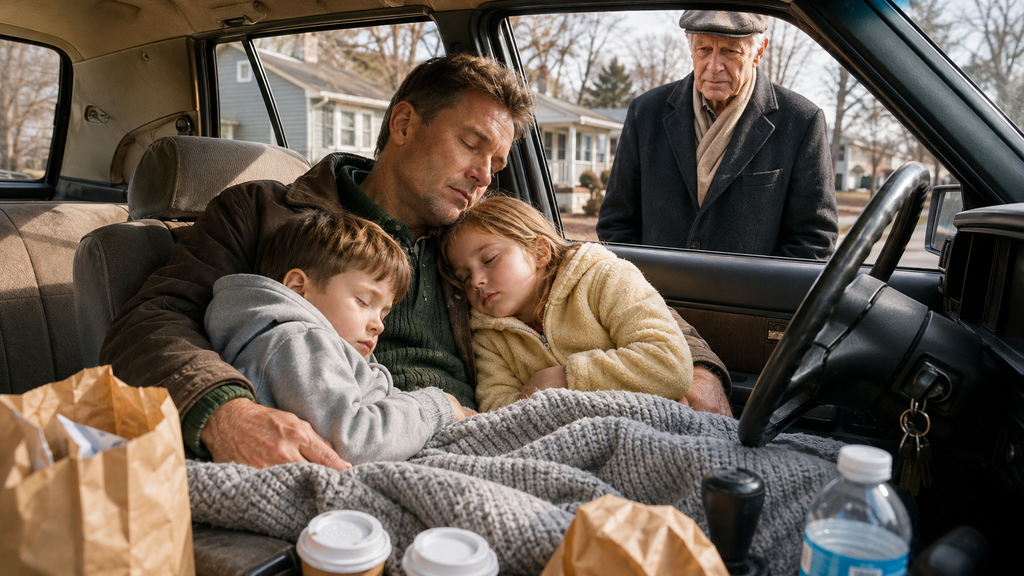
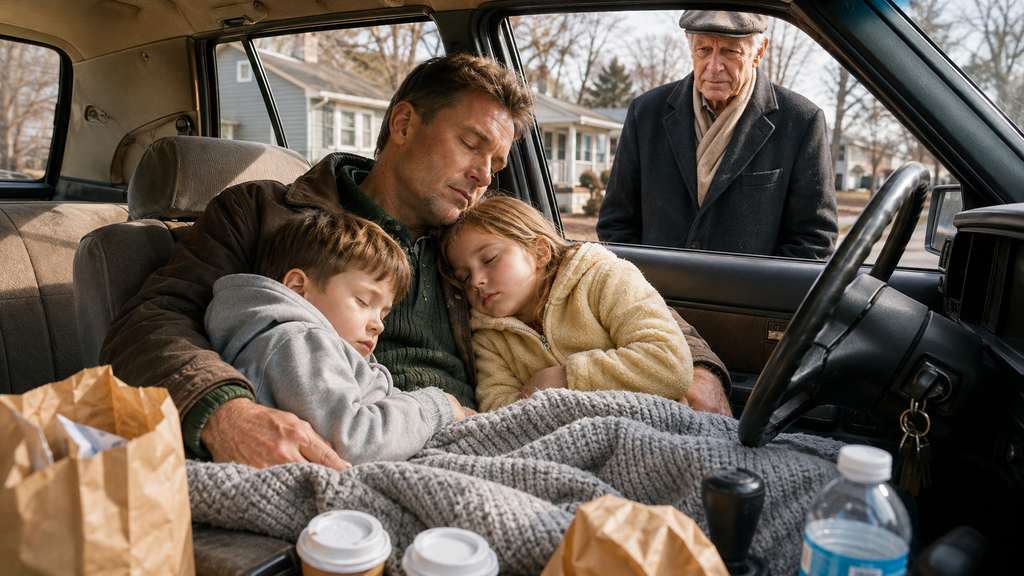
I looked at my thirty-two-year-old son sitting behind the steering wheel of a freezing Honda Civic, with my five-year-old grandsons sleeping beneath a blanket in the back seat, and said only one thing.
“Tell me everything.”
Then I added,
“And this time, Daniel, do not protect anyone.”
PART ONE — THE CAR AT THE EDGE OF THE AIRPORT LOT
The Chicago wind found every opening in my coat.
It came across the long-term parking lot at O’Hare like something alive, cutting beneath my scarf, burning my ears, and making my fingers ache even through my gloves.
I remember thinking that March had no business being that cold.
Then again, Chicago had never cared much about what anyone thought it should be.
I had taken an overnight flight from Seattle because my son, Daniel Foster, was turning thirty-two.
He did not know I was coming.
That was the point.
For the previous few years, birthdays had become phone calls.
A package delivered two days early.
A video chat with Caleb and Noah fighting over who got to hold the phone.
A promise that we would “do something properly next time.”
There was always a next time.
Until suddenly I realized I had begun measuring my relationship with my son in airline miles and postponed plans.
So I bought the ticket.
I planned to rent a car, drive to Daniel’s house in Evanston, knock on the door before breakfast, and complain dramatically about the fact that my grandchildren had apparently forgotten how to call their grandfather without needing to be bribed.
I had presents in my luggage.
Two remote-control cars for the twins.
A watch for Daniel.
Nothing extravagant.
The watch was engraved on the back.
For every hour still ahead. — Dad
I had almost chosen something sentimental about time passing.
Now I am glad I didn’t.
At the rental counter, the woman behind the desk told me my vehicle was parked in the far section of the long-term lot.
I dragged my suitcase through the cold, muttering under my breath because the shuttle had dropped me farther away than I expected.
I was halfway down the row when I noticed the silver Honda Civic.
I knew the license plate before I consciously understood why I had stopped.
Daniel’s car.
I smiled at first.
I actually smiled.
For one stupid second, I thought maybe he had left his car at the airport because he was traveling for work.
Then I noticed the windows.
They were fogged from the inside.
Not lightly misted.
Covered.
I stopped walking.
Something inside me tightened.
The driver’s side window had one small patch where someone had wiped away the condensation.
I took a few steps closer.
There were grocery bags on the passenger floor.
A winter coat was stuffed against the dashboard.
A pair of tiny sneakers sat beside the center console.
I recognized them.
Noah’s.
My suitcase slipped from my hand.
It landed hard on the pavement.
I moved toward the car.
Every part of me was already saying no.
No.
No.
No.
I leaned toward the glass.
Daniel was asleep against the driver’s door.
Not sleeping the way a tired man rests during a road trip.
Sleeping like someone whose body had finally shut down because exhaustion had won.
His beard was longer than I had ever seen it.
His face looked thinner.
There were dark circles beneath his eyes.
His jacket was zipped to his throat.
Then I looked into the back seat.
My grandsons were curled together beneath one thick blanket.
Caleb’s head rested against the window.
Noah was holding the stuffed brown bear he had carried around since he was three.
There were clothes beneath their feet.
Backpacks.
Plastic bags.
Empty water bottles.
Fast-food wrappers.
One small plastic bin filled with crayons.
For several seconds, the wind disappeared.
The airport disappeared.
Everything disappeared.
There was only that car.
That back seat.
Those two little boys.
And my son.
My son, who had once called me because he could not figure out how to install a ceiling fan.
My son, who had been so proud when he bought his first house that he made me walk through every room twice.
My son, who had built a technology company from three laptops, a folding table, and an idea everyone told him would fail.
My son was living in a car.
I knocked hard against the window.
Daniel shot upright.
The speed of it frightened me.
His eyes opened wide, confused and panicked.
His hand immediately reached toward the back seat.
It was the reflex of a father checking his children before checking himself.
Then he saw me.
His face changed.
Shock came first.
Then disbelief.
Then shame.
That was the expression that hurt the most.
Not relief.
Not happiness.
Shame.
He opened the door.
Cold air rushed inside.
“Dad?”
His voice sounded raw.
“What are you doing here?”
I stared at him.
“I came for your birthday.”
His mouth opened.
Nothing came out.
I looked past him at the twins.
“The better question is why my son and my grandsons are sleeping in an airport parking lot.”
He closed his eyes.
“Dad—”
“Daniel.”
“It’s complicated.”
I stared at him.
“You are living in a Honda Civic with two five-year-old boys during a Chicago winter.”
He looked down.
“We have passed complicated.”
His jaw tightened.
“I didn’t want you to see me like this.”
That sentence nearly did something to me.
Not because I was embarrassed for him.
Because he thought there was a version of his life bad enough that his father should not see it.
Movement came from the back seat.
Caleb sat up.
His hair was flattened on one side.
He rubbed both eyes.
Then he saw me.
His entire expression brightened.
“Grandpa?”
I had to turn my face for half a second before answering.
“Yeah, buddy.”
“What are you doing here?”
I swallowed.
“Apparently freezing to death because your dad forgot Chicago has weather.”
Daniel made a broken sound that was almost a laugh.
Caleb smiled.
Noah woke beside him and immediately grabbed his bear.
“Grandpa!”
“Hey, little man.”
“Are you camping with us?”
My eyes went to Daniel.
He stared at the steering wheel.
I understood immediately.
They did not know.
“They think we’re camping,” Daniel whispered.
The words were barely audible.
I looked again at the back seat.
At the blankets.
At the grocery bags.
At the tiny sneakers.
The little boys were excited because, in their minds, their father had turned homelessness into an adventure.
I looked at Daniel.
He had managed to lose nearly everything and still protect his children from understanding exactly how much had been lost.
I crouched beside the open door.
“How about breakfast?”
Caleb sat straighter.
“Pancakes?”
“Absolutely.”
“Chocolate-chip pancakes?”
I nodded solemnly.
“I am a grandfather. We have different nutritional laws.”
Noah raised his hand.
“Can I have whipped cream?”
“Now you’re thinking.”
The boys started moving.
Daniel did not.
I waited until they were climbing out.
Then I leaned close enough that only he could hear me.
“You are not spending another night in this car.”
His eyes filled immediately.
“Dad—”
“I don’t care how we got here yet.”
He swallowed.
“I messed everything up.”
“We’ll decide that after I know what happened.”
“I should have called.”
“Yes.”
He flinched.
I softened my voice.
“Yes, you should have.”
His eyes dropped.
“But you didn’t.”
I put my hand on his shoulder.
“So I came.”
That broke him.
Not loudly.
Daniel did not collapse.
He simply lowered his head and pressed both hands over his face.
For a moment, he was thirty-two.
Then twenty-two.
Then twelve.
Then five.
Every age a son can be while his father is standing beside him.
I squeezed his shoulder.
“Get your boys.”
He wiped his face.
“Dad, you don’t understand.”
“No.”
I looked straight at him.
“I don’t.”
Then I picked up my suitcase.
“But I’m going to.”
PART TWO — EVERYTHING SHE TOOK
An hour later, we were sitting in an airport restaurant.
Caleb and Noah had pancakes.
Whipped cream.
Chocolate chips.
Enough syrup to qualify as structural engineering material.
They were happy.
That mattered more to me than anything else in that moment.
Daniel sat across from me with both hands wrapped around a black coffee.
He had barely touched it.
Every few seconds, he glanced toward the boys.
Making sure they were still there.
Making sure I had not changed my mind.
I leaned forward.
“Start at the beginning.”
He exhaled.
“It’s a long story.”
“I have time.”
He stared into his coffee.
“Dad…”
I waited.
He finally looked at me.
“I need you not to hate me after I tell you.”
My chest tightened.
“Daniel, I found you sleeping in a car.”
He looked away.
“That isn’t what I mean.”
“What do you mean?”
“I trusted her.”
There it was.
The real shame.
Not losing money.
Not the company.
Not even the house.
Trust.
He thought trusting the woman he married had made him foolish.
“Tell me everything,” I said.
He hesitated.
Then I added,
“And do not protect anyone.”
Daniel looked toward Caleb and Noah.
Their heads were bent over their pancakes.
He began.
Lauren Whitaker had left him three months earlier.
According to Daniel, the marriage had been deteriorating much longer than that.
Lauren had always handled paperwork better than he did.
Daniel was an engineer.
He understood systems, software, product design, and people when those people worked inside a company hierarchy.
Household paperwork bored him.
Contracts intimidated him more than he admitted.
Lauren was organized.
Detailed.
Confident.
She remembered deadlines.
She remembered passwords.
She handled taxes.
Insurance.
Banking.
Much of the company bookkeeping.
And Daniel had trusted her.
“About six months before she left,” he said, “she told me we needed to move the house completely into her name.”
“Why?”
“She said if the company ever got sued or ran into creditor problems, somebody might come after the house.”
“And you believed her?”
He nodded.
“I asked whether we should talk to an attorney.”
“What did she say?”
“That we’d waste thousands of dollars being told something she already knew.”
I leaned back.
Daniel saw my expression.
“I know.”
“No,” I said. “Keep going.”
He transferred the house.
Their home.
The place where Caleb and Noah had learned to walk.
The backyard where I had helped Daniel build a swing set badly enough that Lauren threatened to hire someone before we killed the children.
The kitchen where we had eaten Thanksgiving dinner.
The house went into Lauren’s name.
Daniel signed.
A few months later, he came home from work and his key no longer fit the lock.
He tried again.
Then a third time.
He thought the lock was broken.
A man stepped from a car parked across the street.
Process server.
Emergency protective order.
Daniel was prohibited from entering his own home.
Lauren had claimed he was mentally unstable.
Threatening.
Controlling.
Increasingly erratic.
Dangerous around her.
Possibly dangerous around the boys.
My hands tightened around the table.
“What evidence?”
“Messages.”
“What messages?”
“Texts supposedly from me.”
“What did they say?”
Daniel lowered his voice.
“That I’d take the boys and disappear. That if she tried to leave me, she’d regret it. That nobody would ever believe her over me.”
“Did you send them?”
“No.”
He answered instantly.
No hesitation.
No qualification.
“No.”
I studied him.
He did not look away.
“What else?”
“Her parents backed her up.”
Diane and Charles Whitaker.
I knew them.
Not well.
But enough.
Charles was a real-estate developer.
The kind of man who shook your hand while already scanning the room for someone richer.
Diane had always treated concern like a competitive sport.
If Daniel had a cold, she diagnosed pneumonia.
If Caleb fell at the playground, she acted as though someone should be investigated.
“Diane said she had seen me behaving aggressively with the boys,” Daniel continued. “Charles said I’d been irrational about money.”
“Were you?”
“I was stressed.”
“That wasn’t my question.”
He closed his eyes.
“No. I yelled once during an argument with Lauren. I slammed a cabinet door. I said things I regret.”
“Did you threaten her?”
“No.”
“Did you threaten the boys?”
“Never.”
“Hit anyone?”
“No.”
“Break anything?”
“No.”
“Drugs?”
“No.”
“Alcohol problem?”
“No.”
“Anything else I need to hear from you before I hear it from somebody wearing a suit?”
Daniel almost smiled.
“No.”
“Good. Continue.”
The first hearing went badly.
Lauren presented the messages.
Diane described Daniel as unstable.
Charles spoke about “erratic business behavior.”
Daniel’s attorney at the time had treated the hearing as something temporary.
Something they would fix later.
But temporary orders have a way of becoming the shape of someone’s life.
Daniel was granted supervised contact with the twins.
Twice a week.
Diane supervised.
His own mother-in-law.
The woman supporting the allegations against him was allowed to write reports describing how he behaved around his children.
“Why did your attorney agree to that?”
“He said it was better than no visitation.”
I had several thoughts about that attorney.
None of them were useful at breakfast.
“What happened to the company?”
Daniel stared down.
His expression changed again.
This part hurt differently.
Years earlier, I had invested $150,000 in his startup.
I did not give him the money because he was my son.
I gave it to him because he showed me a business plan that was better than most proposals I had reviewed during thirty years in business.
He had customers.
A product.
A path.
He still worked insane hours.
But there was something real there.
Lauren handled many of the operating accounts.
Daniel ran product development and clients.
The day before she requested the protective order, most of the company’s remaining capital was transferred.
“To where?”
“An investment account tied to Charles.”
I stared at him.
“How much?”
“The first transfer was almost exactly your original investment.”
“One hundred fifty thousand?”
He nodded.
“What reason?”
“Repayment of a business loan.”
“What business loan?”
“That’s what I kept asking.”
“Did Charles ever lend the company $150,000?”
“No.”
“Was there a loan agreement?”
“I never saw one.”
“Promissory note?”
“No.”
“Invoice?”
“No.”
“Board approval?”
“No.”
I sat back.
“And nobody thought this was strange?”
“Lauren controlled the paperwork.”
“Who had access?”
“She did. I did. Our bookkeeper had limited access.”
“What happened next?”
“Lauren called clients.”
“What did she say?”
“That I was having a breakdown.”
I stopped moving.
Daniel continued.
“She told two of our largest customers they should protect themselves until I got treatment. One delayed renewal. Another terminated.”
He stared toward the window.
“I couldn’t make payroll.”
His voice changed.
That was the first time I heard anger instead of shame.
“I had people who trusted me. People with kids. Mortgages.”
“What did you do?”
“I emptied what I had personally.”
“You paid them?”
“As much as I could.”
“And then?”
“The company folded.”
He said it quietly.
Like he was talking about a death.
Maybe he was.
People sometimes tell entrepreneurs not to become emotionally attached to their companies.
Those people have never watched someone build one.
A company can be numbers on paper.
It can also be ten years of mornings.
Missed birthdays.
Risks.
Failures.
People.
Identity.
Daniel had watched his collapse while fighting to see his children.
He took temporary labor jobs.
Warehouse work.
Delivery shifts.
IT contracts when he could get them.
His savings disappeared into legal fees.
Without stable income, he lost his apartment.
Without stable housing, Lauren’s attorney argued he was even less capable of having the twins overnight.
It was a trap.
Every loss became evidence supporting the person who had helped create the loss.
“Why are the boys with you now?” I asked.
Daniel looked toward them.
“Lauren went out of town.”
“For what?”
“I don’t know. She said I could have them for four days if I kept them within the county and followed the order.”
“And you brought them here?”
He nodded.
“The first night, we used a cheap motel.”
“Why not every night?”
His jaw tightened.
“Because I have forty-seven dollars until Friday.”
I looked down.
I had to.
My anger had become too visible.
Caleb glanced toward me.
I forced my expression neutral.
“Grandpa, Noah stole my strawberry.”
“I traded!”
Noah protested.
“You did not trade!”
“I gave you bacon.”
“You already ate half of it!”
I pointed at them.
“International breakfast law says all disputes involving bacon must be resolved by the adults.”
They stared at me.
Daniel laughed.
A real laugh this time.
Small.
Brief.
But real.
Then the boys went back to eating.
I looked at my son.
“Why didn’t you call me?”
His smile vanished.
He took a long time answering.
Finally he said,
“Because you invested in me.”
I frowned.
“And?”
“I lost it.”
“My investment?”
“The company. The house. My family. Everything.”
“Daniel—”
“I thought if I called you, I’d have to say it out loud.”
He rubbed his hands together.
“I’d have to tell you that you gave me one hundred fifty thousand dollars because you believed I knew what I was doing, and I let my own wife move money out from under me.”
His voice broke.
“I let her take the house.”
“You signed paperwork your spouse told you protected your family.”
“I should’ve known.”
“Maybe.”
He stared at me.
I did not rescue him from that word.
Maybe he should have asked more questions.
Maybe he should have insisted on independent counsel.
Maybe he had been careless.
Love does not require lying to your children about their mistakes.
But mistakes and deserved destruction are not the same thing.
“You trusted your wife,” I said. “That may have been unwise in ways we’ll understand later. It does not make you responsible for everything someone may have done with that trust.”
His eyes filled.
He blinked rapidly.
“I kept thinking everyone was right.”
“About what?”
“That I was unstable.”
My stomach turned.
“Why?”
“When enough people say something about you…”
He stopped.
“What?”
“You start checking yourself.”
He looked at his hands.
“I’d be angry and think, there. Maybe that’s what she means. I’d cry after a visit with the boys and think, there. Maybe I am losing it.”
I said nothing.
“They made every normal reaction feel like proof.”
That sentence sat between us.
I reached across the table.
“Daniel.”
He looked at me.
“Anyone who convinced you that asking your father for help was proof you couldn’t take care of yourself has already taken too much.”
His mouth tightened.
“I don’t know how to fix it.”
“You don’t.”
He looked surprised.
“I thought you were going to tell me everything would be okay.”
“I’m not going to promise what I don’t know.”
He lowered his eyes.
“What I can promise is that you will not solve this from a parking lot.”
I squeezed his hand.
“This ends with you sleeping in that car.”
PART THREE — WE BUILT A CASE, NOT A WAR
That afternoon, I booked a larger hotel suite.
Not because it was luxurious.
Because it had two bedrooms.
Daniel argued.
Of course he argued.
“Dad, this place costs too much.”
“I can afford it.”
“I can sleep on the sofa.”
“You can sleep in a bed.”
“I don’t need—”
I turned.
“Daniel.”
He stopped.
“You have spent months having other people decide what you need.”
I pointed toward the bedroom.
“For tonight, your father has decided you need eight hours of sleep.”
For the first time, he didn’t argue.
The twins thought the hotel was wonderful.
They jumped between beds.
Discovered the tiny refrigerator.
Fought over who got which pillow.
Noah stood in front of the window watching airplanes.
Caleb found the ice machine and acted like he had discovered an industrial miracle.
Children can make temporary places feel permanent.
That night, after they fell asleep, Daniel came into the living room.
I was sitting at the small desk with a legal pad.
“Who are you calling?”
“People.”
“That sounds dangerous.”
“It should.”
He smiled weakly.
My first call was to David Park.
David and I had known each other through business circles for nearly three decades.
Corporate law.
Transactions.
Litigation.
The kind of man who could listen to a ten-minute explanation and immediately identify the three sentences that mattered.
He let me talk without interruption.
Then he said,
“You need two things.”
“Name them.”
“A serious family-law attorney and a forensic accountant.”
“Can you handle the company side?”
“Yes.”
“Who handles family court?”
There was no hesitation.
“Melissa Grant.”
“Good?”
“Very.”
“Expensive?”
“Extremely.”
“Better.”
David laughed.
“You sound angry.”
“I found my son living in a car.”
Silence.
Then his voice changed.
“I’ll call her.”
My second call was to Karen Blake.
Detective Karen Blake.
Old friend.
Chicago police.
Years earlier, I had helped her family through a business dispute.
She owed me nothing.
That mattered.
I did not call Karen because I wanted someone wearing a badge to frighten Lauren.
I called because I needed to know the difference between what felt criminal and what could actually be documented.
Karen listened.
Then she said,
“I can’t use police access for this.”
“I know.”
“I can’t pull records because you’re angry.”
“I know.”
“And I won’t make a domestic dispute into a criminal investigation because you asked.”
“That’s why I called you.”
She paused.
“What do you have?”
“Financial transfers. Possibly fabricated messages.”
“Then preserve everything.”
“How?”
“Legally. Through attorneys. Devices. Original files. Carrier records. Bank records. Don’t touch anything you shouldn’t. Don’t confront anybody. Don’t threaten anybody.”
She knew me too well.
“Ray?”
“Yes?”
“Do not become the story.”
I looked through the glass toward the bedroom where my grandsons were sleeping.
“I won’t.”
“Good. Build facts.”
That became our rule.
Build facts.
Not revenge.
Not rage.
Facts.
The following morning, we met Melissa Grant.
Her office was downtown.
Glass walls.
Minimal decoration.
No framed slogans about justice.
No theatrical bookshelves.
She wore a charcoal suit and had the controlled expression of someone who had heard every possible version of a family disaster.
Daniel told his story.
At first, he rushed.
Then he apologized.
Then he backed up.
Melissa stopped him.
“Mr. Foster.”
Daniel looked at her.
“You do not need to persuade me emotionally.”
He stiffened.
“You need to tell me what happened.”
“I am.”
“No.”
She leaned forward.
“You are telling me why you think your former wife is a terrible person. That may or may not be relevant later.”
Daniel blinked.
“What I need first is what we can prove.”
That was the moment I knew David had recommended the right attorney.
Melissa opened a tablet.
“House transfer?”
“Documents exist.”
“Company accounts?”
“Yes.”
“Threatening messages?”
“Screenshots.”
“Original device?”
“I still have my phone from that period.”
“Good. Do not alter it.”
She continued.
“Therapy?”
Daniel flinched.
“Yes.”
“Why?”
“Stress.”
“Diagnosis?”
“Anxiety. Exhaustion.”
“Any psychiatric hospitalization?”
“No.”
“Suicidal threats?”
“No.”
“Violent ideation?”
“No.”
“Medication?”
“Short-term sleep medication for a while.”
“Any reason your therapist would describe you as dangerous?”
“No.”
“Then stop treating therapy like a confession.”
Daniel stared at her.
Melissa continued.
“Seeking help when you are under stress is not evidence that you are dangerous. Hiding a legitimate medical history because you are ashamed can create more problems than the history itself.”
Daniel looked at me.
I gave him a small nod.
His therapist was Dr. Priya Shah.
Melissa requested records only with Daniel’s authorization and only those relevant to the allegations.
Dr. Shah’s notes documented exactly what Daniel had told us.
Anxiety.
Sleep deprivation.
Work pressure.
Marital stress.
No psychosis.
No violent ideation.
No threats toward his children.
Daniel had done what people constantly tell struggling adults to do.
He had asked for help.
Then that act had been turned against him.
Melissa refused to let us become theatrical about it.
“The strongest response to exaggerated evidence is not exaggerated counter-evidence.”
She looked at both of us.
“It is clean evidence.”
So we cleaned up Daniel’s life one piece at a time.
I rented him a modest three-bedroom apartment in Evanston.
Not a luxury building.
Not a penthouse anyone could claim was designed to impress the court.
A safe apartment.
Near the boys’ school.
Near their doctors.
Near the routines they already knew.
Daniel protested about the rent.
“I’m paying you back.”
“Fine.”
“I mean it.”
“Then get a job first.”
He did.
A former colleague named Marcus Bell had heard rumors about Daniel’s divorce months earlier.
He had kept his distance.
Now, after reviewing Daniel’s work history and talking with former customers, he offered him a senior engineering position at a growing technology company.
Not charity.
Employment.
Daniel came home after signing the offer and sat at the kitchen counter holding the contract.
“You okay?” I asked.
He nodded.
Then shook his head.
Then laughed.
“I forgot what it feels like to be hired.”
I poured coffee.
“Probably a lot like being hired.”
“No.”
He looked at the paper again.
“It feels like somebody looked at me and didn’t see the story she told.”
That stayed with me.
We documented everything honestly.
My assistance with the apartment.
Daniel’s employment.
His therapy.
His parenting schedule.
The hotel.
The car.
We hid nothing.
Melissa’s position was simple.
Support from family did not make a parent unstable.
Sometimes family was exactly what stability looked like.
Then she started following the money.
PART FOUR — THE MONEY HAD A MEMORY
Melissa hired Ethan Cho.
If Hollywood had designed a forensic accountant, Ethan would have disappointed everyone.
No dramatic personality.
No expensive watch.
No aggressive questions.
He wore wire-frame glasses, carried a plain black backpack, and spoke so calmly that I sometimes wanted to check whether he had a pulse.
Then he opened financial records.
And suddenly every dollar in the room seemed nervous.
Weeks passed.
Subpoenas.
Bank statements.
Accounting exports.
Email records.
Corporate filings.
Vendor lists.
Payment authorizations.
Daniel became restless.
“How long does this take?”
Ethan looked up from his laptop.
“As long as the money takes to tell the truth.”
Daniel glanced at me.
I shrugged.
“He’s an accountant. They’re allowed one dramatic sentence per quarter.”
Ethan ignored me.
Three weeks later, he asked us to meet.
There was a flowchart on the conference-room screen.
Boxes.
Dates.
Account numbers.
Arrows.
My original $150,000 investment entered the company cleanly.
It had been used for hiring, software infrastructure, marketing, and operating expenses.
Nothing unusual.
Then Ethan highlighted one transaction.
$150,000 had left the operating account.
Recipient: an account controlled by Charles Whitaker.
Description:
Vendor Settlement.
Ethan folded his hands.
“We asked for the vendor agreement.”
Daniel leaned forward.
“And?”
“None has been produced.”
“Invoice?”
“No.”
“Services?”
“We have not identified services corresponding to the transfer.”
“Loan agreement?”
“No executed agreement has been produced.”
I stared at the screen.
“So my investment goes into Daniel’s company, and eventually an identical amount goes to Lauren’s father.”
Ethan looked at me.
“That is factually accurate.”
“Call it what it is.”
Melissa cut in immediately.
“No.”
I looked at her.
She was staring at Daniel, not me.
“We are not going to call anything theft unless we can establish theft.”
Daniel sat back.
Ethan changed the slide.
More arrows appeared.
Smaller transfers.
Five hundred.
Nine hundred.
Two thousand.
Three thousand.
Amounts that would not frighten anyone individually.
Money moved from company accounts into accounts Lauren controlled.
Then some moved onward to entities associated with Charles.
Not once.
Repeatedly.
Over roughly fourteen months.
Ethan had reconstructed approximately $280,000 in transfers requiring explanation.
Daniel stared at the number.
His face went white.
“No.”
Nobody spoke.
He stood.
Walked away from the table.
Put both hands on the window.
“No.”
I moved toward him.
He shook his head.
“I was borrowing on my own credit card to make payroll.”
His voice rose.
“I was calling customers at midnight.”
“Daniel—”
“I cancelled my health insurance for three months.”
He turned around.
“I sold my motorcycle.”
I remembered.
He had told me he no longer had time to ride.
“I was working eighteen-hour days because Lauren kept telling me the company was bleeding cash.”
His chest moved rapidly.
“All that time…”
Melissa stood.
“Sit down.”
“I can’t.”
“Yes, you can.”
He looked at her angrily.
“You don’t understand.”
“I understand you are about thirty seconds from turning a financial analysis into an emotional collapse someone could later describe out of context.”
That stopped him.
It sounded cruel.
It wasn’t.
Melissa pointed at the chair.
“Sit.”
Daniel sat.
She waited.
“Breathe.”
He did.
“Again.”
He breathed.
Then she said,
“You are allowed to be angry.”
His jaw tightened.
“You are allowed to be devastated.”
His eyes filled.
“But your anger does not establish what happened to this money.”
She pointed at Ethan’s chart.
“Records do.”
Daniel nodded slowly.
Ethan spoke.
“These transactions deserve explanation.”
Nothing more.
Nothing less.
That discipline protected us.
Because we were not going to answer one questionable story by creating another.
The visitation records came next.
Diane Whitaker had written detailed reports from Daniel’s supervised visits.
Father appeared emotionally intense.
Father hovered over Noah in a manner that appeared controlling.
Father questioned Caleb repeatedly regarding home life.
Father became visibly agitated when visit ended.
Read alone, the notes sounded disturbing.
Then Melissa obtained records from a neutral professional visitation center.
The difference was astonishing.
Children greeted father enthusiastically.
Both children initiated physical affection.
Father demonstrated appropriate redirection.
No observable signs of fear.
Father remained calm during transition.
One report described Noah becoming upset when he could not find a toy.
Daniel knelt beside him.
Helped him breathe.
Asked where he remembered seeing it.
Then helped him search.
Diane had described a similar moment months earlier as Daniel “hovering aggressively over the child.”
Melissa placed both descriptions beside each other.
“See the problem?”
Daniel nodded.
“It sounds like two different fathers.”
“Exactly.”
She tapped the paper.
“This does not prove Diane knowingly lied.”
Daniel’s expression tightened.
“Then what does it prove?”
“That interpretation changes depending on who is interpreting.”
She looked at him.
“And that neutral observation matters.”
Then came the messages.
The screenshots that had nearly destroyed him.
PART FIVE — THE MESSAGES THAT NEVER TRAVELED
A digital-forensics specialist named Aaron Patel examined Daniel’s old phone.
Not casually.
Not by scrolling through screenshots.
The device was preserved and analyzed properly.
Melissa sought carrier records through legal channels.
Dates.
Times.
Transmission records.
The screenshots Lauren had submitted were compared against data that existed outside either spouse’s control.
At first, nothing happened.
Then Aaron found the first inconsistency.
A threatening message supposedly sent by Daniel at 11:14 p.m.
There was no matching transmission in the carrier record.
Then another.
Then another.
Some timestamps did not align.
Some image characteristics were inconsistent with direct screenshots from Daniel’s device.
Several files contained indications of editing or assembly.
Not proof that every accusation had been fabricated.
But enough to make the foundation shake.
Daniel sat in Aaron’s office staring at the report.
“So I’m not crazy.”
Nobody answered immediately.
He laughed once.
It sounded terrible.
“I kept looking through my phone.”
He rubbed his forehead.
“Night after night. I thought maybe I’d deleted something and forgotten.”
His voice dropped.
“I started wondering whether I could’ve sent things when I was exhausted.”
I wanted to say something.
Nothing felt adequate.
Daniel looked at me.
“Do you know what it’s like to be afraid of your own memory?”
“No.”
“It’s worse than being accused.”
He swallowed.
“Because if someone says you did something you know you didn’t do, you fight.”
His eyes were wet.
“But when everyone treats the accusation like it already happened…”
He looked down.
“You start wondering whether you are the least reliable person in your own life.”
I put my hand over his.
“That ends here.”
He looked at me.
“Not because we know everything,” I said. “Because we finally know enough to stop treating every accusation as fact.”
Six months after I found Daniel at O’Hare, we returned to court.
This time, he walked through the courthouse doors in a dark suit.
His hair was cut.
His face was fuller.
He was still nervous.
That mattered.
People think strength means not being afraid.
It doesn’t.
Sometimes strength is knowing exactly what a room can take from you and walking into it anyway.
Lauren arrived with Diane.
Charles.
And her attorney, Scott Lambert.
Lauren looked polished.
Calm.
She wore navy blue.
Her hair was pinned neatly.
If someone had photographed the hallway, nobody could have identified the villain.
That realization bothered me.
Then I understood the problem.
I was still thinking in terms of villains.
Melissa was not.
She was thinking about credibility.
Evidence.
Parenting.
Facts.
Judge Eleanor Briggs entered shortly after nine.
She was in her sixties.
Silver hair.
Sharp eyes.
No visible patience for performance.
The hearing began with Daniel’s current circumstances.
Employment.
Apartment.
Therapy.
Compliance.
Parenting history.
Scott Lambert stood.
“Isn’t it true that Mr. Foster’s present housing exists only because his father pays for it?”
Daniel’s shoulders tightened.
Melissa did not react.
“My client has disclosed family support.”
“Then would you agree he is not independently stable?”
“Objection.”
The judge looked toward Scott.
“Counsel?”
Scott adjusted.
“Your Honor, financial dependency is relevant to the father’s claimed change in circumstances.”
Melissa stood.
“Financial support from extended family does not automatically establish instability. Mr. Foster has lawful housing, employment, consistent therapy, and documented compliance with every court requirement.”
Judge Briggs looked at Daniel.
“Are you employed?”
“Yes, Your Honor.”
“Full time?”
“Yes.”
“Current lease?”
“In my name. My father helped with the initial costs.”
The judge nodded.
No drama.
No humiliation.
Just fact.
Then came Diane’s visitation reports.
Melissa approached slowly.
“Mrs. Whitaker, you wrote that Mr. Foster frequently behaved aggressively during supervised contact?”
“Yes.”
“Toward the children?”
“Sometimes.”
“What does ‘aggressively’ mean?”
Diane hesitated.
“He could be intense.”
“Intense?”
“He hovered.”
“Please describe an example.”
Diane mentioned a visit during which Noah struggled with his shoe.
Daniel had moved quickly toward him.
Knelt close.
Taken over.
Melissa picked up a neutral supervisor report.
“Would it surprise you to learn that a licensed professional later observed Mr. Foster helping Noah with shoes and described the interaction as appropriate parental assistance?”
Scott objected.
Judge Briggs allowed limited questioning.
Diane defended herself.
“I know Daniel better than some stranger at a visitation center.”
Melissa nodded.
“Exactly.”
Diane looked confused.
Melissa continued.
“You had existing beliefs about him when you supervised the visits, correct?”
“I had concerns.”
“Concerns based partly on what your daughter told you?”
“Yes.”
“And you wanted to protect your grandchildren?”
“Of course.”
“So your interpretation of Mr. Foster’s behavior was not neutral.”
Scott stood.
“Argumentative.”
“Sustained.”
Melissa moved on.
She did not need Diane to confess bias.
The point existed.
Then the digital evidence came.
Aaron Patel explained screenshots.
Carrier records.
Transmission logs.
Metadata.
File characteristics.
He used plain language.
That helped.
“Would every text message necessarily appear in every carrier record?” Scott asked.
“No.”
“Can metadata be altered during normal device transfers?”
“Yes.”
“So you cannot tell this court that every disputed screenshot was fabricated?”
“No. That is not my conclusion.”
Scott looked satisfied.
Then Melissa stood.
“What is your conclusion?”
Aaron turned toward the judge.
“That several submitted screenshots do not correspond with available independent records in ways I would expect if they were direct, unmodified captures of messages sent from Mr. Foster’s device.”
Silence.
Lauren shifted in her chair.
Melissa called her later.
The questioning was careful.
“Did Daniel send every threatening message represented in the screenshots you submitted?”
Lauren looked at Scott.
“I believed so.”
“That was not my question.”
Scott objected.
Judge Briggs instructed Melissa to rephrase.
Melissa did.
“Were you personally present when each screenshot was created from your device?”
“No.”
“Who prepared them?”
“Some were sent to me.”
“By whom?”
“My mother helped organize evidence.”
Diane’s face changed.
Melissa continued.
“Did you verify every image before submitting it?”
Lauren swallowed.
“I was under enormous stress.”
“Did you verify them?”
“Not individually.”
There it was.
Not a confession.
Not a dramatic collapse.
Something more important.
Uncertainty.
The evidence that had once been treated like concrete was beginning to behave like sand.
Then Ethan Cho took the stand.
Money rarely makes good courtroom drama.
It is too boring.
Too specific.
Too dependent on documents.
That day, boring became powerful.
Ethan traced my $150,000.
Explained the company accounts.
Explained the transfer to Charles.
Explained the missing documentation.
Explained the smaller related transfers.
Scott challenged him.
“Isn’t it possible these transfers represented legitimate family financing?”
“Yes.”
Daniel looked alarmed.
I touched his arm.
Ethan continued.
“That explanation would normally be supported by documentation.”
“What documentation?”
“Loan agreements. Repayment schedules. Promissory notes. Invoices. Corporate authorization. Correspondence. Accounting treatment consistent with debt.”
“Could an agreement be verbal?”
“Yes.”
“So absence of paperwork does not establish fraud?”
“No.”
Scott smiled.
“Thank you.”
Melissa stood.
“Mr. Cho, has any produced document established the claimed $150,000 business loan?”
“No.”
“Has any produced document explained the full pattern of approximately $280,000 in disputed transfers?”
“No.”
“Would you consider that pattern worthy of further accounting examination?”
“Yes.”
That was all.
No accusation.
No speech.
Facts.
Judge Briggs looked toward Lauren.
“Mrs. Whitaker.”
Lauren stiffened.
“Where is the loan agreement supporting the $150,000 repayment?”
“It was verbal.”
“Who negotiated it?”
“My father and Daniel.”
Daniel’s head snapped toward her.
Melissa stood.
“Your Honor—”
Judge Briggs lifted a hand.
She looked at Daniel.
“Mr. Foster, you will have an opportunity.”
Then she returned to Lauren.
“Were you present for this verbal agreement?”
“Not the entire conversation.”
“And the remaining transfers?”
Lauren began explaining.
Family reimbursements.
Expenses.
Temporary advances.
Payments.
The problem was not that every explanation was impossible.
The problem was that the explanations changed.
By the time she finished, the courtroom felt different.
The original case had been simple.
Unstable husband.
Frightened wife.
Concerned family.
Dangerous father.
Now every part had complications.
The judge called a recess.
Daniel walked into the hallway.
His hands were shaking.
“I think I’m going to be sick.”
Melissa gave him water.
“Do not predict the ruling.”
“What if she believes Lauren?”
“She will believe what she believes.”
“That’s comforting.”
“No.”
Melissa looked at him.
“But you cannot control her decision.”
Daniel stared toward the courtroom doors.
“I just want my sons.”
“I know.”
“I lost six months.”
“I know.”
“Caleb asked me last week why I can’t tuck him in at Mom’s house.”
Melissa’s expression softened for the first time.
“Then remember why you are here.”
Daniel closed his eyes.
“I am not trying to punish their mother.”
“Good.”
“I want them to have a mother.”
“I know.”
“I just want them to have me too.”
Melissa nodded.
“That is the sentence you remember.”
The court resumed.
Judge Briggs returned.
Nobody breathed normally.
Her ruling was not the revenge fantasy angry people like to imagine.
She did not slam a gavel and call Lauren a liar.
She did not immediately hand Daniel full custody.
She did something far more believable.
She reconsidered.
She said the evidence supporting the original restrictions now presented significant credibility concerns.
The neutral visitation records did not support an ongoing assumption that Daniel posed a danger during ordinary parenting interactions.
The disputed electronic evidence required further scrutiny.
Daniel had demonstrated consistent compliance, stable employment, suitable housing, and continuing treatment.
The court would modify the temporary arrangement.
Immediately.
Daniel would receive expanded parenting time.
Unsupervised periods.
Then overnight visits through a structured transition.
A guardian ad litem and custody evaluator would continue reviewing the best interests of Caleb and Noah.
The financial questions would proceed separately.
Potential issues involving false evidence or improper financial conduct could be referred to appropriate authorities.
Daniel lowered his head.
His shoulders started shaking.
I put my arm around him.
He was crying.
Not because he had won.
He had not.
Not yet.
He was crying because, for the first time in months, someone with authority had stopped assuming the worst thing said about him must be true.
PART SIX — THE FIRST NIGHT HOME
Two weeks later, Caleb and Noah slept in Daniel’s apartment for the first time.
Daniel treated the occasion as if a foreign head of state were visiting.
He bought matching bedding.
Then returned it because he remembered they hated matching things.
He stocked the refrigerator.
Too much.
Fruit.
Yogurt.
Milk.
Chicken.
Juice.
Cheese.
Three kinds of cereal.
Four kinds of snacks.
I opened a cabinet.
“You planning for a siege?”
“They might want pretzels.”
“You own six bags.”
“They like different shapes.”
“They are five.”
“That’s exactly why shapes matter.”
He cleaned everything twice.
Vacuumed.
Checked the smoke detectors.
Installed outlet covers.
I watched him put a childproof latch on a cabinet containing nothing more dangerous than paper towels.
“Daniel.”
“What?”
“You’re losing perspective.”
“I’m being responsible.”
“You’re childproofing Bounty.”
He stared at the latch.
Then laughed.
“Okay.”
He removed it.
The boys arrived at four.
Lauren remained in the car.
No confrontation.
No speech.
Caleb ran toward Daniel.
Noah followed.
Daniel dropped to his knees.
They hit him hard enough to nearly knock him over.
I saw his face above their shoulders.
His eyes closed.
His hands held both boys.
He did not look at Lauren.
He did not look at me.
That moment belonged to three people.
That night we made pizza.
Not ordered.
Made.
The twins put too much cheese on everything.
Noah declared mushrooms illegal.
Caleb attempted to create a pizza shaped like a dinosaur.
It looked like a shoe.
Daniel laughed.
Later, I stayed long enough to help clean.
Then I picked up my coat.
Daniel followed me to the door.
“You’re leaving?”
“That is generally what coats mean.”
He looked nervous.
“You don’t have to.”
“Yes, I do.”
“Why?”
“Because they are staying with their father.”
His eyes flicked toward the hallway.
“I haven’t done bedtime alone in almost a year.”
“You did it for years before that.”
“What if they get upset?”
“Then they get upset.”
“What if they ask for Lauren?”
“You tell them it’s okay to miss their mother.”
He stared at me.
“What if I mess something up?”
I put my hand on his shoulder.
“You will.”
He blinked.
“Great.”
“You’ll give someone the wrong cup. You’ll forget pajama day. You’ll lose a mitten. One day you will say something stupid.”
“Encouraging.”
“That’s parenting.”
He swallowed.
“You’re not auditioning for fatherhood, Daniel.”
I looked toward the boys’ bedroom.
“You are their father.”
I left.
At 10:43 p.m., he texted me.
They’re asleep.
A minute later:
Both of them.
Then:
In beds.
Then:
Dad, they’re actually here.
I stared at that message for a long time.
Finally I wrote back.
I know.
PART SEVEN — THE FINAL CUSTODY ORDER
The final custody determination did not come quickly.
Real life rarely respects the schedule of a dramatic story.
There were interviews.
Reports.
More records.
Teachers were contacted.
Therapists were consulted.
Professional supervisors provided observations.
Both parents were evaluated.
The guardian ad litem spent time examining not simply what Daniel and Lauren claimed about each other, but what Caleb and Noah actually needed.
The boys loved their mother.
That fact mattered.
They loved their father.
That mattered too.
Daniel never asked them to choose.
Melissa warned him repeatedly.
“No questions about court.”
“I know.”
“No questions about what happens at their mother’s house unless safety requires it.”
“I know.”
“No speaking badly about Lauren.”
“I know.”
“And if they repeat something painful?”
“I listen.”
“And?”
“I do not interrogate.”
“Good.”
It was difficult.
Caleb once told him,
“Grandma Diane says you used to be sick.”
Daniel froze.
I saw it happen.
We were eating lunch.
For a split second, every emotion crossed his face.
Then he set down his sandwich.
“I was having a hard time.”
Caleb looked worried.
“Are you still sick?”
Daniel thought carefully.
“I still talk to a doctor when I’m stressed.”
“Like when I go to Dr. Mitchell?”
“Kind of.”
“Do you get stickers?”
Daniel smiled.
“No.”
“That’s not fair.”
“I agree.”
And that was the end of it.
Daniel called Melissa afterward.
“Should I document what Diane said?”
“Yes.”
“Should we confront her?”
“No.”
“Why not?”
“Because Caleb is five.”
That answer became another rule.
The children were not evidence containers.
They were children.
Eventually, the evaluator’s findings became clear.
Daniel’s bond with Caleb and Noah was strong.
The boys showed affection toward him and comfort in his home.
No pattern of dangerous behavior was substantiated during neutral observation.
Lauren’s repeated efforts to limit contact, combined with concerns about evidence reliability, weighed against her credibility.
The final order designated Daniel as the parent with the majority of parenting time.
Lauren retained defined parenting rights.
Decision-making responsibilities were structured carefully.
Neither parent would be allowed to use access, education, health care, or schedules as weapons.
Diane no longer supervised anything.
When Melissa called Daniel with the final order, he was at work.
He left the building and sat on a bench outside.
I drove to him.
He was still sitting there when I arrived.
“Well?” I asked.
He handed me the document.
I already knew.
His face had told me.
“You okay?”
He nodded.
Then said,
“No.”
I sat beside him.
“I thought I’d feel happy.”
“You don’t?”
“I do.”
He looked at the page.
“But Caleb and Noah still have to live through this.”
“Yes.”
“And Lauren is still their mother.”
“Yes.”
“And nothing puts the last year back.”
“No.”
He nodded slowly.
“I keep thinking about the car.”
“So do I.”
He looked toward me.
“I used to think getting custody back would make me who I was before.”
“And?”
“I don’t want to be who I was before.”
That surprised me.
He continued.
“That guy thought love meant never asking questions.”
He looked at the papers.
“He thought protecting a marriage meant avoiding conflict.”
A small laugh.
“He thought therapy was something he should hide.”
He shook his head.
“I don’t want to be him again.”
I put my arm across the bench.
“Good.”
Daniel looked at me.
“You agree?”
“I liked the old you.”
“Thanks.”
“He was an idiot sometimes.”
Daniel laughed.
“Also thanks.”
We sat quietly.
Then he said,
“I want to be better.”
“You are.”
He looked skeptical.
“No inspirational speech?”
“No.”
I stood.
“Come on.”
“Where?”
“Your sons get out of school soon.”
That changed his face.
For all the lawyers.
Reports.
Hearings.
Money.
Arguments.
Evidence.
That was what the entire fight had actually been about.
A father standing outside an elementary school when the bell rang.
Caleb came out first.
He saw Daniel.
Dropped his backpack.
Ran.
Noah followed screaming,
“Dad!”
Daniel opened both arms.
That was the victory.
Not a ruling.
Not a financial order.
That.
PART EIGHT — THE OTHER CASE
The company money remained separate.
As Melissa had warned us from the beginning, family court was not a criminal courtroom.
It could consider financial circumstances when relevant.
It could evaluate credibility.
But it would not magically transform into a fraud prosecution because we were angry.
David handled the corporate matters.
Ethan continued the reconstruction.
Accounting remedies followed.
Negotiations.
Civil claims.
Property division.
Disclosures.
Some disputed funds were restored through settlement.
Other issues required further proceedings.
Charles came under increased scrutiny as transactions uncovered during discovery raised questions beyond Daniel’s company.
Regulators and tax authorities began examining certain records.
I never got the satisfying movie scene where Charles Whitaker was dragged away while dramatic music played.
Real consequences are slower.
Paperwork.
Audits.
Depositions.
Settlement conferences.
Letters nobody wants to receive.
Deadlines.
Lawyers billing by the hour.
Lauren eventually became responsible for restoring substantial value through financial settlement and property allocation.
Potential criminal issues involving fabricated evidence or financial conduct were handled separately by appropriate authorities.
Daniel did not celebrate.
One evening I found him sitting at his kitchen table after the boys were asleep.
He was reading one of Ethan’s reports.
“Why are you still looking at that?”
“I don’t know.”
“Yes, you do.”
He closed it.
“I keep trying to find the moment I should’ve seen it.”
I sat across from him.
“Seen what?”
“All of it.”
“You think there was one moment?”
“There must’ve been.”
“No.”
He looked at me.
“Betrayal rarely announces itself.”
I tapped the report.
“If Lauren had walked into the kitchen and said, ‘I’m going to transfer money, damage your company, accuse you of being dangerous, and try to reduce your access to the boys,’ I assume you would’ve objected.”
His mouth twitched.
“Probably.”
“Exactly.”
I leaned back.
“People survive by reviewing the past because they want to believe there was a door they could’ve chosen not to enter.”
Daniel stared at me.
“Sometimes there was.”
“And sometimes?”
“Sometimes you only recognize the room after someone locks it.”
He looked down at the report.
After a moment, he closed the folder.
Then he put it in a drawer.
Not because the past no longer mattered.
Because for one night, he decided the future mattered more.
PART NINE — STARTING AGAIN
Daniel eventually started another company.
Smaller this time.
Slower.
I expected him to avoid entrepreneurship after what happened.
Instead, he told me,
“She already took one company from me. I’m not letting fear take the next one.”
He remained employed while developing the new business carefully.
No reckless leap.
No eighty-hour weeks immediately.
No single person controlling every financial account.
David reviewed the corporate agreements.
A professional bookkeeper handled routine transactions.
A separate accountant reviewed records.
Large transfers required multiple approvals.
Daniel inspected statements.
Not obsessively.
Responsibly.
One evening I teased him.
“Look at you. Reading contracts.”
He frowned at me.
“I always read contracts.”
“You signed your house away.”
He pointed a pen at me.
“Too soon.”
“It has been more than a year.”
“Still too soon.”
I laughed.
So did he.
That mattered too.
We kept talking about recovery as though it were a staircase.
Step one.
Step two.
Step three.
But Daniel’s recovery was more like weather.
Some days clear.
Some days terrible.
One Tuesday, he would seem completely himself.
Then on Friday, an email from an attorney would send him into an hour of silence.
He continued seeing Dr. Shah.
He learned to recognize anxiety before it became panic.
He learned sleep was not laziness.
He learned that asking me to take the twins for an afternoon did not mean he was failing as a father.
I learned things too.
I learned that rescuing an adult child can become another form of control if you are not careful.
At first, I wanted to fix everything.
Pay every bill.
Call every person.
Make every decision.
Melissa saw it.
One afternoon, after a meeting, she stopped me.
“Ray.”
“Yes?”
“Whose case is this?”
“Daniel’s.”
“Whose life?”
“Daniel’s.”
“Then stop answering before he does.”
I did not enjoy that conversation.
Which usually means it was useful.
So I stepped back.
Not away.
Back.
There is a difference.
I let Daniel speak to his lawyers.
I let him make employment decisions.
I let him manage the twins.
I let him have bad days without treating them like emergencies.
I was his father.
Not his replacement nervous system.
And somewhere in the middle of all that, I made another decision.
I stayed in Illinois.
Seattle had been home for years.
But home changes.
I found an apartment fifteen minutes from Daniel.
Two bedrooms.
Balcony.
Decent kitchen.
Caleb and Noah immediately claimed the second bedroom even though they spent only occasional nights there.
Within a month, my apartment contained dinosaur socks, crayons without boxes, one shoe nobody claimed, and enough plastic building blocks to make walking after dark a medically irresponsible decision.
Caleb discovered my snack cabinet.
Noah discovered that I was easier to negotiate with than his father.
Daniel accused me of undermining parental authority.
I accused him of becoming boring.
We developed a healthy system.
He made rules.
I selectively misunderstood them.
The boys grew.
The car disappeared from daily conversation.
Daniel eventually sold it.
He almost kept it.
I understood.
Objects can become witnesses.
That Honda had held the worst period of his life.
But it had also kept his sons warm enough.
Carried him to jobs.
Given him a place to sleep when he had nowhere else.
He cleaned it before selling it.
Really cleaned it.
Every pocket.
Every compartment.
Under the seats.
In the back, beneath where Noah’s booster seat had been, he found a folded drawing.
Crayon.
Four stick figures.
Daniel.
Caleb.
Noah.
And me.
Above us, Caleb had written in shaky letters:
FAMLY
Daniel brought the drawing to my apartment.
He did not say anything.
He placed it on the table.
I looked at it.
“When was this?”
“I think the hotel.”
“Why am I taller than everyone?”
“He knows greatness.”
Daniel laughed.
Then his eyes filled.
“He drew us after you found us.”
I looked at the picture again.
Four figures.
One sun.
A blue shape that might have been an airplane.
Children understand rescue differently from adults.
Caleb probably did not know his father had been broke.
He did not understand protective orders.
Financial transfers.
Custody law.
He knew there had been a car.
Then Grandpa arrived.
Then there was breakfast.
Then beds.
Then Dad got a house.
That was his timeline.
Maybe children are smarter than we are.
They remember who showed up.
PART TEN — WHAT FATHERS ACTUALLY DO
Almost a year after that morning at O’Hare, Daniel and I sat on my balcony.
Planes moved across the distant sky.
Inside, Caleb and Noah were playing Jenga.
Or fighting over Jenga.
With those two, the distinction was philosophical.
Daniel had a beer.
I had coffee.
He stared toward the horizon for a long time.
I knew that silence.
There are different kinds of quiet between fathers and sons.
Comfortable quiet.
Angry quiet.
Embarrassed quiet.
The quiet before something difficult.
This was the last one.
“Dad?”
“Yeah?”
“I never thanked you.”
I looked at him.
“For what?”
He gave me an irritated look.
“You know what.”
“No.”
“For coming.”
“That was an airline ticket.”
“You know what I mean.”
I took a drink of coffee.
“You don’t owe me gratitude for showing up.”
He shook his head.
“That’s not true.”
“Daniel—”
“If you hadn’t come…”
He stopped.
His eyes stayed on the sky.
“If you hadn’t come that morning, I don’t know how long I would’ve stayed in that car.”
I said nothing.
“I kept telling myself it was temporary.”
He laughed softly.
“Everything was temporary.”
“The motel was temporary.”
“The car was temporary.”
“The job was temporary.”
“Not seeing the boys enough was temporary.”
He rubbed his thumb along the bottle.
“Then temporary became my life.”
I understood.
“They convinced me asking for help proved I was incapable.”
His voice lowered.
“And the worst part?”
“What?”
“I believed them.”
He looked toward me.
“I really believed them.”
I felt something sharp behind my ribs.
“I wondered whether maybe Lauren was right.”
“About you being dangerous?”
“About everything.”
He looked ashamed even saying it.
“I wondered if maybe I was unstable.”
“If maybe I remembered our marriage wrong.”
“If maybe I was the reason the company failed.”
“If maybe the boys were better off without me around so much.”
“Daniel.”
“I know.”
He held up a hand.
“I know now.”
Then he said something I will never forget.
“When enough people repeat the same version of you, eventually their voice gets inside your head.”
The planes moved silently in the distance.
“A lie repeated often enough can feel like evidence,” I said.
Daniel nodded.
“Especially when you’re exhausted.”
“Yes.”
“And alone.”
“Yes.”
He swallowed.
“You believed me.”
I thought about that.
Then shook my head.
“Not exactly.”
He frowned.
“What does that mean?”
“I believed you deserved to be heard.”
“That’s the same thing.”
“No.”
I turned toward him.
“If the evidence had shown you threatened Lauren, I would have expected you to face that.”
He stared at me.
“If the evidence had shown you frightened the boys, I would’ve cared more about their safety than your pride.”
He looked away.
“If you had stolen money, lied, hurt someone, or done something terrible, loving you would not have required me to pretend otherwise.”
Daniel was quiet.
“I didn’t know every fact when I found you.”
I thought about the parking lot.
The fogged windows.
The blanket.
His face.
“But I knew my son deserved investigation before condemnation.”
Daniel’s eyes filled.
“That was enough.”
“No.”
I looked through the balcony door.
At the two boys inside.
“It was the beginning.”
A crashing sound came from the living room.
Then Caleb shouted.
“GRANDPA!”
Noah yelled,
“IT WAS STRATEGY!”
Daniel closed his eyes.
“What did he do?”
“I’m afraid to ask.”
Caleb appeared at the door.
“Noah cheated.”
“I did not!”
“You pushed the table!”
“I adjusted the environment!”
I looked at Daniel.
“Your child is going into politics.”
Daniel laughed.
“Noah.”
“What?”
“Stop adjusting the environment.”
Caleb grabbed my hand.
“Grandpa, you have to be judge.”
“Why me?”
“Because Dad always says we both lose.”
“That sounds fair.”
“No, it doesn’t!”
I let him drag me inside.
The Jenga tower leaned at an impossible angle.
Caleb pointed.
“Look.”
“I’m looking.”
“Don’t let it fall.”
For one strange second, my throat closed.
I stared at the tower.
Then I remembered the car.
The silver Honda.
The frost.
The condensation.
Daniel sleeping against the door.
My grandsons beneath a blanket.
I remembered thinking that everything had already fallen.
House.
Marriage.
Company.
Money.
Reputation.
Trust.
I had arrived too late to stop any of it.
That was what had haunted me.
Parents spend years believing our job is to prevent collapse.
Catch the bicycle.
Stop the fall.
Warn them about the bad decision.
Protect them from the bad person.
Keep the tower standing.
But our children become adults.
We cannot protect them from everything.
Sometimes the call comes after the damage.
Sometimes we discover they never called at all.
Sometimes we arrive and find the pieces already on the floor.
Caleb tugged my sleeve.
“Grandpa?”
I looked down.
“What?”
“You’re not helping.”
I smiled.
“Sorry.”
I sat beside him.
The tower moved.
Noah gasped.
Daniel stood in the doorway.
He was smiling.
Different from the man I had found at O’Hare.
Not because every wound was healed.
Not because every problem had disappeared.
Because the shame was gone.
I placed my hand beside the tower.
Caleb whispered,
“Don’t let it fall.”
I looked at him.
“I can’t promise that.”
His eyes widened.
“Why not?”
“Because towers fall.”
“That’s bad.”
“Sometimes.”
I picked up one of the loose blocks.
“But you know what happens afterward?”
“What?”
“We build again.”
Caleb considered this.
Noah sat cross-legged beside him.
“Can we make it taller?”
“Absolutely.”
“Can we use all the pieces?”
“We’ll try.”
Daniel was still standing in the doorway.
His eyes met mine.
He understood.
Of course he did.
Caleb pulled a block.
The tower shifted.
For one miraculous second, it stayed upright.
Then everything collapsed.
Wooden pieces scattered across the coffee table and floor.
Both boys screamed with laughter.
Noah threw both arms into the air.
“I WON!”
“You knocked it down!”
“That means I won!”
“It means everybody lost!”
Daniel laughed so hard he had to lean against the doorway.
I bent down and began collecting pieces.
Caleb joined me.
Then Noah.
Then Daniel.
Four people on the floor.
Picking up blocks.
One by one.
I thought again about Daniel in that airport parking lot.
At thirty-two years old, he believed he had lost everything.
His house.
His company.
His marriage.
His reputation.
Most of his time with his children.
He thought those losses proved something about who he was.
They didn’t.
He had made mistakes.
Trusted where he should have verified.
Stayed silent when he should have called.
Allowed shame to isolate him.
But he was still Daniel.
Still a father.
Still my son.
And maybe that was the lesson I had learned too late.
Our children do not stop needing fathers when they become adults.
They need us differently.
When they are young, we hold the bicycle.
When they are older, we hold the phone.
Sometimes we hold our tongues.
Sometimes we hold boundaries.
Sometimes we hold them accountable.
And sometimes, when life has stripped away nearly everything they thought made them worthy, we simply hold the door open long enough for them to walk back inside.
Fatherhood is not making sure your children never fail.
It is not writing checks until every consequence disappears.
It is not believing them blindly.
It is not fighting every person who hurts them.
It is staying close enough to ask questions.
To recognize shame.
To tell truth from panic.
To know when helping becomes controlling.
To know when stepping back becomes abandoning.
To know the difference between saving someone and giving them somewhere safe to save themselves.
That morning at O’Hare, I could not restore Daniel’s company.
I could not erase Lauren’s accusations.
I could not give him back the months he had lost with his sons.
I could not make the legal system move faster.
I could not turn him into the man he had been before.
All I could do was knock on the window.
That turned out to be enough for the first moment.
Then breakfast.
Then a hotel.
Then an attorney.
Then documents.
Then an apartment.
Then work.
Then visits.
Then overnight stays.
Then school pickups.
Then bedtime.
Then ordinary life.
Recovery arrived without announcing itself.
Not as one victory.
As a thousand ordinary things returning.
Milk in the refrigerator.
Shoes by the door.
Children fighting over cereal.
Homework on the table.
A father complaining that somebody left the bathroom light on.
Saturday morning cartoons.
Lost teeth.
Doctor appointments.
Birthday cakes.
Laundry.
The unremarkable things people do not understand are miracles until somebody takes them away.
Caleb handed me the last Jenga block.
“Grandpa.”
“Yeah?”
“Build it.”
I put the block in the middle of the table.
“No.”
He frowned.
“Why?”
I pointed at Daniel.
“We build it.”
Daniel smiled.
The boys moved closer.
And together, we started again.
EPILOGUE — THE BIRTHDAY WE FINALLY CELEBRATED
The following March, I insisted on celebrating Daniel’s thirty-third birthday properly.
He objected.
“I’m thirty-three, Dad. I don’t need a party.”
“That’s convenient because I don’t remember asking.”
Caleb wanted balloons.
Noah wanted chocolate cake.
Daniel wanted dinner somewhere quiet.
We compromised.
Balloons.
Chocolate cake.
Dinner at home.
Marcus came with his wife.
David stopped by.
Even Melissa appeared briefly.
She brought Daniel a bottle of wine and gave the twins two small puzzles.
No legal files.
No court language.
No discussions about Lauren.
Just dinner.
At some point, Caleb asked,
“Dad, what did you do last birthday?”
The room changed.
Only slightly.
But I felt it.
Daniel looked at me.
I looked at him.
Noah was already eating frosting with his finger.
Daniel could have lied.
Instead, he smiled.
“Grandpa surprised us.”
Caleb nodded.
“At the camping place.”
Daniel’s eyes softened.
“Yeah.”
“The parking lot.”
“Yeah.”
“Was it your best birthday?”
Daniel looked toward me.
Then at his sons.
“No.”
Caleb seemed disappointed.
“Why?”
Daniel reached over and wiped frosting from Noah’s cheek.
“Because it was a hard birthday.”
Caleb thought about that.
“But Grandpa came.”
“He did.”
“And we had pancakes.”
“We did.”
“With whipped cream.”
“A ridiculous amount.”
Caleb smiled.
“So it was a little good.”
Daniel’s face changed.
He looked at me.
“Yeah.”
His voice became quiet.
“It was a little good.”
After cake, I gave him the present I had carried through O’Hare one year earlier.
The watch.
It had remained in my suitcase that entire first week.
Then in a drawer.
I had almost forgotten it.
Daniel opened the box.
He stared at it.
“Dad…”
“Turn it over.”
He did.
He read the engraving.
For every hour still ahead. — Dad
He stopped breathing for a second.
Then he closed his hand around it.
“I bought that before I knew what had happened,” I said.
Daniel looked up.
“Good timing.”
“Apparently.”
He put it on.
The boys demanded to see.
Caleb grabbed his wrist.
“What does it say?”
Daniel read the words aloud.
Caleb frowned.
“What does that mean?”
Daniel looked at me.
I let him answer.
“It means there’s more.”
“More what?”
“Everything.”
Noah climbed onto his lap.
“More birthdays?”
Daniel kissed his head.
“Lots of birthdays.”
“More pancakes?”
“Unfortunately.”
“More camping?”
Daniel and I looked at each other.
“No.”
We said it at exactly the same time.
Everyone laughed.
Later that night, after the boys were asleep and the guests had gone home, Daniel stood in his kitchen washing glasses.
I helped.
“You know,” he said, “when I was in the car, I kept thinking I’d call you when I fixed things.”
I put a glass into the cabinet.
“You would’ve been waiting awhile.”
“That’s the point.”
He dried his hands.
“I thought I had to become someone worth helping before I asked for help.”
I looked at him.
“That’s backwards.”
“I know.”
“Do you?”
He smiled.
“I’m learning.”
I nodded toward the hallway where his sons were sleeping.
“Make sure they learn earlier.”
His expression became serious.
“They will.”
“How?”
“When they mess up, I’ll make them tell me.”
“That should work wonderfully when they’re teenagers.”
He laughed.
“I’ll tell them what you told me.”
“What was that?”
He looked directly at me.
“Tell me everything. And don’t protect anyone.”
I smiled.
“Leave out the part where your grandfather was freezing in an airport parking lot.”
“No chance.”
He picked up another glass.
Outside the window, snow had started falling.
Soft.
Almost silent.
A year earlier, cold had felt like an enemy.
Now it was just weather.
That may have been the greatest difference of all.
Pain had stopped meaning doom.
A bad day was a bad day.
A legal letter was a legal letter.
Anxiety was anxiety.
A mistake was a mistake.
None of them had to become an identity.
Daniel was no longer the man accused of being unstable.
No longer the man whose company failed.
No longer the man living in a Honda.
He was Daniel.
Father.
Son.
Engineer.
Founder.
Painfully average cook.
Overprotective buyer of children’s snacks.
Terrible Jenga judge.
A man who had survived a period of his life he once believed would define everything afterward.
It didn’t.
Because our worst chapter is still only a chapter.
The story keeps moving.
But only if we do.
Before I left, I stopped at the boys’ bedroom.
Caleb and Noah were asleep.
Daniel stood beside me.
“Dad?”
“Yeah?”
“Do you ever think about what would’ve happened if you hadn’t decided to surprise me?”
“Yes.”
“All the time?”
“Less now.”
He nodded.
“What do you think would’ve happened?”
I looked at the boys.
“I don’t know.”
That was the truth.
Maybe Daniel would have called.
Maybe someone else would have found him.
Maybe he would have fixed things alone.
Maybe everything would have become worse.
Life is full of alternate futures we should be grateful we never have to visit.
Daniel leaned against the doorframe.
“I still hate that you saw me like that.”
I turned toward him.
“Like what?”
“In the car.”
“Why?”
“I don’t know.”
“You were ashamed.”
He nodded.
“I was.”
“Are you now?”
He thought.
Then shook his head.
“No.”
“Good.”
I put on my coat.
Daniel walked me toward the door.
Just before I left, I looked back.
At the warm kitchen.
At the drawings on the refrigerator.
At the tiny shoes near the wall.
At the watch on Daniel’s wrist.
At ordinary life.
The kind people overlook every day.
I remembered the first thing I said when I saw him.
This ends with you sleeping in that car.
At the time, I thought I was talking about homelessness.
I wasn’t.
Not entirely.
What needed to end was larger.
The silence.
The shame.
The belief that failure made him unworthy of help.
The idea that being accused meant he had to accept every accusation.
The belief that fathers are only useful while their children are small enough to carry.
I had been wrong about that for years.
Our children grow taller.
Their problems grow heavier.
And eventually, there are things no father can lift for them.
But we can still stand beside them while they lift.
We can still remind them where home is.
We can still answer.
We can still come.
Sometimes that is enough.
I opened the door.
Daniel called after me.
“Dad?”
I turned.
“Thanks.”
I looked at my son.
Alive.
Standing.
Home.
I smiled.
“Anytime.”
And this time, we both knew exactly what that meant.
THE END! THANK YOU FOR READING!❤️