 Reading Time: 33 minutes
At exactly 9:45 on a rainy Tuesday night, my daughter told me she never wanted to hear from me again. I remember the time because I stared at the little digital numbers in the corner of my phone until they blurred.
9:45 p.m. Outside, October rain whispered against the kitchen window. Inside, my house was quiet. Too quiet. The kind of quiet that had become normal after my husband died.
I stood at the kitchen counter holding a mug of chamomile tea between both hands, letting the warmth soak into my fingers.
The tea bag string hung over the edge.
The little paper tag rested against the porcelain.
I had just finished paying my electric bill.
The refrigerator hummed.
The clock above the stove ticked.
Somewhere in the gutters, rainwater rushed through a downspout.
Then my phone vibrated against the granite.
I smiled.
I actually smiled.
Because when Sarah texted me at night, it was usually a picture of Leo.
My grandson.
Seven years old.
Missing one front tooth.
Obsessed with dinosaurs.
Certain that ketchup was a food group.
I imagined another picture of him asleep with a book across his chest.
Or maybe one of the ridiculous drawings he liked to make of me fighting a Tyrannosaurus rex.
I reached for my phone.
And my smile disappeared.
The message was from Sarah.
But there was no picture.
Only words.
Cold, carefully chosen words.
Mom, David and I have decided we need real distance from you. Your negativity and constant involvement have become too much for us. Please respect our decision and don’t look for us anymore. We’re done having this conversation.
I read it once.
Then again.
Then a third time.
My fingers loosened around the mug.
The little paper tag from the tea bag slipped into the water.
For several seconds, I just stood there.
I could hear my own breathing.
I could hear the rain.
I could hear the clock ticking.
And somehow that ordinary little clock sounded unbearably loud.
My name is Amber Mitchell.
I was sixty-seven years old that fall.
I had been a widow for nine years.
And until that night, I had spent most of my life believing that being a mother meant remaining available forever.
Available when your child was sick.
Available when she was frightened.
Available when she got married.
Available when she had her own baby.
Available when she needed a babysitter.
Available when she needed advice.
Available when she needed money.
Especially money.
I looked at Sarah’s message again.
Your negativity.
Your constant involvement.
Don’t look for us anymore.
The words did not sound like Sarah.
Not entirely.
I knew my daughter.
I knew the way she spoke.
I knew the words she reached for when she was angry.
And I knew David.
My son-in-law.
David liked phrases that made selfishness sound sophisticated.
He loved words like boundaries, toxicity, emotional labor, personal space, and unhealthy attachment.
When I once asked Sarah to call before dropping by because I had a doctor’s appointment, David said I was “creating unnecessary tension.”
When Sarah suggested I buy Leo a wildly expensive birthday gift and I explained that it wasn’t in my budget, David said I was “making money emotional.”
When I asked if I could spend a Saturday afternoon with Leo, I was apparently “not respecting their family unit.”
Family unit.
As if I were a stranger standing outside a gated compound.
At first, Sarah used to roll her eyes when David spoke that way.
Then, slowly, she started repeating him.
That was what hurt.
Not David.
Sarah.
My only child.
The little girl whose fever I had monitored through the night when she was six.
The teenager whose first heartbreak I had sat through until three in the morning.
The woman whose hand I had held while she gave birth to Leo.
The daughter who had once told me, “I don’t know what I’d do without you.”
Now she was telling me to disappear.
I placed my phone on the counter.
I looked around the kitchen.
Sarah was everywhere.
On the refrigerator was a picture of her at eight years old, standing on a soccer field with grass stains on her knees.
Another showed her at high school graduation, grinning so widely that her eyes were nearly closed.
Another showed her wedding day.
David beside her.
Me beside them.
And there was the hospital photo from the day Leo was born.
Sarah pale and exhausted, holding that tiny red-faced baby against her chest.
I stood beside her crying so hard that one of the nurses brought me tissues.
“You’re going to drown the baby,” Sarah had joked.
Michael had been alive then.
My husband.
My best friend.
My steady place in the world.
There was a photograph of him on the refrigerator too.
Taken during our last trip to Maine.
His gray hair blowing in the wind.
One arm around my shoulders.
The other hand shading his eyes from the sun.
Michael would have known what to say.
Or maybe he wouldn’t have said anything right away.
That had always been his gift.
He never confused an immediate reaction with a necessary one.
“Anger gets stupid when you let it drive,” he used to say.
“Make it sit in the passenger seat.”
I looked at his photograph.
Then I looked down at my phone.
My banking app was still open.
I had been paying bills before Sarah’s message arrived.
And there, under recurring transfers, were two payments.
Mortgage assistance — Sarah & David — $1,200 monthly.
Auto loan assistance — $450 monthly.
Total:
$1,650.
Every month.
Automatic.
For four years.
I stared at those numbers.
Suddenly, Sarah’s message looked different.
For years, I had called that money help.
Temporary help.
Family help.
The kind of thing mothers do.
When David’s business struggled, I helped.
When Sarah said childcare costs were crushing them, I helped.
When they bought a larger house because they wanted Leo in a better school district, I helped.
When their expenses increased, I helped again.
I never demanded repayment.
I never held it over their heads.
I never called them at the end of the month asking for gratitude.
I simply paid.
Month after month.
Year after year.
But standing there in my kitchen that night, I suddenly wondered something I had never allowed myself to wonder before.
What did they call it?
Help?
Or entitlement?
Because anything that arrives predictably enough eventually stops feeling like a gift.
It becomes expected.
Like electricity.
Like water.
Like gravity.
I opened Sarah’s message one more time.
Please respect our decision and don’t look for us anymore.
I don’t know what changed inside me in that moment.
There was no explosion.
No dramatic speech.
No sudden fury.
Something simply became clear.
They wanted distance.
I could give them distance.
All of it.
I opened the message box and typed slowly.
No problem. I will respect your request. I am also canceling the automatic mortgage and vehicle payments I have been making. Effective immediately, you will need to handle those directly yourselves.
I read it twice.
No insult.
No accusation.
No guilt.
No threat.
Just information.
Then I pressed send.
My heart began pounding.
For one second, the old version of me screamed inside my head.
Amber, what are you doing?
What if Sarah gets angry?
What if she keeps Leo from you?
What if she really leaves?
My thumb hovered over my banking app.
Then I heard Michael’s voice in my memory.
Not a ghost.
Just a memory.
The kind that becomes part of your own thinking after you love someone long enough.
Don’t pay people to tolerate you.
He had never actually said those exact words.
But he would have understood them.
I canceled the mortgage transfer.
A confirmation appeared.
Recurring payment deleted.
I canceled the car payment.
Recurring payment deleted.
That was it.
Eighty thousand dollars’ worth of habit ended with two taps.
No thunder cracked.
No music swelled.
No lightning struck the house.
The refrigerator kept humming.
The rain kept falling.
My tea went cold.
And for the first time in four years, the next month belonged entirely to me.
I carried my mug to the sink.
Turned off the kitchen light.
Went upstairs.
I expected to cry myself to sleep.
Instead, I slept for nearly seven uninterrupted hours.
The best sleep I had had in months.
When I woke the next morning, pale sunlight was coming through the blinds.
The rain was gone.
The house felt different.
Not happier.
Not yet.
Just larger.
I made coffee.
Toasted an English muffin.
Sat at the dining room table.
Then I opened my laptop.
And I did something I had been avoiding for years.
I calculated.
Really calculated.
$1,650 a month.
$19,800 a year.
Over four years, $79,200.
Nearly eighty thousand dollars.
And that wasn’t everything.
There was the family phone plan.
Streaming accounts.
A storage unit.
Leo’s preschool tuition during a difficult year.
The new refrigerator when theirs stopped working.
A credit-card balance I quietly paid off after David’s first business idea collapsed.
Dental expenses.
Roof repairs.
Emergency plumbing.
A new washing machine.
Leo’s summer camp.
A stroller Sarah insisted was “an investment.”
A designer diaper bag.
Furniture.
Birthday parties.
Groceries.
One vacation deposit that Sarah promised to repay and never mentioned again.
Each expense had seemed manageable in isolation.
A few hundred here.
A thousand there.
A mother’s help.
A grandmother’s love.
But added together?
I wasn’t assisting their household.
I was subsidizing it.
My pension was not large.
Most months, nearly all of it disappeared into Sarah and David’s lives.
I lived mostly on Social Security and the modest investment income Michael had left me.
I bought generic cereal.
Waited for meat to go on sale.
Used coupons.
Turned down the thermostat.
Delayed repairs.
My guest-room window had leaked cold air every winter for three years because the contractor wanted $1,900 to replace it.
Every time I considered doing it, Sarah had another emergency.
My winter coat was six years old.
The lining inside one pocket had ripped.
I had sewn it twice.
Meanwhile, Sarah drove a nearly new SUV.
David had turned their garage into a home gym.
Two summers earlier, they had remodeled their kitchen.
Quartz countertops.
New cabinets.
A wine refrigerator.
Pendant lights.
Sarah had sent me photographs proudly.
I had told her it looked beautiful.
And it did.
I simply hadn’t asked the question that should have been obvious.
If they could afford renovations, why was I paying part of their mortgage?
At 8:15 that morning, my phone vibrated.
Sarah.
Mom, what do you mean you canceled it?
I took a slow sip of coffee.
Another text arrived.
The mortgage drafts on the first. Today is the 28th. You can’t suddenly stop it.
Then:
David is really stressed. His business is finally starting to turn a corner. We need that transfer. Please don’t overreact because of one emotional conversation.
I stared at the last sentence.
One emotional conversation.
Less than twelve hours earlier, my daughter had told me not to look for her anymore.
Now I was overreacting.
I turned my phone face down.
It vibrated again.
Then again.
Then again.
Mom?
Please answer.
Then a message from David.
Amber, call us. This needs to be discussed like adults.
I almost laughed.
Discussed like adults.
Apparently telling me to disappear required no adult discussion.
But withdrawing my money did.
I finished my coffee.
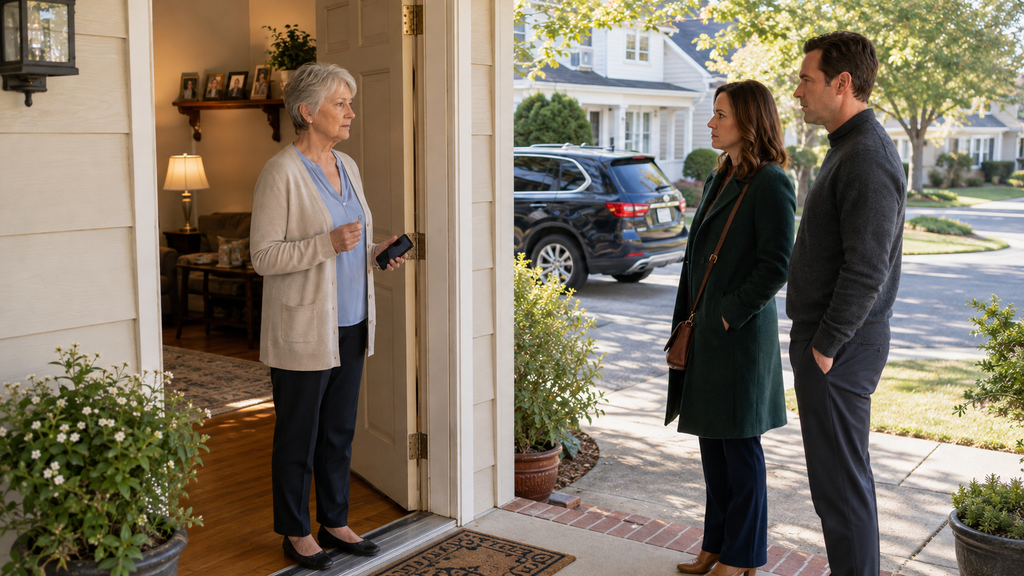
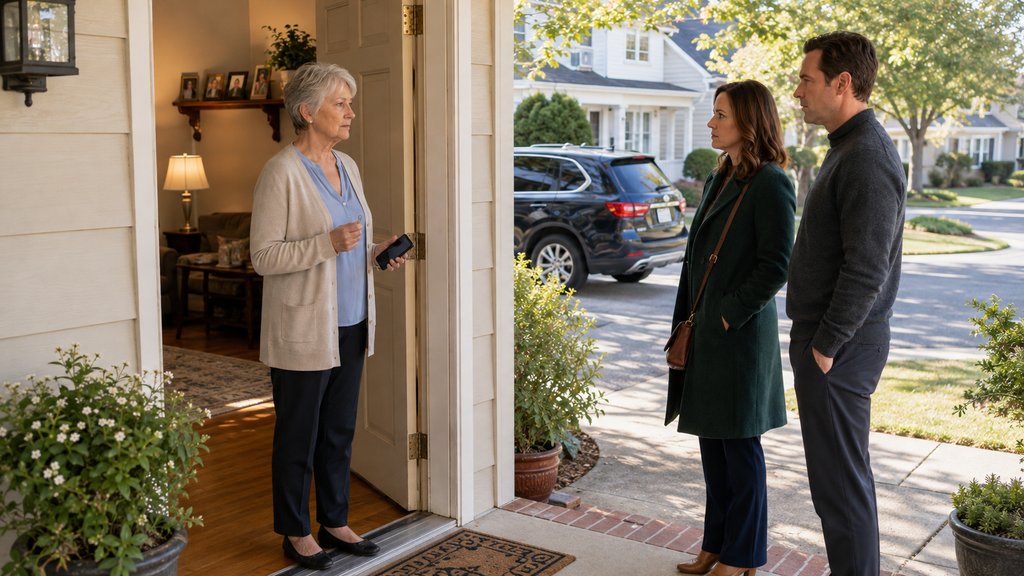
At 9:22, my doorbell rang.
I didn’t need to check the camera.
I knew.
Sarah and David stood on my front porch.
Sarah wore a camel-colored coat and carried the structured leather handbag I had bought for her birthday two years earlier.
David stood beside her in a dark quarter-zip sweater.
His arms were folded.
He had the expression he wore whenever a waiter made a mistake with his order.
Annoyed.
Not frightened.
Not sad.
Annoyed.
I opened the front door.
But I did not step aside.
“Mom,” Sarah said immediately. “Why aren’t you answering?”
I looked at her.
“You asked me not to contact you.”
She blinked.
“This isn’t about that.”
“It seems exactly about that.”
David stepped forward.
“Amber, we asked for emotional space. That doesn’t mean you suddenly pull financial commitments.”
I looked at him.
“Commitments?”
“Yes.”
“What contract did we sign?”
He frowned.
“You know what I mean.”
“I know I chose to help you.”
“You’ve been doing it for four years.”
“That doesn’t make it permanent.”
Sarah’s voice softened.
“Mom, the mortgage is due.”
“Then pay it.”
“We don’t have twelve hundred dollars just sitting around.”
I glanced past her.
Their SUV sat in my driveway.
Clean.
Shiny.
Newer than my own car by almost a decade.
My eyes moved to Sarah’s handbag.
Then back to her.
“I’m sorry to hear that.”
David’s face tightened.
“You’re doing this to punish us.”
“No.”
“Of course you are.”
“I am respecting your request.”
“Don’t twist this.”
“I didn’t write the message, David.”
Sarah stepped closer.
“We asked you to stop hovering.”
“Then I stopped.”
“You don’t have to take everything so literally.”
I stared at her.
That hurt more than I expected.
Because I had spent years taking her needs literally.
When she said she couldn’t afford childcare, I didn’t say, “I’m sure you’re exaggerating.”
When she said the car payment was crushing them, I didn’t say, “Don’t take everything so literally.”
When she said she needed twelve hundred dollars for the mortgage, I transferred twelve hundred dollars.
Every month.
“You said my involvement was suffocating,” I said quietly.
Sarah looked away.
“Money is involvement.”
David exhaled loudly.
“This is financial manipulation.”
I almost admired the speed with which he turned my money into his victimhood.
“No,” I said. “Financial manipulation would be me offering money in exchange for access to Leo. I haven’t done that.”
His jaw tightened.
“I simply won’t finance people who have asked me not to be part of their lives.”
Sarah reached toward me.
“Mom, can we please go inside?”
“No.”
Her hand stopped.
“We can talk here.”
The disappointment that crossed her face almost broke me.
For years, that expression had controlled me more effectively than any demand.
Sarah disappointed.
Sarah upset.
Sarah needing me.
I had spent half my life rushing to remove discomfort from my daughter’s path.
That morning, I discovered something important.
Seeing your child uncomfortable does not mean you are required to fix it.
She lowered her hand.
“We were angry last night.”
“You sounded very clear.”
“David and I had been talking about boundaries.”
“That’s your right.”
“We didn’t mean you should disappear financially too.”
Silence.
Sarah froze.
She heard herself.
So did David.
His head turned sharply toward her.
But it was too late.
There it was.
The truth.
They wanted me gone.
Not the money.
They had separated me into two categories.
Amber the mother.
Amber the account.
The mother was exhausting.
The account was essential.
Sarah flushed.
“That’s not what I meant.”
I nodded slowly.
“I think it’s exactly what you meant.”
Her car keys hung from one finger.
And there, among the silver key rings, I saw a small brass key.
My spare house key.
I pointed toward it.
“I’ll take that back too.”
Sarah stared at me.
“What?”
“My house key.”
“Mom.”
“You asked for distance.”
“That doesn’t mean I can’t have your key.”
“Why would you need unrestricted access to my home if you don’t want a relationship with me?”
She opened her mouth.
Closed it.
Then slowly unhooked the key.
She placed it in my palm.
It was warm from her hand.
I curled my fingers around it.
“Have a good day.”
David stared at me.
“You’re serious.”
“Yes.”
“This is going to permanently damage your relationship with your daughter.”
I looked him directly in the eyes.
“The message she sent last night already damaged it.”
He started to answer.
I closed the door.
Then locked the deadbolt.
For several minutes, I could hear them on the porch.
David’s voice.
Low.
Sharp.
Sarah’s quicker voice answering.
Then footsteps.
Car doors.
An engine.
Silence.
I carried the brass key to the entry table.
Dropped it into the ceramic bowl where I kept spare change.
It made a small metallic sound.
Clean.
Final.
That afternoon, I went into the backyard.
Gardening had been Michael’s hobby.
Tomatoes.
Peppers.
Green beans.
Basil.
He used to spend Saturday mornings kneeling in the dirt, wearing an ancient baseball cap and pretending not to notice when I photographed him.
After he died, I nearly let the garden disappear.
Then one spring I found tomato seedlings growing from seeds left in the soil.
Stubborn little things.
They reminded me of him.
So I started gardening too.
I was pulling dead vines when my neighbor, Martha Reynolds, appeared over the fence.
Martha was seventy-two.
Twice widowed.
Always wore lipstick, even when taking garbage cans to the curb.
She possessed the extraordinary ability to know everything happening within three houses of her while insisting she never gossiped.
“Heard voices this morning,” she said.
I kept pulling weeds.
“Sound carries.”
“Especially when David is speaking.”
I laughed before I could stop myself.
Martha leaned her elbows on the fence.
“You okay?”
“Yes.”
“That sounded like a dishonest yes.”
I stood.
Brushed dirt from my gloves.
“Sarah and David want distance.”
Martha’s eyebrows nearly reached her hairline.
“From you?”
“Yes.”
“The woman paying half their bills?”
I stared at her.
“How do you know that?”
She looked offended.
“Amber, please. I have eyes.”
“Martha.”
“What? You think I haven’t noticed you cutting back on everything while Sarah drives around in a vehicle worth more than my first house?”
I looked down.
She softened.
“I’m sorry.”
“No. You’re not wrong.”
For a moment, she said nothing.
Then she hesitated.
“I saw David yesterday.”
“Where?”
“Garden center.”
My stomach tightened.
“He was loading a television into the SUV.”
“So?”
“Amber, that box was nearly as tall as I am.”
I looked at her.
“He told the employee helping him that they were finishing a basement home theater.”
I stopped breathing for half a second.
“They told me this morning they don’t have twelve hundred dollars for the mortgage.”
Martha’s mouth pressed into a thin line.
“Well.”
“They bought a huge television.”
“Apparently.”
“They aren’t broke.”
“No.”
“They spend their money on what they want because they know I will cover what they need.”
Martha didn’t answer immediately.
She didn’t have to.
The truth had already landed.
Hard.
For years, every emergency had sounded genuine.
And perhaps some were.
But somewhere along the way, I had become the person responsible for necessities, which freed them to spend their own money on desires.
They bought entertainment.
I paid the mortgage.
They remodeled kitchens.
I postponed windows.
They upgraded vehicles.
I repaired the same coat pocket twice.
I removed my gardening gloves.
Martha watched my face.
“You want tea?”
“Yes.”
Her kitchen smelled like lemon loaf.
She poured tea into floral cups and pushed a plate of sliced cake toward me.
I told her most of what had happened.
Not every detail.
Enough.
She listened without interrupting.
When I finished, Martha sat back.
“You know the danger of being dependable?”
“What?”
“People start treating their dependence on you as if it’s one of their own achievements.”
I gave her a tired smile.
“You had that prepared.”
“I’ve had children for fifty years. I’ve prepared many things.”
That night, I opened a notebook.
On the first page, I wrote:
CONNECTIONS TO SARAH AND DAVID
Then I started listing.
Mortgage.
Car payment.
Phone plan.
Streaming accounts.
Storage unit.
Vehicle co-signing.
Emergency credit card.
House key.
Subscriptions.
Insurance documents.
Online memberships.
I stared at the page.
Our lives were more tangled together than I had realized.
Not emotionally.
Financially.
Logistically.
The process of untangling them took several days.
I did not act recklessly.
I didn’t cancel their phone numbers and leave them stranded.
I contacted the provider and arranged a transfer of responsibility.
They received instructions for opening their own account.
My phone bill dropped from more than two hundred dollars a month to fifty-one.
I changed streaming passwords.
Logged every device out.
I reviewed the vehicle paperwork with the bank.
I couldn’t simply erase my name as co-signer.
But the loan officer told me Sarah and David had sufficient income and payment history to apply for refinancing.
So I requested the paperwork.
Then there was the storage unit.
I had almost forgotten about it.
Michael and I rented it years earlier when we downsized.
After he died, I kept it because some of his tools and our holiday boxes were there.
Two years earlier, Sarah asked if she could put “a few things” inside.
I said yes.
Of course I did.
On Friday morning, I drove to the facility.
I entered my code.
The metal gate rattled open.
I pulled up outside Unit 214.
Unlocked it.
Raised the rolling door.
Then stood there staring.
A few things?
My belongings occupied perhaps one quarter of the unit.
Michael’s red toolbox.
Two boxes of photographs.
Winter clothing.
Christmas ornaments.
A folded card table.
Everything else belonged to Sarah and David.
Kayaks.
Old dining chairs.
A designer high chair Leo had outgrown.
Boxes of seasonal decorations.
A huge rug.
Exercise equipment.
Lamps.
A portable wine refrigerator.
Business inventory from one of David’s abandoned online ventures.
Plastic bins.
Old toys.
Unused patio cushions.
A broken treadmill.
I started laughing.
Not because it was funny.
Because sometimes absurdity reaches a point where laughter is the only reasonable response.
I was paying $150 a month to store belongings for people who said my presence took up too much space in their lives.
The irony was almost elegant.
I hired two workers from the facility to help move my things.
Michael’s toolbox went into the trunk of my car.
Photographs into the back seat.
Christmas decorations beside them.
Everything belonging to Sarah and David stayed.
At the management office, I gave thirty days’ notice.
The woman behind the counter looked at the account.
“You want us to contact the other occupants?”
“They’re not occupants. The unit is mine.”
She nodded.
“Do they know you’re closing it?”
“They will.”
I gave her their contact information.
Paid the final month.
Then drove home.
Michael’s red toolbox sat buckled into the passenger seat.
I hadn’t opened it in years.
When I got home, I carried it into the garage.
Set it on his old workbench.
Unlatched the metal clasps.
The smell hit me immediately.
Machine oil.
Wood dust.
Metal.
A faint trace of something I couldn’t name.
Maybe not even a smell.
Maybe just memory.
Inside were his screwdrivers lined neatly in one drawer.
His tape measure.
A carpenter’s pencil.
A wrench with blue paint on the handle.
A little jar filled with screws he refused to throw away.
I picked up the tape measure.
And that was when I cried.
Not because of Sarah.
Not exactly.
I cried because I suddenly understood how much of my own life I had moved into storage to create more room for hers.
Michael’s things.
My travel plans.
My home repairs.
My savings.
My time.
My wants.
Even my grief.
Everything had been pushed aside whenever Sarah needed something.
I sat on the old garage stool holding that tape measure and cried until my face hurt.
Then I wiped my eyes.
Put the tool back.
And brought the rest of Michael home.
Two weeks passed.
Then three.
October turned into November.
Sarah and David’s calls slowed when they realized I wasn’t reversing course.
But the silence was not easy.
Because Leo was inside it.
I missed my grandson more than I can describe.
He was innocent.
He had not written the message.
He did not understand mortgages or boundaries or resentment.
He only knew Grandma used to appear.
And then Grandma didn’t.
His pictures surrounded me.
One on the refrigerator.
One beside my bed.
One in the hallway.
For several nights, I picked up my phone and nearly called Sarah.
I imagined saying:
Fine.
I’ll restart the payments.
Just let me see Leo.
The temptation frightened me.
Because if I did that, what was I teaching him?
What was I teaching myself?
That love could be purchased?
That access to a child justified financial obedience?
That I had to pay for the privilege of being family?
No.
Pain did not mean my boundary was wrong.
Sometimes pain was simply the cost of not abandoning myself anymore.
Then Thanksgiving approached.
For five years, I had hosted Thanksgiving dinner.
I bought the turkey.
Made Michael’s mother’s stuffing recipe.
Sweet potatoes.
Mashed potatoes.
Green beans.
Cranberry sauce.
Gravy.
Rolls.
Two pies.
Sometimes three if David’s parents came.
Sarah liked organic turkey.
David preferred extra gravy.
Leo hated cranberry sauce but insisted it needed to be on the table because “that’s the rule.”
I did all the shopping.
Most of the cooking.
Almost all the cleanup.
Sarah photographed the table.
David watched football.
I packed leftovers into containers for them before they left.
I used to love Thanksgiving.
Somewhere along the way, tradition had turned into labor everyone assumed would simply appear.
One week before Thanksgiving, Sarah emailed me.
The subject line was:
Thanksgiving Plan
I stared at it for several seconds before opening it.
Her message read:
Mom,
David’s parents are coming this year, so we’re hosting at our house. Since you already know how everyone likes the turkey and sides, can you make the usual meal and bring it over around 2:00? We want to keep dinner small with David’s parents, so you don’t need to stay, but it would help us a lot if you could drop everything at the kitchen door.
Thanks.
I read it twice.
Then a third time.
They wanted my turkey.
My stuffing.
My mashed potatoes.
My pies.
My grocery money.
My labor.
My time.
But not me at the table.
They wanted Thanksgiving catered by the woman they had told to disappear.
The old Amber would have cried.
Then she would have made a shopping list.
She would have told herself:
Maybe if the turkey is perfect, Sarah will soften.
Maybe if I make Leo’s favorite rolls, I can see him at the door.
Maybe love requires swallowing pride.
But sitting at my kitchen table that day, I finally understood something.
Self-respect and pride are not the same thing.
I clicked reply.
Typed three words.
No, thank you.
Sent.
Then I walked next door.
Martha answered wearing a gray sweatshirt with huge letters across the front.
RETIRED: ASK SOMEONE ELSE.
I pointed at it.
“Appropriate.”
“I live by it.”
“What are you doing for Thanksgiving?”
“My daughter is visiting her in-laws. My son is taking the children to his wife’s family.”
“So?”
“So I bought a small chicken and planned to watch old movies while criticizing television chefs.”
“Want company?”
Martha grinned.
“I thought you’d never ask.”
Thanksgiving morning arrived bright and cold.
For the first time in years, I did not wake before dawn to wrestle with a turkey.
I slept until eight.
Stayed in my pajamas.
Watched the parade.
Made one pecan pie.
Not because anyone expected it.
Because I wanted pie.
At noon, I showered.
I wore a burgundy sweater Sarah once said made me look “too serious.”
I looked in the mirror.
It looked fine.
At one-thirty, I carried the pie and a bottle of wine across the yard.
Martha had set her best china.
“For two people?” I asked.
“I respect poultry.”
We laughed.
We ate roast chicken with herbs.
Mashed potatoes.
Green beans.
Cranberry sauce from a can because Martha said homemade cranberry sauce was “performative nonsense.”
At 2:15, my phone rang.
David.
I ignored it.
Ten minutes later:
Sarah.
Then David again.
Martha looked toward the phone.
“Think someone discovered Thanksgiving requires food?”
“It seems possible.”
We kept eating.
At three, I listened to one voicemail.
Sarah’s voice came through tense and breathless.
“Mom, where are you? David’s parents are here. We don’t have the turkey or anything. You said no thank you, but I thought you were just upset and would still bring it. Please call me.”
I paused the voicemail.
Martha stared.
“She thought no meant yes?”
“Apparently.”
“That is ambitious.”
I laughed so suddenly I nearly choked.
Then I listened to the second voicemail.
Sarah sounded less controlled.
“This is really embarrassing. We have people here and no food plan because we were counting on you.”
I deleted it.
Their emergency was not mine.
Their embarrassment was not mine.
Their lack of planning was not mine.
They had organized an entire holiday around the assumption that my boundary was temporary theater.
A performance.
Something I would eventually abandon once they applied enough pressure.
That Thanksgiving taught them something.
It taught me something too.
The world does not collapse when a mother says no.
Sometimes dinner does.
But the world doesn’t.
The Monday after Thanksgiving, David came to my house.
I was sweeping leaves from the porch.
He pulled into my driveway in a sedan.
The SUV was gone.
I noticed immediately.
He marched toward me.
“You humiliated us.”
I kept sweeping.
“Good morning, David.”
“Don’t do that.”
I stopped.
“Do what?”
“That calm voice.”
“What voice would you prefer?”
“You knew my parents were coming.”
“Yes.”
“We had nothing prepared.”
“You had a week.”
“You always cook.”
“Not this year.”
“You made Sarah look ridiculous.”
“No.”
I leaned both hands on the broom.
“Sarah invited your parents to Thanksgiving. She then asked a woman she had explicitly excluded from the dinner to cook the entire meal.”
David’s nostrils flared.
“She was trying to keep things small.”
“Then a small gathering needed a small meal.”
“You’re enjoying this.”
I thought about it.
“No.”
And I meant it.
“I don’t enjoy Sarah being embarrassed. I enjoy no longer believing it is my responsibility to prevent her from ever being embarrassed.”
He stared at me.
“The mortgage payment bounced.”
“You had notice.”
“We had other commitments.”
“So do I.”
“You were the one who suddenly stopped paying.”
“After you told me not to be part of your lives.”
He shook his head.
“You keep using that message to justify everything.”
“It doesn’t justify everything.”
I looked at him.
“It explains everything.”
He crossed his arms.
“We were talking about family boundaries.”
“So am I.”
“What?”
“Family cannot mean you want distance from my opinions, my presence, my questions, my holidays, and my needs, but not from my bank account.”
He looked away.
I continued.
“The bank will be sending paperwork about the car loan.”
His head snapped back.
“What paperwork?”
“I requested release as co-signer through refinancing.”
“You can’t do that.”
“The bank says you qualify to apply.”
“Our interest rate could go up.”
“That is something you and Sarah will have to consider.”
“You’re dismantling everything.”
I shook my head.
“No.”
“That’s exactly what you’re doing.”
“I’m returning it.”
He frowned.
“What?”
“Your responsibilities.”
The words landed between us.
His face hardened.
Then I remembered Martha.
“I heard about the television.”
His eyes shifted.
“What television?”
“The one for the basement home theater.”
His silence answered me.
“You had money for that.”
“It was on sale.”
For the first time, I laughed in his face.
Not cruelly.
It simply escaped me.
He looked furious.
“What is funny?”
“Nothing.”
I shook my head.
“I’m glad you got a good deal.”
“This isn’t funny, Amber.”
“No.”
I looked toward my old car.
Then toward the guest-room window with peeling trim.
“It really isn’t.”
He left soon afterward.
And he never showed up at my house without calling again.
Winter arrived early that year.
In December, I went shopping for a coat.
A proper one.
Navy wool.
Warm lining.
Deep pockets.
I stood inside the fitting room staring at the price tag for almost ten minutes.
Then I did the math.
The coat cost less than three months of Sarah’s phone service.
I bought it.
I wore it out of the store.
A week later, I called the contractor.
The guest-room window cost $1,850.
When the installation was finished, I stood in the room during a windy afternoon.
No whistle.
No cold draft.
No towel pushed against the sill.
I placed my hand on the glass.
Warm.
Solid.
I felt an almost ridiculous happiness.
For years, I had lived with that leaking window because someone else’s emergency always came first.
That month, I transferred $1,650 into my savings account.
The same amount I used to send Sarah and David.
I created a new account and named it:
MINE
January.
$1,650.
February.
$1,650.
March.
$1,650.
Watching that balance grow felt strange at first.
Almost selfish.
Then I reminded myself:
I was sixty-seven.
My husband was gone.
My working years were behind me.
Saving for my own life was not selfish.
It was sane.
By spring, there was enough money to do something Michael and I had talked about for years.
The Grand Canyon.
We had always planned to go.
Next year.
After Sarah finished college.
After the wedding.
After Leo was born.
After Michael retired.
After his knee improved.
After.
After.
After.
Then cancer came.
And suddenly there was no after.
I found a guided trip for autumn.
Five days.
Arizona.
Transportation.
Hotel.
Sunrise overlook.
I stared at the booking page for half an hour.
Then pressed purchase.
When the confirmation appeared, I cried.
Because joy can hurt when you realize how long you postponed it.
Martha came over that evening carrying sparkling cider.
“To Arizona,” she said.
“To Arizona.”
“And to not financing televisions.”
“Especially televisions.”
I still missed Leo.
That never stopped.
His birthday came in February.
I bought him a dinosaur book.
A beautiful hardcover book filled with illustrations.
No check.
No gift card.
No expensive electronic toy.
Inside the card I wrote:
Happy birthday, sweetheart. Grandma loves you every day.
I mailed it.
Tracking showed it was delivered.
No one responded.
That hurt more than anything else.
I let myself cry.
Then I placed the tracking confirmation in the trash.
Pain does not automatically mean a boundary is wrong.
Sometimes pain is simply proof that the situation matters.
Six months after Sarah’s message, spring returned.
Tomato plants appeared in the garden.
My new window opened smoothly.
My savings account continued to grow.
At my annual medical appointment, my doctor looked at my chart.
“Your blood pressure is better.”
“Good.”
“You sleeping?”
“Better.”
“You change something?”
I smiled.
“My budget.”
She laughed.
I did not explain.
One Tuesday evening in May, I was sitting on the patio reading when my phone chimed.
Sarah.
I stared at her name.
I had unblocked her a month earlier.
Not because I was waiting for an apology.
Because I realized I didn’t need to block someone in order to maintain a boundary.
Her message said:
Mom, things have been difficult. David had to sell the SUV, and we’re probably going to downsize the house. His business is slower than expected. I know everything got out of hand between us. I miss you. Can we please just go back to the way things were? I’m sorry.
I read it several times.
I miss you.
Those words wrapped around my heart.
I wanted them.
I had wanted them for months.
But another sentence mattered more.
Can we please just go back to the way things were?
The way things were.
I paid.
They accepted.
I cooked.
They consumed.
I adjusted.
They complained.
I waited to see Leo.
They decided when.
I hid my sacrifices.
They assumed I could afford them.
No.
Going backward was not reconciliation.
Going backward was restoration of a broken system.
I didn’t answer that night.
The following morning, Sarah sent another message.
I meant the apology.
I sat at my dining room table.
Made coffee.
And replied.
I believe you’re sorry things became painful. I’m sorry you’re struggling. I love you, Sarah, and I love Leo. But we cannot go back to the way things were. I will not resume paying your household expenses. If you want a relationship with me, it has to be a relationship, not a financial arrangement.
I paused.
Then added:
If you’d like to meet for coffee sometime, just you and me, I’m open to that.
I sent it.
Three days passed.
Then she replied.
Okay.
We met Saturday morning.
A small café halfway between our houses.
Neutral territory.
Sarah arrived five minutes late.
No designer handbag.
No SUV.
Her hair was pulled back carelessly.
She looked thinner.
Tired.
Older somehow.
For one painful second, I wanted to stand and hug her.
Instead, I waited.
She sat.
“Hi, Mom.”
“Hi, sweetheart.”
The word slipped out naturally.
Her eyes filled immediately.
Mine almost did too.
Neither of us spoke for a moment.
Then Sarah said, “You really changed.”
I shook my head.
“No.”
She frowned.
“I stopped doing something.”
“What?”
“Making myself responsible for whether you’re comfortable with me.”
She stared at her coffee.
“I hate how everything happened.”
“So do I.”
“David thinks you’re trying to split us up.”
“I’m not.”
“He says you blame him.”
“I blamed him for a long time.”
She looked up.
“And now?”
“Now I blame both of you for the message.”
Her eyes filled.
“I wrote it.”
I stared.
“What?”
“I wrote it.”
“All of it?”
“He suggested some wording.”
“But you sent it.”
“Yes.”
That hurt.
It also helped.
For months, I had turned David into the villain because it protected the image I carried of Sarah.
My daughter couldn’t really want me gone.
David manipulated her.
David poisoned her thinking.
David wrote the message.
Except he hadn’t.
Sarah had.
She reached for a napkin.
“I’m sorry.”
“Why did you send it?”
She wiped at one eye.
“Because every time I talked to you, I felt guilty.”
“For what?”
“Everything.”
“I didn’t ask you for money.”
“I know.”
“I didn’t ask you to take care of me.”
“I know.”
“Then what did I make you feel guilty about?”
She stared down.
“You were sacrificing so much.”
I froze.
“And instead of feeling grateful,” she continued, “I started feeling angry.”
That answer surprised me.
“Angry at me?”
“Yes.”
“Why?”
“Because every time you paid something, I knew.”
“Knew what?”
“That I should be doing better.”
I said nothing.
She continued.
“I knew you were helping with the mortgage. The car. Leo’s preschool. The phone bill.”
“But you kept accepting it.”
“Yes.”
“Why?”
“Because we needed it.”
“Did you?”
She flinched.
I thought about the television.
The remodeling.
The SUV.
“I thought we did,” she whispered.
“That isn’t the same thing.”
“I know.”
I leaned back.
She looked at me.
“I thought you had more money.”
“Why?”
“Because you never said no.”
The sentence stopped me.
Because there it was.
My part.
Not blame.
Responsibility.
I had spent decades saying yes while secretly counting the cost.
I had wanted Sarah to understand my sacrifice without forcing me to admit I was sacrificing.
I wanted her to notice.
To ask.
To insist I keep something for myself.
But she wasn’t a mind reader.
Silence can create entitlement too.
Not because the entitled person is innocent.
But because unlimited generosity can disguise the existence of limits.
“You should have asked,” I said.
“I know.”
“And I should have told you.”
Her expression crumpled.
“Were you struggling?”
“Sometimes.”
“The coat?”
I looked at her.
“What?”
“You mentioned once on the phone that you needed a new winter coat.”
I looked away.
“I kept postponing it.”
“Oh, Mom.”
“This isn’t about making you feel terrible.”
“But it does.”
“Good.”
She stared at me.
I softened.
“Not because I want to hurt you. Because guilt isn’t always useless. Sometimes guilt tells us we crossed a line.”
Tears rolled down her face.
I handed her another napkin.
“I chose to help you,” I said. “That part belongs to me. I made those decisions.”
She nodded.
“But when my help became expected instead of appreciated, I should have stopped much sooner.”
She stared at me.
“David said if we didn’t accept your help, you’d find another way to involve yourself.”
I closed my eyes.
“That sounds like David.”
“But I agreed with him.”
I opened my eyes.
“Thank you.”
“For what?”
“For admitting that.”
She cried harder.
We talked for nearly two hours.
Not perfectly.
Not magically.
There were things she remembered differently.
Things I defended too quickly.
Things she apologized for.
Things I apologized for.
I admitted I sometimes used help as a way to feel necessary.
Not intentionally.
But I did.
After Michael died, Sarah and Leo became the center of my world.
I made myself indispensable because being needed felt safer than being lonely.
Sarah admitted she noticed.
And sometimes used it.
Not maliciously.
Conveniently.
Families can hurt each other without waking up in the morning planning cruelty.
Sometimes harm grows through habit.
At the end of the conversation, Sarah looked down at her hands.
Then she said quietly:
“Leo asks about you.”
My throat closed.
“What does he ask?”
“Why Grandma doesn’t come anymore.”
I swallowed.
“What did you tell him?”
“That adults were working something out.”
I nodded.
“Good.”
“He misses you.”
“I miss him every day.”
She looked at me.
“Would you like to see him next weekend?”
Every part of me screamed yes.
I forced myself to breathe first.
“Only if there are no conditions.”
Her face tightened.
“There aren’t.”
“No money discussion before or afterward.”
“Okay.”
“No using Leo to pass messages between us.”
“Okay.”
“And David needs to understand I’m not restarting the payments.”
She nodded.
“He knows.”
“Does he accept it?”
She hesitated.
“No.”
I almost smiled.
“Honest.”
“He’s learning.”
The following Saturday, Sarah brought Leo to my house.
I watched through the front window as her car pulled into the driveway.
Before she even parked properly, the rear door opened.
Leo jumped out.
“Leo!” Sarah yelled.
He didn’t care.
He ran.
Straight up the walkway.
Up the steps.
I opened the door.
“Grandma!”
I dropped to my knees.
He crashed into me so hard I nearly fell backward.
I wrapped both arms around him.
He smelled like sunscreen.
Cereal.
Grass.
Childhood.
I buried my face in his hair.
And cried.
“You’re squishing me,” he laughed.
“I know.”
“Grandma.”
“I know.”
He pulled back.
Studied my face.
“Why are you crying?”
“Because I’m happy.”
“That’s weird.”
“It is.”
Behind him, Sarah stood beside the car.
She was crying too.
Leo didn’t notice.
He was already looking over my shoulder.
“Do you still have the pancake pan?”
“What pancake pan?”
His face fell.
“The dinosaur one!”
I gasped dramatically.
“That old thing?”
“Grandma!”
I laughed.
“Yes. I still have it.”
“Can we make them?”
“Absolutely.”
He ran toward the kitchen.
I looked at Sarah.
For a moment, neither of us spoke.
Then she walked up the steps.
“Thank you.”
I shook my head.
“Don’t thank me for loving him.”
She nodded.
That morning erased nothing.
But it gave us something to build on.
And rebuilding, I learned, is different from pretending nothing broke.
Sarah and I repaired our relationship slowly.
There were no grand promises.
No overnight transformation.
She began calling without asking for anything.
At first, I found myself suspicious.
I would answer and wait.
What does she need?
Then sometimes she would simply say:
“I was thinking about you.”
Or:
“Leo said something funny.”
Or:
“Do you remember Grandma’s pie recipe?”
And eventually, I stopped waiting for the request.
They sold the larger house.
Moved into a smaller one.
Three bedrooms.
No finished basement.
No home theater.
They survived.
David sold the giant television with the old house.
I did not mention it.
Mostly.
One Christmas, Martha gave me a miniature television ornament.
I laughed so hard tears came.
Sarah asked what was funny.
“Nothing.”
Martha looked innocent.
David and I remained distant.
That was okay.
One of the lessons I learned was that not every relationship needs to become warm.
Some relationships only need to become respectful.
Eventually, David apologized.
It happened one afternoon almost a year after the message.
He and Sarah came to pick up Leo.
Sarah took Leo outside to find his shoes.
David remained in my kitchen.
He cleared his throat.
“I handled things badly.”
I looked at him.
“Yes.”
He frowned slightly.
Maybe he had expected me to rescue him from his apology too.
I didn’t.
Silence stretched.
Then he said:
“I’m sorry.”
“Thank you.”
He nodded.
That was it.
No hug.
No tears.
No long speech.
I didn’t need theater.
I needed behavior.
And slowly, his behavior changed.
He called before visiting.
Stopped discussing my finances.
Stopped suggesting that my boundaries were attacks on him.
When Leo had a school event, Sarah invited me.
No money discussion.
No condition.
No hidden favor.
The following year, his school held Grandparents Day.
I wore my navy coat.
The good one.
Leo held my hand through the hallway.
“This is my cubby.”
“Very impressive.”
“This is where we do science.”
“Excellent.”
“This is where Dylan threw up.”
“I could have lived without that information.”
He laughed.
Inside his classroom, the children had written essays about someone important to them.
Leo dragged me toward his desk.
“Read mine.”
His paper said:
My grandma makes dinosaur pancakes and knows how to grow tomatoes.
I read it twice.
Then the next line.
She went to the Grand Canyon even though she was scared of heights.
I looked at him.
“I was not scared.”
“You sent Mom a picture holding the railing.”
“That was because of wind.”
“It wasn’t windy.”
“Your mother lies.”
Behind us, Sarah laughed.
It was effortless.
Real.
The first family laugh I could remember in years that had no tension underneath it.
And yes.
I had gone to the Grand Canyon.
Martha came too.
She claimed she joined because she didn’t trust my snack choices.
We traveled across Arizona with a bus full of retirees, three anniversary couples, one retired dentist who told everyone about his knee replacement, and a man from Wisconsin who photographed nearly every gas station we passed.
On the second morning, we woke before sunrise.
I stood at the overlook while the sky changed.
Gray.
Purple.
Pink.
Then gold.
Light spilled across the canyon walls.
Layer after layer appeared.
Vast.
Ancient.
Impossible.
I thought of Michael.
He should have been beside me.
For a moment, grief hit just as sharply as it had nine years earlier.
I imagined his hand around mine.
His voice saying:
“Worth waiting for.”
Then I looked at the horizon.
And thought:
No.
Some things are not worth waiting for.
Some things need to be lived while time still allows them.
I cried.
Then Martha took a picture.
In it, I’m standing near the railing wearing a red scarf.
Laughing.
The photograph now hangs in my living room.
Months later, Sarah stood looking at it.
“You look happy.”
“I was.”
She touched the edge of the frame.
“Were you unhappy before?”
I thought about the question.
“No.”
She looked at me.
“That would be too simple.”
“What were you?”
“Tired.”
Her expression changed.
“Because of us?”
“Partly.”
She looked down.
I touched her hand.
“And partly because I forgot I was allowed to have a life after becoming somebody’s mother.”
She looked at me for a long time.
“You know you’re still my mother.”
“I know.”
“I still need you.”
“I know that too.”
She smiled.
“Just not twelve hundred dollars a month.”
I laughed.
“Excellent progress.”
Three years have passed since the Tuesday night Sarah told me never to look for her again.
She pays her own mortgage now.
Her own car.
Her own phone.
Her own storage.
David’s business eventually became stable.
Funny how quickly people become resourceful once someone else stops automatically filling every gap.
Leo is ten.
He still loves dinosaurs.
Although apparently calling a velociraptor “a dinosaur” without specifying its exact species and geological period is now unacceptable.
He spends some Saturdays with me.
Sarah brings him.
Sometimes she stays for coffee.
Sometimes she leaves and comes back later.
Nobody counts hours.
Nobody keeps score.
Nobody disguises invoices as affection.
I still help them sometimes.
I am still me.
Last winter, their furnace stopped working during a freezing week.
I offered them my guest rooms until it was repaired.
David immediately said:
“We’re handling the repair bill.”
I smiled.
“I didn’t ask.”
He actually smiled back.
Progress comes in strange forms.
When Leo needed money for a school field trip, I paid for it.
Because I wanted to.
That distinction matters.
From the outside, generosity and obligation can look identical.
A check is a check.
A paid bill is a paid bill.
But inside your heart, they feel completely different.
Generosity says:
I choose this.
Obligation says:
I am afraid of what happens if I don’t.
I lived too many years in the second sentence.
My guest-room window doesn’t leak anymore.
Michael’s tools are in my garage.
The storage unit is gone.
The money that once disappeared into Sarah and David’s household now pays for my home repairs.
My travel.
My savings.
Chosen gifts.
And a small scholarship I created at the community college where Michael once took evening classes.
Nothing enormous.
Enough to help one adult student every year with books and tuition.
When I received the first thank-you letter, I cried.
The student wrote that the scholarship allowed her to reduce her work hours enough to complete a nursing course.
I thought:
This is what money should feel like.
A gift.
Not ransom.
Martha still watches everything from the other side of the fence.
Last week, I was pruning tomato plants when she yelled:
“Your daughter is here.”
“I have a doorbell!”
“I’m faster!”
Sarah came through the side gate carrying lemonade.
She kissed my cheek.
Then passed a glass to Martha over the fence.
Leo immediately began digging through the garden because he insisted worms were “essential agricultural workers.”
Sarah and I sat beneath the patio umbrella.
For a while, we talked about ordinary things.
School.
A recipe.
Her job.
A neighbor’s new dog.
Then suddenly Sarah went quiet.
“Mom?”
“Yes?”
“Do you still have that message?”
I knew exactly which one.
“What message?”
She gave me a look.
“You know.”
I smiled.
“No.”
Her eyebrows lifted.
“You deleted it?”
“Yes.”
“When?”
“Last year.”
“Why?”
I looked toward Leo.
For a long time after everything happened, I kept screenshots.
Several copies.
One on my phone.
One emailed to myself.
One saved on my laptop.
Proof.
Proof that I had not imagined the cruelty.
Proof that my response had been reasonable.
Proof that I had been told to leave.
Proof that I had a right to stop paying.
Whenever guilt appeared, I reread it.
Then one day, I realized something.
I didn’t need evidence anymore.
I didn’t need Sarah’s old cruelty to justify my present boundaries.
I didn’t need to reopen the wound every time I wanted to protect the scar.
So I deleted it.
“I didn’t need it anymore,” I told her.
Sarah stared into her lemonade.
“I still hate that I sent it.”
“I know.”
“I’m glad you didn’t completely listen.”
I smiled.
“Oh, sweetheart. I listened very carefully.”
She groaned.
“You know what I mean.”
“I do.”
She watched Leo digging in the garden.
Then her voice softened.
“Do you forgive me?”
Once, I would have answered immediately.
Yes.
Of course.
Whatever made my daughter feel better.
Whatever stopped discomfort.
Whatever kept the peace.
But forgiveness deserved more thought than that.
So I looked at her.
Really looked.
My daughter.
Older.
Wiser.
Still imperfect.
Like me.
“Yes.”
Her eyes filled.
“But forgiveness is not the same as going back.”
She nodded.
“I know.”
“That took me a long time to understand.”
“What part?”
“That sometimes love survives because the old arrangement doesn’t.”
She smiled through her tears.
“That sounds annoyingly wise.”
“I’m seventy now. I’m entitled.”
From the other side of the fence, Martha yelled:
“She has always been annoying!”
I threw a gardening glove at her.
It fell about five feet short.
Martha laughed.
“My shoulder isn’t what it used to be,” I complained.
“That isn’t why you missed.”
Sarah laughed.
Leo looked up.
“What’s funny?”
“Nothing,” we all said.
That evening, after Sarah and Leo left, I stood alone in my kitchen.
The same kitchen.
Same granite counter.
Same refrigerator hum.
Same window above the sink.
I made chamomile tea.
My phone rested beside the mug.
No angry messages.
No recurring mortgage transfer waiting to drain my account.
No demand.
No accusation.
Then the screen lit.
A photo from Sarah.
Leo asleep in the back seat.
His mouth slightly open.
A dinosaur book resting across his stomach.
Underneath, Sarah had written:
He had the best day. Thanks, Mom.
I stared at the words.
Thanks, Mom.
Nothing else.
Not:
We need something.
Not:
Can you pay this?
Not:
David thinks you should…
Not:
You always do this.
Just:
Thanks, Mom.
It sounds ordinary.
It is ordinary.
That’s precisely why I value it.
The night Sarah told me to disappear, I thought I was losing my daughter.
But that was not exactly what happened.
What I truly lost was a role I should have abandoned years earlier.
The rescuer.
The silent payer.
The woman who believed saying no might make people stop loving her.
The mother who thought sacrifice was meaningful only when nobody noticed its cost.
The grandmother who accepted scraps of access because she was afraid demanding respect would mean losing Leo.
The widow who made herself useful so she wouldn’t have to admit she was lonely.
That role died.
And yes, losing it cost me something.
Months without my grandson.
A lonely Christmas season.
Thanksgiving without my daughter.
Nights wondering whether Sarah would ever call again.
Days when guilt whispered that I had gone too far.
But boundaries cost something because unhealthy arrangements benefit somebody.
When you change the arrangement, the person benefiting from it usually protests.
I also had to confront uncomfortable truths about myself.
I had to stop pretending everyone else was responsible for my resentment.
I had said yes.
Again.
And again.
And again.
Even when I wanted to say no.
I had given beyond my comfort and then secretly wished people would notice my discomfort without being told.
I had confused being indispensable with being loved.
I had confused being needed with belonging.
I had confused sacrifice with motherhood.
Those are not easy things to admit.
But they are true.
People often describe boundaries as walls.
I don’t see mine that way anymore.
My boundary became a door.
A real door.
It opens.
It closes.
It locks.
People knock.
I decide whether to answer.
The people standing outside know they are invited into my life because I want them there.
Not because they possess a key.
Not because they have access to my bank account.
Not because I am frightened they’ll punish me if I say no.
And strangely enough, once I stopped financing my relationship with Sarah, the relationship became warmer.
She calls because she wants to hear my voice.
I answer because I want to hear hers.
No transfer required.
No invoice underneath the conversation.
No silent debt.
No fear.
Sometimes the distance someone demands from you is exactly what reveals what they truly valued.
Did they want space from you?
Or did they want your benefits without your presence?
That rainy Tuesday night, Sarah and David thought they could keep one and discard the other.
They learned otherwise.
So did I.
My tea had gone cold while I looked at Leo’s sleeping face on my phone.
I smiled.
Reheated the mug.
Turned off the kitchen light.
And started upstairs.
Halfway there, I stopped.
For years after Michael died, silence had frightened me.
It made the house feel empty.
Too big.
Too still.
Like every quiet room was reminding me that someone was missing.
But standing there that evening, holding my warm mug in both hands, I noticed something had changed.
The silence no longer felt like abandonment.
It felt peaceful.
The repaired window upstairs belonged to me.
The old photographs belonged to me.
Michael’s tools in the garage belonged to me.
The savings account belonged to me.
My time belonged to me.
My choices belonged to me.
My love belonged to me too.
And because it belonged to me, I could give it freely.
Not desperately.
Not transactionally.
Not fearfully.
Freely.
I looked once more toward the kitchen where, three years earlier, a message had broken something open inside me.
For a long time, I thought that message was the cruelest thing my daughter had ever done.
Maybe it was.
But it also forced me to stop disappearing.
Sometimes a door has to slam before you realize you have been standing in someone else’s doorway your entire life, waiting for permission to enter.
I don’t wait anymore.
Sarah has her home.
David has his responsibilities.
Leo has a grandmother who loves him without buying the right to do so.
And I have my life.
A life I almost gave away one automatic payment at a time.
I walked upstairs.
The floorboards creaked beneath my feet.
Rain began tapping softly against the windows again.
Just like that Tuesday night three years before.
Except this time, there was no message waiting to break my heart.
No demand waiting in my banking app.
No daughter telling me that I was too much.
Only warmth.
Quiet.
And the unmistakable comfort of knowing that every room around me was mine.
For so many years, I believed love meant keeping the door open no matter how people entered.
Now I know better.
Love can open the door.
Self-respect decides who gets a key.
And sometimes the most loving thing you can do—for your children and for yourself—is hand their responsibilities back to them and finally stop apologizing for keeping your own life.
That night, I carried my tea into my bedroom, placed it beside the photograph of Michael, and smiled at him.
“You would have told me sooner, wouldn’t you?”
His photograph, of course, said nothing.
But I could almost hear him laughing.
I climbed into bed.
Turned off the lamp.
And as the rain softened outside, I realized the quiet house no longer felt empty.
For the first time in a very long time…
It felt like home.
It felt like peace.
Most of all—
it felt like mine.
THE END! THANK YOU FOR READING!❤️