 Reading Time: 39 minutes
Richard knocked again. Harder this time. The newborn jerked in my arms. Her tiny face tightened, and a weak cry escaped from beneath the hospital blanket. Ethan reacted instantly.
He crossed the room and put one hand beneath the baby’s head, whispering something soft enough that I couldn’t hear it. That was when I realized something that made my heart ache.
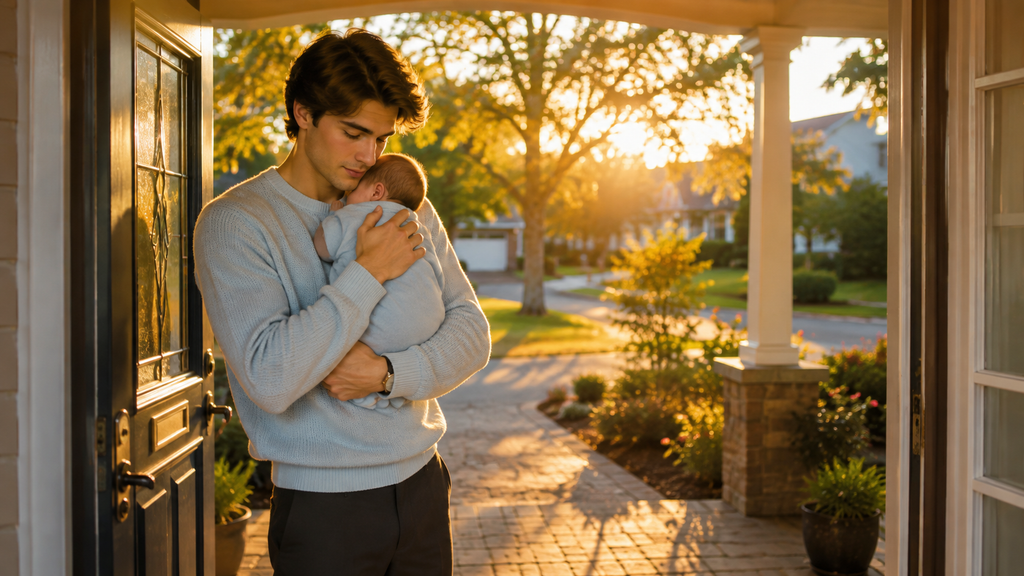
My son knew how to hold a newborn.
He knew how to calm her.
He knew the way her head needed support and the exact rhythm that soothed her.
There had been an entire year of Ethan’s life I knew nothing about.
And now he was standing in front of me, soaked from the rain, terrified of his own father, protecting a baby whose mother had disappeared.
“Laura!”
Richard’s voice came through the front door.
“Open the door.”
Ethan’s hand closed around my wrist.
“Mom.”
His eyes were begging me.
“Don’t.”
I looked down at the baby.
Then at the photographs scattered across my living-room floor.
Photographs of me.
Sleeping house.
Bedroom window.
Driveway.
Grocery store.
Work parking lot.
My own front porch.
Someone had been watching me for months.
Maybe years.
And my husband was standing ten feet away on the other side of the door.
“Why is he here?” I whispered.
Ethan shook his head.
“I don’t know.”
“You said Ava disappeared yesterday.”
“Yes.”
“And now your father suddenly leaves work in the middle of the afternoon and comes straight home?”
“I know.”
Richard hit the door again.
“Laura!”
I jumped.
The baby started crying.
Richard stopped knocking.
For three seconds there was absolute silence.
Then his voice changed.
It became quieter.
“Is there a baby in there?”
Ethan went pale.
I saw the answer in my son’s face before either of us spoke.
Richard knew.
Maybe not everything.
But enough.
“Mom,” Ethan whispered. “We need to go.”
“Where?”
“Anywhere.”
“You’re carrying a newborn.”
“I know.”
“You’re exhausted.”
“I know.”
“Ava is missing.”
“I know!”
His voice cracked on the last word.
The baby cried harder.
Ethan immediately lowered his voice.
“I know.”
He pressed both hands against his face.
For one terrible second, the eighteen-year-old boy I remembered came back.
The boy who had walked out carrying a duffel bag because his father had decided adulthood began with abandonment.
Then Ethan looked at me.
“I don’t know what I’m doing, Mom.”
That broke something inside me.
Because for twelve months I had told myself that my son had chosen silence.
That he had chosen not to answer me.
That he needed space.
That perhaps Richard was right and Ethan needed to learn independence.
But standing there, I understood the truth.
Ethan had been eighteen.
Barely eighteen.
He had been scared.
And instead of protecting him, I had asked him to wait while I tried to convince the man hurting him to become reasonable.
I had failed him.
Maybe not with cruelty.
Maybe not intentionally.
But failure does not become harmless simply because it came from fear.
I placed the baby carefully against my shoulder.
Then I looked at Ethan.
“We’re not running.”
His expression hardened.
“Mom—”
“I spent twenty-three years making myself smaller whenever your father became angry.”
Richard hit the door again.
I looked toward it.
“I am finished doing that.”
I reached for my phone.
Ethan’s eyes widened.
“You promised you wouldn’t call Dad.”
“I’m not calling your father.”
I dialed 911.
Richard must have heard my voice through the door because he began pounding again.
“Laura, open this door right now!”
The operator answered.
“911. What is your emergency?”
I stared directly at the front door.
“My husband is outside my house.”
There was a brief pause.
“Is he threatening you?”
“I don’t know yet.”
Richard shouted my name again.
I continued.
“My adult son arrived here frightened. He says someone is missing. He brought documents and photographs that may involve my husband.”
The operator’s tone sharpened.
“Are you and your son currently safe?”
“The door is locked.”
“Does your husband have a key?”
My blood turned cold.
Of course he had a key.
I looked at Ethan.
Richard stopped knocking.
We heard metal.
A key sliding into the lock.
Ethan lunged forward.
“Mom.”
The deadbolt turned.
I had locked it from inside, but Richard’s key worked.
The door moved an inch before catching against the security chain.
Richard shoved it.
The chain snapped tight.
Through the narrow opening, I saw one of his eyes.
Not angry.
Not confused.
Cold.
Calculating.
“Laura.”
I had known that man since I was twenty-six years old.
I had slept beside him for twenty-three years.
Raised a child with him.
Vacationed with him.
Held his hand at funerals.
Sat beside him in emergency rooms.
Celebrated anniversaries.
Bought birthday cakes.
Fought about bills.
Laughed at movies.
Shared thousands of ordinary mornings.
Yet the eye looking through that narrow opening belonged to someone I suddenly did not recognize.
Richard looked past me.
His gaze landed on Ethan.
Then the baby.
Then the open suitcase.
His face changed.
Only slightly.
But I saw it.
Fear.
“Where did you get that?” he asked.
Ethan said nothing.
Richard shoved the door again.
“Where did you get that suitcase?”
And that was the moment I knew.
Not suspected.
Knew.
Because an innocent man would have asked why Ethan was home.
He would have asked whose baby I was holding.
He would have asked why I had called the police.
Richard asked about the suitcase.
I stepped closer to the door.
“You know what’s inside.”
His jaw tightened.
“Laura, open the door.”
“Answer me.”
“You don’t understand what you’re looking at.”
“Then explain it.”
“Open the door.”
“No.”
Richard stared at me through the gap.
Something in his expression shifted.
For twenty-three years, that expression had worked.
The tightened mouth.
The lowered voice.
The warning behind his eyes.
Richard never needed to scream continuously.
He only needed to teach everyone around him what happened when they challenged him.
I had learned to recognize the warning.
So had Ethan.
But for the first time, I did not move.
Richard noticed.
“Laura.”
“No.”
“Stop being dramatic.”
There it was.
The sentence he had used for years whenever my emotions became inconvenient.
Stop being dramatic.
When I cried after Ethan left.
Stop being dramatic.
When I questioned a large withdrawal from our savings account.
Stop being dramatic.
When I wondered why Richard sometimes disappeared for hours without answering his phone.
Stop being dramatic.
When I asked why our home security cameras seemed to record me more often than they recorded anything happening outside.
I felt my grip tighten around the baby.
“You need to leave.”
“This is my house.”
“Not tonight.”
His eyes shifted toward Ethan.
“You.”
Ethan flinched.
Richard saw it.
“Give me the suitcase.”
“No.”
“You stole private property.”
Ethan stepped closer to me.
“I took evidence.”
“You broke into a storage unit.”
“A storage unit you told Mom didn’t exist.”
“That is none of your business.”
“It became my business when I found pictures of my mother taped inside a filing cabinet.”
Richard’s face tightened.
“Give me the suitcase.”
Ethan shook his head.
“No.”
Richard pushed the door again.
The chain groaned.
The baby wailed.
I stepped backward instinctively.
The 911 operator was still on my phone.
“Ma’am? Officers are on the way. Do not open the door.”
Richard heard her.
His entire expression changed.
“You called the police?”
I said nothing.
He stared at me.
“You called the police on your husband?”
And somehow, even then, he made it sound as though I were betraying him.
Not as though we were surrounded by photographs he had hidden.
Not as though a young woman connected to him had vanished.
Not as though our terrified son had arrived carrying a newborn.
My decision to ask for help was the offense.
I looked him in the eye.
“Yes.”
Richard stepped backward from the door.
For one second I thought he might leave.
Instead, he walked toward the side of the house.
Ethan swore under his breath.
“The garage.”
I remembered the connecting door between the garage and kitchen.
It was usually unlocked.
“Stay here.”
I handed the baby to Ethan.
“Mom—”
I ran.
I heard the garage door beginning to rise as I reached the kitchen.
The mechanical grinding sounded impossibly loud.
I reached the interior door.
Locked the knob.
Turned the deadbolt.
Then dragged one of the heavy dining chairs beneath the handle even though I knew it would do almost nothing if Richard truly wanted to force his way inside.
Seconds later, the garage door shook.
Richard tried the knob.
“Laura!”
I backed away.
“I called the police.”
“You have no idea what Ethan has gotten involved in!”
“Then tell me.”
Silence.
“Where is Ava?”
That silence was different.
Longer.
Ethan appeared behind me carrying the baby.
Richard finally answered.
“Who told you that name?”
I closed my eyes.
There it was again.
Confirmation.
“You know her.”
Richard’s voice lowered.
“Laura, listen to me.”
“No. You listen to me.”
My hands were shaking, but my voice wasn’t.
“Where is Ava?”
“I don’t know.”
“Who is she?”
No answer.
“Richard!”
“She’s nobody you need to concern yourself with.”
Ethan made a sound somewhere between a laugh and a sob.
“Nobody?”
Richard heard him.
“Ethan, stay out of this.”
“She’s my sister.”
The entire house went silent.
Even the baby had stopped crying.
I turned toward Ethan.
He was staring at the kitchen door.
I thought I had misheard him.
“What?”
Ethan looked at me.
His eyes were wet.
“Ava is my sister.”
The room tilted.
I put one hand against the counter.
“No.”
Ethan nodded.
“Half-sister.”
“No.”
“I’m sorry.”
“Ethan…”
“Dad is her father.”
The sentence entered my mind but would not become real.
Richard and I had been married for twenty-three years.
Ethan was nineteen now.
Ava looked maybe twenty-three or twenty-four in the photograph.
I did the math.
I hated myself for doing the math.
“Before we married?” I whispered.
Ethan looked toward the kitchen door.
“Ask him.”
I did.
“Richard?”
Nothing.
“Is Ava your daughter?”
Nothing.
My entire marriage seemed to compress itself into that silence.
All twenty-three years.
Every promise.
Every anniversary.
Every time Richard had accused me of being paranoid.
Every time he had made me apologize for asking a question he didn’t want to answer.
Every time he told Ethan honesty was character.
Every lecture about responsibility.
Every speech about becoming a man.
“Is Ava your daughter?”
I shouted it this time.
Richard answered quietly.
“Yes.”
One word.
That was all it took to divide my life into before and after.
Ethan moved toward me.
“Mom.”
I held up my hand.
I needed air.
I needed the kitchen to stop moving.
I needed the refrigerator humming beside me to stop sounding so strangely normal.
A photograph was stuck to the refrigerator with a magnet.
Ethan at sixteen.
Richard standing beside him.
Richard’s hand resting proudly on his son’s shoulder.
I stared at it.
“You have a daughter.”
“Yes.”
“How old?”
Richard did not answer.
“How old is she?”
“Twenty-four.”
I nearly laughed.
Not because anything was funny.
Because my mind could not find another reaction.
Twenty-four.
Richard and I had been married twenty-three years.
“Did you know about her when we got married?”
Silence.
“That is a yes.”
“Laura—”
“Did you know?”
“Yes.”
The word hit harder the second time.
I slid my hand across the countertop because my legs had suddenly become unreliable.
“You married me knowing you had a child.”
“It was complicated.”
“Children aren’t complicated, Richard.”
“You don’t know the circumstances.”
“I know you abandoned one child before teaching me how to abandon another.”
That finally silenced him.
I looked at Ethan.
He had tears running down his face now, but he was still rocking the baby gently.
“Tell me everything.”
Ethan swallowed.
“Not here.”
“Yes. Here.”
“Mom—”
“I have been lied to long enough.”
He looked at me for several seconds.
Then nodded.
“Ava’s mother was named Claire.”
The name meant nothing to me.
Ethan continued.
“Dad met her before he met you. They were together for a while. She got pregnant.”
I looked toward the door.
Richard said nothing.
“He didn’t want a baby,” Ethan continued. “At least not with her. Claire refused to… make the problem disappear.”
Richard struck the door with his palm.
“Watch your words.”
Ethan’s face transformed.
For the first time since arriving, fear disappeared.
“You don’t get to tell me what words to use anymore.”
“Ethan.”
“No.”
My son stepped toward the door.
“You kicked me into the street with eighty-seven dollars in my checking account and told me the real world would make me a man.”
“Because you needed discipline.”
“No.”
Ethan’s voice shook.
“You kicked me out because I found the photograph.”
I stared at him.
“What photograph?”
“The night before my birthday.”
Everything inside me went still.
Ethan looked at me.
“I was looking for my birth certificate.”
I remembered.
He had needed it.
A community-college application.
A part-time job.
Something ordinary.
“I thought Dad kept our documents in his office.”
He laughed bitterly.
“He did.”
Richard shouted through the door.
“Ethan, enough.”
But Ethan kept going.
“I opened the bottom drawer because I remembered seeing Dad put passports there once. There was an envelope underneath them.”
I could see the memory happening behind his eyes.
“There was a picture of Dad when he was younger.”
Ethan swallowed.
“He was holding a baby.”
My eyes moved toward the kitchen door.
“Not you,” Ethan said.
“The date was twenty-four years ago.”
I understood.
“Ava.”
“Yes.”
“I confronted him.”
“When?”
“That night.”
My lungs stopped working properly.
The morning Ethan was thrown out, his eyes had been red.
He hadn’t slept.
I had assumed it was because Richard had told him he would have to move out.
But the decision hadn’t begun that morning.
Richard had already confronted him.
“What did he tell you?”
Ethan looked ashamed.
“He told me you knew.”
I felt something tear open inside me.
“What?”
“He said you knew about Ava. He said that was why you never asked questions about the money.”
“What money?”
“The accounts.”
I looked at Richard’s side of the door.
“What accounts?”
No answer.
Ethan continued.
“He told me you had signed papers too.”
“I never signed anything involving Ava.”
“I know that now.”
“But you believed him then.”
Ethan’s expression broke.
“I was eighteen.”
The words nearly brought me to my knees.
“I was eighteen, Mom.”
I covered my mouth.
“He showed me documents with your signature.”
“My signature?”
“Yes.”
“I never—”
“I know.”
Ethan nodded quickly.
“I know.”
His voice became smaller.
“But that night, I didn’t.”
I thought back to the next morning.
Ethan refusing to look at me.
His frightening calm.
I’m never going to forgive either of you.
Not Richard.
Either of you.
He had believed I knew.
He had believed his mother had helped hide another abandoned child.
And when I asked him to give me time so I could talk to Richard, I had accidentally confirmed everything.
Oh God.
“Ethan.”
I reached for him.
This time he didn’t pull away.
I touched his face.
“I didn’t know.”
“I know.”
“I swear to you.”
“I know now.”
“I would never—”
“I know, Mom.”
His voice cracked.
“But then you let me leave.”
There are sentences that injure you because they are cruel.
And there are sentences that injure you because they are true.
That one was true.
I closed my eyes.
“Yes.”
He started shaking his head.
“You don’t have to—”
“Yes.”
I forced myself to look at him.
“I let you leave.”
Tears blurred him.
“I should have stood in that doorway.”
“Mom.”
“I should have told your father that if you left, I left.”
Richard yelled my name from the garage.
I ignored him.
“You were eighteen years old.”
“I said horrible things to you.”
“You were eighteen.”
“I ignored your calls.”
“You were eighteen.”
“I wanted you to hurt.”
“I know.”
“I thought you chose him.”
“I know.”
Ethan cried then.
Not dramatically.
He simply lowered his head while tears fell onto the hospital blanket wrapped around the sleeping baby.
“I’m sorry.”
I pulled him against me.
Carefully.
Awkwardly.
Because the newborn was between us.
I wrapped my arms around both of them.
“No.”
I pressed my cheek against Ethan’s wet hair.
“You do not apologize to me for surviving something I should have protected you from.”
His shoulders shook.
“I missed you.”
That destroyed me.
“I missed you too.”
“I wanted to call.”
“I know.”
“Sometimes I would type something and delete it.”
“I know.”
“I kept thinking maybe you knew.”
“I didn’t.”
“I know.”
We stayed like that until Richard slammed his fist against the door.
“Are you both finished?”
Ethan stiffened.
Something inside me went cold.
I stepped away from my son.
Then I walked to the kitchen door.
“Where is Ava?”
“I already told you. I don’t know.”
“What happened to Claire?”
Richard didn’t answer.
“Where is Ava’s mother?”
“Dead.”
My stomach tightened.
Ethan whispered behind me.
“Cancer. Six years ago.”
I looked back.
“How do you know?”
Ethan took a breath.
“Because Ava told me.”
“When did you meet her?”
“Three weeks after Dad kicked me out.”
Of all the things Ethan had said, that one confused me most.
“What?”
His lips trembled.
“I was sleeping in a twenty-four-hour laundromat.”
I stared at him.
He shrugged, embarrassed.
“It was warm.”
My husband had been sleeping beside me in a king-sized bed while our son slept beneath fluorescent lights beside washing machines.
I felt sick.
“I had spent most of the money I had on a motel for the first few nights,” Ethan continued.
“Then food.”
“Then a deposit someone stole from me for a room that didn’t exist.”
“Ethan…”
“I was stupid.”
“No.”
“I was.”
“No. You were eighteen.”
He nodded faintly.
“There was a diner beside the laundromat. Ava worked nights.”
I looked at the photograph lying on the counter.
Ava.
Dark hair.
Tired eyes.
Newborn against her chest.
“She started giving me leftover food after her shift.”
He smiled faintly.
“She pretended they were going to throw it away.”
“They weren’t?”
“No.”
His smile disappeared.
“She was buying it.”
Something about that tiny detail hurt worse than almost everything else.
A stranger had fed my son while I was twenty minutes away wondering whether sending another text would make me seem desperate.
“She eventually found out I didn’t have a place to stay.”
“So she took you in?”
“For a few nights.”
Ethan looked down.
“Then a few weeks.”
“Where?”
“She rented a tiny apartment over a hardware store.”
His expression softened.
“The bedroom window didn’t close all the way. The heat barely worked. The neighbor played country music until two in the morning.”
He smiled.
“But it was safe.”
I pictured it.
My son sleeping on a stranger’s couch.
No father.
No mother.
No home.
“And she knew who you were?”
“Not at first.”
He hesitated.
“Or at least that’s what she told me.”
“What does that mean?”
“One night my wallet fell out of my jacket. She saw my license.”
I understood immediately.
“Our address.”
“And our last name.”
“Yes.”
“Richard’s surname.”
Ethan nodded.
“She went quiet for two days.”
“Then?”
“She showed me a box Claire had left her.”
“What was inside?”
“Letters.”
I looked toward the kitchen door.
Richard did not move.
“Letters from Dad.”
Ethan’s voice grew harder.
“Birthday cards he never mailed.”
“Bank receipts.”
“Photographs.”
“An old DNA test.”
I stared at him.
“A DNA test?”
“Ava made him do it when she turned eighteen.”
“So Richard knew with certainty.”
“Yes.”
“For six years.”
“Longer. The test just confirmed it.”
I looked at the kitchen door.
“You knew.”
Richard sighed.
“Laura—”
“You knew that girl was your daughter.”
“Yes.”
“And you never told me.”
“It would have destroyed our family.”
I actually laughed.
A broken, disbelieving sound.
“No, Richard.”
I touched the door.
“This destroyed our family.”
“You’re emotional.”
“I am holding a file full of photographs taken of me without my knowledge.”
“There is an explanation.”
“My son says you forged my signature.”
“That is not what happened.”
“Then what happened?”
Richard was silent.
Ethan moved beside me.
“Show her the blue folder.”
He pointed toward the suitcase.
I returned to the living room.
The baby began fussing.
Ethan followed.
At the bottom of the suitcase was a dark-blue folder secured with an elastic band.
I opened it.
Bank statements.
Loan documents.
Insurance forms.
Copies of identification cards.
Signatures.
My signature.
Except I had never made them.
At least twenty pages carried a version of my name.
Laura Mitchell.
Sometimes neat.
Sometimes rushed.
Sometimes nearly perfect.
I felt dizzy.
“What are these?”
Ethan pointed.
“Look at the account numbers.”
I did.
Three were familiar.
Our mortgage.
Joint savings.
A retirement investment.
Then there were accounts I had never seen.
Accounts opened in my name.
Accounts in Claire’s name.
Accounts in Ava’s name.
Other women.
Names I did not recognize.
Monica Perez.
Sarah Bennett.
Helen Morris.
Janet Calloway.
Donna Reeves.
“What is this?”
Ethan looked at me.
“Dad had access to all of them.”
“How?”
“I don’t know exactly.”
Richard’s voice came through the kitchen.
“Because he doesn’t understand what he stole!”
I looked toward the door.
“Then explain it.”
“They were clients.”
“Clients?”
“Yes.”
“You told me you stopped doing private financial consulting fifteen years ago.”
“I reduced it.”
“You told me you stopped.”
“It wasn’t relevant to you.”
Every answer revealed another lie.
“What did Claire have to do with it?”
No response.
Ethan answered instead.
“She worked for him.”
I looked at him.
“She handled bookkeeping.”
Of course.
Claire knew where money went.
Claire knew which accounts existed.
Claire knew what Richard was doing.
“She found irregularities,” Ethan said.
“How do you know?”
“Ava had copies of her mother’s notes.”
He opened another envelope.
Pages of handwritten numbers.
Dates.
Transfers.
Initials.
“The police need this,” I whispered.
Richard struck the kitchen door.
“Laura, you have no idea what that woman was doing.”
“You mean Claire?”
“She stole from me.”
“Then why do you have copies of her daughter’s identification?”
Silence.
“Why do you have photographs of me?”
Richard hesitated.
That hesitation answered more than words.
“Who took them?”
“Someone I hired.”
The room seemed to shrink.
“You hired someone to follow me?”
“It wasn’t like that.”
“Someone photographed my bedroom window.”
“I needed to know who you were talking to.”
I stared at the door.
“Why?”
“Because you started asking questions.”
“What questions?”
“About the money.”
I remembered.
Two years earlier.
A twenty-eight-thousand-dollar withdrawal from one of our investment accounts.
Richard said it had been moved into a higher-yield fund.
I asked for paperwork.
He became furious.
Not immediately.
First dismissive.
Then offended.
Then somehow I ended the evening apologizing for implying I didn’t trust him.
After that, I stopped asking.
My skin crawled.
“You had me followed because I asked what happened to our money?”
“I needed to know whether someone had put ideas in your head.”
“Someone?”
“A lawyer.”
“A banker.”
“Ethan.”
The last name startled us both.
I looked at my son.
Richard continued.
“You started talking about giving Ethan access to an account when he turned eighteen.”
My stomach tightened.
“The education fund.”
“Yes.”
The fund Richard and I had contributed to since Ethan was born.
“What happened to it?”
No answer.
“What happened to Ethan’s education fund?”
Richard did not speak.
Ethan closed his eyes.
“He took most of it.”
I turned.
“No.”
“He moved it.”
“No.”
“I found the transfers.”
I had saved birthday money.
Tax refunds.
A portion of every Christmas bonus.
My parents had contributed before they died.
Nearly eighty thousand dollars should have been there.
“How much is left?”
Ethan whispered.
“About six thousand.”
I felt my knees weaken.
I sat on the sofa.
Richard called through the house.
“I was going to replace it.”
Ethan laughed.
“When?”
“I had investments pending.”
“You stole from your son.”
“I borrowed money that belonged to this family.”
“It was for his education!”
“He didn’t need eighty thousand dollars to attend community college.”
The cruelty was so casual that even after everything, it stunned me.
Ethan looked at the floor.
And I understood how many times Richard must have spoken to him like that when I wasn’t around.
Small sentences.
Tiny cuts.
Nothing dramatic enough to expose easily.
Just enough to teach a child that every dream required his father’s approval.
I looked at Ethan.
“You can go anywhere you want.”
He gave me a sad smile.
“That isn’t really the problem right now.”
A siren sounded faintly in the distance.
Richard heard it too.
The garage door handle stopped moving.
Then footsteps.
Fast.
Moving away.
“He’s leaving,” Ethan said.
I rushed to the front window.
Richard was crossing the driveway toward his car.
“Tell them he’s leaving,” the emergency operator instructed.
I did.
The siren grew louder.
Richard opened his car door.
Before he could get inside, two police vehicles turned onto our street.
One blocked the driveway.
Another stopped behind it.
Richard froze.
For a moment I saw him standing beneath the rain.
My husband.
The father of my child.
The man who had controlled nearly every emotional temperature inside our home for two decades.
He looked strangely small.
An officer stepped out.
“Sir, stay where you are.”
Richard raised his hands.
“This is a misunderstanding.”
Of course it was.
Everything was always a misunderstanding when Richard was finally forced to explain himself.
The officer approached.
Another officer came toward our front door.
I unlocked it only after the dispatcher told me officers were outside.
When I opened the door, cold rain blew into the hallway.
A female officer stood there.
“Laura?”
“Yes.”
“I’m Officer Ramirez.”
Her eyes went to Ethan and the newborn.
Then to the photographs.
Her expression changed.
“What happened here?”
I tried to answer.
Nothing came out.
Ethan did.
“A woman is missing.”
Officer Ramirez became completely focused.
“Who?”
“Ava Cole.”
“What is your relationship to Ava?”
Ethan looked at Richard standing beside the patrol car.
“She’s my half-sister.”
The officer followed his gaze.
“That man is her father?”
“Yes.”
Richard shouted from the driveway.
“I haven’t done anything!”
Officer Ramirez ignored him.
“When did you last see Ava?”
“Yesterday morning.”
“Where?”
“Our apartment.”
My head turned.
“Our?”
Ethan gave me an apologetic glance.
“Ava and I eventually rented a two-bedroom together.”
I nodded.
There would be time for that later.
“What happened yesterday?” Officer Ramirez asked.
“Ava left around nine.”
“Where was she going?”
“She said she was meeting someone.”
“Who?”
“A detective.”
Richard looked sharply toward us.
Officer Ramirez noticed.
“Do you know the detective’s name?”
Ethan nodded.
“Daniel Brooks.”
Officer Ramirez’s expression changed.
“You’re sure?”
“Yes.”
She touched the radio on her shoulder.
“Dispatch, can you contact Detective Brooks? Possible connection to missing adult Ava Cole.”
Static answered.
Richard began speaking rapidly to the other officer.
“He broke into my storage unit. He stole confidential records. I came home because my security company alerted me.”
Ethan looked at me.
“There.”
“What?”
“That’s how he knew.”
I remembered asking.
How did Richard know Ethan was here?
He hadn’t.
He knew the storage unit had been entered.
And when Ethan took the suitcase, Richard had guessed where he would go.
Home.
Richard called toward us.
“That suitcase is stolen property.”
Officer Ramirez turned.
“Sir, stop speaking to them.”
“They’re making wild accusations.”
“Then you can explain them after we understand whether someone is missing.”
“My son is unstable.”
Ethan went rigid.
Richard continued.
“He disappeared for a year. Now he breaks into my property and fills my wife’s head with nonsense.”
I stepped onto the porch.
“Do not call him unstable.”
Richard stared at me.
“Laura.”
“No.”
Rain struck my face.
“You don’t get to do that anymore.”
“This is exactly what I was afraid of.”
“What?”
“Ethan turning you against me.”
I almost smiled.
“You did that yourself.”
His face hardened.
“You’re making a mistake.”
“No.”
I shook my head.
“My mistake happened one year ago when I let you force our son through that door.”
Richard glanced toward the officers.
“Force?”
He laughed.
“He was eighteen.”
Officer Ramirez looked at him.
Richard realized too late how it sounded.
“He was an adult,” he corrected.
I stared at him.
“You spent eighteen years telling Ethan he wasn’t mature enough to decide what time he could come home.”
Richard said nothing.
“You controlled his phone.”
“His bank account.”
“His car.”
“His friends.”
“His work schedule.”
“Then the morning after his eighteenth birthday, suddenly he was adult enough to survive without a home.”
“It was discipline.”
“No.”
I looked at Ethan standing inside.
“It was punishment.”
Richard’s eyes narrowed.
I understood then.
He had not kicked Ethan out because he believed eighteen-year-olds needed independence.
He had kicked Ethan out because Ethan discovered Ava.
Richard had dressed retaliation in the language of fatherhood.
And I had believed him long enough to help him do it.
Officer Ramirez’s radio crackled.
A dispatcher spoke.
She turned away, listening carefully.
Then she looked at Ethan.
“Detective Brooks is coming here.”
Ethan stepped forward.
“You reached him?”
“Yes.”
“Does he know where Ava is?”
The officer hesitated.
“I don’t know.”
Ethan’s face collapsed slightly.
“What does that mean?”
“It means we wait for him to get here.”
“Please.”
He hugged the newborn closer.
“She just had a baby.”
“How old?”
“Eight days.”
My heart stopped.
Eight days.
The child in Ethan’s arms was only eight days old.
“Her name is Lily,” Ethan whispered.
I looked at the baby.
Lily.
I touched the edge of the blanket.
“Hi, Lily.”
Her tiny mouth opened.
One fist emerged.
Perfect fingers.
Eight days in the world.
Already surrounded by secrets that began decades before she existed.
“Where is Lily’s father?” Officer Ramirez asked.
Ethan’s expression softened with grief.
“His name was Caleb.”
Was.
The word told me before he explained.
“He died four months ago.”
“I’m sorry.”
“Car accident.”
Ethan swallowed.
“Ava doesn’t really have anybody else.”
He looked at Richard.
“She definitely doesn’t have him.”
Richard turned his face away.
It was the smallest movement.
But I saw something in it.
Not guilt.
Annoyance.
As though Ava’s existence had become an administrative problem that refused to disappear.
I suddenly hated him.
Not the explosive hatred of a dramatic moment.
Something colder.
Cleaner.
The kind of hatred that arrives after love finally runs out of excuses.
The police brought us inside while they spoke separately with Richard.
I made tea because I didn’t know what else to do.
Nobody drank it.
Ethan sat at the kitchen table with Lily.
I warmed a bottle under his instructions.
“Not the microwave,” he said quickly.
“I know.”
Then I realized I hadn’t fed a baby in nineteen years.
“You check it here.”
He touched the inside of his wrist.
I smiled despite everything.
“I remember.”
He looked embarrassed.
“Sorry.”
“Don’t apologize.”
I handed him the bottle.
“You’re good with her.”
His eyes moved toward Lily.
“Ava was terrified.”
“Of being a mother?”
“Of everything.”
He smiled faintly.
“The first night home from the hospital, Lily sneezed and Ava called the nurse hotline.”
I laughed.
Ethan laughed too.
It was the first time I had heard my son laugh in a year.
For half a second, the kitchen was ours again.
Then the front door opened.
Officer Ramirez entered with a man in plain clothes.
Mid-forties.
Gray beginning at the temples.
Rain on his shoulders.
“Ethan?”
My son stood immediately.
“I’m Detective Brooks.”
Ethan didn’t care about introductions.
“Where is Ava?”
Detective Brooks looked at Lily.
Then at Ethan.
“She’s alive.”
Ethan nearly dropped into his chair.
I grabbed the table.
Alive.
Ava was alive.
“Where?” Ethan asked.
“She’s at St. Matthew’s.”
“The hospital?”
“Yes.”
“Why?”
“She was brought in early this morning.”
Ethan’s voice rose.
“Why didn’t anyone call me?”
“She didn’t have identification when she was found.”
“What happened to her?”
Detective Brooks glanced toward Officer Ramirez.
Then toward me.
“Who are you?”
“I’m Laura Mitchell.”
His face changed.
“Richard Mitchell’s wife?”
“For the moment.”
The words surprised even me.
Detective Brooks studied me.
Then nodded.
“Ava mentioned you.”
My throat tightened.
“She knows me?”
“She knows about you.”
I looked at Ethan.
“She left a written statement with our office three days ago.”
“What kind of statement?”
“A detailed one.”
The detective glanced at the suitcase.
“Apparently connected to whatever is in that.”
Ethan stood.
“Can I see her?”
“In a little while.”
“What happened?”
Detective Brooks sat down.
“Ava was supposed to meet me yesterday morning.”
“She told me.”
“She never arrived.”
Ethan’s face tightened.
“We began trying to locate her.”
“Why didn’t you contact me?”
“She specifically asked us not to contact you until we had more information.”
Ethan stared at him.
“Why?”
“Because she was worried someone might be monitoring your phone.”
Richard.
I could feel his presence outside without seeing him.
“Was she right?” I asked.
Detective Brooks looked toward the photographs.
“We’re working on that.”
“What happened to Ava?”
He exhaled.
“A convenience-store employee found her sitting behind the building shortly after five this morning.”
“Why?”
“She had walked almost seven miles.”
Ethan’s face drained of color.
“From where?”
“A motel outside the county line.”
“Why was she there?”
“That’s what we’re still determining.”
“Did Dad take her?”
Detective Brooks chose his words carefully.
“Ava says Richard met her yesterday morning.”
Ethan stood completely still.
“At your office?”
“No.”
“She was on her way to us.”
My fingers went cold.
“He intercepted her?”
“She says he was waiting near her car.”
I closed my eyes.
Of course he knew.
The photographs.
Tracking.
Money.
Control.
“What did he do?” Ethan asked.
“She says he persuaded her to get into his vehicle.”
“Persuaded?”
Detective Brooks nodded.
“She says he told her he knew where you were and that you were in trouble.”
Ethan whispered something I couldn’t hear.
“She believed him.”
The detective continued.
“Ava says Richard drove her to a motel.”
“Why?”
“He wanted to talk.”
I stared at him.
“Talk.”
“That’s her description.”
“Did he hurt her?”
“No serious physical injuries.”
The phrase did not comfort me.
“She says he took her phone and keys.”
Ethan’s jaw clenched.
“He left her there?”
“Eventually.”
“Why?”
Detective Brooks looked at the suitcase.
“He wanted to know where the documents were.”
Everything fit.
Ava and Ethan had taken the evidence.
Richard realized.
He confronted Ava.
She refused to tell him.
He took her phone.
Her keys.
Left her stranded.
Then the security notification came from the storage unit.
And Richard came home looking for Ethan.
“Did Ava tell him I had the suitcase?” Ethan asked.
“No.”
The relief on his face was immediate.
“She told him she had destroyed the records.”
Detective Brooks almost smiled.
“She was apparently convincing.”
Ethan closed his eyes.
“Of course she was.”
I looked at him.
“She protected you.”
He nodded.
“She always does.”
The detective’s expression softened.
“She also told us that if anything happened to her, Lily would be with you.”
Ethan looked down at the baby.
His chin trembled.
“She trusted me.”
“She did.”
“Can I see her?”
“Yes.”
“But before you leave, I need the suitcase.”
Ethan looked instinctively at me.
A year earlier, he might have looked toward Richard for permission.
Now he looked toward me.
I nodded.
“Give it to him.”
Detective Brooks examined the first folder.
Then the second.
He stopped at the identification cards.
“Where exactly did you find this?”
Ethan explained.
A storage facility twenty miles from our house.
Unit 318.
Leased under the name Robert Kelley.
Richard’s middle name was Robert.
His mother’s maiden name was Kelley.
So clever.
So obvious.
The detective photographed several pages.
Then looked at me.
“Mrs. Mitchell, are these your signatures?”
“No.”
“You’re certain?”
“Yes.”
“Have you ever given your husband power of attorney?”
“No.”
“Permission to sign financial documents on your behalf?”
“No.”
“Access to your identification?”
“He’s my husband.”
The words felt strange now.
“Of course he had access.”
Detective Brooks nodded grimly.
He turned several pages.
“How long have you been married?”
“Twenty-three years.”
He stopped.
One document was dated nineteen years earlier.
My forged signature was at the bottom.
My son was three months old when someone had signed my name to that form.
I suddenly understood that the man I believed had changed over time had perhaps never changed at all.
Maybe I had simply learned to stop looking.
Richard wasn’t arrested immediately.
That surprised me.
I wanted dramatic handcuffs.
A slammed patrol-car door.
Some physical sign that the world finally understood what he had done.
Real life was slower.
More careful.
The officers questioned him.
Detective Brooks took possession of the suitcase.
Richard insisted the financial papers had legitimate explanations.
He claimed the photographs were part of a private investigation after he became concerned I was “making unusual inquiries.”
He claimed Ava willingly went with him.
He claimed she gave him her phone.
He claimed he had returned her keys.
He claimed Ethan had stolen confidential business records and broken into private property.
He claimed everyone misunderstood him.
Richard had spent his entire adult life becoming very skilled at explanations.
But explanations have limits when documents exist.
So do lies.
Especially when the people you controlled begin comparing stories.
Detective Brooks asked whether Ethan and I had somewhere else to stay.
I looked around the kitchen.
The house suddenly felt contaminated.
Twenty-three years of my life were in those rooms.
My wedding china.
Ethan’s height marks behind the pantry door.
Family photographs.
Christmas decorations in the attic.
The scratch on the hardwood floor from the day Ethan learned to walk and pushed a dining chair across the room.
Richard’s jackets.
Richard’s shoes.
Richard’s coffee cup beside the sink.
My whole marriage.
I looked at Ethan.
“Yes.”
“We do.”
He looked surprised.
“Where?”
I picked up my phone.
“My sister.”
My younger sister, Marianne, lived forty minutes away.
Richard disliked her.
That alone suddenly felt like an excellent reason to go.
Marianne answered on the second ring.
“Laura?”
I had not called her after midnight or during a crisis.
I had simply called.
Yet something in my breathing must have told her.
“What happened?”
“Can Ethan and I come over?”
Silence.
Then:
“Ethan?”
“Yes.”
“He’s with you?”
“Yes.”
Another pause.
“Come.”
No questions.
No hesitation.
“Bring whatever you need.”
I started crying.
Marianne’s voice softened.
“Laura?”
“There’s a baby too.”
“A baby?”
“I’ll explain.”
“Okay.”
Another pause.
“Bring the baby.”
That was all.
I packed one suitcase.
There was something almost poetic about that.
A year earlier, Richard had put Ethan’s life into a duffel bag.
Now I stood in the same bedroom Richard and I had shared for more than two decades and packed enough clothing for myself into one suitcase.
I did not pack our wedding album.
I did not pack jewelry he had given me.
I did not pack anniversary cards.
I took medication.
Documents.
Clothes.
My mother’s necklace.
A photograph of Ethan from kindergarten.
My laptop.
And the folder containing the little paperwork Detective Brooks allowed me to keep.
When I came downstairs, Richard was standing in the living room with an officer.
He wasn’t handcuffed.
He looked furious.
“Where are you going?”
I kept walking.
“Laura.”
I stopped.
Ethan stood behind me holding Lily’s carrier.
Richard pointed toward him.
“He is manipulating you.”
I almost couldn’t believe it.
“Our son?”
“He has hated me for a year.”
“Maybe ask yourself why.”
“You think this is proof of something?”
He gestured toward the missing suitcase.
“You have heard one side.”
“I heard you admit Ava is your daughter.”
His face tightened.
“That has nothing to do with this.”
“It has everything to do with this.”
“I made a mistake before we were married.”
“Ava is not a mistake.”
“That isn’t what I meant.”
“You hid your child for twenty-four years.”
“I supported Claire financially.”
“With stolen money?”
His jaw clenched.
“Careful.”
There it was again.
Careful.
I smiled.
The expression unsettled him.
For twenty-three years, careful had meant stop.
Careful had meant retreat.
Careful had meant you are approaching the edge of my patience.
But something had changed.
“Or what?”
Richard blinked.
“What?”
“You said careful.”
I stepped closer.
“What happens if I’m not careful anymore?”
He looked toward the police officer.
Good.
For once Richard remembered there was a witness.
I continued.
“Will you raise your voice?”
“Call me hysterical?”
“Tell me I’m confused?”
“Move money and say I misunderstood?”
“Have someone photograph me?”
“Forge my signature?”
“Throw me out too?”
Richard’s face reddened.
“I have never thrown you out.”
“No.”
I lifted my suitcase.
“I’m leaving by choice.”
He stared at it.
I watched him understand.
“You’re coming back.”
“No.”
“You’re upset.”
“Yes.”
“You’ll calm down.”
“No.”
“Laura.”
“I’m filing for divorce.”
The room went silent.
Richard actually smiled.
It was not a kind smile.
“You won’t.”
Twenty-three years distilled into two words.
You won’t.
He believed he knew me.
Maybe he had known the woman I had spent two decades becoming.
The woman who negotiated instead of confronted.
Who apologized to preserve peace.
Who mistook endurance for loyalty.
But that woman had opened the door one year too late.
And I could not undo that.
I could only refuse to be her again.
“Watch me.”
Then I walked out.
Ethan followed.
At Marianne’s house, I finally met Lily properly.
Marianne took one look at Ethan and burst into tears.
He stood awkwardly in her entryway, one hand still on the baby carrier.
She hugged him anyway.
“I’m angry with you,” she whispered.
Ethan stiffened.
Then she added:
“But I’m much angrier with the adults.”
He started crying.
Marianne held him tighter.
I looked away because I could barely handle my own emotions.
Then she noticed Lily.
“Oh my God.”
Her eyes widened.
“She’s tiny.”
“Eight days,” Ethan said.
Marianne looked at me.
I nodded.
“Coffee first.”
She pointed toward the kitchen.
“Then someone tells me everything.”
We were halfway through the story when Detective Brooks called.
Ava was asking for Ethan.
He drove to the hospital immediately.
I went with him.
Marianne kept Lily because bringing an eight-day-old baby back into a hospital in the middle of everything seemed unnecessary.
The ride was almost silent.
Three times I tried to speak.
Three times I stopped.
Finally Ethan said:
“You can ask.”
“What?”
“Whatever you keep trying to ask.”
I watched highway lights sweep across his face.
“Do you hate me?”
He stared ahead.
The question hung between us.
“I did.”
The answer hurt.
But I had asked for truth.
So I accepted it.
“For a while.”
He continued.
“I hated both of you.”
“Then I stopped hating you.”
“When?”
He thought.
“When you kept calling.”
I swallowed.
“You never answered.”
“I know.”
“But you listened?”
“Sometimes.”
My chest tightened.
“The voicemail on Christmas…”
I looked at him.
He nodded.
I remembered leaving it.
Merry Christmas, sweetheart.
I don’t know where you are.
I don’t know if you want to hear my voice.
I just need you to know there’s a plate for you here.
There will always be a plate for you here.
“I listened to that one a lot,” he whispered.
I turned toward the window because tears had filled my eyes.
“I almost called.”
“Why didn’t you?”
“Because Dad called me two hours later.”
My head snapped toward him.
“Your father called you?”
“Yes.”
“When?”
“Christmas.”
Richard had told me he did not know Ethan’s phone number anymore.
He had claimed Ethan blocked him.
“What did he say?”
Ethan laughed bitterly.
“He said if I contacted you, he would tell you everything I had supposedly stolen from him.”
“Stolen?”
“He said he’d report the car.”
The old Honda Ethan drove had been titled in Richard’s name.
Even though Ethan had paid half of it from his summer jobs.
“He said he’d report my phone.”
“He said he’d tell my school I had falsified financial information.”
“Why?”
“To scare me.”
Ethan shrugged.
“It worked.”
“Why didn’t you tell me?”
“Because I still didn’t know how much you knew.”
I nodded.
There was no answer that would make it better.
“So no,” Ethan said quietly.
“I don’t hate you.”
He looked at me.
“But I don’t know how to go back to how things were.”
I reached across the console.
I did not touch him.
I simply placed my hand there.
“We don’t go back.”
He looked at it.
“We build something new.”
After several seconds, Ethan placed his hand over mine.
Not forgiveness.
Not yet.
Something better.
A beginning.
Ava was in a hospital bed when we arrived.
She looked even younger than she had in the photograph.
Her dark hair was tangled.
One cheek was bruised from what the nurse later explained was a fall during her long walk.
There was an IV in her arm.
She saw Ethan.
Then she started crying.
He crossed the room so quickly he nearly knocked over the chair.
“You idiot.”
Ava laughed through her tears.
“That’s your opening line?”
“You absolute idiot.”
She wrapped her arms around him.
“I’m sorry.”
“I thought you were dead.”
“I know.”
“You left your baby with me!”
“I trust you.”
“I changed four diapers!”
“Congratulations.”
“One was catastrophic.”
Ava started laughing.
Then Ethan cried.
They held each other.
I stood near the door, feeling like an intruder inside a relationship formed during the year I had lost.
Then Ava looked over Ethan’s shoulder.
She saw me.
Her laughter disappeared.
For a moment, neither of us moved.
“You’re Laura.”
I nodded.
“You look like your pictures.”
The words sent a chill through me.
Ava immediately realized what she had said.
“Sorry.”
“No.”
I stepped closer.
“Apparently a lot of people have seen more pictures of me than I knew existed.”
She gave a weak smile.
Then her expression became uncertain.
“I wasn’t sure you would come.”
“Neither was I.”
That made her laugh softly.
I approached the bed.
Up close, I could see Richard in her.
Not exactly.
But enough.
The same line around the eyes.
The same shape of the chin Ethan had inherited.
Once you knew, you could not unknow it.
She watched me notice.
“I look like him.”
It wasn’t a question.
“A little.”
“I’m sorry.”
My heart broke.
“For what?”
She shrugged.
“For existing, I guess.”
I sat beside her.
“No.”
I took her hand.
“Never apologize for someone else deciding your existence was inconvenient.”
Her face crumpled.
She looked away.
“Your husband hated me before he even knew me.”
I shook my head.
“My husband feared consequences.”
“That is not the same thing as you being unworthy of love.”
Ava cried quietly.
Then she whispered:
“My mom used to say something like that.”
“I wish I could have known her.”
Ava studied me.
“She knew about you.”
I expected jealousy.
Resentment.
Maybe hatred.
Instead Ava said:
“She felt sorry for you.”
That hurt in a different way.
“Why?”
“Because she said you had no idea.”
My throat tightened.
“She tried to tell you once.”
I stared at her.
“What?”
“When I was eleven.”
Ava reached toward the bedside drawer.
Inside was an old envelope.
Creased.
Yellowing.
My name was written across the front.
LAURA MITCHELL.
I recognized neither the handwriting nor the envelope.
“What is this?”
“My mom wrote it.”
“Did she send it?”
“She tried.”
“What happened?”
Ava looked toward Ethan.
“He intercepted it.”
Richard.
Of course.
“How do you know?”
“He kept it.”
I stared at her.
“In the storage unit?”
“Yes.”
My hands began shaking as I opened the envelope.
The letter was twelve years old.
Claire had written only two pages.
I read slowly.
She did not sound bitter.
That made it worse.
She wrote that she had no desire to destroy my marriage.
She wrote that she believed I had a right to know Richard had a daughter.
She explained that Richard had provided money irregularly but refused to acknowledge Ava publicly.
She wrote that she had discovered financial records involving my name and feared I might not know about them.
Near the bottom was one sentence I read three times.
If you already know all of this and have chosen to remain silent, then forgive me for interfering.
But if you do not know, I hope someone finally gives you the truth.
I lowered the paper.
For twelve years, that letter had existed.
The truth had tried to reach me.
Richard had locked it in a storage unit.
I cried for a woman I had never met.
A woman I might once have believed was the threat to my marriage.
She wasn’t.
She had been trying to warn me.
“What happened after she wrote this?”
Ava looked at her hands.
“Dad showed up at our apartment.”
My skin crawled hearing her call him Dad.
Not because she shouldn’t.
Because she should have been able to.
“He told Mom if she contacted you again, he would stop sending money.”
“Did she?”
“No.”
Ava smiled sadly.
“She started saving everything instead.”
“The letters.”
“The statements.”
“The photographs.”
“Everything.”
“And after she died?”
“I got the box.”
“Why didn’t you contact me?”
“I almost did.”
She looked toward Ethan.
“Then three weeks after Richard kicked Ethan out, he walked into the diner where I worked.”
Ethan gave a tired laugh.
“Technically, I was asked to leave because I fell asleep in a booth.”
“You were asleep for forty minutes.”
“I was tired.”
“You drooled on the menu.”
“That part is slander.”
I smiled.
Ava smiled too.
Then she continued.
“I saw his last name.”
“Mitchell.”
“Yes.”
“And?”
“I thought maybe it was coincidence.”
“Then I saw the address on his license.”
My old home.
Her father’s home.
“I realized who he was.”
“You knew immediately?”
“Pretty much.”
“Did you tell him?”
“Not for several weeks.”
“Why help him?”
Ava looked genuinely confused by the question.
“Because he was my brother.”
Just like that.
No philosophy.
No complicated explanation.
Because he was my brother.
Richard had treated blood like a burden.
Ava treated it like a reason to help.
“She gave me her couch,” Ethan said.
Ava rolled her eyes.
“You were pathetic.”
“I had charm.”
“You smelled like laundromat detergent.”
“I had showered in a sink.”
“That is not helping your argument.”
They smiled at each other.
I saw it then.
Family.
Not the polished photographs Richard insisted we take every December.
Not matching clothes.
Not blood alone.
Family was an exhausted twenty-four-year-old waitress buying extra food because an eighteen-year-old boy was hungry.
Family was a boy learning to sterilize bottles because his half-sister had just given birth and was terrified.
Family was trust created in bad apartments and hospital rooms.
Richard had spent his whole life demanding respect.
Ava and Ethan had somehow created loyalty.
Two very different things.
Over the next week, Richard’s world began to come apart.
Not instantly.
Not dramatically.
Piece by piece.
Detectives searched the storage unit after obtaining a warrant.
They found more than Ethan and Ava had taken.
Boxes.
Hard drives.
Old phones.
Financial records stretching back nearly two decades.
Copies of identification belonging to former clients.
Several documents carrying signatures people later denied making.
Files on Claire.
Files on Ava.
Files on me.
Even a file on Ethan.
That one nearly broke me.
His school schedule.
Copies of his bank statements.
Screenshots of text conversations Richard apparently obtained from an old family cloud account.
Notes.
Names of friends.
Addresses.
Dates.
One handwritten page carried the title:
ETHAN — POSSIBLE INFLUENCES.
His own son had been reduced to a surveillance project.
When Ethan saw it, he stared for a long time.
Then he said:
“I used to think he knew me.”
I sat beside him.
“He studied you.”
“That isn’t the same thing.”
“No.”
It wasn’t.
Detective Brooks eventually explained that Richard’s financial activities appeared much larger than any of us understood.
Several women whose identification appeared in the suitcase had once trusted him with investments.
Some were elderly.
Some were recently widowed.
Some had inherited money.
Richard used a complicated network of accounts to move funds in ways that were difficult to trace.
Some money returned.
Some didn’t.
In some cases, Richard claimed losses were investments gone wrong.
In others, investigators suspected forged authorizations.
Claire had discovered enough to become dangerous to him.
So Richard kept her quiet with money and threats.
Then Claire became ill.
And after she died, Richard assumed the evidence died with her.
It didn’t.
She left it to Ava.
Ava spent years afraid to do anything with it.
Until Ethan arrived.
Her brother.
Richard’s son.
Proof that Richard had eventually created the respectable family he once told Claire he could never have.
That anger changed something in Ava.
Then Ethan showed her the story Richard had told him.
That Laura knew.
That Laura had signed documents.
That Laura had participated.
Ava didn’t believe it.
“My mom didn’t believe it either,” she told Ethan.
That was why they went looking.
That was why they found the storage unit.
That was why Richard panicked.
Three months after Ethan came home, Richard was indicted on multiple financial charges.
Other investigations continued.
His lawyer advised him not to contact me.
The court later made that instruction official.
Our divorce moved more quickly than I expected because once investigators froze several assets, Richard’s usual strategy of financial intimidation became harder.
The house was sold eventually.
I thought losing it would devastate me.
It didn’t.
I cried when I removed the pencil marks from behind the pantry door.
Not literally.
I couldn’t remove them.
I cut out that narrow strip of wood.
Marianne stood behind me while I did it.
“You’re destroying the wall.”
“I know.”
“The new owners might object.”
“They can buy a piece of trim.”
She helped me pry it loose.
There they were.
Ethan — age 4.
Ethan — age 6.
Ethan — age 9.
A scribbled line at age twelve because he had stood on his toes.
Age fifteen.
Seventeen.
The last line.
I carried that board out of the house.
Everything else could belong to somebody else.
That belonged to me.
Ethan did not move back in with me.
That surprised people.
They expected a movie ending.
Mother and son reunited.
Bedroom restored.
Family healed.
But healing does not mean pretending the injury never happened.
Ethan had built a life.
A fragile one.
But his.
He enrolled in classes again.
Found steady work.
Shared an apartment with Ava and Lily for several more months.
I helped with rent once.
He made me write it down as a loan.
I did.
Then I secretly cried in my car because the son Richard accused of needing too much protection had become fiercely determined never to owe anyone anything.
I wanted to tell him he didn’t need to prove himself.
Instead, I waited.
One evening, he finally said it himself.
“I think Dad made me feel like accepting help was weakness.”
We were eating dinner in my new apartment.
I put down my fork.
“And what do you think now?”
He considered it.
“I think knowing when you need people might actually be harder.”
I smiled.
“I think you’re right.”
“Don’t make it weird.”
“I wasn’t.”
“You were about to cry.”
“I absolutely was not.”
He pointed at me.
“You’re crying.”
“I have allergies.”
“It’s January.”
“Very aggressive winter allergies.”
He laughed.
Then I laughed.
We had more moments like that.
Small ones.
Real ones.
He still got quiet sometimes.
He still hesitated before telling me things.
There were boundaries I had to learn not to take personally.
Once, I called three times because he didn’t answer.
When he finally picked up, he sounded irritated.
“Mom.”
I froze.
The old panic started.
“I’m sorry.”
He heard it.
“No.”
His voice softened.
“I’m not disappearing.”
I sat down.
“I know.”
“You don’t have to panic if I don’t answer.”
“I’m trying.”
“I know.”
A pause.
“Love you.”
It was the first time he had said it since returning.
I couldn’t speak.
“Mom?”
“I’m here.”
“You okay?”
“Yes.”
I pressed my hand to my mouth.
“I love you too.”
After we hung up, I cried for fifteen minutes.
Ava eventually found an apartment of her own.
She hated accepting help even more than Ethan did.
Apparently stubbornness was something both inherited from Richard.
But unlike Richard, they used theirs mostly against themselves.
Lily grew.
That was perhaps the most beautiful part.
While the adults around her untangled twenty-four years of deception, Lily simply grew.
At three months, she discovered ceiling fans.
At four months, she laughed whenever Ethan sneezed.
At six months, she grabbed my glasses every time I held her.
At eight months, she refused to eat mashed peas with such personal outrage that Ava recorded it.
At ten months, she said something that sounded suspiciously like “Eth.”
Ethan claimed it was his name.
Ava insisted the baby had hiccupped.
At eleven months, she pulled herself onto her feet using my coffee table.
And one week before her first birthday, Ava called me.
“Laura?”
“Yes?”
“I need to ask you something.”
Her voice sounded nervous.
That always frightened me now.
“What happened?”
“Nothing.”
“Is Lily okay?”
“She’s fine.”
“Ethan?”
“Also fine.”
“Then what?”
A pause.
“Would it be weird if Lily called you Grandma?”
I stopped breathing.
Ava rushed to continue.
“You don’t have to. I know technically you’re not my mother and Richard is my biological father, so there isn’t really a normal label for this, and maybe it would be confusing, and I don’t want you to feel pressured—”
“Ava.”
She stopped.
“Yes.”
“I would love that.”
Silence.
Then she cried.
I cried too.
We were apparently a family of very frequent criers.
Lily’s first birthday was held in Marianne’s backyard.
Nothing extravagant.
Balloons.
A cake Ava attempted to make herself that leaned noticeably to the left.
Ethan grilled burgers.
Marianne complained he was burning them.
Ethan told her that “charred” was a culinary style.
She threatened to remove him from the grill.
Lily wore a yellow dress.
At one point, she grabbed a fistful of frosting and smeared it into Ethan’s hair.
Ava laughed so hard she nearly dropped her phone.
I stood a few feet away watching them.
My son.
My husband’s daughter.
The granddaughter he had nearly treated as another secret to manage.
I expected to feel grief.
Instead, I felt something lighter.
Freedom, perhaps.
Not happiness untouched by pain.
Something stronger.
Happiness that had survived it.
Later that afternoon, Ethan came and stood beside me.
“You okay?”
I nodded.
“I was thinking.”
“Dangerous.”
I nudged him.
He smiled.
Then I asked something I had been afraid to ask for months.
“Do you ever wish you had never come back that day?”
His smile disappeared.
He looked across the yard.
Ava was helping Lily stand.
Marianne was taking pictures.
Finally Ethan said:
“I almost didn’t.”
“What?”
“That day.”
He rubbed the back of his neck.
“I stood across the street for about twenty minutes.”
My heart tightened.
“In the rain?”
“Yes.”
“Why?”
“I didn’t know whether Dad was home.”
“And if he had been?”
“I probably would’ve left.”
The thought was unbearable.
“What changed your mind?”
He looked at me.
“I saw the curtains.”
“The curtains?”
“You never close the living-room curtains completely during the day.”
I laughed softly.
“You always leave one side open because you say the room gets depressing without natural light.”
“I do.”
“So I knew you were probably home.”
He paused.
“And I remembered something.”
“What?”
“The day I left.”
My smile disappeared.
“You came outside after me.”
I remembered.
Richard had stood in the doorway.
Ethan had reached the sidewalk.
I followed.
I had begged him to wait.
He had kept walking.
“You yelled that you loved me.”
“I did.”
“I pretended I didn’t hear.”
My throat tightened.
“But I heard.”
He looked away.
“I heard every word.”
I touched his arm.
“I meant every word.”
“I know.”
“I should have done more.”
“I know.”
The words could have been cruel.
They weren’t.
They were simply true.
Then Ethan looked at me.
“But you did more when I came back.”
I swallowed.
“I was late.”
“Yeah.”
He gave me a sad smile.
“But you opened the door.”
I started crying.
Ethan groaned.
“Here we go.”
“I’m fine.”
“You are openly crying.”
“It’s emotional.”
“You cry during insurance commercials now.”
“They manipulate people.”
He laughed.
Then he wrapped one arm around me.
I leaned against him.
For a while we watched Lily destroy the remains of her birthday cake.
Ava looked over.
“Family picture!”
Ethan immediately protested.
“No.”
“Yes.”
“My hair has frosting in it.”
“Exactly.”
Marianne grabbed my arm.
“You too.”
We gathered beneath the maple tree.
Ava held Lily.
Ethan stood beside them.
I stood on Ava’s other side.
Marianne balanced her phone on a little tripod and set the timer.
“Ten seconds!”
We crowded together.
Lily tried to escape.
Ethan complained that the sun was in his eyes.
Ava told him to stop being dramatic.
I laughed at that phrase.
For years those words had been a weapon.
Now, spoken playfully between siblings, they had no power at all.
The phone flashed.
One photograph.
Not posed perfectly.
Not symmetrical.
Not respectable.
Real.
A week later, I printed it.
I placed it in a frame beside the board containing Ethan’s childhood height marks.
Sometimes visitors ask how I know Ava.
The answer depends on who asks.
Sometimes I say she is Ethan’s sister.
Sometimes I say she is Lily’s mother.
Sometimes I say she is family.
All of those answers are true.
Richard eventually accepted a plea agreement after several former clients came forward.
The investigation found enough evidence that his attorney advised him against trial.
I attended one hearing.
Only one.
Not because I needed revenge.
Because I wanted to see him without the walls of our house protecting the illusion I had lived inside.
He looked older.
Smaller.
Gray around the temples.
When he noticed me, he stared for several seconds.
Then he looked away.
After the hearing, his attorney approached me.
“Mr. Mitchell asked whether you would be willing to speak with him.”
“No.”
“He says he wants to apologize.”
“No.”
“He says there are things he wants to explain.”
I smiled.
“I spent twenty-three years listening to explanations.”
Then I walked away.
Outside the courthouse, Ethan was waiting.
He had not gone inside.
Neither had Ava.
That was their choice.
I respected it.
“How’d it go?” he asked.
“It’s over.”
He studied me.
“Really?”
I considered that.
“No.”
I smiled.
“But that part is.”
We drove home together.
And yes, I mean home.
Not the old house.
Not Richard’s house.
Not any particular building.
Home had changed meaning.
Home was the place where Ethan could walk through a door without asking whether he was allowed to stay.
Home was Ava falling asleep on my sofa while Lily slept against her chest.
Home was Marianne criticizing everyone’s cooking.
Home was a spare key given without conditions.
Home was food in the refrigerator that no one had to earn.
Home was disagreement without fear.
Home was an unanswered phone call that did not become punishment.
Home was the right to leave.
And the right to return.
Sometimes I still think about the morning Richard threw Ethan out.
The duffel bag beside the kitchen chair.
The unfinished breakfast.
The coffee cooling in my hand.
Richard saying:
“You’re leaving today.”
And me saying:
“Give me a little time. I’ll talk to your father.”
If I could stand beside that version of myself, I would tell her not to ask for time.
I would tell her that some moments do not allow neutrality.
I would tell her that peace purchased with someone else’s pain is not peace.
I would tell her that a child does not stop needing a parent because the calendar says eighteen.
I would tell her to put herself between her son and the door.
I cannot do that.
I cannot rewrite that morning.
But I can tell you what happened one year later.
My son came back.
He came back thinner.
Older.
Angrier.
Stronger.
He came back carrying a newborn and a battered suitcase filled with the truth.
He told me to lock the door.
And for once in my life, I understood that the danger was not the child standing outside society’s expectations.
The danger was the man whose rules I had spent too many years obeying.
That night, I locked Richard out.
But that wasn’t really what changed everything.
What changed everything was that I finally opened the door for Ethan.
Months after Lily’s first birthday, Ethan came to my apartment on a Sunday morning.
No warning.
No emergency.
He walked in carrying grocery bags.
I stared at him.
“What are you doing here?”
“Making breakfast.”
“You know how?”
“Rude.”
He pulled eggs from one bag.
Bacon.
Bread.
Orange juice.
Then he placed a box of pancake mix on the counter.
I smiled.
“Why?”
He shrugged.
“No reason.”
Ava arrived twenty minutes later with Lily.
Marianne invited herself after hearing about food.
Soon my quiet apartment became loud.
Bacon popping.
Lily banging a wooden spoon against the cabinet.
Ava complaining about how Ethan cut strawberries.
Marianne drinking coffee she had not helped make.
I stood in the doorway watching.
Ethan noticed.
“What?”
“Nothing.”
“You’re staring.”
“I’m allowed to stare. It’s my apartment.”
“You’re making it weird.”
I smiled.
“Okay.”
He returned to the stove.
Then, without looking at me, he said:
“Mom?”
“Yes?”
“Do you remember that morning?”
I knew exactly which one.
“Yes.”
“When Dad kicked me out.”
My chest tightened.
“Yes.”
“I never finished breakfast.”
I looked at the plate he was preparing.
Eggs.
Toast.
Bacon.
Almost exactly what he had been eating that morning.
He set it on the table.
Then he pulled out a chair.
“I figured maybe I should.”
I could not speak.
Ethan sat down.
He took one bite.
Looked at me.
And smiled.
“There.”
“What?”
“Finished it.”
My vision blurred.
He groaned.
“Seriously?”
I laughed through my tears.
“I’m sorry.”
“You cry about everything.”
“I’m your mother.”
“That’s not a medical diagnosis.”
Ava laughed from the living room.
“What did you do to her?”
“Nothing!”
Ethan shouted.
“She’s being emotional again.”
Marianne called back:
“She raised you. She earned emotional.”
Ethan shook his head.
Then he looked at me.
This time, neither of us looked away.
No unfinished sentence.
No locked door.
No father deciding who deserved to stay.
Just my son sitting at my table finishing the breakfast that had been interrupted one year earlier.
I sat across from him.
Outside, morning sunlight filled the windows.
Lily laughed in the next room.
Ava was arguing with Marianne.
Life was loud.
Messy.
Imperfect.
Safe.
Ethan reached for another piece of toast.
And I understood something I wish I had understood years earlier.
The real world did teach my son how to become a man.
But not in the way Richard intended.
It taught Ethan that strength was not cruelty.
That independence was not isolation.
That protecting someone did not make them weak.
That love without control was possible.
And my son taught me something too.
Coming home is not the same thing as going backward.
Sometimes coming home means returning to the place where everything broke…
and discovering that this time, someone is finally brave enough to open the door.
I looked at Ethan.
“Want more coffee?”
He nodded.
“Yeah.”
I stood.
Then he added quietly:
“Thanks, Mom.”
I turned.
“For coffee?”
He shook his head.
“No.”
His eyes met mine.
“For opening the door.”
My throat tightened.
I walked over and kissed the top of his head.
“Always.”
And this time…
I meant it in a way that could never be taken back.
THE END! THANK YOU FOR READING!❤️