 Reading Time: 9 minutes
My son came home from his mother’s house walking strangely, clenching his teeth, and unable to sit down. I did not call a lawyer. I did not argue with my ex. I called 911 before anyone could erase the evidence.
Tommy was eight years old, and he arrived with his backpack slung over one shoulder, his face pale, and his eyes swollen from crying in silence for so long. His mother, Lauren, dropped him at the curb like she did every Sunday and did not even get out of the car.
She just shouted from the window, “He’s being dramatic, just ignore him.” Then she drove away. I knew something was wrong before my son said a single word. He did not run to me.
He did not hug me tight like he always did.
He just stood there in the entryway, his legs trembling, as if every movement hurt.
“Dad,” he whispered, “can I sleep standing up?”
I felt my soul sink to the floor.
I knelt in front of him.
“What happened, champ?”
Tommy looked down.
“Nothing.”
That word scared me more than a scream.
Because children say “nothing” when someone has taught them to be afraid.
Lauren and I had been divorced for two years.
She had custody during the week, and I had Tommy on weekends.
Every time he came back from her house, he was quieter.
First, he stopped singing in the car.
Then he started biting his nails until they bled.
Then he started begging me not to take him back on Mondays.
“Mom gets mad if I say things,” he told me once.
I talked to the school.
I talked to a psychologist.
I talked to Lauren.
She always had an answer.
“You’re manipulating him.”
“He’s just looking for attention.”
“You’re a bitter father.”
And somehow, everyone believed her more.
Because Lauren was well-spoken.
Because she had perfect family photos on Facebook.
Because at school meetings she smiled, brought cookies, and called Tommy “very sensitive.”
But that night, no smile could cover up what I was seeing.
Tommy tried to sit on the sofa and let out a groan that broke my heart.
“No, Dad,” he gasped. “Not there.”
His hands were shaking.
He was breaking out in a cold sweat.
His shirt was stuck to his body.
I stood slowly, grabbed my phone, and dialed.
“911, what is your emergency?”
My voice was flat.
“My son just arrived from his mother’s house. He is in severe pain. He cannot sit down. I need an ambulance and a police officer.”
Tommy looked up, terrified.
“No, Dad. Don’t call. Mom said if the police came, you would go to jail.”
That was when I realized the damage was not only physical.
They had put fear into him too.
I knelt back down and took his hands.
“Listen to me, son. You didn’t do anything wrong.”
He started to cry without making a sound.
As if even crying was forbidden.
The ambulance arrived first.
Then a police cruiser.
The neighbors came out to watch from behind curtains and front windows.
I did not care.
An EMT came in, saw Tommy, and her expression changed instantly.
“Who brought him here in this condition?”
“His mother dropped him off fifteen minutes ago.”
“Did she leave?”
“Yes.”
The EMT took a slow breath.
“We’re going to the hospital. Now.”
Tommy clung to my neck when they tried to help him onto the stretcher.
“Dad, don’t leave me.”
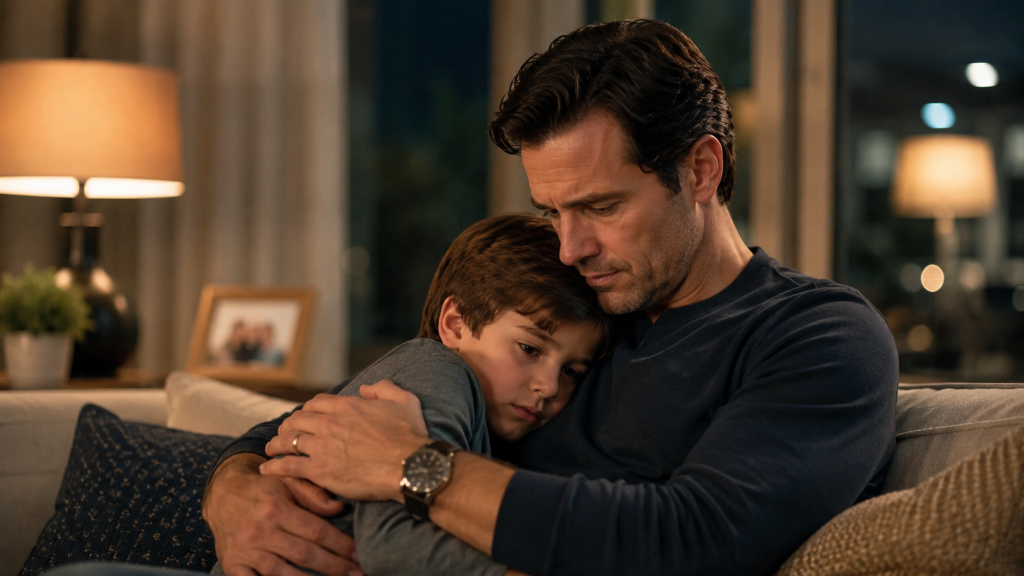
“I’m never leaving you.”
In the ER, a doctor asked to examine him.
I wanted to go in, but a social worker stopped me gently.
“We need to follow protocol.”
“I’m his father.”
“That’s exactly why we need to protect him properly.”
That phrase hit me.
Protect him properly.
And what had I been doing all those months?
Waiting?
Documenting moods?
Saving texts?
Believing a court hearing would eventually solve what my son was screaming with his eyes?
I stayed in the hallway, my hands slick with sweat, listening to doors opening and closing.
Twenty minutes later, Lauren arrived.
She walked in furious, her hair perfect, an expensive handbag on her arm, and a jacket I had bought her back when I still believed we were a family.
“What did you do, Andrew?” she spat. “Did you call the police over a tantrum?”
I did not answer.
She tried to walk into Tommy’s room.
A nurse stopped her.
“You can’t go in.”
“I’m his mother.”
“For that very reason, ma’am. Please wait here.”
Lauren froze.
It was the first time I had seen her lose control in public.
“My son fell in the bathroom,” she said quickly. “I was going to explain it.”
A police officer looked up.
“You were going to explain it?”
Lauren lifted her chin.
“He slipped. Children fall. Andrew is using this to attack me because he wants custody.”
I stared at her, unable to speak.
Even then, she was performing.
Then the doctor came out, his face grave, holding a sealed report.
“Mr. Carter,” he said to me, then looked at the officer, “we have concerns that require immediate protective action.”
Lauren’s confidence cracked.
“What does that mean?”
The doctor did not answer her.
The social worker stepped forward.
“Tommy has given a statement. We also documented injuries inconsistent with a simple fall.”
Lauren’s mouth opened.
No words came.
Then a second police officer walked in holding a tablet.
“Mrs. Carter, we contacted the school counselor. Tommy has been reporting fear of returning to your home for weeks.”
Lauren snapped, “He lies!”
That was the moment Tommy’s small voice came from behind the half-open ER door.
“Dad doesn’t make me lie.”
Everyone turned.
He stood wrapped in a hospital blanket, trembling but awake, his eyes locked on his mother.
“You said if I told, Dad would go away forever.”
Lauren went pale.
I stepped toward him, but the nurse gently held up a hand, keeping the space calm.
The officer turned to Lauren.
“Ma’am, you need to come with us to answer some questions.”
“No,” she hissed. “You can’t do this. I’m his mother.”
The social worker’s voice was steady.
“And right now, he is under hospital protection.”
For the first time in two years, Lauren had no control over the room.
She looked at me with pure hatred.
“You planned this.”
I shook my head, tears finally breaking loose.
“No, Lauren. I listened to him.”
Hours later, a judge granted an emergency protection order.
Tommy was released into my care with strict instructions, follow-up appointments, and a caseworker assigned before sunrise.
When I carried him to the car, he whispered, “Do I have to go back?”
I kissed his hair.
“Not tonight. Not tomorrow. Not until the truth is finished.”
But the truth was only beginning.
Because the next morning, my attorney called and said, “Andrew, you need to sit down. The hospital records aren’t the only evidence. Someone at Lauren’s house finally came forward.”
Her name was Denise.
She was Lauren’s neighbor.
A retired nurse who lived next door and had apparently heard things for months.
Shouting.
Crying.
Doors slamming.
Tommy pleading.
At first, Denise thought it was ordinary family conflict.
Then she began noticing Tommy outside alone too often, sitting on the porch steps with his backpack, even in cold weather.
She had called Lauren once to ask if everything was okay.
Lauren told her to mind her business.
But the night Tommy came to me, Denise heard enough through the open kitchen window to know something serious had happened.
She recorded part of the shouting on her phone.
She had not known what to do with it until she saw Lauren speeding away with Tommy in the car.
Then, when police knocked on her door the next morning, she told them everything.
My attorney, Karen Mills, sent me the written statement.
I read it three times.
Not because I wanted to suffer.
Because I needed to stop doubting myself.
For two years, Lauren had made me feel like an unstable father looking for problems.
Now there were medical records.
A child’s statement.
School notes.
A neighbor’s account.
Audio.
A timeline.
Facts.
The first custody hearing happened fast.
Emergency fast.
Lauren arrived with her lawyer and a face full of controlled outrage.
She wore a soft pink blouse and pearl earrings.
She looked like the mother from the school bake sale.
Not the woman who had tried to walk into an ER and rewrite pain into a bathroom fall.
Her lawyer argued that I had overreacted.
That Tommy was sensitive.
That I had poisoned him against his mother.
Karen stood and placed the hospital report before the judge.
Then the school counselor’s notes.
Then the neighbor’s statement.
Then the recording.
Lauren stared straight ahead while her own voice filled the courtroom.
Sharp.
Cold.
Threatening.
Not the whole story.
But enough.
The judge’s expression changed.
Lauren’s attorney stopped looking confident.
Tommy did not testify in open court.
Karen made sure of that.
Instead, a child advocate submitted his statement and recommendations.
Supervised contact only.
No unsupervised custody.
Continued medical care.
Therapy.
Further investigation.
When the judge granted me temporary full custody, I did not feel victorious.
I felt exhausted.
Tommy was safe for now.
But safe for now is not the same as healed.
The first weeks were quiet.
Too quiet.
Tommy slept with the light on.
He asked permission to open the fridge.
He apologized when he dropped a spoon.
He flinched when my phone rang.
He had nightmares where he whispered, “Don’t tell.”
I learned quickly that protection after harm is not dramatic.
It is ordinary.
It is making pancakes and not asking why he only eats half.
It is sitting on the hallway floor at two in the morning because he is afraid to sleep alone.
It is telling him, again and again, “You are not in trouble.”
His therapist, Dr. Patel, explained it gently.
“Children who have been controlled often need time to believe safety is real.”
“How do I make him believe it?” I asked.
“You don’t make him,” she said. “You show him. Repeatedly.”
So I did.
Every day.
When Tommy spilled juice, I handed him a towel and said, “Accidents happen.”
When he cried because he forgot his homework folder, I said, “We can solve problems.”
When he asked, “Are you mad?” I answered, “No, buddy. I’m here.”
Small things became repair work.
The investigation into Lauren’s home widened.
I learned there had been a boyfriend.
Derek.
Tommy had been afraid to say his name.
Lauren had kept him hidden from the custody paperwork, from the school, from me.
Denise had seen his truck outside often.
The police questioned him too.
Once Derek entered the story, Lauren’s version collapsed further.
She said he was only a friend.
Then she said Tommy misunderstood.
Then she said she had not known.
But texts between Lauren and Derek showed she knew more than she admitted.
That was the part that hurt differently.
Not only that danger had existed.
But that Lauren had chosen protecting her image over protecting our son.
When Derek was charged after the investigation, Lauren tried to call me.
I did not answer.
Then she texted:
Andrew, please. I made mistakes, but I love my son.
I stared at the message for a long time.
Then I forwarded it to Karen.
No reply.
That became my rule.
No private conversations.
No emotional traps.
No arguing in hallways.
No letting Lauren turn my anger into evidence against me.
Everything went through lawyers, caseworkers, and court orders.
For once, the truth had witnesses.
Months passed.
Temporary custody became extended.
Extended became permanent primary custody.
Lauren was granted supervised visitation only after completing court-ordered requirements.
The first visit took place at a family center with a supervisor in the room.
Tommy did not want to go.
I did not want him to go.
But Dr. Patel helped prepare him.
“You can say stop,” she told him. “You can ask for a break. You are allowed to have feelings.”
He looked at me.
“You’ll be outside?”
“The whole time.”
He carried a small blue stone in his pocket.
A grounding stone, Dr. Patel called it.
I called it courage.
After the visit, Tommy came out pale but steady.
Lauren had cried, he said.
She had apologized.
He did not know if he believed her.
“That’s okay,” I said. “You don’t have to decide today.”
That night, he fell asleep on the couch during a movie.
For the first time in months, his face looked peaceful.
I covered him with a blanket and sat there watching him breathe.
I thought about all the times people told me to be patient.
To document.
To not make accusations without proof.
To give Lauren the benefit of the doubt.
There is a dangerous line between being careful and being passive.
I had walked too close to that line for too long.
The night Tommy came home unable to sit down, I finally crossed it in the right direction.
I stopped trying to convince Lauren.
I stopped trying to win arguments.
I stopped trying to look reasonable to people who were not seeing my child.
I called 911.
That call saved him.
Not because police are magic.
Not because the system is perfect.
It is not.
But because it created a record Lauren could not charm away.
It brought medical professionals into the room.
It brought social workers.
It brought officers.
It preserved statements before fear could rewrite them.
It made the invisible visible.
A year later, Tommy and I moved to a smaller house closer to his school.
He picked the paint color for his room.
Green.
“Like dinosaurs,” he said.
I bought glow-in-the-dark stars for his ceiling.
He joined a science club.
Started singing in the car again.
Not every day.
Not loudly at first.
But one morning, while I drove him to school, he hummed along with the radio.
I kept my eyes on the road and cried silently.
He noticed.
“Dad?”
“Yeah, champ?”
“Are you sad?”
I shook my head.
“No. Happy.”
He smiled a little.
“Because I’m singing?”
“Because you’re here.”
He looked out the window.
Then reached over and rested his hand on my arm.
“I’m glad you called,” he whispered.
I could not speak.
So I placed my hand over his and drove.
People sometimes ask why I did not call Lauren first.
Why I did not try to handle it privately.
Why I involved emergency services.
My answer is simple.
Private is where fear grows.
Private is where children are told to lie.
Private is where adults rehearse excuses.
Private is where evidence disappears.
That night, I did not need a debate.
I needed help.
My son came home from his mother’s house walking strangely, clenching his teeth, and unable to sit down.
I did not call a lawyer first.
I did not call my ex.
I called 911 before anyone could erase the evidence.
And because I did, a doctor documented the truth.
A social worker protected him.
A neighbor came forward.
A judge listened.
And my son finally learned the sentence every child deserves to believe:
You are safe now.
Not because the world became perfect.
Not because the past disappeared.
But because one frightened little boy came home in pain, and this time, his father did not wait for permission to protect him.
THE END! THANKS FOR READING!