 Reading Time: 30 minutes
For a moment, I almost gave him the answer I had been giving everyone for the past eight years. Home. Safe. Nothing exciting. Nothing anyone needed to worry about.
Instead, I looked toward the airplane window. Snow was collecting along the edge of the runway, and beyond it, the airport lights glowed through the gray December morning.
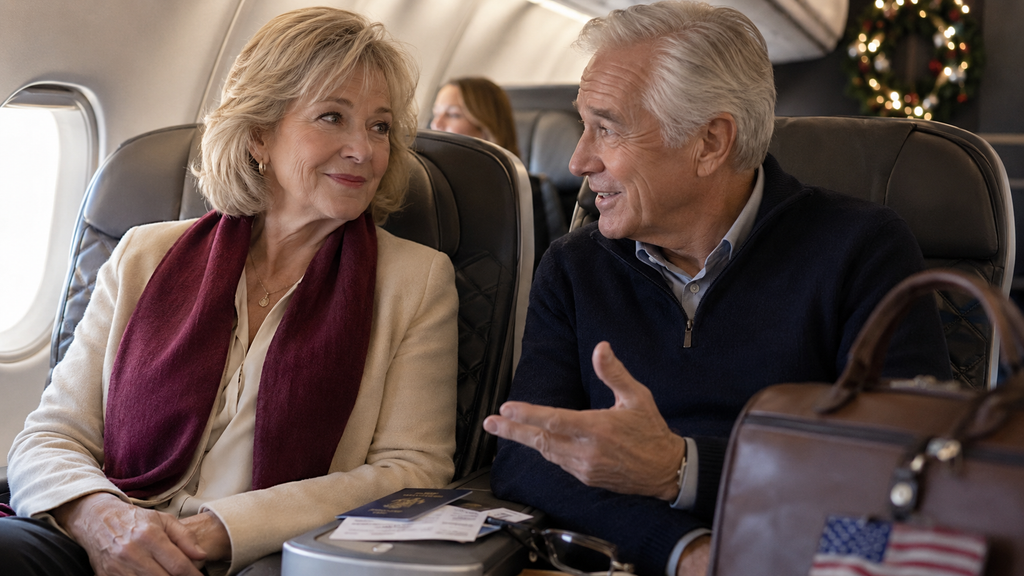
“Heading out,” I said.
The man smiled.
“Good.”
I laughed softly.
“You say that like there’s a correct answer.”
“There is when someone says it with the expression you just did.”
I turned toward him.
“What expression?”
“The expression of someone who has finally done something she’s been talking herself out of for a very long time.”
I stared at him.
He lifted both hands.
“I apologize. That sounded terribly intrusive.”
“No,” I said, surprising myself. “It was accurate.”
He smiled again.
Up close, I could see that he was probably a few years older than I was. He had kind blue eyes, a neatly trimmed silver beard, and the sort of calm confidence that didn’t need attention.
He extended his hand.
“Thomas.”
“Linda.”
“Nice to meet you, Linda.”
“You too.”
The plane began moving away from the gate.
My stomach tightened.
Not because I was afraid of flying.
Because until that exact moment, some part of me still believed Mark might call and say, “Mom, forget everything. Come spend Christmas with us.”
Some foolish little part of me expected the universe to restore everything to the way it used to be.
Then the wheels lifted from the runway.
The city disappeared beneath the clouds.
And with it went the Christmas I had spent years trying to preserve.
I didn’t know yet that the stranger sitting beside me was about to change the way my family saw me.
More importantly, I didn’t know he was about to change the way I saw myself.
Thomas opened a book after takeoff.
I tried to read too, but every few minutes I found myself staring through the window.
Eventually, he closed his book.
“First solo trip?”
“Is it that obvious?”
“Only because you’ve checked your passport four times.”
I looked down.
My passport was sitting safely inside my purse.
I laughed.
“Five.”
“That’s a respectable number.”
“Have you traveled much?”
“A little.”
There was something about the way he said it that made me suspect “a little” meant more than he wanted to admit.
“What about you?” he asked.
“My husband and I went to Europe once. Years ago.”
“Good trip?”
“The best.”
“What happened to him?”
There was no awkwardness in his voice.
No pity.
Just a simple question.
“He died eight years ago.”
Thomas’s face softened.
“I’m sorry.”
“Thank you.”
He looked toward the window.
“My wife died six years ago.”
There was a pause between us.
The strange thing about grief is that sometimes you can recognize another person who carries it without either of you saying much.
It is like noticing someone else speaking a language you thought only you understood.
“Was this a trip you took together?” I asked.
“No.”
He hesitated.
“It was a trip she wanted us to take.”
Something in his voice made me wait.
He continued.
“Evelyn loved Christmas markets. Every December she would cut pictures from magazines and leave them around the house where she knew I’d find them.”
I smiled.
“That sounds deliberate.”
“It was extremely deliberate.”
He chuckled.
“She wanted Vienna. Salzburg. Lucerne. Munich. I always told her we’d go the following year.”
His smile faded.
“There is always another year until suddenly there isn’t.”
Those words sat quietly between us.
I looked down at my hands.
“My husband used to tell me that I spent too much time taking care of everyone else.”
“What did you tell him?”
“That someone had to.”
Thomas nodded.
“And now?”
I thought about Hannah’s voice.
You can stay home and relax.
I thought about Mark promising they would “stop by after the holidays.”
I thought about my suitcase sitting upstairs for years while I waited for my life to become useful again.
“Now,” I said slowly, “I’m beginning to wonder if maybe he had a point.”
Thomas smiled.
“Well, Linda, if we survive airline food, I think Europe has a fair chance of helping us both.”
For the first time in days, I laughed without forcing it.
We talked on and off through most of the flight.
I learned Thomas had two grown daughters.
One lived in Boston.
The other lived in California.
Both had families of their own.
He told me that his daughters worried about him traveling alone.
“They think once a man turns seventy, he becomes incapable of reading signs in airports.”
“How old are you?”
“Seventy-one.”
“Then clearly they are right.”
He put a hand over his heart.
“Cruel.”
I smiled.
“What did you do before you retired?”
“Hotels.”
“That sounds interesting.”
“Sometimes.”
“Management?”
“You could call it that.”
Then he asked me about my life.
I told him I had worked as an elementary school librarian for nearly thirty years.
His face brightened.
“A librarian?”
“Yes.”
“Then I’m sitting beside a dangerous woman.”
“Dangerous?”
“You know things.”
I laughed again.
It had been so long since I had talked to a stranger without thinking about what they needed from me.
Thomas wasn’t asking whether I had made pecan pie.
He wasn’t asking me to watch children.
He wasn’t asking me to move dinner because someone else had plans.
He was simply curious about me.
Linda.
Not Mom.
Not Grandma.
Not Mark’s widowed mother.
Just Linda.
When we landed in Munich, I expected we would say goodbye and continue with our separate journeys.
Instead, while we were waiting for our luggage, Thomas looked at the tag hanging from my carry-on.
“You’re on the Evergreen Christmas tour?”
I stared at him.
“You too?”
He started laughing.
“Well, either fate has a sense of humor, or this tour company has very aggressive marketing.”
We were on the same trip.
Twelve days.
Germany.
Austria.
Switzerland.
I don’t know why, but that made me unexpectedly happy.
Our group met near the airport exit.
There were twenty-three of us.
Couples.
Two sisters from Arizona.
A retired teacher from Michigan.
A widower traveling with his adult daughter.
And me.
I noticed something else immediately.
Thomas didn’t act as though we had to stay together just because we had sat beside each other.
He spoke to everyone.
He carried one elderly woman’s suitcase when one of its wheels became stuck.
He asked the tour guide questions.
He helped a nervous man find his missing passport, which turned out to be inside the man’s coat.
He was comfortable anywhere.
That first evening, we arrived at our hotel near Munich’s old town.
I stood in my room looking at the bed, the heavy curtains, and the small chocolate placed on the pillow.
For a moment, loneliness returned.
I reached for my phone.
There were no messages from Mark.
No messages from Hannah.
They thought I was home.
Probably sitting beside my fireplace.
Probably wearing my slippers.
Probably waiting for Christmas to be over.
I almost called.
Then there was a knock on my door.
Thomas stood in the hallway wearing a dark wool coat.
“A few of us are walking to the Christmas market. You interested?”
Every instinct I had developed over the previous eight years told me to say no.
I was tired.
It was cold.
I should unpack.
I should call Mark.
I should behave like the version of myself everyone expected.
Instead, I grabbed my coat.
“Give me two minutes.”
Munich was glowing.
That is the only way I can describe it.
Thousands of tiny lights hung above the streets.
Wooden stalls surrounded the square.
There were ornaments, candles, roasted almonds, gingerbread, scarves, handmade toys, and cups of steaming mulled wine.
Church bells rang somewhere beyond the buildings.
Snowflakes drifted through the lights.
I stopped in the middle of the square.
Thomas looked at me.
“You all right?”
I nodded.
“I forgot places could look like this.”
He didn’t laugh.
He understood exactly what I meant.
We walked for hours.
I bought a small wooden angel.
Thomas bought nothing until we passed a stand selling hand-painted Christmas ornaments.
He picked up a tiny glass star.
“Evelyn would have bought twelve of these,” he said.
“Then you should buy one.”
He looked at me.
“I don’t need another ornament.”
“That’s not what I said.”
He considered this.
Then he purchased it.
Later, we stood near a large Christmas tree holding hot drinks.
Someone from our group offered to take our picture.
I almost said no.
For years, I had hated photographs of myself.
I always noticed the lines around my eyes.
The gray in my hair.
The difference between the woman in the photograph and the young bride standing beside Paul in our wedding album.
But Thomas simply stood beside me.
“Come on, librarian. Document the evidence.”
So I smiled.
A real smile.
The photograph showed the two of us beneath thousands of Christmas lights.
My cheeks were pink from the cold.
Thomas was holding his ridiculous glass ornament.
I looked happy.
Not pretending-to-be-happy happy.
Not “don’t worry about me” happy.
Happy.
That night, lying in bed, I looked at the picture again.
Then, without thinking too much, I posted it on Facebook.
I wrote:
“Sometimes the Christmas you didn’t plan becomes the one you needed. Munich tonight. I think I remembered how to smile.”
Then I went to sleep.
At 6:12 the next morning, my phone began vibrating.
At first, I thought it was my alarm.
Then it vibrated again.
And again.
And again.
I reached for it.
Seventeen missed calls.
Thirty-four text messages.
Dozens of Facebook notifications.
My heart jumped.
I immediately thought something terrible had happened.
Then I saw Mark’s messages.
MOM CALL ME.
MOM???
WHERE ARE YOU?
PLEASE CALL ME AS SOON AS YOU SEE THIS.
Then Hannah.
Linda, please call us.
We didn’t know you were traveling.
Please answer your phone.
Then another message appeared.
Linda, do you know who that man is?
I sat upright.
What man?
Then I remembered the photograph.
Thomas.
I stared at Hannah’s message.
I typed:
Yes. His name is Thomas.
Three dots appeared immediately.
Then disappeared.
Then appeared again.
Finally Hannah responded.
I know his name.
Do you know WHO he is?
Before I could answer, Mark called.
I stared at the screen for a few seconds.
Then answered.
“Hello?”
“Mom!”
He sounded panicked.
“Are you okay?”
“I’m fine.”
“Where are you?”
“Munich.”
“Germany?”
I looked around my hotel room.
“Unless there’s another Munich with this many pretzels.”
“Mom, this isn’t funny.”
“Why not?”
“Because you disappeared!”
“I didn’t disappear.”
“You left the country without telling us.”
I closed my eyes.
For a moment, I was tempted to apologize.
That reflex was so deeply rooted in me.
Sorry for worrying you.
Sorry for not asking permission.
Sorry for having a life you didn’t approve in advance.
Then I remembered Hannah telling me I could stay home.
“You told me you were spending Christmas with Hannah’s family,” I said.
“I know, but—”
“And you told me you would visit after the holidays.”
“Yes, but—”
“So I made plans.”
“With some man?”
I looked at the empty chair by the window.
“I met Thomas on the airplane.”
Mark went silent.
“You met him on the plane?”
“Yes.”
“You seriously don’t know who he is?”
“No.”
There was another pause.
Then Mark lowered his voice.
“Mom, that is Thomas Caldwell.”
“That’s what he told me.”
“Thomas Caldwell.”
“Yes, Mark. I understand his name.”
“The Caldwell.”
I frowned.
“Am I supposed to know what that means?”
In the background, I heard Hannah saying something quickly.
Then Mark said, “Caldwell Hospitality.”
Nothing.
“Caldwell Hotels?”
Still nothing.
“Mom, the Caldwell Grand in Chicago? The resort in Aspen? The properties in New York, London, Paris?”
“Oh.”
I looked toward the window.
“Those are his?”
“He founded the entire company.”
I blinked.
I thought about Thomas carrying Mrs. Jennings’s broken suitcase.
I thought about him searching for someone else’s passport on the airport floor.
I thought about him joking about airline food.
“You’re telling me Thomas owns hotels?”
“He owns more than hotels.”
“Interesting.”
“Interesting?”
Mark sounded as though I had just told him the weather forecast.
“Mom, the man is worth—”
“I don’t care.”
He stopped.
I surprised both of us.
I really didn’t care.
Not even a little.
Mark started again.
“How did you end up traveling with him?”
“We’re on the same tour.”
“You’re on a group tour with Thomas Caldwell?”
“Apparently.”
“Does he know who you are?”
That question bothered me.
I sat straighter.
“What exactly do you mean by that?”
“No, I just mean—”
“I’m your mother, Mark. That isn’t a secret identity.”
“I didn’t mean it like that.”
I could hear Hannah speaking in the background again.
Then Mark said, “Why didn’t you tell us you were going?”
“Would it have changed your Christmas plans?”
Silence.
There it was.
The answer.
“No,” I said softly. “I didn’t think so.”
“Mom…”
“You told me to relax at home. I decided Germany sounded more relaxing.”
“That’s not fair.”
I almost laughed.
“Which part?”
He had no answer.
Finally, he sighed.
“We were worried.”
“I understand.”
“Promise you’ll call us later.”
“I’m leaving for a walking tour in twenty minutes.”
“Then tonight.”
“We’ll see.”
“Mom.”
“Mark.”
It was the first time I had ever answered him that way.
Not angrily.
Not cruelly.
Simply as one adult speaking to another.
“I love you,” I said. “I’m safe. I’m having a wonderful time. And you don’t need to manage this.”
Then I hung up.
My hands were shaking.
I sat there staring at the phone.
For sixty-seven years, I had thought boundaries had to sound like anger.
That they required shouting or punishment or dramatic declarations.
But sometimes a boundary is nothing more than refusing to explain a decision that belongs to you.
There was another knock on my door.
When I opened it, Thomas stood there.
“Breakfast?”
I stared at him.
“What?”
He looked concerned.
“Are you all right?”
“Yes.”
Then I folded my arms.
“Actually, I have a question.”
“That sounds ominous.”
“Do you own half the hotels on the planet?”
Thomas closed his eyes.
“Oh.”
“That’s your answer?”
“I was hoping we might reach Vienna before Google ruined everything.”
I started laughing.
He looked embarrassed.
Actually embarrassed.
“You told me you worked in hotels.”
“I did.”
“You founded Caldwell Hospitality.”
“Technically.”
“Technically?”
“I had help.”
I stared at him.
He sighed.
“Would you prefer I start again?”
“Go ahead.”
He extended his hand as though we were meeting for the first time.
“Hello. My name is Thomas Caldwell. I am seventy-one years old. I’m retired. I have two daughters who tell me I need hearing aids. I make terrible coffee. I spent most of my adult life building hotels. I sold the controlling interest several years ago, although I still own a substantial portion of the company.”
I raised an eyebrow.
“How substantial?”
“Enough that your son apparently recognized me.”
I laughed.
“How do you know my son recognized you?”
“Your phone has been ringing loud enough to wake Austria.”
I shook my head.
Thomas’s expression became more serious.
“I should have told you.”
“Why didn’t you?”
“Because I enjoyed being Thomas.”
That answer stopped me.
He glanced down the hallway.
“People behave differently when they know.”
I understood that better than he realized.
“When Paul died,” I said, “people behaved differently around me too.”
Thomas looked at me.
“They stopped inviting me to couples’ dinners. People whispered when they mentioned anniversaries. Friends thought talking about their husbands would upset me.”
He nodded.
“For you, people saw money. For me, they saw grief.”
“And sometimes you just want someone to see you.”
“Yes.”
I smiled.
“Well, Thomas, I still think your taste in Christmas ornaments is questionable.”
Relief crossed his face.
“So we’re still getting breakfast?”
“Only if the billionaire buys coffee.”
“I knew this would happen.”
I laughed all the way to the elevator.
Over the next several days, I forgot about Facebook.
Mostly.
We traveled from Munich into Austria.
We walked through Salzburg beneath snow-covered roofs.
I listened to choirs sing in old churches.
I ate pastries I couldn’t pronounce.
I bought gifts for people I hadn’t planned to buy gifts for, including myself.
That felt strange at first.
Buying something simply because I liked it.
Not because it would look nice in Mark’s house.
Not because Hannah might use it.
Not because someone’s birthday was coming.
Because I wanted it.
In Salzburg, I bought a red wool scarf.
I stood in front of the mirror wearing it and heard Paul’s voice in my head.
Look at you.
I almost cried.
Then I smiled.
Thomas and I became friends in the effortless way that sometimes happens when two people meet at exactly the right moment.
We talked about our spouses often.
That surprised me.
I thought mentioning Paul around another man would feel wrong.
Instead, it felt comforting.
Thomas never competed with a ghost.
He asked questions.
What was Paul like?
What made him laugh?
What did we argue about?
I told him about Paul burning Thanksgiving dinner because he insisted on deep-frying a turkey after watching one television program.
Thomas laughed so hard he nearly spilled his coffee.
Then he told me Evelyn once tried to surprise him by repainting their bedroom while he was away.
“She chose yellow.”
“What kind of yellow?”
“Imagine a school bus suffering an identity crisis.”
I laughed.
“Did you repaint it?”
“Absolutely not.”
“Why?”
“Because she loved it.”
That told me more about Thomas than any article about his business ever could.
Meanwhile, my phone continued filling with messages.
Some were from people I hadn’t heard from in months.
A former coworker wrote:
Linda! Europe looks amazing!
A neighbor commented:
You look ten years younger!
Someone else asked:
Who is your handsome friend?
Then Hannah’s mother, Carol, commented beneath one picture.
What a wonderful surprise! We’ll have to hear ALL about it when you get home!
I stared at that message for a long time.
Carol had my phone number.
She had never called me before Christmas.
She had never asked whether I had plans.
She hadn’t suggested they include me.
Now she wanted to hear “all about it.”
I knew why.
Thomas was standing beside me in two photographs.
Suddenly, I was interesting.
For one ugly moment, I wanted to post ten more pictures.
I wanted Hannah to see me laughing.
I wanted Carol to wonder.
I wanted Mark to feel guilty.
Then I stopped myself.
Because if I began shaping my happiness around their reaction, I would still be living for them.
Just in a different way.
So I put my phone in my purse.
And went outside.
On December 23, we reached Vienna.
That city nearly broke my heart.
In the best possible way.
Our group attended a classical concert that evening.
The hall was glowing with chandeliers.
I wore a dark green dress I had almost left at home because I thought it was “too nice.”
Thomas wore a black suit.
When he saw me in the lobby, he stopped.
For one terrifying second, I thought something was wrong with my dress.
Then he smiled.
“You look beautiful.”
I had heard Paul say those words hundreds of times.
But hearing them again after eight years felt like someone had opened a locked room inside me.
I looked down.
“Thank you.”
Thomas offered his arm.
I took it.
During the concert, I cried.
Quietly.
Not because I was sad.
Not entirely.
I cried because I realized I had spent eight years believing that loyalty to Paul meant remaining exactly where he had left me.
Same house.
Same routines.
Same holidays.
Same pie.
Same empty chair.
But Paul had loved me.
And anyone who truly loved me would never have asked me to turn the rest of my life into a memorial.
After the concert, Thomas and I walked back through Vienna.
Snow was falling.
The streets were quiet.
He stopped beneath a row of lights.
“Linda.”
“Yes?”
“Can I tell you something without making this trip uncomfortable?”
“That depends entirely on what you’re about to say.”
He smiled.
“I like you.”
I looked at him.
“I like you too.”
“No.”
He shook his head.
“I mean I like you.”
My heart gave one ridiculous little jump.
I was sixty-seven years old, and suddenly I felt sixteen.
“Thomas…”
“I’m not asking for anything.”
He spoke gently.
“I don’t know what happens after this trip. Maybe we go home and discover we were simply two lonely people who met at Christmas.”
“That sounds romantic when you say it.”
“I’ve practiced.”
I smiled.
Then his expression softened.
“But I wanted you to know that spending time with you has been the best part of this journey.”
My eyes burned.
“No one has said something like that to me in a very long time.”
“Then people around you have been careless.”
I shook my head.
“No. I think I made it easy for them.”
He frowned slightly.
“What do you mean?”
“I trained everyone to expect that I would always be available.”
Thomas listened.
“I said yes when I wanted to say no. I changed my plans. I cooked. I hosted. I babysat. I told everyone I was fine.”
My voice became quieter.
“Maybe after a while, they believed me.”
Thomas was silent for a moment.
Then he said, “Being generous isn’t the same as volunteering to disappear.”
Those words stayed with me.
Being generous isn’t the same as volunteering to disappear.
I had disappeared.
Little by little.
Not because Mark forced me.
Not because Hannah had some evil plan.
But because every time someone took a step backward from me, I rushed forward to close the distance.
When they stopped calling as often, I called more.
When they stopped visiting, I offered to come to them.
When they made other plans, I rearranged mine.
I was so terrified of losing my family that I had made myself endlessly convenient.
And convenient people are very easy to overlook.
Thomas gently touched my hand.
“Too much?”
I shook my head.
“No.”
Then, after eight years of believing that part of my life was finished, I turned my hand over and held his.
We walked back to the hotel that way.
Nothing dramatic happened.
No movie kiss beneath the snow.
No declarations.
Just two people holding hands.
It was enough.
Christmas Eve was when everything finally changed with my family.
Our group had dinner in a small restaurant overlooking the river.
I had just ordered dessert when Mark called.
I nearly ignored it.
Then I saw he had called three times.
I excused myself and stepped into the lobby.
“Hello?”
“Mom.”
His voice was different.
Not angry.
Not panicked.
Tired.
“Are you all right?” I asked.
“Yes.”
There was a pause.
“Hannah and I had a fight.”
I leaned against the wall.
“I’m sorry.”
“It was about you.”
I closed my eyes.
“Mark, I don’t want to become something you two fight about.”
“No. You need to hear this.”
I waited.
He took a breath.
“I asked Hannah why we couldn’t have invited you to Christmas at Carol’s.”
My heart tightened.
“What did she say?”
“That her mother wanted it to be ‘just family.’”
I almost laughed at the cruelty hidden inside such a small phrase.
Just family.
I was Mark’s mother.
But apparently marriage had pushed me outside some invisible border.
Mark continued.
“I told Hannah you are family.”
I swallowed.
“She said she knew that, but her mom gets overwhelmed when too many people come.”
“How many people are going?”
Another pause.
“Twenty-two.”
I closed my eyes.
Twenty-two.
Carol could host twenty-two people.
But twenty-three would have been overwhelming.
Mark’s voice cracked slightly.
“I should have said something sooner.”
I said nothing.
“I should have told them if you weren’t invited, we wouldn’t go.”
Still I said nothing.
“Mom?”
“I’m here.”
“I’m sorry.”
Those two words landed differently this time.
Not “I’m sorry you feel hurt.”
Not “I’m sorry, but you understand.”
Just:
I’m sorry.
I looked through the doorway into the restaurant.
Thomas was sitting with the group.
He saw me and gave me a small questioning look.
I nodded to show him I was all right.
“Mark,” I said, “I love you.”
“I love you too.”
“But I need to tell you something, and I need you not to interrupt.”
“Okay.”
“I did not come to Europe to punish you.”
“I know.”
“I didn’t come here hoping you would feel guilty. I didn’t post those pictures to embarrass anyone.”
“I know.”
“But when Hannah told me to stay home, something in me finally understood that I had been waiting for you to make me feel included.”
My voice shook.
“That wasn’t your responsibility, Mark. And it wasn’t fair to me either.”
He was quiet.
“I built my whole life around whether you needed me.”
“Mom…”
“Please let me finish.”
He stopped.
“When your father died, I was lost. Being your mother gave me somewhere to put all that love. So I cooked. I helped. I showed up. And because I was afraid of being alone, I never built anything else.”
Tears filled my eyes.
“You grew up. You got married. You built a life. That is what you were supposed to do.”
“I never wanted you to feel abandoned.”
“I know.”
And I meant it.
That realization mattered.
Mark had been careless.
He had been cowardly.
He had allowed Hannah to make a decision that hurt me because disagreeing with her would have been uncomfortable.
But he had not spent years plotting to remove me from his life.
People don’t always hurt us because they hate us.
Sometimes they hurt us because they assume we will survive whatever they do.
And I had always made survival look easy.
“I should have stood up for you,” Mark said.
“Yes.”
I didn’t soften it.
“Yes, you should have.”
He breathed out.
That might have been the first time in his adult life I allowed him to sit inside the discomfort of disappointing me.
Then I continued.
“But I also should have stood up for myself.”
“What happens now?”
The question sounded almost childlike.
I smiled through my tears.
“Now you spend Christmas with your wife.”
“You’re not angry?”
“I was hurt.”
“There’s a difference?”
“A big one.”
I glanced toward the restaurant again.
“And I’m spending Christmas in Vienna.”
Mark laughed weakly.
“Still can’t believe that.”
“Neither can I.”
Then his voice changed.
“So…”
I knew what was coming.
“So?”
“Thomas Caldwell.”
I burst out laughing.
“Mark.”
“What? I’m curious.”
“He’s my friend.”
“Just your friend?”
“That is absolutely none of your business.”
“Oh my God.”
“What?”
“You’re dating.”
“I did not say that.”
“You used your mother voice.”
“I am your mother.”
“That voice specifically means I’m right.”
I smiled.
For the first time in weeks, talking to my son felt normal.
Not perfect.
But real.
Then Mark grew serious again.
“Mom?”
“Yes?”
“Merry Christmas.”
My throat tightened.
“Merry Christmas, sweetheart.”
When I returned to the table, Thomas glanced at me.
“Everything okay?”
I sat down.
“I think so.”
Then I smiled.
“Actually, I think it might be.”
Christmas morning arrived quietly.
I woke before sunrise.
For several minutes, I didn’t know where I was.
Then I saw the curtains.
The suitcase.
The red scarf hanging from the chair.
Vienna.
I walked to the window.
Snow had covered the rooftops.
Church bells began ringing somewhere in the distance.
And I started crying.
I thought about every Christmas morning with Paul.
Mark running down the stairs in pajamas.
Wrapping paper everywhere.
Coffee brewing.
Paul pretending he didn’t know where I had hidden his presents.
Then I thought about the Christmas I had expected this year.
An empty house.
A television playing holiday movies.
A pecan pie no one needed.
I whispered, “Merry Christmas, Paul.”
For a second, I could almost feel him there.
Not telling me to go home.
Not asking why I was traveling with another man.
Just smiling that crooked smile of his.
Finally.
That was what I imagined him saying.
Finally, Linda.
I dressed and went downstairs.
Thomas was waiting in the lobby.
In his hands was a small package.
“No,” I said immediately.
He frowned.
“What?”
“You bought me something.”
“That is generally how Christmas works.”
“I didn’t buy you anything.”
“You purchased three coffees yesterday.”
“That’s not a Christmas gift.”
“One was extremely overpriced.”
I laughed.
He handed me the package.
Inside was a small leather travel journal.
On the first page, he had written:
For the places you haven’t seen yet.
I stared at the words.
“Thomas…”
“It’s not expensive.”
“That’s not why I’m crying.”
“I had hoped.”
I touched the page.
For the places you haven’t seen yet.
Not the places Paul and I should have gone.
Not the places Mark might invite me.
The places I hadn’t seen yet.
Future tense.
I had forgotten how beautiful future tense could be.
“Thank you,” I whispered.
Then I reached into my purse.
“I lied.”
Thomas raised an eyebrow.
I handed him a small box.
He opened it.
Inside was another glass Christmas star.
The same type he had bought for Evelyn in Munich.
He looked at me.
“I bought it yesterday,” I said. “For your tree.”
He turned it carefully in his hand.
“I already have one.”
“I know.”
“Why two?”
“One is for the Christmas you wished you had taken.”
I touched the second star.
“And one is for the Christmas you actually did.”
Thomas’s eyes filled with tears.
He didn’t speak for several seconds.
Then he leaned forward and kissed my cheek.
“Thank you, Linda.”
That was all.
But it was enough.
Our group spent Christmas Day together.
We ate too much.
We laughed.
We took photographs.
One of the women from Arizona persuaded everyone to sing Christmas songs even though half the group didn’t know all the words.
Thomas had a terrible singing voice.
Absolutely terrible.
I told him so.
He said money had protected him from hearing that truth for decades.
Late that afternoon, we walked through the city alone.
He asked if I regretted coming.
I thought about it.
“No.”
“Not even a little?”
“I regret waiting this long.”
He nodded.
“That makes two of us.”
Then he stopped walking.
“Linda.”
I looked at him.
“When we go home, I’d like to see you again.”
The words were simple.
But my heart pounded.
“You live in Boston.”
“Part of the year.”
“And I live outside Chicago.”
“I own airplanes.”
I stared at him.
He winced.
“That sounded worse out loud.”
I started laughing.
“That was the first billionaire thing you’ve said all week.”
“I was doing so well.”
“You were.”
He smiled.
Then grew serious again.
“I’m not asking you to change your life.”
That mattered.
“I don’t want to rescue you. I don’t think you need rescuing.”
“Good.”
“I just want dinner.”
“Dinner?”
“Possibly several dinners.”
I pretended to consider.
“Are these dinners in hotels you own?”
“If that improves my chances.”
“It might hurt them.”
He laughed.
Then I said, “I would like that.”
His expression softened.
“Several dinners?”
“Let’s survive one.”
“Practical woman.”
“I was a librarian. We believe in trial periods.”
He took my hand again.
And this time, beneath the Christmas lights in Vienna, he kissed me.
Softly.
Carefully.
Like a question.
I kissed him back.
Not because I had forgotten Paul.
Not because Thomas replaced him.
No one could.
Love does not work that way.
The heart is not a chair with room for only one person.
Paul had been part of my story.
A huge part.
Thomas did not erase a single page.
He simply made me wonder if there might be another chapter.
Three days later, the photographs caused a second explosion.
This time, it wasn’t because Thomas appeared beside me.
It was because I posted a picture of myself standing alone near Lake Lucerne.
I was wearing my red scarf.
The mountains rose behind me.
I wrote:
“Sixty-seven is not too late. Being left out of someone else’s plans might be the beginning of making your own.”
The post spread farther than I expected.
Old friends shared it.
Women I had never met commented beneath it.
One wrote:
“My husband died five years ago. I needed to read this today.”
Another said:
“My kids have their own lives and I’ve been angry about it. Maybe I need one too.”
Another wrote:
“I’m 72. Just booked my first solo cruise.”
I sat in the hotel lobby reading those comments with tears running down my face.
Thomas sat across from me.
“What happened?”
I showed him.
He read quietly.
Then he handed the phone back.
“You realize what you did, don’t you?”
“What?”
“You gave people permission.”
I shook my head.
“I’m hardly qualified to give anyone permission.”
“That’s why it matters.”
He smiled.
“You didn’t tell them how to live. You simply showed them that you started.”
That evening, Hannah called me.
I almost didn’t answer.
But something told me I should.
“Hello?”
“Linda.”
Her voice was quiet.
“Merry Christmas.”
“It was two days ago.”
“I know.”
There was an awkward silence.
“I wanted to apologize.”
I waited.
“I shouldn’t have told you to stay home.”
“No.”
She inhaled sharply.
“No, you shouldn’t have.”
There was another pause.
“I didn’t mean it the way it sounded.”
I closed my eyes.
“Hannah, how did you mean it?”
She struggled for an answer.
Finally, she said, “My mom wanted Christmas at her house. Mark was stressed. I thought you would understand.”
There it was again.
Understand.
The word people use when they want the kindest person in the room to absorb the consequences of everyone else’s choices.
“I did understand,” I said.
She seemed surprised.
“You did?”
“Yes. I understood exactly where I stood.”
“Linda…”
“That doesn’t mean I hate you.”
“I never thought—”
“And I’m not asking Mark to choose between us.”
“Okay.”
“But I won’t pretend it didn’t hurt just to make everyone comfortable.”
Her voice became softer.
“I was selfish.”
I said nothing.
She continued.
“My mother can be difficult.”
“Carol wasn’t the person who called me.”
Silence.
I could almost hear Hannah processing that.
“You were,” I said.
“I know.”
“So don’t blame your mother for words you chose.”
“I’m sorry.”
This time, I believed her.
Not because the apology fixed everything.
It didn’t.
But because she wasn’t trying to escape responsibility anymore.
“Thank you.”
Then Hannah gave a nervous little laugh.
“I have to ask.”
“About Thomas?”
“Yes.”
I laughed.
“Everyone suddenly cares very much about Thomas.”
“I knew who he was because my company held a conference at one of his hotels. His photograph was in the lobby.”
“That sounds like something he would hate.”
“He looked very serious in the photograph.”
“He’s not.”
Another silence.
Then Hannah said something that surprised me.
“You look happy.”
I looked across the lobby.
Thomas was trying to convince our tour guide that hot chocolate counted as a complete meal.
“I am.”
“I haven’t seen you look like that in a long time.”
Neither had I.
When I returned home in early January, Mark was waiting at the airport.
I saw him before he saw me.
My son.
Forty-one years old.
Same dark hair as Paul.
Same habit of shifting his weight when nervous.
When he spotted me, relief crossed his face.
“Mom.”
He hugged me so tightly I nearly dropped my bag.
“I missed you.”
“I was gone twelve days.”
“I know.”
“You went three weeks without visiting me last summer.”
“That’s different.”
“How?”
He pulled back.
“I don’t know.”
I smiled.
He took my suitcase.
Then he looked behind me.
I raised an eyebrow.
“Looking for someone?”
“No.”
“Mark.”
“Maybe.”
“Thomas flew to Boston yesterday.”
“Oh.”
He tried to hide his disappointment.
I laughed.
“You wanted to meet him?”
“I’m curious.”
“You are forty-one years old and nosier than you were at twelve.”
“That sounds genetic.”
As we walked toward the parking garage, he reached for my suitcase.
I didn’t fight him.
Some things mothers are allowed to enjoy.
Halfway to the car, he said, “Hannah made dinner.”
“That’s nice.”
“She wants to apologize in person.”
“I’m willing to listen.”
“She feels terrible.”
I stopped walking.
Mark turned toward me.
“Please don’t do that.”
“What?”
“Ask me to make her feel better.”
His face changed.
“I wasn’t.”
“You were about to.”
He looked down.
“Maybe.”
I touched his arm.
“I don’t want her to feel terrible forever. But feeling bad after hurting someone isn’t an emergency.”
Mark stared at me.
“When did you start talking like this?”
“Somewhere between Munich and Vienna.”
He smiled.
“I like Europe Mom.”
“So do I.”
Dinner at Mark and Hannah’s house was awkward at first.
Carol wasn’t there.
For that, I was grateful.
Hannah had made roast chicken.
There were flowers on the table.
My pecan pie was not there.
That made me smile.
For years, I had been assigned the pie automatically.
This time, Hannah had bought dessert.
After dinner, she put down her fork.
“Linda, can we talk?”
“Of course.”
She looked at Mark.
Then at me.
“I was rude to you.”
I waited.
“And I’ve been thinking about why.”
That surprised me.
She continued.
“When Mark and I got married, you were always there.”
I almost interrupted.
She held up a hand.
“Not in a bad way.”
I stayed quiet.
“You helped us constantly. When we bought this house, you packed boxes. When I had surgery, you brought meals. When work was crazy, you helped with everything.”
She looked ashamed.
“I think I stopped seeing those things as gifts.”
My chest tightened.
“I started seeing them as things you would always do.”
I nodded slowly.
“That’s fair.”
“And because you never complained, I assumed you didn’t need anything from us.”
There it was.
The truth.
Not villainy.
Habit.
People had mistaken my silence for absence of need.
“I should have asked,” Hannah said.
“Yes.”
She looked at me.
“I’m sorry.”
“Thank you.”
Then I said something that surprised both of them.
“But I also need to apologize.”
Mark frowned.
“For what?”
“For not being honest.”
They looked confused.
“I have said ‘I’m fine’ thousands of times when I wasn’t fine.”
My voice softened.
“I expected both of you to somehow know what I refused to say.”
Neither interrupted.
“That wasn’t fair either.”
Mark reached across the table.
“Mom…”
“I’m not finished.”
He smiled faintly.
“Right. Europe Mom.”
I nearly laughed.
“I’m not going back to the way things were.”
Hannah stiffened slightly.
I continued.
“I love you both. I want to be part of your lives. But I will not build my entire life around whether I’m invited into yours.”
They were silent.
“I’m going to travel.”
Mark smiled.
“I guessed.”
“I joined a photography class.”
“You did?”
“Yes.”
“I’m also volunteering at the library twice a week.”
Hannah smiled.
“That sounds perfect for you.”
“And I’m thinking about changing the guest room.”
Mark frowned.
“The room Dad used as his office?”
“Yes.”
I had kept Paul’s office almost untouched for eight years.
His desk.
His shelves.
His old reading chair.
I dusted everything but rarely entered.
“What are you going to do with it?” Mark asked.
“Turn it into a room I can actually use.”
For a second, grief passed across his face.
I understood.
That room held his father too.
“I’m keeping some things,” I said. “But your father would think we were insane for turning an entire room into a museum.”
Mark laughed.
“That’s true.”
Then Hannah asked the question both of them had been trying not to ask all evening.
“Will you see Thomas again?”
I took a sip of water.
“Saturday.”
Mark nearly choked.
“He’s coming here?”
“Yes.”
“To Chicago?”
“Yes.”
“For you?”
“Mark.”
“What?”
“You’re doing it again.”
“Doing what?”
“Acting as if I’m incapable of being interesting to someone.”
His face turned red.
“I didn’t mean—”
I laughed.
“I’m teasing.”
He pointed at me.
“Europe Mom is dangerous.”
“You have no idea.”
Thomas arrived Saturday afternoon.
He did not arrive in a limousine.
He did not bring an entourage.
He rented a perfectly ordinary car and got lost twice because he refused to use the voice directions on his phone.
He showed up at my door carrying flowers and complaining about Chicago traffic.
“You built hotels in major cities,” I said.
“Yes.”
“And Chicago traffic defeated you?”
“Completely.”
I invited him inside.
He looked around my house slowly.
This was the house where Paul and I had raised Mark.
The house where I had spent eight years alone.
For the first time, I wondered how Thomas saw it.
He stopped at a photograph of Paul and me.
Our twenty-fifth anniversary.
“He had kind eyes,” Thomas said.
“He did.”
I waited for awkwardness.
There wasn’t any.
Thomas looked at the photograph for another moment.
“Thank you for taking care of her until I got here, Paul.”
I stared at him.
“Did you just talk to my husband?”
“Yes.”
“Do you usually speak to dead men on first dates?”
“This is a first date?”
“Apparently.”
He smiled.
“Then I’m nervous.”
“You own an international hotel company.”
“Which has nothing to do with whether you will agree to a second date.”
I laughed.
That evening, we went to dinner.
Not one of his hotels.
My choice.
A small Italian restaurant Paul and I used to love.
I wondered whether that would feel strange.
It didn’t.
Instead, it felt like letting the past and future sit at the same table without asking either one to leave.
After dinner, Thomas walked me to my door.
He kissed me gently.
Then said, “Next weekend?”
“I’ll check my schedule.”
His eyes widened.
“You have a schedule now?”
“I’m a very busy woman.”
“What happened to the lonely lady I met on the airplane?”
I looked at him.
“She got off.”
Winter became spring.
Spring became summer.
My life changed slowly.
Not like a movie.
There was no single dramatic moment where everything became perfect.
Mark still forgot to call sometimes.
Hannah still occasionally assumed I was available to help without asking first.
But now I answered honestly.
Sometimes I said yes.
Sometimes I said no.
The first time Hannah called and asked if I could help with something on a Saturday, I said, “I can’t. Thomas and I are going to Wisconsin for the weekend.”
She paused.
Then said, “Okay. Have fun.”
That was it.
No disaster.
No family collapse.
No one stopped loving me because I had plans.
I wondered how much of my old life had been built around fears I had never tested.
Thomas and I traveled.
Not constantly.
And not always extravagantly.
He took me to Boston.
I showed him the little diner near my house where Paul used to order pancakes.
We went to Maine.
Then Charleston.
Then, in September, we returned to Europe.
This time, there was no tour group.
I carried the leather journal he had given me.
The pages were filling.
Munich.
Vienna.
Lucerne.
Boston.
Bar Harbor.
Charleston.
Prague.
Budapest.
I left several pages blank on purpose.
For the places I hadn’t seen yet.
The following December, almost one year after Hannah had told me I could stay home, Mark called.
“Mom, what are you doing for Christmas?”
I smiled.
“That sounds suspiciously like an invitation.”
“It is.”
“To where?”
“Our house.”
“And Hannah’s mother?”
“She’s coming too.”
I laughed.
“Twenty-three people?”
“Twenty-four.”
“Twenty-four?”
“Yes.”
“Who else did you invite?”
There was a pause.
“Thomas.”
I covered my mouth.
“Mark Dawson.”
“What?”
“You invited my boyfriend to Christmas?”
“I am trying to be mature.”
“You’re terrible at it.”
“I know.”
Then he said more quietly, “I wanted everyone together.”
My heart warmed.
“I’d like that.”
“So you’re coming?”
“I need to check something.”
“Mom.”
“I’m serious.”
“What could you possibly be doing on Christmas?”
I smiled as I looked across the room.
My suitcase was open on the bed.
Thomas had suggested we spend three days in Quebec City before Christmas and return on December 24.
One year earlier, I would have canceled any plan instantly if Mark invited me.
This time, I didn’t.
“We’re coming back from Quebec on Christmas Eve.”
Mark was silent.
Then he laughed.
“Of course you are.”
“We should be home before dinner.”
“Fine.”
“And I’m not making pecan pie.”
“What?”
“You heard me.”
“Mom, that’s tradition.”
“Then you make it.”
He groaned.
“Now I understand why Dad always said you were terrifying.”
“Your father was a wise man.”
Christmas at Mark’s house was imperfect.
Which made it perfect.
Carol hugged me too enthusiastically at the door.
Then she spent ten uncomfortable minutes pretending she had always supported my European trip.
I let her.
Some battles aren’t worth fighting.
Hannah had cooked.
Mark had attempted my pecan pie.
It looked like a building code violation.
Thomas ate two slices.
I whispered, “You don’t have to do that.”
He whispered back, “I’m trying to win your son.”
“You already have more money than he does.”
Thomas nearly spit out his coffee.
Later that evening, Mark handed me a gift.
Inside was a framed photograph.
The picture from Munich.
The first one.
Thomas and me standing beneath the Christmas lights.
The photograph that had made my phone explode.
Beneath it, Mark had added a small engraved plate.
It read:
The Christmas Mom Chose Herself.
I stared at it.
My eyes filled.
Mark sat beside me.
“I hated that picture when I first saw it.”
I looked at him.
“Why?”
“Because you looked happy without us.”
His honesty surprised me.
He continued.
“I know how selfish that sounds.”
“A little.”
He smiled.
“But then I realized that was the problem.”
“What was?”
“I thought your happiness was supposed to happen around us.”
I swallowed.
He touched the frame.
“I didn’t realize you were allowed to have a whole life I wasn’t at the center of.”
I laughed through my tears.
“You were four years old the last time you thought that was acceptable.”
“I know.”
He put his arm around me.
“I’m glad you went.”
“So am I.”
“I’m glad you met him too.”
He glanced across the room.
Thomas was talking with Hannah and Carol.
Carol was clearly asking him something about hotels.
Thomas looked trapped.
I smiled.
“He may not be glad at this exact moment.”
Mark laughed.
Then he grew serious.
“Are you going to marry him?”
I nearly dropped the picture.
“Mark!”
“What?”
“We’ve been together less than a year.”
“You’re sixty-eight.”
“What does that have to do with anything?”
“You don’t have thirty years to decide.”
I smacked his arm.
He laughed.
Across the room, Thomas looked over.
“Everything okay?”
“Your friend is being rude,” I called.
Thomas looked at Mark.
“That doesn’t narrow it down.”
Everyone laughed.
For years, I believed belonging meant being invited into someone else’s home.
That Christmas, sitting among laughter and terrible pecan pie, I finally understood something.
Belonging is not the same as being needed.
It is not earning your place by cooking, helping, sacrificing, forgiving, and making yourself small enough to fit around everyone else.
Real belonging leaves room for you too.
The following morning, I woke before everyone else.
The house was quiet.
I walked into the living room.
The tree lights were still glowing.
Wrapping paper covered the floor.
Thomas had fallen asleep in an armchair the night before, although he had eventually gone back to the hotel because he insisted he was “too old for couches and too dignified for air mattresses.”
I smiled at the memory.
On the mantel sat the framed photograph Mark had given me.
I picked it up.
There I was.
One year earlier.
Red-cheeked.
Nervous.
Standing beside a man I barely knew.
When I posted that photograph, my phone exploded because everyone wanted to know who the man sitting next to me on the airplane had been.
Thomas Caldwell.
Founder of a hotel empire.
Millionaire many times over.
A man whose name opened doors.
For a while, everyone thought that was the remarkable part of the story.
It wasn’t.
The remarkable part was that when Thomas first sat beside me, he didn’t know I spent Christmases making pecan pie.
He didn’t know I had been widowed.
He didn’t know I was Mark’s mother.
He didn’t know I had spent years making myself useful so no one would notice how lonely I had become.
He simply looked at me and asked:
“Headed home or heading out?”
That was the question that changed everything.
Not because of who he was.
Because of who I finally decided to become.
I put the photograph back on the mantel.
Behind me, I heard footsteps.
Mark entered the room carrying two cups of coffee.
He handed me one.
“Couldn’t sleep?”
“Old people wake early.”
“You said that. Not me.”
“Smart boy.”
He looked at the photograph.
Then he said, “Mom?”
“Yes?”
“Were you really going to spend Christmas alone last year without telling me how upset you were?”
I thought about it.
“Yes.”
His face tightened.
“Why?”
“Because I thought being a good mother meant never making you feel guilty.”
He looked down.
“And now?”
“Now I think being a good mother means letting you know me as a person.”
He nodded slowly.
“I think I’d like that.”
I touched his cheek.
“So would I.”
We stood quietly for a moment.
Then Mark smiled.
“Do you know what Hannah told me yesterday?”
“What?”
“She said she’s afraid you’re cooler than we are now.”
I laughed.
“She should be.”
“I told her Europe Mom is unstoppable.”
“She sounds exhausting.”
“She is.”
We walked into the kitchen together.
A few minutes later, Hannah joined us.
Then Thomas arrived carrying pastries because apparently billionaires are incapable of showing up anywhere empty-handed.
Carol appeared shortly after him.
The house filled with noise.
Coffee.
Laughter.
Arguments over breakfast.
Ordinary family life.
No dramatic speeches.
No perfect apologies.
Just people trying a little harder than they had before.
And me?
I no longer wondered whether I belonged.
I knew I did.
But I also knew something better.
Even if one day there was no chair waiting for me at someone else’s table, I would never again sit at home staring at an empty one.
I could book the flight.
I could take the train.
I could walk into a restaurant alone.
I could learn something new.
I could call an old friend.
I could fall in love.
I could change my mind.
I could say yes.
I could say no.
I could miss Paul and still laugh with Thomas.
I could love my son without making him the entire reason I woke up each morning.
I could be sixty-eight and still have plans for seventy.
And eighty.
And however many years I was lucky enough to receive.
That summer, Thomas and I returned to Munich.
We found the same Christmas ornament shop, although there were no Christmas decorations because it was June.
The owner recognized Thomas.
Of course she did.
Apparently everyone recognized him except me.
Thomas bought another glass star anyway.
“Three?” I asked.
He nodded.
“What is this one for?”
He handed it to me.
I turned it over in my palm.
“For next Christmas?”
“No.”
“Then what?”
“For the Christmas you got left behind.”
I stared at him.
He smiled.
“Because that turned out to be the one that sent you somewhere.”
I felt tears sting my eyes.
“You realize that doesn’t make any sense.”
“It sounded profound in my head.”
I laughed.
Then he took my hand.
We stepped outside into the warm afternoon.
People moved around us.
Tourists.
Families.
Couples.
People beginning journeys.
People ending them.
People rushing toward trains and restaurants and lives we knew nothing about.
Thomas looked at me.
“Where next?”
A year earlier, I would have asked him what he wanted.
I would have worried about schedules.
About Mark.
About the house.
About what people might think.
This time, I opened my travel journal.
I looked at the blank pages.
Then I smiled.
“I’ve always wanted to see Italy.”
Thomas nodded.
“Italy it is.”
I closed the journal.
And as we started walking, I realized that the best thing Hannah ever told me might have been the cruelest thing she ever said.
“You can stay home.”
Because for the first time in years, I understood that I didn’t have to.
And I never would again.
THE END! THANK YOU FOR READING!❤️