 Reading Time: 12 minutes
I drove three hours to surprise my husband. But the security guard looked at me and said, “His wife is upstairs.” Then I saw another woman wearing my military pendant.
The security guard laughed when I told him I was there to surprise Graham. Not a nervous laugh. Not the kind of laugh a person gives when they are uncomfortable.
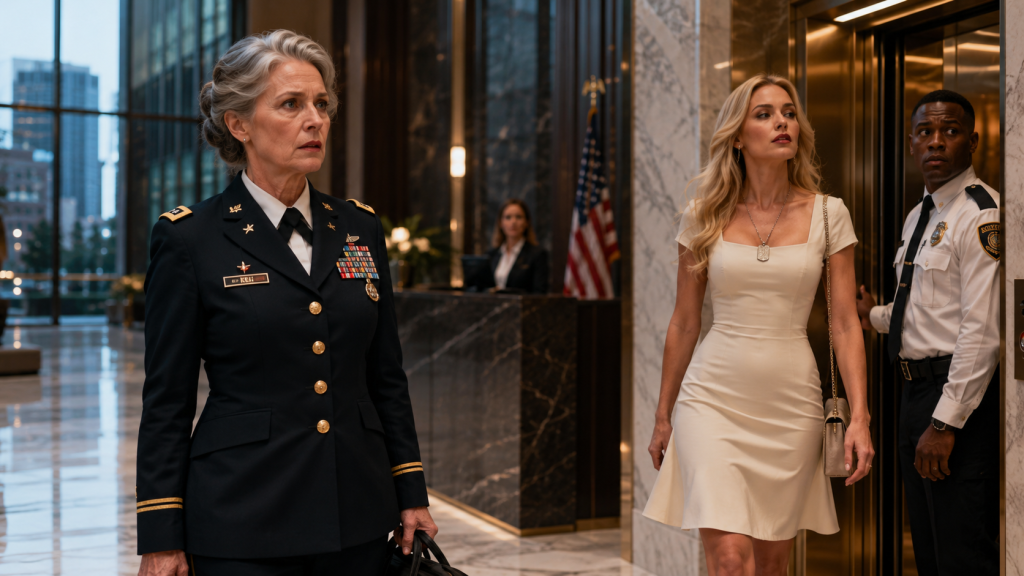
It was casual, amused, almost pitying, as if a gray-haired woman in an Army dress uniform had just walked into the lobby of one of Nashville’s most expensive logistics firms and claimed she owned the moon.
“I’m sorry,” I said, because I honestly thought I had misheard him. The guard leaned back in his chair, still smiling.
“Ma’am, Mr. Whitlock’s wife is already upstairs.”
For a moment, the lobby seemed to tilt.
The marble floor.
The steel elevators.
The glass walls overlooking downtown Nashville.
The American flag standing beside the receptionist’s desk.
Everything stayed exactly where it was, yet nothing made sense anymore.
“My husband,” I said slowly, “is Graham Whitlock.”
The guard’s smile weakened.
“Yes, ma’am.”
“And you’re telling me his wife is already here?”
He glanced toward the private elevator bank.
“She comes in almost every day.”
The words landed softly, but they split something open inside me.
I had driven three hours from Fort Campbell after receiving unexpected leave.
I had not called Graham because I wanted to surprise him.
After thirty-one years of marriage, after missed anniversaries, holiday dinners over video calls, and birthdays celebrated with packages mailed across oceans, I thought we had earned one old-fashioned romantic moment.
I imagined walking into his office.
I imagined his face lighting up.
I imagined him taking me into his arms and whispering, “Eleanor, you’re home.”
Instead, a twenty-six-year-old security guard was looking at me like I was confused.
Then he said the sentence that changed my life.
“There she is now.”
I turned.
A woman stepped out of the executive elevator wearing a cream designer dress, nude heels, and a diamond pendant that caught the lobby lights like a blade.
She was younger than me by at least fifteen years.
Blonde.
Polished.
Confident.
The kind of woman who had never had to wonder whether dust from a military convoy would ever wash out of her hair.
Two employees passing through the lobby smiled at her.
“Morning, Mrs. Whitlock,” one of them said.
Mrs. Whitlock.
My name.
My place.
My life.
The woman gave a graceful little nod, then looked directly at me.
Our eyes met for half a second.
Something flickered across her face.
Not confusion.
Not surprise.
Recognition.
Then she walked past me as if I were a stranger.
I should have shouted.
I should have followed her.
I should have marched upstairs and demanded to see Graham.
But thirty-two years in the United States Army had trained certain instincts into my bones.
When the ground shifts beneath you, you do not scream.
You assess.
You breathe.
You gather facts before you fire.
So I turned back to the guard and forced a smile.
“Must be a misunderstanding,” I said.
He looked relieved.
“Happens more than you’d think.”
No, I thought.
It does not.
Outside, the Tennessee sun hit my face with cruel brightness.
I walked to a bench near the curb and sat down with my small overnight bag beside my polished shoes.
Cars moved in and out of the parking garage.
Employees hurried past carrying coffee and laptops.
Life continued all around me, ordinary and careless.
My phone buzzed.
A text from Graham.
Miss you, Ellie. Counting the days.
I stared at those words until they blurred.
He thought I was still overseas for another month.
He thought I was waking up in a military housing unit thousands of miles away, not sitting outside his office after being told another woman had taken my name.
The obvious answer was an affair.
But affairs hide.
This woman was not hidden.
She walked through his company like she owned the building.
Employees greeted her.
Security recognized her.
No one whispered.
No one acted guilty.
That meant this was bigger than betrayal.
This was replacement.
That afternoon, I checked into a hotel under my maiden name, Eleanor Hayes.
Not because I was afraid of Graham finding me, but because I needed silence.
I needed a place where I could stop being a wife and start thinking like the officer I had spent my adult life becoming.
From the window of my room, I could see the Nashville skyline glowing gold in the late afternoon.
Somewhere in that city, my husband was probably having lunch with the woman everyone believed was his wife.
I opened my laptop.
The first thing I searched was his company website.
Whitlock Freight & Supply.
Founded by Graham Whitlock.
Chief Executive Officer.
Community leader.
Husband.
Patriot.
Visionary.
There were photographs from charity galas, ribbon cuttings, veterans’ fundraisers, hospital donations, golf tournaments.
And there she was.
Again and again.
The blonde woman stood beside him in nearly every picture.
Her hand rested on his arm.
His smile looked warm, proud, familiar.
The captions called her Graham’s wife, Celeste.
Celeste Whitlock.
I clicked photo after photo until my fingertips went cold.
In one picture, she wore my pearl earrings.
In another, she stood in front of my house on Christmas Eve, holding a glass of wine beside the fireplace I had helped design.
Then I saw the photo that made the room disappear.
Graham and Celeste on the stage at last year’s Veterans Honor Dinner.
Behind them hung a massive American flag.
On Celeste’s neck was my silver star pendant, the one Graham had given me after my promotion to colonel.
The caption read:
Graham and Celeste Whitlock, proud supporters of military families.
Military families.
I closed the laptop so hard the desk shook.
For nearly a minute, I could not move.
Then my phone rang.
It was my daughter, Audrey.
“Mom?” she said. “Are you back in the States?”
My chest tightened.
“Why?”
There was a pause.
“Because Dad just called me. He sounded panicked. He asked if I had heard from you.”
I stood slowly.
“What exactly did he say?”
Audrey’s voice dropped.
“He said if you contacted me, I should tell him immediately.”
The hotel room went silent.
My husband knew.
Somehow, Graham knew I was home.
And by the fear in my daughter’s voice, I understood something even worse.
He was not worried about our marriage.
He was worried about what I might discover next.
I told Audrey not to call him back.
Then I did the hardest thing a mother can do.
I asked my own daughter what she knew.
She went quiet for so long I could hear my heartbeat.
“Mom,” she whispered, “Dad told everyone you two separated years ago. He said you stayed in the Army because you didn’t want family life anymore.”
My hand tightened around the phone.
“And Celeste?”
Her voice cracked.
“He introduced her as his wife at company events. I thought… I thought you knew.”
For a moment, I had to grip the hotel desk to stay standing.
Then Audrey added the sentence that made my blood run cold.
“Mom, she’s been signing papers with your name.”
I opened my laptop again.
This time, I searched public business filings, property records, charity registrations, procurement awards—everything.
Celeste Whitlock appeared everywhere.
But beneath several documents was a signature that stopped my breath.
Eleanor M. Whitlock.
My signature.
Forged.
Graham had not only replaced me in public.
He had used my identity to secure veteran contracts, military spouse grants, and tax advantages built on my service record.
Then Audrey sent me a photo from last Christmas.
Celeste in my living room, wearing my pendant, standing beside my husband.
And behind them, on the mantel, was my deployment shadow box.
My medals.
My nameplate.
My life turned into decoration for his lie.
I called the one person Graham feared more than any lawyer.
Colonel Marcus Reed, my former commander, now attached to federal procurement oversight.
“Eleanor,” he said, “tell me this isn’t about Whitlock Freight.”
I closed my eyes.
“It is.”
His voice changed instantly.
“Then come to the federal building at 0800. Bring everything. And do not warn your husband.”
That night, Graham texted me.
Ellie, wherever you are, let’s talk before you do something emotional.
I stared at the message and finally replied:
Too late. I already did something official.
The next morning, I arrived at the federal building in full uniform.
Not because I needed drama.
Because Graham had used that uniform without permission.
Now it would walk into the room attached to its rightful owner.
Colonel Reed met me in a conference room with two investigators and a procurement attorney.
They did not ask me if I was emotional.
They asked for documents.
I gave them everything.
Screenshots.
Photos.
Public filings.
The company website.
Audrey’s messages.
The gala pictures.
Copies of my real signature.
Copies of the forged ones.
The attorney studied the first folder, then the second.
Her expression grew colder with every page.
“This is not merely marital misconduct,” she said.
“I know.”
“If your service record was used to qualify for contracts, and another woman impersonated you in official filings, we may be looking at fraud, identity misuse, false certification, and procurement violations.”
Colonel Reed looked at me.
“Did Graham ever have your authorization to use your name on these documents?”
“No.”
“Did Celeste ever have permission to represent herself as you?”
I almost laughed.
“No.”
One investigator turned a laptop toward me.
“Do you recognize this account?”
It was an email address.
I stared.
“No. That isn’t mine.”
He clicked.
The inbox opened.
There were messages sent under my name for years.
Thanking donors.
Accepting invitations.
Submitting veteran partnership statements.
Confirming my attendance at events I had never attended.
Every message was signed:
Colonel Eleanor Whitlock, U.S. Army.
I felt something inside me go very still.
Not because of the affair.
Not because of Celeste.
Because Graham had taken the one identity I earned without him and used it like company stationery.
Colonel Reed saw my face.
“Take a breath, Eleanor.”
I did.
Then I said, “I want all of it investigated.”
He nodded once.
“It already is.”
By noon, Whitlock Freight & Supply’s federal payments were placed under review.
By three, investigators had notified the contracting office.
By five, a subpoena was being prepared.
By six, Graham finally called.
I let it ring.
Then he called Audrey.
She did not answer.
Then he texted me.
You don’t understand what you’re doing.
I replied:
I understand chain of command.
No more messages came that night.
The following week was quiet in the way artillery is quiet before impact.
I stayed in Nashville under my maiden name.
Audrey flew in from Denver and met me at the hotel.
When she saw me, she burst into tears.
“I should have told you.”
I held her tightly.
“No, sweetheart. Your father built the lie. Not you.”
“He made it sound like you chose the Army over us.”
I pulled back and looked at her.
“Did you believe him?”
Her face crumpled.
“Sometimes.”
That hurt.
But truth often hurts before it heals.
“I chose service,” I said. “But I never stopped choosing you.”
“I know that now.”
We spent two hours going through old messages, holiday videos, bank statements, and emails.
Audrey remembered moments I had missed while deployed.
Celeste appearing at fundraisers.
Celeste hosting dinners.
Celeste correcting people who asked about me by saying, “Eleanor prefers privacy.”
Privacy.
Another word turned into a cage.
Three days later, federal agents arrived at Whitlock Freight & Supply.
Not with sirens.
Not with movie drama.
With suits, badges, documents, and calm authority.
Graham called me within minutes.
This time, I answered.
His voice was wild.
“Eleanor, what have you done?”
I looked out my hotel window at the city he had used as a stage.
“I asked questions.”
“You sent federal investigators to my company.”
“No, Graham. Your forged documents did that.”
He lowered his voice.
“Listen to me. This can still be fixed.”
“Can it?”
“Yes. We say it was a misunderstanding. Celeste handled appearances while you were away. You knew. You were busy. You signed off informally.”
I closed my eyes.
Even now, he wanted me to save him.
Not apologize.
Not confess.
Just stand in front of his disaster and absorb the blast.
“No.”
His breathing sharpened.
“You want to destroy everything we built?”
“What we built?” I said softly. “You replaced me in our home, put my medals behind your mistress, forged my name, and turned my service into a marketing tool.”
“She is not my mistress.”
The words were so absurd that I laughed once.
“What is she, then?”
Silence.
Then, barely above a whisper:
“She’s pregnant.”
For one moment, the world narrowed again.
Thirty-one years of marriage.
A daughter.
Deployments.
Funerals.
Christmases missed and made up later.
Letters.
Photographs.
Promises whispered in airports.
And now this.
A new wife who was not his wife.
A new child.
A new life built inside the ruins of mine.
“Eleanor?”
I inhaled.
“Congratulations,” I said. “You’ll need to explain that in divorce court too.”
Then I hung up.
The investigation moved quickly after the raid.
Celeste had signed at least nine documents using my name.
Graham had approved an internal profile listing me as a veteran consultant for the company, though I had never received a salary, contract, or even a request.
Whitlock Freight had won multiple contracts after claiming military family leadership and veteran-connected compliance advantages.
Some claims were legal if true.
They were not true.
My service had been packaged, sold, and weaponized.
The board panicked.
Investors panicked.
Graham’s carefully built image cracked in public before he could hide it.
The local paper ran the headline:
Decorated Army Colonel Says Husband Used Her Identity in Corporate Fraud Probe.
The photograph they used was not of Celeste.
It was of me.
Taken at a change-of-command ceremony years earlier, standing straight in uniform, my silver star pendant visible at my throat.
The real one.
When the story broke, Celeste disappeared from social media.
Graham issued a statement calling the situation “a painful family misunderstanding.”
Colonel Reed sent me the statement with one sentence:
They always call fraud a misunderstanding before the evidence speaks.
The evidence spoke loudly.
At the first divorce hearing, Graham looked older.
For once, he wore no confident smile.
Celeste was not there.
His attorney tried to frame the matter as a long separation.
My attorney placed three photographs on the table.
One of Graham texting me “Miss you, Ellie.”
One of Celeste being introduced publicly as his wife.
One of my forged signature beside my authentic one.
The judge looked at Graham.
“Mr. Whitlock, were you legally separated from Colonel Whitlock?”
Graham’s mouth tightened.
“No, Your Honor.”
“Were you divorced?”
“No.”
“Did Colonel Whitlock authorize another woman to sign her name?”
“No.”
That one word changed the room.
No.
Simple.
Official.
Under oath.
After the hearing, Graham tried to approach me in the hallway.
Audrey stepped between us.
It startled me.
My daughter, who had once called him first for everything, now stood in front of me like a shield.
“Don’t,” she said.
Graham looked wounded.
“Audrey, I’m your father.”
“And she’s my mother.”
His face folded.
I almost felt sorry for him.
Almost.
He looked at me over Audrey’s shoulder.
“Ellie, please. I lost control.”
“No,” I said. “You built control. You lost cover.”
The federal case did not end overnight.
Cases like that rarely do.
Contracts were suspended.
Payments frozen.
The board removed Graham as CEO pending investigation.
Celeste, under pressure, claimed Graham told her I had agreed to everything.
Then investigators produced emails from her private account asking whether “Eleanor’s signature looked convincing enough.”
After that, her story changed.
Again.
And again.
The truth did not.
Months passed.
I returned to duty, but something in me had shifted.
For years, I had thought distance was the sacrifice that strained my marriage.
Now I understood that absence had simply given Graham room to become who he already was.
He had not replaced me because I was gone.
He replaced me because he wanted the benefits of my name without the inconvenience of my presence.
On my last day before finalizing the divorce, I went back to the house.
My house.
Our house.
The house where Celeste had worn my pearls and posed beside my fireplace.
A locksmith met me there.
So did Audrey.
We walked through room by room.
The furniture looked familiar and foreign.
In the living room, my shadow box still sat on the mantel.
My medals.
My nameplate.
My deployment coin.
Audrey reached for it.
“Do you want me to take it down?”
“No,” I said.
I lifted it myself.
It was heavier than I remembered.
Or maybe I was simply feeling the weight properly now.
In the master bedroom, Celeste’s perfume still lingered faintly.
I opened the jewelry drawer.
Empty.
My pearl earrings were gone.
So was the original pendant.
But the Army had taught me something long before marriage taught me anything.
Symbols matter.
But the symbol is not the service.
Celeste could wear my pendant.
She could stand in my house.
She could sign my name.
But she could not become me.
I packed only what mattered.
The shadow box.
Photographs of Audrey.
My father’s Bible.
A folded flag from my mother’s funeral.
Letters Graham had sent me during my first deployment.
I almost threw those away.
Then I kept them.
Not because I wanted him back.
Because they proved something important.
There had been a time when I loved honestly.
His betrayal did not make my love foolish.
It made his character false.
The divorce finalized six months after my surprise visit to Nashville.
I reclaimed my maiden name professionally and legally.
Colonel Eleanor Hayes.
Not because Whitlock disgusted me.
But because Hayes had always been mine first.
Graham lost his company position, several contracts, and the public reputation he had built on patriotism he borrowed from me.
Celeste eventually gave a statement through counsel and vanished from Nashville before her child was born.
I do not know where she went.
I hope, for the child’s sake, she learned the difference between being chosen and being used as decoration.
Audrey and I rebuilt slowly.
Trust is not repaired in one conversation.
But we had the truth now, and truth is a cleaner foundation than polite lies.
One evening, she asked, “Mom, why didn’t you scream in the lobby?”
I smiled.
“Because I was in uniform.”
She shook her head.
“No. Really.”
I thought about it.
The guard’s laugh.
Celeste’s pendant.
The text from Graham.
The feeling of my life splitting open under marble lights.
“Because screaming would have given him warning,” I said. “And I needed evidence.”
Audrey smiled a little.
“That sounds like you.”
Maybe it did.
I am sixty years old now.
A decorated Army colonel.
A mother.
A woman who drove three hours to surprise her husband and discovered he had turned my absence into a stage for another woman.
People ask if the pendant hurt the most.
It did not.
The pendant was silver.
Replaceable.
What hurt most was the shadow box.
My medals behind them in that Christmas photo.
My life turned into atmosphere.
Proof of service used to decorate a lie.
But that was also what saved me.
Because Graham forgot that a military record is not a costume.
A signature is not a prop.
A wife is not a vacancy to be filled while she is serving her country.
And a woman trained to gather facts before she fires does not need to shout to bring down a man who built his empire on fraud.
The guard was wrong that day.
Graham’s wife was not upstairs.
His lie was.
His wife was standing in the lobby, in uniform, watching carefully.
And by the time Graham realized I was home, it was already too late.
I had stopped being the woman he could replace.
I had become the witness who could prove everything.
THE END! THANKS FOR READING!