 Reading Time: 38 minutes
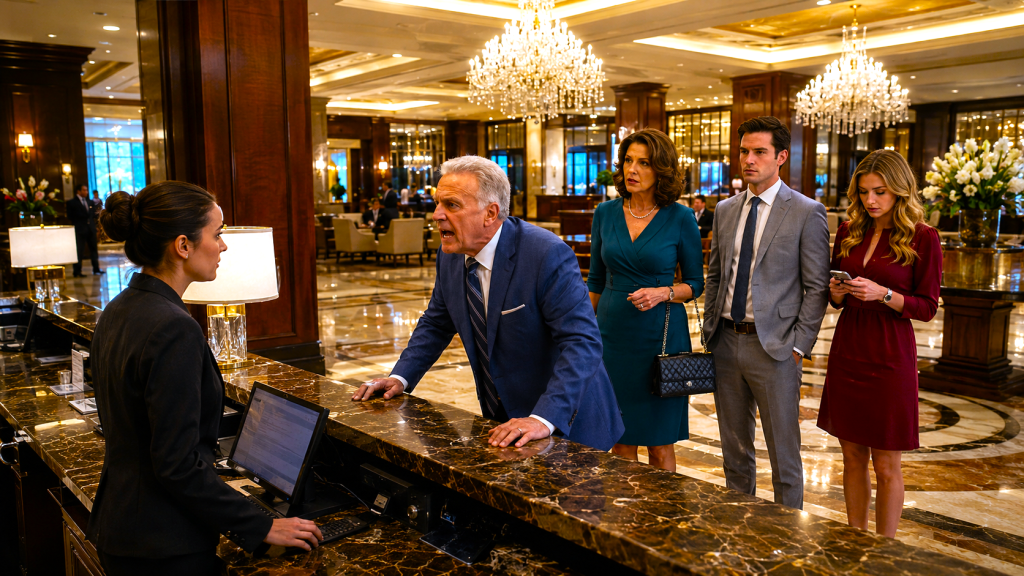
The family who erased me for seven years walked into my hotel like they still owned a piece of my future. My father didn’t say hello. He didn’t ask how I had been.
He stepped across the polished marble lobby, looked around at the brass lights, the fresh flowers, the guests checking in for the weekend, and said, loud enough for my front desk manager to hear, “So, you think owning a little hotel makes you better than us now?”
The lobby went still.
Behind him stood my mother, dressed carefully in a navy wrap dress, her hands folded around a small clutch like she had practiced looking gentle. My brother Derek stood beside her in a stiff collared shirt, his wife Cassandra scrolling on her phone as if this were already beneath her.
Seven years.
Not one birthday call.
Not one message after I graduated.
Not one word when I built my first property, sold it, reinvested, failed, tried again, and finally came back to Savannah as the owner of the Aldren.
And now they were standing in my lobby on a Friday night, under warm chandelier light, expecting me to shrink.
I kept my voice calm.
“Welcome to the Aldren,” I said. “Do you have a reservation?”
My father laughed.
It was the same laugh from my childhood. The one that made every room feel smaller. The one that always told me the joke was me.
“A reservation?” he said, turning toward my mother. “She’s asking if we have a reservation.”
My mother gave me that soft smile she used when she wanted something.
“Maya, sweetheart,” she said, “we didn’t even know this was your place. We’re here for Derek’s company dinner. He’s being recognized tonight.”
Derek glanced at me once and looked away.
That glance told me everything.
I stepped behind the front desk and checked the event list. The rooftop had been bought out by Hollis Group for a private client dinner.
Derek’s name was there.
One seat.
Not four.
No family guests.
No plus-three.
I looked back up at them.
“I’m seeing one confirmed seat under Derek Lawson,” I said. “The rooftop is a private event tonight, so I can’t add anyone without authorization from the host company.”
Derek’s jaw tightened.
“Can you just call up there and get it sorted?”
“I can contact the event coordinator, but the guest list is controlled by the host.”
My father stepped closer.
“Maya,” he said, lowering his voice just enough to make it feel personal. “We drove three hours. Your mother is tired. Surely you can find your family a table somewhere.”
Your family.
The words landed strangely after seven years of silence.
Still, I nodded.
“Of course. The dining room has availability.”
I had Celia, our dining manager, seat them near the window at one of the better tables because I ran my hotel professionally. I sent over the bread course. I checked on a rehearsal dinner in the courtyard. I handled a room-key issue for a couple from Nashville. I approved a last-minute dessert change for the rooftop event.
For thirty minutes, I let myself believe that would be the end of it.
Then Celia found me outside the kitchen.
“They’re asking for you again,” she said quietly.
When I reached the table, my father was sitting with his arms crossed. My mother’s bread roll sat untouched on the plate. Cassandra’s phone was face down now.
Derek was gone.
Of course he was.
Upstairs, where the important people were.
“Sit down,” my father said.
I stayed standing.
“Is there something wrong with the service?”
His mouth tightened.
“You can help us by acting like a daughter instead of a hotel employee.”
A server passed behind me carrying two plates. The silverware on the table caught the candlelight. My mother reached out and touched my wrist like she still had permission.
“We just want to talk, baby. We’ve missed you.”
Seven years, and the lie arrived wrapped in sweetness.
I gently moved my hand away.
“I’m working.”
My father leaned forward.
“Derek is being made partner next month.”
I said nothing.
“That changes things for this family,” he continued. “Socially. Professionally. People will be watching how we present ourselves.”
Cassandra lifted her chin slightly, as if the sentence had been written for her.
“They’re looking at a house in Ardsley Park,” my father said. “A real house. The kind that fits this next stage.”
There it was.
Not an apology.
Not a reunion.
A bill.
My mother rushed in softly.
“We only need help bridging the gap until Derek’s bonus comes through.”
“How much?” I asked.
My father didn’t blink.
“Sixty thousand.”
The table went quiet.
Outside the window, Savannah moved on without us. A couple walked past beneath the streetlamps. A valet opened the door for a guest. Somewhere upstairs, a room full of strangers laughed over drinks.
I looked at my father.
“No.”
The word came out clean.
His expression changed first in the eyes.
“You own a hotel, Maya. Don’t tell me you don’t have it.”
“What I have isn’t the point.”
“Then what is the point?”
“The last major financial decision this family made involving me was when my college fund disappeared without my knowledge,” I said. “Forty-two thousand dollars that had been meant for my education went to fix Derek’s situation. I worked my way through school after that. I built everything from there myself.”
My mother looked down.
Cassandra stopped pretending not to listen.
My father’s face hardened.
“That was years ago. You clearly landed on your feet.”
“I landed on my feet because I refused to stay where you left me.”
His hands flattened against the table.
“You chose to cut off your family.”
I almost smiled.
“No. I chose to stop standing at a locked door.”
For the first time that night, my father stopped performing.
His voice dropped.
“Let me be clear with you. Derek’s firm has relationships with people connected to this property. I happen to know someone who handles commercial leases in this area.”
Celia, across the room, froze near the host stand.
My father kept his eyes on me.
“It would be very easy for a concern to be raised when renewal comes around. Operators can be replaced. Buildings can change hands. You should think carefully about which relationships matter.”
My mother whispered, “Maya, don’t make this difficult.”
The candle between us flickered.
For a second, all I could hear was the old kitchen refrigerator from my childhood, humming while my father told me my future had already been spent.
Then I looked at the man across the table.
Calmly.
Directly.
And I asked, “Dad… who do you think owns this building?”
1. The Silence After the Question
My father stared at me.
It was only two or three seconds, but I watched an entire argument happen behind his eyes.
First confusion.
Then annoyance.
Then calculation.
Finally, he leaned back and gave a dismissive shrug.
“The investment company that owns half this block, obviously.”
Cassandra reached for her wine.
My mother looked between us.
I pulled out the empty chair at the end of the table and sat down for the first time.
“What investment company?”
My father frowned.
“Savannah Meridian.”
“Interesting.”
“What’s interesting about it?”
I folded my hands.
“Savannah Meridian Holdings LLC.”
He gave an impatient nod.
“Yes.”
I waited.
Nothing.
So I said, “I own Savannah Meridian.”
Cassandra’s wineglass stopped halfway to her mouth.
My mother blinked.
My father actually smiled.
Not because he believed me.
Because he thought I was joking.
“Maya.”
“I’m serious.”
“You own a hotel,” he said. “You do not own a commercial property company.”
“I own both.”
His smile disappeared.
I continued before he could interrupt.
“Savannah Meridian owns this building, the parking structure behind it, the retail unit next door, and two smaller properties on Whitaker Street. The Aldren Hotel is operated by Aldren Hospitality, which is another company I control.”
My father’s face went completely still.
Cassandra lowered her glass.
My mother whispered, “You own the building?”
“Yes.”
“All of it?”
“Yes.”
My father pushed back his chair slightly.
“That’s impossible.”
I almost asked which part.
The fact that I had succeeded?
Or the fact that I had succeeded without him?
Instead, I reached into my blazer pocket and pulled out my business card.
I set it on the table.
MAYA LAWSON
FOUNDER & MANAGING MEMBER
ALDREN HOSPITALITY GROUP
SAVANNAH MERIDIAN HOLDINGS
My father picked it up.
He looked at the front.
Then the back.
As if there might be an explanation printed somewhere in smaller letters.
“There’s no landlord for you to call,” I said. “There’s no lease renewal you can threaten. If someone from Derek’s firm told you otherwise, either they don’t know who owns the property or Derek has been telling you a story.”
For the first time that evening, Cassandra looked genuinely nervous.
My mother said, “Derek told us you managed this place.”
“Derek knows more than that.”
My father looked sharply at me.
“What does that mean?”
Before I could answer, the elevator doors opened across the lobby.
Derek stepped out with a man I recognized immediately.
Simon Hollis.
Founder of Hollis Group.
Derek’s employer.
And one of the people scheduled to meet me privately after the rooftop dinner.
Simon was in his late sixties, with silver hair and the calm manner of a man who had spent decades listening before speaking. His firm specialized in commercial redevelopment and private real estate investment.
Two years earlier, Hollis Group had tried to buy one of my properties.
I had declined.
Six months later, Simon and I had begun discussing something more interesting.
A joint redevelopment project.
Derek saw his family at the table and stopped.
Then he saw me sitting with them.
His face changed.
Simon followed his gaze.
“Maya,” he called warmly. “There you are.”
My father looked at me.
Then at Simon.
Then at Derek.
Simon came over and shook my hand.
“Beautiful event,” I said.
“You and your team have done a terrific job.”
He turned toward my family.
“Derek, I didn’t realize these were Maya’s parents.”
Derek cleared his throat.
“We’re related, yes.”
Related.
Not sister.
Not family.
Related.
Simon smiled politely at my parents.
“You must be proud of her.”
Nobody answered.
I almost laughed.
Simon’s smile weakened slightly.
Then he looked back at me.
“Are we still on for nine?”
“Absolutely.”
“Excellent. I have the revised numbers with me. I think you’ll like what the team put together.”
Derek was staring at me now.
“What revised numbers?”
Simon glanced toward him.
“For the East Broad project.”
Derek’s face drained of color.
I knew exactly why.
Because Derek had spent the last six months trying to become a partner at a firm where his estranged younger sister was quietly negotiating a multimillion-dollar development with the founder.
And apparently, he had never told our parents.
2. What Happened Seven Years Earlier
To understand why Derek looked frightened, you have to understand what happened the last time our family sat together around a table.
I was twenty-two.
Derek was twenty-eight.
He had always been the center of our parents’ plans.
He was the firstborn.
The son.
The one my father introduced by accomplishments.
“My son Derek, the future attorney.”
“My son Derek, top of his class.”
“My son Derek, joining a prestigious firm.”
I was usually introduced afterward.
“And this is Maya.”
When I was accepted into a highly regarded hospitality management program, my mother hugged me and said, “That’ll be nice until you decide what you really want to do.”
My father asked why I needed college to learn how to check people into hotels.
I laughed because I thought he was joking.
He wasn’t.
My grandmother, my mother’s mother, was different.
She had worked at a small inn near Charleston for nearly thirty years. She loved hotels—not the glamorous image of them, but the idea of temporary shelter becoming meaningful.
“A good hotel,” she once told me, “is a place where strangers trust you with a tiny piece of their lives.”
When she died, she left money for both Derek and me.
My parents managed the accounts until we were old enough to use them.
Mine contained forty-two thousand dollars by the time I entered college.
Or it should have.
During my junior year, I went to the bank because I needed tuition money.
The account held $1,137.
I thought there had been a mistake.
There hadn’t.
My father had transferred almost everything eighteen months earlier.
To Derek.
Derek had made what everyone called “a bad investment.”
That phrase was generous.
He had borrowed money to buy into a speculative restaurant project with two friends, used more borrowed money to renovate a leased building, and personally guaranteed debts he couldn’t repay.
When it collapsed, he panicked.
My father saved him.
With my money.
I confronted them at Sunday dinner.
I can still picture the room.
Roast chicken.
Green beans.
The chipped serving bowl my mother refused to throw away.
Derek staring at his plate.
My father drinking iced tea like we were discussing the weather.
“You weren’t using all of it,” he said.
“It was my college fund.”
“You had scholarships.”
“Not enough.”
“You can work.”
“Why couldn’t Derek?”
That changed everything.
My father put down his glass.
“Your brother made a mistake.”
“So you stole from me to fix it?”
My mother gasped.
“Don’t use that word.”
“What word should I use?”
“We’re family,” she said.
Apparently, family was the word people used when they wanted the victim to finance the person who hurt them.
I looked at Derek.
“Did you know the money was mine?”
He said nothing.
“Derek.”
Finally, he muttered, “Dad said it would get replaced.”
“Did you know?”
“Yes.”
That single word broke something in me.
Not because the money was gone.
Money can be earned again.
It broke because he had known.
My brother had watched our father take the security our grandmother left me and had accepted it because his failure mattered more than my future.
I stood up.
My father pointed at my chair.
“Sit down.”
“No.”
“Maya.”
“I’m done.”
He followed me into the kitchen.
“You walk out that door over money, don’t expect to come crawling back when the real world teaches you how hard it is.”
I remember turning around.
“The real world didn’t take my college money. You did.”
My mother began crying.
That made me the cruel one.
It always did.
I packed two bags that night.
I stayed with a classmate for three weeks.
Then I found a tiny room above a laundromat.
I worked mornings at a hotel front desk, classes during the afternoon, and restaurant shifts on weekends.
I graduated nine months later.
Nobody from my family came.
I sent my mother one text afterward.
I’m willing to talk if everyone can acknowledge what happened and we can discuss a repayment plan.
She responded the next morning.
Your father is too hurt by your behavior to speak with you.
That was the final message between us for seven years.
Until they walked into the Aldren.
3. The Things They Never Saw
My family assumed my life had become easier because they only saw the finished building.
They didn’t see the beginning.
My first job after graduation paid less than Derek spent leasing his first luxury car.
I worked at a struggling hotel outside Atlanta where the carpet smelled faintly damp and half the rooms needed renovation.
I loved it.
The owner was a seventy-year-old widow named Ruth Aldren.
Ruth knew everything about the property.
Which room had the best sunrise.
Which plumbing line froze first.
Which housekeeper was supporting three grandchildren.
Which corporate customer paid late.
She taught me that owning property had very little to do with marble lobbies and everything to do with numbers, maintenance, patience, and people.
For four years, I learned everything I could.
Eventually, Ruth offered me a tiny equity stake in a twenty-room property she wanted to renovate.
I invested every dollar I had saved.
It nearly ruined me.
Construction costs exploded.
Our lender changed terms.
A tropical storm damaged the roof three weeks before reopening.
I maxed out credit cards.
For six months, I slept in Room 8 because I couldn’t afford rent somewhere else.
But the property survived.
Then it thrived.
Three years later, we sold it.
My share was enough to change my life.
Not enough to retire.
Enough to choose my next risk.
I bought a neglected ten-unit building.
Renovated it.
Refinanced.
Bought another.
Sold one.
Lost money on another.
Made it back.
Learned.
Repeated.
By thirty-two, I had become very good at being underestimated.
Then Ruth died.
Her daughter called me six months later.
She was selling some of Ruth’s remaining holdings, including an old commercial building in Savannah that had once been a hotel.
The place was beautiful beneath the neglect.
Tall windows.
Original plaster.
Brass elevator doors.
A rooftop overlooking the historic district.
It also needed millions of dollars.
Everyone told me not to buy it.
I bought it.
I named the restored hotel the Aldren.
Not after myself.
After the woman who had treated my ambition as something worth teaching instead of something worth mocking.
Opening night was the proudest night of my life.
I stood alone on the rooftop after the guests left and cried.
Then I went downstairs and helped housekeeping because three employees had called out sick.
That was ownership.
Not the ribbon cutting.
The work after everyone went home.
My parents knew none of it.
But Derek did.
Because eighteen months before that Friday night, Hollis Group had approached Savannah Meridian about purchasing a parking structure I owned.
Derek was on the legal team.
He had seen my name.
He had seen the ownership records.
He had known.
And never once had he called.
4. My Brother’s Real Problem
Simon checked his watch.
“I’m going upstairs. Maya, whenever you’re ready.”
“I’ll see you at nine.”
He nodded and returned to the elevator.
Derek stayed behind.
The moment the doors closed, my father turned toward him.
“You knew?”
Derek glanced around the dining room.
“Can we not do this here?”
“You knew she owned the building?”
“I knew she had an interest in it.”
I raised an eyebrow.
“An interest?”
Derek looked at me sharply.
I could see the old instinct arriving—the belief that if he sounded confident enough, reality would adjust itself around him.
“The corporate structure is complicated.”
“No, it isn’t.”
“Maya.”
“Savannah Meridian owns the building. I own Savannah Meridian. That’s not complicated.”
My father looked at Derek.
“You told me her company leased the hotel.”
Derek ran a hand along his jaw.
“It technically does.”
I almost admired the desperation.
“Aldren Hospitality leases operating space from Savannah Meridian,” I said. “Both are mine. It’s an internal structure for liability and financing.”
My father’s expression darkened.
“So you lied.”
Derek pushed his chair in.
“I simplified it.”
Cassandra finally spoke.
“You told us Maya was basically the general manager.”
My mother looked genuinely confused.
“Why would you say that?”
“Because none of this matters!” Derek snapped.
Several diners turned.
Celia took one step toward us.
I gave her a tiny shake of my head.
Not yet.
Derek lowered his voice.
“The issue is the house.”
I looked at Cassandra.
“What house?”
She stared at her husband.
Apparently, this part had not been fully disclosed either.
My father answered.
“They have an offer accepted. Closing is next week.”
“For how much?”
“That’s private.”
“You came here asking me for sixty thousand dollars. Privacy has left the building.”
Cassandra closed her eyes briefly.
“One point three.”
I looked at her.
“One point three million?”
She nodded.
“They already own a house,” I said.
My mother answered, “It’s not appropriate anymore.”
I almost asked whether houses had developed social rankings while I was gone.
Cassandra spoke quickly.
“Derek’s partnership track changes our needs. We entertain clients. Other partners live in that area.”
Something in the way she said partnership track caught my attention.
Not partnership.
Track.
I turned to Derek.
“Dad said you’re being made partner next month.”
His jaw tightened.
“That’s the expectation.”
“The expectation according to whom?”
Silence.
My father looked at him.
“According to the firm.”
Derek didn’t answer.
I understood.
“Oh.”
Cassandra looked at me.
“What?”
“He hasn’t been offered partnership.”
Derek’s face flushed.
“You don’t know what you’re talking about.”
“I know Simon.”
“That doesn’t mean you understand internal firm decisions.”
“I understand he personally told me two weeks ago that the partnership committee wouldn’t finalize promotions until January.”
My father’s expression changed.
“January?”
Derek glared at me.
“You had no right to discuss me with Simon.”
“We weren’t discussing you.”
That hurt him more.
“He mentioned staffing for East Broad,” I continued. “Your name came up because you’ve been handling part of the preliminary work.”
My father stared at Derek.
“You said it was finalized.”
“It basically is.”
Cassandra whispered, “You told me the vote already happened.”
Derek turned on her.
“Not now.”
That was when I realized the sixty thousand dollars wasn’t merely for a house.
It was for a performance Derek could no longer afford.
He had told everyone he was becoming partner.
He and Cassandra had committed to a house based on money he didn’t have yet.
And somehow, after seven years without speaking to me, the family solution had once again become Maya pays.
Different decade.
Same table.
5. The Threat Becomes a Mistake
My father pointed at me.
“This is exactly why families should communicate. You know people at Derek’s company. You have resources. Instead of helping, you’re sitting here enjoying embarrassing him.”
“I didn’t bring any of this up.”
“You deliberately challenged him.”
“You asked me for sixty thousand dollars and threatened my business.”
“I did no such thing.”
Celia shifted near the host stand.
I looked directly at my father.
“You said you knew people connected to my lease and that a concern could be raised when renewal came around.”
“I was advising you.”
“No. You were threatening me.”
My mother reached for my hand again.
“Maya, your father gets forceful when he’s worried.”
I moved my hand.
“Mom, stop translating him into a nicer person.”
Her face fell.
For years, that had been her role.
Dad didn’t insult us.
He was under pressure.
Dad didn’t control us.
He cared.
Dad didn’t steal my college fund.
He made a difficult family decision.
I had spent half my childhood learning that the correct response to being mistreated was to describe it more politely.
Not anymore.
Derek leaned closer.
“Can we settle this privately?”
“This is private.”
“We’re sitting in a restaurant.”
“My restaurant.”
His eyes narrowed.
That tiny sentence irritated him.
“My restaurant.”
Not because I was showing off.
Because the facts had stopped cooperating with the family hierarchy.
My father stood.
“We’re leaving.”
My mother looked startled.
“But dinner—”
“We’re leaving.”
He reached for his jacket.
Then he turned to me.
“I hope proving a point was worth losing your brother.”
I stared at him.
“I lost my brother seven years ago.”
Derek laughed bitterly.
“There she goes. The martyr.”
I felt something inside me go very quiet.
“What did you call me?”
“You heard me.”
He stepped closer.
“You’ve built your entire personality around that college fund. Forty-two thousand dollars. You act like we destroyed your life.”
“No. You didn’t destroy it.”
“Exactly.”
“But you tried to make the consequences mine.”
He looked away.
I continued.
“You made a reckless investment. Dad used money Grandma left me to rescue you. You knew. Nobody apologized. Nobody repaid it. And when I asked for accountability, all three of you stopped speaking to me.”
“You left.”
“I gave you my phone number.”
“You were hostile.”
“I asked you to repay stolen money.”
My father slammed his palm onto the table.
“Enough with that word!”
Every head nearby turned.
Celia came over immediately.
“Mr. Lawson,” she said calmly, “I need you to lower your voice.”
My father looked offended.
“Excuse me?”
“This is a dining room. Other guests are being disturbed.”
“I am speaking to my daughter.”
“And you are speaking loudly enough to disrupt service.”
For a moment, I saw him considering whether to challenge her.
Then Celia added, “If that continues, I’ll need to ask you to leave.”
My father looked at me.
“You’re going to let an employee speak to me like that?”
“Yes.”
Celia gave me the smallest nod.
My father’s face turned red.
“You’ve changed.”
“No,” I said. “You just don’t have authority over me anymore.”
That sentence ended the evening.
He grabbed his jacket.
My mother stood slowly, tears filling her eyes.
Cassandra collected her purse.
Derek remained still.
Then I remembered something.
“Derek.”
He looked at me.
“I need you to stay for a minute.”
My father scoffed.
“Why?”
“Because there’s something involving Hollis Group that he and I need to clarify.”
Derek’s face went pale again.
That was the moment I knew there was more.
6. The Email I Hadn’t Understood
Three days earlier, my attorney, Elena Morris, had forwarded me an unusual email.
A junior analyst working on the East Broad redevelopment had noticed that one section of the preliminary due-diligence packet contained financial assumptions we had never approved.
Nothing illegal.
Not yet.
But strange.
The packet estimated what Savannah Meridian might accept in exchange for granting certain development rights.
The numbers were far too low.
Elena thought it was probably an outdated worksheet.
I had agreed.
Now I wasn’t so sure.
I looked at Derek.
“Did you work on the preliminary valuation materials for East Broad?”
His answer came too quickly.
“I reviewed documents.”
“Did you prepare any internal estimate of what my company would accept?”
“That’s normal.”
“Did you send anything outside your firm?”
“No.”
Cassandra stared at him.
My father said, “What is this about?”
I ignored him.
“Derek, did you use information from your work on my deal when you spoke to Dad about my finances?”
“No.”
“You told him I had a landlord.”
“I told him you had a lease.”
“That’s not what I asked.”
He sighed.
“Maya, you’re trying to turn a family disagreement into a business issue.”
“No. You did that when Dad threatened my property using information he said came through your professional relationships.”
For the first time, Derek seemed to understand the seriousness of what his father had done.
He turned to him.
“What exactly did you say?”
My father looked annoyed.
“I told her people know people.”
“Who did you name?”
“No one.”
“Dad.”
“No one!”
Derek stepped away from the table and rubbed his forehead.
Cassandra whispered, “What’s happening?”
I knew.
Professional confidentiality was not something Hollis Group treated casually.
If Derek had been discussing internal property information with our father—especially while the firm was negotiating with my companies—it could threaten far more than his imaginary partnership announcement.
I stood.
“This conversation is finished for tonight.”
Derek looked at me.
“Maya.”
“I have a meeting.”
“Don’t bring this up to Simon.”
I stopped.
The sentence hung between us.
My father stared at him.
Cassandra’s face drained.
I looked at my brother carefully.
“Why wouldn’t I?”
“Because there’s nothing to bring up.”
“Then you shouldn’t be worried.”
“Maya.”
“What did you do?”
“Nothing.”
“What did you tell Dad?”
“Nothing confidential.”
That answer told me everything.
Not nothing.
Nothing confidential.
Which meant information had been shared.
The only question was how much.
My mother began crying softly.
“I knew this was a mistake.”
I looked at her.
“What was?”
“Coming here.”
My father glared at her.
She immediately became quiet.
That hurt more than I expected.
Seven years had passed, and she was still afraid of his displeasure.
I wasn’t.
Not anymore.
I looked at Derek.
“You need to leave.”
“Are you going to tell Simon?”
“I’m going to conduct my business appropriately.”
“You know what that means.”
“Yes.”
He stepped closer.
“If I lose my promotion because of this—”
“Because of what?”
He stopped.
Exactly.
If there was nothing, there was nothing to lose.
My father muttered, “Unbelievable.”
I turned toward Celia.
“Please remove their dinner from the bill.”
Celia nodded.
My mother looked hopeful for half a second.
Then I added, “And note that they are not authorized for guest areas of the hotel tonight.”
My father’s head snapped toward me.
“You’re banning us?”
“I’m asking you to leave my workplace after you threatened me and disrupted my dining room.”
“You really think you’re somebody now.”
I met his eyes.
“I think I’m the owner.”
He walked out without another word.
My mother followed.
Cassandra hesitated.
Then she followed them too.
Derek remained a moment longer.
He looked at me with something I hadn’t seen from him before.
Not anger.
Fear.
“Please,” he said quietly.
That one word almost moved me.
Almost.
But I remembered being twenty-two, standing in my parents’ kitchen, asking the same thing.
Please explain.
Please replace the money.
Please acknowledge what happened.
Please don’t make me lose my family just because I won’t pretend this was okay.
Nobody had listened.
I stepped aside.
“The exit is behind you.”
7. The Meeting Upstairs
At nine o’clock, I sat across from Simon Hollis and two members of his development team in my conference room.
For twenty minutes, we discussed the East Broad project.
Hollis Group wanted to redevelop an aging mixed-use block near one of my smaller properties. My parking structure provided access that would make the project significantly more valuable.
We were negotiating an easement, shared parking rights, and potentially a minority ownership stake.
It was the biggest deal I had ever considered.
Eventually Simon closed his folder.
“There’s one other matter.”
I knew.
He slid a document across the table.
“Did your attorney contact you about this?”
“Yes.”
“Do you recognize these figures?”
I scanned the spreadsheet.
“No.”
“They represent a hypothetical price for your access rights.”
It was less than half what my own consultants estimated.
“Who prepared this?”
Simon’s jaw tightened.
“That’s what we’re investigating.”
I looked at him.
“Was Derek involved?”
He didn’t answer immediately.
That silence was answer enough.
“He was one of several people with access.”
“Simon, my father came into my hotel tonight asking me for sixty thousand dollars.”
His eyebrows rose.
“That’s certainly not my business.”
“It became relevant when he threatened to interfere with my lease renewal by using relationships connected to Derek’s firm.”
Simon stopped moving.
I continued.
“He believed this property had an outside landlord. Derek apparently told him something along those lines. When I questioned Derek about information he shared, he asked me not to tell you.”
The two executives beside Simon exchanged looks.
Simon spoke carefully.
“Did Derek directly threaten you?”
“No.”
“Did he ask you to make a business concession?”
“No.”
“Did your father reference our firm by name?”
“No.”
I could have exaggerated.
I didn’t.
Facts were enough.
Simon leaned back.
“Thank you for telling me precisely what happened.”
“I’m not asking you to fire my brother.”
“I know.”
“I’m also not asking for special treatment.”
“I know that too.”
I looked at the spreadsheet again.
“What happens now?”
“We determine who created the figures, why, and whether they were distributed.”
“And our deal?”
“Continues.”
He paused.
“Unless you prefer otherwise.”
“No.”
I had spent too many years separating my emotions from my business decisions to collapse them now.
Simon nodded.
“Good.”
Before leaving, he stopped near the door.
“For what it’s worth, Maya, when Derek joined us, I didn’t know he was your brother.”
“I assumed.”
“When I eventually realized the connection, he described you as estranged.”
“That’s accurate.”
“He also said you inherited money from family and went into hotels.”
For a moment, I couldn’t speak.
“Inherited?”
Simon seemed to realize he had stepped into something.
“That was his wording.”
I almost laughed.
The only inheritance I had received was the forty-two thousand dollars Derek had helped take from me.
Apparently even my success had been rewritten until he could live with it.
“Thank you,” I said.
After everyone left, I went downstairs.
The lobby was quieter now.
A couple sat near the fireplace.
Celia was reviewing the next day’s occupancy report.
She looked up.
“You okay?”
I considered lying.
Then I said, “I think my brother told people I inherited my business.”
Celia stared at me.
“You slept in a storage room during construction because your apartment lease expired.”
“Room 214.”
“214 didn’t have working air-conditioning yet.”
“I had a fan.”
She shook her head.
“Families are weird.”
I laughed.
That was the first time all night.
“Yes,” I said. “They are.”
8. What My Mother Finally Admitted
At 6:17 the next morning, my phone rang.
Mom.
I watched it vibrate.
For seven years, I had imagined seeing that name on my screen.
In some versions, she apologized.
In others, someone was sick.
Sometimes she simply said she missed me.
Never once had I imagined the first call coming because my brother’s career might be in danger.
I answered anyway.
“Hello.”
“Maya?”
Her voice cracked.
“Yes.”
“I’m downstairs.”
I sat up.
“At the hotel?”
“Yes.”
“Why?”
“I need ten minutes.”
I almost refused.
Then I looked out my apartment window at the gray Savannah morning.
“Give me twenty.”
The Aldren had a small courtyard behind the dining room. At that hour, it was empty.
My mother was sitting beneath an ivy-covered wall when I arrived.
She looked smaller than the night before.
No navy dress.
No careful makeup.
Just jeans, a cardigan, and tired eyes.
She stood when she saw me.
“I’m sorry.”
Two words.
Seven years late.
Still, they reached somewhere deep.
“For what?”
Her face crumpled slightly.
“For more than I know how to say.”
I sat across from her.
She gripped her coffee.
“Your father doesn’t know I came.”
“I guessed.”
“He thinks you humiliated Derek intentionally.”
“I didn’t.”
“I know.”
That surprised me.
She looked toward the courtyard fountain.
“Last night I kept thinking about your grandmother.”
“Why?”
“Because she would hate what we did.”
I waited.
Mom took a slow breath.
“The money wasn’t supposed to be permanent.”
“That doesn’t make it better.”
“I know.”
“Did you know before Dad transferred it?”
Her eyes filled.
“Yes.”
I had suspected it.
Knowing still hurt.
“And you agreed?”
“I didn’t agree. I just didn’t stop him.”
“That is agreement when you have a choice.”
She nodded.
No excuses.
That mattered.
“Your father said Derek could lose everything,” she continued. “His credit. His job prospects. Maybe face a lawsuit. He said you had scholarships and could recover.”
“So you chose him.”
“Yes.”
The honesty landed harder than another excuse would have.
She wiped her cheek.
“I told myself it was temporary. I told myself your father would replace it. Then his business had a bad year. Then another. And by the time you found out, he was ashamed.”
“Dad wasn’t ashamed.”
“He was.”
“He was angry.”
“Your father turns shame into anger.”
“That may explain him. It doesn’t excuse him.”
“I know.”
We sat in silence.
A bird landed on the stone edge of the fountain.
Then my mother said something I wasn’t expecting.
“Derek has been borrowing money from us for years.”
I looked at her.
“How much?”
“I don’t know anymore.”
“Mom.”
“Probably more than a hundred thousand.”
I stared at her.
She continued quickly.
“Not all at once. A car payment here. Private school deposit. Credit cards. Vacations they already booked. Your father always says Derek’s income will catch up.”
Of course.
The family had been financing an image.
“What about Dad’s business?”
Her eyes lowered.
“He sold it.”
“When?”
“Two years ago.”
“For how much?”
“Less than people think.”
I understood the sixty thousand now.
They didn’t have it.
That was why they had come.
Not because I was the easiest source.
Because I was the last one.
“Why does Derek need that house?”
“He doesn’t.”
“Then why are you asking me to help buy it?”
“I shouldn’t have.”
She stared into her coffee.
“Your father is obsessed with Derek becoming partner. He thinks it proves something.”
“What?”
“That we made the right investment.”
The words hung between us.
I felt sick.
“The right investment?”
She closed her eyes.
“Maya, I’m sorry.”
“So this is still about the forty-two thousand.”
“In his mind? Maybe.”
My father had sacrificed my college fund for his son.
Now he needed Derek to become spectacular enough to justify it.
And every new rescue became proof that the first rescue had been wise.
If Derek failed, my father would have to confront something far worse than a bad financial decision.
He would have to admit he had hurt one child for another and accomplished nothing except teaching both of us the wrong lessons.
My mother reached into her purse.
She placed an envelope on the table.
“What is this?”
“A check.”
I didn’t touch it.
“For how much?”
“Forty-two thousand.”
I looked at her.
“You have forty-two thousand dollars?”
“It’s from my personal savings.”
“Mom, I don’t need this money.”
“I know.”
“Then why?”
“Because owing it let us keep telling ourselves you were unreasonable.”
Her voice shook.
“If I give it back, maybe I have to admit you were right.”
I slid the envelope back toward her.
“No.”
Her face fell.
“I thought—”
“I don’t want repayment like this.”
“I don’t understand.”
“I wanted accountability, not money.”
“You deserve both.”
“Maybe. But emptying your savings seven years later doesn’t repair what happened.”
“What would?”
I thought about it.
“Stop helping Derek lie.”
She stared at me.
“Stop paying for the image. Stop telling Dad his behavior is concern. Stop telling Derek every consequence is someone else’s cruelty.”
Her hands trembled.
“And you?”
“What about me?”
“What can I do about us?”
That answer was harder.
Because anger is simple when the person who hurt you refuses to acknowledge it.
Remorse complicates things.
“I don’t know yet.”
She nodded.
It was probably the first time in my life she accepted an answer she didn’t like without trying to change it.
Before she left, she paused.
“Derek didn’t invite us last night.”
“I know.”
She looked surprised.
“How?”
“The guest list.”
She sighed.
“Your father found out about the dinner from a friend. We thought if we appeared, Derek could bring us upstairs.”
Another performance.
Another room they weren’t actually invited into.
“Mom?”
“Yes?”
“You should go home and ask yourself when your life became an audience for Dad and Derek.”
She cried then.
Quietly.
But she didn’t argue.
9. Derek Comes Back
Three days passed.
Then Derek arrived at my office.
This time he had an appointment.
Progress.
I made him wait twelve minutes because I was actually in a meeting, not because I wanted revenge.
When I entered, he was standing by the window looking down at the street.
He looked exhausted.
“No suit?” I asked.
He glanced at his open-collar shirt.
“I’m on administrative leave.”
I sat down.
“So Simon spoke to you.”
“Yesterday.”
“What happened?”
“They’re conducting an internal review.”
I waited.
He turned toward me.
“I didn’t leak confidential documents.”
“I didn’t say you did.”
“But you think I did.”
“I think you told Dad more than you should have.”
He sat.
For once, he didn’t deny it.
“I complained about the deal.”
“To Dad?”
“Yes.”
“Why?”
“Because it was frustrating.”
“What was?”
He laughed without humor.
“You.”
“Me personally?”
“You sitting across from senior partners negotiating like you belonged there.”
I stared at him.
At least it was honest.
“You couldn’t handle that?”
“I didn’t say it was rational.”
“No. It isn’t.”
He rubbed his face.
“I spent my whole life being the successful one.”
There it was.
Not the smartest one.
Not the happiest.
The successful one.
“I know.”
“You were the little sister who worked at hotels.”
“I still work at hotels.”
“You know what I mean.”
“Yes. I do.”
He looked toward the window.
“When your company showed up in that deal, I thought it was another Maya Lawson. Then I opened the ownership file.”
“And?”
“I felt sick.”
“Why?”
“Because you were doing better than me.”
I appreciated the truth and hated it at the same time.
“Did you tell Mom and Dad?”
“No.”
“Why?”
“Because Dad would ask questions.”
“What questions?”
“How you did it. Why we didn’t know. Why we weren’t part of it.”
“So you told them I was basically managing the property.”
“Yes.”
“And that I inherited money?”
His eyes lowered.
“Yes.”
“From whom?”
“Grandma.”
I let out a short laugh.
“The money Grandma left me paid your debt.”
“I know.”
“Do you hear how ugly that is?”
“Yes.”
The answer came quietly.
I waited.
He continued.
“When Dad asked why you had stopped speaking to us, I told people you became obsessed with the money.”
“People?”
“Cassandra. Some relatives.”
I leaned back.
“So the family story became that I inherited money, built a hotel with it, and abandoned everyone because I was bitter.”
“When you say it like that…”
“How else would I say it?”
He didn’t answer.
I looked at my brother and realized something uncomfortable.
For seven years, I had imagined him as a villain in a very simple story.
He wasn’t.
He was weaker than that.
Derek had spent his life being rewarded for avoiding consequences. Every failure was quietly repaired before it could teach him anything.
My parents had not merely favored him.
They had crippled him in a different way.
That didn’t erase what he had done.
It explained why he was still doing it at thirty-seven.
“What did you share with Dad about the East Broad project?”
“General details.”
“What general details?”
“That your company owned key property. That Hollis wanted access. That there were lease structures involved.”
“Did you tell him numbers?”
“No.”
“Did you prepare the low valuation?”
He hesitated.
There.
“Yes.”
“Why?”
“It was an internal scenario.”
“Based on what?”
“My assumption that you might value a quick cash transaction.”
“Because?”
He looked embarrassed.
“Because I thought your companies were more leveraged than they are.”
“Why?”
“I underestimated you.”
At least there it was.
He had not falsified documents.
He had not committed some elaborate fraud.
He had done something almost more revealing.
He had built a multimillion-dollar professional assumption around the same belief our father had carried into my lobby:
Maya couldn’t possibly be as strong as she looked.
Someone else had to own the real asset.
Someone else had to hold the power.
Some hidden debt had to explain her success.
I folded my hands.
“Does Simon know you prepared it?”
“Yes.”
“And?”
“He said bad analysis isn’t a firing offense.”
“That sounds like Simon.”
“Using personal assumptions about a counterparty without disclosing the relationship might be.”
“That also sounds like Simon.”
Derek looked at me.
“The partnership vote is delayed.”
“I’m sorry.”
He blinked.
“You are?”
“I don’t want you to fail.”
“Could’ve fooled me.”
“I want you to stop expecting me to protect you from your choices. Those aren’t the same thing.”
He stared at the floor.
Then he said, “The house deal collapsed.”
“Good.”
He almost smiled.
“Cassandra said the same thing.”
That surprised me.
“She did?”
“She thought we could afford it because I told her my compensation was basically guaranteed.”
“Was it?”
“No.”
“So you lied to her too.”
“Yes.”
He sat quietly.
“My marriage is not doing great.”
“I’m not qualified to help with that.”
“I know.”
For the first time in years, we almost sounded like siblings.
Then he reached into his bag.
He placed a folder on my desk.
Inside was a repayment agreement.
Forty-two thousand dollars.
Plus interest.
Monthly installments.
I stared at it.
“Mom told you about the check?”
“She told me you refused it.”
“This debt wasn’t hers.”
“I know.”
“Can you actually afford these payments?”
He nodded.
“If I stop trying to live like someone who earns twice what I earn.”
I closed the folder.
“That sounds useful.”
“Will you accept it?”
“Yes.”
His eyes widened.
Apparently he expected a dramatic refusal.
I pushed the folder toward him.
“But I want one change.”
“What?”
“Don’t pay me interest.”
“Maya—”
“I’m serious. Pay back what was taken. That’s enough.”
He looked at me for a long moment.
Then nodded.
Before he left, he stopped at my office door.
“Were you really sleeping in one of the hotel rooms during construction?”
“Room 214.”
He laughed softly.
“Dad tells people you had investors handling everything.”
“I had investors.”
“So?”
“They expected me to handle everything.”
He nodded.
Then he said, “I should have called you years ago.”
“Yes.”
“I’m sorry.”
I believed him.
That didn’t erase seven years.
But apologies aren’t erasers.
They’re doors.
You still decide whether to open them.
10. My Father’s Final Attempt
My father lasted eleven days before contacting me.
He didn’t call.
He sent a certified letter.
That was exactly the sort of thing he would do.
The letter accused me of interfering with Derek’s career, humiliating the family publicly, manipulating my mother, and using my financial position to punish people who had “made sacrifices” for me.
The final paragraph said:
If you continue creating problems for Derek professionally, I will have no choice but to protect this family through whatever legal means are available.
I read it twice.
Then I forwarded it to Elena.
She called me immediately.
“Does your father enjoy paying lawyers?”
“I don’t think he has one.”
“He’s threatening legal action in writing?”
“He likes stationery.”
Elena sighed.
“Do you want me to respond?”
“Yes.”
“Polite or terrifying?”
“Polite.”
“Shame.”
Her response was three paragraphs.
It stated that I had not interfered with Derek’s employment, that Hollis Group’s internal personnel matters were outside my control, and that further threats or attempts to disrupt my businesses should be directed through counsel.
My father never replied.
But three weeks later, he appeared one last time.
Not at my hotel.
At my mother’s new apartment.
I know because she called me.
She had left him.
Not dramatically.
No screaming scene.
No shattered plates.
After thirty-eight years of marriage, my mother packed two suitcases and moved into a furnished apartment near her sister.
She told Dad she needed time.
He told her she was destroying the family.
That sentence finally stopped working.
I visited her on a Sunday afternoon.
The apartment was small but bright.
She had bought yellow kitchen towels.
I had never seen her choose yellow anything because my father disliked bright colors in the house.
We were drinking coffee when someone knocked.
Mom went pale.
“I didn’t tell him you were here.”
“Do you want me to leave?”
She looked at the door.
Then at me.
“No.”
She opened it.
Dad walked in.
He saw me at the kitchen table.
His expression hardened.
“Of course.”
Mom closed the door.
“Richard, you can’t just come over.”
“I’m your husband.”
“We’re separated.”
“Because she manipulated you.”
I stood.
“I’m leaving.”
“No,” Mom said.
The strength in her voice surprised all three of us.
“You stay.”
Dad stared at her.
She straightened.
“This is my apartment. Maya is my guest.”
He laughed bitterly.
“So now you’re taking orders from her.”
“I’m not taking orders from anyone.”
I saw my mother realize the truth of that sentence as she said it.
My father looked at me.
“You happy?”
“No.”
“You got what you wanted. Your brother’s career is damaged. Your mother left me. The family is destroyed.”
“You keep describing consequences as things I did to you.”
His jaw clenched.
“You could have given us the money.”
“And then what?”
“What?”
“Suppose I gave you sixty thousand dollars. Derek buys the house. His promotion doesn’t happen. He needs another fifty thousand next year. Then what?”
“That’s hypothetical.”
“No, Dad. That’s our entire family history.”
Mom sat down slowly.
I continued.
“You fixed every problem by deciding someone else should pay for it. Usually Mom. Sometimes me. Always anyone except Derek.”
“I helped my son.”
“You prevented your son from learning.”
“You don’t understand what being a parent means.”
“No. I understand exactly what you thought it meant.”
He stepped toward me.
“After everything I gave you—”
“What did you give me?”
The question stopped him.
Not because my father had never provided for me.
He had.
Food.
A home.
School clothes.
Family vacations.
He wasn’t a cartoon monster.
That was part of why healing had been difficult.
People can love you and still hurt you.
People can provide for you and still control you.
People can believe they are good parents while refusing to acknowledge the damage they caused.
“I gave you a good childhood,” he finally said.
“In many ways, yes.”
He seemed surprised.
I continued.
“And then when I became an adult and disagreed with you, you treated independence like betrayal.”
“You abandoned us.”
“I asked for one conversation and repayment.”
“It was forty-two thousand dollars!”
Mom flinched.
I looked at him.
“There it is.”
“What?”
“You still think the amount decides whether it mattered.”
He stared at me.
“It could have been four hundred dollars. You took something that belonged to me, gave it to Derek, lied about it, and then demanded gratitude because I survived.”
His face changed.
For a moment, I thought he might finally understand.
Instead, he said, “You always were dramatic.”
Mom stood.
“Leave.”
He looked at her.
“What?”
“Leave, Richard.”
“You’re choosing her?”
“No.”
Mom walked to the door.
“I’m choosing myself.”
My father stared at both of us.
Then he left.
The door clicked shut.
My mother leaned against it and started crying.
I walked over.
For the first time in seven years, I hugged her.
11. The Partnership Decision
January arrived.
Hollis Group completed its internal review.
Derek had violated company disclosure procedures by failing to formally identify our family relationship when he became involved with the East Broad project.
He had also used assumptions about my supposed financial situation when preparing a valuation model.
He had not shared confidential documents externally.
He had not committed fraud.
He kept his job.
He did not become partner.
At least not that year.
Simon moved him away from my project.
Another attorney took over.
The East Broad deal closed in February.
Savannah Meridian received a significant cash payment, long-term parking revenue, and a minority stake in the completed redevelopment.
It was better than the original proposal.
Not because my brother had been punished.
Because I negotiated well.
Months later, Derek called me.
Not for money.
Not about our parents.
He asked if I wanted coffee.
I said yes.
We met at a small café far away from the Aldren.
Neutral territory.
He looked healthier.
Less polished.
More real.
He had sold his expensive car.
Cassandra had taken over their household finances.
They were seeing a marriage counselor.
They had stayed in their old house.
Apparently, it was still capable of holding human beings despite not being in Ardsley Park.
“I made the fourth payment yesterday,” he said.
“I saw.”
“Cassandra asked why you didn’t make me pay interest.”
“What did you tell her?”
“That you probably wanted the money itself to stop being the point.”
I smiled.
“Good answer.”
He stirred his coffee.
“Dad still says you ruined everything.”
“I know.”
“He says you turned Mom against him.”
“I know.”
“He says Simon would have promoted me if you hadn’t complained.”
“Do you believe that?”
Derek looked at me.
“No.”
That was progress.
He reached into his jacket and handed me something.
An old photograph.
Grandma.
She was standing outside the inn where she had worked, probably in her fifties, wearing a long skirt and laughing at whoever held the camera.
“I found this at Mom’s,” he said.
I touched the edge of the photo.
“I’ve never seen it.”
“There’s writing on the back.”
I turned it over.
My grandmother’s handwriting was faded but readable.
There is always room for the person willing to build the table.
I swallowed.
“She would’ve loved your hotel,” Derek said.
“Yes.”
“I think she would’ve been angry with me.”
“Yes.”
He laughed.
“Could you lie once?”
“No.”
“Fair enough.”
He became serious.
“I don’t expect us to suddenly be close.”
“Good.”
“But I’d like to know you again.”
That was harder than forgiving money.
Relationships don’t restart from where they stopped.
Seven years hadn’t disappeared.
He had missed my graduation.
I had missed his wedding anniversary parties, promotions, holidays, ordinary Sundays.
We were siblings with a childhood in common and adulthood mostly unknown.
But maybe rebuilding didn’t require pretending there had never been rubble.
“We can start with coffee,” I said.
He smiled.
“Coffee sounds manageable.”
12. A Different Kind of Family Dinner
One year after the night my family invaded the Aldren, I stood in the same dining room near the same window.
The table was set for six.
Not because everything had returned to normal.
Nothing had.
Because normal had been the problem.
My mother arrived first.
She had officially filed for divorce four months earlier.
She was nervous but happier.
She had begun volunteering at a community arts center and had taken a trip to Charleston with her sister without asking anyone’s permission.
Derek and Cassandra arrived next.
Their marriage had survived.
Derek had completed his repayment to me two months early after receiving a bonus.
He still hadn’t made partner.
He seemed strangely okay with that.
“I spent ten years trying to become impressive enough for Dad,” he told me once. “Turns out I didn’t know what I wanted after that.”
Cassandra had changed too.
She apologized to me for the first evening.
“I knew asking you for sixty thousand was ridiculous,” she admitted. “I just didn’t want to be the person who said we couldn’t afford the life we were pretending to afford.”
Celia joined us after her shift.
So did Elena, my attorney, who had become one of my closest friends.
Six people.
No performance.
No required seating based on who mattered most.
No one discussing social status.
Halfway through dinner, Derek lifted his glass.
I groaned.
“No speeches.”
“It’s short.”
“That’s what Dad always said before twenty-minute speeches.”
Mom laughed.
Derek smiled.
Then he looked at me.
“One year ago, I came into this hotel pretending I was being recognized for something I hadn’t actually earned yet.”
Cassandra put her face in her hands.
“Oh, God.”
He continued.
“And somehow I left having learned that my little sister owned the building, my promotion wasn’t real, my house was unaffordable, and my father had accidentally threatened the one person at the table who absolutely could not be threatened with eviction.”
Everyone laughed.
Even me.
Derek lifted his glass higher.
“I don’t recommend the experience.”
“Get to the point,” I said.
“The point is, Maya built something none of us understood because none of us bothered to understand her.”
His expression became serious.
“And I spent years making her success smaller so mine could feel bigger.”
The room quieted.
“I’m sorry.”
I looked at him.
“Thank you.”
He raised the glass.
“To the Aldren.”
Everyone joined.
But I shook my head.
“No.”
Derek frowned.
“No?”
I raised my own glass.
“To Grandma.”
My mother smiled through tears.
“To Grandma.”
We drank.
And for a while, it was just dinner.
Not a reckoning.
Not a negotiation.
Dinner.
That may sound ordinary.
To me, it felt extraordinary.
13. The Man Who Never Apologized
My father did not come.
He had been invited.
That surprised everyone, including me.
Six weeks before dinner, I mailed him a simple card.
We are having dinner at the Aldren on September 14 at seven. You are welcome if you can come without discussing money, blame, Derek’s job, Mom’s decisions, or the past as something everyone except you caused.
If you are ready to have dinner with us as adults, there will be a chair.
He never replied.
The chair remained empty.
For a long time, I thought healing meant eventually convincing my father to understand.
It doesn’t.
Sometimes healing means accepting that another person may never become the person required for reconciliation.
I could not make my father apologize.
I could not make him see that love without respect becomes control.
I could not make him understand that providing for a child does not purchase lifelong obedience.
What I could do was stop arranging my life around the possibility that one day he might understand.
That was freedom.
Three months later, on Christmas Eve, a package arrived at the hotel.
No return address.
Inside was a small wooden box.
My childhood jewelry box.
The one I had left behind when I moved out at twenty-two.
Inside were old photographs, two school medals, my grandmother’s recipe cards, and a hotel keychain she had given me when I was ten.
At the bottom was a folded piece of paper.
My father’s handwriting.
I opened it.
Maya,
I still believe many things could have been handled differently. I also know I handled some things badly.
I almost laughed.
“Some things.”
Typical Dad.
But I kept reading.
I told myself taking the money was justified because Derek needed it more at the time. I told myself you would recover because you were always stubborn enough to recover.
I see now that recovering does not mean something was acceptable.
I sat down.
The lobby around me blurred.
I was angry when you succeeded without us because it proved you did not need me. I should have been proud.
I do not know how to fix seven years.
Dad.
No dramatic apology.
No declaration.
No request for forgiveness.
For anyone else, it might have seemed inadequate.
For my father, it was an earthquake.
I folded the letter and placed it back in the box.
Then I called my mother.
“Did you tell Dad to send me something?”
“No.”
“Did Derek?”
“I don’t think so.”
I stared through the office window toward the lobby.
Guests were checking in for Christmas.
A child was pulling a red suitcase covered in stickers.
Someone near the fireplace was laughing.
“Are you okay?” Mom asked.
“Yes.”
And I was.
I didn’t call Dad that night.
I wasn’t ready.
But I didn’t throw the letter away either.
14. What Happened to the $60,000
People sometimes ask what happened to the money my family wanted.
The truth is, nothing happened to that sixty thousand dollars because it was never theirs.
I didn’t give Derek the down payment.
I didn’t loan it to my parents.
I didn’t use it to prove a point.
A few months later, I invested roughly that amount into something Grandma would have liked.
The Aldren created an annual scholarship for students studying hospitality management who were working significant hours to pay their own tuition.
The first recipient was a twenty-year-old woman named Tasha Greene.
Her mother worked two jobs.
Her father had died when she was sixteen.
Tasha worked nights at a restaurant and mornings at a motel front desk while taking classes.
When I called to tell her she had received the scholarship, she went silent.
Then she asked me to repeat myself.
“You won’t have to work both jobs next semester,” I told her.
She started crying.
So did I.
At the scholarship dinner, she asked why I had created it.
I could have told her the whole story.
Instead, I said, “Someone once helped me believe hospitality could be a real future. I’m passing that forward.”
That felt better than revenge.
My father had once taken forty-two thousand dollars from my future to save Derek from his past.
Years later, I had enough money to help someone else walk into her future without carrying that same fear.
That was the only financial return I ever needed from the experience.
15. Two Years Later
Two years after the confrontation, the Aldren expanded.
We purchased the adjacent building and added twenty-three rooms, a library lounge, and a small event space.
Hollis Group completed the East Broad redevelopment.
My ownership stake became one of Savannah Meridian’s strongest investments.
Celia became general manager of the Aldren.
I became CEO of a hospitality group with four properties.
And Derek finally became partner.
When he called me with the news, he sounded almost embarrassed.
“Well?” I said. “Are we supposed to buy you a mansion now?”
He laughed.
“No. Cassandra says we’re staying exactly where we are.”
“Smart woman.”
“The kids like the backyard.”
“Even though it’s not socially appropriate?”
“Apparently they’ve survived.”
He paused.
“Maya?”
“Yes?”
“Simon told me something today.”
“What?”
“He said the reason he voted for me this time was that I had finally stopped trying to convince everyone I deserved it.”
I smiled.
“That sounds like Simon.”
“I thought you’d say that.”
Then his voice softened.
“Dad called me.”
I went quiet.
“He wants to know if you’ll meet him.”
“Did he say why?”
“He said because he doesn’t want another year to pass.”
I looked around my office.
Grandma’s photograph sat on a shelf.
Beside it was the old hotel keychain Dad had returned.
For years, I had imagined this moment too.
The apology.
The reunion.
The perfect scene where someone finally understood everything.
Real life is quieter.
“I’ll think about it,” I said.
And I did.
Two weeks later, I met my father for breakfast.
Not at the Aldren.
Not at his house.
A diner halfway between Savannah and where he lived.
He was already sitting in a booth when I arrived.
He stood awkwardly.
“Hello, Maya.”
“Hi, Dad.”
No accusation.
No demand.
No sixty thousand dollars.
We ordered coffee.
For the first ten minutes, we talked about nothing.
Traffic.
Weather.
A highway construction project.
Then he finally placed both hands around his mug.
“I owe you an apology.”
I waited.
He looked directly at me.
Not at the table.
Not through me.
At me.
“I stole your money.”
There was the word.
The one that had made him slam his hand on tables for years.
“I convinced myself it belonged to the family. It didn’t. It belonged to you.”
I felt tears sting my eyes.
He continued.
“I punished you for being angry because admitting you had a right to be angry meant admitting what I had done.”
I said nothing.
“I also spent years making everything a competition between you and Derek.”
“Yes.”
“I thought pushing him made him stronger.”
“It didn’t.”
“I know.”
He swallowed.
“And I thought pushing you away would make you come back.”
I almost smiled.
“You seriously miscalculated that one.”
To my surprise, he laughed.
A small, tired laugh.
“Yes.”
Then he said, “I’m proud of you.”
It was the sentence I had wanted since I was a child.
I expected fireworks inside me.
Instead, I felt something softer.
Sadness.
Relief.
Love.
Distance.
All of it together.
“Thank you,” I said.
He nodded.
“I don’t expect things to be normal.”
“They won’t be.”
“I’d like the chance to know you.”
I thought about Derek saying almost exactly the same thing.
Maybe families repeat more than damage.
Maybe they can repeat repair too.
“We can start with breakfast,” I said.
Dad smiled.
“Breakfast sounds manageable.”
16. The Table I Built
Three years after that Friday night, I stood on the Aldren rooftop at sunset.
Savannah stretched below me in shades of gold.
Our anniversary celebration was beginning.
Employees moved between tables.
Guests gathered near the rail.
Music floated softly from the corner.
My mother arrived with her sister.
Derek came with Cassandra and their children.
Celia was directing three servers while pretending she wasn’t working.
Elena appeared carrying a bottle of champagne nobody had asked her to bring.
And then my father stepped off the elevator.
He paused when he saw me.
We still weren’t effortless.
Maybe we never would be.
There were boundaries.
There were topics we navigated carefully.
There were years that could not be recovered.
But he came.
That mattered.
He approached me.
“Quite a little hotel,” he said.
I stared at him.
For half a second, I couldn’t tell whether he had lost his mind.
Then his mouth twitched.
He was joking.
I laughed so loudly that several people turned.
“Careful,” I said. “I know the landlord.”
Dad smiled.
“I heard she’s difficult.”
“Terrible.”
He looked around the rooftop.
Then he said quietly, “Your grandmother would have loved this.”
“I think so too.”
My niece ran toward us.
“Aunt Maya!”
I bent down and caught her.
She wrapped her arms around my neck.
Behind her, Derek was carrying a cake box.
Cassandra shouted at him not to tilt it.
Mom was laughing.
Nobody looked impressive.
Nobody looked important.
Nobody was performing for anyone.
They simply looked like people I loved.
Imperfectly.
Carefully.
By choice.
Later that evening, after dinner, I walked downstairs and stood for a moment in the lobby.
The same marble floors.
The same brass lights.
Fresh flowers on the central table.
Three years earlier, my father had walked through those doors believing my success was another resource the family could claim.
He had threatened to call a landlord who didn’t exist.
He thought the old rules still applied.
Dad commanded.
Mom softened.
Derek received.
Maya paid.
The mistake wasn’t asking me for sixty thousand dollars.
Families ask one another for help all the time.
The mistake was believing my answer didn’t matter.
That my “no” was only the beginning of a negotiation.
That love meant access.
That blood meant ownership.
That surviving what they had done somehow erased what they had done.
I learned something during those seven years without them.
You can love people and still refuse to finance their mistakes.
You can forgive someone and still require changed behavior.
You can understand why somebody hurt you without volunteering to be hurt again.
And sometimes the strongest thing you can say to the people who raised you is not a dramatic speech.
It is simply:
No.
No, you cannot have my money because you demanded it.
No, you cannot threaten what I built.
No, you cannot rewrite the past because the truth makes you uncomfortable.
No, you cannot disappear for seven years and return expecting the old version of me to still be waiting in the same chair.
But there was another lesson too.
Boundaries are not walls unless you make them permanent.
Sometimes they are doors with locks.
Healthy people knock.
They wait.
They understand that being allowed inside is a privilege.
My family eventually learned to knock.
Some faster than others.
I learned that I could choose when to open the door.
I looked through the lobby windows toward the street.
Then Celia called from the front desk.
“Maya, we have a problem.”
I turned.
“What now?”
She held up a reservation sheet.
“Wedding party booked twelve rooms and somehow brought twenty-seven relatives.”
I laughed.
“Of course they did.”
“Want me to handle it?”
I glanced toward the elevator, where my family was waiting for me upstairs.
“No,” I said. “I’ve got it.”
I crossed the lobby toward the desk.
Because this was my hotel.
My business.
My life.
Nobody had handed it to me.
Nobody had rescued it for me.
Nobody could threaten to take it away because I refused to obey.
I had built the table.
And now I decided who had a seat.
THE END