 Reading Time: 27 minutes

At first, I tried to convince myself that Noah had simply changed his mind. But the words coming out of his mouth didn’t sound like my son. Something wasn’t right.
So I grabbed my keys, drove straight to his father’s house, and what I overheard through an open window made my hands shake. My name is Rachel. I’m forty, and Noah has lived primarily with me since Matt and I divorced six years ago.
For most of that time, it had been the two of us.
Friday nights meant pizza.
Sunday mornings meant pancakes.
And every August, we spent far too long shopping for school supplies because Noah insisted on comparing practically every backpack before choosing one.
That summer was no different.
Everything was ready for seventh grade.
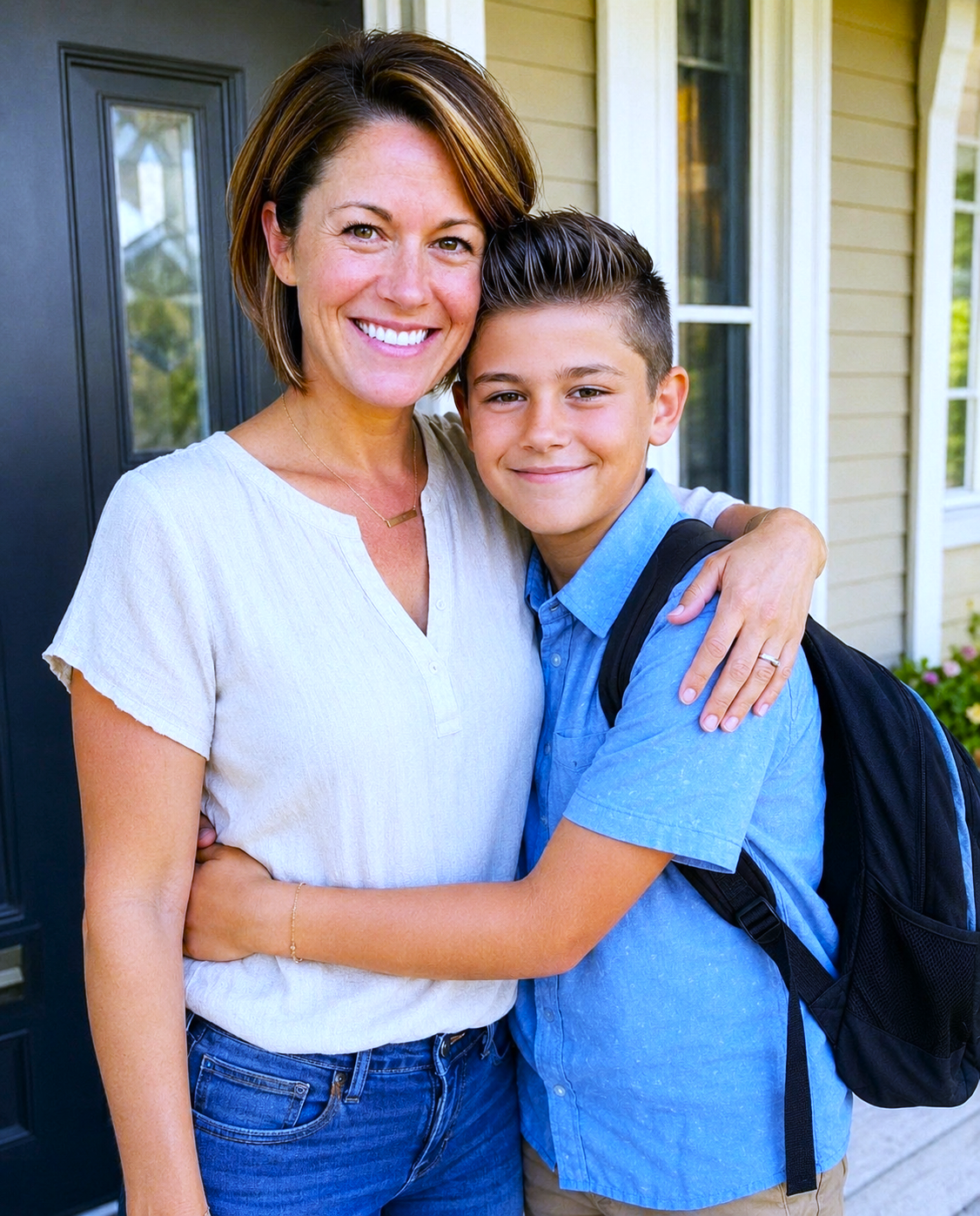
His new shoes waited beside the front door. His notebooks were stacked on his desk. I had even taken Monday off so we could continue our tradition of taking a picture together before his first day.

There was just one problem.
Noah wasn’t home yet.
He was finishing the last two weeks of summer vacation with Matt and his wife, Jessica.
Nothing about the visit had worried me.
Noah called almost every night.
He asked about things at home, reminded me which cereal to buy, and even told me what outfit he planned to wear on the first day of school.
So when his name appeared on my phone two days before classes began, I answered cheerfully.
“Hey, buddy. Ready to come home?”
Silence.
It lasted long enough to make me uneasy.
Then Noah finally spoke.
“Mom… I’m not coming back.”
I stopped smiling.
“What do you mean?”
“I want to stay here with Dad.”
For a moment, I thought I had misunderstood him.
“You want to live there permanently?”
“Yeah.”
“Why, sweetheart?”
Another hesitation.
Then he said something strange.
“Jessica’s better.”
“Better at what?”
“At… everything.”
My stomach tightened.
But what he said next bothered me even more.
“We can finally be a real family.”
I went completely still.
For six years, I had worked hard to make sure Noah never believed our home was somehow less of a family simply because his parents were divorced.
I chose my next words carefully.
“Noah, did somebody tell you that?”
“No.”
Too fast.
The answer came almost before I finished asking the question.
Then I heard Jessica in the background.
“Give me the phone, sweetheart.”
A few seconds later, her voice replaced Noah’s.
“Rachel, please don’t make this more difficult than it needs to be. Noah wants to stay with us.”
I couldn’t understand what was happening.
Jessica had never seemed interested in having Noah live there full-time.
Matt had even admitted before that she enjoyed the weeks when Noah was with me because she preferred having the house to herself.
Now suddenly she wanted him permanently?
“Put Noah back on,” I said.
“There’s no reason to upset him.”
“I’m his mother.”
“And Matt is his father.”
I ended the call.
Then I immediately called Matt.
“Tell me what’s going on.”
He sighed.
“Nothing is going on. Noah wants to stay.”
“Since when?”
“He likes being here.”
“Three days ago, he was telling me what he wanted for breakfast when he came home.”
“Kids change their minds.”
“He’s twelve, Matt.”
Silence.
Then Matt said something that sent a chill through me.
“We’ve already started looking into transferring him to a school near us.”
I gripped the phone tighter.
“You’re changing our son’s school without even discussing it with me?”
“We’re only exploring options.”
“Why?”
“Because this is what Noah wants.”
He kept repeating those words.
It’s what Noah wants.
But something inside me refused to believe it was that simple.
I stopped arguing.
I picked up my purse and keys and drove directly to Matt’s house.
The entire way there, Noah’s strange phrases kept replaying in my head.
Jessica’s better.
We can be a real family.
I need to stay here.
Those weren’t the words of the boy who had been happily planning his return home only days earlier.
When I reached their neighborhood, I parked a short distance from the house.
My heart was pounding as I walked toward the front door.
I intended to knock.
I intended to sit down with Matt, Jessica, and Noah and find out exactly what had happened.
But before I reached the porch, I heard raised voices coming from an open window.
Matt and Jessica were arguing.
I stopped.
At first, their words were difficult to understand.
Then I heard my son’s name.
“You can’t keep putting this on Noah,” Matt said.
I froze.
Jessica answered sharply.
“I’m trying to save this family.”
I moved closer without even realizing I was doing it.
Matt said something too quietly for me to hear.
Then Jessica raised her voice.
“You’re miserable every time he goes back to Rachel! You spend days complaining about how empty this house feels.”
My chest tightened.
Matt responded immediately.
“That doesn’t mean Noah should be responsible for making me happy.”
My fingers went cold.
Then Jessica said the sentence that made everything suddenly fall into place.
“If Noah stays here, maybe you’ll finally be happy. Maybe our marriage actually has a chance if your son stops leaving every other week.”
I stood motionless outside the window.
Now I understood.
Jessica hadn’t suddenly decided she desperately wanted to raise my child.
She believed Noah could fix her marriage.
Matt missed his son whenever Noah returned to me, and instead of dealing with that like adults, Jessica had apparently decided the solution was to keep Noah there permanently.
But there was something even worse.
From the strange things Noah had said on the phone, I realized someone had made my twelve-year-old son believe his father’s happiness depended on him.
That if he came home to me, Dad would be miserable.
That if he stayed, Dad would be happy.
That perhaps Matt and Jessica’s marriage would survive because of him.
They had placed an adult burden on the shoulders of a child.
I wanted to storm through the door.
Instead, I stayed where I was.
Because then Matt said something else.
“Did you actually tell Noah our marriage might fall apart if he went back to his mother?”
There was a long silence.
Jessica didn’t answer.
Matt repeated the question.
This time his voice was louder.
“Jessica, what exactly did you tell my son?”
My heart started pounding.
Finally, she answered.
And when I heard what she had been telling Noah during those two weeks, I realized the phone call asking to live with them had never truly been my son’s decision at all.
What Jessica Had Told My Son
Jessica’s voice dropped, but I could still hear her through the open window.
“I told him the truth.”
“What truth?” Matt demanded.
“That you miss him. That you hate this schedule. That you’re unhappy every time he leaves.”
“That is not his responsibility.”
“He deserves to know how much his father wants him.”
“That is not what you told him, Jessica.”
Another silence.
Then Matt spoke again.
“What did you say?”
Jessica exhaled sharply.
“I told him this house feels different when he’s gone.”
“That’s not all.”
“I told him you get depressed.”
I covered my mouth with one hand.
Matt’s voice became quieter.
“Did you tell him I cry?”
Jessica didn’t answer.
“Jessica.”
“Once,” she said. “I said you cried once.”
I had known Matt for fourteen years.
He was not a cruel man.
He was not always a brave one either.
During our marriage, avoidance had been his greatest weakness. He hated confrontation so much that he often waited until problems became disasters before addressing them.
But what I heard in his voice now was unmistakable horror.
“You told my twelve-year-old son that I cry because he leaves?”
“I said you miss him.”
“No. You told him my emotional state depends on where he lives.”
“You’re twisting this.”
“I’m repeating exactly what you just admitted.”
My knees felt weak.
Then Jessica said something that made my eyes sting.
“He asked why we’ve been arguing so much.”
Matt went silent.
“So I told him,” she continued. “I said part of the problem is that you’ve never adjusted to not having him here all the time.”
“You told a child that?”
“He already knew we were having problems!”
“He knew we argued sometimes. He did not need to believe he caused it.”
“He didn’t cause it.”
“But you made him think he could fix it.”
Jessica didn’t respond.
That silence told me everything.
Matt’s next question came slowly.
“Did you tell him our marriage might end?”
“I said things between us were difficult.”
“Jessica.”
“I said maybe having everyone together would make things better.”
“Did you use the words divorce or separation?”
Another long pause.
Then she said, “Maybe.”
I shut my eyes.
For two weeks, Noah had apparently been living in a house where an adult had convinced him that his father was heartbroken when he left and that his father’s marriage might collapse unless he stayed.
No wonder my happy child had sounded like someone delivering a hostage statement.
Then Matt asked the question I had been afraid to hear.
“What else?”
Jessica sounded defensive now.
“I told him Rachel would understand.”
My eyes snapped open.
“What?”
“You heard me.”
Matt sounded furious.
“You told him his mother would understand if he didn’t go home?”
“She has him most of the year.”
“Because that is our custody agreement.”
“You get holidays and alternate weekends. It isn’t equal.”
“That doesn’t mean we manipulate him into choosing.”
“I didn’t manipulate him.”
“You told him I was miserable, our marriage was failing, and he could help fix it.”
“I was trying to make him see that he belongs here too.”
“He knows he belongs here.”
“Does he?”
The bitterness in her voice surprised me.
“He talks about Rachel’s house like that’s his real home. He calls his bedroom there ‘my room’ and the room here ‘the guest room.’ He talks about her traditions. Her pancakes. Her stupid first-day picture. Her neighborhood. His friends. Everything is Rachel.”
My stomach twisted.
I had never asked Noah to talk that way.
I had never wanted Jessica to feel like a visitor in his life.
But suddenly I understood something I had missed.
This was not only about Matt.
Jessica was competing with me.
Not openly.
Not in a way I had recognized.
But somewhere along the way, my relationship with my son had become something she felt she needed to defeat.
Matt apparently understood it too.
“This is not a competition.”
“No,” Jessica snapped. “It’s easy for you to say that because you already have a child. I’m the one living in a house that empties out every other Sunday.”
There was pain in her voice.
Real pain.
For half a second, I felt sorry for her.
Then I remembered my son’s frightened silence on the phone.
Pain can explain terrible behavior.
It does not excuse it.
Matt said, “You cannot use Noah to fix what is wrong between us.”
Jessica started crying.
“I’m trying to keep you.”
“Then talk to me. Go to counseling with me. Yell at me if you need to. But you do not put this on my son.”
“He loves you.”
“And that is exactly why what you did is so cruel.”
The words hit me hard.
Because Matt was right.
Jessica had chosen the one thing Noah would be unable to ignore.
His love for his father.
I heard movement inside.
Then a smaller voice said something.
“Dad?”
Noah.
My heart stopped.
The argument ended instantly.
Matt said, “Buddy, how long have you been standing there?”
Noah didn’t answer.
I couldn’t stay outside anymore.
I stepped onto the porch and knocked.
Everything inside went silent.
A few seconds later, the door opened.
Matt stood there looking pale.
When he saw me, his shoulders dropped.
“Rachel.”
“I heard enough.”
Behind him, Jessica stared at me.
Her face changed.
Noah stood at the end of the hallway.
The moment our eyes met, he looked down.
That hurt more than anything.
I stepped inside.
“Noah.”
He didn’t move.
I crouched slightly so I wasn’t towering over him.
“Can I talk to you?”
His eyes filled with tears.
Then he asked the question that broke my heart.
“If I go home with you, is Dad going to be okay?”
Matt made a sound like someone had punched him.
I looked at my son.
“Yes,” I said immediately. “Your dad is going to be okay.”
Noah glanced at Matt.
“Are you sure?”
Matt crossed the room and knelt in front of him.
“Buddy, look at me.”
Noah did.
“I need you to hear something, and I need you to believe me. You are not responsible for making me happy.”
Noah’s chin started trembling.
“You’re sad when I leave.”
“Sometimes I miss you. That is different.”
“Jessica said you don’t sleep.”
Matt looked at his wife.
I had never seen that expression on his face before.
Then he turned back to Noah.
“I’m an adult. If I’m sad, I handle it. If I can’t sleep, I handle it. If Jessica and I have problems, we handle them. You do not fix adult problems.”
Noah started crying.
“But she said—”
“I know.”
“She said you two might split up.”
Matt closed his eyes briefly.
“That is not because of you.”
“She said if I stayed—”
“Noah.” Matt took both of his hands. “Even if you lived here every day for the rest of your childhood, you could not fix a marriage. That is not a child’s job.”
I felt tears running down my face.
Noah looked at me.
“Mom, I didn’t want to hurt you.”
“I know.”
“I thought you’d be okay.”
“I will always be okay enough for you to choose what you truly need.”
“I thought Dad wouldn’t.”
That sentence destroyed whatever composure I had left.
I walked forward and hugged him.
He clung to me so tightly I could feel him shaking.
For a long moment, nobody spoke.
Then Jessica said quietly, “I never meant for him to feel like this.”
I looked at her over Noah’s shoulder.
“But he does.”
She opened her mouth.
I stopped her.
“Not now.”
For once, she listened.
The Notebook in His Backpack
Noah wanted to come home with me.
Not tomorrow.
Not after dinner.
Immediately.
Matt helped him pack.
Jessica disappeared upstairs.
I stayed near the front door while Noah gathered his clothes.
Then he came downstairs carrying his backpack.
It was the new one he and I had spent almost an hour choosing three weeks earlier.
He had wanted one with enough compartments for his school laptop but not so many that he would “look like a survivalist.”
Normally, the sight would have made me laugh.
That day, it made my chest ache.
Matt followed him down.
“I’ll bring the rest of his stuff tomorrow.”
I nodded.
Then he looked at Noah.
“Can I hug you?”
Noah hesitated.
That hesitation nearly broke Matt.
But after a moment, Noah stepped forward.
Matt wrapped both arms around him.
“I love you.”
“I love you too.”
“You don’t ever have to choose between us.”
Noah whispered, “Okay.”
“And if any adult ever tells you that you have to keep them happy, you tell your mom. Or me. Or Grandma. Or a teacher. Anybody you trust.”
Noah nodded.
Then he and I walked to my car.
I expected him to talk on the drive home.
He didn’t.
He stared out the window.
When we reached our neighborhood, he finally said, “Mom?”
“Yeah?”
“Are you mad at me?”
I pulled over.
I couldn’t answer that question while driving.
I turned toward him.
“No.”
“Not even a little?”
“Not at you.”
“I told you I didn’t want to live with you anymore.”
“You told me what you thought you had to say.”
“I still said it.”
“You are allowed to make mistakes. You are allowed to be confused. You are even allowed to someday decide that you genuinely want to spend more time at your dad’s house.”
His eyes widened.
“You wouldn’t be mad?”
“I might be sad. But my feelings are my responsibility.”
That was the sentence he needed.
I saw it immediately.
His shoulders relaxed.
“My feelings are not your job, Noah.”
He stared at me.
Then he whispered, “Jessica said moms are stronger about this stuff.”
“What stuff?”
“She said you had me most of the time, so losing some days wouldn’t hurt you as much.”
I felt anger rise again.
But I kept my voice calm.
“She doesn’t get to decide what hurts me.”
“I’m sorry.”
“Stop apologizing.”
He nodded.
Then, after a pause, he said, “Can we go home now?”
Home.
He said it naturally.
Not to hurt his father.
Not to make a point.
Just because that was what our house was to him.
I started the car.
When we got inside, Noah went straight to his room.
Ten minutes later, I heard him moving things around.
Then his bedroom door opened.
“Mom?”
I looked up from the kitchen.
He stood in the hallway holding a spiral notebook.
“I think you should read something.”
He handed it to me.
The first several pages were random summer notes.
Video game passwords.
A list of movies he wanted to watch.
A drawing of a sneaker.
Then halfway through the notebook, the handwriting changed.
The letters became smaller.
More cramped.
At the top of one page, Noah had written:
Reasons I should stay at Dad’s.
Below it was a list.
Dad is sad when I leave.
Jessica says he gets quiet for days.
Their marriage is having problems.
If I stay, Dad will be happier.
Mom is stronger.
Mom already had six years with me.
Dad deserves a turn.
Jessica says a boy needs his father more when he gets older.
If I leave, they might get divorced.
I had to stop reading.
My vision blurred.
There was another page.
Things I will miss.
Mom’s pancakes.
My room.
Eli and Marcus.
Walking to school.
Friday pizza.
Mom singing wrong words in the car.
My desk.
Grandma being close.
Taking our school picture.
Then one final line.
Maybe missing things is what being fair feels like.
I sat on the edge of his bed and cried.
Not loudly.
I didn’t want him to feel responsible for that too.
But Noah saw me.
He sat beside me.
“I didn’t know what to do.”
I put the notebook down.
“You should never have been put in that position.”
“She kept asking me to think about Dad.”
“That was unfair.”
“She said if I really loved him, I would understand.”
There it was.
The deepest cut.
Not just pressure.
A test of love.
“If I really loved him.”
I turned toward Noah.
“Listen carefully. Anybody who tells you that you have to prove your love by hurting yourself, giving up something important, keeping a secret, or taking responsibility for their feelings is asking too much.”
He nodded slowly.
“Even family?”
“Especially family.”
He leaned against me.
After a few minutes, I asked, “Did your dad know she was saying these things?”
“No.”
“Are you sure?”
“Dad was working a lot. Jessica mostly talked to me when he wasn’t there.”
That mattered.
It didn’t erase Matt’s responsibility entirely. He had allowed his marital problems to become visible enough that Noah noticed them.
But this was different from knowingly participating.
I took pictures of every page in the notebook.
Not because I wanted revenge.
Because I realized we might need help.
Professional help.
And possibly legal help.
The Call From My Ex-Husband
Matt called that evening.
“I’m sorry.”
I was standing at the kitchen sink.
Noah was upstairs showering.
“For what part?”
“For not seeing it.”
I stayed silent.
Matt continued.
“I knew Jessica was talking to him about spending more time here. I didn’t know what she was saying.”
“You were already researching schools.”
“I know.”
“So somewhere along the way, you accepted that this was Noah’s decision without asking enough questions.”
“You’re right.”
I didn’t expect that answer.
Matt had spent years defending himself reflexively whenever I criticized anything.
That night, he sounded exhausted.
“I wanted it to be true,” he admitted.
“What?”
“That Noah wanted to stay.”
The honesty hurt.
But I respected it.
“I miss him, Rachel. I hate watching him leave. I hate being the weekend dad. I hate knowing you know his teachers better and his friends’ parents better. I hate that when he gets sick at school, they call you first.”
“That was the arrangement we agreed to.”
“I know.”
“You moved forty-five minutes away.”
“I know.”
“You took the job that requires travel.”
“I know.”
His voice cracked.
“I know all of it. But when he said he wanted to stay, part of me felt like I had finally been chosen.”
There it was.
The truth beneath the entire disaster.
Not just Jessica’s insecurity.
Matt’s too.
“You should not need your child to choose you.”
“I know.”
“Because when you make a child choose, somebody always loses. Usually the child.”
“I know.”
I heard him inhale shakily.
“Jessica packed a bag.”
I said nothing.
“She’s going to her sister’s.”
“That’s between you and her.”
“I told her she can’t be alone with Noah right now.”
I was relieved he understood how serious it was.
Then he asked, “Can I see him tomorrow?”
I hesitated.
My instinct screamed no.
But this wasn’t about punishing Matt.
Noah loved his father.
And Matt had been the first person inside that house to tell him the truth.
“Yes,” I said. “But here.”
“At your house?”
“Yes.”
“Okay.”
“And I’ll be nearby.”
“Fair.”
I paused.
“Matt, there’s something else.”
“What?”
“He wrote everything down.”
Silence.
“What do you mean?”
I told him about the notebook.
When I read the final line—Maybe missing things is what being fair feels like—Matt started crying.
I had heard my ex-husband cry only twice in fourteen years.
The first was when Noah was born.
The second was when Matt’s father died.
Now there was a third.
“I did this,” he whispered.
“Jessica said the words.”
“But I created the opening.”
I didn’t comfort him.
That wasn’t my job.
And unlike Noah, Matt was an adult.
He needed to sit with what had happened.
Before we hung up, I said, “I’m calling a family therapist tomorrow.”
“Okay.”
“And my attorney.”
Matt went quiet.
Then he said, “Okay.”
No argument.
No accusation.
Just acceptance.
The First Day of School
The next morning, Noah slept until almost ten.
When he came downstairs, his hair was messy and his eyes looked tired.
“Can we still do the picture tomorrow?” he asked.
I nearly cried again.
“Of course.”
“And pancakes?”
“Obviously.”
He smiled.
It was small.
But it was his smile.
That afternoon, Matt came over.
I stayed in the kitchen while he and Noah sat on the back deck.
I couldn’t hear everything they said.
I didn’t try to.
At one point, Noah cried.
Then Matt cried.
Then they hugged.
When Matt left, he stopped beside me.
“I told him I’m going to counseling.”
“Good.”
“And I told him he never has to protect my feelings.”
“Good.”
Matt stared at the floor.
“I also told him I’m sorry I let the school transfer conversation happen.”
I nodded.
Then he said, “I’m not going to fight you about the school.”
“There shouldn’t be a fight.”
“I know.”
The next morning, I woke before my alarm.
By six-thirty, pancakes were on the table.
By seven, Noah was dressed.
Blue polo shirt.
Khaki pants.
New shoes.
And the backpack he had almost lost because someone convinced him fairness meant abandoning half his life.
We walked outside.
I set my phone against the porch railing like I did every year.
Noah stood beside me.
At the last second, he put his arm around my waist.
The camera clicked.
Then he said, “Send that one to Dad.”
I looked at him.
“You sure?”
“Yeah.”
So I did.
Matt responded less than a minute later.
Tell him he looks great. I love him. Have a good first day, buddy.
No guilt.
No sadness.
No “wish you were here.”
Just love.
That was how it should have been all along.
When Jessica Tried to Rewrite What Happened
Three days later, Jessica sent me a message.
It was long.
She began by apologizing.
Then, paragraph by paragraph, the apology dissolved.
She said she had been “misunderstood.”
She said Noah was “emotionally mature for his age.”
She said children deserved to understand “family realities.”
She said Matt had complained for years about the custody arrangement.
Then she suggested I had created the problem by making my home “too comfortable” and treating Noah like he belonged more with me.
I read the message twice.
Then I forwarded it to my attorney.
I did not reply.
An hour later, another message arrived.
I hope you realize keeping Noah away from us will only make him resent you.
That one went to my attorney too.
Then another.
He told me many times he wished he lived here.
That was interesting.
Because Noah had told me the opposite.
When I gently asked whether he had ever said that to Jessica, he looked embarrassed.
“Once.”
“When?”
“She asked if I liked Dad’s house.”
“And?”
“I said yes.”
“What happened next?”
“She asked if I ever wished I could stay longer.”
“And you said?”
“I said sometimes.”
That was completely normal.
Of course Noah sometimes wanted extra days with his father.
Children can love two homes.
They can miss one parent while staying with another.
Jessica had taken a normal feeling and stretched it into evidence for a decision Noah had never independently made.
My attorney, Claire Bennett, had represented me during the original divorce.
She was calm, practical, and uninterested in theatrics.
When I showed her the notebook, her expression hardened.
“This is concerning.”
“Can she actually do this?”
“Unfortunately, adults pressure children in custody situations more often than people realize.”
“I don’t want to take Noah away from his father.”
“That’s important.”
“I mean it. Matt messed up. But Noah loves him.”
Claire nodded.
“Then our goal is not punishment. It’s protection.”
That sentence became my anchor.
Not punishment.
Protection.
We filed a request to clarify educational decision-making and to prevent unilateral school changes.
We also asked that both households participate in family counseling and that neither parent—or stepparent—discuss custody, divorce, financial issues, or marital conflict with Noah in a way that placed pressure on him.
Claire told me the court might appoint a guardian ad litem if the conflict continued.
I hoped it wouldn’t.
I wanted adults to fix this without making Noah walk into a courtroom.
But Jessica had other plans.
The Email to the School
The following Monday, I received a call from Noah’s school counselor.
“Mrs. Harper?”
“Yes?”
“This is Denise Morris from Westbrook Middle School. I wanted to verify something regarding Noah.”
My stomach tightened.
“What happened?”
“We received an email stating Noah may be withdrawing.”
I closed my eyes.
“From whom?”
“His stepmother.”
I felt anger explode through me.
“Jessica does not have legal authority to withdraw him.”
“That’s why we called.”
The counselor explained that Jessica had emailed the school several days before Noah returned home.
She claimed “the family” had decided Noah would transfer to a school in Matt’s district.
She had even requested instructions for obtaining his records.
I asked for a copy.
Because I was Noah’s custodial parent and the email concerned his enrollment, the school provided it.
Jessica had written:
Noah has made the mature decision to reside full-time with his father and me. We believe this will provide the stable two-parent household he needs as he enters adolescence.
Stable two-parent household.
I stared at those words.
Then I remembered what Noah had told me.
We can finally be a real family.
Now I knew exactly where that phrase came from.
Jessica had not merely suggested that living with Matt might be nice.
She had framed my home as deficient.
Less stable.
Less complete.
Less real.
I forwarded the email to Claire.
Then I sent a copy to Matt.
He called five minutes later.
“I didn’t know she sent this.”
“I believe you.”
“I swear to you, Rachel.”
“I said I believe you.”
He exhaled.
Then I heard him whisper something I almost didn’t catch.
“What has she done?”
That evening, Matt told me he had asked Jessica to stay with her sister indefinitely.
She accused him of choosing me over his wife.
He told her it had nothing to do with choosing me.
It was about choosing Noah’s well-being over adult pride.
For once, Matt chose confrontation.
It was six years too late to save our marriage.
But maybe not too late to protect our son.
The Therapist Asked One Question
We found a child and family therapist named Dr. Elaine Morris.
Noah met with her first.
Then I met with her.
Then Matt.
Jessica was invited but declined.
She said therapy would “put ideas in Noah’s head.”
That statement alone told me she was afraid of what he might say once someone gave him a safe place to speak.
After several sessions, Dr. Morris asked Matt and me to come together.
Noah sat between us on a sofa.
He looked uncomfortable.
Dr. Morris placed a box of tissues on the table.
Then she asked one question.
“Noah, if nobody’s feelings could be hurt—not your mom’s, not your dad’s, not Jessica’s—where would you want to live?”
Noah stared at his shoes.
“For school?”
“For your normal routine.”
He was quiet for almost a minute.
Then he said, “With Mom.”
Matt looked down.
Dr. Morris continued.
“Why?”
“My school is close. My friends are there. Grandma is ten minutes away. I know the neighborhood. I like my room.”
“Do you love your dad?”
Noah looked shocked.
“Yeah.”
“Does choosing to live primarily with your mother mean you love him less?”
“No.”
“Are you sure?”
Noah glanced at Matt.
Matt’s eyes were wet.
“I hope you’re sure,” he said. “Because it doesn’t.”
Noah looked back at Dr. Morris.
“No. I don’t love him less.”
“Would you like to spend more time with him?”
“Sometimes.”
“What would that look like?”
Noah thought.
“Maybe longer weekends sometimes. Or Dad could come to my games more.”
Matt nodded immediately.
“I can do that.”
“And maybe dinner on Wednesdays if he’s not working.”
“I can do that too.”
I felt something loosen inside me.
This was what adults should have done from the beginning.
Ask.
Listen.
Adjust.
Without making Noah carry the weight.
Then Dr. Morris turned to me.
“Rachel, if Noah asked for more time with Matt, how would you feel?”
I answered honestly.
“I’d miss him.”
Noah looked at me.
I continued.
“But I would handle that. I would never ask him to stay home because I was lonely.”
Dr. Morris nodded.
Then she turned to Matt.
“And you?”
Matt wiped his eyes.
“I need to learn to do the same.”
Noah reached for his father’s hand.
That small gesture mattered more than any court order ever could.
Jessica’s Version of “Family”
The legal hearing was scheduled for six weeks later.
By then, school was underway.
Noah was doing better.
He joined the robotics club.
He complained about algebra.
He ate enough cereal to bankrupt a grocery store.
Normal life returned slowly.
Then Jessica asked to see him.
Matt called me first.
“She says she wants to apologize.”
“What does Noah want?”
“He says he doesn’t know.”
“Then don’t make him decide immediately.”
Matt agreed.
Dr. Morris suggested that if Noah wanted contact, the first meeting should happen in her office.
Noah eventually agreed.
I wasn’t in the room.
Neither was Matt.
Later, Noah told me what happened.
Jessica cried.
She told him she loved him.
She said she had only wanted everyone to be together.
Then she said, “I guess I wanted a family so badly that I forgot you already had one.”
That was the first thing she said that sounded like true understanding.
Noah told her, “I have two.”
She nodded.
Then he said something I will never forget.
“Dad’s house doesn’t become more of a family if I live there. And Mom’s doesn’t become less of one if I leave.”
Dr. Morris told me later that Jessica had cried for several minutes after that.
I don’t know whether she cried from guilt, grief, or shame.
Maybe all three.
But for the first time, she listened without defending herself.
That did not erase what happened.
It did not mean I trusted her.
Forgiveness and access are not the same thing.
And adults do not earn immediate restoration simply because they finally understand the harm they caused.
The Court Hearing
The hearing arrived on a rainy Thursday morning.
Noah did not testify in open court.
I was grateful.
Instead, the judge reviewed statements from Dr. Morris, school records, our existing custody agreement, and the documents Claire had submitted.
That included Jessica’s email to the school and photographs of Noah’s notebook.
Matt’s attorney surprised me by saying he did not oppose keeping Noah primarily enrolled and residing with me.
The judge looked at him.
“Mr. Harper, you agree the child should remain in his current school?”
“Yes, Your Honor.”
“And you agree that no future school transfer should occur without written agreement of both parents or court approval?”
“Yes.”
“And you agree that the child should not be placed in the middle of marital or custody disputes?”
Matt swallowed.
“Yes.”
The judge then looked at Jessica.
She had attended with her own attorney because some of the requested restrictions involved her contact with Noah.
“Mrs. Harper, do you understand why the court is concerned?”
Jessica nodded.
“I do.”
“Do you believe it was appropriate to tell a twelve-year-old that his father’s marriage might fail if he returned to his mother?”
“No.”
“Did you tell him that?”
Jessica’s attorney leaned toward her.
Jessica whispered with him.
Then she answered.
“Yes.”
“Did you tell him his mother would be less hurt by losing parenting time because she was ‘stronger’?”
“Yes.”
“Did you suggest he could improve your marriage by remaining in your household?”
Jessica’s face reddened.
“Yes.”
The judge removed her glasses.
“A child is not marriage counseling.”
The courtroom went silent.
“A child is not an emotional support system for adults. A child is not proof that one household is more legitimate than another. And a child should never be made to believe the continued happiness or stability of adults depends on where that child sleeps.”
Jessica lowered her head.
The judge continued.
“Whatever your intentions, the result was emotional pressure.”
Then she turned to Matt.
“You bear responsibility as well.”
Matt nodded.
“You are the parent. Even if you did not know the precise language being used, your child was aware of your marital distress and your dissatisfaction with the custody arrangement.”
“I understand.”
“You may miss your son. That is natural. But missing a child does not entitle a parent to place emotional weight on that child.”
“No, Your Honor.”
The final order preserved my primary residential custody.
Matt kept his regular parenting time, with some added flexibility if Noah requested additional visits.
Both of us were required to continue family counseling for six months.
Neither household was permitted to discuss legal disputes or adult relationship problems with Noah in a manner that pressured him.
Jessica was not prohibited from seeing Noah forever.
But for the next three months, contact had to occur with Matt present or in a therapeutic setting.
Some people might think I should have demanded more.
Maybe full custody.
Maybe no contact.
Maybe punishment.
But Claire had reminded me of our goal.
Protection.
Not revenge.
Noah loved his father.
Matt had admitted his mistakes and was doing the work to repair them.
Destroying that relationship to punish Jessica would have made me guilty of the same kind of thinking—using Noah to settle adult pain.
I refused.
What Happened to Matt and Jessica
Their marriage did not survive.
Not because Noah returned to me.
That distinction mattered.
They separated four months after the hearing.
Matt told me only what I needed to know.
Counseling had exposed problems that existed long before that summer.
Resentment.
Different expectations about children.
Loneliness.
Poor communication.
Jessica had believed that if Noah lived with them permanently, Matt would become the husband she wanted.
Matt had believed Jessica would eventually become comfortable with the realities of co-parenting.
Both were waiting for someone else to change.
Noah had simply become the solution they tried to force onto a problem that belonged to them.
When they finally decided to divorce, Matt told Noah himself.
He asked me to be there.
We sat in my living room.
Matt spoke carefully.
“Jessica and I are separating.”
Noah’s face immediately went pale.
I saw the old fear return.
“Because I came home?”
Matt moved closer.
“No.”
“But—”
“Noah, listen to me. If you had stayed with me every day, we would still be separating.”
“Really?”
“Really.”
“Then why?”
“Because adults can care about each other and still realize they aren’t good partners.”
Noah stared at him.
“You promise it wasn’t me?”
Matt’s voice broke.
“I promise with everything I have.”
Noah looked at me.
I nodded.
“It wasn’t you.”
Then Noah asked, “Is Jessica okay?”
That was my son.
After everything, he still cared.
Matt said, “She’s sad. So am I. But we’re adults, and we’re getting help.”
Noah nodded.
For the first time, someone announced an adult problem without asking him to solve it.
That was progress.
A Different Kind of Father
Over the next year, Matt changed.
Not magically.
Not perfectly.
But noticeably.
He started attending Noah’s school events even when they weren’t on “his” days.
He came to robotics competitions.
He sat three rows behind me at band concerts.
He learned the names of Noah’s teachers.
He stopped treating parenting time like a scoreboard.
Sometimes Noah spent an extra Saturday with him.
Sometimes he came home early.
Nobody called either choice betrayal.
Matt also moved closer.
Not next door.
Thank goodness.
But fifteen minutes away.
That made Wednesday dinners possible.
It made soccer practices possible.
It meant Noah no longer needed to choose between maintaining his school life and seeing his father more.
One evening, about ten months after everything happened, Matt dropped Noah off after dinner.
Noah ran inside to finish homework.
Matt stayed on the porch.
“I owe you an apology.”
“You already apologized.”
“Not for this.”
I waited.
He looked toward the driveway.
“When we divorced, I told myself you got the better deal because Noah lived with you most of the time.”
I crossed my arms.
“You never said that.”
“I thought it.”
He gave a tired smile.
“And I resented you for things that were actually consequences of choices I made. I moved farther away. I took the travel job. I skipped school events because they were inconvenient. Then I felt excluded because you knew more about his daily life.”
I said nothing.
“I wanted to feel chosen without doing the work of being present.”
That was one of the most honest things Matt had ever said.
“I’m trying to change that.”
“I can see.”
He nodded.
Then he said, “Thank you for not using what happened to take him away from me.”
I looked through the window.
Noah was at the kitchen table, pencil between his teeth, staring dramatically at a math worksheet as if algebra had personally betrayed him.
“He needs both of us.”
Matt looked at him too.
“Yeah.”
“But he needs us healthy.”
“Yeah.”
“And he never gets used as proof of who he loves more.”
“Never again.”
That was enough.
The Message From Jessica
Almost a year after the phone call that started everything, Jessica emailed me.
I nearly deleted it.
Then I saw the subject line.
For Rachel — no response required
So I read it.
She wrote that therapy had forced her to confront why she had behaved the way she did.
She had grown up with divorced parents who constantly competed for her loyalty.
Her mother celebrated whenever she rejected her father.
Her father bought gifts to make her prefer his house.
Jessica had spent her childhood believing love meant choosing sides.
Then she had grown up and repeated the pattern from the opposite direction.
She wrote:
I told myself I was helping Noah choose the better home. I understand now that a loving adult would never have asked him to choose at all.
I sat with that sentence for a long time.
She apologized for calling my family less real.
She apologized for using Matt’s emotions as leverage.
She apologized for making Noah believe sacrifice was proof of love.
Then she wrote:
I know saying sorry does not restore trust. I am not asking for that. I only want you to know that I understand now why what I did was wrong.
I did not suddenly forgive everything.
But I believed that apology more than the first one.
Because it contained no excuse.
No “but.”
No blame.
Just responsibility.
I replied with three sentences.
Thank you for acknowledging it. Noah is doing well. I hope you are too.
Then I closed my laptop.
Some endings do not require friendship.
Sometimes peace is enough.
One Year Later
The following August, two days before school started, my phone rang.
Noah.
He was spending the weekend with Matt.
For half a second, my body remembered the previous year.
The silence.
The fear.
The drive.
The open window.
Then I answered.
“Hey, buddy.”
“Mom, emergency.”
My heart jumped.
“What happened?”
“I forgot which backpack we ordered.”
I laughed so loudly Matt apparently heard me from across the room.
In the background, he shouted, “Tell her I voted for the gray one!”
Noah groaned.
“The gray one makes me look forty.”
“You are thirteen.”
“Exactly.”
I sat down on the couch, smiling.
“So what’s the emergency?”
“I need you to send me the picture of the black one.”
“Done.”
“And Dad says I can stay until Sunday night if that’s okay.”
“Of course.”
“You sure?”
There was still a tiny trace of hesitation in his voice.
A leftover scar from the year before.
“Yes.”
“You won’t be lonely?”
There it was.
I answered carefully.
“I’ll miss you.”
He went quiet.
Then I added, “And I’ll handle it.”
I could hear the smile in his voice.
“Okay.”
“Have fun with Dad.”
“I will.”
“And remind him you need to be home by eight because school starts Monday.”
Matt shouted from the background, “I know!”
“You forgot last year.”
“That was once!”
Noah laughed.
It was loud.
Easy.
Free.
That sound told me more than any therapist, lawyer, or judge ever could.
My son was no longer measuring every word against the emotional stability of the adults around him.
He was just thirteen.
Exactly as he should be.
The First-Day Picture
Monday morning arrived.
I made pancakes.
Noah complained that I had made too many.
Then he ate six.
He wore a dark green shirt and new sneakers.
The black backpack won.
At seven-fifteen, we stepped onto the porch.
I placed my phone on the railing.
“Same spot?” I asked.
“Obviously.”
He stood beside me.
But before I started the timer, a car pulled into the driveway.
Matt got out.
Noah’s eyes widened.
“What are you doing here?”
Matt held up two coffees and a paper bag.
“Your mother said there were pancakes. I brought backup.”
I had not invited him.
But I didn’t mind.
Noah looked between us.
Then he smiled.
“Can Dad be in the picture?”
For a second, Matt and I both hesitated.
Six years earlier, that question might have been complicated.
A year earlier, it might have felt loaded.
Now it felt simple.
“Sure,” I said.
Matt stood on Noah’s other side.
Noah put one arm around me.
The other around his father.
The timer blinked.
Three.
Two.
One.
The camera clicked.
Later, when I looked at the picture, I noticed something I hadn’t seen in the moment.
Noah wasn’t leaning toward either of us.
He stood straight in the middle.
Not divided.
Not choosing.
Supported.
There is a difference.
For years, I thought successful co-parenting meant avoiding fights.
I was wrong.
Sometimes adults can avoid shouting and still quietly make a child carry their disappointment.
Sometimes we call it love when what we really mean is need.
Sometimes we tell children, “I miss you,” when underneath it we are asking, “Will you prove I matter more?”
The lesson that summer taught all of us was painfully simple.
Children should be loved.
They should be guided.
They should be listened to.
But they should never be given responsibility for holding adults together.
Noah did not save Matt’s marriage.
He did not destroy it either.
He did not owe me permanent loyalty because I had been his primary parent.
He did not owe Matt extra time because his father felt lonely.
He did not owe Jessica the family she imagined.
He owed himself the freedom to be a kid.
That was all.
After we took the picture, Matt handed Noah one of the coffees.
I stared at him.
“He’s thirteen.”
“It’s hot chocolate.”
Noah took a sip.
“It’s coffee.”
Matt looked horrified.
I started laughing.
Noah laughed too.
Then Matt grabbed the cup.
“Absolutely not.”
“Dad!”
“You have enough energy.”
“I’m practically falling asleep.”
“You ate six pancakes.”
“That was emotional support breakfast.”
We were still arguing when the school bus turned onto our street.
Noah grabbed his backpack.
Then he stopped.
He hugged me.
“Love you, Mom.”
“Love you too.”
He hugged Matt.
“Love you, Dad.”
“Love you, buddy.”
Then he started toward the bus.
Halfway down the driveway, he turned.
“Hey!”
We both looked up.
“Don’t be sad while I’m gone!”
Matt and I exchanged a glance.
Then I called back, “We’ll survive!”
Matt added, “Barely!”
Noah rolled his eyes.
But he was smiling when he climbed onto the bus.
And this time, when he left, neither of us asked him to look back.
We simply stood there and let him go.
Because that is what love is supposed to do.
THE END