
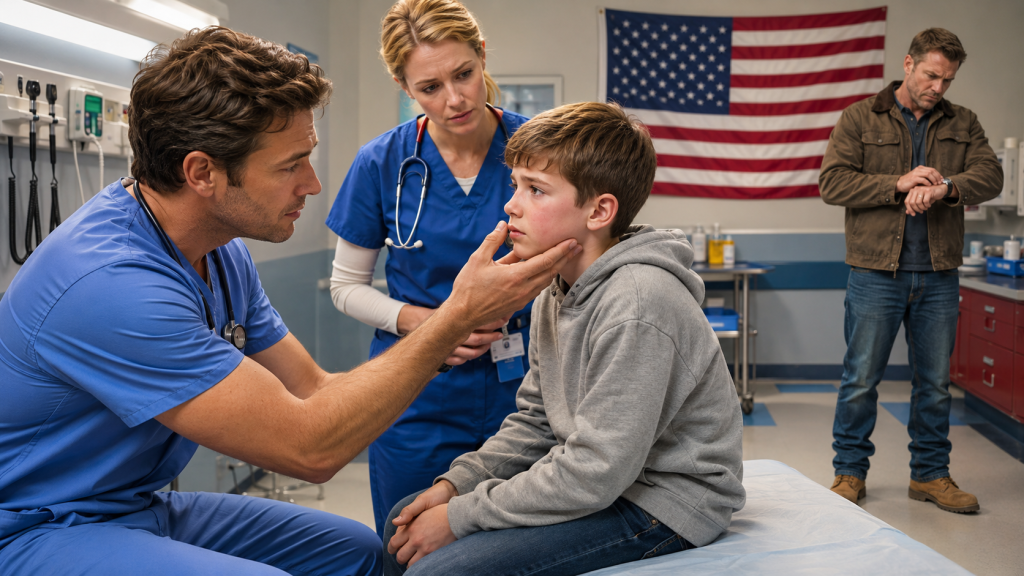
My nine-year-old patient’s stepfather dragged him into the emergency room by the wrist, demanded antibiotics, and said, “He’s not worth missing a shift over.”
Then I touched the boy’s swollen face—and something beneath his skin pushed back against my glove. The man stopped breathing.
So did I.
At 3:14 that rainy Tuesday morning, the emergency department at our small coastal Oregon hospital had finally gone quiet. Rain tapped against the ambulance-bay doors. Wet footprints crossed the waiting-room tile, a crooked stack of magazines sagged beside triage, and somebody’s coffee had been abandoned long enough to turn cold.
That was when Greg Mercer walked in with Leo.
Greg stayed close to the exit as though he had already decided how quickly they would leave. He wore work boots, a waterproof jacket, and a heavy steel watch that he checked three times before the registration clerk finished asking Leo’s name.
“Spider bite,” Greg announced. “Give him a Z-Pak or something. I work in three hours.”
Leo stood beside him in a gray hoodie soaked around the shoulders.
He was nine years old.
Greg could not remember his birthday.
“My wife handles that paperwork garbage.”
As he said it, his hand tightened around Leo’s wrist.
The boy did not cry out.
He simply turned his body sideways, almost automatically, making himself smaller.

I had worked emergency medicine for seventeen years. There are movements children make when they are frightened by needles, pain, or strangers.
And then there are movements children make when they are frightened of a specific person.
They are not the same.
I stepped between them.
“I’m Dr. Thomas. I’ll examine him in Room Four.”
Greg tried to follow close behind, but Leo walked ahead.
Inside, the boy sat on the paper-covered exam bed with both hands hidden in the front pocket of his hoodie while rainwater dripped from his shoes.
“Sit straight,” Greg ordered.
Leo’s shoulders snapped backward so quickly that the movement looked rehearsed.
Sarah, my night nurse, stood in the doorway holding the chart. She had been an ER nurse almost as long as I had been a doctor, and we had learned to communicate with expressions other people rarely noticed.
She tapped the chart twice.
Something was wrong.
Greg had told triage that the swelling had started after a spider bite.
He could not say when Leo had been bitten.
He could not describe the spider.
He did not know whether Leo had a fever.
And every time Sarah asked Leo a question, Greg answered.
“Looks dental from here,” Sarah murmured when Greg looked away.
I rolled my stool toward Leo but stopped well beyond his knees.
“Leo, can I lower your hood so I can see your face?”
He looked at Greg first.
Then he nodded.
I slowly pulled the hood back.
The right side of his face was swollen from his cheekbone almost to his jaw. Purple discoloration lay beneath hot, stretched skin. Near the center was a round opening that looked too deep and too clean to be an ordinary scratch.
There was also a smell.
Faint.
Damp earth mixed with something strangely sweet.
Greg wrinkled his nose.
“Nasty, right?”
Leo kept staring at the pens in my scrub pocket.
“Does your face burn?” I asked.
“No.”
“Does it sting?”
He shook his head.
“What does it feel like?”
For the first time, he looked directly at me.
“Heavy.”
Greg sighed dramatically.
“He exaggerates everything.”
I ignored him.
“When did you first notice it?”
Leo opened his mouth.
“Saturday,” Greg answered.
I turned toward him.
“I was asking Leo.”
Greg’s jaw tightened.
I needed the man farther away.
“There’s a pediatric examination clearance rule,” I said. “I need you against the far wall while I assess him.”
There was no such rule.
Greg looked at Sarah.
She did not blink.
He moved to the wall.
That was when Leo pulled his left hand from his pocket.
Bruises covered two fingers.
A thin red mark circled his wrist.
I also noticed how dry his lips were.
“When did you last eat?”
Leo thought about it.
“Yesterday.”
“What did you have?”
He looked uncertain.
“Toast.”
“Breakfast?”
He nodded.
It was after three in the morning.
Greg pushed away from the wall.
“He refuses food when he’s mad.”
I cleaned the skin beside the wound while Sarah prepared the equipment for blood work.
“Leo, I’m going to press gently around the swelling. Tell me if anything hurts.”
He nodded.
I placed two gloved fingers against his cheek.
The swelling was firm in some places, soft in others.
Then something underneath my fingertips rolled away.
I froze.
I told myself it was fluid shifting inside an abscess.
I pressed once more, very lightly.
Something moved toward my fingers.
Then pushed back.
I lifted my hand.
Across the room, Greg stopped checking his watch.
For half a second, nobody spoke.
Then he said, “We’re leaving.”
He crossed the room and grabbed Leo’s jacket.
Leo slid off the opposite side of the bed so quickly that the examination paper tore beneath his shoe.
Sarah pressed the silent security button.
Greg saw her thumb move.
His expression changed.
“You can’t hold my kid here.”
“You brought a seriously ill child into my department,” I told him. “He needs blood work, imaging, IV medication, and a surgical consultation.”
“He needs to stop lying.”
Leo lowered his eyes and moved until his shoulder almost touched my arm.
Two hospital security officers appeared outside the door.
Greg immediately smiled.
The transformation was remarkable.
One moment he had been furious.
The next he was the exhausted, reasonable parent dealing with a troublesome child.
“I’m tired,” he said. “The boy plays rough. His mother knows how he is.”
One officer asked Greg to step into the hall.
“I’m his father.”
“Step into the hallway, sir.”
“Stepfather,” Leo whispered.
Greg heard him.
The look he gave the boy lasted less than a second.
It was enough.
The officers escorted Greg away.
Sarah closed the door.
For a while, Leo and I said nothing.
I gave him water and crackers. He ate half of one cracker first, then glanced toward the door.
“No one is taking those away,” Sarah said gently.
He ate the rest.
I waited until the room had been quiet for several minutes before asking the question that mattered.
“Leo, did a spider make the mark around your wrist?”
He shook his head.
“What happened to your face?”
He picked at a loose thread on his hoodie and wound it around one finger.
Then he slowly let it unwind.
“He put me in the shed.”
1. The Shed
I kept my voice level.
“Who put you in the shed?”
“Greg.”
“For how long?”
Leo shrugged.
That worried me more than an exact answer would have.
“A few hours?”
Another shrug.
“Overnight?”
His eyes filled with tears.
“Two sleeps.”
Sarah turned away for a moment.
I felt something cold settle in my stomach.
“Was the door locked?”
Leo nodded.
“From the outside?”
Another nod.
“Why?”
This time his answer came immediately.
“I took food.”
“Food from where?”
“The kitchen.”
“What kind of food?”
“A granola bar.”
He said it like a confession.
Not stealing money.
Not breaking something.
A granola bar.
I asked why he needed to take food.
Leo rubbed his thumb across the red mark on his wrist.
“Greg said I was getting spoiled.”
I stopped asking questions.
There is a point in an examination when gathering more information yourself can do more harm than good. Children should not have to tell the same traumatic story to five different adults because each adult is curious.
I told Leo he had done nothing wrong by telling us.
Sarah called the pediatrician on call, the hospital social worker, and law enforcement. I contacted the regional pediatric surgery service because whatever was happening inside Leo’s cheek needed treatment beyond what our small hospital could safely provide.
His temperature was 102.1.
His heart rate was too fast.
Blood tests showed significant infection and dehydration.
We started IV fluids and antibiotics.
Then radiology called.
The CT scan did not show a dental abscess.
It showed a deep infected pocket extending through the soft tissue of Leo’s cheek.
Inside that pocket were several small irregular structures.
The radiologist hesitated before saying what he thought they might be.
“Foreign material?”
“Possibly.”
“Wood?”
“Some of it, maybe.”
“What about the movement?”
Another pause.
“I’d have surgery look.”
Twenty minutes later, Dr. Naomi Patel, the pediatric surgeon from the regional center, reviewed the images remotely.
She called me directly.
“Transfer him.”
“How urgent?”
“Now.”
“What do you think it is?”
“I’d rather confirm after exploration.”
That was physician language for something neither of us wanted to say over the phone.
I looked through the glass at Leo.
Sarah had given him a warmed blanket.
He was asleep sitting partly upright because lying on the swollen side of his face hurt too much.
“What should I tell the guardian?”
“Which guardian?”
“That,” I said, “is becoming complicated.”
A deputy arrived first.
Then our hospital social worker, Elaine.
Greg had already changed his story twice.
According to the deputy, Greg first claimed Leo had been playing in the shed.
Then he said Leo had locked himself inside.
Then he said there was no lock.
The deputy had asked him one simple question.
“If there’s no lock, why did you tell hospital staff you had to let him out Sunday morning?”
Greg stopped talking after that.
At 4:27 a.m., Elaine found Leo’s mother’s number.
Her name was Megan Mercer.
We called.
No answer.
Called again.
Nothing.
Greg claimed she was “probably asleep at work.”
“What does that mean?” I asked.
“She does overnight inventory at a distribution center inland,” Elaine said. “Four twelve-hour shifts.”
That meant Megan might have left for work before Leo was put into the shed and returned after he was released.
It did not explain the bruises.
It did not explain the hunger.
But it meant we still did not understand the entire house.
At 4:41, Megan finally called back.
Sarah handed me the phone.
A woman’s frightened voice said, “Where is my son?”
2. What His Mother Knew
I told Megan Leo was stable but seriously ill and needed transfer.
There was silence.
Then she asked, “Is Greg there?”
“He’s speaking with law enforcement.”
Another silence.
Longer this time.
“What happened?”
“I need you to come to the hospital.”
“I’m forty-seven miles away.”
“Drive safely. Leo is being transferred to Newport Children’s Medical Center. You can meet him there.”
Her breathing changed.
“Transferred?”
“Yes.”
“Greg said it was a mosquito bite.”
I looked at Sarah.
“What did Greg tell you happened?”
Megan began crying.
“He texted me a picture yesterday. He said Leo scratched a bug bite and it got infected. I told him to take Leo to urgent care. He said he would.”
“When did you last see your son?”
“Friday afternoon.”
It was now Tuesday morning.
“What?”
“I work four nights in a row. We’re short-staffed. I sleep at my sister’s apartment near the warehouse between shifts because the drive home is almost an hour.”
Her voice broke.
“Please tell me what happened.”
I could not give her all of Leo’s statement over the phone, especially with an investigation starting, but I told her his injuries did not fit the story Greg had provided.
Megan went silent again.
Then she said something I remembered for years.
“I knew he was too strict.”
Not violent.
Not dangerous.
Too strict.
People later asked how a mother could leave her son with a man like Greg.
That is an understandable question.
It is also rarely a simple one.
Abuse often does not begin with locked sheds.
It begins with rules.
With criticism.
With convincing someone that their instincts are wrong.
Greg controlled the household money because Megan was “bad with numbers.” He handled school messages because she was “too emotional.” He told her Leo manipulated her because she was “soft.” If Leo complained, Greg said the boy resented having a stepfather.
Then Greg gradually moved the line.
Push-ups as punishment became skipped dessert.
Skipped dessert became skipped meals.
Standing in the corner became standing outside.
A grabbed arm became “I had to restrain him because he was having a tantrum.”
By the time the behavior became unmistakably dangerous, everyone in the house had been trained to doubt their own interpretation of it.
That did not erase Megan’s responsibility.
But it helped explain why the truth had been hidden in plain sight.
The ambulance crew arrived at 5:06.
Before they took him, Leo grabbed my sleeve.
“Is Greg coming?”
“No.”
“Can he?”
“No.”
He studied my face as if he needed to know whether I was making a promise I could actually keep.
“Not in the ambulance?”
“Not in the ambulance.”
His fingers loosened.
“Okay.”
As paramedics rolled him toward the exit, one of the deputies returned.
“We’re getting a warrant for the property.”
“What changed?”
He held up a phone.
“Mom called back. Told us there’s a camera inside the shed.”
3. The Camera Greg Forgot
The camera had belonged to Megan’s father.
Years earlier, when the shed contained expensive fishing gear and power tools, he installed a small motion-activated security camera in the rafters.
After his death, Megan forgot about it.
Greg apparently did too.
The camera was old.
It did not transmit continuously.
But it saved short clips to a memory card whenever movement triggered it.
Police recovered the card that morning.
I did not see the footage that day.
I am grateful for that.
I eventually saw part of it months later during the court proceedings.
Twenty-six seconds were enough.
Leo stood inside the shed wearing the same gray hoodie he wore in my emergency room.
Greg stood outside.
There was no sound for the first few seconds.
Then Greg’s voice became audible.
“You want to behave like an animal, you can sleep where animals belong.”
The door closed.
A metal latch dropped.
The screen went dark.
Later clips showed Leo moving around inside.
He had no coat.
No blanket.
The nighttime temperature fell into the low forties.
In one clip, he held an empty plastic bottle beneath rainwater leaking through the roof.
In another, he pressed his face near a gap beside the door and called, “Mom?”
Nobody answered.
The final clip from the second night showed Leo sitting on the floor with his knees against his chest.