 Reading Time: 35 minutes
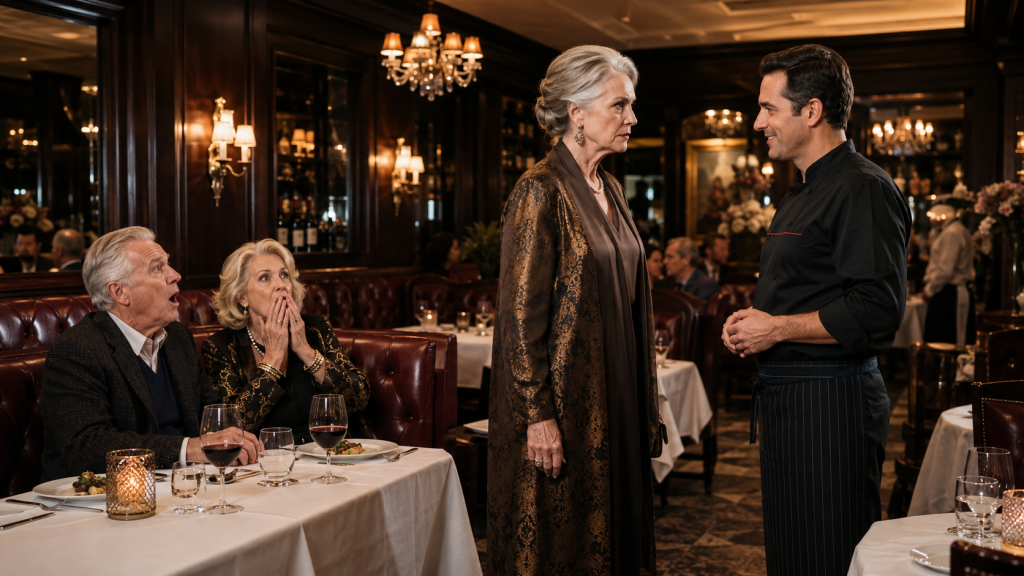
The water glass was cold in my hand, but I never lifted it. That was all they had allowed me. Water. No menu. No meal. No polite question about what I wanted to order. Just one glass placed carefully in front of me while everyone else at the table waited for lobster, wine, and dessert beneath the warm glow of crystal chandeliers.
My daughter-in-law, Marlene, was the one who made it happen. She spoke to the waiter with the polished sweetness people often mistake for class when they have never had cruelty served to them with perfect diction.
“We don’t need anything for her,” she said, nodding toward me without actually looking at me. “Water is fine.”
The waiter hesitated.

He looked at me.
For half a second, I could see the question in his eyes.
Was that really what I wanted?
Before I could answer, Marlene smiled.
“She doesn’t eat much.”
Then my son, Michael, my only child, added the sentence that settled over the table like smoke.
“You should know your place, Mom.”
I looked at him.
Really looked at him.
At the forty-year-old man in the tailored navy jacket.
At the expensive watch I had helped him buy after his first big promotion.
At the son I had once walked to elementary school in the rain because we could afford one umbrella but not two.
At the boy I had fed before myself more times than he would ever know.
At the teenager whose college application essays I had proofread at midnight after cleaning office buildings since five in the morning.
At the grown man who could no longer meet my eyes while agreeing to humiliate his mother in public.
I did not cry.
I did not argue.
I did not ask him why.
Instead, I gave him the one word I wanted him to remember later.
“Noted.”
Marlene paused.
Only for a moment.
I think my calm disappointed her.
She had expected something else.
Perhaps tears.
Perhaps anger.
Perhaps one of those emotional scenes people provoke and then use as proof that you are unstable.
But I had spent too many years learning what silence can do in a room full of arrogant people.
And although no one at that table knew it yet, their evening had already begun to unravel.
1. The Woman They Thought They Knew
My name is Helen Carter.
I was sixty-four years old that evening, and I did not become the kind of woman who could sit calmly through humiliation by accident.
Life trained me.
Not gently.
Michael’s father, Robert, disappeared from our marriage when Michael was nine.
He did not die.
Sometimes I think death might have been easier to explain to a child.
Robert simply decided that responsibility was heavier than he wanted his life to be.
One Saturday morning, he packed two suitcases while Michael was at a friend’s house and left a note on the kitchen table.
It said he needed “space.”
Space turned into a different city.
Then another woman.
Then missed child-support payments.
Then birthdays remembered two weeks late.
Then eventually silence.
For the first year after Robert left, Michael believed his father would come back.
Every time a car slowed in front of our apartment building, he would look toward the window.
Every time the phone rang after dinner, his face would brighten.
“Is that Dad?”
Usually, it was a collection agency.
Or my sister.
Or the electric company.
Tomorrow became my most hated word because Robert kept promising it.
“I’ll call tomorrow.”
“I’ll send the money tomorrow.”
“I’ll come see Michael tomorrow.”
Tomorrow almost never came.
So I stopped waiting for it.
I worked.
I cleaned corporate offices before sunrise.
I served lunches at a hotel.
I cooked in an industrial kitchen where the smell of onions, bleach, burned coffee, and exhaustion soaked so deeply into my clothes that some nights I could still smell work after showering twice.
I learned how to stretch a roasted chicken across three dinners.
I learned which utility companies would give you three extra days if you called before the due date.
I learned that children notice when money is tight even when adults think they are hiding it.
And I learned something else.
Being poor does not mean being helpless.
I refused to let Michael feel ashamed of our circumstances.
He had clean clothes.
School supplies.
Birthday cakes.
Dentist appointments.
Soccer cleats.
A used computer when his high school started requiring online assignments.
He never knew how many times I quietly went without something so he would not have to.
There were winters when I wore a coat so thin I could feel the wind through the lining.
There were months when my idea of lunch was coffee and half a sandwich left over from the kitchen.
There was one Christmas when I sold a gold bracelet my mother had given me so Michael could have the laptop required for his college courses.
I never told him.
Not because I wanted to become some martyr whose sacrifices could later be used as emotional debt.
I simply believed that was what mothers did.
You built the bridge.
Your child crossed it.
And hopefully, one day, he remembered there had been a bridge at all.
Michael was smart.
Very smart.
He studied business administration, graduated with honors, and landed a position at a financial services company.
His first salary seemed enormous to both of us.
He took me to dinner after receiving his first paycheck.
Not anywhere fancy.
Just a little Italian restaurant near his apartment.
He ordered spaghetti and meatballs, and I had chicken parmesan.
Halfway through dinner, he reached across the table and squeezed my hand.
“You did this,” he said.
I laughed.
“No. You did.”
“I wouldn’t be here without you.”
Those words lived in my heart for years.
Sometimes I still wonder where that young man went.
2. When Marlene Entered Our Lives
Michael met Marlene when he was thirty-three.
He called me after their third date.
That alone told me he was serious.
“She’s different, Mom.”
Every mother knows that sentence.
It usually means her son is falling in love.
I asked what made Marlene different.
“She’s ambitious. Sophisticated. She knows exactly what she wants.”
I smiled into the phone.
“So do most dangerous women.”
He laughed.
I was joking.
At least then I was.
Marlene came from money.
Not unimaginable wealth, but enough that she had never known the fear of a declined debit card at the grocery store.
Her father, Charles Whitmore, had owned several commercial properties.
Her mother, Diane, had spent most of her adult life involved in charities, art committees, and organizations whose meetings seemed to require expensive lunches.
Marlene worked in luxury real estate.
She knew designer labels by sight.
She could identify whether jewelry was real before the person wearing it finished shaking her hand.
The first time Michael brought her to my house, I made pot roast.
She complimented it three times.
She also asked whether I had considered renovating the kitchen.
I told myself she was making conversation.
When she looked around my living room and said, “It’s very cozy,” I told myself cozy was a compliment.
When she learned I had worked in food service and said, “Michael really climbed far,” I told myself she was praising him.
People can ignore many warning signs when they are determined to keep peace in a family.
I became excellent at it.
Michael proposed after eleven months.
Their wedding was beautiful.
I contributed twelve thousand dollars from savings.
Michael told me it was unnecessary.
Marlene did not.
At the reception, Diane introduced me to several guests as “Michael’s hardworking little mother.”
Little mother.
I was five-foot-seven.
There was nothing little about me.
Still, I smiled.
After all, it was their wedding day.
Then came the small changes.
Sunday phone calls became shorter.
Holiday plans were suddenly complicated because Marlene’s family had traditions.
Birthday dinners moved to restaurants I could barely afford.
When Michael and Marlene bought their first home, I gave them five thousand dollars toward furniture.
Marlene thanked me by saying, “That will cover the guest-room set.”
Not thank you.
Not you shouldn’t have.
Just an accounting of where my money would be used.
And still, I said nothing.
My relationship with Michael gradually became something scheduled between his more important obligations.
I tried not to take it personally.
Adult children build their own lives.
That is how it should be.
But distance is not always measured in miles.
Sometimes it is measured in tone.
A delayed reply.
A forgotten invitation.
A sentence beginning with, “Marlene thinks…”
Marlene thinks we should do Thanksgiving with her parents this year.
Marlene thinks you should sell your house before repairs become too expensive.
Marlene thinks you worry too much.
Marlene thinks you should stop giving advice unless someone asks.
Eventually, I began to wonder whether Michael thought anything on his own.
3. The Part of My Life Michael Never Understood
There was something Michael did not know about me.
Not because I intentionally hid it.
He simply stopped asking questions.
Years earlier, when Michael was still in high school, I worked evenings at a small restaurant called Bella Vista.
Back then, Bella Vista was not glamorous.
It had twelve tables.
The chairs did not match.
The kitchen ceiling leaked whenever it rained hard.
The owner, Miguel Reyes, was an immigrant from Spain who had spent nearly twenty years saving enough money to open the place.
His wife handled the books.
His teenage son Antonio washed dishes.
I worked there three nights a week.
Miguel treated employees like family.
When Michael broke his wrist playing soccer, Miguel covered two weeks of my shifts without cutting my hours permanently.
When my mother died, he closed the restaurant early so the staff could attend the funeral.
When my car would not start, Antonio drove me home after closing.
They were good people.
Then a fire damaged the kitchen.
Insurance covered some repairs but not enough.
The restaurant was already struggling.
Miguel needed nearly forty thousand dollars quickly or he would lose the business.
At that time, I had received a modest inheritance after my aunt died.
Forty-seven thousand dollars.
It was more money than I had ever possessed at once.
My sister told me to put it toward retirement.
A coworker told me to buy a better car.
Instead, I loaned Miguel thirty thousand.
People later called that decision reckless.
Maybe it was.
But I knew his character.
Miguel insisted we sign formal paperwork.
He also insisted that instead of simple interest, I accept a small percentage of ownership.
“Someday,” he told me, “this place will be worth something.”
I laughed.
“Miguel, someday I’ll be ninety.”
“Then you will be a rich ninety-year-old.”
The restaurant survived.
Then it grew.
A food critic discovered it.
Antonio studied culinary arts.
Miguel bought the building next door and expanded.
Bella Vista became Maison Aurelia after Antonio took over.
The name changed.
The chairs changed.
The customers definitely changed.
But my ownership percentage remained.
Over time, profits were reinvested.
Property was acquired.
A catering division opened.
An investment group later bought a minority interest at a valuation that nearly made me fall out of my chair when I read it.
I never considered myself wealthy.
I lived modestly.
My house was paid off.
My car was six years old.
I clipped coupons out of habit.
Most of my distributions from the restaurant went into investments or charitable accounts.
Michael knew I had retirement savings.
He did not know the scale.
And after a while, I decided not to correct his assumptions.
Money reveals people.
Sometimes the best way to know how someone values you is to let them believe you have nothing they need.
4. The Invitation
A week before that dinner, Michael called me.
It was unusual enough that I checked the screen twice.
“Hey, Mom.”
His voice sounded warmer than usual.
“Hello, stranger.”
He laughed.
That old laugh.
For a moment, I felt hopeful.
“We should have dinner.”
“We should.”
“No, I mean a real dinner. Marlene and I have been talking. Things have felt strained lately.”
That surprised me.
Marlene admitting tension was like a cat admitting it had knocked over the vase.
“We’d like to reconnect,” he continued. “Her parents will be there too, but it will still be intimate.”
Intimate.
That word should have warned me.
Intimate cruelty is often the most carefully arranged kind.
I asked where.
He named Maison Aurelia.
I almost laughed.
He had no idea.
Michael had been there twice before for business dinners, but the restaurant’s ownership structure was private.
Antonio knew I preferred discretion.
Most staff knew me simply as Mrs. Helen, the longtime family friend who occasionally appeared in the kitchen or office.
I did not interfere in daily operations.
I had no desire to play restaurant owner.
But during the previous month, something important had changed.
Miguel, now in his late seventies, had decided to sell the remaining shares he still controlled.
An outside hospitality company made an offer.
Antonio did not want the restaurant swallowed by a corporation.
Neither did I.
So after several weeks of discussions with attorneys and accountants, I agreed to purchase enough of Miguel’s remaining stake to become the majority individual owner.
The final transfer documents were scheduled to be completed the same day as Michael’s dinner.
I almost told him.
Then I decided against it.
Not for any dramatic reason.
I simply thought there would be time later.
I had no idea how important that silence would become.
5. The Dinner Table
I prepared carefully that evening.
More carefully than I wanted to admit.
I wore a pearl-gray dress I had bought for a museum fundraiser.
Small earrings.
Low heels.
A little lipstick.
I spent fifteen minutes arranging my hair, then laughed at myself in the mirror.
“Sixty-four years old,” I muttered, “and still trying to impress your child.”
Some habits never leave us.
I arrived five minutes early.
Maison Aurelia was beautiful that night.
Tall windows reflected the city lights.
The dining room glowed beneath chandeliers imported from Venice.
White linen covered each table.
The silverware was polished enough to reflect faces.
A pianist played quietly near the bar.
I had watched the restaurant grow from twelve mismatched tables into this.
Every time I entered, I remembered Miguel standing in the original kitchen with rainwater dripping into a bucket beside the stove.
Marlene and her parents were already seated.
Michael stood when he saw me.
Halfway.
Not fully.
Just enough movement to acknowledge my arrival without actually coming around to hug me.
“Mom.”
“Michael.”
Marlene smiled.
“Helen. You look… nice.”
There are compliments shaped like knives.
I recognized that one.
“Thank you. So do you.”
My chair was at the far side of the table.
Slightly removed from the central arrangement.
Diane and Charles sat nearest Marlene.
Michael sat opposite his wife.
My chair seemed almost added afterward.
I noticed.
I sat anyway.
The waiter arrived.
His name was Daniel.
I knew him.
He had worked at Maison Aurelia for nearly four years.
Our eyes met.
He recognized me immediately.
I gave the smallest shake of my head.
No special treatment.
Not yet.
Marlene picked up the menu.
“We already know what we’re having.”
Daniel smiled professionally.
“Of course.”
She ordered four lobster thermidors.
“Large portions.”
Then premium white wine.
Appetizers.
A cheese course.
Charles requested a particular vintage.
Daniel wrote everything down.
Then he turned toward me.
“And for you, Mrs.—”
“We don’t need anything for her,” Marlene interrupted.
Daniel stopped.
I watched his expression change.
“Excuse me?”
“Water is fine.”
He looked at me.
“Madam, would you like to see the menu?”
Before I could answer, Marlene leaned slightly toward him.
“She’s fine. We’re trying to help her be sensible.”
Sensible.
Diane smiled faintly.
Michael stared at the table.
Daniel was uncomfortable.
That much was obvious.
I could have ended it immediately.
I could have told him to bring me whatever I wanted.
I could have asked for Antonio.
I could have announced that I owned part of the restaurant.
Instead, I looked at Michael.
That was the moment that mattered.
Not Marlene.
Not her parents.
My son.
Would he say something?
Would he stop this?
Michael finally looked at me.
Then he sighed.
“Mom, please don’t make this difficult.”
“I haven’t said anything.”
“I know. I’m just saying…”
He glanced toward Marlene.
Then came the words.
“You should know your place, Mom.”
Diane lowered her eyes.
Charles took a sip of wine.
Marlene looked satisfied.
I felt something inside me go quiet.
Not break.
Quiet.
There is a difference.
Breaking hurts.
Quiet means you have finally understood something you resisted understanding for too long.
I looked at Michael and said, “Noted.”
6. The Meal I Was Not Allowed to Eat
Daniel brought my water.
Nothing else.
The appetizers arrived.
Four plates.
Then bread.
Again, four settings.
The lobster followed.
Rich sauce.
Golden tops.
Butter shimmering around the shells.
Diane praised the presentation.
Charles raised his glass.
“To family.”
I nearly smiled at the irony.
Marlene tasted her lobster and closed her eyes.
“Perfect.”
Michael ate quickly.
He still avoided looking at me.
After several minutes, Charles turned toward me.
“So, Helen, are you enjoying retirement?”
“I am.”
“What do you do all day?”
The question was delivered casually, but the implication was clear.
What could someone like you possibly have to occupy her time?
“I stay busy.”
Marlene laughed softly.
“Mom reorganizes closets.”
Michael said it as though it were a joke.
I looked at him.
“I reorganized one closet.”
“Three times,” he said.
Everyone laughed.
Not loudly.
That polite expensive kind of laughter designed to make cruelty appear civilized.
I took a sip of water.
Diane leaned toward me.
“Retirement can be difficult for women who have defined themselves through work.”
“I haven’t found that.”
“That’s good. Some people struggle when they no longer feel useful.”
Marlene added, “Especially without strong financial planning.”
There it was.
I had wondered how long it would take.
“Financial planning?”
She dabbed her mouth with a napkin.
“We’re concerned about you.”
Michael nodded.
“Mom, we’ve talked about this.”
No, we had not.
He had once suggested I consider downsizing my home.
That was all.
“What exactly concerns you?”
Marlene looked almost pleased that I had opened the door.
“Your long-term situation.”
“My situation?”
“Your house is old. Maintenance costs money. Healthcare gets more expensive. You don’t have unlimited savings.”
“How do you know?”
The table became quiet.
Michael frowned.
“Mom.”
“I’m asking a reasonable question.”
Marlene exchanged a look with him.
“We know you worked service jobs most of your life.”
There was the phrase.
Service jobs.
I had cooked food.
Cleaned offices.
Managed kitchens.
Balanced schedules.
Supervised people.
Fed families.
Paid taxes.
Raised a child.
But in Marlene’s mouth, service jobs meant something smaller.
Something below.
She continued.
“We just think you should live within appropriate expectations.”
“Appropriate according to whom?”
Michael put down his fork.
“This is what I meant.”
“What did you mean?”
He lowered his voice.
“Sometimes you act like you’re part of decisions that aren’t yours.”
I stared at him.
“What decisions?”
“Our future. Our finances. Our social life.”
“I have never asked about your finances.”
“But you make comments.”
“I asked why you were buying a third car when you told me you were worried about debt.”
Marlene’s face tightened.
“That was private.”
“You discussed it in front of me.”
“It wasn’t an invitation for judgment.”
I almost laughed.
“So this dinner is about teaching me boundaries?”
No one answered.
And suddenly I understood.
This had not been reconciliation.
This was a lesson.
They had brought me to an expensive restaurant, excluded me from the meal, seated me at the edge of the table, and planned to explain my proper position in their lives.
Water was not about money.
It was symbolism.
You do not belong at our level.
I looked around the table.
“Was refusing me dinner part of the lesson?”
Diane shifted in her chair.
Marlene remained calm.
“You’re being dramatic.”
“I’m sitting in front of a glass of water while four people eat lobster.”
“You could eat before you came.”
Michael muttered, “Mom, please.”
I turned toward him.
“You invited me to dinner.”
He rubbed his forehead.
“I knew this would happen.”
That sentence hurt more than the first.
Not because he was angry.
Because he had already decided that my reaction to mistreatment was the problem.
Marlene placed her hand over his.
“Michael, don’t let her ruin the evening.”
I sat back.
Then I did something that seemed to confuse them.
I smiled.
Not sarcastically.
Not bitterly.
Just calmly.
“Continue.”
Marlene blinked.
“What?”
“You wanted to teach me something. Continue.”
No one spoke.
“Please,” I said. “I’m listening.”
Charles cleared his throat.
“I think everyone means well.”
“I’m sure.”
Diane shifted the subject to a charity gala.
The conversation moved on.
But something had changed.
They were no longer comfortable.
My silence had become a mirror.
And none of them liked what they could see.
7. The Chef Walked Out
Ten minutes later, the kitchen door opened.
Antonio Reyes stepped into the dining room.
Even from across the room, I recognized the way he moved.
Confident.
Fast.
Focused.
He had been a skinny seventeen-year-old dishwasher when I first met him.
Now he was fifty-two, silver beginning at his temples, one of the most respected chefs in the city.
Several diners noticed him.
Maison Aurelia’s head chef rarely came into the dining room during peak service.
Antonio crossed the room.
Passed three tables.
Then another.
And stopped directly beside me.
Marlene looked up.
Antonio removed his chef’s hat.
He bowed his head slightly.
“Mrs. Helen.”
His tone held unmistakable respect.
The table froze.
“Antonio.”
“I’m sorry to interrupt your dinner.”
Marlene glanced at my empty place setting.
Antonio noticed it.
His eyes moved to the water.
Then the four lobster plates.
His expression changed.
Only slightly.
But I knew him well enough to see it.
He looked at Daniel, who stood several feet away.
Daniel subtly shook his head.
Antonio returned his attention to me.
“The attorneys have finished.”
I nodded.
“Everything?”
“Everything. We need one final acknowledgment in the office. No rush. When you’re ready.”
Marlene put down her fork.
“Attorneys?”
Antonio glanced at her.
Then back to me.
“Yes.”
Michael finally looked directly at me.
“What attorneys?”
I lifted my water.
Took one calm sip.
Set it down.
“I suppose we should find out.”
Antonio offered his hand as I stood.
I did not need help.
But I took it.
Not because I wanted to make a show.
Because respect should be accepted when offered sincerely.
I followed him toward the office.
Behind me, chairs moved.
Michael and Marlene stood.
Antonio turned.
“Mrs. Helen only.”
Michael blinked.
“I’m her son.”
“I understand.”
“I’m coming.”
I looked at Antonio.
“It’s fine.”
The five of us ended up walking through the restaurant together.
Me.
Michael.
Marlene.
Charles.
Diane.
A strange little procession.
Staff members greeted me as we passed.
“Good evening, Mrs. Helen.”
“Congratulations, Mrs. Carter.”
“Wonderful news.”
Each greeting made Marlene’s expression tighter.
By the time we entered Antonio’s office, her face had lost all color.
8. The Folder on the Desk
Antonio closed the door.
On the desk lay several documents.
He turned them toward me.
“As of four-thirty this afternoon, the transfer was officially recorded.”
Michael looked from him to me.
“What transfer?”
Antonio smiled.
“The ownership transfer.”
Silence.
Marlene spoke first.
“Ownership of what?”
Antonio glanced around the office.
“Maison Aurelia.”
I watched their faces.
Charles frowned.
Diane stared at me.
Michael looked confused.
Marlene laughed once.
A short sound.
“That doesn’t make sense.”
I said nothing.
Antonio continued.
“My father retained a significant share after I took over operations. Mrs. Carter has been an investor since the original Bella Vista days. She acquired most of my father’s remaining interest today.”
Michael finally found his voice.
“Mom owns part of this restaurant?”
Antonio smiled.
“Your mother is now the largest individual shareholder.”
The room went absolutely still.
Not quiet.
Still.
There are moments when people’s assumptions collapse so quickly you can almost hear them.
Michael stared at me.
“How much?”
I raised an eyebrow.
“How much what?”
“How much do you own?”
“Enough.”
Marlene walked closer to the desk.
“You invested here?”
“Years ago.”
“How many years?”
“Twenty-two.”
Michael looked wounded.
“You never told me.”
“That isn’t true.”
He frowned.
“What?”
“I told you years ago that I had invested in a restaurant.”
“When?”
“You were nineteen. You said restaurants were risky and then asked whether I could help pay for your summer program.”
He stared at me.
He remembered.
I could see it happen.
“That was this restaurant?”
“Back then it was called Bella Vista.”
Charles suddenly became interested.
“Bella Vista? The original Spanish place on Grant Avenue?”
Antonio nodded.
“My father’s restaurant.”
Charles looked at me differently.
Not kindly.
Calculatingly.
I had seen that look before.
It appears when people realize someone they dismissed might be useful.
Diane smiled.
“Helen, how wonderful. You should have told us.”
I almost admired the speed of the transformation.
Ten minutes earlier, I had needed lessons about financial planning.
Now suddenly I was wonderful.
“I didn’t realize my investments were required dinner conversation.”
Marlene’s lips tightened.
“No one said required.”
“You just said I should have told you.”
“That’s because we’re family.”
There it was.
Family.
The word had returned remarkably quickly.
9. The Bill
Antonio looked at my empty place again.
“Mrs. Helen, did you eat?”
I smiled.
“I wasn’t hungry enough to cause trouble.”
He did not smile back.
“What happened?”
Michael stepped forward.
“Nothing.”
Antonio’s eyes moved toward him.
“I asked Mrs. Helen.”
Marlene crossed her arms.
“We ordered for the table.”
Antonio glanced toward the four lobster plates visible through the partially open office door.
“For four people.”
“Yes.”
“There are five of you.”
Diane spoke softly.
“It was a misunderstanding.”
“No,” I said.
Everyone looked at me.
“It wasn’t.”
Michael’s jaw tightened.
“Mom.”
“No, Michael. If this evening taught me anything, it is that words should be accurate.”
I turned toward Antonio.
“Marlene ordered lobster for everyone except me. She told the waiter I was allowed water. Michael told me to know my place.”
Antonio’s expression hardened.
He looked at Michael.
I had seen Antonio angry in kitchens before.
He never needed to raise his voice.
That made it worse.
Michael’s face flushed.
“It sounds bad when she says it like that.”
I almost laughed.
“How should I say it?”
“That wasn’t what I meant.”
“What did you mean?”
He had no answer.
Antonio slowly removed his reading glasses and placed them on the desk.
“Mrs. Helen kept this restaurant alive before most of our current customers knew it existed.”
Marlene said, “We didn’t know.”
Antonio looked at her.
“Would it matter?”
She opened her mouth.
Closed it.
He continued.
“When my father could not pay contractors after the fire, Helen gave him money she had saved while working two jobs.”
Michael turned toward me.
“You never told me that.”
Again.
That phrase.
As though everything he had failed to learn was something I had deliberately hidden.
Antonio continued.
“She worked shifts here while raising you.”
Michael lowered his eyes.
“She helped my family keep our home.”
I touched Antonio’s arm.
“That’s enough.”
He nodded.
But he was not finished.
“There is another matter.”
He picked up a printed receipt.
“The dinner account.”
Charles cleared his throat.
“I’ll handle it.”
Antonio handed him the bill.
Charles’s eyes widened.
Marlene looked over his shoulder.
The total was just under three thousand dollars.
Premium wine had done most of the damage.
Marlene looked toward me.
“Helen.”
Just my name.
But suddenly it carried warmth.
Amazing what ownership papers can do to a person’s tone.
I waited.
“Surely,” she continued, “this can be taken care of internally.”
“Internally?”
“Well, since you own the restaurant.”
I smiled.
“Ten minutes ago I wasn’t permitted to order dinner here.”
She flushed.
“That’s not fair.”
“No?”
“We were trying to make a point.”
“You did.”
Michael rubbed his face.
“Mom, can we stop?”
“No one is stopping you from paying your bill.”
He stared at me.
“You’re seriously going to charge us?”
“I’m not charging you anything. The restaurant is.”
“But you own it.”
“And?”
“You could comp the meal.”
“I could.”
He waited.
I smiled.
“I won’t.”
Charles unexpectedly laughed.
A single surprised laugh.
Diane looked at him.
He quickly became serious.
I turned to Antonio.
“Please have the kitchen prepare one lobster thermidor for me to take home.”
Antonio smiled.
“Of course.”
“And add it to my personal account.”
“No.”
“Antonio.”
“Absolutely not.”
“Then I’ll pay cash.”
“You are impossible.”
“So was your father.”
For the first time that night, I laughed naturally.
Michael watched us as though I had become a stranger.
But the truth was simpler.
He had stopped seeing me long before that evening.
10. Outside the Restaurant
I left fifteen minutes later carrying a beautifully packed lobster dinner.
Michael followed me onto the sidewalk.
“Mom.”
I kept walking.
“Mom, please.”
I stopped beneath the awning.
Cars moved through the wet street.
The air smelled like rain.
For a moment, I was transported back thirty years.
One umbrella.
Michael’s small hand inside mine.
His sneakers splashing through puddles while I tried to keep his school papers dry.
I hated how clearly I could still see that boy.
Because the man standing in front of me looked nothing like him.
“Can we talk?”
“You had an entire dinner to talk.”
“I messed up.”
“Yes.”
He seemed surprised by the simplicity of my answer.
“I shouldn’t have said that.”
“No.”
“I was frustrated.”
“With what?”
He hesitated.
“With everything.”
“That is not an answer.”
He looked toward the restaurant doors.
“Marlene thinks you judge us.”
“This evening was her response?”
“She wanted boundaries.”
“So you starved your mother at a table?”
His face tightened.
“Stop saying starved.”
“What would you call inviting someone to dinner and refusing to let them eat?”
“You could have ordered.”
“I was not given a menu.”
“You could have asked.”
“That is what you want to defend?”
He looked down.
“No.”
Rain began tapping against the awning.
I held the food bag in one hand.
“Michael, I can forgive an insult.”
He looked up.
“I can forgive a bad evening. I can forgive embarrassment. I can forgive anger.”
His expression softened slightly.
“But what happened tonight wasn’t a sudden mistake.”
He said nothing.
“It was planned.”
“Mom—”
“The chair placement. The lecture. The food. Your wife had discussed it with you.”
His silence answered.
I felt something painful but clarifying settle inside me.
“How long?”
He rubbed his jaw.
“A few days.”
“So for several days, you knew your wife intended to invite me to dinner and deliberately exclude me from the meal.”
“It wasn’t supposed to be like that.”
“How was it supposed to be?”
He whispered, “A wake-up call.”
I almost smiled.
Instead, I nodded.
“I woke up.”
“Mom.”
“No, Michael. That part worked.”
11. The Real Reason Behind Their “Lesson”
He finally told me the truth.
Not all at once.
People rarely do when the truth makes them look ugly.
It came in pieces.
Marlene believed I was becoming too involved in their lives.
She resented that Michael had asked my advice about a business investment.
She resented that I had warned him about using home equity to finance luxury purchases.
She resented that he still occasionally called me when he was stressed.
But there was more.
Money.
There is often more when money enters the room.
Michael and Marlene had accumulated debt.
Much more than I knew.
Cars.
Travel.
Credit cards.
A failed investment in a boutique fitness company.
Marlene’s real estate income had dropped.
Michael had recently missed out on a promotion.
They had refinanced their house once.
Then borrowed against it.
And they had started discussing me.
Not with me.
About me.
My house was worth nearly seven hundred thousand dollars.
It was paid off.
Marlene believed I should sell it.
Move into a smaller condominium.
Then “help family while I was alive instead of leaving money later.”
I stared at Michael.
“That was the point of tonight?”
He shifted.
“Partly.”
The rain fell harder.
“You wanted me to sell my home.”
“We thought it might make sense.”
“For whom?”
“Everyone.”
“There is only one person who owns that house.”
He closed his eyes briefly.
“I know.”
“No. You knew. That is different.”
He looked exhausted.
“We’re struggling.”
There it was.
The sentence he should have begun with.
Not know your place.
Not water.
Not humiliation.
We’re struggling.
Had he called me and said those two words, I would have listened.
I might have helped.
I had helped him all his life.
But entitlement destroys the grace of asking.
“How much?”
He hesitated.
“Mom.”
“How much debt?”
“About two hundred eighty thousand.”
I stared at him.
Not including the mortgage.
He could see that I understood.
“Some of it is business.”
“How much credit-card debt?”
“Seventy.”
“Thousand?”
He nodded.
“What did you buy?”
His face flushed.
“Marlene handles a lot of household spending.”
Of course.
Blame had arrived.
Right on schedule.
“And you?”
“I should have paid more attention.”
“Yes.”
“I thought we could fix it.”
“With my house.”
He looked away.
And suddenly the entire evening became painfully obvious.
They had wanted to shrink me emotionally before asking me to shrink my life financially.
Convince me I was old.
Simple.
Financially vulnerable.
Dependent.
Then present selling the house as a sensible solution.
Maybe they believed if I felt small enough, I would hand over whatever they wanted simply to remain included.
That realization hurt more than the lobster.
12. My Son Asked the Wrong Question
Michael looked at me.
“How much is your share in the restaurant worth?”
That was the moment.
The final one.
The question that told me his mind had already moved from shame to calculation.
Not Are you okay?
Not How could I have done this?
Not Can you forgive me?
How much is your share worth?
I laughed softly.
Michael’s face changed.
“What?”
“Nothing.”
“I was just asking.”
“I know.”
“Because if you’re financially secure, maybe we don’t need to worry about—”
“Stop.”
He did.
I had rarely used that tone with him as an adult.
“I am going home.”
“Mom, please don’t shut me out.”
“I’m not shutting you out.”
“It feels like it.”
“Consequences often feel like rejection to people who expected unlimited access.”
He stared at me.
I continued.
“You are my son. I love you. That does not mean you are entitled to my money, my home, my dignity, or my silence.”
He swallowed.
“I’m sorry.”
“I believe you are sorry tonight.”
“What does that mean?”
“It means I don’t yet know what you’ll be tomorrow when the embarrassment fades.”
He looked toward the wet street.
“I really messed this up.”
“Yes.”
“Can I fix it?”
“Not with words.”
He nodded slowly.
That was the first sensible thing he had done all evening.
I walked to my car.
This time, he did not follow.
13. The Phone Calls Began
The first call came at 8:10 the next morning.
Marlene.
I let it ring.
At 8:17, Diane called.
At 8:32, Michael.
At 9:04, Charles.
By noon, I had eleven missed calls.
I made coffee.
Watered my plants.
Ate leftover lobster for lunch.
It tasted excellent.
Around two, Michael sent a message.
Mom, I deserve your anger. I’m sorry. Please call when you’re ready.
Marlene’s message was different.
I think emotions got out of hand last night. We all said things that were misunderstood. We should clear the air before this damages the family.
No apology.
No accountability.
Just mutual misunderstanding.
I deleted it.
Then Diane called again.
I answered.
“Helen.”
Her voice was warm.
Almost maternal.
“Helen, thank goodness.”
“Hello, Diane.”
“I’ve been worried sick.”
“I’m fine.”
“Last night became so unfortunate.”
“Yes.”
“I want you to know Charles and I never meant to make you uncomfortable.”
“You ate lobster while I drank water.”
Silence.
“That was Marlene’s decision.”
“You stayed.”
Another silence.
“You’re right.”
That surprised me.
Diane lowered her voice.
“I’m ashamed.”
I waited.
“I should have spoken up.”
“Yes.”
“I didn’t.”
“No.”
“I wish I had.”
That sounded real.
Not complete.
But real.
I thanked her for calling.
Before hanging up, she said something unexpected.
“Be careful with Marlene.”
I paused.
“What does that mean?”
Diane exhaled.
“She is frightened about money.”
“I know.”
“No. I don’t think you do.”
14. What Marlene Had Been Telling People
Diane came to my house two days later.
Alone.
She sat at my kitchen table.
The same table where Michael had done homework as a child.
The same table where I had once counted quarters to see whether I could afford groceries until payday.
Diane looked uncomfortable there.
Not because my home was shabby.
It wasn’t.
But because the room belonged to a version of life she had never lived.
She removed her gloves.
“Marlene has been telling people that you are becoming financially dependent on them.”
I stared at her.
“What?”
“For months.”
I almost laughed.
“Dependent how?”
“She has said they may eventually need to support you.”
That explained certain comments at family gatherings.
The pitying looks.
The advice about senior housing.
The strange way one of Marlene’s friends once told me, “It’s wonderful Michael is able to help.”
I had thought she meant emotionally.
Diane continued.
“She told us you couldn’t afford repairs on your home.”
“My roof was replaced last year.”
“I know that now.”
“Who did she say paid for it?”
“Michael.”
I shook my head slowly.
I had paid twenty-one thousand dollars for that roof.
Cash.
“She also said you were pressuring Michael for money.”
I sat back.
That one hurt.
Not because strangers believed it.
Because my son had apparently allowed it.
“Did Michael know?”
“I don’t know.”
I looked at Diane.
She looked away.
Which meant yes.
Or at least probably.
“What else?”
Diane hesitated.
“They planned to discuss the house after dinner.”
There it was.
Confirmation.
“They wanted you to sell.”
“Yes.”
“And give them money.”
“She said it would be structured as an early inheritance.”
I felt almost physically cold.
“How much?”
“One hundred fifty thousand.”
I laughed.
I could not help it.
Diane looked embarrassed.
“Marlene said it would solve their short-term debt problem.”
“Short-term?”
“That was her phrase.”
I stood and walked toward the kitchen window.
Outside, leaves moved gently in the afternoon breeze.
This house had been mine for twenty-eight years.
I had painted walls.
Replaced floors.
Planted the maple tree out back.
Michael’s height marks were still inside a closet door.
And my daughter-in-law had apparently converted it into a number on her debt spreadsheet.
15. I Changed My Estate Plan
The next morning, I called my attorney.
Not because I wanted revenge.
Revenge is expensive emotionally.
I wanted clarity.
My attorney, Sandra Patel, had handled the Maison Aurelia transfer.
She also knew my finances better than anyone.
I met her that afternoon.
“My will needs updating.”
She looked at me over her glasses.
“Major update?”
“Yes.”
Previously, Michael was my primary heir.
The house.
Investments.
Restaurant shares.
Everything.
I had assumed that was natural.
One child.
One inheritance.
But inheritance is not an obligation to reward entitlement.
I did not disinherit him.
Despite everything, he was still my son.
Instead, I created structure.
A large portion of my estate would go into a charitable foundation supporting single parents working in hospitality and service industries.
Another portion would fund culinary scholarships through Maison Aurelia.
Michael would receive a trust.
Enough to be meaningful.
Not enough to rescue reckless spending.
He could receive additional funds under specific conditions tied to financial counseling and debt management.
Sandra looked at me.
“You’re sure?”
“Yes.”
“And Marlene?”
“Nothing directly.”
She nodded.
“That simplifies things.”
I smiled.
For the first time in days, I felt lighter.
Money had spent too many years as something I saved from fear.
Now it could become something I used with intention.
16. Michael Came Alone
One week passed before Michael came to my house.
No Marlene.
He stood on the porch holding flowers.
I almost laughed at the cliché.
Still, I let him in.
We sat at the kitchen table.
He looked around.
His eyes stopped on the old doorway where I had marked his height every birthday.
“You kept that.”
“Of course.”
He touched the marks.
Age ten.
Age eleven.
Age twelve.
Beside age thirteen, he had written in his own handwriting:
Taller than Mom soon.
He had not been.
Not until fifteen.
Michael sat down.
“I’m ashamed.”
I poured coffee.
“That’s a beginning.”
He nodded.
“I knew Marlene was planning to talk about your house.”
I said nothing.
“I didn’t know she was going to do the thing with the food.”
“Did you stop it?”
“No.”
“Then the distinction does not help much.”
“I know.”
He looked exhausted.
“I’ve been thinking about what you said.”
“Which part?”
“That I asked the wrong question outside the restaurant.”
I waited.
“I asked what your ownership was worth.”
“Yes.”
“I heard myself later.”
He rubbed both hands over his face.
“I sounded disgusting.”
“You sounded frightened.”
He looked surprised.
“Fright can make greed look reasonable.”
His eyes filled.
That was the first time I had seen him cry in years.
“I’m in trouble, Mom.”
“I know.”
“Real trouble.”
“I know.”
“I was scared to tell you.”
“So you chose humiliation instead?”
“No.”
He shook his head.
“That’s not what I mean. Marlene kept saying if we could get you to understand that the house was too much for you, then maybe you’d sell. She said it would help everyone.”
“And you believed that?”
“I wanted to.”
There it was.
The most honest sentence yet.
He wanted to believe something convenient.
“How much do you owe?”
“Two hundred seventy-eight thousand, excluding the mortgage.”
“And assets?”
“We could sell the cars.”
“You should.”
He nodded.
“We are.”
“What else?”
“Canceling the club membership. Selling some jewelry.”
I did not react.
“Marlene hates it.”
“I imagine.”
“She says I’m panicking.”
“You are.”
He nodded.
“But maybe I should have panicked sooner.”
“Yes.”
He gave a weak smile.
“That sounds like you.”
“I hope so.”
Then his expression changed.
“Mom, I’m not asking you for money.”
That mattered.
More than he knew.
“I came to say that.”
I waited.
“I don’t want the house. I don’t want restaurant money. I don’t want anything.”
“Be careful making promises while emotional.”
“I mean it.”
“Then prove it.”
“How?”
“Fix your life using what belongs to you.”
He nodded.
It would be difficult.
That was the point.
17. Marlene Was Not Finished
Three days later, Marlene came to Maison Aurelia.
Without Michael.
Antonio called me.
“She wants to speak with you.”
“About?”
“She says restaurant business.”
I almost laughed.
Marlene had never been involved in restaurant business.
I drove downtown.
She was waiting in a private dining room.
Perfect hair.
Perfect coat.
Perfect anger.
“Helen.”
“Marlene.”
She did not offer a hug.
I appreciated the honesty.
“I think we should speak directly.”
“Good.”
She placed a folder on the table.
Inside was a proposal.
A proposal.
I read the first page.
Then the second.
Marlene had apparently decided Maison Aurelia should expand.
Second location.
Luxury development district.
She had identified commercial property.
One of her father’s contacts could arrange financing.
She believed she could oversee branding and real estate.
I closed the folder.
“No.”
She stared.
“You haven’t finished.”
“I don’t need to.”
“You’re letting personal feelings affect business.”
“No. I’m preventing someone with two hundred seventy-eight thousand dollars of household debt from directing my investments.”
Her face hardened.
“Michael told you everything.”
“Enough.”
“You think you’re better than us now.”
I almost felt sorry for her.
Almost.
“Marlene, I cleaned toilets for money.”
She blinked.
“I have been hungry. I have stood in grocery aisles calculating whether I could afford milk and gasoline in the same week. I have worn shoes with cardboard inside them because my son needed new ones more than I did.”
She looked away.
“I don’t think I am better than anyone.”
I leaned forward.
“But I know the difference between having money and having character.”
Her jaw tightened.
“That’s easy to say now that you’re rich.”
“I was the same person when you thought I was poor.”
That silenced her.
For several seconds.
Then she whispered, “You set us up.”
I stared at her.
“How?”
“You knew the restaurant was yours.”
“I knew my ownership transfer was being finalized.”
“And you let us treat you like that.”
The absurdity was breathtaking.
“I let you reveal how you wanted to treat me.”
“That’s manipulation.”
“No, Marlene. Manipulation would have required me to create your behavior. I merely did not interrupt it.”
Her eyes filled with angry tears.
“You enjoyed humiliating us.”
“I paid for my own dinner and walked away.”
“You made us pay nearly three thousand dollars!”
“You ordered it.”
“That’s not the point.”
“It is exactly the point.”
18. The Sentence That Ended the Argument
Marlene stood.
“You don’t understand what it’s like.”
“What?”
“To have everything falling apart.”
I studied her.
For the first time, the sophistication slipped.
She looked tired.
Afraid.
Human.
“You could have told me.”
She laughed bitterly.
“And said what? Helen, we spent too much money and now we need help?”
“Yes.”
“You would have judged us.”
“Probably.”
She looked shocked.
I smiled.
“You would have deserved some judgment.”
Despite herself, she almost laughed.
Then her face crumpled again.
“My parents think we’re successful.”
“There is your real problem.”
She looked at me.
“You are living for witnesses.”
That sentence landed.
She sat slowly.
For the first time since I had known her, Marlene had no performance ready.
No polished sentence.
No social smile.
Just silence.
I continued.
“You wanted expensive cars because people could see them. Expensive trips because people could photograph them. Expensive clothes because people could recognize them. And now you want my money because the truth is becoming visible.”
She stared at the table.
“You don’t know everything.”
“No. But I know enough.”
She whispered, “Michael is furious with me.”
“He should also be furious with himself.”
“He says we have to sell the house.”
I paused.
Their house.
Not mine.
“That may be necessary.”
“I love that house.”
“I understand.”
She looked up sharply.
“Do you?”
“Yes.”
“I worked for that house.”
“So did I.”
The meaning took a moment.
Then she understood.
I meant mine.
She lowered her eyes.
That was the end of the argument.
19. What Happened to Their Marriage
Michael and Marlene did not divorce.
At least not then.
But their marriage changed.
Sometimes consequences do not arrive like thunder.
Sometimes they arrive as spreadsheets.
Appointments.
Sold cars.
Canceled trips.
Uncomfortable conversations.
Michael entered a debt management program.
They sold one luxury SUV and Michael’s sports car.
Marlene sold several pieces of jewelry.
They canceled a vacation to France.
They put their house on the market.
That was the hardest part.
Marlene cried when it sold.
I did not celebrate.
Loss is still loss even when it comes from your own mistakes.
They moved into a smaller townhouse.
Still nice.
Still comfortable.
Just not impressive enough for the image Marlene had spent years maintaining.
Several friends disappeared.
That did not surprise me.
When your social life is built around status, financial difficulty performs excellent crowd control.
Diane later told me that Marlene had stopped attending one of her charity committees because the membership fees were too high.
“What did she tell people?” I asked.
“That she needed more time with family.”
We both smiled.
Some habits take longer to die.
20. Michael Had to Learn Who I Was Again
My relationship with Michael did not repair itself quickly.
I did not want it to.
Fast forgiveness often produces temporary remorse.
I wanted change.
He started calling every Sunday.
At first, our conversations were awkward.
“How was your week?”
“Fine.”
“What did you do?”
“Things.”
Eventually, he began asking real questions.
He asked about Bella Vista.
About Miguel.
About the years I worked there.
About why I invested.
He asked how much the restaurant had grown.
I answered some things.
Not everything.
One afternoon, he visited Maison Aurelia while I was reviewing foundation plans with Antonio.
Michael stood in the kitchen doorway watching us.
Antonio was telling a story about the old restaurant.
“Your mother once chased a raccoon out of the storage room with a broom.”
Michael stared at me.
“You never told me that.”
I laughed.
“You were fourteen. You didn’t care about raccoons.”
“I would have cared.”
“No. You cared about a girl named Jennifer and a video game.”
He smiled.
“Fair.”
That afternoon, Michael stayed for three hours.
He listened.
Really listened.
At one point, Antonio showed him a photograph from twenty years earlier.
I was standing in the original kitchen wearing an apron.
My hair tied back.
Miguel beside me.
Antonio in the background.
Michael stared at the picture.
“You look tired.”
“I was tired.”
“How many jobs were you working then?”
“Three sometimes.”
He swallowed.
“I didn’t know.”
“You were a child.”
“I should have known later.”
I touched his hand.
“Yes.”
He nodded.
There was no cruelty in that truth.
Only responsibility.
21. The Scholarship Dinner
Six months after the lobster incident, Maison Aurelia hosted its first annual scholarship dinner for single parents working in hospitality.
The foundation funded tuition, childcare assistance, transportation grants, and emergency support.
We named the program after Miguel.
He cried when I told him.
“You should put your name on it,” he argued.
“No.”
“You gave the money.”
“You built the restaurant.”
“You saved it.”
“We can fight about this until one of us dies.”
Miguel smiled.
“I am older. I will win.”
The event sold out.
Michael attended.
So did Marlene.
When I saw her, I was surprised.
She wore a simple black dress.
No dramatic jewelry.
No visible designer label.
She looked nervous.
Diane and Charles came too.
At dinner, Marlene sat across from me.
The irony was not lost on either of us.
Every guest received the same meal.
When the first course arrived, Marlene looked at me.
Then at my plate.
Then back at me.
For a moment, I thought she might cry.
Instead, she said quietly, “I’m glad you’re eating.”
I almost laughed.
“So am I.”
Later that evening, one scholarship recipient spoke.
Her name was Teresa.
Thirty-seven.
Two children.
Widowed.
Working full-time in a hotel kitchen while studying nursing.
She stood at the podium and said, “People who have never been poor think poverty is about wanting things. Mostly, it’s about choosing which important thing you cannot have this month.”
The room became silent.
I looked at Michael.
He was crying.
Not dramatically.
Just quietly.
Marlene reached for his hand.
For once, the gesture looked genuine.
22. Marlene Finally Apologized
After the event, Marlene found me near the kitchen.
“Helen?”
“Yes?”
“Can we talk?”
We stepped into a quiet corridor.
She took a breath.
“I owe you an apology.”
I waited.
No helping.
No making it easier.
If someone has an apology to give, let them carry its full weight.
“What I did at dinner was cruel.”
“Yes.”
“I wanted you to feel small.”
I appreciated the honesty.
“Why?”
“Because I felt small.”
That surprised me.
She continued.
“I was terrified. I had debt I couldn’t control. My career was slowing down. Michael was pulling away because we fought constantly about money. And every time I looked at you, you seemed calm.”
I said nothing.
“You had less than us—or I thought you did—but you weren’t scared.”
“I was scared many times.”
“But you didn’t look like it.”
“I had practice.”
She nodded.
“I resented you.”
“For being poor?”
She gave a sad laugh.
“For being okay.”
That was probably the most honest thing Marlene had ever said to me.
“I thought if I could make Michael see you as a burden, then he would stop listening to you.”
“That is difficult to forgive.”
“I know.”
She looked toward the dining room.
“I’m not asking you to forget.”
“Good.”
“I just wanted to say I’m sorry without explaining it away.”
I studied her face.
Then I nodded.
“Thank you.”
She looked surprised.
“Is that all?”
“For today.”
Fair forgiveness has boundaries.
She understood.
23. One Year Later
A year after the dinner, Michael invited me to lunch.
Not Maison Aurelia.
A small diner.
Red booths.
Coffee in thick white mugs.
The kind of place where the waitress calls everyone honey.
I loved it.
Michael arrived first.
He stood fully when I entered.
Then hugged me.
Not halfway.
Not awkwardly.
A real hug.
We ordered sandwiches.
Both of us.
No one controlled anyone else’s menu.
Halfway through lunch, Michael slid an envelope toward me.
I looked at it.
“What is this?”
“Open it.”
Inside was a check.
Five thousand dollars.
I frowned.
“Why are you giving me money?”
“It’s not for you.”
“Then why am I holding it?”
He smiled.
“It’s for the scholarship fund.”
I looked at the check again.
“We can accept online donations.”
“I know.”
“Then why—”
“Because I wanted to hand it to you.”
My throat tightened.
He continued.
“We finished paying off one of the big debts last month.”
“That’s good.”
“We still have work to do.”
“I know.”
“But I wanted the first extra money we had to go somewhere that mattered.”
I looked at him.
“Michael, you don’t have to prove anything to me with money.”
“I know.”
“Then why?”
He looked down.
“Because all my life, I thought your sacrifices were just normal mom things.”
My eyes burned.
“I never understood they were choices.”
He looked up.
“You chose me over yourself a thousand times.”
I swallowed.
“I’m not asking you to repay me.”
“I know.”
“I mean it.”
“I know, Mom.”
He reached across the table.
“I’m just finally trying to become someone who notices.”
That was the moment I forgave him.
Not when he apologized.
Not when he sold the cars.
Not when he called every Sunday.
There.
In a cheap diner.
With a five-thousand-dollar check.
Not because of the amount.
Because he finally understood what gratitude was supposed to look like.
24. What “Know Your Place” Means to Me Now
People sometimes ask whether I regret staying quiet at that dinner.
No.
Silence is not always weakness.
Sometimes silence is observation.
Sometimes the most powerful thing you can do when someone reveals their character is avoid interrupting them.
Marlene thought my place was at the edge of the table.
With water.
No menu.
No voice.
Michael thought my place was behind his marriage, behind his image, behind whatever version of success he was trying to maintain.
They were both wrong.
But I was wrong too.
For years, I believed my place was wherever my son needed me.
Behind him.
Under him.
Around him.
Protecting him.
Rescuing him.
Sacrificing quietly.
That is not love.
At least, not healthy love.
A mother’s place is not beneath her child.
A wife’s place is not beneath her husband.
A poor person’s place is not beneath a wealthy one.
A server’s place is not beneath the customer.
A cleaner’s place is not beneath the executive whose office she cleans.
Work does not determine worth.
Money does not determine class.
And family does not grant anyone permission to humiliate you.
My place is where I stand with dignity.
That night, it happened to be beside a glass of water.
Today, it may be in the boardroom at Maison Aurelia.
Tomorrow, it may be at my kitchen table eating toast.
The room does not determine my value.
Neither does the person sitting across from me.
25. The Last Dinner
Two years after the original dinner, we celebrated my sixty-sixth birthday at Maison Aurelia.
I did not choose the restaurant.
Michael did.
The invitation said:
Dinner for Mom. Everyone eats. Everyone behaves.
I laughed for five minutes.
Antonio reserved the same table.
I almost refused.
Then I understood why Michael had chosen it.
We sat in the same places.
Except this time, Michael pulled my chair toward the center.
Marlene handed me the menu first.
“What are you having?”
I studied it dramatically.
“Water.”
Everyone stared.
Then I laughed.
Even Marlene.
Especially Marlene.
I ordered lobster.
So did Michael.
Diane chose salmon.
Charles ordered steak.
Marlene ordered pasta.
During dinner, no one discussed money.
No one discussed property.
No one offered advice about aging.
We talked about ordinary things.
Movies.
Weather.
Michael’s job.
A trip Diane wanted to take.
A new dessert Antonio was testing.
It was almost boring.
It was wonderful.
When dessert arrived, Michael raised his glass.
“I want to say something.”
I groaned.
“No speeches.”
“One sentence.”
“Michael.”
“One.”
I sighed.
“Fine.”
He looked directly at me.
“To the woman who spent her whole life giving me a place in the world before I understood how much space she deserved in mine.”
The table became quiet.
My eyes filled.
Marlene squeezed my hand.
I looked at my son.
At the man he had been.
At the boy he once was.
At the better man he was trying to become.
Then I lifted my glass.
“Noted.”
Michael laughed.
So did everyone else.
And that time, the word meant something completely different.
Epilogue: The Glass of Water
I still think about that glass sometimes.
Cold.
Untouched.
Sitting in front of me while four people ate a meal I had not been allowed to order.
For a while, I considered keeping the glass.
Antonio joked that we could put it in the restaurant office as a reminder.
I told him absolutely not.
Objects do not deserve that much power.
But memories can become useful when we understand them.
That dinner taught me more than Marlene ever intended.
It taught me that people often show you exactly how they value you when they believe you have nothing to offer them.
It taught me that money does not create character.
It only removes certain excuses.
It taught Michael that a mother can love her child deeply without funding his mistakes.
It taught Marlene that appearances are expensive and dignity cannot be financed.
And it taught me something I wish I had understood decades earlier.
You do not have to scream when someone disrespects you.
You do not always have to fight.
You do not need to prove your worth by revealing everything you own, everything you have accomplished, or everyone who respects you.
Sometimes you simply watch.
You listen.
You remember.
And when the moment comes, you stand.
Not to destroy anyone.
Not to humiliate them back.
Just to make sure they understand one thing clearly.
Your kindness was never weakness.
Your modest life was never evidence of failure.
Your silence was never permission.
And your place was never theirs to assign.
That evening began with my daughter-in-law sliding a glass of water toward me and saying, “That’s enough.”
My son followed with, “Know your place, Mom.”
They believed they were teaching an old woman where she belonged.
Instead, they discovered that the woman they had pushed to the edge of the table had quietly helped build the very room in which they were trying to make her feel small.
And the most satisfying part was not owning the restaurant.
It was not the three-thousand-dollar bill.
It was not the shock on their faces when Antonio bowed beside my chair.
It was watching my son learn that respect cannot depend on someone’s bank account.
It was watching my daughter-in-law eventually learn that humiliation does not become acceptable simply because it is delivered politely.
And it was learning that I could forgive them without returning to the version of myself who accepted everything for the sake of peace.
Peace without respect is not peace.
It is surrender.
I had surrendered enough.
So now, whenever someone tells me where my place should be, I smile.
Because at sixty-six years old, I finally know the answer.
My place is anywhere I am treated with dignity.
And if there is no seat for me there, I am perfectly capable of standing up and walking away.
THE END!