 Reading Time: 23 minutes
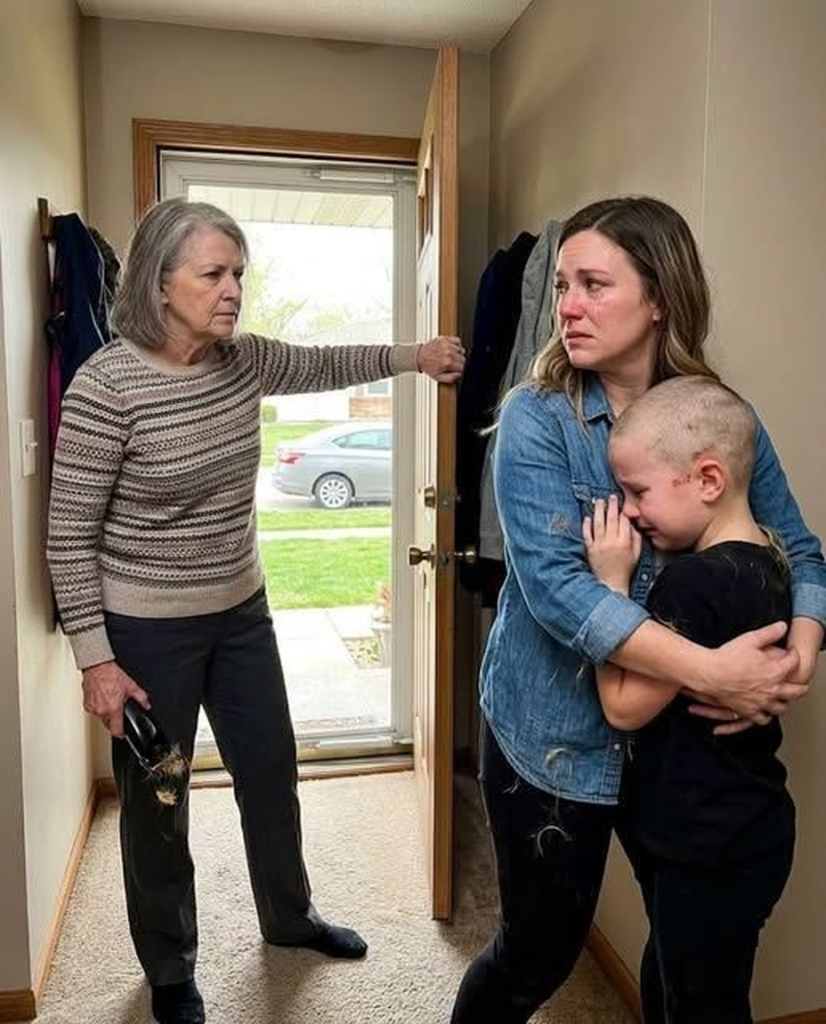
When I picked up my eight-year-old daughter from my mother-in-law’s house that Tuesday afternoon, I expected the usual things. A sticky face from too much candy.
A backpack filled with half-finished worksheets. And another lecture from Judith about how children needed more structure than I was apparently capable of providing.
Instead, I walked into the guest room and found Meadow sitting on the floor with her knees pulled tightly against her chest.

For several seconds, my mind refused to understand what I was seeing.
Her golden hair was everywhere.
It covered the beige carpet in long uneven strands.
Some pieces clung to Meadow’s shirt.
Others were wrapped around her bare feet.
The hair she had been growing since preschool—the hair she brushed carefully every morning and sometimes asked me to braid before school—was gone.
In its place was uneven stubble.
The skin above her left ear was red where the clippers had scraped too close.
Meadow looked up at me.
Her mouth opened.
Nothing came out.
Then she pressed both hands against her bare head and began shaking.
“Meadow?”
I dropped my purse.
Behind me, someone cleared her throat.
I turned.
My mother-in-law, Judith, stood in the doorway holding electric clippers.
She did not look embarrassed.
She did not look worried.
She looked satisfied.
As though she had finally corrected some terrible problem the rest of us had been too weak to address.
“What did you do?”
Judith gave me the same look she used whenever she believed I was being overly emotional.
“Don’t start.”
I stared at the clippers in her hand.
“What did you do to her?”
“She was becoming vain.”
For one strange second, I thought I had misheard her.
“What?”
“She spends too much time in front of mirrors. Always brushing that hair. Asking for ribbons. Wanting those silly braids.”
Judith shrugged.
“Girls who become obsessed with appearance need humility.”
I crossed the room so quickly that my knee hit the bedframe.
I barely felt it.
I dropped beside Meadow and crawled through piles of her hair to reach her.
She folded herself against me.
Her whole body trembled so hard her teeth clicked together.
I wrapped both arms around her.
“I’m here, baby.”
Her fingers grabbed my shirt.
I could feel her trying not to cry.
Judith kept talking.
“She was warned.”
I looked over my shoulder.
“Warned about what?”
“Talking back.”
Meadow made a tiny sound against my chest.
Judith continued as if she were describing a perfectly reasonable consequence for failing to finish homework.
“She refused to stop brushing her hair after I told her to clean the guest room. She rolled her eyes. I told her vanity had consequences.”
I stared at her.
“You shaved an eight-year-old child’s head because she brushed her hair?”
“You always twist everything.”
“Did she agree to this?”
Judith’s mouth tightened.
“She is eight. Children don’t get to agree with discipline.”
My stomach turned.
I pulled Meadow closer.
“Where is Dustin?”
“At work.”
“Does he know?”
Judith hesitated.
Only for half a second.
But I saw it.
“I called him.”
The room seemed to shrink.
“What did he say?”
“He said I should handle the behavior however I thought appropriate.”
I looked down at my daughter.
Meadow’s eyes were fixed on the clippers.
Then she whispered the sentence that split my marriage open.
“Daddy said Grandma knows best.”
My throat closed.
I wanted to tell myself Meadow had misunderstood.
I wanted to believe Dustin had said something harmless that Judith had twisted.
But I knew my husband.
I knew how often he defended his mother.
I knew how many times he had told me, “Mom is old-fashioned, that’s all.”
I knew how many times he had laughed when Judith criticized my parenting.
And most of all, I knew that Meadow did not invent sentences like that.
I stood with my daughter in my arms.
She was getting too big for me to carry comfortably, but at that moment she felt like a toddler again.
Small.
Terrified.
Completely dependent on me to get her out.
“We’re leaving.”
Judith stepped aside at first.
Then followed us down the hallway.
“You’re making this into something it isn’t.”
I kept walking.
“She’ll thank me someday.”
I reached the front door.
Judith moved in front of it.
She planted both feet on the hardwood floor and crossed her arms.
“You’re not taking her anywhere while you’re acting like this.”
Meadow buried her face against my shoulder.
I could feel tears soaking through my shirt.
“Move.”
Judith gave me a small smile.
“Hair grows back.”
“Move.”
“You need to calm down.”
“Get out of the doorway.”
She stared at me.
I must have looked different from the woman she was used to controlling because the smile disappeared.
For almost eleven years, I had swallowed my irritation for Dustin’s sake.
I had smiled through Thanksgiving insults.
Ignored comments about my weight.
Pretended not to hear when Judith called Meadow “too sensitive.”
I had spent years trying to keep peace in a family where peace meant Judith got her way.
That woman was gone.
“Move,” I said again.
Judith stepped aside.
She was still holding the clippers.
I carried Meadow outside.
I did not look back.
The Drive Home
Meadow did not speak during the twenty-minute drive.
Not once.
At every red light, I looked at her through the rearview mirror.
She sat in the back seat with her arms wrapped around herself.
Her head was turned toward the window.
I wanted to ask what happened.
I wanted every detail.
But something told me not to make her relive it while she was still trapped inside it.
So I simply said, “You’re safe with me.”
Her eyes moved toward the mirror.
“You didn’t do anything wrong.”
A tear rolled down her cheek.
I gripped the steering wheel tighter.
At home, Meadow went straight to her room.
I followed.
She stood in front of her dresser and stared at the mirror.
Then she turned the mirror toward the wall.
That nearly broke me.
Meadow had always loved her hair.
Not because she was vain.
Because it connected her to my mother.
My mother, Evelyn, had died when Meadow was five.
Before cancer took most of her strength, Mom spent Sunday mornings sitting behind Meadow with a comb and a spray bottle, teaching her how to braid.
“You’ve got sunshine hair,” Mom used to tell her.
After Mom died, Meadow began asking me to braid her hair the same way.
Sometimes she would touch the braid and say, “Grandma Evelyn taught us.”
Judith knew that.
She had heard Meadow say it.
And she shaved it off anyway.
I found a soft pink winter hat in the back of Meadow’s closet.
It was May.
She put it on and pulled it down over her ears.
That night she slept wearing it.
She wore it to breakfast the next morning.
I made strawberry pancakes, her favorite.
She pushed them around the plate.
“Does your head hurt?”
A tiny nod.
“Can I look?”
Her hands immediately went to the hat.
“No.”
“Okay.”
I did not touch it.
Twenty minutes later, I found her at the kitchen table drawing.
A small girl with no hair.
Beside her stood a huge woman with oversized arms.
In the corner was a man with no face.
“What’s this?”
Meadow covered the picture.
I backed away.
“You don’t have to tell me.”
Around noon, Dustin called.
I had ignored eleven previous calls.
This time, I answered.
“Where are you?”
His tone sounded irritated.
Not frightened.
Not concerned.
I looked through the doorway at Meadow.
“She’s with me.”
“Obviously. Mom said you stormed out like a lunatic.”
My grip tightened around the phone.
“Your mother shaved our daughter’s head.”
“I know.”
The casualness of those two words made me cold.
“You know?”
“Mom explained what happened.”
“Did you tell her she could do it?”
Silence.
“Dustin.”
“I told her Meadow had been difficult lately.”
“That isn’t what I asked.”
“I said Mom should handle it.”
I closed my eyes.
“You gave her permission.”
“I gave my mother permission to discipline her granddaughter.”
“She held clippers to our daughter’s head while Meadow was crying.”
“You weren’t there.”
“Neither were you.”
That stopped him.
Then he sighed.
“Can we not turn this into some dramatic crusade? Hair grows back.”
The exact same sentence.
I should have known.
Judith had not merely convinced Dustin afterward.
They had already decided together that what happened was acceptable.
“Her scalp is cut.”
“What?”
“There are red marks above her ear.”
“That happens with clippers.”
I almost dropped the phone.
“Do you hear yourself?”
He became defensive.
“Mom was trying to help.”
“Have you asked whether Meadow is okay?”
“I’m trying to talk to you.”
“That isn’t what I asked.”
Silence.
Then Dustin said something I never forgot.
“You always encourage her to be fragile.”
I hung up.
The Doctor
I called Meadow’s pediatrician.
When I explained what had happened, the receptionist’s voice changed immediately.
“Bring her in.”
We were there forty minutes later.
Meadow wore her pink hat into the examination room.
Dr. Melissa Grant had treated Meadow since infancy.
She did not ask Meadow to remove the hat immediately.
Instead, she sat on the rolling stool several feet away.
“Your mom told me something happened yesterday.”
Meadow stared at her shoes.
Dr. Grant spoke softly.
“You’re not in trouble.”
Meadow’s fingers tightened around the edges of the hat.
“No one here is angry with you.”
After almost a minute, Meadow whispered, “Grandma was angry.”
“I understand.”
Dr. Grant asked whether she could examine Meadow’s head.
Meadow looked at me.
I said, “Only if you want her to.”
Slowly, Meadow removed the hat.
Dr. Grant’s expression remained calm, but I saw her jaw tighten.
She examined the irritated areas and the small nicks left by the clippers.
She asked Meadow a few simple questions.
“Did you want your hair cut?”
“No.”
“Did you tell your grandmother that?”
“Yes.”
“What happened when you told her no?”
Meadow swallowed.
“She said I was being disrespectful.”
Dr. Grant waited.
Meadow continued.
“She made me sit on the floor.”
My hands went cold.
“Was anyone else there?”
“No.”
“Did she stop when you asked?”
Meadow shook her head.
Dr. Grant photographed the injuries with my permission.
Then she asked me to step into the hallway while a nurse stayed with Meadow.
I knew before she spoke.
“I have to make a report.”
I nodded.
“This is not about a haircut,” Dr. Grant said. “This is about an adult forcibly altering a child’s body as punishment while the child was distressed and refusing consent. Meadow is also showing signs of an acute trauma response.”
There it was.
The word I had been afraid to say.
“Abuse?”
Dr. Grant held my gaze.
“Yes.”
I leaned against the wall.
“And because of what you told me about the doorway and her father’s involvement, I’m documenting everything.”
I thought of Dustin defending Judith.
Calling Meadow fragile.
Calling me dramatic.
Something inside me hardened.
I had spent years asking whether I was overreacting.
I was finished asking.
The Question My Sister Asked
My older sister Francine worked as a paralegal at a family law firm.
When I called her, I made it halfway through the story before she interrupted.
“Where is Meadow now?”
“With me.”
“Is Dustin there?”
“No.”
“Good. Listen carefully.”
I grabbed a notebook.
“Photograph everything. Her scalp. The hair if you still have access to it. Any texts from Dustin. Any messages from Judith. Do not delete anything. Do not argue with them over the phone if you can avoid it.”
“What do I do next?”
“Did the doctor document it?”
“Yes.”
“Good.”
Francine paused.
“Pack what Meadow needs.”
I looked toward the living room.
She was sitting on the couch with her purple stuffed elephant pressed against her chest.
Francine asked, “Can you stay with me?”
“Yes.”
“Then come.”
“What about Dustin?”
“What about him?”
“He’ll say I kidnapped her.”
“You are her mother, and there is no custody order preventing you from leaving the marital home with her. We’ll talk to an attorney today.”
I sat down.
The reality of what I was considering finally landed.
Divorce.
Custody.
Lawyers.
Possibly selling the house.
Possibly losing friends.
Possibly losing people I had called family for more than a decade.
Francine’s voice softened.
“Abigail?”
“Yes?”
“What are you willing to lose?”
I watched Meadow.
Her fingers were gripping the purple elephant so tightly that the fabric folded beneath them.
I knew my answer.
“Everything except my child.”
We Left Before Dustin Came Home
I packed two suitcases.
Clothes.
School books.
Medication.
Meadow’s favorite blanket.
The small wooden jewelry box that had belonged to my mother.
Photographs.
Documents.
And the purple elephant.
Before leaving, I photographed every room in the house.
Francine’s attorney had told me not to remove joint property unnecessarily.
I took only what belonged to Meadow or me.
At 5:47 that evening, I pulled out of the driveway.
Dustin arrived home eleven minutes later.
The doorbell camera recorded him walking inside.
At 6:03, my phone rang.
Then again.
Then again.
By 6:30, he had left eight messages.
The first was angry.
“You can’t take my daughter and disappear.”
The second was offended.
“You are punishing me because you hate my mother.”
The third blamed me.
“You’re teaching Meadow she can run away whenever she doesn’t like discipline.”
The fourth mentioned appearances.
“Do you understand how this is going to look if people find out?”
Not until message number nine did Dustin finally use the word “hurt.”
And he was talking about himself.
“You have no idea how much you’re hurting me.”
Not Meadow.
Him.
I saved every message.
Later that evening, he began texting.
MOM DIDN’T MEAN ANYTHING BY IT.
YOU’RE MAKING THIS WORSE.
SHE LOVES MEADOW.
YOU NEED TO BRING HER HOME.
My attorney, Caroline Wells, told me to respond once.
I wrote:
Meadow has been medically evaluated. We will communicate through counsel regarding temporary arrangements. Please do not come to Francine’s home.
Dustin replied:
THIS IS INSANE.
Then:
MY MOTHER WAS TRYING TO HELP.
I screenshotted both.
The First Hearing
By Friday morning, I was sitting in family court.
I had barely slept.
Meadow sat beside me wearing her pink hat.
Under the table, she held her purple elephant.
Caroline sat on my other side with a thick folder.
Inside were photographs.
Medical notes.
Messages.
A copy of the mandatory report.
And our request for temporary protective custody while the court reviewed what had happened.
The courtroom doors opened.
Dustin entered.
Judith walked beside him.
There were several open seats.
One beside Meadow.
Two near Dustin’s attorney.
An empty chair between both families.
Dustin walked past all of them.
He sat beside his mother.
Then he rested his hand on Judith’s shoulder as if she were the person who needed protection.
Meadow noticed.
Her head lowered.
The judge entered a few minutes later.
Judge Helen Barker was a woman in her early sixties with silver hair and the calm expression of someone who had spent decades watching families reveal things they never expected to reveal in public.
She reviewed the paperwork.
She turned to the photographs.
First one.
Then another.
When she reached the image showing the red marks near Meadow’s ear, she stopped turning pages.
She lifted the photograph.
Then looked at Dustin.
“Mr. Hale.”
“Yes, Your Honor?”
“Did you give your mother permission to shave your daughter’s head against her will?”
Dustin glanced at Judith.
It lasted less than a second.
Judge Barker noticed.
So did I.
“I told Mom to handle the behavior.”
“That was not my question.”
Dustin shifted.
“I didn’t tell her exactly what to do.”
“Did you authorize your mother to decide what punishment to use?”
“I trusted her judgment.”
Judge Barker placed the photograph on top of the folder.
“Did you speak with your daughter afterward?”
“I tried.”
“What did she say?”
“Abigail took her away before I could explain.”
Caroline handed our attorney another document.
Dustin’s messages.
Judge Barker read them.
Then read them again.
“Mr. Hale, I see several messages regarding your wife leaving the residence. Several defending your mother. Several references to your embarrassment.”
She looked up.
“I do not see a single question asking whether your daughter required medical care.”
Dustin opened his mouth.
The judge continued.
“Your daughter is sitting approximately six feet away from you. You entered this courtroom, walked past her without speaking, and chose to sit next to the adult who held the clippers.”
Silence.
Dustin’s face reddened.
Judith spoke before anyone asked her to.
“He knows who caused this mess.”
Judge Barker turned slowly.
“Mrs. Hale, you were not asked to speak.”
Judith gripped her purse.
Judge Barker closed the folder.
She called the attorneys forward.
After several minutes, they returned to their tables.
The judge adjusted her glasses.
“I am issuing a temporary custody order.”
Dustin’s attorney leaned closer to him.
Judge Barker continued.
“Until further review, Meadow will remain in her mother’s physical custody.”
I exhaled for what felt like the first time that morning.
Then the judge raised one finger.
“The order contains an additional condition.”
Judith frowned.
“Mr. Hale will not have unsupervised parenting time until he completes a parenting assessment and demonstrates that he understands the difference between reasonable discipline and degrading punishment.”
Dustin stiffened.
“And,” Judge Barker added, “Mrs. Judith Hale is to have no contact with Meadow pending investigation unless specifically authorized by this court.”
Judith shot to her feet.
“You cannot keep me from my granddaughter.”
The judge did not raise her voice.
“Sit down.”
“She needs me.”
“Sit down, Mrs. Hale.”
“She is being manipulated.”
A bailiff moved closer.
Judith slowly returned to her chair.
Judge Barker looked directly at her.
“You are not Meadow’s parent. You do not possess an independent right to discipline her, alter her appearance against her wishes, prevent her mother from leaving, or determine what is best for her simply because you believe your intentions are good.”
Judith stared straight ahead.
The judge then looked at Dustin.
“And you, Mr. Hale, should understand something else.”
Dustin swallowed.
“A parent may delegate childcare. A parent does not delegate responsibility.”
I felt Meadow’s hand slip into mine beneath the table.
For the first time since Tuesday, she squeezed back.
Judith’s Version of the Story
Within days, Judith began telling relatives that I had destroyed the family over a haircut.
According to her version, Meadow had been “throwing a tantrum.”
Judith had “given her a trim.”
I had “become hysterical.”
The doctor had “overreacted.”
And the court had been “manipulated by a vindictive daughter-in-law.”
Some relatives believed her.
Others called me privately.
Dustin’s cousin Rachel said something that made my stomach drop.
“Abigail, I thought you knew how Judith was.”
“What do you mean?”
There was a long pause.
“She cut my hair when I was thirteen.”
I sat up.
“What?”
“I stayed with her one summer. I dyed a purple streak without asking my mother. Aunt Judith cut my hair to my chin while I cried.”
“Did anyone know?”
“My mom did.”
“And?”
“She said Judith was strict.”
Rachel’s voice became quieter.
“I haven’t let my children stay alone with her. Ever.”
I hung up and stared at the wall.
This had happened before.
Maybe not exactly like Meadow.
But the belief behind it was old.
Judith believed children owed adults access to their bodies.
Hair.
Clothes.
Food.
Privacy.
Affection.
Everything.
And the family had spent years translating control into the word “strict.”
Meadow Started Therapy
The court-appointed child therapist was named Dr. Sonia Patel.
At the first appointment, Meadow refused to speak.
Dr. Patel did not pressure her.
She placed markers, clay, dolls, and paper on a small table.
For forty-five minutes, Meadow drew.
At the second appointment, she whispered.
At the third, she told Dr. Patel that Grandma Judith had made her sit on a kitchen chair first.
“She told me if I moved, she would shave my eyebrows too.”
When Dr. Patel later shared that statement with the appropriate professionals, I had to leave the room.
I made it to the bathroom before I cried.
Not because of the hair.
Because Meadow had spent more than an hour believing she had to stay perfectly still or Judith would take more.
Dr. Patel explained that children sometimes appear “well behaved” during frightening events because freezing is a survival response.
Judith had interpreted Meadow’s stillness as obedience.
It was fear.
For weeks, Meadow checked locks.
She asked whether Judith knew where Francine lived.
She asked whether hair could be glued back on.
She stopped wanting anyone behind her.
At bedtime, I sat where she could see me.
Sometimes she asked the same question three or four times.
“Grandma can’t come here?”
“No.”
“Daddy can’t bring her?”
“No.”
“The judge said?”
“Yes.”
Only then would she sleep.
Dustin’s Supervised Visit
Dustin’s first supervised visit happened three weeks after the hearing.
I was not in the room.
A trained supervisor was present.
Meadow had agreed to go after several conversations with Dr. Patel.
She wore a blue baseball cap instead of the pink winter hat.
I waited in the parking lot.
After forty minutes, the supervisor came outside.
“The visit is ending early.”
My stomach dropped.
“What happened?”
“Meadow asked her father why he let his mother cut her hair.”
I waited.
“He told her Grandma made a mistake.”
That sounded almost reasonable.
Then the supervisor continued.
“But he also told Meadow that everyone makes mistakes and that she needed to stop being angry if the family was going to heal.”
I closed my eyes.
He still didn’t understand.
Meadow came through the door moments later.
She was crying silently.
I crouched.
“Want to go home?”
She nodded.
That evening, Dustin texted me.
YOU’RE TURNING HER AGAINST ME.
I forwarded it to Caroline.
She replied with four words.
Save it. Don’t respond.
Then Judith Made Everything Worse
Two months after the first hearing, Judith violated the no-contact order.
She did not appear at Francine’s house.
She did something she thought would be safer.
She waited outside Meadow’s school.
A teacher noticed her standing near the dismissal area and alerted the office because Judith’s photograph had been included in Meadow’s safety plan.
The principal called me.
Police were notified.
Judith claimed she had only wanted to give Meadow a birthday gift.
There was no gift in her car.
There was, however, a handwritten letter.
The letter began:
Dear Meadow, Someday you will understand that Grandma was the only person brave enough to teach you humility.
I read one paragraph and stopped.
Caroline submitted it to the court.
Judge Barker was not impressed.
Judith’s attorney argued that no physical contact had occurred.
The judge replied that a no-contact order did not mean “no contact unless you stand twenty feet away holding a letter.”
Judith was warned that another violation could result in more serious consequences.
She left court furious.
Dustin did not condemn what she had done.
Instead he told his evaluator that his mother was “having difficulty adjusting.”
That sentence appeared in the parenting assessment.
So did another.
Mr. Hale demonstrates persistent minimization of the child’s reported distress when acknowledging that distress would require criticism of his mother.
When Caroline read that aloud to me, I felt something between grief and relief.
For years, I had wondered whether I was imagining the dynamic.
I wasn’t.
Dustin’s first loyalty had never been to our marriage.
It had never even been to Meadow.
It was to Judith.
The Marriage I Finally Understood
Once I stopped defending Dustin in my own mind, memories rearranged themselves.
Our wedding.
Judith hated the flowers I chose.
Dustin told me changing them was easier than “starting the marriage with drama.”
When Meadow was born, Judith wanted to be in the delivery room.
I said no.
Dustin spent the first hour after Meadow’s birth apologizing to his mother for hurting her feelings.
When Meadow was four, Judith forced her to finish a plate after she said she was full.
Meadow vomited.
Dustin called it “old-school parenting.”
When Meadow was six, Judith mocked her for crying after losing a stuffed rabbit.
Dustin told me not to “raise a victim.”
Every conflict had followed the same pattern.
Judith crossed a line.
I objected.
Dustin reframed my objection as the real problem.
I had been trying to negotiate boundaries with two people who did not believe I was entitled to have them.
The shaved head was not the beginning.
It was simply the first violation impossible enough that I stopped explaining it away.
Divorce Papers
I filed for divorce in July.
Dustin acted shocked.
“You’re ending eleven years over this?”
We were speaking through attorneys, but during a settlement conference he asked for five minutes privately in an adjoining room.
I agreed only because Caroline remained outside.
Dustin closed the door.
“You used to be reasonable.”
“I used to keep giving in.”
“Mom made one bad choice.”
“You still call it a choice.”
“What do you want me to say?”
“That you failed your daughter.”
His eyes hardened.
“That’s what this is about? You want me to humiliate myself?”
I almost laughed.
“You think admitting you were wrong is humiliation?”
“I think you want me to choose between my wife and my mother.”
“No.”
I stood.
“I wanted you to choose your eight-year-old child when someone hurt her.”
He looked away.
That answer was enough.
Meadow’s Hair Began to Grow Back
By September, Meadow’s hair was long enough to lie flat.
The first time she went to school without a hat, I cried in the car after dropping her off.
Not because she looked different.
Because she had chosen it herself.
That mattered.
Dr. Patel taught us something I wish I had understood years earlier.
After someone violates a child’s bodily autonomy, even small choices can help rebuild safety.
Which shirt?
Braids or no braids?
Hug or no hug?
Door open or closed?
Haircut now or later?
Meadow got to choose.
Some mornings she wanted a headband.
Some mornings nothing.
I never told her she looked prettier either way.
I told her she looked like Meadow.
One evening she stood in front of the bathroom mirror and rubbed the short hair between her fingers.
“It’s coming back.”
“Yes.”
“Will it look like Grandma Evelyn’s again?”
My throat tightened.
“You mean long?”
She nodded.
“If you want it long.”
She looked at herself for another moment.
“I think I do.”
“Then we’ll let it grow.”
She smiled.
It was small.
But it was real.
The Final Custody Hearing
The final hearing took place almost eight months after the day I found Meadow on Judith’s guest-room floor.
By then, stacks of paperwork had accumulated.
Therapy summaries.
The parenting assessment.
School reports.
Supervised visitation notes.
The no-contact violation.
Text messages.
Statements from relatives.
Medical documentation.
Dustin had completed court-ordered parenting classes.
He had also begun individual therapy.
To his credit, there were signs of improvement.
But improvement and accountability are not identical.
During testimony, Caroline asked him a simple question.
“When did you first realize shaving Meadow’s head was wrong?”
Dustin paused.
“After the doctor’s report.”
Caroline looked down at her notes.
“Not when your daughter told you she did not want it done?”
“I wasn’t there.”
“Not when your wife told you Meadow was shaking?”
“I didn’t know the full context.”
“Not when you saw the photographs?”
“I understood it had gone too far.”
“When did you apologize to Meadow without mentioning your mother’s intentions?”
Silence.
Dustin’s attorney objected.
The judge allowed the question.
Dustin rubbed his hands together.
“I’ve apologized.”
“That was not my question.”
He looked toward Judge Barker.
Then toward me.
Finally, he said, “Recently.”
Caroline returned to her table.
Judith was not present.
Her attorney had advised her not to attend.
When Judge Barker issued the final order, she was careful.
Dustin would retain legal rights as Meadow’s father.
He would have graduated parenting time beginning with continued supervision, moving toward unsupervised daytime visits only if Meadow’s therapist and the appointed professionals believed she was ready.
Overnight visits would be reconsidered later.
Judith remained prohibited from contact.
Dustin was specifically forbidden from facilitating indirect communication between Judith and Meadow.
The judge made clear that the restrictions were based not only on what Judith had done but on Dustin’s prolonged failure to protect Meadow afterward.
Then Judge Barker looked directly at us.
“Children are not property.”
The room became still.
“They are not extensions of their parents or grandparents. Discipline does not grant an adult ownership over a child’s body, dignity, or fear.”
She turned toward Dustin.
“Your daughter did not need you to agree with every emotion she experienced. She needed you to recognize that she was frightened and protect her.”
Dustin lowered his head.
The judge continued.
“This court cannot order a parent to understand that emotionally. It can only establish conditions that protect the child while the parent demonstrates whether that understanding develops.”
Then she signed the order.
It was over.
Not the family.
Not the healing.
But the battle over whether what happened mattered.
That part was over.
It mattered.
The law had said so.
The doctor had said so.
The therapist had said so.
Most importantly, Meadow had said so.
The Apology
Three months after the final hearing, Dustin asked during a supervised visit whether he could say something to Meadow.
The supervisor agreed.
According to the written report, Dustin sat across from her.
He did not mention Judith.
He did not mention me.
He did not mention the divorce.
He said:
“I should have protected you. I was wrong.”
Meadow apparently stared at him for several seconds.
Then she asked, “Do you still think Grandma knows best?”
Dustin cried.
For the first time, he answered correctly.
“No.”
Meadow did not hug him.
She did not forgive him immediately.
She did not run into his arms like a movie ending.
She simply nodded.
That was enough.
Healing does not always look dramatic.
Sometimes it looks like a child finally hearing the sentence she deserved eight months earlier.
Judith Tried One Last Time
Almost a year after the incident, Judith mailed a package to my house.
She used no return address.
Inside was a silver hairbrush.
Underneath it was a birthday card.
For my beautiful granddaughter. Someday your mother will stop keeping us apart.
I did not show Meadow.
The order still prohibited contact.
I photographed the package.
Called Caroline.
Turned everything over.
This time, Judith faced consequences for deliberately violating the order again.
Her attorney attempted to describe the package as a grandmother’s gesture of love.
The court viewed it differently.
Judge Barker reminded Judith that love did not create permission.
Judith was ordered to cease all direct and indirect contact, and the court extended the restrictions indefinitely pending any future petition.
Outside the courthouse, Judith finally confronted me.
“You stole my granddaughter.”
I stopped walking.
For a second, the old Abigail nearly returned.
The woman who would explain.
Soften.
Apologize.
Try to keep the peace.
Instead, I looked at Judith.
“No.”
She stared at me.
“You lost access to Meadow because you believed loving her gave you the right to hurt and control her.”
Her face tightened.
“You turned everyone against me.”
“I didn’t have to.”
I walked away.
One Year Later
On the first anniversary of the haircut, I expected Meadow to be upset.
Instead, she surprised me.
“Can we go somewhere?”
“Where?”
“A salon.”
My heart jumped.
“For a haircut?”
She nodded.
Her hair had grown past her shoulders.
Not as long as it had been before Judith shaved it.
But long enough to braid again.
“Are you sure?”
“Yes.”
At the salon, I explained quietly to the stylist that Meadow needed to be asked before anyone touched her hair.
The stylist understood immediately.
She introduced herself as Grace.
Then she crouched beside Meadow’s chair.
“How much would you like me to cut?”
Meadow held up two fingers.
“This much.”
Grace showed her on a comb.
“About this much?”
“Yes.”
“Would you like layers?”
“No.”
“Would you like me to wash it first?”
Meadow thought.
“Yes.”
Every question mattered.
Every answer belonged to Meadow.
I sat across the room pretending to read a magazine.
When Grace finished, she turned Meadow toward the mirror.
“What do you think?”
Meadow touched the ends.
Then smiled.
“I like it.”
Grace did not say, “See? Hair grows back.”
She did not know those words had once been used to dismiss what happened.
Instead, she said, “Good. It’s your hair.”
Meadow looked at me through the mirror.
I had to blink quickly.
Outside, the afternoon sun caught the golden strands around her shoulders.
She ran ahead toward the car.
Then stopped.
“Mom?”
“Yes?”
“Can you braid it tonight?”
“Of course.”
“Grandma Evelyn’s braid.”
I smiled.
“Grandma Evelyn’s braid.”
Two Years Later
Today, Meadow is ten.
Her hair reaches halfway down her back.
Some days she wears it braided.
Some days in a ponytail.
Some days she leaves it tangled until I remind her that brushing is necessary unless she wants me to spend thirty minutes negotiating with knots before school.
She laughs now when I say it.
Dustin sees her regularly.
It took nearly two years for his visits to become unsupervised.
He continued therapy.
He stopped defending Judith.
He stopped asking Meadow to forgive faster than she was ready.
He and I will probably never be friends.
But we have learned to communicate about our daughter without turning every disagreement into a battlefield.
I consider that progress.
Judith has not seen Meadow since that Tuesday afternoon.
People occasionally ask whether I feel guilty.
“She’s getting older.”
“She misses her granddaughter.”
“Surely she learned her lesson.”
Maybe she did.
Maybe she didn’t.
But Meadow is not the reward Judith receives for becoming a better person.
That is something I wish more families understood.
Children are not prizes distributed when adults apologize.
Forgiveness does not automatically restore access.
Love does not erase boundaries.
And family titles do not create ownership.
The Purple Elephant
Last month, I was cleaning Meadow’s room when I found her purple elephant sitting at the back of the closet.
The fabric was worn.
One ear had been repaired twice.
For months after the incident, Meadow carried that elephant everywhere.
Therapy.
Court.
School meetings.
Visits with Dustin.
Bed.
Breakfast.
Sometimes even into the bathroom.
Now it had been sitting untouched long enough to gather dust.
I almost cried.
Not because she no longer loved it.
Because she no longer needed to grip it just to feel safe.
Meadow walked in while I was holding it.
“You found Ellie.”
“I did.”
She took the elephant from me.
For a moment I thought she might put it on her bed.
Instead, she placed it carefully on the top shelf.
“I want to keep her.”
“Of course.”
“For when I’m older.”
I smiled.
“Sounds good.”
She turned toward the mirror.
Her hair was loose.
Golden.
Long.
Completely hers.
“Mom?”
“Yes?”
“Do you remember when Grandma Judith said girls who like their hair are vain?”
I stopped.
“I remember.”
Meadow ran her fingers through the ends.
“I don’t think she was right.”
I walked over and stood beside her.
“No. She wasn’t.”
Meadow studied herself in the mirror.
Then she said something I will remember for the rest of my life.
“I think you can like something about yourself without thinking you’re better than everybody.”
I looked at my daughter.
Ten years old.
And already understanding something Judith had never learned.
“You absolutely can.”
She smiled.
Then ran downstairs because she had forgotten her backpack.
I stayed in front of the mirror for a moment longer.
Two years earlier, Meadow had turned that same mirror toward the wall because looking at herself hurt too much.
Now she barely noticed it.
That, more than the court orders or legal documents, told me how far she had come.
What I Finally Learned
For years, I believed keeping a family together meant tolerating discomfort.
Choosing battles.
Forgiving quickly.
Avoiding scenes.
Being the bigger person.
I believed boundaries should bend when grandparents were involved because grandparents loved differently.
I believed a husband caught between his wife and his mother deserved sympathy.
I was wrong about something important.
There are moments when keeping the peace simply means keeping quiet while someone else gets hurt.
That is not peace.
It is permission.
When I carried Meadow out of Judith’s house, I did not know whether my marriage would survive.
I did not know where we would live.
I did not know how expensive the legal process would become.
I did not know who would believe me.
I only knew that my daughter was trembling against my chest and the woman behind us believed she had done nothing wrong.
Sometimes you do not need to know the entire road ahead.
You only need to recognize the door you can never walk back through.
Mine was Judith’s front door.
The moment she stepped aside, I carried Meadow across that threshold.
And I never returned.
Epilogue
A few weeks ago, Meadow had a school presentation about family traditions.
She could have chosen Christmas.
Birthdays.
Summer vacations.
Instead, she chose braiding.
She brought an old photograph of my mother.
In the picture, Mom was sitting behind a four-year-old Meadow on our porch.
Meadow’s hair was spread across Mom’s hands.
The presentation was titled:
“The Braid My Grandma Taught Me.”
I sat in the back row while Meadow stood in front of her class.
She explained how her grandmother Evelyn had taught her that hair could hold memories.
Then Meadow demonstrated the braid on a mannequin head.
She never mentioned Judith.
She never mentioned the clippers.
She did not have to.
Trauma may become part of a person’s story.
It does not have to become the title.
At the end of the presentation, Meadow looked toward me.
I smiled.
She smiled back.
Then she reached behind her head and touched the braid hanging down her back.
The same braid she had once believed was gone forever.
That evening, after dinner, Meadow sat between my knees while I took the braid apart.
One section at a time.
Her hair fell across her shoulders.
“Too tight?” I asked.
“No.”
“Want it braided again tomorrow?”
She considered it.
“Maybe.”
“Your choice.”
She leaned back against me.
“I know.”
Two simple words.
But they meant everything.
Because two years earlier, a woman holding clippers had taught my daughter that adults could take choices away from her simply because they were older.
It became my job to teach her something stronger.
Her voice mattered.
Her fear mattered.
Her boundaries mattered.
Her body belonged to her.
And when someone she loved crossed a line, she was allowed to say no.
Even if that person was family.
Especially if that person was family.
I cannot undo what happened in Judith’s guest room.
I cannot place those golden strands back on the carpet and somehow reverse time.
I cannot erase the memory of my daughter sitting among pieces of herself while an adult called humiliation discipline.
But I can make sure Meadow grows up knowing that what happened was never her fault, never deserved, and never something she had to forgive simply because the person responsible shared her last name.
Her hair grew back.
Judith had been right about that one thing.
What she never understood was that the hair was never the real issue.
Trust does not always grow back.
Access does not automatically grow back.
And once a mother realizes that protecting the peace means sacrificing her child’s safety, sometimes the marriage does not grow back either.
But Meadow did.
Piece by piece.
Choice by choice.
Day by day.
She grew back stronger than anything Judith tried to cut away.
And if I lost a marriage, a mother-in-law, and a version of the family I once thought I had in order to protect that growth, then I know exactly what I would choose if I had to live that Tuesday again.
Everything except my child.
Every single time.
THE END