 Reading Time: 10 minutes
Adrian’s charming facade shattered, revealing the panicked predator underneath. His hand twitched beneath the tablecloth. For the first time that evening, Commander Adrian Vale stopped looking at me like a woman he intended to control.
He looked at me like a threat. “Martin Cole,” he repeated quietly. I lifted my glass and took a slow sip of water. “You know the name.” His eyes narrowed. “I know a lot of names.” “Then you probably know Jonas Mercer too.”
That did it.
The color drained another shade from his face.
Jonas wasn’t merely my lead analyst.
He was the man coordinating the counterintelligence team currently surrounding my Georgetown residence.
Adrian leaned closer.
“You have no idea what you’re talking about.”
“I know Martin entered through my rear service entrance at 8:14.”
His jaw tightened.
“I know he disabled the hallway camera at 8:16.”
A pulse jumped in his neck.
“I know two additional men entered through the basement access at 8:18.”
I placed my glass down.
“And I know they’re presently searching a bedroom closet that hasn’t contained anything classified in eleven months.”
His eyes flicked toward his phone.
I smiled.
“Don’t.”
His hand froze.
“If you touch that phone, Commander, the men inside my apartment will receive a signal they aren’t expecting.”
“What signal?”
“The one telling them the operation has failed.”
For several seconds, neither of us moved.
Around us, silverware clinked.
A woman at the next table laughed.
A waiter poured wine for an elderly couple celebrating an anniversary.
The entire restaurant continued around us as though nothing had changed.
But between Adrian and me, the date was over.
The interrogation had begun.
He recovered quickly.
Men like Adrian always did.
Arrogance had carried him through enough rooms that he genuinely believed confidence could substitute for innocence.
“You’re trying to intimidate me,” he said.
“No.”
I tilted my head.
“I’m giving you the opportunity to stop making this worse.”
He actually laughed.
“You?”
His voice was barely above a whisper.
“You think you’re in a position to give me opportunities?”
Then his hand shot across the table and seized my forearm.
Hard.
His fingers closed exactly where my sleeve concealed the scar I’d received during an extraction operation six years earlier.
His smile returned.
Not charming this time.
Cruel.
“You’ll follow my rules, sweetheart.”
The words landed softly.
That almost made them worse.
I looked down at his hand.
Then at his face.
My mother’s voice echoed inside my head from three nights earlier.
Be grateful he even looked your way, Serena.
According to her, Adrian was everything a woman like me should have wanted.
Decorated.
Educated.
Commanding.
Respectable.
She had spent half my childhood telling me that my accomplishments were intimidating, my independence unfeminine, my silence strange.
Even after joining the Navy, even after building a career I couldn’t discuss with her, I remained the daughter who somehow needed fixing.
Adrian had simply sensed the opening.
He thought he had been handed a lonely, insecure woman trained to accept condescension as attention.
He was wrong.
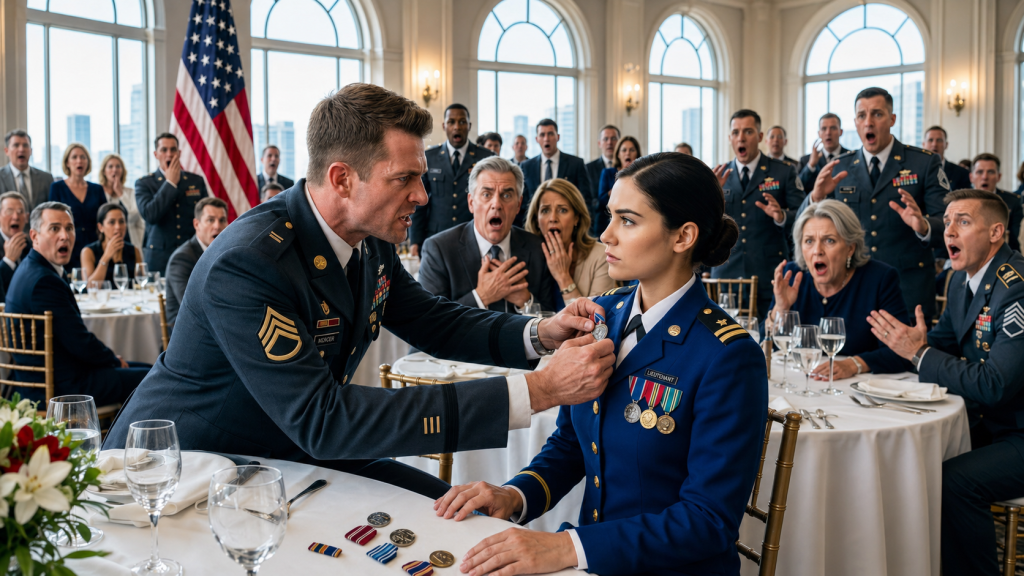
Very slowly, I reached into my bag with my free hand.
His grip tightened.
“What are you doing?”
I removed a small black presentation case.
Then I set it on the white tablecloth.
Adrian stared at it.
I opened the lid.
Inside rested the insignia and medal from my most recent flag promotion ceremony.
The tiny metallic pieces caught the amber restaurant light.
Then I placed my identification beside them.
Rear Admiral Serena Ward.
Office of Naval Intelligence.
Director, Special Strategic Assessments.
Adrian stared.
For one second.
Two.
Three.
His fingers loosened around my arm.
I pulled free.
The room seemed suddenly very quiet despite the conversations surrounding us.
Adrian looked from the insignia to my face.
Then back again.
“No.”
It came out as a whisper.
I leaned back.
“Actually, Commander…”
I allowed the pause to stretch.
“I set the rules.”
The blood vanished completely from his face.
He swallowed.
“That’s impossible.”
“Which part?”
“You’re thirty-eight.”
“Thirty-nine next month.”
“You never—”
“Told you?”
I smiled without warmth.
“You didn’t ask. You were too busy explaining leadership to me.”
His breathing changed.
Shallower.
Faster.
He stared at the identification again.
“You said you worked near the Pentagon.”
“I do.”
“You said you filed paperwork.”
“I occasionally sign paperwork.”
I leaned slightly forward.
“Some of it ends careers.”
His eyes snapped up.
That was the moment he understood.
Not merely that I outranked him.
Not merely that I had deceived him.
He finally understood that this dinner had never been his operation.
It was mine.
“You knew,” he whispered.
“I suspected.”
“Since when?”
“Since your name appeared in an unauthorized-access review connected to my father’s final assignment.”
His eyes went perfectly still.
My father, Admiral Thomas Ward, had died eleven months earlier in what the official report called a single-vehicle accident caused by mechanical failure.
I had accepted that explanation for exactly nine days.
Then one of his attorneys delivered a sealed letter.
Not a classified drive.
Not evidence.
A letter.
Serena, it began.
If you’re reading this, someone decided I knew too much.
My father had spent the final year of his life tracing an illegal procurement network that stretched through private defense contractors, foreign intermediaries, and compromised personnel inside the Navy.
Adrian Vale’s name had surfaced twice.
Never enough for an arrest.
Never enough for formal charges.
But enough for surveillance.
Enough for tonight.
My father’s letter mentioned an encrypted archive.
An archive Adrian apparently believed was hidden inside my apartment.
It wasn’t.
The drive had never been there.
The entire residence had been bait.
Adrian slowly pushed back from the table.
“I’m leaving.”
“No, you’re not.”
“You can’t detain me.”
“I haven’t.”
“Then move.”
“I’m not blocking you.”
He glanced around.
That was when he noticed them.
The man reading a newspaper at the bar.
Naval Criminal Investigative Service.
The woman sitting alone near the windows.
Defense Counterintelligence.
The waiter who had taken our order.
Federal agent.
Adrian’s face collapsed.
Every exit was covered.
He looked at me with naked fury.
“You set me up.”
“No.”
My voice remained calm.
“You set yourself up the moment you sent men into the private residence of a flag officer searching for classified material.”
“You have nothing connecting me to those men.”
My secure phone vibrated once.
I checked it.
Jonas.
Package secured.
Three detained.
Audio recovered.
Adrian must have read the answer in my expression.
“What?”
I turned the screen toward myself.
“Martin Cole is in custody.”
His nostrils flared.
“He’s talking.”
“That’s a lie.”
“Probably.”
I shrugged.
“But your reaction was useful.”
His eyes filled with hatred.
“You arrogant—”
He reached beneath his jacket.
Three people moved simultaneously.
The man at the bar stood.
The woman by the window reached inside her coat.
The waiter dropped the pleasant expression completely.
“Hands where we can see them, Commander.”
Adrian froze.
Every civilian instinct in the restaurant suddenly awakened.
People stopped eating.
A chair scraped backward.
Someone whispered, “Oh my God.”
Adrian slowly raised both hands.
He looked at me as if I had betrayed him personally.
“You think you won?”
“No.”
I closed the presentation case.
“I think we’re finally beginning.”
They escorted Adrian through a private service exit seventeen minutes later.
No dramatic handcuffs in the center of the dining room.
No television cameras.
No shouting.
Men like him often imagined their downfall would be cinematic.
It rarely was.
Sometimes ruin looked like a quiet elevator ride beside two investigators who already knew your secrets.
I remained at the table.
The waiter who was actually Agent Morales returned wearing his real expression.
“We recovered three devices from the residence,” he said quietly. “One had remote access credentials matching a secure naval network.”
“Adrian’s?”
“We’re verifying.”
“And Cole?”
“Alive, angry, and suddenly very interested in cooperation.”
I nodded.
“Jonas?”
“Waiting outside.”
I stood.
Then my personal phone began ringing.
Not the encrypted one.
My regular phone.
Mom.
Of course.
I almost ignored it.
Instead, I answered.
“Hello?”
Her voice exploded through the speaker.
“Serena! What did you do?”
I closed my eyes briefly.
“Good evening, Mother.”
“Adrian’s mother just called me hysterical! She says he’s been taken by federal agents!”
“That sounds inconvenient.”
“Don’t joke!”
“I’m not joking.”
“What happened?”
I walked toward the restaurant’s private corridor.
“He committed several serious crimes.”
Silence.
Then:
“Adrian?”
“Yes.”
“Commander Vale?”
“The same.”
“That’s ridiculous. He comes from an excellent family.”
Apparently treason was acceptable if one’s parents owned property in Annapolis.
“Mom.”
“Did you embarrass him? Is this because the date went badly?”
I actually stopped walking.
For almost forty years, I had trained myself not to let my mother’s words reach places she hadn’t earned the right to touch.
But some habits survive every promotion.
Every medal.
Every classified briefing.
Every room where powerful men stopped talking when you entered because your signature could change national policy.
To my mother, I was still the disappointing daughter who couldn’t keep a boyfriend.
“You think federal agents arrested a Navy commander because I didn’t enjoy dinner?”
“I don’t know what to think! You never tell me anything!”
That sentence landed differently.
Because it was true.
Not for the reasons she thought.
I had hidden my career because much of it was classified.
But I had also hidden parts that weren’t.
My promotion.
My command.
My commendations.
My authority.
Somewhere along the way, secrecy had become easier than enduring her ability to minimize everything I accomplished.
“You’re right,” I said.
She went silent.
“I don’t tell you much.”
“Well—”
“But have you ever asked why?”
Another pause.
“Serena…”
“You told me to be grateful Adrian looked my way.”
“I was trying to help.”
“You told him I was lonely.”
“I said you worked too much.”
“You told him I needed a man who could ‘handle’ me.”
Her silence confirmed it.
I felt something inside me finally settle.
Not break.
Settle.
Like an object finally placed where it belonged.
“Do you know what Adrian did tonight?”
“What?”
“He arranged for three men to break into my home while he kept me occupied.”
My mother gasped.
“He grabbed me when he believed I was becoming suspicious.”
“Oh my God.”
“He was searching for something connected to Dad.”
Her breathing stopped.
For the first time, all the defensiveness vanished.
“What do you mean connected to your father?”
I looked through the glass doors toward the dark Chesapeake.
“Dad didn’t die because his brakes failed.”
The silence on the other end became enormous.
“What?”
“I can’t explain everything yet.”
“Serena…”
“But Adrian may have been part of the network Dad was investigating.”
My mother made a small sound.
Not quite a sob.
For once, I wasn’t angry with her.
Whatever she had done to me, she had loved my father.
And she had spent eleven months believing his death was random.
“So this date…”
Her voice trembled.
“Yes.”
“He knew who you were?”
“He knew I was Thomas Ward’s daughter.”
“But not…”
“Not who I am.”
“What do you mean?”
I looked down at the black case still in my hand.
Maybe I was tired.
Maybe nearly losing my father’s investigation had finally exhausted my instinct for secrecy.
Or maybe I had simply reached the point where I no longer needed my mother to approve of my life before I admitted it existed.
“I’m a Rear Admiral, Mom.”
Nothing.
I almost checked whether the call had disconnected.
Then she whispered:
“What?”
“I was promoted seven months ago.”
“Rear… Admiral?”
“Yes.”
“But you said you were an analyst.”
“I was an analyst fifteen years ago.”
“I don’t understand.”
“You never asked.”
That ended the conversation more effectively than anger ever could.
Three days later, Adrian Vale was formally placed under military investigation.
Within two weeks, Martin Cole provided investigators with access to an offshore communications archive.
The evidence was worse than we expected.
Adrian had been feeding procurement schedules, vessel-maintenance vulnerabilities, and restricted deployment information to a private intermediary operating through two shell companies.
He told investigators he had never considered himself a traitor.
That fascinated me.
Apparently betrayal became respectable if you called it consulting.
But the archive contained something else.
A recording.
My father’s voice.
It had been made six days before his death.
I listened to it alone in my office.
“If they come after Serena,” Dad said, “they’ve already lost.”
My throat tightened.
His voice continued.
“She’s better than I ever was at seeing the move after the move. Don’t underestimate her because she doesn’t announce herself.”
I covered my mouth.
For eleven months, I had refused to cry where anyone could see me.
That morning, behind a locked office door, I finally did.
My father had known.
Not that he would die.
But that the investigation had become dangerous.
He had intentionally allowed rumors to spread about an encrypted drive.
Then he had sent different fragments of false information through separate channels.
Adrian’s group chased the fragment that led to me.
That was how we identified the leak.
My father had turned his own murderers’ greed into a trail.
His last operation had ended with his daughter finishing it.
Six months later, twelve people had been charged across military and civilian jurisdictions.
Two contracting companies lost their licenses.
A foreign intermediary was arrested overseas.
Adrian accepted a plea agreement after investigators showed him the full evidence package.
He lost his commission.
His clearance.
His career.
And eventually, his freedom.
I never visited him.
I never needed to.
People sometimes imagine revenge means watching the person who hurt you suffer.
I discovered something better.
Becoming so completely unreachable that their punishment no longer matters.
My mother changed too.
Not immediately.
People rarely transform simply because they discover they were wrong.
At first, she apologized constantly.
Then she tried explaining.
Then defending.
Then apologizing again.
Finally, one Sunday afternoon, she came to my townhouse carrying a cardboard box.
Inside were dozens of newspaper clippings about my father.
Photographs.
Old ceremony programs.
And beneath them, a small velvet case.
Dad’s first command pin.
“He wanted you to have this,” she said.
I stared at it.
“Why didn’t you give it to me?”
Her eyes filled with tears.
“Because I was angry.”
“At me?”
“At everything.”
She looked down.
“Your father understood your world. I didn’t. After he died, every time you disappeared into work, it felt like losing him again.”
That didn’t erase the things she’d said.
But it explained something.
Sometimes understanding isn’t forgiveness.
Sometimes it’s simply the first honest brick in a bridge.
She rubbed her thumb against the cardboard box.
“I thought if you married someone like Adrian, maybe you’d have a normal life.”
I almost laughed.
“What exactly is a normal life?”
She gave a watery smile.
“I’m beginning to suspect I’ve never known.”
I took my father’s pin.
Then she looked around my living room.
Her eyes landed on a framed photograph from my promotion ceremony.
Uniform.
Stars.
Full honors.
My mother stared at it for a long time.
“You really are an admiral.”
“I’ve been trying to tell you.”
“No.”
She shook her head.
“You haven’t.”
Fair.
Then she looked at me.
“But maybe now I’ll listen.”
A year after that disastrous blind date, I returned to the Harbor Room.
Not for romance.
Not for an operation.
For dinner.
Alone.
The Chesapeake was calm that evening.
Moonlight stretched across the water, turning the surface silver.
The same waiter from the first night approached my table.
An actual waiter this time.
“Would you like to see the menu, Admiral?”
I smiled.
“Yes.”
“And may I recommend the sea bass?”
I laughed.
“Absolutely not.”
He looked horrified until he realized I was joking.
“Salmon?”
“No.”
I opened the menu.
“I think I’ll choose for myself.”
“Of course.”
As he walked away, my phone buzzed.
A message from my mother.
There’s a cardiologist at my church who’s single.
I stared at it.
Then another message arrived.
I’m kidding.
Then:
Mostly.
I laughed so loudly that the couple at the next table looked over.
For the first time in years, I didn’t care.
I thought about Adrian.
About that moment when he grabbed my arm and told me I would follow his rules.
Men like him confuse authority with dominance.
They believe leadership is making other people smaller.
They believe strength means controlling the room.
My father taught me something different.
Real authority doesn’t need to announce itself.
Real strength doesn’t need to humiliate anyone.
And real power is knowing exactly who you are before someone else tries to tell you.
That night, I ordered dinner, watched the moon rise over the Chesapeake, and raised my glass toward the empty chair across from me.
“To you, Dad,” I whispered.
My father had spent his life protecting secrets.
In the end, one of those secrets protected me.
And Adrian?
He had walked into that restaurant believing he was meeting a lonely Pentagon clerk whose mother had practically begged him to give her a chance.
He thought I was seven minutes late.
He never realized—
he was already eleven months behind.
And by the time my medal touched that table with one sharp metallic clink…
his entire operation had already fallen apart.
He wanted me to follow his rules.
Instead, he learned the lesson my father had taught me long before I ever wore stars on my shoulders:
Never underestimate the quietest person at the table.
Sometimes she isn’t waiting for permission to speak.
Sometimes she’s waiting for you to finish confessing.
THE END! THANK YOU FOR READING!❤️