 Reading Time: 13 minutes
I brought my late grandmother’s necklace into a pawn shop because I needed rent money. I did not bring it there because I wanted to. I brought it there because desperation has a way of making your hands do things your heart begs you not to do.
After my divorce, I had almost nothing left. A cracked phone. Two trash bags of clothes. A worn shoebox full of old photographs. And my grandmother’s necklace. My ex-husband, Daniel, had taken nearly everything else.
He took the apartment because his name was on the lease.
He took the car because his father had helped with the down payment.
He took the furniture because he claimed he had paid for “most of it,” even though I had scrubbed it, repaired it, decorated it, and lived with it for years.
He even took the good coffee maker.
I remember standing in the empty bedroom on the last day, holding a trash bag of clothes in one hand and my grandmother’s shoebox in the other.
Daniel leaned against the doorframe, already impatient.
“You got everything?” he asked.
I looked around the room where I had lost a baby, lost a marriage, and finally lost the illusion that love made people kind.
“Yes,” I said.
He glanced at the shoebox.
“What’s in there?”
“Nothing you want.”
He laughed.
“Then I’m sure it’s worthless.”
That was Daniel.
If he could not sell it, spend it, or show it off, he thought it had no value.
Three months earlier, I had miscarried.
I was ten weeks along.
It was early enough that some people acted like I should recover quickly, but late enough that I had already imagined everything.
A name.
A crib.
A tiny hand curled around my finger.
Daniel did not hold me when it happened.
He drove me home from the clinic in silence, then said he needed air.
The air turned out to be a twenty-four-year-old receptionist from his gym.
By the time I found out, he was already half gone.
By the time the divorce papers came, he was fully gone.
He told people I had become “too sad to live with.”
That was how he explained abandoning his wife after a miscarriage.
I let him have his story.
I was too tired to fight everyone’s opinion of me.
For weeks, I lived off diner tips and stubbornness.
My friend Rosa let me sleep on her couch for ten days.
Then I found a tiny studio apartment above a closed bakery on the edge of downtown.
It smelled like sugar when the heat came on.
The walls were thin.
The sink dripped.
The window stuck in the frame.
But it was mine.
Or at least, it was supposed to be.
I worked double shifts, smiled at customers who snapped their fingers, carried plates until my wrists ached, and counted tips under a yellow kitchen light every night.
Still, I fell behind.
Grief is expensive in ways no one warns you about.
You miss work.
You forget bills.
You buy food you cannot eat.
You pay for prescriptions, bus rides, late fees, and all the little costs of trying not to fall apart in public.
Then one afternoon, I climbed the stairs to my apartment and saw a red notice taped to my door.
FINAL WARNING.
My rent was overdue.
I had three days.
I stood in the hallway reading the notice while someone’s television played loudly behind the next door.
Three days.
No family to call.
No savings.
No husband.
No baby.
Just me, a shoebox, and a necklace I had promised never to sell.
That night, I sat on my bed and opened the shoebox.
Inside were photographs of my grandmother, Merinda.
Everyone called her Nana.
In the photos, she was always serious.
Dark hair pulled back.
Sharp eyes.
A mouth that rarely smiled but always softened when she looked at me.
She raised me after my mother died when I was a baby.
At least, that was what I had always been told.
My father was unknown.
My mother had been young.
Nana never liked talking about it.
“Some stories are not ready until you are strong enough to carry them,” she once told me.
I used to think that was just an old woman’s way of avoiding painful memories.
At the bottom of the shoebox was the necklace.
Wrapped in a square of faded blue silk.
I lifted it carefully.
It was heavier than it looked.
Gold, but not bright.
Warm.
Old.
At the center hung a deep red stone surrounded by tiny engraved leaves.
On the back of the pendant was a mark I had never understood.
A bird with outstretched wings over three stars.
Nana had given it to me two weeks before she died.
Her hands were thin by then.
Her voice was weak.
But her eyes were fierce.
“Promise me you will keep this,” she whispered.
“I promise.”
“No matter what anyone tells you.”
I frowned.
“Who would tell me anything?”
She squeezed my hand.
“One day, someone may recognize it.”
I had thought she was confused from the medication.
“Nana, what does that mean?”
But she only closed her eyes.
“If you ever have nowhere else to go, take it to a man named Howard Vale. He used to own a pawn shop downtown.”
That was all.
After she died, I kept the necklace hidden.
Through moves.
Through marriage.
Through every argument with Daniel.
I never wore it.
It felt too important.
Too private.
Too connected to the only person who had loved me without conditions.
Now I held it in my palm and cried.
“I’m sorry, Nana,” I whispered. “I just need one more month.”
I cried the entire night over what I was about to do.
The next morning, I put the necklace in my coat pocket and walked downtown.
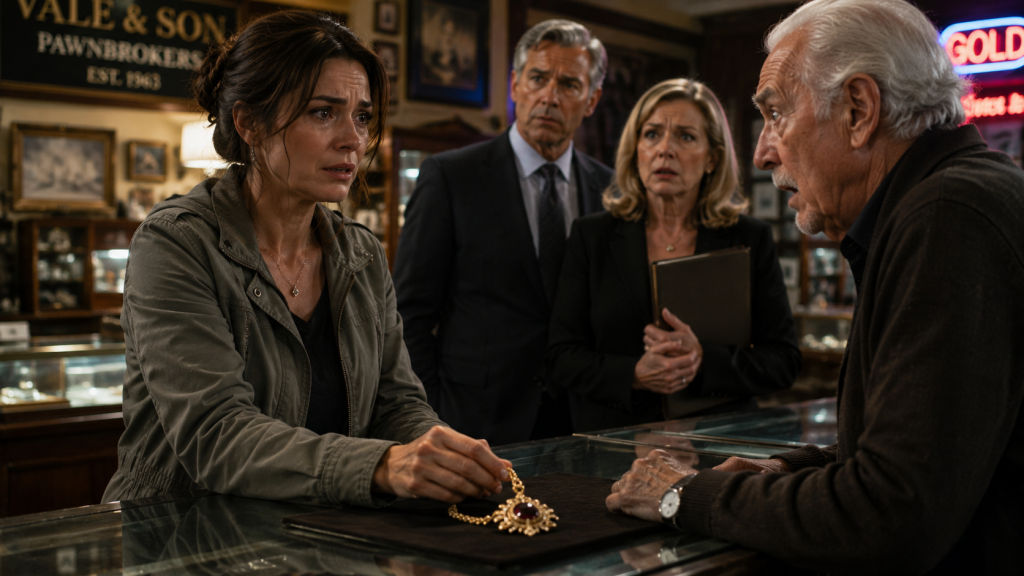
The pawn shop sat between a check-cashing place and an old barber shop.
Vale & Son Pawnbrokers.
The sign looked like it had been hanging there for fifty years.
The bell over the door jingled when I entered.
Inside, the air smelled like dust, metal, and lemon cleaner.
Glass cases held rings, watches, coins, guitars, and things people had surrendered when life pressed too hard.
An old man stood behind the counter, polishing a pocket watch.
“Can I help you, ma’am?” he asked.
His voice was kind.
That almost broke me.
“I need to sell this.”
I placed the necklace on the counter like it might hurt me.
He barely glanced at it.
Then his hands froze.
The cloth slipped from his fingers.
The color drained from his face so quickly I thought he might collapse.
He leaned closer.
Then closer.
“Where did you get this?” he whispered.
“It was my grandmother’s.”
His eyes snapped to mine.
“What was your grandmother’s name?”
“Merinda L.”
His mouth opened.
Then shut.
He stumbled back one step as if the counter had shocked him.
“Miss,” he said, voice shaking, “you need to sit down.”
My stomach dropped.
“Is it fake?”
“No.”
He swallowed hard.
“It is very real.”
I reached for the necklace.
“Then how much can you give me? I only need enough for rent.”
He gently placed his hand near it, not touching me.
“Please don’t sell this.”
“I don’t have a choice.”
“You have more choices than you know.”
Before I could respond, he grabbed a cordless phone from under the counter and pressed a speed dial.
His hands trembled.
“I have it,” he said when someone answered. “The necklace. She’s here.”
I stepped back.
“Who are you calling?”
He covered the receiver and looked at me with wide eyes.
“Miss, the master has been searching for you for twenty years.”
The word master made my skin prickle.
“What master?”
Before he could answer, a lock clicked behind the showroom.
The back door opened slowly.
A tall man stepped inside wearing an expensive gray coat.
Behind him came a woman with silver hair, sharp glasses, and a leather folder pressed to her chest.
The man looked at me and stopped.
His face changed in a way I still cannot describe.
Like grief had walked into the room wearing my face.
“Elena?” he whispered.
I gripped the counter.
“My name is Clara.”
His eyes filled with tears.
“Your mother named you Elena Clara before she disappeared.”
My knees almost gave out.
“No.”
The old pawn dealer lowered the phone.
The woman with the folder stepped forward.
“My name is Vivian Shaw. I am an attorney for the Vale family.”
“Vale?” I repeated.
Howard Vale, the pawn dealer, nodded gently.
“This is Mr. Adrian Vale.”
The tall man took another step toward me.
I stepped back.
“Do not come closer.”
He stopped immediately.
“I’m sorry,” he said. “I know this is impossible.”
“Impossible is a mild word.”
Vivian opened the folder and removed a photograph.
She placed it on the glass counter.
My breath caught.
In the photo, Nana stood beside a young woman who looked almost exactly like me.
Same eyes.
Same mouth.
Same slight tilt of the chin.
The young woman held a newborn wrapped in a blue blanket.
Around her neck was the necklace.
“This is your mother,” Vivian said. “Isabella Vale.”
I stared at the photograph.
My whole life, I had only seen one blurry picture of my mother.
Nana told me most had been lost in a fire.
I touched the edge of the image.
“She looks like me.”
Adrian’s voice broke.
“She was my sister.”
I looked up.
“Your sister?”
He nodded.
“My younger sister.”
I could not breathe properly.
“That means…”
“I am your uncle.”
The pawn shop seemed to spin.
I grabbed the nearest chair and sat down.
Howard poured water into a paper cup and handed it to me.
My hands shook so badly water spilled onto my coat.
“No,” I said. “My grandmother raised me. My mother died when I was a baby. That’s what I was told.”
Adrian’s face twisted with pain.
“We were told you died too.”
The cup slipped from my hand.
“What?”
Vivian placed another document on the counter.
A death certificate.
My name was on it.
Elena Clara Vale.
Date of death: twenty years earlier.
Age: nine months.
My vision blurred.
“That’s not possible.”
“No,” Vivian said. “It was fraudulent.”
I stared at the paper.
Someone had declared me dead while I was still alive.
While Nana was feeding me, bathing me, teaching me how to tie my shoes, wiping my tears, making pancakes on Sundays.
“Why?” I whispered.
Adrian looked at the necklace.
“Because you were the last direct heir.”
The words meant nothing at first.
He explained slowly.
The Vale family was old money.
Not famous celebrity money.
Quiet money.
Real estate, shipping investments, land trusts, private foundations.
My grandfather, Adrian’s father, had controlled the estate.
When Isabella became pregnant, she refused to reveal the father’s identity.
There was conflict.
Arguments.
Threats.
Then one night, Isabella disappeared with me.
According to official records, she died in an accident months later, and I died with her.
But no bodies were ever properly identified.
“My father believed the documents,” Adrian said. “I never did.”
Vivian added, “Your grandmother Merinda was not your grandmother by blood. She worked for the Vale family for many years. She helped Isabella escape.”
I gripped the necklace.
“My Nana was my grandmother.”
Adrian nodded quickly.
“Yes. In every way that matters.”
That softened me slightly.
Not much.
But enough to keep listening.
Vivian opened another page.
“The necklace is not only jewelry. The pendant contains your family crest and a hidden serial mark. Each primary heir had one piece made and registered. This one belonged to Isabella. She must have given it to Merinda for you.”
“Why didn’t Nana tell me?”
Adrian’s eyes filled again.
“Because the people who erased you had power. If they knew you were alive, they could come for you.”
My mouth went dry.
“Who?”
Vivian hesitated.
Adrian answered.
“My father’s business partner. Charles Renwick. He took control of several trusts after Isabella and you were declared dead. When my father died, Renwick became executor of a large portion of the estate.”
“Is he still alive?”
“Yes,” Vivian said. “And very wealthy because of what happened.”
I looked around the pawn shop.
The cases.
The watches.
The necklace on the counter.
I had come in hoping for rent money.
Now strangers were telling me I had been erased for inheritance.
“This is insane,” I said.
“Yes,” Vivian replied. “But it is documented.”
She showed me birth records.
Photographs.
Letters from Isabella to Merinda.
A trust document listing Isabella’s child as beneficiary.
A note written by Nana.
My hands shook when I saw her handwriting.
If Elena ever comes to you with the necklace, protect her first. Explain later. She has lost enough.
I pressed the page to my chest.
For the first time since entering the shop, I cried.
Not delicate tears.
Not movie tears.
The kind that come from your bones.
Nana had not lied because she did not love me.
She lied because she was trying to keep me alive.
Adrian knelt in front of me, still careful not to touch me.
“I searched for you for twenty years,” he said. “Every lead ended in nothing. Every time I thought I found you, the trail disappeared. Then I gave Howard instructions. If the necklace ever appeared, call me.”
I wiped my face.
“How do I know this is not some scam?”
Vivian’s expression softened.
“You don’t. Not yet. So you should take time. Hire your own attorney. Verify every document. We will pay for independent counsel if needed, but you choose the lawyer.”
That answer made me trust her more than any dramatic promise could have.
A scammer would have rushed me.
They did not.
Howard pushed the necklace back toward me.
“Take it, child,” he said. “This was never meant to be sold.”
I closed my hand around it.
“What happens now?”
Vivian slid a card across the counter.
“Now we prove you are Elena Clara Vale.”
“And if you do?”
Adrian looked at me with something like awe and sorrow.
“Then the trust your mother created for you becomes yours.”
“How much?” I asked.
I hated that my voice shook.
Vivian did not answer immediately.
“That depends on the court ruling, recovered assets, and Renwick’s opposition.”
“Just tell me.”
Adrian swallowed.
“Enough that your ex-husband should be very afraid he abandoned you.”
I laughed once.
A strange, broken sound.
Daniel had left me with trash bags.
He thought I was worthless.
He had no idea I had walked out carrying the key to a life stolen before I could speak.
The next weeks became a blur.
DNA tests.
Lawyers.
Private investigators.
Court filings.
Old records.
Vivian introduced me to an attorney named Marisol Crane, who represented me independently.
Marisol was direct, sharp, and allergic to nonsense.
After reviewing the documents, she sat across from me and said, “Clara, I believe you are who they say you are.”
My hands went cold.
“What does that mean?”
“It means your life is about to become very complicated.”
She was right.
Charles Renwick denied everything.
His lawyers called me an opportunist.
They suggested Nana had stolen the necklace.
They questioned my timing.
They implied I had manufactured grief to gain wealth.
Marisol smiled when she read their first response.
“Good,” she said.
“Good?”
“They’re scared.”
Adrian remained steady.
He gave statements.
He produced old letters.
He cried only once, during a deposition, when shown the photograph of my mother holding me.
“I told them she would never let her baby die alone,” he said. “No one listened.”
The DNA results came back on a Thursday.
Probability of biological relationship between Adrian Vale and Clara: 99.98%.
I stared at the page.
I had family.
Blood family.
Living family.
Not the kind that raised me.
Nana had done that.
But a family that had searched.
That had mourned.
That had been lied to too.
I went to Nana’s grave that afternoon.
The necklace hung around my neck for the first time.
I sat in the grass and told her everything.
“I know,” I whispered. “I know you saved me.”
The wind moved through the trees.
For a moment, I imagined her sitting beside me, sharp-eyed and serious.
Some stories are not ready until you are strong enough to carry them.
“I’m strong now,” I said.
The court case took nearly a year.
During that time, Daniel heard rumors.
Of course he did.
Men like him always develop interest when money enters the room.
He called me from a new number.
“Clara,” he said warmly, as if he had not left me broken.
I almost hung up.
“What do you want?”
“I heard some things. Are you okay?”
I smiled into the phone.
“Funny. You never asked that after the miscarriage.”
Silence.
Then, “I made mistakes.”
“You made choices.”
“I was grieving too.”
“No,” I said. “You were dating a gym receptionist.”
He sighed.
“Can we meet?”
“No.”
“We were married. If something is happening financially, I may have a right to—”
I hung up.
Then I sent the number to Marisol.
She laughed for a full ten seconds.
“Predictable,” she said.
Daniel tried once more through an attorney.
Marisol responded with the divorce decree, which confirmed he had waived all future claims to separate inheritances, family trusts, and assets acquired after separation.
My father may not have been known to me then.
But Nana had taught me enough to read before signing.
When the final ruling came, I sat in court between Marisol and Adrian.
The judge recognized me legally as Elena Clara Vale, daughter of Isabella Vale, beneficiary of the Isabella Vale Trust.
The fraudulent death certificate was voided.
An investigation into Renwick’s handling of the estate was ordered.
Several accounts were frozen.
Properties were placed under review.
I did not understand all the legal details.
I only understood the sentence that made Adrian cover his face with both hands.
“The petitioner’s identity is restored.”
Restored.
Not created.
Not gifted.
Restored.
Something stolen had been returned.
After court, Adrian hugged me for the first time.
He asked permission first.
That mattered.
I said yes.
He held me gently, like he was afraid I might disappear again.
“I wish Isabella could see you,” he whispered.
I cried into his coat.
“What was she like?”
He pulled back, smiling through tears.
“Stubborn. Brilliant. Terrible at baking. Loved old movies. Hated being told what to do.”
I laughed.
“That sounds familiar.”
Over time, I learned more.
My mother had not abandoned me.
She had run because she feared Renwick and the people around him.
Nana had helped her hide.
But Isabella became sick after childbirth.
Complications.
No hospital records under her real name.
She died when I was nine months old.
Nana buried her quietly and kept running with me.
She became my grandmother because love is not always biological.
Sometimes it is a promise kept in secret for twenty years.
The trust did not make me instantly happy.
Money cannot repair a miscarriage.
It cannot erase betrayal.
It cannot bring back Nana or my mother.
But it can create safety.
And safety is not a small thing.
I paid my rent.
Then I bought the building above the old bakery.
I fixed the dripping sink.
Repaired the window.
Repainted the walls.
I kept the little studio as my first true place of survival.
Later, with Adrian’s help, I started a foundation in Nana’s name for women leaving abusive marriages and rebuilding after loss.
The Merinda House Fund.
Its first grant paid rent for a woman with two children whose husband had emptied their account.
The second helped a waitress get her car repaired so she could keep working.
The third covered legal fees for someone whose ex thought poverty would force her back.
Every check felt like a message to my past self.
Hold on.
Help is coming.
One afternoon, months after the ruling, I returned to Vale & Son Pawnbrokers.
Howard was behind the counter, polishing a watch just like the first day.
He smiled when he saw me.
“Miss Elena.”
I shook my head.
“Clara is fine.”
He nodded.
“Clara, then.”
I placed a framed photograph on the counter.
It was a copy of the picture Vivian had shown me.
Nana.
My mother.
Me as a baby.
“I thought you should have this,” I said.
Howard’s eyes misted.
“She would be proud.”
“Which one?”
He smiled.
“Both.”
I touched the necklace at my throat.
“I came here to sell it.”
“But you didn’t.”
“No,” I said. “You stopped me.”
He shook his head.
“The necklace stopped you. I only recognized it.”
That night, I stood in front of the mirror in my apartment.
For the first time, I looked at the necklace not as a memory of poverty, grief, or desperation.
I saw it as proof.
Proof that Nana loved me enough to lie to the world.
Proof that my mother had existed.
Proof that I had survived people who wanted me erased.
Daniel had once told me I had nothing.
He was wrong.
I had my grandmother’s shoebox.
I had a necklace.
I had a name buried under a false death certificate.
I had a family that had searched for me.
Most of all, I had the one thing no court could grant and no husband could take.
I had remained myself.
I walked into that pawn shop ready to sell the last piece of my past just to survive one more month.
Instead, I found the truth.
My grandmother had not left me jewelry.
She had left me a key.
And when the right door finally opened, I did not find a fairy tale waiting behind it.
I found something better.
Justice.
A family.
A future.
And the voice of the woman who raised me, echoing through everything I became.
Keep it, child.
One day, someone may recognize it.
She was right.
Someone did.
And at last, so did I.
THE END! THANKS FOR READING!