
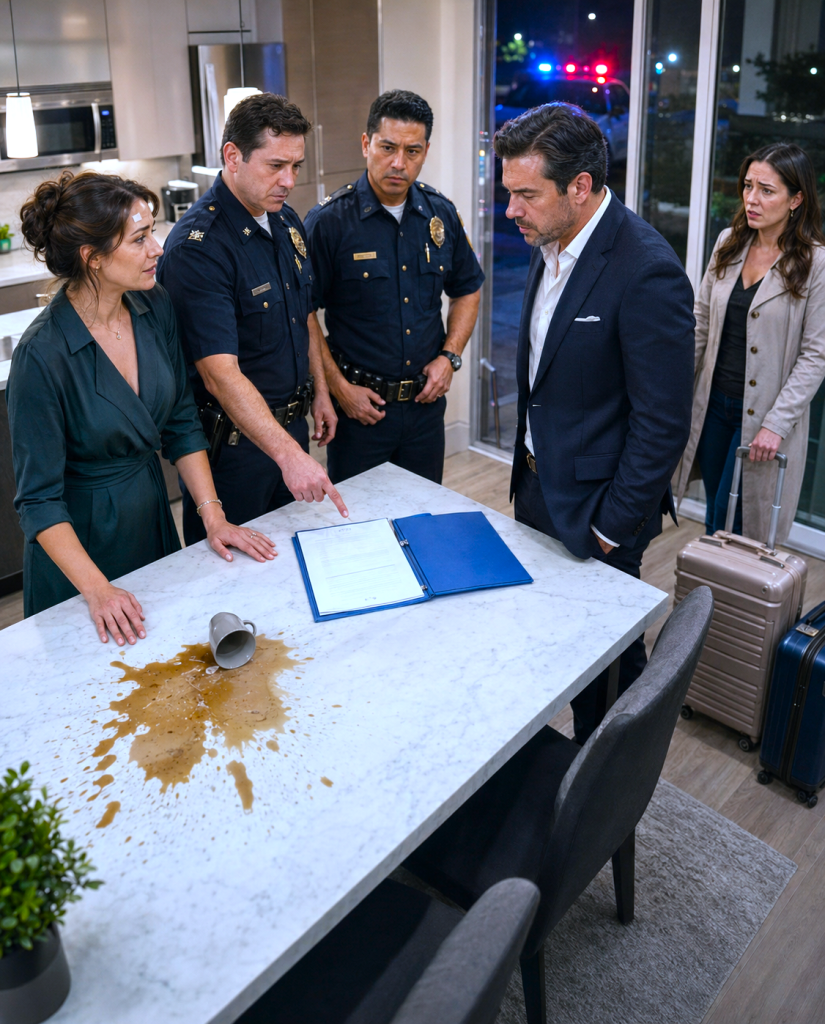
Part 2 — The Name on the Deed: He didn’t read it out loud. He didn’t need to. His mouth moved once, silently, over the single name printed at the top of the deed, and Brenda, still standing frozen with her suitcase against her ankle, leaned over his shoulder to see it for herself.
“That’s not possible,” she said. “You told me this was your place. You told me she just lived here.” The officer looked between them, his expression carefully neutral in the way officers learn to maintain during exactly these moments. “Sir, can you confirm you don’t hold ownership interest in this property?”
Iván’s jaw worked silently for a moment before he found words. “My father-in-law bought this apartment as a wedding gift. I assumed it was in both our names.”

“It’s in my name alone,” I said, finally speaking. “My father gave it to me before we married, specifically in my name, because he never fully trusted you, Iván. I never corrected your assumption because it never seemed important enough to argue about, until today.”
“You let me believe—” he started.
“I let you believe whatever made you easiest to live with,” I said. “That was my mistake, not yours to weaponize.”
The second officer, who’d been quietly documenting the scene, turned to Brenda. “Ma’am, can I ask what you intended to do with those suitcases this evening?”
Brenda’s face flushed. “Iván told me to grab some things. He said Alejandra owed the family, that it was time to collect.”
“Collect,” I repeated. “You mean steal, while I was at the hospital getting burns documented from the coffee your brother threw at my face.”
“I didn’t know about the coffee,” Brenda said quickly, though her eyes wouldn’t meet mine.
“You knew enough to bring empty suitcases,” the officer said.
Iván’s confidence, the same unshakable certainty that had carried him through years of controlling our household, was visibly collapsing in real time, piece by piece, as he understood the full scope of what he’d walked into. “Alejandra, we can talk about this. Privately. This doesn’t need to involve the police.”
“It already involves the police,” I said. “It involved them the moment you decided burning my face was an acceptable way to negotiate.”
Part 3 — What the Neighbors Had Already Told Investigators
The officers separated Iván and Brenda into different rooms before continuing their questioning, standard procedure, one explained to me quietly, for situations involving potential coercion between family members present at a scene.
While they worked, I sat at the dining table with my folder of documents, the deed now returned to its place among years of careful, quiet preparation I hadn’t fully realized I’d been assembling until that exact evening — bank statements showing years of Iván’s controlling oversight of my spending, photographs I’d discreetly taken of bruises from earlier, smaller incidents I’d previously explained away as accidents even to myself, and a growing folder of Brenda’s “borrowed” items that had never once been returned.
Officer Delgado, who’d taken my initial statement at the hospital, returned to update me once his partner finished with Iván. “We’ve also reached out to a few of your neighbors, given the noise complaint history on file for this address. Two separate neighbors confirmed hearing raised voices and what sounded like physical altercations on multiple previous occasions.”