 Reading Time: 19 minutes
I married a man thirty years older for his fortune. After his funeral, his lawyer gave me a box and said, “He made sure you got exactly what you deserved.” Everyone thought I married Russell for his money. They were not entirely wrong.
I was thirty-two, drowning in bills, and one missed paycheck away from losing my apartment. Russell was sixty-two, wealthy, widowed, and lonely in a way rich people try to hide with marble floors and expensive watches. We met at a charity dinner where I was serving champagne.
He asked my name.
Then he asked if my feet hurt. No man had asked me that in years. Three months later, he proposed. My friends called me insane.
His children called me worse.
“You think you’re getting the house?” his daughter hissed at me after the wedding. “You’ll get nothing.”
Russell heard her.
He only smiled and said, “She’ll get exactly what she deserves.”
I told myself I did not care what they thought.
But the truth was, I liked the comfort.
The warm house.
The quiet mornings.
The way I no longer checked my bank account before buying groceries.
Russell was kind to me.
Kinder than I expected.
And somewhere along the way, shamefully, inconveniently, I stopped pretending I did not care about him.
My name is Elise.
Before Russell, my life had been a long series of almosts.
I almost finished college, but my mother got sick and I had to work.
I almost saved enough money to move somewhere nicer, but then my car engine died.
I almost got promoted at the catering company, but the owner’s niece needed a job.
I was not lazy.
I was not foolish.
I was simply tired in the way poor people are tired, where every day begins with math and ends with choosing which bill can wait.
Rent.
Electricity.
Medication for my mother.
Credit card interest.
Gas.
Food.
Another late fee.
Another apology.
Another month survived but not escaped.
So when Russell Whitmore asked my name at that charity dinner, I was standing in shoes that had rubbed my heels raw, holding a tray of champagne glasses, smiling at people who donated more in one evening than I made in three months.
He sat alone near the back of the ballroom, not because no one knew who he was, but because everyone did.
People looked at him with calculation.
Investors.
Board members.
Socialites.
Women with glittering necklaces and practiced laughter.
He watched them all with an expression that was not cold exactly.
Just distant.
When I offered him champagne, he said, “No, thank you.”
Then he looked down at my shoes.
“Do your feet hurt?”
I blinked.
“What?”
“Your left foot. You’re shifting weight away from it.”
I should have laughed it off, but something about his voice made honesty easier.
“They’re killing me.”
He nodded toward the empty chair beside him.
“Sit for two minutes. I’ll pretend you’re explaining the menu.”
I almost refused.
Then pain decided for me.
I sat.
He asked my name.
“Elise Carter.”
“Russell Whitmore.”
“I know.”
That made him smile.
“Of course you do.”
I expected arrogance.
Instead, he sounded weary.
For those two minutes, we talked about nothing.
The overcooked salmon.
The terrible string quartet.
The way charity dinners somehow made helping people feel expensive and distant.
When my manager saw me sitting, his eyes nearly jumped out of his head.
I stood quickly.
Russell noticed.
“Will you be in trouble?”
“Probably.”
He raised one hand, and my manager immediately transformed from furious to delighted.
“Mr. Whitmore, is everything all right?”
“Perfect,” Russell said. “Miss Carter was helping me understand the program. She’s very good at her job.”
My manager beamed like I had saved the evening.
That was the first thing Russell gave me.
Not money.
A rescue so subtle I did not have to feel embarrassed.
The second thing he gave me was his card.
Not in a creepy way.
Not with a wink.
He simply placed it beneath the untouched champagne glass and said, “If you ever need a better job, call my office. You should not be punished for painful shoes.”
I did not call for three weeks.
Pride is funny when you are broke.
It will let you eat toast for dinner before it lets you admit you need help.
Then my landlord taped a final notice to my door.
My mother’s prescription refill came due.
And my checking account had forty-three dollars in it.
I called.
Russell did not offer me money.
He offered me work.
A temporary administrative role at one of his charitable foundations.
Filing.
Scheduling.
Donor correspondence.
Nothing glamorous.
But it paid almost twice what catering did.
On my first day, I expected him to flirt.
He did not.
He passed through the office, asked if the chair was comfortable, and left.
That was Russell.
Small kindnesses.
No performance.
Over the next months, I learned the rhythms of his life.
He had been widowed five years.
His wife, Caroline, had died of a heart condition after forty years of marriage.
He had three adult children.
Vanessa.
Martin.
Graham.
They all called often when they wanted something.
Rarely when they did not.
Russell did not complain about them.
That was the sad part.
He defended them even when they were cruel.
“Vanessa has always been spirited,” he would say after she snapped at staff.
“Martin is under pressure,” he would say when Martin demanded another investment.
“Graham has never known what to do with grief,” he would say when Graham forgot his birthday.
I recognized that kind of defending.
I had done it for my own mother’s drinking brother for years.
Excuses are sometimes love wearing a blindfold.
Russell began inviting me for lunch to discuss foundation projects.
Then dinner.
Then Sunday drives.
He was not flashy with me.
He did not throw diamonds at my feet or fly me to Paris.
He asked what books I liked.
He noticed I hated mushrooms.
He sent soup when my mother was in the hospital.
He remembered the anniversary of her death six months later and left white lilies on my desk with a note that said:
Grief is quieter when someone remembers.
No man had ever remembered my grief before.
When he proposed, I said no.
The first time.
We were sitting on a bench near the lake behind his house.
The house was enormous, white stone and tall windows, with gardens that looked almost too careful to be real.
He held a small velvet box in his hand.
Not open.
Just resting there.
“Elise,” he said, “I would like to marry you.”
I stared at him.
“Russell.”
“I know what people will say.”
“They’ll say I’m a gold digger.”
“Yes.”
“They’ll say you’re foolish.”
“I’ve been called worse by people with less imagination.”
I laughed despite myself.
Then I shook my head.
“No.”
His face did not fall.
He simply nodded.
“Because you don’t care for me?”
“That’s not fair.”
“Because of the money?”
“Yes.”
He looked out at the water.
“I cannot become poor to make loving me more acceptable.”
“And I cannot become your wife without everyone assuming I was bought.”
“Were you?”
I turned sharply.
He met my eyes.
Not accusing.
Asking.
That was worse.
“I don’t know,” I whispered.
He nodded again.
“Then don’t answer yet.”
Two weeks later, my mother died.
Russell came to the funeral and stood in the back.
He did not make himself visible.
He did not perform grief he had not earned.
Afterward, when everyone left and I sat alone beside the grave, he walked over and handed me a thermos of coffee.
“My Caroline hated funeral coffee,” he said quietly. “She said it tasted like sorrow and burnt dirt.”
I laughed.
Then cried.
Then leaned against him because I had no one else.
A month later, I said yes.
People think decisions are clean.
They are not.
I said yes because I cared about him.
I said yes because I was tired of being alone.
I said yes because I was afraid of poverty.
I said yes because his house was warm.
I said yes because he made me feel seen.
All of those reasons lived together.
Some noble.
Some not.
But all true.
His children hated me immediately.
Vanessa was forty-one, elegant, sharp, and furious that a woman nine years younger than her had become her stepmother.
Martin was thirty-eight, divorced twice, and dependent on Russell’s investment bailouts.
Graham was thirty-five, charming in public and cruel in private, the kind of man who called every woman “sweetheart” like it was a downgrade.
At the wedding, they smiled for photographs.
At the reception, Vanessa cornered me near the hallway.
“You think you’re getting the house?” she hissed. “You’ll get nothing.”
Russell appeared behind her.
“I heard that.”
Vanessa turned red.
“Dad, I was just—”
He smiled softly, but his eyes were tired.
“She’ll get exactly what she deserves.”
Vanessa looked satisfied, as if that meant nothing.
I pretended not to care.
I told myself the marriage was practical.
That I had not married his children.
That Russell and I had an agreement between adults.
But the first time Vanessa called me a waitress in my own kitchen, I cried in the pantry.
Russell found me there.
He said nothing at first.
He only took the dish towel from my hand and hung it on the hook.
Then he said, “You are not what they call you.”
I wiped my face.
“Maybe I am.”
“No.”
“You don’t know what I was thinking when I married you.”
He leaned against the counter.
“Perhaps not. But I know what you do.”
“What does that mean?”
“It means motives are complicated. Conduct is clearer.”
That sentence stayed with me.
Conduct is clearer.
So I tried to let my conduct tell the truth, even when my heart still argued with itself.
I learned Russell’s routines.
He liked tea at 6:30, coffee at 8, and a glass of water by his bed even though he rarely drank it.
He loved old detective novels.
He hated red roses because Caroline’s funeral had been full of them.
He liked jazz, but only on rainy afternoons.
He got quiet every Thursday evening because Caroline had died on a Thursday.
I stopped scheduling anything important then.
At first, I thought caring for him was part of the role I had accepted.
A wife performs.
A wife remembers.
A wife makes the house softer.
But over time, it stopped feeling like performance.
When he laughed, I felt proud.
When he forgot a name and pretended he had not, I worried.
When he fell asleep in the sunroom with a book open on his chest, I tucked a blanket over him without thinking.
When Vanessa visited and made cutting remarks, I no longer cried in the pantry.
I stood beside Russell and let silence answer her.
Two years into our marriage, Russell got sick.
Not suddenly.
That would have been kinder.
It began with fatigue.
Then weight loss.
Then a scan.
Then a doctor with careful eyes saying words that made the world narrow.
Pancreatic cancer.
Stage four.
I remember Russell asking, “How long?”
The doctor hesitated.
“Months. Possibly a year with treatment.”
Russell nodded like he was reviewing a contract.
I reached for his hand under the table.
His fingers closed around mine.
In the car afterward, he said, “You can leave, Elise.”
I turned toward him.
“What?”
“I would not blame you. This is not what you signed up for.”
I stared at him until he looked ashamed.
“Is that what you think of me?”
“No.”
“Then never say that again.”
He nodded.
“I’m sorry.”
That was the moment something inside me changed permanently.
Maybe I had married him for safety.
Maybe I had enjoyed the comfort.
Maybe the beginning was messy and imperfect and partly selfish.
But love had arrived somewhere along the way, quietly, without asking permission.
And now that he was dying, I could not imagine abandoning him to prove my motives pure.
His children came alive after the diagnosis.
Not with tenderness.
With inventory.
Vanessa wanted to discuss estate planning.
Martin wanted clarity about company shares.
Graham asked whether the lake house was still in the trust.
Russell’s face aged ten years during that first family meeting.
He sat in his leather chair, a blanket over his knees, while his children spoke around him as if he had already become paperwork.
I finally interrupted.
“Your father is sitting right here.”
Vanessa glared at me.
“This is a family matter.”
“I’m his wife.”
“You are his mistake.”
The room went still.
Russell closed his eyes.
When he opened them, his voice was quiet.
“Leave.”
Vanessa blinked.
“What?”
“All three of you. Leave.”
Martin sputtered.
“Dad, we’re only trying to—”
“Leave.”
They left furious.
After the door closed, Russell looked at me.
“I should have done that years ago.”
I sat beside him.
“You loved them.”
“I indulged them.”
“Sometimes those look similar.”
He smiled faintly.
“You sound like me.”
“Terrifying, isn’t it?”
He laughed then, softly, and I stored the sound away because I knew I would need it later.
The months that followed stripped life down to essentials.
Medication schedules.
Hospital beds.
Insurance forms.
Soft foods.
Night sweats.
Nausea.
Pain.
Good days measured by whether he could sit in the garden.
Bad days measured by how long I could hide my fear.
His children visited less once they realized illness was not a dramatic inheritance meeting but a long, uncomfortable, human thing.
Vanessa came twice and complained about the smell of medication.
Martin called mostly to ask whether Russell had signed documents.
Graham sent flowers and a card with his assistant’s handwriting.
I slept in the chair beside Russell’s bed.
I learned how to read pain in the corner of his mouth.
I learned how to crush pills into applesauce.
I learned that dying people apologize for needing water.
“Elise,” he whispered one night, “you should sleep.”
“So should you.”
“I’m dying. I get special rules.”
I smiled through tears.
“Then use one to stop bossing me.”
He reached for my hand.
“You stayed.”
“Yes.”
“Why?”
I looked at him.
“Because you’re my husband.”
His eyes filled.
“I was afraid you’d say because of the will.”
I almost laughed.
Then I saw he meant it.
That fear had sat inside him all along.
Not loudly.
Not accusingly.
Just there.
A shadow behind every kindness.
I leaned close.
“Russell, listen to me. I don’t care what you leave me.”
“That is not entirely true.”
I paused.
Then smiled sadly.
“No. It isn’t entirely true. Money matters. Security matters. I know too well what life costs. But I care more that you are not alone.”
He closed his eyes.
“Thank you for telling me the truth.”
“You always liked truth more than flattery.”
“Truth lasts longer.”
The next week, his lawyer came to the house.
Edmund Vale.
A tall, precise man with silver glasses and the emotional range of carved oak.
He had been Russell’s attorney for decades.
I left them alone in the study.
Vanessa called me while they were inside.
“I know Dad is changing things,” she said without greeting.
“Hello to you too.”
“If you manipulate him, I will bury you in court.”
I looked down at my hands.
They smelled faintly of antiseptic from Russell’s medicine.
“Vanessa, your father is dying.”
“And you’re circling.”
The old me might have defended myself.
The newer me simply said, “Goodbye.”
Then I hung up.
Russell died on a Sunday morning in October.
Rain tapped softly against the windows.
Jazz played low from the speaker because Saturday had been too painful and I had forgotten to turn it off.
His hand was in mine.
His last words were not dramatic.
No grand confession.
No hidden secret.
He simply opened his eyes, looked at me, and whispered, “There you are.”
Then he was gone.
I have no beautiful way to describe what happened next.
Death is quiet.
Then loud.
Calls.
Forms.
People.
Funeral home.
Flowers.
Condolences.
Clothes.
Questions.
His children arrived like a weather front.
Vanessa took charge of the funeral program without asking.
Martin asked about access to the house safe two hours after his father’s body was taken.
Graham walked through the wine cellar and pocketed two bottles until I asked him to put them back.
At the funeral, they sat in the front row.
I sat beside them.
Vanessa wore black and satisfaction.
Martin whispered to Graham during the hymn.
Patricia, one of Russell’s old friends, squeezed my shoulder and said, “He looked peaceful because of you.”
That nearly undid me.
After the burial, Vanessa hugged me in front of everyone.
Her arms were stiff.
Her perfume expensive.
Her mouth near my ear.
“Now you’ll learn what he really thought of you.”
I said nothing.
I had already lost the only person in that family who ever spoke to me gently.
Three days later, Edmund Vale called me into his office.
Vanessa and her brothers were already there when I arrived.
Of course they were.
Vanessa sat upright in a cream suit, eyes bright with anticipation.
Martin looked bored but eager.
Graham winked at the receptionist, because apparently grief had not improved him.
I wore the black dress I had worn to the funeral because I had not had the strength to choose another.
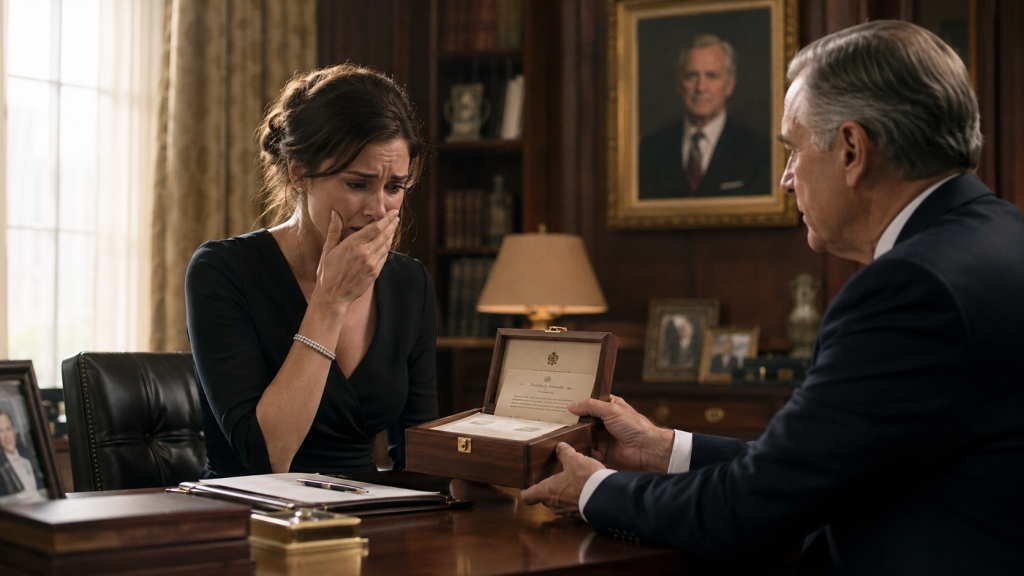
Edmund came in carrying a small wooden box.
He placed it in front of me.
“Mrs. Whitmore,” he said, “Mr. Whitmore made sure you got exactly what you deserved.”
My stomach dropped.
Vanessa laughed under her breath.
Martin smirked.
Graham leaned back.
“There it is,” Vanessa whispered. “The famous line.”
I looked at the box.
It was not large.
Not jewelry-box small, but close.
Polished walnut.
Brass latch.
My hands shook when I opened it.
Inside was not jewelry.
Not cash.
Not a deed.
It was a stack of letters.
Each one dated from the first month of our marriage.
On top was a note in Russell’s handwriting.
My darling Elise,
If they are reading this with you, let them hear the truth.
Edmund pressed play on a recorder.
Russell’s voice filled the room.
Weak, but clear.
“My children think she married me for money. Maybe she did at first.”
Vanessa smiled sharply.
Russell continued.
“I know because Elise was honest enough to never pretend poverty had not frightened her. I valued that honesty more than your performances.”
Vanessa’s smile faded.
“She came into my life with empty pockets and tired eyes. I came into hers with money, loneliness, and arrogance disguised as generosity. None of us began cleanly.”
My throat tightened.
On the recording, Russell took a slow breath.
“But over the years, she became the only person in this family who did not treat my life as a waiting room for my death.”
Graham shifted in his chair.
Martin stared at the floor.
Vanessa’s hands clenched.
Russell’s voice continued.
“When I became ill, she stayed. She learned every medication. She slept in chairs. She argued with doctors. She cleaned what pride told me no one should see. She made me laugh when my body had become a prison. She was my wife in the only way that matters.”
I covered my mouth.
Edmund did not look at me.
He was staring at the recorder like he had heard the message before and still respected it.
“So yes,” Russell said, “she gets exactly what she deserves: everything you tried to take from her.”
Vanessa stood so fast her chair struck the wall.
“No.”
Edmund stopped the recorder.
Then opened a folder.
“Mr. Whitmore’s final estate documents are clear.”
Martin leaned forward.
“What does everything mean?”
Edmund adjusted his glasses.
“The primary residence, the lake house, the personal investment accounts outside the family trust, the art collection, and the liquid assets listed in Schedule B transfer to Mrs. Elise Whitmore.”
Vanessa’s face went white.
“You’re lying.”
“I am not.”
“What about the company?”
“The company remains in the existing trust structure with voting controls assigned to the board, not to any of you individually.”
Graham sat up.
“Wait, what?”
Edmund continued.
“Each of you receives the amount designated in your prior trust disbursement schedule, reduced by outstanding loans and advances taken from Mr. Whitmore over the last decade.”
Martin’s mouth fell open.
“Reduced?”
“Yes.”
Vanessa pointed at me.
“She manipulated him.”
Edmund looked at her coolly.
“Your father anticipated that accusation. The estate plan was drafted with two independent physicians confirming capacity, two outside witnesses, and video documentation. You are welcome to challenge it. You are unlikely to succeed.”
Vanessa turned on me.
“You did this.”
I could barely speak.
“I didn’t know.”
She laughed bitterly.
“Of course. Innocent Elise.”
I looked at the wooden box.
At the letters.
At Russell’s handwriting.
“No,” I said quietly. “Not innocent. Just loved.”
That made her angrier than any insult would have.
She stormed out.
Martin followed, muttering about lawyers.
Graham lingered long enough to say, “You know he felt guilty. That’s all this is.”
I looked at him.
“Maybe. But guilt did more for me than your love did for him.”
His face reddened.
Then he left too.
When the door closed, the office became very quiet.
Edmund removed his glasses.
“Your husband left additional instructions.”
I almost laughed.
“Of course he did.”
“He requested that you read the letters privately. One for each month of your marriage. He began writing them early, then updated them after his diagnosis.”
My hand trembled over the box.
“Why didn’t he tell me?”
“I think he wanted you to have his voice after everyone else tried to drown it out.”
That broke me.
Not the house.
Not the money.
Not Vanessa’s rage.
That sentence.
His voice.
After everyone else tried to drown it out.
I took the box home.
Home.
That word felt different now.
For years, I had lived in Russell’s house.
Then our house.
Now, suddenly, legally, it was mine.
But that night it did not feel like a prize.
It felt enormous and empty.
I sat in his chair in the study and opened the first letter.
Elise,
Today you put your shoes under the bench in the hallway, which means you are starting to believe you may leave traces of yourself here. Good. I hope someday you leave them everywhere.
I cried.
Then read another.
Elise,
Vanessa was cruel at dinner tonight. You smiled as if it did not hurt. I saw that it did. I am sorry my children sharpen themselves on you. I am trying to learn how to stop them without losing them. I fear I have confused cowardice with patience.
Another.
Elise,
You asked me if I loved Caroline more. The answer is not more. It is differently. Caroline was my youth, my history, my children. You are my late sunlight. I did not know life still had that color.
I read until dawn.
Letter after letter.
Small observations.
Apologies.
Jokes.
Truths.
He had seen everything.
My fear.
My shame.
My effort.
My love before I knew it had become love.
He had known the marriage began imperfectly.
He had loved me anyway.
In the weeks after the will reading, the children attacked.
Not physically.
Legally.
Socially.
Publicly.
Vanessa told friends I had seduced a dying man.
Martin claimed Russell had dementia, though medical records showed otherwise.
Graham told a tabloid blogger I had been a waitress who “played nurse for a payout.”
The headline appeared two days later.
YOUNG WIDOW INHERITS MILLIONS FROM ELDERLY HUSBAND.
I stared at it over breakfast and felt nothing at first.
Then I heard Russell’s voice in my head.
You are not what they call you.
So I did something I never expected.
I gave an interview.
Not to a gossip site.
To a local paper writing about Russell’s foundation.
I spoke about his work.
His donations.
His belief in practical kindness.
I did not defend my marriage in detail.
I did not list what I had done for him.
I did not cry on camera.
At the end, the journalist asked, “How do you respond to people who say you married him for money?”
I looked at her.
“I married him for many reasons, some better than others. But I stayed because I loved him. People who require simple stories will never understand real ones.”
That quote spread.
Vanessa hated it.
Russell would have smiled.
The legal challenge came anyway.
For almost a year, the estate was tied up in motions and accusations.
Vanessa’s attorneys requested medical records.
Financial records.
Private correspondence.
Edmund handled everything with surgical calm.
The video documentation of Russell signing the final documents became the turning point.
I watched it once.
Only once.
Russell sat at the long table in the study, thinner than I remembered, but fully himself.
The attorney asked, “Mr. Whitmore, why are you leaving the majority of these assets to your wife?”
Russell answered without hesitation.
“Because she is my wife.”
“Do you understand this will disappoint your children?”
“Yes.”
“Do you believe anyone has pressured you?”
Russell smiled faintly.
“My children have pressured me for forty years. Elise has not.”
“Do you understand the extent of your estate?”
“I built it. Of course I understand it.”
“And the phrase you requested included in your statement?”
Russell looked directly into the camera.
“She gets exactly what she deserves.”
The attorney asked, “What does that mean to you?”
Russell’s eyes softened.
“It means she gets gratitude. Protection. A home. The dignity my family denied her. And whatever peace money can buy after grief has taken everything else.”
I turned off the video before it ended.
I could not bear more.
The challenge failed.
Vanessa appealed, then withdrew when Edmund presented evidence of advances Russell had given her and her brothers over the years.
Millions.
Business bailouts.
Home purchases.
Divorce settlements.
Tuition for children.
Rehab for Graham that the family never discussed.
They had not been disinherited.
They had already been paid.
That was what Russell’s records proved.
The estate finalized fourteen months after his death.
By then, grief had changed shape.
It no longer struck like lightning.
It settled like weather.
Some days, I woke and forgot he was gone for three seconds.
Then remembered.
Other days, I felt peace in small things.
Tea at 6:30.
Jazz on rainy afternoons.
No red roses in the house.
I began working with the foundation full time.
Not as Russell’s widow only.
As its director.
The staff had expected me to sell everything and disappear into luxury.
Instead, I expanded the hardship grant program for medical caregivers.
It felt right.
Russell would have understood.
I created a fund for home health aides, nurses, and family caregivers who needed emergency support.
The first year, we helped sixty-two people.
Sixty-two.
Russell’s age when we met.
I took that as a sign, though I do not usually believe in signs.
One afternoon, Vanessa came to the foundation office.
No appointment.
She looked thinner.
Less polished.
Still angry, but tired beneath it.
My assistant asked if I wanted security.
I said no.
Vanessa entered my office and looked around.
“So now you sit in his chair.”
“No,” I said. “I sit in mine.”
Her mouth tightened.
“I did not come to fight.”
“Then why did you come?”
She placed a small envelope on my desk.
“I found this in my father’s old things.”
I did not touch it.
“What is it?”
“A letter to me.”
Her voice cracked slightly.
“He wrote one for each of us too.”
That surprised me.
Vanessa looked toward the window.
“He said I mistook inheritance for love because he taught me to. He said every check he wrote instead of every boundary he failed to set made me worse.”
I said nothing.
“He said you made him brave.”
Her eyes filled with tears she clearly hated.
“I hated you for that.”
“For what?”
“For getting the version of him I wanted.”
The words hung between us.
For the first time, I did not see Vanessa as only cruel.
I saw a daughter who had lost her father long before he died, then watched another woman receive his tenderness.
That did not excuse her.
But it explained the wound beneath the weapon.
“He loved you,” I said quietly.
She laughed once.
“Not enough to leave me the house.”
“Maybe he thought he had already left you too much of the wrong thing.”
She looked at me sharply.
Then, unexpectedly, she nodded.
We did not become friends.
Life is not that sentimental.
But something shifted.
She apologized badly.
Awkwardly.
With more pride than softness.
“I said things I should not have.”
“Yes.”
“I made your grief harder.”
“Yes.”
“I’m sorry.”
I accepted.
Not because she deserved it.
Because I did not want to carry her forever.
Martin never apologized.
Graham sent me a Christmas card once signed with only his name, which felt like progress from a man who had once called me sweetheart like a slur.
I learned to stop waiting for justice to look complete.
Sometimes justice is partial.
A signed deed.
A failed lawsuit.
An apology that limps.
A quiet house where no one calls you a gold digger unless you invite them in, which I did not.
Three years after Russell died, I opened the last letter in the wooden box.
I had saved it.
I do not know why.
Maybe because finishing the box felt like losing him again.
It was dated one week before his death.
My darling Elise,
If you are reading this last, I hope time has passed.
I hope the house does not feel like a mausoleum.
I hope you have put flowers in the blue room, the ones you like, not the ones guests expect.
I hope you have forgiven yourself for the beginning.
I have.
I knew you were frightened when you married me.
I was frightened too.
You feared poverty.
I feared dying unloved in a house full of people waiting for my signature.
We were both using something.
You used my shelter.
I used your warmth.
Then, somehow, by grace or accident, we became true.
Do not let anyone make you ashamed of a love that grew honestly from imperfect soil.
Live.
Spend the money when you need to.
Give it away when it helps.
Keep the lake house because sunsets belong to those who sit still long enough to receive them.
And when someone says you got what you deserved, smile.
They will think it means money.
You will know it means being seen.
Yours,
Russell
I read the last line over and over.
Being seen.
That was what he had given me first.
Before the house.
Before the jewels.
Before the will.
Before the fortune.
He saw that my feet hurt.
He saw that I was tired.
He saw that I was afraid.
He saw that I stayed.
And in the end, he made sure the world saw it too.
Not everyone believed it.
Some people still preferred the simple story.
Young woman.
Old man.
Money.
Gold digger.
Fortune.
They could keep it.
Simple stories are comfortable for people who do not want the burden of understanding.
I knew the truth.
Russell knew it.
That was enough.
On the fourth anniversary of his death, I drove to the lake house alone.
The air was cool, and the sky turned lavender over the water.
I brought his favorite detective novel, a thermos of tea, and one letter from the box.
The first one.
The one about my shoes in the hallway.
I sat on the dock and read it again.
Then I took off my shoes and placed them beside me.
A silly gesture.
A private answer.
Proof that I was still leaving traces.
The house was mine.
The lake house was mine.
The money was mine.
But more than that, my story was mine.
Not Vanessa’s.
Not the tabloids’.
Not the friends who thought they understood.
Mine.
I married a man thirty years older for his fortune.
That is one truth.
I learned his tea schedule, held his hand through cancer, slept in hospital chairs, protected his dignity, and loved him when there was nothing left to gain but grief.
That is another.
Both can exist.
Both are real.
But if you ask me what Russell meant when he said I would get exactly what I deserved, I no longer think first of the will.
I think of the box.
The letters.
The recording.
His voice filling that law office while his children waited for my humiliation and received his truth instead.
I think of Vanessa’s face when she realized her father had not been fooled.
He had been grateful.
I think of the final letter and the line that freed me from the shame of my own imperfect beginning.
Do not let anyone make you ashamed of a love that grew honestly from imperfect soil.
So yes.
I got exactly what I deserved.
Not because I was pure.
Not because I was innocent.
Not because my motives had been spotless from the start.
I got what I deserved because when comfort became illness, when marble floors became hospital paths, when wealth could no longer protect him from pain, I stayed.
And Russell, kind, lonely, complicated Russell, made sure that after he was gone, no one could call that staying worthless.
He left me the fortune.
But the real inheritance was the truth.
And that, more than the house, more than the accounts, more than every diamond Vanessa thought she had been born entitled to, was the gift that finally made me rich.
THE END! THANKS FOR READING