 Reading Time: 20 minutes
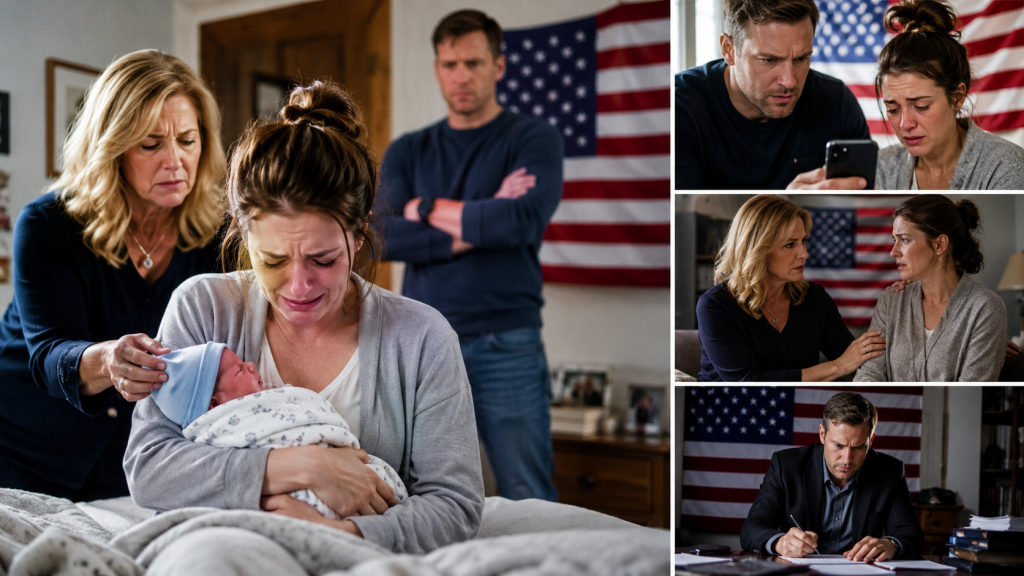
I discovered my mother using our crying newborn to torment my wife while she was still weak from a dangerous postpartum complication.
She had crushed my wife’s pain medication and scattered the pieces across the bedroom floor before whispering words I would remember for the rest of my life.
“Crawl down and clean every bit of it. Only then can you hold your baby.”
Online, my mother played the role of a loving grandmother. She posted photographs of herself holding my newborn son and wrote long captions about family, sacrifice, and unconditional love.
What she did not know was that I was sitting three blocks away, watching everything through a hidden camera.
I was recording every word.
And before that day ended, the perfect life she had built on lies was going to begin falling apart.
Part 1: The Camera That Exposed My Mother
At exactly 9:15 that morning, my phone vibrated while I sat in my car three blocks from home.
The nursery camera had gone offline again.
I stared at the notification.

Camera disconnected.
It was the fourth time in six days.
The first time, my mother blamed the internet.
The second time, she said she had accidentally unplugged something while vacuuming.
The third time, she laughed and told me I was becoming paranoid.
Maybe I was.
But my job had taught me something useful about repeated accidents.
After enough repetitions, they stop looking accidental.
My name is Daniel Mercer. I was thirty-eight years old and worked as an operations director for a regional manufacturing company. Most of my working life consisted of solving problems before they became disasters.
I believed in systems.
I believed in documentation.
And above all, I believed patterns mattered.
The night before, after the nursery camera mysteriously disconnected again, I installed a second camera.
It was tiny.
It had its own cellular connection, so shutting off our router would not affect it.
I positioned it high on a bookshelf facing the bedroom doorway and part of the nursery.
I told nobody.
Not even Emma.
I expected to catch my mother unplugging the router.
Instead, I saw my wife on the floor.
For several seconds, my mind could not understand what my eyes were seeing.
Emma was beside our bed, one hand gripping the mattress.
Her face was pale.
Her body was trembling.
Pieces of something were scattered around her.
Then I realized there was broken glass on the floor.
Beside it were fragments of her prescription pain medication.
And standing a few feet away was my mother, Vivian.
She was holding our three-week-old son, Oliver.
Oliver was crying.
Not fussing.
Crying.
The desperate, breathless cry of a newborn who wanted his mother.
Emma reached toward him.
“Please, Vivian.”
My mother’s voice was calm.
That was the part I would remember most.
There was no shouting.
No uncontrolled anger.
No confusion.
She sounded completely composed.
“Oliver is crying because his mother is weak and useless.”
Emma’s face crumpled.
“Please give him to me.”
Vivian moved backward.
“No.”
“Please.”
“You made this mess.”
Emma looked at the floor.
“I didn’t.”
“You dropped your medicine.”
“You knocked it out of my hand.”
My mother’s expression changed.
It was only slightly, but I saw it.
“Are you calling me a liar?”
Emma said nothing.
“Clean it up.”
“I can’t bend down. The doctor said—”
“I know what the doctor said.”
“Then please—”
“Get down and clean every piece.”
Emma began crying harder.
My mother looked at Oliver.
Then she looked back at my wife.
“Only then will I let you hold him.”
My hand tightened around the phone.
Every instinct in my body told me to start the car, race home and pull my mother away from my family.
I almost did.
Then I stopped.
Emma and Oliver needed protection.
Not chaos.
If I stormed into the house screaming, Vivian would immediately transform herself into the victim.
She had been doing it my entire life.
So I forced myself to think.
I saved the recording.
Then I called my older sister, Natalie.
She answered on the second ring.
“Hey, Danny.”
Her voice was cheerful.
I couldn’t speak normally.
“I’m sending you something.”
“What?”
“Watch it.”
“Daniel, what’s wrong?”
“Just watch.”
I sent her three minutes of footage.
Then I waited.
Thirty seconds passed.
A minute.
Two minutes.
When Natalie finally spoke again, her voice had changed.
“Oh my God.”
I closed my eyes.
“Natalie?”
She was crying.
Then she whispered something that changed everything I thought I knew about our family.
“She used to do this to me too.”
I opened my eyes.
“What?”
“When Lily was born.”
Natalie’s daughter was eleven now.
I remembered visiting Natalie after the birth.
I remembered my mother staying with her.
I remembered Natalie becoming quiet.
Withdrawn.
I remembered Vivian telling everyone that Natalie was struggling emotionally and that we needed to be patient with her.
At the time, I believed my mother.
“What did she do?”
Natalie struggled to answer.
“She would take Lily away when she cried.”
My stomach turned.
“She told me babies could sense bad mothers. She’d stand outside my bedroom holding Lily while I begged her to bring her back.”
“Natalie…”
“She controlled my food. She hid my phone. She told Mark I was unstable.”
Mark was Natalie’s ex-husband.
Their marriage had collapsed when Lily was two.
Suddenly I wondered how much of that story I had misunderstood.
“Why didn’t you tell me?”
“I tried.”
The answer hurt worse than I expected.
“When?”
“Years ago.”
“I don’t remember.”
“Yes, you do.”
I said nothing.
“You told me Mom was stressed and that she was only trying to help.”
Memory returned like a door opening.
Natalie crying in my apartment.
Me defending Vivian.
Me telling my own sister that our mother meant well.
I gripped the steering wheel.
“I’m sorry.”
“You didn’t know.”
“I should have listened.”
“Daniel, don’t do this now. Get Emma and Oliver away from her.”
“I will.”
“Promise me.”
“I promise.”
“And save everything.”
“I already am.”
There was silence.
Then Natalie said, “She’s going to lie.”
“I know.”
“She’ll tell everyone Emma attacked her.”
“I know.”
“She’ll tell people you’re being controlled.”
“I know.”
“She’ll make herself the victim.”
That was when I looked at the recording again.
“Not this time.”
I called our attorney.
Then I drove home.
I did not speed.
That required more control than anything I had ever done.
When I entered through the front door, I could hear Oliver crying upstairs.
I climbed the stairs.
My mother was still standing near the nursery.
Emma was kneeling beside the bed.
She looked smaller than I had ever seen her.
Her hands were trembling as she tried to gather the scattered medication without touching the broken glass.
“Mom.”
Vivian turned.
The transformation happened instantly.
The cold expression vanished.
Her shoulders relaxed.
Concern appeared on her face.
“Oh, Daniel! Thank goodness you’re home.”
She hurried toward me.
“Emma had another dizzy spell. She dropped her medicine and started panicking. I’ve been trying to calm her down.”
I looked at Emma.
She stared at me silently.
My mother continued.
“Poor Oliver is frightened because she won’t stop crying.”
I had watched what happened.
I had heard every word.
And she lied to my face without hesitation.
That frightened me more than anger would have.
“Quiet.”
Vivian stopped.
“Excuse me?”
I walked past her.
Emma whispered my name.
“Daniel…”
I crouched carefully beside her.
“You’re done cleaning.”
“She said—”
“I know.”
I helped her upright.
She winced.
That was when I noticed a dark stain spreading across her clothing.
Fear replaced my anger.
“Emma, are you bleeding?”
Her eyes filled.
“I think I hurt something when I bent down.”
My mother interrupted.
“She is exaggerating.”
I turned.
“Don’t speak.”
Vivian stared at me.
I had never spoken to her that way.
Neither of us was accustomed to it.
I guided Emma toward the armchair.
Then I faced my mother.
“Give me my son.”
Vivian tightened her arms around Oliver.
“Daniel, she’s in no condition to hold him.”
“Give me Oliver.”
“I’m his grandmother.”
“And I’m his father.”
“I’m trying to protect him.”
“From his mother?”
Vivian lowered her voice.
“Emma is unstable.”
There it was.
The same word she had apparently used against Natalie.
“She’s exhausted. She’s emotional. She can’t even manage her medication properly.”
I took out my phone.
My mother’s expression changed.
I pressed play.
Her own voice filled the room.
“Oliver is crying because his mother is weak and useless.”
Vivian froze.
Then came Emma’s voice.
“Please give him to me.”
And Vivian again.
“Get down and clean every piece. Only then will I let you hold him.”
I stopped the video.
For several seconds, nobody spoke.
The color drained from my mother’s face.
“Where did you get that?”
“You disconnected the nursery camera.”
She stared at me.
“You forgot to look for the second one.”
Her mouth opened.
I continued.
“I watched everything.”
“Daniel—”
“Natalie watched it too.”
That name struck her harder than anything else.
“Natalie?”
“Yes.”
My mother recovered quickly.
People like Vivian always do.
“It was a joke.”
I stared at her.
“What?”
“I was trying to motivate Emma.”
“By keeping her baby from her?”
“You don’t understand the situation.”
“I watched the situation.”
“Emma has been lazy since she came home.”
Emma flinched.
I saw it.
My mother saw it too.
And for the first time, I understood how deliberate those small comments had been.
“You’re weak.”
“You’re dramatic.”
“You’re not producing enough milk.”
“You’re holding him wrong.”
“You’re making Daniel do everything.”
Each sentence alone could be dismissed.
Together, they formed a pattern.
Vivian looked at Emma.
“She turned you against me.”
“No.”
My mother looked back at me.
“She did.”
“No, Mom. You did that yourself.”
I stepped closer.
“Give me Oliver.”
This time, she did.
I placed him carefully in Emma’s arms.
His crying began to settle almost immediately.
Emma kissed his forehead again and again.
Then I looked at my mother.
“Pack your bags.”
She laughed.
It sounded almost automatic.
“What?”
“You’re leaving.”
“This is my son’s house.”
“Yes.”
“I gave up everything to come help you.”
“Nobody asked you to abuse my wife.”
Her face hardened.
“You’re choosing her over your mother?”
“I am choosing my wife and child over someone who hurt them.”
“I raised you!”
“And that doesn’t give you ownership of me.”
Vivian stared at me.
Then she pointed toward Emma.
“One day you’ll understand what she is.”
I checked my watch.
“You have ten minutes.”
“You wouldn’t.”
“If you’re still here in eleven, I’m calling the police.”
She stared at me for another moment.
Then she walked toward the guest bedroom.
For the first time in my life, my mother obeyed me.
But getting Vivian out of the house turned out to be the easiest part.
Because while she was packing, Emma suddenly whispered my name.
“Daniel.”
I turned.
Her face had gone almost white.
Something was wrong.
Very wrong.
Part 2: The Hospital
I called emergency services.
Within minutes, the house was filled with paramedics.
Vivian emerged from the guest room carrying a suitcase.
“What is happening?”
I ignored her.
The paramedics examined Emma.
One of them asked how recently she had given birth.
“Three weeks.”
“Complications?”
“Yes.”
I explained what her doctors had told us.
The paramedic’s expression became serious.
“We’re taking her in.”
Emma looked terrified.
“Oliver?”
“I’ve got him.”
“I don’t want to leave him.”
“You’re not leaving him. We’re coming.”
Vivian stepped forward.
“I can watch the baby.”
Every person in the room went silent.
I looked at her.
“No.”
“Daniel, don’t be ridiculous.”
“You are not touching him.”
Her face flushed.
The paramedics helped Emma onto the stretcher.
As they carried her downstairs, Vivian followed me.
“Are you seriously going to humiliate me in front of strangers?”
I stopped.
That sentence told me everything.
My wife was being taken back to the hospital, and my mother’s concern was humiliation.
I opened the front door.
“Leave.”
“You’ll regret this.”
“Maybe.”
“You think that woman loves you?”
“Leave.”
“I am your mother.”
“And Emma is my wife.”
She stared at me.
I opened the door wider.
Vivian walked outside.
Before leaving, she turned toward me.
“You’ll come crawling back when she destroys this family.”
I closed the door.
Then I locked it.
At the hospital, doctors discovered that Emma’s recovery had been aggravated by physical strain and stress. She needed treatment and observation, but fortunately they believed she would recover.
I sat beside her hospital bed with Oliver sleeping nearby.
Emma barely spoke for the first hour.
Eventually, she looked at me.
“I’m sorry.”
The words shocked me.
“For what?”
“For causing all this.”
“You didn’t cause anything.”
“She kept saying you were exhausted because of me.”
I stared at her.
“What else did she say?”
Emma looked away.
That question opened a door.
And what came through it made me realize the camera had captured only one morning of something that had been happening for weeks.
Vivian had been waking Emma when Oliver was asleep because she claimed mothers should not nap during the day.
She had intentionally prepared foods Emma had been told to avoid.
She had hidden clean bottles and then criticized Emma for being disorganized.
She had repeatedly told Emma that I complained about her when I was at work.
That was a lie.
She told Emma I regretted becoming a father.
Another lie.
She told her that I had privately admitted she looked different after childbirth and that I no longer found her attractive.
Another lie.
“She said you told her?”
Emma nodded.
“I believed her.”
“Emma, I never said any of those things.”
“I know that now.”
“Why didn’t you tell me?”
Her answer broke my heart.
“Because she said if I complained, you’d think I was trying to make you choose between your mother and your wife.”
The trap was perfect.
Vivian had created the conflict and then made Emma afraid to expose it.
I took Emma’s hand.
“Listen to me. You never have to protect me from the truth.”
She cried quietly.
“I thought I was failing.”
“You aren’t.”
“She made everything feel like proof that I was a bad mother.”
I looked at Oliver.
He was sleeping peacefully.
“You’re his mother. Nothing she says changes that.”
That evening, Natalie arrived.
She walked into the hospital room, saw Emma, and immediately began crying.
Emma looked confused.
Natalie hugged her.
“I’m sorry.”
“For what?”
“For not seeing it sooner.”
They talked for nearly two hours.
Natalie told Emma things she had never told me.
The similarities were chilling.
Vivian had used nearly identical tactics with both women.
Isolation.
Sleep disruption.
Criticism.
Control.
Then sympathy in public.
Natalie finally explained why she had kept quiet.
“Everyone loved her.”
Emma nodded.
That was the problem.
Vivian had spent decades building a reputation.
She volunteered.
She organized charity events.
She brought meals to sick neighbors.
She posted photographs of birthdays, graduations and family dinners.
People constantly told us how lucky we were to have her.
Natalie looked at me.
“If you expose her, people aren’t going to believe you.”
“I know.”
“She’ll already be telling her version.”
Natalie was right.
My phone had been buzzing constantly.
I finally looked.
Twenty-seven missed calls.
Dozens of messages.
Some were from relatives.
Some were family friends.
Then I opened social media.
Vivian had posted.
The photograph she chose was one taken two days earlier.
She was holding Oliver.
Emma was visible in the background.
The caption began:
Sometimes loving your family means walking away when you are being mistreated.
I kept reading.
According to Vivian, she had sacrificed weeks of her life to help her “struggling daughter-in-law.”
She claimed Emma had become increasingly unstable.
She said I had arrived home, misunderstood an innocent situation, screamed at her and thrown her onto the street.
She ended by asking people not to judge because she was “heartbroken enough already.”
Hundreds of reactions.
Dozens of supportive comments.
Natalie looked over my shoulder.
“She works fast.”
I almost responded.
Then I stopped.
“No.”
“What?”
“I’m not fighting her on social media tonight.”
“Why?”
“Because Emma needs me here.”
That was the first decision I made differently from my mother.
She cared about controlling the story.
I cared about my family.
So I put the phone away.
The next morning, I called an attorney.
Part 3: The Evidence
Our attorney’s name was Rachel Bennett.
I sent her the footage.
I sent screenshots of Vivian’s post.
I sent medical documentation from Emma’s discharge instructions.
I also gave her copies of text messages Vivian had sent during the previous weeks.
Rachel called me after reviewing everything.
“Do not delete anything.”
“I won’t.”
“Do not edit the original footage.”
“Understood.”
“And don’t get into a public argument.”
“I haven’t.”
“Good.”
Then she asked me a question.
“Does your mother have access to your house?”
“She had a key.”
“Change the locks.”
I did.
Then I changed every password.
Security system.
Wi-Fi.
Shared streaming accounts.
Family cloud storage.
Everything.
I removed Vivian from our emergency contact list.
I notified the hospital that she was not authorized to receive information about Emma.
Then Natalie called.
“Daniel, you need to see something.”
She sent me a screenshot.
My mother had made another post.
This time, she claimed Emma was preventing her from seeing Oliver.
Technically, that part was true.
What she did not mention was why.
Several relatives were now openly criticizing me.
My aunt Linda called.
“Daniel, whatever happened, she’s still your mother.”
I answered calmly.
“Aunt Linda, did she tell you what happened?”
“She said there was an argument.”
“There wasn’t an argument.”
“She said Emma dropped some medication.”
“That isn’t what happened.”
“Then what happened?”
I paused.
Rachel had advised me not to distribute the footage casually.
So I said, “There is video.”
Linda became quiet.
“What kind of video?”
“The kind that shows exactly what happened.”
Another pause.
“Vivian said there was no video.”
That interested me.
“How would she know?”
Linda said nothing.
“Ask her that.”
Then I ended the call.
Over the next several days, something unexpected happened.
People started contacting Natalie.
Not me.
Natalie.
A cousin remembered Vivian humiliating her as a teenager.
An old family friend remembered Vivian telling everyone his wife was unstable after they stopped visiting.
Then Mark, Natalie’s former husband, called.
That conversation was difficult.
He apologized.
He said Vivian had repeatedly contacted him during Natalie’s postpartum period, warning him that Natalie was becoming mentally unstable.
“She told me not to trust anything Natalie said about her.”
Natalie closed her eyes.
Mark continued.
“She said Natalie might try to isolate me from the family.”
The manipulation had been designed years in advance.
My mother did not simply hurt people.
She controlled how everyone interpreted their reactions.
If they became angry, they were unstable.
If they withdrew, they were ungrateful.
If they challenged her, they were cruel.
And if they exposed her, they were attacking a devoted mother.
I began writing everything down.
Dates.
Messages.
Witnesses.
Incidents.
Patterns.
For once, Vivian’s greatest strength—her confidence that nobody would compare stories—became her weakness.
Because we compared them.
Part 4: My Mother Came Back
Four days after Emma returned home, someone rang the doorbell.
I checked the camera.
Vivian.
She was standing on our porch holding flowers.
Beside her were two women from her church.
That was deliberate.
Witnesses.
I opened the door but did not invite anyone inside.
Vivian smiled sadly.
“Daniel.”
“What do you want?”
“I came to see my grandson.”
“No.”
One of the women looked uncomfortable.
Vivian sighed.
“Please don’t do this in front of people.”
“You brought people.”
Her smile tightened.
“I thought having neutral witnesses might help.”
“Help what?”
“Help us reconcile.”
“There is nothing to reconcile today.”
She lowered her voice.
“Daniel, people are worried about you.”
“Who?”
“Everyone.”
“That’s not an answer.”
She looked toward the women.
Then she turned back.
“May I see Oliver?”
“No.”
“May I see Emma?”
“No.”
“Why?”
“You know why.”
Her eyes hardened for half a second.
Then the sadness returned.
“I made one mistake.”
“No. You got caught once.”
That landed.
One of the women beside her looked at Vivian.
My mother noticed.
“Daniel is angry.”
“I am.”
“He isn’t thinking clearly.”
I looked at the two women.
“Would either of you like to know what happened?”
Vivian immediately interrupted.
“This is a private family matter.”
I almost laughed.
She had brought witnesses to my door after posting about us publicly.
Now it was private.
I looked directly at her.
“Leave my property.”
She lifted the flowers.
“At least take these to Emma.”
“No.”
“Daniel.”
“No.”
Her voice changed.
“After everything I have done for you?”
There was the real Vivian.
I closed the door.
She remained outside for another six minutes.
Then she left.
But before she reached her car, she looked directly into our doorbell camera.
And smiled.
That smile bothered me.
Two days later, I discovered why.
Vivian had contacted an attorney.
She intended to pursue grandparent visitation.
When Rachel told me, I almost laughed from disbelief.
“She thinks she can force access to Oliver?”
“She can file whatever she wants,” Rachel said. “That doesn’t mean she’ll succeed.”
“What should we do?”
“Exactly what you’ve been doing.”
Document.
Protect.
Stay calm.
Vivian had spent her life winning emotional battles.
Now she had entered a world where evidence mattered.
That changed everything.
Part 5: The Family Meeting
The confrontation that finally broke Vivian’s story happened three weeks later.
My uncle Robert organized a family meeting.
I initially refused.
Then Natalie convinced me.
“She keeps telling everyone different versions. Put everyone in one room.”
Emma did not attend.
That was my decision and hers.
She was recovering.
She owed nobody an explanation.
Natalie came with me.
There were fourteen people at Robert’s house.
Vivian arrived last.
She looked composed.
Beautifully dressed.
Calm.
Victimized.
She sat across from me.
“I hope you’re finally ready to talk.”
“I am.”
Uncle Robert began.
“We’re here because this has gotten out of control.”
Vivian nodded sadly.
“I never wanted any of this.”
Natalie looked at me.
I said nothing.
Vivian continued.
“I only wanted to help.”
I placed my phone on the table.
“Then let’s start there.”
Her eyes dropped toward it.
I had prepared carefully.
I did not play the most upsetting footage first.
I showed the nursery camera disconnecting.
Then Vivian entering the room.
Then her checking the monitor.
Then unplugging it.
Robert frowned.
“Why did you unplug the camera?”
Vivian answered immediately.
“It was malfunctioning.”
I played the next clip.
It showed her looking directly at the disconnected camera and saying quietly:
“Now we can have some privacy.”
Nobody spoke.
Vivian shifted.
“That proves nothing.”
I played another clip.
Her voice filled the room.
“Oliver is crying because his mother is weak and useless.”
My aunt covered her mouth.
Then came the rest.
“Get down and clean every piece.”
And finally:
“Only then will I let you hold him.”
I stopped the recording.
The room was silent.
Vivian looked around.
Nobody defended her.
“It sounds worse without context.”
Natalie laughed once.
There was no humor in it.
“What context makes that acceptable?”
Vivian turned toward her.
“You stay out of this.”
“No.”
Natalie’s voice shook.
But she continued.
“You did it to me too.”
Vivian’s face changed.
“That is a lie.”
“You told Mark I was unstable.”
“You were unstable.”
“You took Lily from me when she cried.”
“I was helping.”
“You hid my phone.”
“You needed rest.”
“You told me my daughter cried because she could sense I didn’t love her.”
“I never said that.”
Natalie took out her phone.
“Mark remembers.”
Vivian looked around the table.
“You’re all enjoying this, aren’t you?”
There it was again.
Not remorse.
Humiliation.
She did not care that Emma had suffered.
She cared that people could see her.
Uncle Robert spoke quietly.
“Vivian, did you make Emma get onto the floor?”
“She was being dramatic.”
“That’s not what I asked.”
Vivian stood.
“I will not sit here while my children attack me.”
Nobody moved.
She picked up her purse.
Then she looked at me.
“When your marriage falls apart, don’t come to me.”
I answered quietly.
“I won’t.”
She left.
This time, nobody followed her.
Part 6: The Perfect Grandmother Disappears
Vivian’s social media posts changed after the family meeting.
First, she deleted the original accusations.
Then she posted vague quotes about betrayal.
Then came messages about “toxic adult children.”
Then forgiveness.
Then boundaries.
Then silence.
People had begun asking questions she could no longer control.
Several relatives apologized to Emma.
Some apologized to Natalie.
A few did not.
That was fine.
We stopped measuring truth by how many people accepted it.
Vivian eventually withdrew her attempt to pursue visitation after her attorney received documentation through the legal process.
Our attorney handled communication from that point forward.
Vivian was told not to come to our home.
She was not allowed unsupervised contact with Oliver.
For the foreseeable future, she would have no relationship with him at all.
I expected that decision to hurt more.
Instead, it felt like removing a weight I had carried without realizing it.
But the real healing was slower.
Emma still apologized for things that were not her fault.
If Oliver cried while I was cooking dinner, she sometimes tried to get up too quickly.
“I’ve got him,” I would say.
“I should—”
“You’re allowed to rest.”
Those words became important in our house.
You’re allowed to rest.
Sometimes she cried when I said them.
Natalie visited often.
She and Emma developed a friendship that had never existed before.
One afternoon, I found them sitting together while Oliver slept.
Natalie was telling Emma about Lily’s first year.
Not the polished version.
The real one.
The exhaustion.
The fear.
The guilt.
Emma listened.
Then she said, “I thought I was the only one.”
Natalie shook her head.
“That is how people like her survive. They make everyone think they’re the only one.”
I stood outside the room listening.
That sentence stayed with me.
Secrets protect the person creating them.
Truth connects the people surviving them.
Part 7: Six Months Later
Six months passed.
Oliver became a completely different baby.
He laughed constantly.
He loved ceiling fans.
He hated peas.
He had discovered that dropping spoons from his high chair made adults pick them up.
Emma was stronger.
Not exactly the person she had been before the delivery.
Something had changed.
But change was not always damage.
Sometimes it was clarity.
One Saturday morning, I walked into the kitchen and found her standing beside the counter with Oliver on her hip.
Sunlight filled the room.
She was laughing because he had grabbed a banana and refused to release it.
For a moment, I simply watched them.
Emma noticed.
“What?”
“Nothing.”
“You’re staring.”
“I know.”
She smiled.
“What?”
“I almost forgot what this house was supposed to feel like.”
Her expression softened.
“So did I.”
I kissed her.
Oliver immediately shoved the banana between our faces.
Emma laughed.
My phone buzzed.
I checked it.
A message from Vivian.
It was the first direct message she had sent me in nearly two months.
I hope someday you’ll understand that everything I did was because I loved you.
I read it twice.
Months earlier, those words would have pulled me into an argument.
I would have explained.
Defended.
Proved.
Now I understood something.
Not every accusation requires an answer.
Not every relationship deserves unlimited chances.
And love without respect is not love simply because someone gives it that name.
I blocked the number.
Then I returned to breakfast.
Part 8: One Year Later
On Oliver’s first birthday, we kept the celebration small.
Natalie came with Lily.
Uncle Robert came.
A few close friends joined us.
There were balloons in the backyard and a ridiculous blue cake that Oliver immediately destroyed with both hands.
Emma laughed harder than anyone.
At one point, Natalie stood beside me watching our children.
“You okay?”
I nodded.
“You?”
She considered the question.
“Better.”
Then she smiled.
“It’s strange.”
“What?”
“For years, I thought keeping the family together meant keeping Mom happy.”
I understood exactly what she meant.
“And now?”
“Now I think keeping a family together sometimes means protecting it from someone who shares your last name.”
Across the yard, Emma lifted Oliver into the air.
He squealed.
I remembered that morning a year earlier.
The crying baby.
The broken glass.
Emma trembling on the floor.
Vivian standing over her.
For a long time, I felt guilty that I had waited those few minutes before entering the house.
Emma eventually asked me about it.
“Do you regret not coming immediately?”
“Yes.”
She shook her head.
“Don’t.”
“I watched you suffer.”
“You also made sure nobody could tell me it didn’t happen.”
That distinction mattered.
The camera did more than expose Vivian.
It gave Emma something abuse often steals.
Certainty.
She did not have to wonder whether she had misunderstood.
She did not have to question whether she had exaggerated.
She did not have to accept someone else’s rewritten version of that morning.
There was evidence.
There was truth.
And there were finally people willing to stand beside her.
Later that evening, after everyone left, Emma and I cleaned the backyard.
Oliver had fallen asleep.
I carried him upstairs.
As I passed the bookshelf where I had hidden the second camera, I stopped.
It was still there.
We no longer used it.
I took it down.
Emma watched from the doorway.
“Getting rid of it?”
“Yeah.”
She smiled.
“Good.”
I placed it inside a drawer.
The recordings remained backed up with our attorney, but I no longer wanted cameras hidden around our home.
Our house did not need to feel like a crime scene.
It needed to become a home again.
Emma walked over and rested her head against my shoulder.
“Do you ever miss her?”
She did not need to say who.
“Sometimes.”
That answer surprised even me.
Emma looked up.
“I miss who I thought she was.”
She nodded.
That was exactly it.
I missed birthday cakes.
Christmas mornings.
Family vacations.
I missed the woman who sat beside me when I was sick as a child.
I missed the mother I believed I had.
But accepting what Vivian had done did not require pretending every memory was false.
Human beings are more complicated than that.
Someone can give you good memories and still become unsafe.
Someone can love you in the only way they understand and still hurt people you have a responsibility to protect.
Understanding that does not mean tolerating it.
Forgiveness, if it ever came, did not require access.
And being my mother did not give Vivian the right to harm my wife.
Emma looked toward Oliver’s crib.
“He’s safe.”
“Yes.”
“So are we.”
I put my arm around her.
“Yes.”
That was enough.
Epilogue
Nearly two years after the morning that changed our family, a letter arrived.
There was no return address.
I recognized Vivian’s handwriting.
I almost threw it away.
Instead, I opened it.
The letter was three pages long.
For the first page, she talked about loneliness.
The second page was about everything she believed she had sacrificed for Natalie and me.
But halfway through the third page, I found something I had never expected.
I was cruel to Emma.
I stopped reading.
Then continued.
I told myself I was teaching her to be stronger. I told myself I knew what was best for Oliver. I told myself you would eventually thank me. I have spent a long time realizing those explanations were excuses.
I sat at the kitchen table.
Emma was upstairs putting Oliver down for his nap.
The letter continued.
I do not expect forgiveness. I understand why you do not trust me. I am writing because I should have said this without asking for anything in return: I was wrong.
There was no request to see Oliver.
No demand that I call.
No accusation against Emma.
Just an apology.
I did not know whether it represented permanent change.
I still don’t.
People often mistake an apology for proof.
It isn’t.
An apology is a beginning.
Behavior is the evidence.
I showed the letter to Emma.
She read it slowly.
Then she placed it on the table.
“What do you want to do?”
“I don’t know.”
“You don’t have to decide today.”
There it was again.
The freedom Vivian had rarely given anyone.
Time.
Choice.
Space.
So I did nothing.
I did not call my mother.
I did not send an angry response.
I did not rush toward reconciliation because an apology had arrived.
We continued living our lives.
Maybe someday Vivian would become someone who could safely exist within our family again.
Maybe she wouldn’t.
That decision would depend on years of actions, not three pages of words.
But there was something else I finally understood.
The greatest consequence Vivian faced was not the collapse of her social reputation.
It was not losing access to our home.
It was not relatives discovering the truth.
It was losing the privilege of being trusted.
Trust is built quietly.
So is its destruction.
And sometimes, the person who destroys it does not realize what they have lost until the door finally closes.
The morning I watched my mother torment my wife through that hidden camera, I thought I was witnessing the destruction of my family.
I was wrong.
I was witnessing the moment I finally understood which family I was responsible for protecting.
My wife.
My son.
My sister.
And eventually, myself.
For most of my life, Vivian had taught us that loyalty meant silence.
That family problems stayed inside the family.
That respecting your mother meant never challenging her.
That keeping peace was more important than telling the truth.
But silence had never created peace.
It had only given her privacy.
The camera ended that privacy.
Natalie’s courage ended the isolation.
Emma’s recovery ended the control.
And boundaries ended the cycle.
Oliver will grow up knowing his family history someday.
When he is old enough to understand, we will tell him the truth without teaching him hatred.
We will tell him that his grandmother made choices that hurt people.
We will also teach him something I learned much later than I should have.
Family is not permission.
Love is not ownership.
Forgiveness is not access.
And protecting someone does not mean controlling them.
Sometimes the most loving sentence you can say is:
“No. You cannot treat my family this way.”
I wish I had learned that before Emma was ever hurt.
I wish I had believed Natalie years earlier.
I cannot change either of those things.
What I can do is make sure the lesson does not end with me.
The hidden camera is still inside that drawer.
I haven’t watched the recording in more than a year.
I don’t need to.
I remember what happened.
More importantly, I know what happened next.
My wife healed.
My sister finally told the truth.
My son remained safe.
And the cycle stopped at our front door.
THE END! Thank you for reading.