 Reading Time: 24 minutes
At Christmas dinner, in the house I had owned for thirty-one years, my son-in-law pointed at my chair and said, “You can’t sit there.” His mother was already sitting in my place, drinking my wine, at the table I had spent two days preparing.
My daughter looked down, too afraid to defend me. So I picked up my coat and left them with the meal. But I did not leave them the house.
Part 1: Christmas Dinner
My son-in-law, Ryan Caldwell, spoke quietly enough that the children in the living room would not hear him. But everyone at the Christmas dinner table heard.
“You can’t sit there.”
The chair he pointed to was mine.
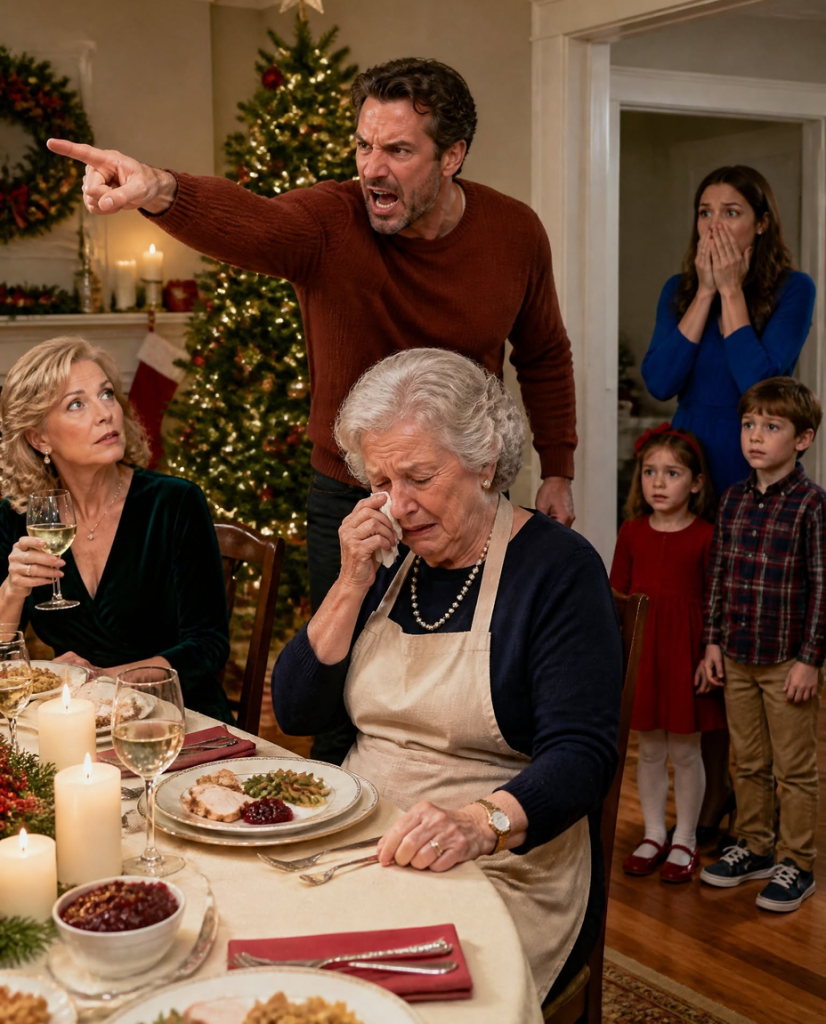
It had no nameplate. There was nothing carved into the wood saying it belonged to me. But it had been my place at the head of that dining table for thirty-one years, inside the Ohio home my late husband, Henry, and I had bought together.
I had served birthdays, Thanksgivings, graduations, anniversaries, and every Christmas meal from that chair since my daughter, Emily, was six years old.
I looked from Ryan’s hand to his face.
He was wearing the navy sweater I had bought him.
Behind him, his mother, Linda, sat comfortably in my chair, her red nails wrapped around a glass of Cabernet from a bottle I had been saving.
“Excuse me?” I asked.
Ryan smiled.
Not warmly.
“My mother is sitting there. She’s the guest of honor this year.”
Emily stood near the kitchen doorway holding a bowl of mashed potatoes.
Her face was pale.
She met my eyes for one second.
Then she looked down.
That was when I understood.
This had been planned.
The dining room was crowded with Ryan’s relatives. His brother and sister-in-law were already seated. His aunt had brought her husband. Two cousins I had met only once were drinking cocktails near the window.
My grandchildren, Ava and Noah, had been squeezed between Ryan’s nieces and nephews.
Linda sat at the head of the table as if she owned the house.
My house.
I had spent two days preparing the meal.
I had paid for the prime rib, the wine, the desserts, the decorations, and most of the expensive gifts beneath the tree.
I had polished the silver Henry’s mother gave us for our tenth anniversary.
I had ironed the tablecloth.
I had baked Emily’s favorite pecan pie at six that morning.
I had opened my home because Emily had quietly begged me to help create one peaceful Christmas.
Now her husband was telling me I had no place at my own table.
“Ryan,” Emily said softly.
He turned toward her.
“Don’t start.”
She froze.
“Your mother always makes everything about herself,” he continued.
Something inside me went completely still.
There are moments when anger feels hot.
This was not one of them.
This felt cold.
Clear.
I placed the gravy boat on the table.
Then I untied my apron and folded it neatly beside the plate I had expected to use.
“You’re right,” I said.
Ryan blinked.
“What?”
“I cannot sit here.”
I walked into the foyer.
Behind me, chairs shifted.
Someone whispered.
Ryan called my name, but I did not stop.
I picked up my purse and winter coat.
“Mom?”
Emily’s voice followed me.
I put on my coat and opened the front door.
Snow was falling over the porch.
Emily appeared behind me.
“Where are you going?”
I looked at my daughter.
She was forty-one years old, but at that moment I saw the little girl who used to run downstairs on Christmas morning in footed pajamas.
I loved her.
That was precisely why I could no longer pretend everything was fine.
“The meal is finished,” I said.
Emily frowned.
“The house is not.”
Then I stepped into the snowy Christmas evening and closed the door behind me.
I heard Ryan laugh before I reached my car.
He thought I was being dramatic.
That was Ryan’s favorite word whenever someone objected to his behavior.
Dramatic.
He had used it when Emily cried because he canceled their anniversary dinner to go golfing.
He used it when I asked why he had borrowed my car without permission.
He used it when his mother criticized Emily’s weight at Thanksgiving and I told her to stop.
Everything was dramatic unless Ryan wanted it.
Then it was important.
I started my car and sat there while snow gathered against the windshield.
Through the dining room windows, I could see them moving around my table.
Nobody came outside.
Not even Emily.
I drove away.
I did not know it then, but leaving that Christmas dinner would change all our lives.
Because Ryan had forgotten something important.
He believed living in a house gave him rights to it.
It did not.
And after three years of quietly watching my generosity become an expectation, I was finally ready to remind him.
Part 2: The House Henry Built With Me
My name is Margaret Bennett.
I was sixty-eight years old that Christmas.
Henry and I bought the house in 1995.
It was not impressive then.
The roof leaked over the upstairs bathroom. The kitchen cabinets were yellow. The basement flooded every spring.
But Henry stood in the backyard the first afternoon we toured it and pointed toward an old maple tree.
“Emily could have a swing there.”
That was enough for me.
We bought it.
For the next twenty-four years, we built our life inside those walls.
Henry was an electrician.
I worked first as a receptionist and later as an office manager for a dental practice.
Neither of us came from money.
Every improvement represented months of saving.
We replaced the roof ourselves with help from Henry’s brothers.
We remodeled the kitchen when Emily started high school.
Henry built the dining table from walnut.
That table became the center of our family.
When Emily graduated from college, we celebrated there.
When Ryan asked Henry for permission to marry her, they sat at that table.
When Ava was born, we placed her infant carrier beside my chair while everyone ate Thanksgiving dinner.
Then Henry died.
A heart attack took him on an ordinary Tuesday morning.
He was sixty-three.
There are losses that divide your life into before and after.
Henry was mine.
For almost a year, I could not sit at the dining table without looking at his empty place.
Eventually, grief softened enough for memories to become comforting instead of unbearable.
I stayed in the house.
It was paid off.
My name was on the deed.
I had retirement savings and Henry’s life insurance.
I was not wealthy, but I was secure.
Then Ryan lost his job.
That was three years before the Christmas dinner.
Emily called me crying.
Their landlord had raised their rent, Ryan had been unemployed for four months, and their savings were disappearing.
Ava was nine.
Noah was seven.
“Come stay with me,” I told her.
Emily resisted.
Ryan did not.
He arrived the following Saturday with a rented moving truck.
The arrangement was supposed to last six months.
They would use the two upstairs bedrooms and the finished room above the garage.
Ryan would find another job.
They would save money.
Then they would move.
Six months became a year.
A year became two.
By the third year, something strange had happened.
Ryan no longer behaved like a guest.
He behaved like an owner.
At first, it was little things.
He rearranged my garage without asking.
He replaced the living room television and moved mine upstairs.
He invited friends over for football games.
Then Linda began visiting more frequently.
She would arrive Friday and stay until Sunday.
Soon she had opinions about everything.
My curtains were old-fashioned.
My kitchen needed new countertops.
My guest bathroom smelled “elderly.”
Once I walked into the kitchen and found her showing Ryan photographs of remodeled kitchens on her phone.
“This wall should come out,” she said.
I laughed because I assumed she was joking.
Neither of them laughed.
Emily noticed the changes too.
But whenever I asked whether everything was all right, she said she was tired.
I believed her.
I should have asked better questions.
Christmas finally showed me what I had refused to see.
They had stopped thinking of the house as mine.
Part 3: The Hotel Room
I drove twenty minutes to the Hampton Inn near the interstate.
The woman at the front desk looked surprised when I asked whether they had a room available on Christmas night.
“We do.”
“I’ll take it.”
I carried my purse upstairs, removed my coat, and sat on the edge of a hotel bed.
For the first time that evening, I cried.
Not because of the chair.
People would later assume it was about the chair.
It wasn’t.
The chair was simply the moment everything became impossible to ignore.
I cried because my daughter had looked at the floor.
Emily knew what Ryan was doing.
She knew it was wrong.
And she was afraid to challenge him.
That frightened me more than his disrespect ever could.
My phone began ringing.
Emily.
I let it ring.
Then Ryan called.
Then Emily again.
At 8:14, I received a text.
Mom, please answer.
At 8:17:
Ryan says you embarrassed Linda.
At 8:20:
Can you please come home so we can talk?
Home.
I stared at that word.
I typed:
Not tonight. Enjoy Christmas with your family.
Emily replied almost immediately.
You are my family.
I looked at the screen for a long time.
Then I wrote:
Then remember that tomorrow.
I turned off my phone.
The next morning, I woke at six.
Henry had always been an early riser.
Even after nine years without him, Christmas morning still made me expect to hear him downstairs making coffee.
I showered, dressed, and drove to a diner.
Over scrambled eggs and coffee, I made a list.
I wrote down everything I paid for.
Property taxes.
Homeowners insurance.
Electricity.
Gas.
Water.
Internet.
Streaming services.
Groceries.
Ryan and Emily contributed $600 a month.
Their contribution did not cover half the utilities and groceries for four people.
I had never cared.
They were family.
But generosity requires gratitude to remain generosity.
Without gratitude, it becomes entitlement.
At nine, I called my attorney.
His name was Daniel Mercer.
Daniel had handled Henry’s estate.
He answered sounding surprised.
“Margaret?”
“Merry Christmas, Daniel.”
“Merry Christmas. Everything okay?”
“No.”
I told him what happened.
Daniel listened without interrupting.
Then he asked one question.
“Do Ryan and Emily have any ownership interest in the property?”
“No.”
“Lease?”
“No.”
“Written rental agreement?”
“No.”
“Good.”
I did not feel good.
“What are my options?”
“That depends on what you want.”
I looked through the diner window.
Snow covered the parking lot.
“I want my house back.”
Part 4: Going Home
I returned at eleven that morning.
Ryan’s relatives were gone.
Linda’s car was gone too.
The dining room looked as though a restaurant had closed in the middle of service.
Dirty plates remained on the table.
Wineglasses sat everywhere.
A serving spoon had fallen onto the carpet.
My beautiful walnut table had a white heat mark near the center because someone had moved the protective mat from beneath the casserole dish.
Ryan was sitting in the living room watching television.
He did not stand when I entered.
“Well,” he said, “look who decided to come home.”
I removed my gloves.
“Where’s Emily?”
“Upstairs.”
He muted the television.
“You owe my mother an apology.”
I actually thought I had misheard him.
“For what?”
“For humiliating her.”
“In my house?”
“There you go again.”
“Again?”
“Your house. Your chair. Your dinner. Your money. Everything has to be yours.”
I looked around.
“Yes, Ryan. The house is mine.”
He laughed.
“You know what I mean.”
“No. Explain it.”
His expression changed.
“We live here too.”
“You do.”
“For three years.”
“Yes.”
“So maybe you should stop treating us like guests.”
That sentence clarified everything.
“I agree.”
Ryan smiled.
He thought he had won.
Then I said, “You should stop being guests.”
His smile disappeared.
Emily came downstairs.
“Mom.”
Her eyes were swollen.
“Can we talk privately?”
Ryan stood.
“No. We’re finishing this.”
I looked at him.
“No, Ryan. You are finished.”
Silence.
He laughed once.
“What does that mean?”
“It means this arrangement no longer works.”
Emily stepped closer.
“Mom, please.”
I reached into my purse and removed a folder Daniel had emailed me that morning.
I had printed it at the hotel business center.
“I am giving you sixty days to find another place to live.”
Ryan stared at the paper.
Then he looked at me.
“You’re kicking your daughter and grandchildren out?”
“No. I am ending an arrangement that was supposed to last six months.”
“Because of a chair?”
“No.”
My voice remained calm.
“The chair was simply where you finally said out loud what you have been showing me for three years.”
Emily started crying.
“Mom, we don’t have enough saved.”
I looked at her.
That surprised me.
“You’ve lived here for three years.”
Ryan stepped between us.
“Don’t interrogate her.”
“I asked a question.”
“Our finances are none of your business.”
“Then my house is none of yours.”
His face reddened.
“You can’t do this.”
“I already have.”
He grabbed the notice.
“This is ridiculous.”
“Daniel Mercer doesn’t think so.”
Ryan knew Daniel’s name.
His confidence faltered.
“Your lawyer?”
“Yes.”
“You called a lawyer on Christmas?”
“I called my lawyer the morning after you told me I couldn’t sit at my own table.”
He stared at me.
For the first time since I had known him, Ryan Caldwell had nothing to say.
Part 5: What Emily Finally Told Me
That afternoon, Ryan left.
He slammed the front door hard enough to shake the wreath.
Emily sat at the kitchen table.
I made tea.
Neither of us spoke until I placed the cup in front of her.
Then she whispered, “I’m sorry.”
I sat opposite her.
“For Christmas?”
“For everything.”
She covered her face.
The next words came slowly.
Ryan had been working for eighteen months.
I knew that.
What I did not know was that he was earning almost as much as he had before losing his previous job.
They could have moved out.
Ryan did not want to.
“He says staying here lets us build wealth.”
“What wealth?”
Emily looked embarrassed.
Ryan had convinced her they should invest most of their savings.
He controlled the accounts.
She did not know exactly how much they had.
My stomach tightened.
“Do you have access to your own money?”
“Yes.”
The answer came too quickly.
“Emily.”
She looked down.
“He handles most of it.”
I reached across the table.
“Has he hurt you?”
Her head snapped up.
“No. Never.”
I believed her.
But something was still wrong.
“Then why were you afraid to speak last night?”
She cried again.
“Because everything becomes a fight.”
She told me Ryan had changed after losing his job.
Being unemployed embarrassed him.
Moving into his mother-in-law’s house embarrassed him even more.
When he started working again, instead of moving out, he began trying to establish control over the household.
Linda encouraged him.
“She tells him a man shouldn’t feel like a visitor where his children live.”
I almost laughed.
“Then perhaps the man should obtain his own house.”
Emily gave a weak smile.
It disappeared quickly.
“Linda says this house will be ours eventually anyway.”
There it was.
I sat back.
“What?”
Emily looked frightened.
“She thinks you’ll leave it to me.”
“I might.”
“I know.”
“And because you are my daughter, she thinks Ryan already has a claim?”
Emily did not answer.
I remembered the kitchen renovation photographs.
The comments about the bathroom.
The garage rearrangement.
The Christmas chair.
It had never been about furniture.
It was ownership.
Imagined ownership.
I stood.
“Where are the children?”
“Upstairs.”
“Good.”
I walked to the kitchen window.
Henry had planted an oak near the fence the year Ava was born.
It was taller than the garage now.
“This house isn’t Ryan’s inheritance,” I said.
Emily remained silent.
“It isn’t Linda’s future home.”
“I know.”
“Do you?”
She began crying again.
“I don’t know what happened to us.”
I turned.
“Then maybe it’s time you find out.”
Part 6: Linda Returns
Linda arrived the following morning.
She did not knock.
She had been given a key by Ryan months earlier.
I had not known that.
I was standing in the kitchen when she walked inside carrying a handbag and a bakery box.
“Well,” she said. “We need to settle this nonsense.”
I looked at the key in her hand.
“Where did you get that?”
“Ryan gave it to me.”
“Give it back.”
She laughed.
“Margaret.”
“Give me the key.”
Her smile faded.
“This is exactly the behavior I’m talking about.”
“What behavior?”
“Controlling.”
I nearly admired the audacity.
“You entered my home without knocking using a key I never gave you, and you’re calling me controlling?”
She placed the bakery box on the counter.
“Ryan and Emily live here.”
“They do temporarily.”
“They’ve lived here three years.”
“And they are leaving.”
Linda folded her arms.
“You would put your grandchildren on the street over Christmas dinner?”
“No one is going onto the street.”
“You don’t know that.”
“I know your son earns a salary.”
Her eyes changed.
Emily had been right.
Linda knew everything.
“You’ve been discussing their finances?”
“I have been discussing my house.”
“Eventually it belongs to Emily.”
“No.”
The word stopped her.
“What?”
“You seem confused about that.”
“She’s your only child.”
“Yes.”
“Who else would you leave it to?”
“That is none of your concern.”
Her face hardened.
“You’d punish Emily because you don’t like Ryan?”
“I have not made any decisions about my estate based on Christmas dinner.”
That was true.
Not yet.
Linda stepped closer.
“You need to understand something. Your daughter has a family now.”
“I understand perfectly.”
“You’re not the center anymore.”
I looked toward the dining room.
Then back at her.
“Perhaps that explains the chair.”
She rolled her eyes.
“For heaven’s sake. It was a chair.”
“No, Linda. It was a test.”
“A test?”
“To see how much disrespect I would tolerate inside my own home.”
She stared at me.
“And I failed.”
“No. You gave me the answer I needed.”
I held out my hand.
“The key.”
She hesitated.
Then dropped it into my palm.
“You’re going to regret this.”
“No.”
I closed my fingers around the key.
“I regret waiting this long.”
Part 7: The Money
The next surprise came three days later.
I had gone through my bank statements because I wanted to separate every shared household expense before Ryan moved.
That was when I noticed several unusual charges on a credit card I rarely used.
Furniture.
Home improvement supplies.
A television.
Restaurant charges.
The total was $8,460.
At first I assumed fraud.
Then I recognized one purchase.
The new television Ryan had installed in my living room.
I called the credit card company.
The representative explained that an authorized user had made the purchases.
Ryan.
Two years earlier, I had added him to the card when he needed to rent a car for a job interview.
I had forgotten to remove him.
Apparently, Ryan had not forgotten.
I printed every statement.
When he came home, I placed them on the kitchen table.
“What is this?”
He barely glanced at them.
“House expenses.”
“Eight thousand four hundred sixty dollars?”
“You told us to make ourselves comfortable.”
“I did not tell you to use my credit card.”
“The television is in your house.”
“The restaurant charges?”
He shrugged.
“Family meals.”
“Without me?”
His jaw tightened.
“You have plenty of money.”
That sentence hurt more than I expected.
Not because it was true.
Because of what it revealed.
My money had become communal in Ryan’s mind.
His money remained private.
Mine existed to support everyone.
I pointed to the statements.
“You will repay these charges.”
He laughed.
“Sure.”
“I mean it.”
“What are you going to do? Sue me?”
“I hope I won’t have to.”
He looked at me differently then.
“You really want to destroy the family, don’t you?”
I thought about that.
“No. I think I’ve been financing the illusion that this family was healthy.”
He pushed the statements away.
“I’m not paying eight grand.”
“Then Daniel will handle it.”
His chair scraped backward.
“You keep threatening me with your lawyer.”
“No. I keep explaining what happens next.”
He walked out.
I canceled his card that afternoon.
Then I changed every password.
Streaming accounts.
Internet.
Online shopping.
The grocery delivery service.
I removed Ryan from my auto insurance.
I canceled the additional phone line I had been paying for since his unemployment.
Each cancellation represented something I had once done happily.
That was the saddest part.
I had never kept score.
Ryan made keeping score necessary.
Part 8: Sixty Days
The atmosphere in the house changed.
Ryan stopped speaking to me unless necessary.
Linda stopped visiting.
Emily became quieter.
The children knew something was happening.
One evening Noah came into my bedroom.
“Grandma?”
“Yes, sweetheart?”
“Are we moving?”
I closed the book I was reading.
“Yes.”
“Because Dad took your chair?”
Children see more than adults realize.
“No.”
“Dad said you got mad about Christmas.”
I chose my words carefully.
“Your parents need a home of their own.”
“Did we do something wrong?”
My heart broke.
“No. You and Ava did absolutely nothing wrong.”
“Can we still come here?”
I hugged him.
“As long as I am here, this will always be Grandma’s house, and you will always be welcome.”
That distinction mattered.
Grandma’s house.
Not Ryan’s house.
Not an inheritance waiting to happen.
A home belonging to a living person.
Ryan found an apartment during the fifth week.
Emily told me quietly.
It was three bedrooms.
Twenty minutes away.
They could afford it.
I asked the question that had been bothering me.
“How much money do you have saved?”
She swallowed.
“About seventy-four thousand.”
I stared at her.
“You have seventy-four thousand dollars?”
She nodded.
“And Ryan told me you couldn’t afford to move?”
“He wanted to reach one hundred thousand before buying a house.”
I stood speechless.
For three years, I had paid almost everything so they could save.
There was nothing wrong with saving.
What was wrong was allowing me to believe they were struggling while accumulating enough money for a substantial down payment.
“Why didn’t you tell me?”
“Ryan said you would start charging us more.”
That sentence settled heavily between us.
“Would that have been unreasonable?”
“No.”
“Emily, you paid me six hundred dollars a month for four people.”
“I know.”
“I spent more than that on groceries.”
“I know.”
“And he used my credit card.”
“I didn’t know about that.”
I believed her.
She looked ashamed.
“Mom, I’m sorry.”
“I know you are.”
“Can you forgive me?”
I looked at my daughter.
“Yes.”
Her shoulders relaxed.
“But forgiveness doesn’t mean returning to the way things were.”
She nodded slowly.
“I understand.”
I hoped she did.
Part 9: Moving Day
Ryan rented a truck.
I stayed home while they packed.
Most of the furniture upstairs belonged to them.
Some did not.
That created another confrontation.
Ryan carried Henry’s old tool chest toward the truck.
“Put that down.”
He stopped.
“Emily said we could take it.”
Emily appeared behind him.
“I thought Dad would want Ryan to have it.”
I looked at the chest.
Henry’s initials were scratched into one corner.
He had owned it since before we married.
“No.”
Ryan laughed bitterly.
“Of course not.”
“It’s mine.”
“You don’t use tools.”
“That doesn’t make it yours.”
He dropped the handles.
“Fine.”
A few minutes later, he tried to take the lawn mower.
Then the patio heater.
Then a set of dining chairs.
Each time I said no.
By afternoon, his anger had become visible.
Finally, he stood beside the truck.
“You know what your problem is?”
I waited.
“You think possessions matter more than people.”
“No.”
I looked at Emily helping Ava carry a box.
“I think people who care about you don’t treat your possessions as if they already belong to them.”
He stared at me.
“You’ve turned Emily against me.”
“No, Ryan. I gave Emily room to think.”
His face changed.
For a moment, I wondered whether he would shout.
Instead, he climbed into the truck.
Emily hugged me before leaving.
“We’ll call tonight.”
“Take care of the children.”
“I will.”
I watched them drive away.
Then I walked back into my house.
It was quiet.
For the first time in three years, completely quiet.
I went into the dining room.
My chair was exactly where it had always been.
I sat down.
And cried.
Not triumphantly.
Not happily.
I cried because boundaries sometimes arrive years after they were needed, and by then they have to cut through relationships you once hoped would never need them.
Part 10: Emily Comes Back Alone
Three months passed.
I repaired the heat mark on Henry’s table.
I converted the room above the garage into a sewing room.
I joined a gardening group.
Ava and Noah visited every other weekend.
Emily usually brought them.
Ryan never came inside.
Then one rainy April evening, Emily arrived alone.
She looked exhausted.
“Can I come in?”
“Always.”
We sat in the kitchen.
She wrapped both hands around a mug.
“Ryan and I are separating.”
I did not react immediately.
“Are you safe?”
“Yes.”
“The children?”
“They’re okay.”
“What happened?”
She stared into her tea.
“After we moved, I started seeing things differently.”
For the first time in years, Ryan had to pay rent, utilities, groceries, insurance, and household expenses.
He hated it.
He complained constantly.
He blamed Emily.
Then he blamed me.
According to him, if I had allowed them to stay another year, they could have purchased a much larger house.
When Emily suggested buying something modest with the savings they already had, Ryan refused.
He wanted something impressive.
Four bedrooms.
Finished basement.
Large yard.
Two-car garage.
“He wanted a house like yours,” Emily said.
I almost smiled.
“My house did not look like this when your father and I bought it.”
“I told him that.”
Henry and I had built our comfort over decades.
Ryan wanted the finished version immediately.
Then Emily discovered the investments.
The seventy-four thousand dollars was no longer seventy-four thousand.
Ryan had invested almost thirty thousand in risky trades without telling her.
Much of it was gone.
“How much?”
“About nineteen thousand.”
I closed my eyes.
Emily continued.
“When I got angry, he said it was his money because he earned more.”
“Was it?”
“No. Some came from my salary. Some came from what we saved living here.”
“And now?”
“I opened my own account.”
I reached across the table.
“Good.”
She started crying.
“I should have done it years ago.”
“Maybe.”
She looked at me.
“You aren’t going to say I told you so?”
“No.”
“Why?”
“Because you already know.”
She laughed through her tears.
It sounded like the Emily I remembered.
Part 11: Ryan’s Offer
Ryan called me the following week.
I almost did not answer.
“Margaret.”
“Ryan.”
“We need to talk.”
“About?”
“Emily.”
“Then talk to Emily.”
“You’ve poisoned her against me.”
“I have never asked her to leave you.”
“You didn’t have to.”
I remained silent.
He continued.
“If you hadn’t kicked us out, none of this would’ve happened.”
That interested me.
“You believe your marriage depended on living in my house?”
“No. I’m saying you created financial pressure.”
“You had seventy-four thousand dollars saved.”
“Not all of that was liquid.”
“That sounds like a problem for your financial planner.”
He exhaled sharply.
Then his tone changed.
“I want to make peace.”
“For what purpose?”
“For the family.”
I waited.
“I think we should put Christmas behind us.”
“Christmas is behind us.”
“And maybe reconsider the living arrangement.”
There it was.
I almost admired the speed.
“What living arrangement?”
“If Emily and I reconcile, moving back temporarily might help us rebuild.”
“No.”
“You didn’t even think about it.”
“I spent three years thinking about it.”
“We could pay more rent.”
“No.”
“A thousand.”
“No.”
“Fifteen hundred.”
“No.”
He became angry.
“So that’s it?”
“Yes.”
“You’d rather watch your daughter’s marriage fail?”
“Your marriage is not my house’s responsibility.”
Silence.
Then he said something I never forgot.
“That house should be helping the family.”
I looked around my kitchen.
“It is.”
“How?”
“It is giving me a safe, peaceful place to live.”
He hung up.
Part 12: The Will
The experience forced me to consider something I had avoided since Henry’s death.
My estate.
I met Daniel at his office.
My existing will left almost everything to Emily.
If she died before me, the assets passed to her children.
Daniel listened while I explained my concerns.
“I don’t want Ryan controlling this house.”
“Then don’t leave it in a way that allows that.”
We discussed options.
I did not disinherit Emily.
Despite everything, she was my daughter.
I loved her.
But I changed the structure.
The house would be sold after my death unless specific conditions made another arrangement appropriate.
A trust would hold substantial assets for Ava and Noah.
Emily would receive her inheritance separately.
Ryan would have no direct authority over the trust.
I also updated my financial power of attorney, medical directives, beneficiaries, and emergency contacts.
It was not revenge.
It was planning.
There is an important difference.
Revenge tries to make another person suffer.
Planning tries to prevent chaos.
For years, I had avoided these decisions because talking about death felt unpleasant.
Christmas taught me that refusing to plan does not protect a family.
Sometimes it simply leaves a mess for someone else.
Daniel slid the final documents across the desk.
“Are you comfortable with this?”
I read the last page.
“Yes.”
“Then sign here.”
I signed.
Walking out of his office, I felt lighter.
My house was no longer an unspoken prize hanging over the family.
It was simply my home again.
Part 13: Linda’s Last Attempt
I had not heard from Linda in nearly six months when she called.
“Margaret, we should talk woman to woman.”
That phrase rarely introduces a pleasant conversation.
“What would you like to discuss?”
“Our children.”
“They’re adults.”
“They’re destroying their marriage.”
“I am sorry about that.”
“You could help.”
“How?”
“You know how.”
I did.
She wanted the house.
Not ownership, technically.
Access.
A place where Ryan would not have to face the financial consequences of his choices.
“Linda, they lived with me for three years.”
“And they’re your family.”
“Yes.”
“So why wouldn’t you help them?”
“I did.”
“Families don’t put expiration dates on help.”
“Healthy help does.”
She became quiet.
Then she said, “You have four bedrooms and live there alone.”
“And?”
“Doesn’t that seem selfish?”
I smiled.
Not because it was funny.
Because I finally understood the logic completely.
An older woman with unused space was selfish.
An older woman with savings was selfish.
An older woman who refused to subsidize capable adults was selfish.
An older woman who wanted her own chair at her own Christmas table was selfish.
Anything I kept for myself could be redefined as something I was withholding from others.
“No,” I said.
“What?”
“It doesn’t seem selfish.”
“You don’t need that much house.”
“Perhaps not.”
“Then sell it.”
“Perhaps someday.”
“And help Emily.”
“I will decide how I help my daughter.”
“You’re impossible.”
“Then this conversation should probably end.”
Before hanging up, Linda said, “Ryan was right about you.”
I almost asked what she meant.
Then I realized I no longer cared.
“Goodbye, Linda.”
I ended the call.
Part 14: The Next Christmas
One year after the dinner that changed everything, Christmas arrived again.
The house looked different.
Not dramatically.
Just enough.
I had replaced the hallway wallpaper.
I had painted the kitchen a warmer color.
I had donated several pieces of furniture I no longer loved.
For thirty-one years, almost every decision about the house had been connected to someone else.
Henry.
Emily.
The grandchildren.
Guests.
Family gatherings.
That year, I allowed myself to ask a simple question.
What did I like?
It was surprisingly difficult to answer.
Then surprisingly enjoyable.
Emily and the children arrived Christmas Eve.
She and Ryan had finalized their divorce in October.
It was painful.
There were arguments about money and parenting schedules, but they eventually reached an agreement.
I never celebrated the divorce.
A marriage ending is not a victory.
But I celebrated seeing my daughter become herself again.
She had rented a townhouse ten minutes from the children’s school.
She managed her own finances.
She had started saving again.
Most importantly, she no longer looked at the floor when someone spoke harshly to her.
Christmas morning, Ava helped me bake rolls.
Noah attempted to peel potatoes and removed nearly half of each potato with the skin.
Emily laughed.
The sound filled the kitchen.
At four, we set the table.
There were only four of us that year.
No giant crowd.
No performance.
No people competing for status.
Just family.
I placed the prime rib in the center.
Emily carried the vegetables.
Ava poured water.
Noah lit the battery-operated candles because I did not trust him with matches.
Then everyone took their places.
I stood beside my chair.
Emily stopped.
“Mom?”
“Yes?”
She pulled the chair out for me.
“Your seat.”
For a moment, I could not speak.
I sat.
Emily leaned down and kissed my cheek.
“Merry Christmas.”
“Merry Christmas, sweetheart.”
We ate.
We laughed.
After dessert, the children opened gifts.
Later, when Ava and Noah were watching a movie, Emily and I sat at the dining table with coffee.
“I’ve been thinking about last Christmas,” she said.
“So have I.”
“I was angry with you.”
“I know.”
“For making us move.”
“I know that too.”
She looked around the room.
“But you were right.”
I shook my head.
“This isn’t about being right.”
“Yes, it is a little.”
I smiled.
She reached across the table.
“I needed you to do what I couldn’t.”
“What?”
“Say enough.”
Her eyes filled.
“I kept telling myself I was keeping the peace. But I wasn’t. I was just making sure the person willing to be the most difficult always got what he wanted.”
That was one of the wisest things my daughter had ever said.
“Peace and silence aren’t always the same thing,” I told her.
She nodded.
“I know that now.”
Part 15: What Happened to Ryan
Ryan did not disappear from our lives.
He was still Ava and Noah’s father.
For their sake, I remained civil.
He eventually moved into a condominium near his work.
He rebuilt some of the money he had lost.
According to Emily, the divorce forced him to become more responsible with finances.
I hoped that was true.
For nearly a year, he never came inside my house.
Then Noah had his eleventh birthday.
The party was in my backyard.
Emily asked whether Ryan could attend.
“Of course.”
He arrived carrying a gift.
Linda did not come.
Ryan stood awkwardly near the patio while children ran around the yard.
Eventually, he approached me.
“Margaret.”
“Ryan.”
He looked toward the house.
“Place looks good.”
“Thank you.”
There was a long silence.
Then he surprised me.
“I owe you money.”
He handed me an envelope.
Inside was a check.
$8,460.
The exact amount from the credit card charges.
I looked at him.
“I’ve been putting it aside.”
“Thank you.”
He nodded.
Then he started to walk away.
“Ryan.”
He turned.
“Thank you for paying it.”
He looked uncomfortable.
“I shouldn’t have used the card.”
“No.”
“I was angry back then.”
“I know.”
“I thought everyone looked down on me after I lost my job.”
“I didn’t.”
“I know that now.”
That admission cost him something.
I could see it.
He looked toward the yard where Noah was laughing with his friends.
“I kept thinking if I could control everything, nobody would see that I was failing.”
I folded the check.
“Control has a way of creating the failure we’re trying to hide.”
He nodded.
Then, after a moment, he said, “I’m sorry about Christmas.”
I studied him.
“For taking the chair?”
“For acting like the house belonged to me.”
That was the apology I had been waiting for.
Not because I needed it.
Because it meant he finally understood.
“Thank you.”
We never became close.
Some relationships do not return to what they were.
Perhaps they should not.
But we became respectful.
That was enough.
Part 16: Thirty-Two Christmases
The following December marked my thirty-second Christmas in the house.
I woke early.
Snow covered the oak Henry had planted.
I made coffee and walked into the dining room.
Morning sunlight fell across the walnut table.
There were scratches in it now.
Ava had made one with a fork when she was three.
Emily had spilled nail polish near one corner as a teenager.
Henry had accidentally drilled through the underside while repairing a loose support.
The white heat mark from Ryan’s Christmas dinner was barely visible after restoration.
I ran my hand over it.
For years, I believed family peace meant keeping everyone comfortable.
I had confused generosity with obligation.
I had believed that because I had more than I needed, anyone I loved should be allowed to take from it.
Money.
Space.
Time.
Privacy.
Even dignity.
Henry would never have agreed.
He was generous, but he understood boundaries better than I did.
Once, years earlier, Emily had asked him why he locked his workshop.
“Because something can belong to the family and still need a door,” he told her.
I had forgotten that lesson.
My home had always been a place for family.
It still was.
But being welcome inside someone’s home is different from owning it.
Receiving help is different from being entitled to it.
And love is different from surrender.
That Christmas afternoon, Emily arrived with Ava and Noah.
They carried bags through the kitchen.
Ava was thirteen now and nearly as tall as her mother.
Noah immediately asked when dinner would be ready.
“Some traditions never change,” Emily said.
“Thankfully,” I answered.
We cooked together.
Nobody asked who was guest of honor.
Nobody competed for the head of the table.
When dinner was ready, Noah began carrying plates into the dining room.
Then he stopped beside my chair.
“Grandma?”
“Yes?”
He pulled it out dramatically.
“Your throne.”
I laughed.
“It’s a dining chair.”
“Same thing.”
Ava rolled her eyes.
Emily smiled.
I sat down.
Outside, snow fell softly over the yard Henry and I had tended for three decades.
Inside, my family gathered around the table he built.
The house was peaceful.
Not because nobody disagreed.
Not because everyone always behaved perfectly.
It was peaceful because everyone there understood something we had nearly forgotten.
Love does not require one person to disappear so everyone else can feel comfortable.
I looked around the table.
At Emily.
At Ava.
At Noah.
At Henry’s empty place that no longer felt painfully empty.
Then I raised my glass.
“To family.”
Emily raised hers.
“To family.”
Ava and Noah lifted their glasses of sparkling cider.
I smiled.
“And to knowing when you’re welcome.”
Emily laughed.
“And when you’ve overstayed your welcome.”
“That too.”
We touched glasses.
Later that night, after everyone had gone upstairs, I stayed beside the Christmas tree.
The lights reflected against the windows.
Thirty-two Christmases.
Thirty-two years of joy, arguments, grief, birthdays, mistakes, forgiveness, children growing up, and adults learning lessons much later than they should have.
I thought about the woman I had been the Christmas before.
Standing beside that dining table while my son-in-law pointed toward my chair.
“You can’t sit there.”
At the time, those words had felt humiliating.
Now I understood they had been a gift.
Not the kind wrapped beneath a tree.
The kind life occasionally gives you disguised as an insult.
They had forced me to see what I had tolerated.
They had forced Emily to see what her marriage had become.
They had forced Ryan, eventually, to face what entitlement and insecurity had turned him into.
And they had forced all of us to rebuild our relationships on something healthier than silence.
I turned off the Christmas tree lights.
Before going upstairs, I stopped in the dining room.
My chair sat at the head of the table.
I touched its wooden back.
It had never really been about where I sat.
It was about whether I believed I was allowed to have a place in the life I had spent decades building.
I did.
I finally did.
Ryan had told me I couldn’t sit there.
So I left him the Christmas dinner.
I left him the wine.
I left his mother sitting proudly at the head of the table.
I left all of them believing they had won something.
But the next morning, when the dishes were still dirty and the celebration was over, they discovered the truth.
They had been guests.
And I was still the owner.
Not only of the house.
Of my choices.
Of my money.
Of my future.
And, finally, of my peace.
THE END! THANK YOU FOR READING.