
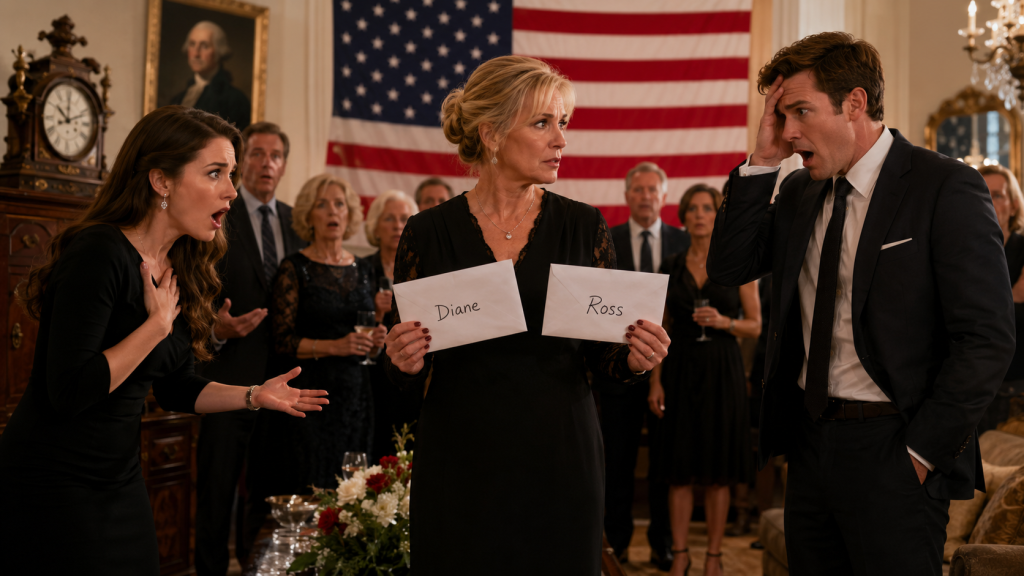
One hour after I buried my husband, his daughter started putting sticky notes on my furniture while the guests were still eating my ham. Pink for her. Blue for her brother.
When she reached for the clock my mother left me, I caught her wrist and said, “Not that one, sweetheart. But since we’re labeling things—your father left you each an envelope, and he made me promise you would open them in front of everyone.”
You should have seen how fast the sticky notes stopped.
My name is Eileen Mercer.

I was married to Frank for nineteen years.
I am his second wife, which his children, Diane and Ross, never once let me forget.
At our wedding, Diane raised her champagne glass and toasted, “To Dad’s replacement.”
Ross laughed so hard he spilled wine down the front of my dress.
Frank was mortified.
I told him it was fine.
That became something of a habit during our marriage.
“It’s fine.”
I said those words when Diane deliberately left my name off Christmas cards addressed to Frank.
I said them when Ross introduced me at his wedding as “Dad’s current wife.”
I said them when neither of them called on my birthday despite expecting me to remember theirs, their spouses’, and eventually their children’s.
Frank always noticed.
Sometimes he apologized.
Sometimes he became angry.
But I never wanted to be the woman who came between a father and his children.
So for nineteen years, I set their places at every holiday table.
For nineteen years, I bought their birthday gifts.
For nineteen years, I cooked Diane’s favorite sweet potato casserole at Thanksgiving and kept Ross’s preferred beer in the refrigerator.
And for nineteen years, Diane looked through me like I was a window.
Then Frank got sick.
Suddenly, I became useful.
I drove him to every appointment.
I learned the names of medications I could barely pronounce.
I kept a notebook beside our bed where I recorded doses, temperatures, meals, symptoms, questions for doctors, and every small change I thought might matter.
When Frank became too weak to climb the stairs, I turned our downstairs den into a bedroom.
When he stopped sleeping through the night, I slept in a recliner beside him.
When food tasted wrong, I tried fifty recipes until I discovered he could tolerate scrambled eggs with a little cheddar and toast with strawberry preserves.
When he was frightened, I held his hand.
When he was angry, I let him be angry.
When he was embarrassed that I had to help him bathe, I pretended it was no different from washing dishes together after Thanksgiving.
Diane visited four times in two years.
Ross came twice.
One of those times, he asked his dying father to co-sign a truck loan.
I was in the kitchen when I heard him.
“Dad, I’m not asking you to pay for it. I just need your name.”
Frank’s voice was weak.
“My name is about all I have left, Ross.”
Ross laughed.
“Come on. Don’t be dramatic.”
I walked into the room.
Ross saw my face and immediately leaned back.
“What?”
“Your father needs to rest.”
“We’re talking.”
“No. You’re asking a sick man for money.”
“I’m asking him to sign a form.”
“Leave.”
His eyebrows lifted.
“You don’t get to tell me when to leave my father’s house.”
Frank spoke before I could.
“Yes, she does.”
Ross looked at him.
Frank pointed toward the door.
“Go home, son.”
Ross left without saying goodbye.
I watched his taillights disappear down our driveway.
Frank stared at the dark window for a long time.
Then he said something I never forgot.
“Eileen, bring me my good pen and two envelopes.”
It was January.
The good pen was a black fountain pen I had given him for our tenth anniversary.
I brought it to him along with two cream-colored envelopes.
Frank wrote for nearly an hour.
He would stop every few minutes because his hand cramped.
I offered to write for him.
He refused.
“These need to be mine.”
When he finished, he folded the pages carefully.
He wrote Diane’s name on one envelope and Ross’s on the other.
Then he sealed both himself and licked the envelopes like they owed him money.
Three days later, he asked me to drive him downtown.
“To Whit’s office.”
Whit Coleman had been Frank’s lawyer for decades. He had handled our taxes, the purchase of the house, Frank’s first divorce settlement, several business matters, and eventually our estate planning.
I drove Frank there on a Tuesday morning.
Whit came downstairs personally and helped him from the car.
“You coming up?” Whit asked me.
Frank shook his head.
“Just me.”
I waited in the car for almost two hours.
Whatever those two men did upstairs, Frank came back smiling for the first time in a month.
Not a tired smile.
Not the little smile he used when he was pretending not to hurt.
A genuine Frank smile.
He settled into the passenger seat and closed his eyes.
“Everything okay?” I asked.
“Better than okay.”
“What did you do?”
“You’ll know when you need to.”
I gave him a look.
He reached over and squeezed my hand.
Then he became serious.
“Promise me one thing.”
“Anything.”
“They open those envelopes at the funeral.”
I stared at him.
“What?”
“Diane and Ross. They open their letters at the house after the funeral. In front of everybody.”
“Frank—”
“Not before. Not after.”
“Why?”
His mouth twitched.
“Because some lessons require witnesses.”
I should have known.
That was Frank.
Quiet for months.
Then one sentence that could move a mountain.
“I promise,” I said.
He squeezed my hand again.
“Good.”
Frank passed away during the first week of October.
He was seventy-four.
I was sixty-eight.
He died at home, holding my hand while I hummed “Abide with Me,” the hymn his mother used to sing when he was a boy.
His last word was my name.
Not because I deserved some grand romantic ending.
I think he was simply checking that I was still there.
I was.
The funeral was Saturday.
Diane arrived wearing new black from head to toe and cried into a tissue that remained mysteriously dry.
Ross checked his phone during the eulogy.
Twice.
After the cemetery, everyone returned to our house for the reception.
I had ordered ham, rolls, potato salad, fruit, coffee, and enough pie to feed half the county.
People filled the living room, kitchen, dining room, and back porch.
Neighbors told stories about Frank.
Former coworkers laughed about the time he accidentally locked himself in the supply room.
Pastor Dave told me Frank had once anonymously paid a young couple’s electric bill for six months.
I didn’t know that.
There were many things about my husband I was learning only after he was gone.
For the first forty-five minutes, Diane and Ross behaved themselves.
Then I saw the first sticky note.
Pink.
It was attached to the china cabinet.
I assumed one of the grandchildren had put it there.
Then I noticed a blue one on Frank’s leather recliner.
Another pink one appeared on the antique side table.
Then I saw Ross holding a tape measure against the television while Mrs. Hendricks from next door watched him with her mouth hanging open.
“What are you doing?” I asked.
Ross barely looked at me.
“Measurements.”
“For what?”
“The moving company.”
“What moving company?”
Diane appeared beside me holding a stack of pink sticky notes.
She smiled.
“Don’t worry about all this today, Eileen.”
She patted my arm.
I looked at her hand.
She removed it.
“Worry about what?”
“Sorting things.”
“Sorting my things?”
“Dad’s things.”
She said it slowly, as though explaining something to a child.
Ross stretched his measuring tape across the television stand.
“Fifty-eight.”
He wrote it down.
Diane placed a pink note on a lamp.
“Just being practical,” she announced to the room. “Eileen will hardly need all this. She’ll be going somewhere smaller.”
The conversations around us faded.
She smiled at me.
“Won’t you, hon?”
“Somewhere smaller,” Ross agreed. “You can keep whatever fits in your car.”
My sister Margaret stood up from the sofa.
Pastor Dave lowered his coffee.
Mrs. Hendricks stopped pretending she wasn’t listening.
I looked from Diane to Ross.
My husband had been buried barely an hour earlier.
There was dirt from his grave still caught in the edge of my shoe.
And his children were dividing my living room.
Oddly, I did not feel angry.
Not yet.
Mostly I felt tired.
Then Diane walked toward the mantel.
She reached for a small walnut clock.
My mother’s clock.
It had belonged to her for thirty-seven years.
After she died, it became mine.
Frank had never owned it.
Diane picked it up.
I caught her wrist.
“Not that one, sweetheart.”
She froze.
I gently removed the clock from her hand and placed it back on the mantel.
“That belonged to my mother.”
Diane pulled her arm away.
“We can figure out personal items later.”
“No need.”
I looked at the pink and blue notes scattered around my home.
Then I remembered my promise.
“But since we’re labeling things, your father left you each an envelope.”
Ross’s tape measure stopped retracting.
Diane stared at me.
“What envelope?”
“He made me promise you would open them after his funeral.”
Her entire expression changed.
“And you waited until now to tell us?”
“He specifically requested that you open them in front of everyone.”
Ross dropped the measuring tape onto the sofa.
“Where are they?”
I walked to the breakfront.
The envelopes had been waiting in the top drawer for three months.
I removed them.
Frank’s handwriting was on the front.
DIANE.
ROSS.
The room became quiet as snow.
Guests suddenly became extremely interested in the contents of their plates while somehow positioning themselves for a better view.
Mrs. Hendricks did not even pretend.
Ross took his envelope first.
“Finally,” he muttered. “Some respect.”
I said nothing.
I handed Diane hers.
She opened it with one red fingernail.
Inside was a single sheet of paper in Frank’s handwriting.
Because Diane apparently assumed the first line would contain either an apology or a dollar amount, she read it aloud.
“By the time you read this, Diane, you have already put your stickers on the furniture.”
She stopped.
Nobody moved.
Her eyes ran down the page.
Her face changed.
Smugness disappeared first.
Then certainty.
Then color.
Ross grabbed the letter.
“What does it say?”
“Give it back.”
He ignored her.
He read the next line aloud.
“And the man standing quietly by the front door is not one of the funeral guests. Say hello to him. He has been waiting all afternoon, and in his briefcase is—”
Ross stopped.
Every head in the room turned toward the front door.
A man in a gray suit stood beside the coat rack.
He had arrived twenty minutes earlier.
I recognized him.
Diane and Ross did not.
He placed his coffee cup on the small entry table.
Then he picked up his briefcase.
“My name is Benjamin Hale,” he said. “I’m an associate with Coleman, Hale and Mercer.”
Diane looked at me.
“Lawyer?”
Benjamin nodded.
“I represent your father’s estate.”
Ross glanced at the envelope in his hand.
“Where’s Whit Coleman?”
“Mr. Coleman retired in July. I assumed responsibility for several of his clients, including your father.”
Diane looked down at Frank’s letter.
“What exactly is in that briefcase?”
Benjamin gave the smallest smile.
“Your father’s final instructions.”
Nobody touched the ham after that.
Benjamin stepped into the living room and placed his briefcase on the coffee table.
Diane sat.
Ross remained standing.
I took Frank’s recliner.
For two years I had refused to sit in it because it was his chair.
That afternoon, I sat down without thinking.
Maybe some part of me understood that Frank was no longer coming back to claim it.
Benjamin opened his briefcase.
He removed a thick folder.
Ross immediately leaned forward.
“Let’s get this over with.”
Benjamin looked at him.
“Your father anticipated you might say something similar.”
Mrs. Hendricks made a sound suspiciously like a cough covering a laugh.
Benjamin continued.
“Frank Mercer signed a new will and several accompanying documents on January seventeenth of this year.”
Diane’s head snapped toward me.
“You knew?”
“No.”
That was true.
I knew Frank had met Whit.
I did not know what he had signed.
Benjamin removed two copies.
“Mr. Mercer requested that I explain the estate structure immediately following the funeral, with both adult children present and, if possible, several neutral witnesses.”
“Why witnesses?” Diane demanded.
Benjamin glanced toward the sticky notes.
“I suspect your father had his reasons.”
Ross crossed his arms.
“Just tell us what we inherited.”
Benjamin nodded.
“The answer requires a little history.”
He turned to me.
“Mrs. Mercer, are you comfortable with me discussing the property arrangements in front of your guests?”
I thought about it.
Then I looked at Diane’s pink note on my china cabinet.
“Very.”
Benjamin opened the folder.
“The residence at 1847 Willow Bend Road was purchased by Eileen Mercer twelve years before her marriage to Frank.”
Diane blinked.
“What?”
I felt something inside me settle.
That house had been mine since I was thirty-seven.