 Reading Time: 18 minutes
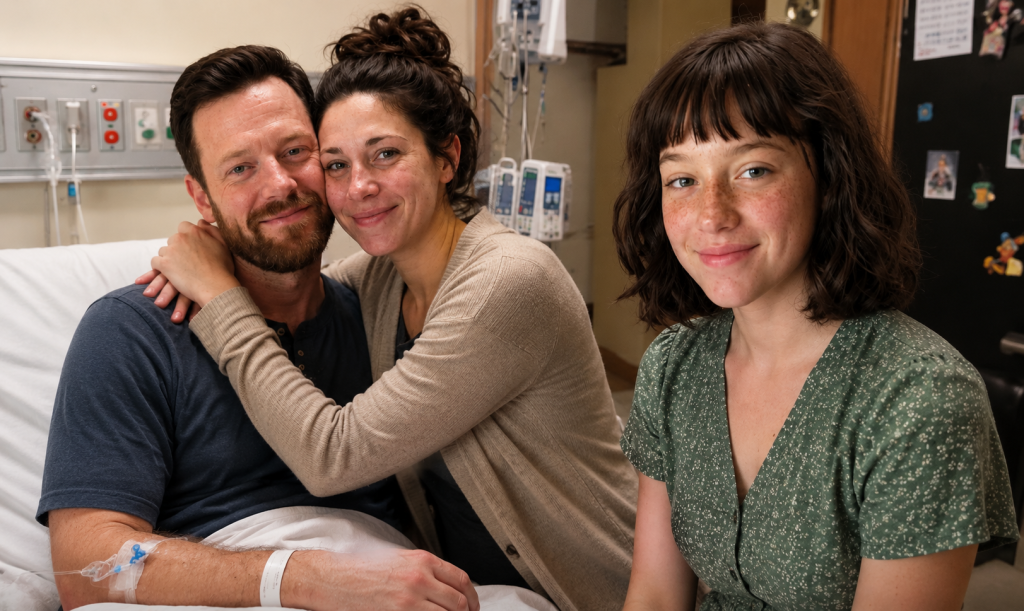
I adopted a sixteen-year-old girl because it was my dying husband’s final request. One day after his funeral, she appeared in my bedroom doorway and said quietly, “It’s time you learned who your husband really was.”
Until that moment, I thought grief was the worst thing a person could feel. I was wrong. My name is Claire Bennett, and for fifteen years, I believed I knew my husband better than anyone in the world. David and I were not one of those couples who lived dramatically.
We had no great public romance. No expensive anniversary trips every year. No perfect photographs arranged for other people to admire.
We had something quieter.
Something I had always believed was stronger.
David warmed my side of the bed on cold nights before I climbed beneath the covers. He reached for my hand instinctively whenever we sat beside each other. If he made coffee first, he always left mine on the kitchen counter with exactly the amount of milk I liked.

We had two children.
Emma was twelve.
Noah was nine.
Our house was noisy, imperfect, and usually cluttered with school bags, shoes, cereal bowls, and laundry that seemed to multiply overnight.
I loved it.
I loved all of it.
And I loved David.
That was why, when a doctor destroyed our future with a few carefully chosen sentences, I felt as if the floor had disappeared beneath my feet.
“Stage four,” Dr. Patel said.
I remember staring at his mouth because I could hear the words but could not seem to understand them.
“There is no treatment that can cure it. We can only make him comfortable.”
David was fifty-one.
He had gone to the doctor because of back pain and fatigue.
We thought he had been working too much.
We joked about getting older.
Three weeks later, we were sitting in an oncology office learning how little time he had left.
I cried in the hospital parking lot.
David didn’t.
He put both hands around mine and said, “Claire, look at me.”
I couldn’t.
“Claire.”
Finally, I raised my head.
His eyes were wet.
“We’re going home,” he said. “We’re going to tell the kids together. And then we’re going to use whatever time we have.”
That was David.
Practical even when his world was ending.
For the first few weeks, he tried to live normally.
He still asked Noah about baseball practice.
He still helped Emma with mathematics.
He still complained when I overloaded the dishwasher.
But his body betrayed him quickly.
His appetite disappeared.
Then his strength.
Then the man who had once carried both children upstairs at the same time needed my arm to walk from our bedroom to the bathroom.
Watching someone you love disappear while they are still sitting in front of you is a particular kind of heartbreak.
Yet something else began troubling me.
David wasn’t only afraid of dying.
He was afraid of leaving something unfinished.
I noticed it at night.
Sometimes I woke at two or three in the morning and found him staring at the ceiling.
His breathing would be shallow.
His eyes open.
“Pain?” I would whisper.
“No.”
“Do you need water?”
“No.”
“What is it, David?”
He would turn toward me and squeeze my hand.
“I’m tired.”
But I knew my husband.
That wasn’t tiredness.
It was guilt.
I became certain of it about a month after his diagnosis.
One evening, after the children had gone to bed, David asked me to sit beside him.
He opened the drawer of his bedside table and removed an old photograph.
It showed a teenage girl.
She had long brown hair, serious gray-blue eyes, and a cautious expression that made her seem older than she probably was.
I turned the photograph over.
Written on the back were two words.
Grace Miller.
“Who is she?”
David swallowed.
“She’s sixteen.”
“That isn’t what I asked.”
He looked away.
Something cold moved through me.
“David.”
“I need you to do something for me.”
“What?”
“I need you to adopt her.”
I actually laughed.
Not because it was funny.
Because the request was so strange that my mind rejected it.
“What did you just say?”
“Grace needs a family.”
“And you want us to adopt her?”
“Yes.”
“Why?”
His face tightened.
“I can’t explain everything yet.”
I stood.
“Then my answer is no.”
“Claire.”
“No. Absolutely not. You show me a photograph of a sixteen-year-old girl I’ve never heard of and ask me to make her legally part of our family, but you won’t tell me why?”
“I will.”
“When?”
“Soon.”
I stared at the photograph again.
Then the thought I had been desperately avoiding finally escaped my mouth.
“Is she your daughter?”
David closed his eyes.
That terrified me more than if he had simply said yes.
“Oh, God.”
“Claire, please.”
“Is she?”
He opened his eyes again.
“Grace is not my biological daughter.”
I searched his face.
“Then who is she?”
“Someone I made a promise to.”
“What promise?”
His eyes filled.
“To make sure she was never alone.”
I wanted to be angry.
I was angry.
But then David began coughing.
I helped him sit upright.
I held the glass while he drank water.
And suddenly I wasn’t arguing with my husband anymore.
I was looking at a dying man.
The father of my children.
The person I had expected to grow old beside.
His hand trembled as he placed it over mine.
“Please, Claire.”
“Why me?”
“Because you are the safest person I know.”
That sentence broke something inside me.
I sat beside him again.
“Where is she now?”
“A temporary foster placement.”
“How long has she been in the system?”
“Most of her life.”
I stared at him.
“And you’ve known about her?”
“Yes.”
“How long?”
He hesitated.
“Years.”
I pulled my hand away.
“Years?”
“Claire—”
“You’ve known this girl for years?”
“Yes.”
“And you’ve never mentioned her?”
“I couldn’t.”
“Couldn’t or wouldn’t?”
He had no answer.
I left the room.
For the first time in fifteen years of marriage, I slept on the sofa.
Three days later, I met Grace.
She arrived with a social worker named Melissa.
Grace carried a faded backpack over one shoulder and a plastic shopping bag in her right hand.
That was almost everything she owned.
She stood on our front porch looking as if she expected someone to tell her there had been a mistake.
“Hi,” I said.
“Hi.”
“I’m Claire.”
“I know.”
She immediately looked past me.
Toward David.
He was sitting in the living room.
The moment Grace saw him, her expression changed.
Not like a daughter seeing her father.
I noticed that immediately.
It was something different.
Relief.
Pain.
Gratitude.
And grief.
David smiled.
“Hey, kiddo.”
Grace’s mouth trembled.
“Hey.”
She crossed the room and hugged him carefully.
David closed his eyes.
His hand rested against the back of her head.
I stood watching them.
Whatever their relationship was, it was real.
That frightened me.
The legal process had already been discussed with social services before David ever approached me. Because of Grace’s age and unusual circumstances, what ultimately moved forward was a permanent guardianship arrangement with the intention of making her part of our family.
To Grace, the terminology mattered less than the promise.
She would have a home.
She would not be moved again.
She would belong somewhere.
I agreed.
Partly for David.
Partly because the frightened girl standing in my living room clearly needed someone.
And partly because I needed to know the truth.
Grace moved into our guest bedroom.
Within days, Emma adored her.
Noah followed her everywhere.
Grace helped with homework without being asked. She cooked scrambled eggs for Noah when I forgot breakfast one morning after spending half the night caring for David.
She folded laundry.
She cleared dishes.
Too much, actually.
“Grace,” I told her one afternoon, “you don’t have to earn your room here.”
She froze.
“I know.”
“No, I don’t think you do.”
Her eyes dropped.
“You’re allowed to just live here.”
For a moment, she looked like she might cry.
Then she nodded.
“Okay.”
But nothing between David and Grace made sense.
Sometimes she sat beside his bed for hours.
Other times they closed the door.
Once I heard her crying.
Another time I heard David say, “You have to tell her after.”
Grace answered, “I don’t want her to hate me.”
“She won’t.”
“You don’t know that.”
“I know Claire.”
I stepped away before they knew I had been listening.
That evening, I confronted David.
“What is she supposed to tell me?”
His face went pale.
“You heard us?”
“Yes.”
He looked toward the hallway.
“Claire, please wait.”
“For what? Your funeral?”
The moment I said it, I regretted it.
David flinched.
I covered my face.
“I’m sorry.”
“Don’t be.”
“I can’t do this. I am losing you, David. I wake every morning wondering whether this is the day my children lose their father. And now I’m living with some enormous secret inside my own house.”
“I know.”
“No, you don’t.”
He reached for me.
I almost stepped away.
Then I saw his hand trembling.
I took it.
“Was there another woman?”
He didn’t answer immediately.
My heart began pounding.
“David.”
“Yes.”
One word.
Fifteen years of marriage suddenly felt unstable beneath my feet.
“When?”
“Before you.”
I stared at him.
“Grace’s mother?”
His eyes filled with tears.
“Yes.”
That was all he would tell me.
Three days later, David was admitted to the hospital.
He never came home.
His final morning was quiet.
Emma held one hand.
Noah held the other.
I sat beside him.
Grace remained near the window until David opened his eyes and whispered her name.
She approached.
He looked at all four of us.
“My family,” he whispered.
Then he looked directly at me.
“I’m sorry.”
I bent close.
“For what?”
But his eyes were already closing.
David died forty minutes later.
The funeral passed in a blur.
People told me what a wonderful man he had been.
A loyal friend.
A devoted father.
A generous neighbor.
A good husband.
Every compliment hurt because I no longer knew whether I believed it.
The morning after the funeral, I woke reaching toward David’s side of the bed.
Cold sheets.
Empty pillow.
Then memory returned.
I sat there for almost an hour.
Eventually, there was a knock.
Grace stood in the doorway.
She looked terrible.
Her eyes were swollen.
Her face was pale.
In her hands was a wooden box I had never seen before.
“There’s something I have to tell you,” she said.
I looked away.
“David was buried yesterday. Whatever this is, can’t it wait?”
“No.”
“Grace—”
“He made me promise.”
She entered and closed the door.
Then she placed the wooden box on the bed between us.
“David made me promise that I would tell you the truth only after he was gone.”
I stared at the box.
“What truth?”
Grace sat in the chair near the window.
For several seconds, she said nothing.
Then she whispered a name.
“Rebecca Miller.”
I looked at her.
“My mother.”
I remembered David admitting there had been another woman before me.
“David knew her?”
Grace nodded.
“They were engaged.”
My breath caught.
“Engaged?”
“Yes.”
I had never known David had nearly married anyone before me.
Grace continued.
“They met when they were twenty-three. Mom told me they were together for almost four years.”
I couldn’t speak.
“She said David loved her. She loved him too.”
“What happened?”
Grace looked at the box.
“She disappeared.”
“What does that mean?”
“She left him without explaining why.”
Grace opened the box.
Inside were letters.
Dozens of them.
Some envelopes were yellow with age.
Others looked newer.
She handed me the oldest.
It was addressed to David.
The handwriting was unfamiliar.
I unfolded it.
David,
By the time you read this, I will already be gone. Please don’t look for me. Please believe that leaving you is the hardest thing I have ever done.
I stopped reading.
“Why did she leave?”
Grace’s voice shook.
“Because she was pregnant.”
My stomach dropped.
I looked at Grace.
She understood immediately.
“Not with me.”
I exhaled.
“Then whose child?”
“My brother.”
The story came slowly.
Rebecca became pregnant while she and David were engaged.
The baby was David’s.
But during the pregnancy, doctors discovered that Rebecca had a serious hereditary medical condition.
She panicked.
She became convinced she was ruining David’s future.
Then she learned that the baby might inherit the condition too.
Rebecca’s family pressured her to leave.
Her father despised David because he came from a working-class family and had no money.
He offered Rebecca financial support if she disappeared and cut contact.
Terrified and twenty-six years old, she did.
She moved across the country.
David searched for her.
For years.
He never found her.
“What happened to the baby?” I asked.
Grace’s eyes filled.
“He was born.”
“What was his name?”
“Samuel.”
I closed my eyes.
David had a son.
Before me.
A son he had never known.
“Is Samuel alive?”
Grace shook her head.
“He died when he was nine.”
The room became completely silent.
I thought of David watching Noah play baseball.
David teaching him to ride a bicycle.
David sitting beside his hospital bed once when Noah had pneumonia, refusing to sleep for thirty-six hours.
He had lost a son before ever meeting me.
And I had never known.
“Did David ever meet Samuel?”
“No.”
Grace wiped her face.
“Mom didn’t contact David until after Samuel died.”
My anger returned.
“And then?”
“She wrote him a letter. She told him everything.”
“When?”
“Seventeen years ago.”
Two years before David and I married.
I did the calculation.
“So he knew before he met me.”
“Yes.”
That hurt.
He had entered our marriage carrying this history and never told me.
“But that still doesn’t explain you.”
Grace nodded.
“No.”
She reached into the box and removed another photograph.
Rebecca was older in this one.
Beside her stood a man I didn’t recognize.
And a little girl.
Grace.
“Years after Samuel died, Mom married my father. His name was Michael.”
I waited.
“He died when I was five.”
Rebecca struggled afterward.
Money became scarce.
Her health worsened.
Eventually, Grace entered foster care when Rebecca became too sick to care for her.
“Where was David?”
“He didn’t know at first.”
“When did he find out?”
“Six years ago.”
My stomach tightened.
Six years.
Six years of our marriage.
Grace looked directly at me.
“My mother called him.”
“Why?”
“She was dying.”
I couldn’t move.
“David went to see her?”
“Yes.”
“Without telling me?”
“Yes.”
“How many times?”
“I don’t know. Several.”
I stood.
The room spun.
Grace rose too.
“Claire—”
“Don’t.”
I walked toward the window.
My husband had lied.
Perhaps not about an affair.
But he had lied with silence.
For six years.
“Did he give her money?”
“Yes.”
“How much?”
“I don’t know.”
“Did he visit you?”
“Yes.”
“How often?”
“A few times every year.”
I turned around.
“You knew my husband for six years?”
Grace began crying.
“Yes.”
“And I knew nothing about you.”
“I wanted him to tell you.”
“But he didn’t.”
“He was afraid.”
“Of what?”
Grace’s answer came quietly.
“Losing you.”
I laughed bitterly.
“So instead he lied to me.”
“He hated himself for it.”
“That doesn’t make it better.”
“I know.”
“No, Grace. You don’t know. I buried my husband yesterday, and today I’m finding out there was an entire part of his life happening behind my back.”
She nodded.
“You have every right to be angry.”
I looked at her.
“Why did he want me to adopt you?”
Grace’s face crumpled.
“Because my mother asked him to protect me.”
Rebecca had died four years earlier.
Before her death, she asked David for one final promise.
Not to take Grace immediately.
Rebecca knew David had a wife and children who knew nothing about her.
Instead, she asked him to watch over Grace.
To make sure she was safe.
To help when he could.
David had done that quietly for four years.
He paid for school supplies.
He attended meetings with social workers.
He sent birthday cards.
He kept track of every foster placement.
Then his cancer diagnosis changed everything.
“He knew he wouldn’t be here anymore,” Grace whispered. “And he was terrified I’d disappear into the system after he died.”
“So he gave me responsibility for a promise I never made.”
Grace looked down.
“Yes.”
That sentence sat heavily between us.
Then she reached into the box.
“There’s one more thing.”
She handed me an envelope.
My name was written across the front.
Claire.
David’s handwriting.
My hands shook.
I opened it.
My dearest Claire,
If you are reading this, then I failed to find the courage to tell you while I was alive.
There is no excuse for that.
Fear explains cowardice. It does not erase it.
I sat down.
Grace quietly left the room.
I continued reading.
David told me everything.
Rebecca.
Samuel.
The years of searching.
The letter announcing Samuel’s death.
The guilt that followed.
Then Grace.
He wrote that when Rebecca contacted him years later, he intended to tell me immediately.
But every time he tried, he imagined destroying our family.
So he postponed it.
One day became a week.
A week became months.
Months became years.
And eventually the truth became so large that admitting it seemed impossible.
Then I reached the paragraph that broke me.
I never betrayed our marriage with another woman, Claire. But I betrayed your trust by deciding which truths you were allowed to know. I told myself I was protecting you. I understand now that I was protecting myself.
I covered my mouth.
There was more.
Please do not keep Grace because of me.
If you cannot love her after learning what I have done, I will understand.
But know this: she is innocent.
She has spent her entire childhood paying for decisions made by adults before she was born.
If there is one final thing I ask of you, it is not that you forgive me.
It is that you do not make Grace pay for my fear.
At the bottom, he had written:
You were the greatest love of my life.
I am sorry I did not trust that your love was strong enough to survive the truth.
David.
I cried until I couldn’t breathe.
Then I became angry again.
Grief does that.
It refuses to stay one thing.
For the next week, Grace and I barely spoke.
I fed the children.
Answered condolence messages.
Signed paperwork.
Sorted flowers.
At night, I read David’s letters.
The wooden box contained nearly twenty years of his hidden history.
I hated him sometimes.
Then I missed him so intensely that I pressed his shirts against my face because they still smelled faintly like him.
I hated myself for loving him.
Then I hated myself for hating him.
One evening, Emma found me crying in the laundry room.
“Mom?”
I quickly wiped my face.
She sat beside me.
“Are you sending Grace away?”
The question surprised me.
“Why would you ask that?”
“She packed her backpack.”
I stood immediately.
Grace was in her bedroom.
The same faded backpack she had arrived with sat open on the bed.
Her clothes were folded inside.
“What are you doing?”
She froze.
“Leaving.”
“Where?”
“I called Melissa.”
“Why?”
Grace stared at the floor.
“Because you don’t want me here.”
“I never said that.”
“You don’t have to.”
My anger softened.
“Grace.”
She finally looked at me.
“I ruined everything.”
“No.”
“You hate David because of me.”
“No.”
“You didn’t hate him before I came.”
I crossed the room.
“Listen carefully. Whatever happened between David and me was between David and me.”
“But if he hadn’t helped me—”
“He made his own choices.”
Grace began crying.
“I don’t want to be another thing someone regrets.”
That sentence destroyed every wall I had been building.
I saw her then.
Not as David’s secret.
Not as Rebecca’s daughter.
Not as another burden attached to my husband’s lies.
I saw a sixteen-year-old girl who had spent her entire life believing she could be abandoned whenever she became inconvenient.
I sat on the bed.
“You aren’t going anywhere tonight.”
She looked uncertain.
“What about tomorrow?”
“We’ll talk tomorrow.”
“And after that?”
“We’ll talk the day after that.”
She almost smiled.
I took one shirt from her backpack and placed it back in the drawer.
Then another.
Grace watched me.
Finally, she began helping.
We unpacked the entire bag without another word.
Healing did not happen immediately.
I did not wake the next morning magically forgiving David.
Some betrayals are complicated because they exist beside genuine love.
David had been a good father.
He had loved me.
He had also lied to me.
All three things were true.
That was the hardest lesson grief taught me.
People are rarely one thing.
Months passed.
Grace remained.
She returned to school.
Emma started calling her “my sister” without thinking about it.
Noah asked Grace to attend his school concert because he wanted “the whole family” there.
And slowly, without ceremony, she became ours.
Six months after David died, I received a call from a lawyer named Andrew Collins.
He asked me to come to his office.
Grace came with me.
Mr. Collins placed a folder on the desk.
“David established a trust several years ago.”
My first reaction was anger.
Another secret.
But this one was different.
The trust contained money David had inherited from his father.
He had divided it equally among Emma, Noah, and Grace.
There was also money set aside for me.
Not enough to make anyone wealthy.
Enough to pay for education.
Enough to provide security.
Enough to prove that David had planned for Grace long before his diagnosis.
Grace stared at the papers.
“I don’t want it.”
Mr. Collins looked surprised.
“It legally belongs to you.”
“I don’t care.”
She looked at me.
“I don’t want Claire thinking that’s why I stayed.”
I reached across the table and took her hand.
“I don’t think that.”
She cried.
So did I.
A year after David’s death, something happened I never expected.
Grace asked me to visit Samuel’s grave with her.
I had never been there.
Neither had she.
Rebecca had been buried nearby.
We drove three hours.
The cemetery was small.
Samuel’s stone was simple.
SAMUEL DAVID MILLER.
Nine years old.
David.
Rebecca had given him his father’s name as his middle name.
I stood staring at it.
For years, I had imagined my husband’s secret as something dark.
Standing beside that grave, I finally understood part of what had haunted him.
He had mourned a child he never got to hold.
He had carried guilt for not finding Rebecca.
Then he had spent years trying to protect Rebecca’s second child because perhaps, in some imperfect way, he believed saving Grace might redeem his failure to save Samuel.
That did not excuse his lies.
But it made them human.
Grace placed flowers on Samuel’s grave.
Then she walked to Rebecca’s.
I stayed behind.
“David loved you,” Grace said suddenly.
I looked at her.
“He talked about you constantly.”
I almost laughed.
“Did he?”
“It was annoying.”
That surprised a smile out of me.
“What did he say?”
“That you always stole his French fries after saying you didn’t want any.”
I laughed.
It was the first time I’d laughed while talking about him since his death.
“He complained about that for fifteen years.”
“He said you sang the wrong words to songs.”
“He was worse.”
“He said you made the house feel safe.”
My smile disappeared.
Grace looked at Rebecca’s grave.
“He wanted to tell you.”
“I know.”
“He was just scared.”
“I know that too.”
“Do you forgive him?”
I looked toward Samuel’s stone.
“I don’t know.”
Grace nodded.
“That’s okay.”
And strangely, hearing those words helped.
Two more years passed.
Grace graduated from high school.
When her name was called, I screamed louder than anyone in the auditorium.
She walked across the stage, accepted her diploma, and immediately searched the crowd.
When she found me, Emma, and Noah, her entire face changed.
Afterward, we took photographs outside.
Grace wore David’s old wristwatch.
I had given it to her that morning.
“You sure?” she had asked.
“Yes.”
“Maybe Noah should have it.”
“Your dad had other watches.”
She stared at me.
“You called him my dad.”
I had.
I hadn’t meant to.
But I didn’t correct myself.
Grace never called David Dad while he was alive.
Their relationship had been too complicated for that.
But sometimes family names arrive after the people themselves are gone.
That evening, after the graduation dinner, Grace handed me an envelope.
“What is this?”
“Something I wrote.”
I opened it later.
Claire,
When I first came to your house, I expected you to send me away as soon as David died.
I kept my backpack half-packed for weeks.
I had learned not to put things in drawers because drawers make you believe you’re staying.
You taught me to unpack.
Not just my clothes.
My life.
I don’t know what word I’m supposed to use for you.
Guardian sounds like paperwork.
Claire sounds too small.
So I hope you don’t mind if someday I call you Mom.
I sat at the kitchen table crying.
Grace entered quietly.
“Well?”
I stood.
She looked terrified.
I opened my arms.
She came toward me.
I held her.
“You can call me whatever feels right.”
She buried her face against my shoulder.
“Okay, Mom.”
That was the moment Grace truly became my daughter.
Not when documents were signed.
Not when David asked me.
Not when she moved into our house.
That night.
Years have passed now.
Emma is in college.
Noah is preparing to graduate high school.
Grace is twenty-three and studying social work.
She says she wants to help children who grow up carrying their belongings in plastic bags.
David’s photograph still sits on my dresser.
For a long time, I considered removing it.
I couldn’t look at his face without remembering the lies.
Eventually, though, I understood something.
Forgiveness did not require me to rewrite history.
I didn’t need to pretend David had done nothing wrong.
He had.
He should have told me about Rebecca.
He should have told me about Samuel.
He should have told me about Grace the first time Rebecca called him.
He should have trusted me.
But I also didn’t need to erase fifteen years of love because he failed me in one enormous part of our marriage.
David could be the husband who warmed my side of the bed and the frightened man who hid the truth.
He could be the father who adored Emma and Noah and the grieving father who never met Samuel.
He could be generous and cowardly.
Loving and flawed.
Human.
The last letter David wrote remains inside the wooden box.
I read it once every year on the anniversary of his death.
For years, I always stopped at the same sentence.
I am sorry I did not trust that your love was strong enough to survive the truth.
Eventually, I realized he had been right about one thing.
My love could have survived the truth.
What nearly destroyed it was the silence.
That is the lesson I carried forward.
Truth can hurt.
Truth can change relationships.
Truth can make us question people we thought we understood completely.
But silence grows in the dark.
It becomes larger than the thing we were originally afraid to say.
David waited until death to tell me his truth.
I wish he hadn’t.
I wish he had sat across from me six years earlier and said, “Claire, there is something difficult I need to tell you.”
I would have cried.
I would have been angry.
We probably would have argued for days.
But eventually, I would have met Grace.
I know that now.
Because despite everything, when David was gone and all his excuses disappeared with him, I looked at the frightened girl he had left behind and made the choice he had been too afraid to trust me to make.
I chose her.
Last Christmas, all three children came home.
I still call them children even though Grace is twenty-three and Emma insists she is perfectly capable of managing her own life.
Noah burned the dinner rolls.
Emma complained that Grace was cheating at cards.
Grace insisted she was simply better at cards.
For a few hours, our kitchen sounded exactly the way it had when David was alive.
Later that evening, I found Grace standing in front of his photograph.
“You okay?” I asked.
She nodded.
“I was just thinking about him.”
“Good thoughts or bad ones?”
“Both.”
I smiled.
“That’s allowed.”
She looked at me.
“Do you think he knew this would happen?”
“What?”
She gestured toward the living room.
Emma and Noah were arguing over a movie.
The Christmas tree lights reflected against the window.
Our house was full again.
“Us,” Grace said.
I thought about it.
“No.”
She seemed surprised.
“No?”
“I think he hoped.”
I slipped my arm around her.
“But I don’t think even David could have known.”
Grace leaned her head against mine.
After a moment, she whispered, “I’m glad he brought me here.”
I looked at David’s photograph.
“So am I.”
There are still days when I miss him.
There are still days when I am angry.
Sometimes both feelings arrive at exactly the same moment.
I’ve stopped trying to decide which one is correct.
Love after betrayal is complicated.
So is grief.
So is family.
Perhaps that is why the simplest truths matter most.
Grace was never the secret that destroyed my marriage.
She was the innocent person caught inside it.
And David’s final request, unfair and frightening as it seemed at the time, eventually gave me something I never expected.
Another daughter.
Another person to love.
Another chair at our table.
Another voice calling from the kitchen.
Another life woven into ours.
The girl who once arrived carrying everything she owned in a backpack and a plastic bag now keeps so many books in her old bedroom that the shelves are bending.
She still comes home without knocking.
She still steals my sweaters.
She still calls me Mom.
And every time she does, I remember the terrified sixteen-year-old standing in my bedroom doorway the morning after David’s funeral.
She believed she was about to destroy my life by telling me the truth.
Instead, she became part of the reason I learned how to rebuild it.
David asked me to give Grace a family.
What none of us understood then was that Grace would help keep mine together.
And perhaps that is the strangest thing about love.
Sometimes it reaches us through promises we never made, truths we never wanted to hear, and people we never expected to call our own.
THE END!Thank you for reading.