 Reading Time: 16 minutes
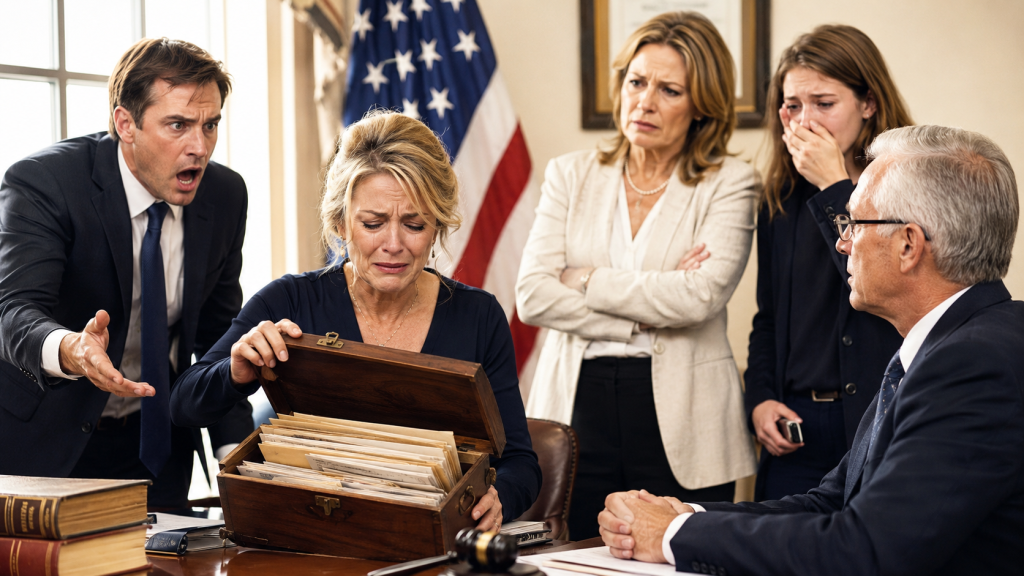
The room changed the moment Mr. Katz placed the old shoebox on the desk. Not slowly. Not gently. It changed the way the sky changes before a storm.
One second, Roy was sitting across from me with the confidence of a man who believed his father’s death had finally delivered everything he had been waiting for. The next, the color disappeared from his face. His sister Sandra stopped reaching for her purse.
Even Sandra’s daughter finally looked up from her phone.
I rested both hands on the shoebox in my lap.
For nine years, I had kept what was inside.
Not because I wanted revenge.
Not because I wanted Arthur’s children to suffer.
I kept it because my husband had asked me to protect the truth.
And I had promised him I would.
Mr. Katz folded his hands on the desk.
“Helen,” he said quietly, “when you’re ready.”
I untied the string.
Inside were twenty-two envelopes.
Each had a date written carefully across the front in Arthur’s handwriting.
The first was dated March 4.
The last was dated January 7.
Roy stared at them.
“What is all that?”
I looked directly at him.
“The truth.”
He gave a short laugh, but there was nervousness underneath it.
“Helen, this is ridiculous. Dad was sick. He was confused.”
Mr. Katz raised his eyes.
“Mr. Whitmore, your father was sick. He was not confused.”
Roy opened his mouth, but nothing came out.
Arthur used to say that Roy’s greatest weakness was not greed.
It was pride.
Roy believed that if he spoke loudly enough, reality would eventually agree with him.
But reality had been sitting quietly inside a shoebox for almost two years.
I removed the first envelope.
Inside was a single sheet of paper.
“March 4,” I said. “Arthur’s first meeting with Mr. Katz after his cancer returned.”
Sandra rolled her eyes.
“Are we seriously going to sit here while you read your diary?”
“This isn’t my diary.”
I placed the paper on the desk.
“It’s a record.”
Mr. Katz nodded.
“Arthur asked Helen to document important incidents involving his care, property and finances. He also met privately with me on numerous occasions.”
Roy leaned forward.
“Why?”
I answered before the lawyer could.

“Because your father knew you were thinking about what would happen to his belongings before you were thinking about what was happening to him.”
Sandra’s face hardened.
“That’s a lie.”
“Is it?”
Mr. Katz adjusted his glasses.
“Arthur came to my office after concluding that his original estate plan no longer reflected his wishes. He believed certain members of his family had become more concerned with his assets than his well-being.”
Roy shook his head.
“No. Dad loved us.”
Mr. Katz’s expression softened.
“Your father did love you.”
Roy looked almost relieved.
Then the lawyer continued.
“He loved you until the day he died. But love does not require blindness.”
Nobody spoke.
Mr. Katz pressed a button on a small recorder.
A familiar voice filled the office.
Arthur.
Even though I knew it was coming, hearing him nearly broke me.
“Roy. Sandra. If you are hearing this, then I am gone.”
Sandra’s eyes widened.
Roy looked toward the recorder.
Arthur continued.
“I want both of you to understand something. I did not make these recordings because I hated you. I made them because I became afraid of what would happen to Helen after I was gone.”
My fingers tightened around the shoebox.
Afraid.
I remembered the first time Arthur had used that word.
It had been two years earlier.
He had been home from the hospital for three days after learning the cancer had returned.
The doctors had been honest.
We were no longer talking about years.
Maybe months.
Maybe less.
That night I sat beside him at two in the morning listening to him breathe.
Arthur hated needing help.
He had spent his entire life being the person other people depended on.
He had been a firefighter for thirty-one years.
He had raised two children.
He fixed leaking pipes, broken doors, lawnmowers and almost anything else someone put in front of him.
Then cancer began taking pieces of his independence.
First his strength.
Then his ability to drive.
Eventually, even walking from the bedroom to the kitchen became an accomplishment.
But cancer never took his mind.
That was the mistake Roy and Sandra made.
They saw a weak old man.
I still saw Arthur.
That night, he reached for my hand.
“Helen.”
“I’m here.”
“Promise me something.”
“Anything.”
“Don’t let them erase me.”
I frowned.
“What are you talking about?”
He glanced toward the hallway.
Roy and Sandra had been staying with us while Arthur recovered from his hospital visit.
“They already started.”
“Arthur…”
“They talk about me like I’m already gone.”
I couldn’t deny it.
Roy had asked about the value of the house before asking whether his father could keep food down.
Sandra had asked where Arthur kept his late mother’s jewelry before asking about his pain.
They spoke about furniture, property and bank accounts as though Arthur’s death were merely a delayed business transaction.
Arthur squeezed my hand.
“I need your help.”
“Tell me what to do.”
“Every month, take me to Katz.”
“Your lawyer?”
He nodded.
“What are you planning?”
A faint smile crossed his face.
“Housekeeping.”
I laughed because I thought he was joking.
He wasn’t.
For the next twenty-two months, Arthur cleaned up everything.
Not the closets.
Not the garage.
Not the basement.
The truth.
Back in Mr. Katz’s office, Arthur’s recorded voice continued.
“Helen, open envelope seven.”
My hands trembled as I found it.
Inside was a photograph.
The moment Roy saw it, he stood.
“Where did you get that?”
I looked at him.
“So you recognize it?”
His face changed.
Only for a second.
But it was enough.
The photograph showed Roy outside Arthur’s bedroom holding a prescription bottle.
Sandra turned toward him.
“What is that?”
Roy looked away.
“I don’t know.”
“You don’t know?”
I removed another document.
“Then perhaps this will help.”
Mr. Katz examined it.
“A pharmacy record.”
Roy’s breathing became heavier.
Arthur’s pain medication had been disappearing faster than prescribed.
At first, I blamed myself.
I thought I had miscounted.
So I started writing down every dose.
Morning.
Afternoon.
Night.
The numbers still didn’t match.
One afternoon, a small security camera Arthur had insisted we install near the hallway captured Roy entering the bedroom while Arthur slept.
He came out carrying the bottle.
Sandra stared at her brother.
“You took Dad’s medication?”
Roy’s face reddened.
“You don’t understand.”
I looked at him.
“Then explain.”
“He was barely using half of it.”
“That wasn’t your decision.”
“I was under pressure.”
Arthur’s voice suddenly came through the recorder again.
“Roy, if you are hearing this, I knew about the pills.”
Roy froze.
“I knew because Helen counted them every night. She thought I didn’t notice what she was doing. But I noticed everything.”
Tears filled my eyes.
Even while dying, Arthur had been watching over me.
“You took something from a dying man because you believed he would never notice,” Arthur said. “You were wrong.”
Roy shoved his chair backward.
“This is insane. I’m not sitting here listening to this.”
He walked toward the door.
Mr. Katz spoke calmly.
“Your father requested that everyone hear the complete recording before the estate documents are distributed.”
Roy turned.
“So now a dead man controls when I can leave?”
Mr. Katz looked at him for a long moment.
“No, Mr. Whitmore. You are free to leave.”
He pushed a folder slightly forward.
“But Arthur specified that anyone leaving before the reading was completed would be considered to have declined any conditional inheritance.”
Roy stopped.
Slowly, he returned to his chair.
That told me everything.
Even now, money was stronger than outrage.
The recording continued.
“Helen, show them the key.”
I reached into the shoebox.
At the bottom was a small brass key.
Sandra recognized it immediately.
“That can’t be…”
“You know what it is,” I said.
Mr. Katz nodded.
“It opens Arthur’s safety deposit box at First National Bank.”
Roy stared at the key.
For the first time that morning, genuine uncertainty appeared on his face.
“What’s inside?”
“You’ll find out.”
He slammed his palm against the desk.
“My father would never hide something from us.”
Mr. Katz’s expression didn’t change.
“He wasn’t hiding it from you.”
He paused.
“He was protecting it from you.”
Arthur’s voice returned.
“Before you ask what is in that box, I want you to remember something. I gave both of you chances.”
I closed my eyes.
I remembered those chances too.
Christmas dinners when Arthur sat near the window waiting for headlights that never appeared.
Birthdays when presents remained unopened because his children canceled at the last minute.
Sunday afternoons when Arthur called Roy and received a text hours later saying he was busy.
Arthur always defended them.
“They have lives.”
“They have responsibilities.”
“They’ll come around.”
For years, I believed him.
Eventually, I realized some people do not come around because they are comfortable exactly where they are.
Arthur continued.
“Do you remember my first heart attack?”
Roy stared at the floor.
Sandra looked away.
“You both came to the hospital. For a little while, I believed you came because you were worried.”
There was a pause.
“Then I heard you outside my room.”
Sandra’s face changed.
“You were discussing who would get the house.”
She covered her mouth.
“I never…”
“Don’t,” I said quietly.
She looked at me.
“Please don’t insult him again by pretending it didn’t happen.”
Arthur had been awake that night.
His own children had stood outside his hospital room dividing his belongings while he was still fighting to stay alive.
“That was when I finally understood something,” Arthur said.
“Blood creates relatives. Love, loyalty and presence create family.”
Roy pointed toward me.
“She poisoned you against us.”
I almost laughed.
Even with Arthur speaking from beyond the grave, Roy still needed someone else to blame.
Mr. Katz opened another folder.
“Arthur anticipated that accusation.”
He removed several documents.
“These are signed statements documenting that Helen was not present during the preparation or execution of the revised estate documents. Arthur also underwent an independent capacity evaluation.”
Roy stared at him.
“You had him evaluated?”
“Arthur requested it himself.”
“Why?”
“Because he knew you might claim he was incompetent.”
Roy fell silent.
Arthur had prepared for every argument.
Mr. Katz turned to the next document.
“Now we come to the house.”
Sandra immediately straightened.
“Dad bought that house before Helen married him.”
“Correct.”
“So she has no right to it.”
“You misunderstand.”
Mr. Katz placed a deed on the desk.
“Arthur transferred ownership twenty-two months ago.”
Sandra frowned.
“To whom?”
The lawyer looked at me.
“Helen Whitmore.”
Silence.
Roy stared at the document.
“No.”
“It was completed legally.”
“No.”
“The deed was recorded.”
“Dad promised me this house!”
The words escaped before Roy could stop them.
And there it was.
Not grief.
Not love.
Ownership.
Mr. Katz leaned back.
“That statement illustrates precisely why your father changed his plans.”
Roy looked at me.
“You stole it.”
I shook my head.
“No.”
“You manipulated a dying man.”
“No.”
“You were his nurse!”
Those words finally came.
The words I had heard in different forms for years.
Just the nurse.
Not his real family.
Not the mother of his children.
Not someone entitled to stand beside him.
Just the woman who cooked his meals, washed his clothes, drove him to chemotherapy, cleaned him when he was too weak to stand and held him through nights when pain made sleep impossible.
I looked at Roy.
“I was never his nurse.”
My voice remained calm.
“I was his wife.”
Arthur’s voice filled the room again.
“Helen.”
My breath caught.
“If you’re hearing this, you’re probably uncomfortable.”
Despite everything, I smiled.
“You always hated fighting. You believed keeping the peace was more important than proving yourself.”
A tear slipped down my cheek.
“But sometimes silence isn’t peace. Sometimes silence simply gives cruel people more room.”
I closed my eyes.
“You did not take my home, Helen.”
My shoulders shook.
“You built it.”
The room blurred through my tears.
“You made coffee in that kitchen every morning. You planted tomatoes I complained about and then ate every summer. You sat beside me through chemotherapy. You slept in hospital chairs. You stayed when there was nothing left to gain.”
Arthur paused.
“You were the person who stayed.”
I covered my mouth.
“And that is why the house belongs to you.”
Even Roy could not interrupt.
Mr. Katz allowed several seconds of silence before speaking.
“There remains the matter of the safety deposit box.”
An hour later, the four of us were standing inside First National Bank.
A manager escorted us downstairs.
The box contained three items.
A thick envelope.
A small notebook.
And an old photograph.
I picked up the photograph.
Arthur and I were sitting on the front steps of the house during our first year together.
We looked younger.
I had forgotten how dark Arthur’s hair had once been.
On the back, he had written:
“The day I found my home.”
My hands shook.
Then I opened the envelope.
Inside was a letter.
My dearest Helen,
If you’re reading this, I’m gone.
I know you. You’re probably apologizing for crying.
Stop doing that.
I laughed through my tears.
Arthur knew me too well.
You spent nine years taking care of me, but you never called it sacrifice. You called it marriage.
You gave me dignity when illness tried to take it.
You gave me companionship when other people became uncomfortable with my sickness.
Most importantly, you never made me feel like a burden.
The children may inherit things from me.
But you inherited my heart long before any lawyer prepared these papers.
I stopped.
Roy and Sandra stood silently.
Then I continued.
I have left something for Roy and Sandra as well.
Both of them looked up.
Roy immediately turned toward Mr. Katz.
“What?”
The lawyer opened the notebook.
“Your father did not completely disinherit either of you.”
Sandra looked stunned.
“There is money?”
“There is.”
“How much?”
Mr. Katz gave her a disappointed look.
Sandra lowered her eyes.
“Sorry.”
“The inheritance is conditional.”
Roy laughed bitterly.
“Of course it is.”
“For twelve months, each of you must complete regular volunteer service at the hospice where your father received end-of-life care.”
Sandra stared.
“You’re serious?”
“Completely.”
“And if we don’t?”
“The funds will be donated to that hospice.”
Roy crossed his arms.
“So Dad is punishing us.”
“No,” I said.
Mr. Katz looked at me and nodded.
“Arthur specifically wrote that the requirement was not punishment.”
The lawyer turned a page.
“He called it an education.”
Roy did not speak again.
That evening, I returned home alone.
For the first time, I unlocked the front door knowing the house truly belonged to me.
Not because I had defeated Arthur’s children.
Not because I had won an inheritance.
Because Arthur had made certain nobody could throw me out of the life we had built together.
I entered the kitchen.
His coffee mug was still beside the sink.
His chair remained near the window.
I touched its wooden back.
“We did it, Arthur.”
The house was quiet.
But I didn’t feel alone.
The first few weeks were difficult.
For nine years, my life had revolved around Arthur.
Medication.
Appointments.
Meals.
Treatments.
Emergency phone calls.
Good days.
Bad days.
Then suddenly there was no schedule.
No one calling my name from the bedroom.
No oxygen machine humming at night.
No Arthur complaining that hospital oatmeal tasted like wallpaper paste.
I even missed the difficult moments.
Because every difficult moment had meant he was still here.
For several mornings, I accidentally prepared two cups of coffee.
The first time I noticed, I cried.
The second time, I laughed.
“You’d make fun of me for this,” I told his empty chair.
Three weeks after the funeral, a letter arrived.
It was from Roy.
I almost didn’t open it.
For nine years, messages from Roy usually contained a request.
Money.
Information.
A favor.
Something involving Arthur’s property.
This envelope was different.
My name was written carefully across the front.
Helen.
Inside was a single page.
Helen,
I don’t know how to write this.
That sentence alone surprised me.
Roy had never admitted not knowing something.
I spent my whole life believing Dad owed me something. His house. His savings. His business. Whatever he had left.
I never thought about what I owed him.
I kept reading.
When Katz told me about the hospice requirement, I thought it was humiliating.
Yesterday I sat with a man named Walter.
He’s dying.
His son hasn’t visited him in six months.
Walter asked me whether I thought his son hated him.
I didn’t know what to say.
Because suddenly I realized I had been that son.
My eyes filled.
I don’t know whether I can fix what I did.
Maybe I waited too long.
But Dad was right about one thing.
You were never “just the nurse.”
You were his wife.
You were the person who stayed when I didn’t.
I’m sorry.
No excuses.
No demands.
Two words.
I’m sorry.
I folded the letter and placed it beside Arthur’s photograph.
“You got through to him,” I whispered.
But later I realized Arthur hadn’t changed Roy.
He had simply created a situation where Roy had to look at himself.
Change was still Roy’s choice.
A month later, Sandra appeared at my door.
For several seconds, I considered pretending I wasn’t home.
I remembered her arriving after Arthur’s death and speaking about furniture before we had even buried him.
I remembered her calling me an outsider.
I remembered her holding my spare house key as if it were proof that she belonged there more than I did.
But I also remembered something Arthur had once told me.
Forgiveness doesn’t mean giving someone permission to hurt you again.
It means refusing to carry their poison for them.
So I opened the door.
Sandra stood on the porch holding a box.
“Helen.”
“Hello, Sandra.”
“I brought something back.”
She opened the box.
The family silver.
She had removed it from the dining room shortly after Arthur died.
“I should have returned it earlier.”
“Yes.”
She looked surprised by my directness.
Then she nodded.
“Yes. I should have.”
I accepted the box.
Neither of us spoke for several moments.
Then Sandra said something I never expected.
“I hated you.”
I looked at her.
“Why?”
“Because Dad loved you.”
Her voice trembled.
“He trusted you. He listened to you. He looked happy when you walked into a room.”
“And?”
“I was his daughter.”
There it was.
Not greed.
Not entirely.
Underneath Sandra’s anger was something more complicated.
Jealousy.
Fear.
The feeling that her father’s second chance at happiness had somehow taken something from her.
“I thought you replaced my mother.”
I shook my head.
“Nobody replaced your mother.”
“Then why did he need you?”
“Because losing one person doesn’t mean you’re required to stop living.”
Sandra stared at me.
“Your father loved your mother,” I continued. “And later, he loved me. Those truths don’t cancel each other.”
Her eyes filled with tears.
“He stopped needing us.”
“No.”
I stepped closer.
“He stopped chasing you.”
That hurt her.
I could see it.
“He called, Sandra. He invited you. He waited. There is a difference between someone not needing you and someone becoming tired of begging you to show up.”
She began to cry.
For the first time in nine years, I saw Arthur’s daughter rather than my enemy.
But understanding her did not erase what she had done.
“I forgive you,” I said.
She looked up hopefully.
“But forgiveness doesn’t mean we’re suddenly a family again.”
Her expression fell.
“Trust has to be rebuilt.”
She nodded.
“I understand.”
“Do you?”
“I think I’m starting to.”
That was enough for that day.
Months passed.
The house slowly became mine in a way paperwork could never accomplish.
I planted flowers along the back fence.
Arthur had always complained that the garden looked lonely.
I painted the kitchen a warm cream because he used to joke that the old wallpaper was older than both of us combined.
I donated some of his clothes.
I kept others.
His old firefighter jacket remained hanging in the hall closet.
I couldn’t part with it.
Not yet.
Then I began volunteering at the hospice.
At first, I went because I missed Arthur.
Eventually, I stayed because I discovered I still had something to give.
I sat with patients whose families lived far away.
I made coffee for exhausted spouses.
Sometimes I simply listened.
Grief taught me that people often don’t need advice.
They need someone willing to remain in the room.
One afternoon, I saw Roy at the end of a hallway.
He was sitting beside Walter.
The old man from his letter.
Roy was reading a newspaper aloud.
Walter had fallen asleep.
Roy didn’t notice me.
He gently pulled the blanket higher over Walter’s chest and continued reading quietly.
I walked away before he saw me.
Something inside me loosened.
Not because Roy had earned forgiveness.
Because for the first time, I saw evidence that Arthur’s final lesson might survive him.
Sandra changed more slowly.
She complained during her first months at the hospice.
She hated the smell.
She hated seeing people sick.
She hated feeling helpless.
Then she met a woman named Margaret.
Margaret had three daughters.
None visited.
Sandra began sitting with her every Thursday.
They talked about gardening, old movies and recipes.
When Margaret died, Sandra called me.
She was crying so hard I could barely understand her.
“I thought I’d be prepared.”
“You never are.”
“She kept asking whether her daughters were coming.”
I closed my eyes.
“I know.”
Sandra whispered:
“Dad waited for us like that, didn’t he?”
I didn’t soften the truth.
“Yes.”
She cried harder.
Sometimes consequences arrive as punishment.
Sometimes they arrive as understanding.
The second kind lasts longer.
Almost a year after Arthur died, Mr. Katz invited us back to his office.
The same office.
The same chairs.
But we were not the same people.
Roy arrived first.
He looked older.
Not physically.
Humility had simply changed the way he carried himself.
Sandra arrived next.
She sat beside him.
Neither demanded anything.
Mr. Katz opened the file.
“You have both fulfilled Arthur’s requirement.”
Roy nodded.
Sandra remained quiet.
“You are therefore eligible to receive the portions of the estate Arthur designated for you.”
Roy looked toward the window.
Then he surprised everyone.
“How much would go to the hospice if I refused it?”
Mr. Katz paused.
“Your entire portion.”
Roy nodded slowly.
“I want half donated.”
Sandra turned toward him.
“What?”
He looked at his sister.
“Dad didn’t owe me all of it.”
Sandra’s eyes filled.
Then she looked at Mr. Katz.
“Do the same with mine.”
The lawyer smiled.
“I believe Arthur would have been pleased.”
Roy looked at me.
“I wish he’d seen me understand.”
I answered quietly.
“Maybe he did.”
A few weeks later, Roy and Sandra came to the house.
Not to claim furniture.
Not to inspect property.
Not to ask about money.
They came carrying food.
We sat at the kitchen table.
Arthur’s chair remained empty.
Nobody tried to sit in it.
At first, conversation was awkward.
Then Roy told a story about Arthur teaching him to ride a bicycle.
Sandra remembered how their father used to burn pancakes every Mother’s Day and insist they were supposed to be black.
I laughed.
“He never told me that.”
Roy smiled.
“There are probably a lot of stories you never heard.”
“And probably many you never heard from me.”
So we traded them.
Their Arthur.
My Arthur.
The father.
The husband.
The firefighter.
The stubborn patient.
The terrible pancake cook.
The man who had loved imperfect people and, even at the end, refused to stop hoping they might become better.
That evening, after everyone left, I sat on the front porch.
The sun was dropping behind the trees.
I held the photograph Arthur had left in the safety deposit box.
The day I found my home.
For months, I had thought he meant the house.
Then I understood.
Arthur had never been talking about the building.
Home was never the deed.
It wasn’t the furniture.
It wasn’t the bank account.
It wasn’t the silver Sandra once believed she was entitled to.
Home was the person beside you when life became difficult.
Home was someone who stayed.
Arthur had been my home.
And for nine years, I had been his.
His children once called me “just the nurse.”
They thought caring for someone made me less important because they measured family through blood and inheritance.
Arthur understood something they didn’t.
Anybody can show up when an estate is being divided.
Anybody can love a healthy person on a beautiful afternoon.
The real measure of love is who remains when there is nothing glamorous left.
Who sits beside the hospital bed.
Who remembers the medication.
Who cleans the kitchen at midnight.
Who holds a trembling hand when the doctor says there are no more treatments.
Who stays when staying becomes difficult.
That was what Arthur left behind.
Not a house.
Not money.
A lesson.
Roy and Sandra received their inheritance eventually.
But the most valuable thing their father gave them could never be deposited into a bank account.
He forced them to understand that love is not something you inherit.
It is something you practice.
As for me, I kept the house.
I kept Arthur’s firefighter jacket.
I kept his ridiculous coffee mug.
I kept the photograph.
And I kept living.
Not because losing him stopped hurting.
It never completely did.
But Arthur had spent his final months making sure I would have a future after his ended.
Refusing to live that future would have been another way of losing him.
So I traveled.
I volunteered.
I planted flowers.
I made new friends.
I learned to drink one cup of coffee in the morning instead of accidentally making two.
Most days, anyway.
Every January, on the anniversary of Arthur’s death, Roy and Sandra came to the house.
We cooked dinner.
Sometimes their children came.
We told Arthur stories.
And every year, before they left, someone placed flowers beside his photograph.
Years later, I found Roy alone on the porch staring at that picture.
“I wasted so much time,” he said.
I sat beside him.
“Yes.”
He looked surprised.
Maybe he expected me to comfort him.
But some truths should not be softened.
“I thought you were going to say I shouldn’t blame myself.”
“You should take responsibility for what you did.”
He looked down.
Then I continued.
“But you don’t have to remain the person who did it.”
Roy looked at me.
“That was your father’s final gift to you.”
“What?”
“A chance to become someone different.”
His eyes filled.
“I wish I could tell him.”
I looked toward the garden Arthur had loved.
“Then live in a way that tells him.”
Roy nodded.
We sat there quietly.
The house creaked behind us.
The flowers moved gently in the evening breeze.
And for a moment, I could almost hear Arthur complaining that I had planted too many.
I smiled.
“What?”
Roy asked.
“Nothing.”
But it wasn’t nothing.
It was memory.
It was grief.
It was gratitude.
It was love continuing after the person who created it was gone.
Arthur’s children once believed inheritance meant receiving what belonged to their father.
Eventually, they learned the truth.
The greatest inheritance is becoming worthy of what someone tried to teach you.
And me?
I finally stopped allowing anyone to call me “just the nurse.”
I was Helen Whitmore.
Arthur’s wife.
His partner.
His family.
The woman who stayed.
And in the end, that was worth more than everything inside the house.
THE END. Thank you for reading.