 Reading Time: 18 minutes
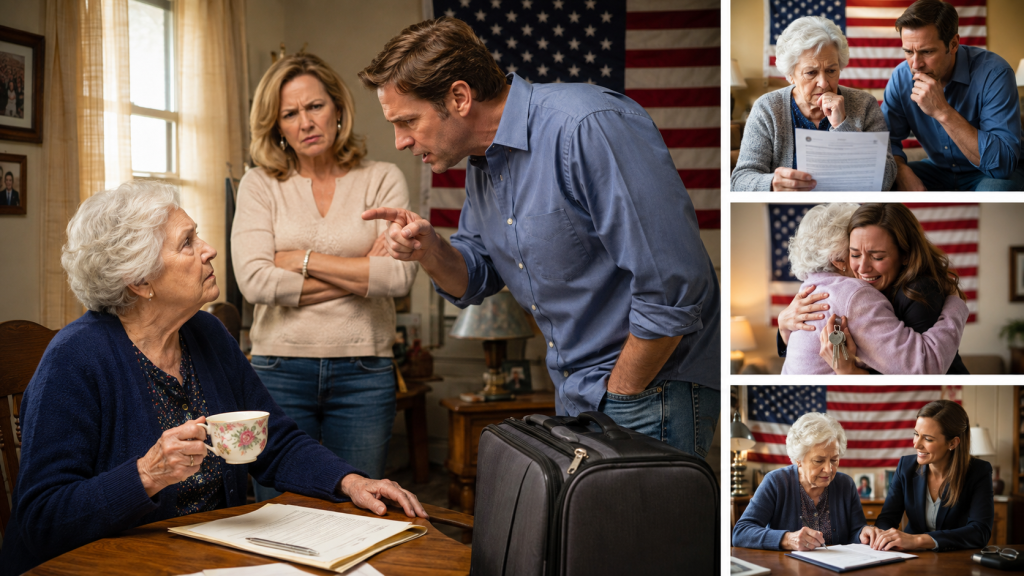
I sold my house six months ago. My son did not know. Yesterday, he set my suitcase beside the front door and said, “A nursing home has a bed for you, Mom. Sign this house over and leave by Friday.”
I sipped my tea, looked at the papers he had placed in front of me, and said, “First ask the person who owns this house.” Greg laughed. “The only man who ever owned this house was buried two years ago.”
He meant his father.

My husband, Walter.
Walter built this house with his own hands in 1974.
He was twenty-eight then, strong enough to carry two bags of cement at once and stubborn enough to believe he could build a home after working ten hours at the factory every day.
We could not afford much.
The first winter, there were blankets covering two unfinished doorways because we had run out of money for doors. Our kitchen cabinets came from a demolition sale. Walter sanded them in the garage while I painted them pale yellow.
Our son Greg was born in the upstairs bedroom three years later.
Our daughter, Melissa, had died as an infant before Greg was born, so perhaps that was why we poured everything we had into him.
Walter coached his baseball team.
I worked weekends at a grocery store to help pay for Greg’s college.
When Greg wrecked his first car, Walter took extra shifts.
When Greg got married the first time, we paid for half the wedding.
When that marriage ended, we opened our door again.
And when Greg remarried Dana, we tried to welcome her too.
Walter used to say, “Family doesn’t keep score.”
For most of my life, I believed him.
Then Walter died.
Two years ago, on a rainy October morning, my husband of fifty-two years closed his eyes in a hospital room while I held his hand.
Three days after the funeral, Greg and Dana arrived with a moving truck.
“You shouldn’t be alone, Mom,” Greg told me.
At first, I was grateful.
Grief makes ordinary things frightening.
The empty side of the bed frightened me.
The silent breakfast table frightened me.
Even taking the garbage bin to the curb alone felt strange because Walter had done it every Thursday for half a century.
So when Greg said he wanted to stay with me for a while, I thought perhaps Walter had left me one final gift.
Our son.
I should have paid more attention to the moving truck.
They were not bringing two suitcases.
They brought furniture.
Boxes.
Dana’s exercise machine.
Greg’s tools.
Two televisions.
A king-size mattress.
By the end of the first week, Dana was complaining about my bedroom.
“The guest room is too small for us,” she said.
“It was good enough when you visited,” I answered.
“That was for weekends.”
Greg looked uncomfortable.
“Mom, you don’t really need that big bedroom anymore.”
I remember staring at him.
That bedroom had been mine for forty-eight years.
Walter’s slippers were still beneath the dresser.
His reading glasses were still in the drawer beside the bed.
I was not ready to move them.
But grief had made me tired of arguments.
So I gave up the bedroom.
By the end of that month, Greg and Dana were sleeping in the room where Walter and I had grown old together.
I was sleeping on a folding bed in the sewing room.
Dana started calling it “our house” at Thanksgiving.
“My family will come to our house for Christmas,” she announced.
Our house.
I noticed it immediately.
Greg did not correct her.
At Christmas, Dana’s sister sat in Walter’s chair.
Her brother parked across my flower bed.
Nobody asked.
In January, Greg began taking three hundred dollars from my pension every month.
“Everybody pays their share, Mom,” he said, holding out his hand.
I looked through the kitchen window at the new truck shining in my driveway.
“Your father and I paid this house off fifteen years ago.”
“You still use electricity.”
“I pay the electricity.”
“And food.”
“I buy most of the groceries.”
He sighed as if I were a difficult child.
“Mom, don’t make everything complicated.”
So I gave him the money.
Three hundred dollars in January.
Three hundred in February.
Three hundred in March.
I told myself he was my son.
That sentence excuses too much when you are a mother.
Then one night in March, I learned what my son thought I was worth.
I woke around one in the morning because I was thirsty.
The sewing room was downstairs, near the kitchen. As I approached the doorway, I heard Greg talking.
He was on the phone.
I almost walked in.
Then I heard my age.
“She’s eighty-one,” he said.
I stopped.
Greg continued.
“The house is worth four hundred thousand, easy. Maybe more with the lot.”
There was a pause.
Then he said, “We list it the day she’s out.”
My hand tightened around the wall.
The person on the other end said something.
Greg laughed.
I will remember that laugh until the day I die.
It was not loud.
That somehow made it worse.
It was casual.
Comfortable.
The laugh of a man discussing an inconvenience that would soon be removed.
Me.
I was the inconvenience.
My son was waiting for me to leave my own house so he could sell it.
I went back to my folding bed without getting the water.
I did not cry.
I lay in darkness looking at the ceiling.
At first I remembered Greg as a baby sleeping on my chest.
Then I remembered his first day of school.
His scraped knees.
His graduation.
Walter teaching him to drive.
Me sitting beside his hospital bed when he had pneumonia at nineteen.
Every memory seemed to ask the same question.
How did that little boy become the man laughing in my kitchen?
By sunrise, the answer no longer mattered.
I knew what I was going to do.
That week, while Greg was working and Dana was visiting her sister, I dressed carefully.
I took the deed.
My checkbook.
Walter’s old leather folder.
Then I called a taxi.
The driver asked where I was going.
I gave him the address of an attorney named Margaret Ellis.
Walter and I had used Margaret years earlier for our wills.
She was nearly seventy now and still worked three days a week.
When I explained what was happening, she took off her glasses.
“Eleanor,” she said, “are you certain?”
“About what?”
“About what you want to do.”
“I’m certain I don’t want my son deciding where I live so he can sell my house.”
She nodded.
Then she asked something important.
“Who do you trust?”
I knew immediately.
“My granddaughter.”
Emily.
Greg’s daughter from his first marriage.
The daughter he stopped calling after marrying Dana.
Greg told people Emily had become rebellious.
He said she had disappeared.
She had not.
She sent me a birthday card every year.
She called at Christmas.
Sometimes she drove two hours just to take me to lunch.
At Walter’s funeral, Emily sat in the back row because Greg had told her she was not welcome with the immediate family.
Walter would have hated that.
I called Emily from Margaret’s office.
She answered on the second ring.
“Grandma?”
“I need to ask you something.”
When I explained, she became silent.
Then I heard her crying.
“Grandma, I don’t want your house.”
“I know.”
“I don’t want your money either.”
“I know that too. That is why I’m asking you.”
The arrangement Margaret created was simple, legal, and carefully documented.
Emily purchased the property under terms Margaret structured after reviewing everything with us. The sale was properly recorded.
But there was one condition that mattered more than anything else.
I received a lifetime lease.
One dollar a year.
As long as I lived, I had the legal right to remain in the house.
No one could throw me out.
Not Greg.
Not Dana.
Not even Emily.
The house belonged to Emily.
My home still belonged to me.
When the papers were signed, Emily hugged me.
“I wish Grandpa could see this.”
I smiled.
“Oh, I think he’d have something to say.”
Margaret laughed.
Probably for the first time that afternoon.
I returned home four hours after leaving.
Dana was sitting on the couch scrolling through her phone.
“Where were you?”
“Church luncheon.”
She barely looked up.
“Nobody misses you here anyway.”
I walked into the kitchen.
Inside the flour tin, beneath an unopened bag of baking powder, I placed my copy of the recorded documents.
Greg and Dana had never cooked anything from scratch in my kitchen.
I knew the papers were safe.
For six months, I watched them plan to sell a house that did not belong to them.
Dana selected paint colors “for the buyers.”
Greg measured the garage.
One Saturday he brought a realtor named Chuck into my living room.
Chuck walked around taking notes.
“Original floors?” he asked.
“My dad put them in.”
Greg said it proudly.
Then he pointed toward me.
“The old lady comes with the house for now, but not for long.”
Chuck laughed.
I was carrying coffee.
I set a cup in front of each of them.
“Cream?”
Neither noticed the way I smiled.
They discussed asking prices while sitting beneath a roof owned by the daughter Greg had abandoned.
Dana wanted to replace my curtains.
Greg talked about staging the house.
Once, I heard them arguing about how to divide the money.
“We need at least eighty thousand for the new place,” Dana said.
“I want the truck paid off first.”
“What about my kitchen?”
“You’ll get your kitchen.”
They had spent my house ten times before discovering it was not theirs.
Then came the suitcase.
Greg placed it by the door on Monday evening.
It was mine.
The brown one Walter and I had taken to Florida on our fortieth anniversary.
On top was a nursing home brochure.
A bed number had been circled in red ink.
Dana stood behind him with her arms folded.
“A nursing home has a bed for you, Mom,” Greg said. “Sign this house over and leave by Friday.”
I looked at the brochure.
Then at my suitcase.
Then at my son.
“First ask the person who owns this house.”
Greg laughed.
“The only man who ever owned this house was buried two years ago.”
I finished my tea.
The following morning, they tried again.
Greg slid a transfer document across the kitchen table.
There was a pen on top.
“Sign.”
“No.”
Dana slammed her cup down.
Coffee splashed onto the saucer.
“Walter is dead, you crazy old woman. Keep talking like that and we’ll tell a judge you’re confused. Confused old women get locked rooms, not sewing rooms.”
I looked at her.
For years, I had mistaken silence for weakness.
Dana had made the same mistake.
“Friday, Mom,” Greg said. “The realtor comes at ten. The van comes at noon. Sign before that, and this stays friendly.”
I nodded.
“Friday.”
That seemed to satisfy him.
Friday morning arrived bright and warm.
Greg put on his good blue shirt.
Dana arranged cookies for the realtor on my mother’s china plate.
The transfer paper was waiting on the kitchen table.
My suitcase remained by the door.
At exactly ten o’clock, the doorbell rang.
Greg smiled.
“Finally.”
He smoothed his shirt and opened the door.
It was not Chuck.
A young woman stood on the porch holding a blue folder and a ring of keys.
Greg’s face changed.
White first.
Then gray.
“You.”
“Hello, Dad.”
Dana stepped into the hallway.
“Greg, who is this?”
“Nobody.”
Emily smiled sadly.
“That’s interesting.”
Greg blocked the doorway.
“You don’t come into this house.”
Emily lifted the keys.
“That’s also interesting, because I have the keys to it.”
She stepped inside.
Dana stared at her.
“Who are you?”
“My name is Emily.”
Dana looked at Greg.
His eyes dropped.
“My daughter,” he finally muttered.
Emily corrected him.
“The daughter you haven’t called in nine years.”
I walked into the hallway.
“Hello, sweetheart.”
Emily’s expression softened immediately.
“Hi, Grandma.”
Greg saw the blue folder.
“What’s that?”
Emily handed it to him.
He snatched it from her.
He opened the folder.
The first page was the recorded deed.
I watched him read.
His eyes moved down the page.
Then returned to the top.
He read the owner’s name once.
Then twice.
As though the letters might rearrange themselves if he stared long enough.
“This isn’t possible.”
Nobody answered.
“You had no money,” he said to Emily. “Who paid—”
“Read the name out loud, Dad.”
His jaw tightened.
“Emily Grace Mercer.”
Dana grabbed the document.
“What?”
She read it herself.
Her face changed too.
“No.”
Emily remained calm.
“Yes.”
“This is fraud,” Greg said.
“No.”
“You tricked an elderly woman.”
That was when I laughed.
For six months I had been waiting for that moment.
“You mean the elderly woman you were trying to force into a nursing home?”
Greg turned toward me.
“Mom, what did you do?”
“I sold my house.”
“When?”
“Six months ago.”
The room became completely silent.
Dana stared at me.
Greg looked as though someone had removed the floor beneath him.
“You couldn’t.”
“I did.”
“You had no right.”
That sentence was almost beautiful.
“No right?”
“It was Dad’s house.”
“And mine.”
“He built it.”
“With our money. During our marriage. And after he died, ownership passed according to the estate documents you never bothered to read because you assumed everything would eventually become yours.”
Greg began pacing.
“We can undo this.”
Emily opened the folder to another page.
“No, you can’t.”
“What is that?”
“Grandma’s lifetime lease.”
Dana took it.
Her lips moved while she read.
Emily explained.
“Grandma has the legal right to live here for the rest of her life. Her rent is one dollar per year.”
Greg stared at me.
“You gave my inheritance to her?”
I stood very still.
“Your inheritance?”
“Yes!”
“Your father has been dead for two years, Greg. Did you ever ask what he left you?”
He hesitated.
Walter had left Greg some money.
Not a fortune.
Twenty-five thousand dollars.
Greg had spent most of it on the truck.
The house had been mine.
“You were going to get it eventually,” he said.
“There it is.”
“What?”
“The sentence you have been living by. Eventually.”
I stepped closer.
“You were waiting for eventually. Waiting for me to die. And when waiting became inconvenient, you decided to speed things along by putting me somewhere else.”
“That’s not fair.”
“No? Then explain the suitcase.”
He looked toward the door.
“Explain the nursing home papers.”
Nothing.
“Explain why I heard you in March saying you would list the house the day I was out.”
Greg froze.
Dana looked at him.
“You heard that?”
“Every word.”
He sank into Walter’s old chair.
For a moment, he looked like a little boy again.
But I was no longer the mother who would confuse pity with forgiveness.
Dana suddenly pointed at Emily.
“She cannot throw us out. We live here.”
Emily nodded.
“You do.”
Dana blinked.
“For now.”
Emily pulled another paper from the folder.
“This is written notice that your permission to occupy the property has been revoked.”
Greg stood again.
“You’re evicting your own father?”
Emily looked directly at him.
“You stopped being interested in being my father a long time ago.”
“I made mistakes.”
“You forgot my birthday nine years in a row.”
“Emily—”
“You told Grandma I disappeared because admitting you abandoned me sounded worse.”
Greg looked away.
Emily’s voice remained steady.
“You told me not to sit with the family at Grandpa’s funeral.”
Dana whispered, “You told me she refused to come.”
Emily looked at her.
“I arrived before you did.”
Dana turned toward Greg.
Something shifted between them.
Not enough to make me pity either one.
But enough for me to realize their marriage contained lies I knew nothing about.
Then the doorbell rang again.
This time it was Chuck.
Greg opened the door halfway.
“Bad time.”
Chuck looked past him and saw everyone.
“I thought we were discussing the listing.”
Emily walked forward.
“There won’t be a listing.”
“Excuse me?”
“I own the property.”
Chuck stared at her.
Then at Greg.
Greg said nothing.
Emily handed him a copy of the deed.
Chuck read the first page.
His professional smile disappeared.
“You told me you owned this property.”
Greg cleared his throat.
“I was going to.”
Chuck closed the folder.
“That is not ownership.”
“We had an understanding.”
“With whom?”
Nobody answered.
Chuck looked at me.
“Ma’am, did you authorize him to list this property?”
“No.”
That ended the conversation.
Chuck handed the folder back.
“I’m leaving.”
Dana followed him toward the door.
“Wait. You already photographed the house.”
“I’ll delete the file.”
“We had buyers interested.”
“You did not have a property to sell.”
The front door closed behind him.
Greg looked at Emily.
“How long do we have?”
“Thirty days.”
Dana exploded.
“Thirty days? We have furniture!”
“So did Grandma when you moved her out of her bedroom.”
Dana turned toward me.
“I never forced you.”
“You told me two people needed the room more than one.”
“That’s different.”
“Why?”
She could not answer.
Emily looked toward the sewing room.
“Grandma, do you want your bedroom back?”
I looked upstairs.
For two years I had avoided that room.
Not because I did not want it.
Because Greg and Dana had filled it with themselves.
“Yes.”
Emily nodded.
“Then she gets it tonight.”
Dana laughed.
“You expect us to move our bed?”
Emily shook her head.
“No. I expect you to move your belongings. The bed belonged to Grandpa and Grandma before you arrived.”
For the first time in years, I saw genuine fury in Dana’s eyes.
But she could do nothing with it.
That evening, Greg carried their clothes into the guest room.
Dana did not help.
She packed her cosmetics while muttering about lawyers.
I climbed the stairs slowly.
When I entered my bedroom, I stopped in the doorway.
The curtains were different.
Dana had moved the dresser.
Walter’s reading lamp was gone.
But the afternoon sunlight still fell across the wooden floor exactly as it had when Walter was alive.
Emily stood behind me.
“You okay?”
I touched the doorframe.
“Your grandfather made this.”
“I know.”
“He measured it wrong the first time.”
Emily smiled.
“Really?”
“The door wouldn’t close. He blamed the hinges for three days before admitting the frame was crooked.”
We both laughed.
Then I cried.
Not because of Greg.
Because suddenly Walter felt close.
Emily put her arms around me.
I rested my head against hers.
“I’m sorry you had to buy the house to protect me.”
“I didn’t buy it just to protect you.”
I looked at her.
She smiled.
“You protected me too, Grandma.”
“How?”
“When Dad stopped calling, you didn’t.”
That sentence healed something inside me.
Not everything.
Some wounds should not disappear completely. They teach us where not to place our hands again.
Greg tried to fight the sale.
He hired an attorney.
The attorney called Margaret.
That conversation apparently lasted less than twenty minutes.
The deed was valid.
The sale was valid.
My lease was valid.
There was nothing to challenge.
Two weeks later, Greg stopped speaking to me.
A week after that, Dana left.
She went to stay with her sister and took half their belongings.
Greg followed several days later.
On his final morning, I found him standing in the kitchen.
The truck was packed.
He looked older.
“Mom.”
I waited.
“Are you really going to let me leave like this?”
The question surprised me.
“Like what?”
“With nothing.”
I looked around the kitchen Walter and I had built a life inside.
“You arrived here with a moving truck, Greg.”
“That’s not what I mean.”
“I know.”
He looked down.
“I’m your son.”
“Yes.”
“Doesn’t that mean anything?”
“It meant everything to me.”
He flinched.
I continued.
“For years, it meant more to me than my comfort. More than my dignity. Sometimes more than common sense.”
“Mom—”
“But being my son did not make my home yours.”
He rubbed his forehead.
“I wasn’t trying to hurt you.”
“You put a suitcase by the door.”
“I thought the nursing home would be better.”
“You circled the bed number before asking me.”
Silence.
“You had already decided.”
He looked toward the window.
“I needed the money.”
There it was.
Not an apology.
The truth.
“What happened?”
He sighed.
“Debt.”
“How much?”
He would not answer.
“Truck?”
He nodded.
“Credit cards?”
Another nod.
“Dana?”
He shrugged.
“All of it.”
I understood then.
Not forgave.
Understood.
Greg had not become wealthy.
He had become desperate while pretending to be successful.
The new truck, dinners, clothes, vacations—they were all built on borrowed money.
And he had looked at his elderly mother and seen an asset.
“I would have helped you,” I said.
He looked at me.
“What?”
“If you had sat at this table and said, ‘Mom, I made mistakes. I’m in trouble,’ I would have listened.”
His eyes filled.
“Would you have given me the house?”
“No.”
He almost smiled.
“But I might have helped you find a way out that didn’t require throwing me away.”
He cried then.
Quietly.
I had seen my son cry only a handful of times.
Part of me wanted to cross the kitchen and hold him.
That instinct never leaves a mother.
But love is not always walking toward someone.
Sometimes love is refusing to move the boundary that may finally force them to change.
“I’m sorry, Mom.”
It was the first real apology I had heard from him in years.
“I hope someday you understand what you are apologizing for.”
He nodded.
Then he picked up his keys.
At the door, he stopped beside the suitcase he had packed for me.
It was still there.
I had deliberately left it untouched.
Greg looked at it.
Then at me.
“I’m sorry about that too.”
He left.
I watched his truck disappear down the road.
Then I carried the suitcase upstairs and unpacked the clothes Dana had chosen for my nursing home.
She had packed three nightgowns.
Two sweaters.
Slippers.
My toothbrush.
No photographs.
Not one.
Fifty-two years with Walter, and they had planned to send me away without even a picture of him.
That detail hurt almost more than anything else.
So that afternoon, Emily and I went through every photograph in the house.
We put Walter back where he belonged.
Wedding picture on the mantel.
Family photograph in the hallway.
Walter holding baby Greg beside the fireplace.
Walter teaching Emily to fish.
Walter and me in Florida on our fortieth anniversary.
The house began feeling like mine again.
Or perhaps like ours.
Emily visits every Sunday now.
She never moved in.
That was important to both of us.
She owns the house, but she knocks before entering.
Every time.
Sometimes I tease her.
“You have keys.”
She always says the same thing.
“Ownership doesn’t replace manners, Grandma.”
I wish Greg had learned that.
He calls occasionally.
Our conversations are short.
He and Dana separated.
I did not celebrate that.
Their marriage was their business.
Greg sold the truck and took a smaller apartment. He says he is paying down his debts.
For my birthday, he sent a card.
Inside, he wrote:
“I spent years thinking about what I would get when you were gone instead of being grateful you were still here.”
I read that sentence several times.
Then I placed the card beside Walter’s photograph.
Maybe there is hope for Greg.
Maybe there isn’t.
I have learned not to build my peace around someone else becoming better.
I am eighty-one years old.
I make my coffee every morning in my kitchen.
I sleep in my own bedroom.
I plant tomatoes beside the fence Walter built.
Once a year, Emily comes over with an envelope.
Inside is my lease renewal receipt.
One dollar.
I hand her a crisp dollar bill.
She signs the receipt with exaggerated seriousness.
“Rent paid in full.”
Then we laugh.
Last Sunday, we were sitting on the porch when Emily asked me something.
“Grandma, do you regret selling it?”
I looked at the house.
Walter’s house.
My house.
Emily’s house.
Funny how one place can be all three things without contradiction.
“No.”
“Not even a little?”
I thought carefully.
“I regret that I needed to.”
That is different.
I wish Greg had walked through my front door three days after his father’s funeral because he loved me and wanted to make sure I ate dinner.
I wish Dana had treated my home like something borrowed rather than something waiting to become hers.
I wish I had never heard my son laughing in the kitchen about how much money my absence could bring him.
But wishes do not rewrite deeds.
And they do not rewrite people.
Actions do.
Walter once told me something when Greg was young.
We had caught him lying about a broken window.
I wanted to punish him immediately.
Walter said, “Give the boy a chance to tell the truth. But don’t remove the consequence just because he finally does.”
I had forgotten that advice.
Now I understand it better than ever.
Greg finally told me the truth.
He needed money.
He had been drowning in debt.
He saw my house as the easiest rescue.
I can understand his desperation without surrendering myself to it.
I can love my son without giving him my home.
I can forgive him without pretending nothing happened.
And I can leave my door open emotionally without ever again handing him the keys.
People sometimes think getting older makes you helpless.
Sometimes it does.
Our knees weaken.
Our hands shake.
We forget where we put our glasses.
We need help carrying groceries.
But age can give you something too.
Perspective.
At eighty-one, I know that a peaceful room is more valuable than an impressive house.
I know that someone who loves you will not demand proof in the form of property.
And I know that being called selfish does not mean you are selfish.
Sometimes “selfish” is simply what people call you when you stop allowing them to use you.
My suitcase is no longer beside the front door.
It is in the closet upstairs.
The nursing home brochure went into the recycling bin.
The transfer paper Greg wanted me to sign was shredded.
But the recorded deed is still inside my flour tin.
Emily laughs because there is no reason to hide it anymore.
I keep it there anyway.
Not because I am afraid someone will steal it.
Because every time I open that tin, I remember the morning I finally stopped waiting for my son to treat me with respect and started protecting myself.
A few weeks ago, Greg came to visit.
He knocked.
That mattered.
I opened the door.
He stood on the porch holding a small toolbox.
“The back gate still sticks,” he said.
I looked at him.
“How do you know?”
“Dad complained about it for twenty years.”
I smiled despite myself.
“That sounds like your father.”
“Can I fix it?”
I stepped aside.
“Yes.”
Not because he was entitled to enter.
Because he asked.
He repaired the gate that afternoon.
We did not discuss inheritance.
We did not discuss the house.
We drank coffee on the porch.
Before leaving, he looked toward Walter’s old workshop.
“I miss him.”
“So do I.”
Then Greg said something I had waited two years to hear.
“I should have been here for you after he died instead of moving in and taking over.”
I looked at my son.
“Yes,” I said. “You should have.”
I did not rescue him from the discomfort of hearing it.
He nodded.
“I know.”
That was enough for that day.
Perhaps families are not repaired through grand speeches.
Perhaps they are repaired like old houses.
One damaged piece at a time.
A hinge.
A board.
A gate that no longer closes properly.
But you must never confuse repairing a relationship with surrendering ownership of your life.
Those are different things.
When Greg drove away, Emily arrived with groceries.
She saw his truck disappearing.
“How did it go?”
“He fixed the gate.”
She raised an eyebrow.
“That’s it?”
“That’s enough.”
We carried the groceries inside.
On the kitchen counter sat a small envelope Greg had left behind.
I opened it.
There was one dollar inside.
And a note.
“For the next year’s rent. Tell Emily it’s from me.”
I laughed until tears came.
Emily read it and laughed too.
Then she put the dollar into the flour tin beside the deed.
That evening, we sat on the porch as the sun went down behind Walter’s maple tree.
I thought about everything that had happened.
The folding bed.
The three hundred dollars.
The phone call in the kitchen.
The secret trip to the lawyer.
The deed.
The suitcase.
Greg’s face when Emily walked through the door carrying those keys.
For a long time, I believed the most important moment was selling the house.
It wasn’t.
The most important moment happened before that.
It happened in the darkness of the sewing room after I overheard my son planning my removal.
That was the moment I finally understood something Walter had known all along.
A home is not merely wood, brick, money, or a name printed on a deed.
A home is the place where your dignity should be safest.
And anyone who demands that you surrender your dignity in order to remain part of a family has misunderstood what family means.
I did not sell my home because I stopped loving my son.
I sold it because I finally remembered to love myself too.
And when Friday came, I did not go to the nursing home.
I did not carry that brown suitcase through the front door.
I did not sign away the life Walter and I had built.
Instead, my son learned that the house he had already spent in his imagination belonged to the daughter he had abandoned.
My granddaughter learned that the grandmother who kept every birthday card she ever sent trusted her completely.
And I learned that eighty-one is not too old to take your life back.
Tonight, I am sitting at the same kitchen table where Greg once pushed those transfer papers toward me.
Walter’s photograph is beside the window.
Emily’s dollar is inside the flour tin.
The back gate closes perfectly.
And my suitcase is exactly where it belongs.
Empty.
Upstairs.
Waiting for the next trip I choose to take.
Not the place someone else chooses to send me.
THE END!Thank you for reading.