 Reading Time: 14 minutes
The day my husband and I got married, every seat reserved for his family stayed empty. Twenty-four chairs. I remember the number because I counted them twice.
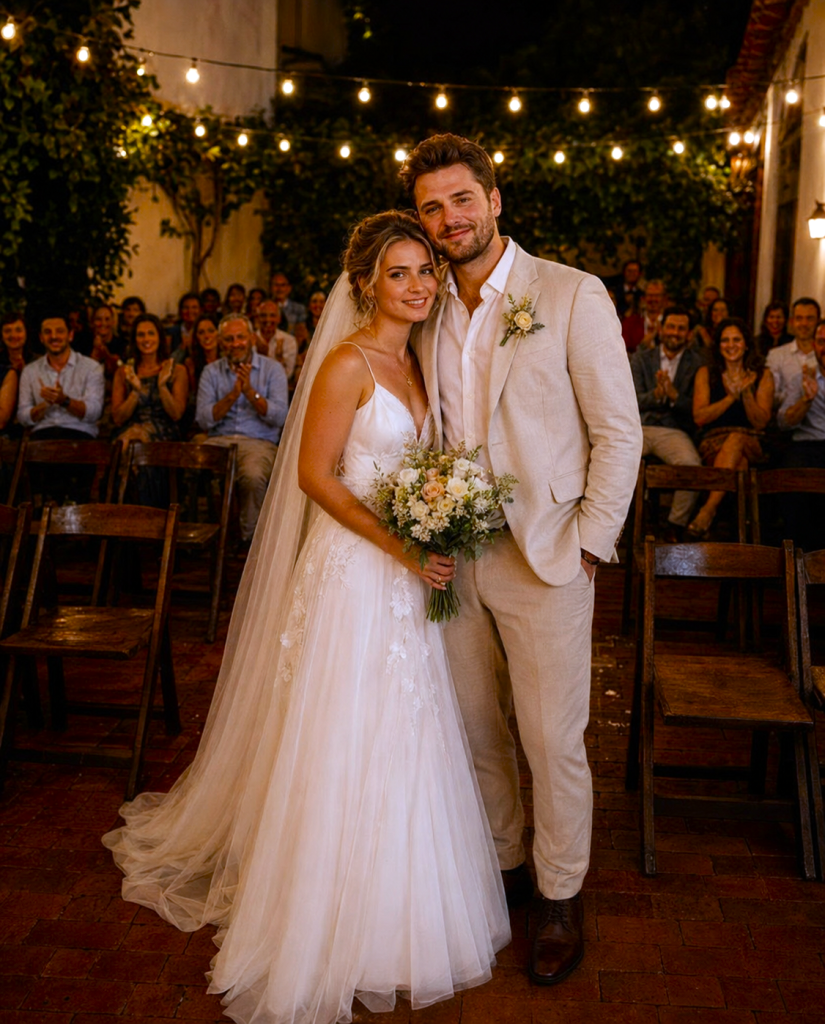
White wooden chairs decorated with small bundles of eucalyptus and cream ribbon, all perfectly arranged beneath the oak trees behind the little vineyard where Daniel and I had chosen to marry.
Not one person from his family came. A week before the wedding, his mother, Margaret Whitmore, had given him an ultimatum.
“If you marry her, don’t expect any of us to be there.”
Her reason was painfully simple.
My mother had been a waitress for more than thirty years. My father owned a small auto repair shop with three employees, two hydraulic lifts, and a coffee machine that had probably been manufactured during the Reagan administration.
We weren’t poor.
But we weren’t wealthy.
Daniel’s family was.
The Whitmores owned several businesses, commercial properties, and a distribution company Daniel’s grandfather had started decades earlier.
Daniel had grown up attending private schools and spending summers at a lake house his parents called “the cottage,” even though it had six bedrooms and its own dock.
His mother had always imagined him marrying someone from what she called “our world.”
Apparently, I wasn’t from it.
Daniel married me anyway.
When the ceremony began and I noticed those empty chairs, I squeezed his hand.
“You can still change your mind,” I whispered.
He looked directly at me.
“I already made my choice.”
Then he smiled.
“And she’s standing in front of me.”
So we got married.
My father cried harder than my mother.
My mother danced until her shoes hurt and eventually kicked them off.
My father’s mechanics showed up wearing suits that looked like they had been purchased that morning.
My childhood friends filled the dance floor.
And somehow, despite those empty chairs, it became one of the happiest days of my life.
Afterward, Daniel cut ties with his family.
I never asked him to.
In fact, I encouraged him several times to reconsider.
“They’re still your parents,” I told him.
“They made their decision,” he replied.
Over the next two years, life became wonderfully ordinary.
We bought a modest three-bedroom house outside Columbus.
The kitchen needed remodeling.
The upstairs bathroom had plumbing that occasionally made sounds like a dying trumpet.
But it belonged to us.
We planted tomatoes in the backyard.
We argued about whether the living room needed another bookshelf.
We talked about children.
Daniel wanted two.
I wanted three.
We jokingly compromised at “two and a half.”
Eventually, I stopped wondering whether his family would ever accept me.
Then, one rainy Saturday morning, someone knocked on our door.
Daniel had gone to help my father replace a transmission at the shop.
I was drinking coffee in the kitchen when I heard the knock.
When I opened the door, Margaret Whitmore was standing there.
She looked different.
Older.
Not dramatically.
Just enough that I noticed.
Her perfectly styled silver-blonde hair was damp from the rain, and she held a leather purse against her side.
For several seconds, neither of us spoke.
Then her eyes drifted past me.
They landed on the framed wedding photograph hanging in our hallway.
She stared at it.
“You still keep it there,” she said quietly.
I didn’t know how to answer.
Of course we kept it there.
It was our wedding photograph.
Finally, she sighed.
“I almost turned around three times before knocking.”
For one foolish second, I thought she had come to apologize.
I stepped aside.
“You should come in.”
She entered slowly.
I offered coffee.
She declined.
We sat across from each other at the kitchen table.
“Before I show you why I came,” she said, “I need you to promise me something.”
“What?”
“Promise you won’t tell Daniel I came here until you’ve seen everything.”
That immediately made me uncomfortable.
“I don’t keep secrets from my husband.”
“I’m not asking you to keep one forever.”
She reached into her purse.
“Just for ten minutes.”
I stared at her.
Then nodded.
Margaret pulled out a thick envelope and placed it on the table.
“I need you to look at these.”
Inside were photographs.
The first showed Daniel sitting across from a woman at a café.
She appeared to be around thirty.
Dark hair.
Blue coat.
Daniel was leaning forward while she spoke.
Another photograph showed them leaving an office building together.
The third showed them walking through a park.
The woman appeared to be crying.
Daniel’s hand rested on her shoulder.
My stomach tightened.
There were twelve photographs.
None proved anything.
But together they created a story my mind desperately didn’t want to read.
I looked at Margaret.
“Who is she?”
“I don’t know.”
“Then where did these come from?”
Margaret hesitated.
“A private investigator.”
I nearly laughed.
“You hired someone to follow your own son?”
Her face tightened with embarrassment.
“I didn’t.”
“Then who did?”
“My husband.”
Daniel’s father.
Richard Whitmore.
Margaret looked toward the window.
“For two years, Richard kept waiting for your marriage to fail.”
She swallowed.
“So did I.”
At least she admitted it.
“We convinced ourselves Daniel would eventually realize he had made a mistake.”
Her voice became quieter.
“But he didn’t.”
I folded my arms.
“So your husband hired someone to prove Daniel was unhappy?”
“To find something that would bring him back.”
The words were ugly.
She knew it.
“I found the envelope in Richard’s office three days ago.”
Margaret pushed the photographs toward me.
“I don’t know who that woman is. But I thought you deserved to know.”
After she left, I sat at the kitchen table for nearly an hour.
Rain tapped against the windows.
I kept trying to invent innocent explanations.
Coworker.
Client.
Old friend.
Someone needing advice.
Then memories started surfacing.
Daniel had extended a business trip by one day several months earlier.
A few weeks later, he had stepped outside during dinner to answer a phone call.
“Bad reception,” he’d said.
There had been a restaurant receipt in his jacket from somewhere we had never visited together.
None of those moments had seemed important then.
Looking at the photographs now, they felt different.
At 2:17 that afternoon, Daniel came home.
He entered through the garage carrying a cardboard box.
“Your dad says this carburetor belongs in a museum.”
He stopped.
I was sitting at the kitchen table.
The photographs were spread in front of me.
His face changed instantly.
Not guilt.
Recognition.
That was somehow worse.
“Where did you get those?”
“Your mother.”
Daniel slowly put the box down.
“She came here?”
“Yes.”
He pulled out a chair.
“Claire—”
“Who is she?”
He looked at the photographs.
Then at me.
“Her name is Emily.”
“How do you know Emily?”
Daniel rubbed both hands over his face.
“I should have told you.”
My heart dropped.
Those five words sounded exactly like the beginning of a confession.
“Are you having an affair?”
His head snapped upward.
“No.”
“Have you ever?”
“No.”
“Then explain this.”
I pushed one photograph toward him.
“The café. The office. The park. Her crying. Your hand on her shoulder.”
Daniel stared at the photograph.
Then he said something I never expected.
“She’s my sister.”
I actually laughed.
Not because it was funny.
Because it sounded absurd.
“You don’t have a sister.”
“I didn’t know I had one either.”
He stood.
“Until eight months ago.”
I stared at him.
Daniel walked toward the small desk beside our kitchen and unlocked the bottom drawer.
He returned holding another envelope.
Inside was a letter.
Old.
Yellowed around the edges.
He handed it to me.
“My grandfather left this for me.”
Daniel’s grandfather, Henry Whitmore, had died the previous year.
According to Daniel, Henry had been the only member of the family who had privately congratulated him on our marriage.
The letter was dated three months before Henry died.
Daniel sat beside me.
“When Grandpa was dying, he asked his attorney to give me this after the estate was settled.”
I unfolded it.
The letter was handwritten.
Daniel explained before I finished reading.
“My father had a relationship with another woman before he married my mother.”
I looked up.
“Your father?”
Daniel nodded.
“She became pregnant.”
According to the letter, Richard had been twenty-four.
The woman was named Laura Bennett.
Richard’s father—Daniel’s grandfather—had discovered the pregnancy.
The Whitmores were already wealthy and socially prominent.
Henry offered Laura money.
She refused.
Eventually, Richard married Margaret.
Laura moved away.
And Emily was born.
“Grandpa regretted it for the rest of his life,” Daniel said.
“He helped Laura financially through someone else, but he never told Dad.”
I looked again at Emily’s photograph.
“So Emily is your half-sister.”
“Yes.”
“Does your father know?”
“Not yet.”
“Your mother?”
“No.”
I stared at him.
“You met her eight months ago and didn’t tell me?”
That hurt more than I expected.
Daniel reached for my hand.
I pulled it away.
“I was trying to protect her.”
“From me?”
“No. From them.”
He pointed toward the photographs.
“From exactly this.”
Emily had contacted Daniel after their grandfather died.
Henry had left instructions with his attorney allowing Emily to contact Daniel if she wished.
At first, she didn’t want money.
She wanted medical information.
Her mother had recently died.
Emily had a six-year-old daughter with a hereditary heart condition, and doctors wanted family history from her biological father’s side.
“That office building,” Daniel said, tapping one photograph, “is a genetic counseling center.”
I felt sick.
Not because Daniel had betrayed me.
Because I had spent the last several hours believing he had.
“And the park?”
“She had just learned her daughter might need surgery eventually.”
I covered my mouth.
Daniel looked exhausted.
“I wanted to tell you a hundred times.”
“Then why didn’t you?”
“Because Emily asked me not to tell anyone until she was ready.”
“I’m your wife.”
“I know.”
His voice cracked slightly.
“And that’s where I made the wrong decision.”
That mattered.
He didn’t defend himself.
He didn’t tell me I was overreacting.
He simply admitted it.
“I should have told Emily that keeping this from you wasn’t something I could do. I was trying to honor her trust, and instead I damaged yours.”
I looked down at the photographs.
Suddenly they told a completely different story.
Not betrayal.
Family.
A family Daniel hadn’t even known existed.
Then another thought occurred to me.
“Why did your mother bring these?”
Daniel’s expression hardened.
“Because my father wanted them.”
“What?”
“He probably intended to use them.”
“To do what?”
“Break us apart.”
That evening, Daniel called his mother.
He put the phone on speaker.
Margaret answered after the second ring.
“Daniel?”
“Mom.”
Silence.
Then:
“Claire told you.”
“Yes.”
Margaret sighed.
“I asked her not to until—”
“You had no right to come into my home carrying surveillance photographs.”
“I was trying to protect your wife.”
“No. You were participating in Dad’s obsession with proving my marriage was a mistake.”
Margaret didn’t answer.
Then Daniel said:
“The woman in those photographs is Dad’s daughter.”
Silence.
Absolute silence.
“What did you say?”
“Her name is Emily Bennett.”
Margaret’s voice changed.
“You’re lying.”
Daniel explained everything.
The letter.
Laura.
The pregnancy.
Henry’s involvement.
Emily’s daughter.
When he finished, Margaret whispered:
“I need to see that letter.”
Daniel looked at me.
“Come tomorrow.”
The next afternoon, Margaret arrived alone.
Daniel handed her Henry’s letter.
She read it standing in our living room.
Halfway through, she sat down.
When she finished, she didn’t speak for several minutes.
Then she looked at Daniel.
“Your father told me Laura Bennett was only a friend.”
Daniel said nothing.
Margaret folded the letter carefully.
“I knew her.”
That surprised both of us.
“She worked at the accounting firm Richard used when we were young. There were rumors.”
Margaret looked ashamed.
“I asked him once.”
“And?”
“He said people were jealous because we were getting married.”
She laughed bitterly.
“I believed him.”
Then Margaret did something I never imagined seeing.
She cried.
Quietly.
No dramatic sobbing.
Just tears running down the face of a woman who had spent decades believing money and reputation could protect her from humiliation.
“I treated you terribly,” she said to me.
I didn’t respond.
She continued.
“I looked at your parents and decided their jobs told me everything I needed to know about them.”
Her eyes dropped.
“And all this time, I was protecting a family image that wasn’t even real.”
That afternoon became the first genuine conversation I ever had with my mother-in-law.
But forgiveness didn’t happen immediately.
Daniel refused to pretend the previous two years hadn’t happened.
“You didn’t just miss my wedding,” he told her. “You tried to make me choose between my wife and my family.”
“I know.”
“You called Claire beneath us.”
“I know.”
“You made Dad think investigating me was acceptable.”
Margaret nodded.
“I know.”
Then she looked at me.
“I came yesterday thinking I was warning you.”
She shook her head.
“But maybe part of me still wanted those photographs to prove I had been right.”
That admission probably mattered more than an apology would have.
Because it was true.
Three days later, Margaret returned.
This time she carried no photographs.
She had one request.
“I want to meet Emily.”
Daniel hesitated.
“That isn’t my decision.”
“I understand.”
“She may want nothing to do with this family.”
“I would understand that too.”
Margaret looked at me.
“Would you ask her?”
Not Daniel.
Me.
I realized why.
Margaret knew Daniel no longer trusted her motives.
And somehow, despite everything, she trusted mine.
I agreed to contact Emily.
We met a week later at the same café from the photographs.
When Emily walked in, I immediately saw Daniel in her.
Not dramatically.
But around the eyes.
She sat across from me nervously.
“I’m guessing you’ve seen the photographs.”
I smiled faintly.
“Yes.”
“I’m sorry.”
“You didn’t take them.”
She laughed.
“No.”
We talked for almost two hours.
Emily was a public school counselor.
She had been married for nine years.
Her daughter’s name was Sophie.
She wanted nothing from the Whitmores financially.
She had only wanted medical information.
Then I told her Margaret wanted to meet her.
Emily stared at her coffee.
“Why?”
“I think she’s trying to understand what her marriage was built around.”
“That sounds like her problem.”
“It is.”
Emily looked at me.
“Do you think I should meet her?”
I thought carefully.
“I think you should only do it if it gives you something you need.”
Two weeks later, Emily agreed.
The meeting happened at our house.
Neutral territory.
Margaret arrived first.
Emily came fifteen minutes later.
When I opened the door, Margaret stood.
The two women stared at each other.
Then Margaret whispered:
“You have Richard’s eyes.”
Emily’s expression hardened.
“I’ve been told.”
Margaret swallowed.
“I owe you an apology for something I didn’t even know I was part of.”
Emily didn’t make it easy.
Good for her.
They talked for nearly three hours.
About Laura.
About Richard.
About Henry.
About choices made decades earlier by people who believed secrets disappeared if enough money was placed on top of them.
They didn’t.
Secrets rarely disappear.
They simply wait.
Eventually, Richard discovered everything.
Margaret confronted him.
He denied it for approximately five minutes.
Then Daniel showed him Henry’s letter.
Richard admitted the truth.
What happened afterward surprised everyone.
Margaret left him.
Not because he had fathered a child before their marriage.
She told us she could have forgiven that.
She left because he had lied for thirty-one years and then hired an investigator to destroy his son’s marriage while hiding the greatest deception in his own.
Their divorce took almost a year.
During that year, something unexpected happened.
Margaret began visiting us.
At first, occasionally.
Then regularly.
She met my parents.
The first dinner was painfully awkward.
My father answered the door wearing the same grease-stained work shirt he wore at the garage.
I wanted to disappear.
Instead, Dad looked at Margaret and said:
“So you’re the woman who thought my daughter wasn’t good enough.”
“Dad.”
“What? Saves time.”
Margaret actually smiled.
“I deserved that.”
My mother served pot roast.
By dessert, Margaret and my mother were discussing gardening.
Six months later, my father repaired Margaret’s car.
When she tried to pay him, he refused.
“You’re family now.”
Margaret stood beside the counter looking stunned.
Then Dad added:
“But if you insult my daughter again, labor is triple.”
That became one of our favorite family jokes.
Emily gradually became part of our lives too.
So did Sophie.
Daniel adored being an uncle.
And when Sophie eventually underwent the heart procedure her doctors recommended, Margaret sat beside Emily in the hospital waiting room for six hours.
She never left.
Sophie recovered beautifully.
A year later, Daniel and I had our first child.
A daughter.
We named her Grace.
The morning after she was born, Margaret came to the hospital carrying flowers.
She stood beside the bassinet staring at her granddaughter.
Then she began crying.
“What?” Daniel asked.
Margaret wiped her cheek.
“I missed your wedding because I thought I knew what kind of family you needed.”
She looked at me.
“I almost missed all of this too.”
I handed Grace to her.
Margaret held her carefully.
“My mother used to say something,” I told her.
“What?”
“That you can tell a person’s wealth by how many people would sit beside them when there’s nothing to gain.”
Margaret looked down at Grace.
“Your mother is wiser than I was.”
“She was a waitress for thirty years. You learn things listening to people talk over pie.”
Margaret laughed.
Two years later, Daniel and I renewed our vows.
Nothing extravagant.
Just family and close friends in our backyard.
There were folding chairs beneath strings of lights.
My father complained about the catering prices.
My mother cried before the ceremony even started.
Emily stood beside me.
Sophie scattered flower petals.
Margaret sat in the front row holding Grace.
And beside her was one empty chair.
It was intentional.
Daniel had asked me about it the night before.
“Are you sure?”
“Yes.”
The chair represented the wedding his family had chosen to miss.
Not as punishment.
As remembrance.
Because forgiveness doesn’t require pretending something never happened.
Sometimes forgiveness means acknowledging the empty chair while being grateful someone finally chose to sit beside you.
Before the ceremony, Margaret approached me.
“I’ve been thinking about that first day I came to your house.”
“With the photographs?”
She nodded.
“I thought I was bringing you evidence that your marriage was failing.”
She looked toward Daniel, who was laughing with my father near the grill.
“Instead, I accidentally brought you evidence that our family was.”
I smiled.
“You also brought us Emily.”
Margaret looked across the yard.
Emily was helping Sophie fix the ribbon on her dress.
“Yes,” she whispered.
“I suppose I did.”
Then she reached into her purse.
For one terrifying second, I thought she had another envelope.
Instead, she pulled out a small velvet box.
Inside was a simple pearl bracelet.
“My mother gave this to me when Daniel was born,” she said.
“It was supposed to stay in the family.”
I raised an eyebrow.
“I thought I wasn’t from your world.”
Margaret looked embarrassed.
“You weren’t.”
She took my hand.
“That was the problem. My world was too small.”
She fastened the bracelet around my wrist.
Daniel called everyone toward the chairs.
As we walked across the lawn, Margaret stopped beside the empty seat.
She touched its wooden back.
“I wish I could go back.”
“I know.”
“I would sit here.”
“I know.”
Then I said something I had learned from my own parents.
“You can’t change the chair you left empty yesterday.”
I looked toward the front row where Grace was waving both hands at us.
“But you can choose where you sit today.”
Margaret smiled.
Then she took her seat beside my mother.
Daniel stood beneath the lights waiting for me.
Four years earlier, he had stood at the end of another aisle surrounded by twenty-four empty chairs.
That day, he had chosen me despite them.
This time there were no sides.
No Whitmores.
No mechanic’s daughter.
No wealthy family.
No marrying up.
No marrying down.
There was simply family.
Imperfect, complicated, occasionally infuriating family.
When I reached Daniel, he took my hands.
“Still choosing me?” he whispered.
I smiled.
“Every day.”
Behind us, Grace squealed.
Everyone laughed.
Even Margaret.
And as Daniel kissed me beneath those backyard lights, I understood something I wish I had understood when I first saw those empty chairs years earlier.
People spend too much time measuring families by the wrong things.
Money.
Education.
Houses.
Jobs.
Last names.
Social circles.
But none of those things tell you who will stand beside you when life becomes difficult.
My father owned a little repair shop.
My mother carried plates for thirty years.
Neither of them ever made Daniel prove he deserved a place at their table.
They simply pulled out a chair.
The Whitmores had everything money could buy, yet nearly lost their son because they believed love needed a résumé.
Margaret eventually learned what my parents had understood all along.
Family isn’t determined by who appears impressive in a photograph.
It’s determined by who shows up.
Years later, the original wedding photograph still hangs in our hallway.
I never replaced it with the vow-renewal picture.
Margaret once asked why.
“Doesn’t it remind you of everything that went wrong?”
I looked at it.
Daniel and I were smiling beneath the oak trees.
Behind us, twenty-four chairs sat empty.
“No,” I said.
“It reminds me of everything that survived.”
Today, beside that photograph hangs another.
Daniel and me renewing our vows.
Grace between us.
My parents standing behind me.
Emily and Sophie beside Daniel.
And Margaret in the front row, smiling so widely you would never guess she had once refused to attend her son’s wedding.
Whenever visitors ask about the two photographs, Daniel usually gives the short explanation.
“Our family needed a second picture.”
But I know the longer truth.
Sometimes people come back into your life carrying an apology.
Sometimes they come carrying regret.
My mother-in-law came carrying photographs she thought would prove I had never belonged in her family.
Instead, those photographs exposed a secret that had been buried for thirty years.
They gave my husband a sister.
They gave a little girl an uncle.
They forced a powerful family to confront the lies hidden behind its perfect reputation.
And somehow, they gave Margaret and me something neither of us expected.
A second chance.
Not to erase the past.
But to build something better after it.
The twenty-four chairs at our first wedding remained empty.
Nothing can change that.
But when our daughter Grace celebrated her fifth birthday, our backyard was so crowded that Daniel had to borrow folding chairs from my father’s garage.
Margaret arrived early.
She carried three chairs from Dad’s truck herself.
When I teased her about it, she laughed.
“Apparently I have experience with empty chairs.”
Then she placed them around the table.
And one by one, people filled them.
That is how I remember our story now.
Not by the chairs that were empty.
By the people who eventually learned to sit together.
THE END! THANK YOU FOR READING.