 Reading Time: 10 minutes
My son came home from his mother’s house walking strangely, clenching his teeth, and unable to sit down. I didn’t call a lawyer. I didn’t argue with my ex. I called 911 before anyone could erase the evidence.
Tommy was eight years old, and he arrived with his backpack slung over one shoulder, his face pale, and his eyes swollen from crying in silence for too long. His mother, Lauren, dropped him at the curb like she did every Sunday and did not even get out of the car.
She just shouted from the window, “He’s being dramatic. Just ignore him.”
I knew something was wrong before my son said a single word.
He did not run to me.
He did not hug me tight like he always did.
He just stood there in the entryway, his legs trembling, as if any movement caused him pain.
“Dad,” he whispered, “can I sleep standing up?”
I felt my soul sink to the floor.
I knelt in front of him.
“What happened, champ?”
Tommy looked down.
“Nothing.”
That word scared me more than a scream.
Because children say “nothing” when someone has taught them to be afraid.
Lauren and I had been divorced for two years.
She had custody during the week, and I had him on weekends.
Every time Tommy came back from her house, he was quieter.
First, he stopped singing in the car.
Then he started biting his nails until the skin around them turned raw.
Then he started begging me not to take him back on Mondays.
“Mom gets mad if I say things,” he would tell me.
I talked to the school.
I talked to a psychologist.
I talked to Lauren.
She always had an answer.
“You’re manipulating him.”
“He’s just looking for attention.”
“You’re a bitter father trying to turn my child against me.”
And everyone believed her more.
Because Lauren was well-spoken.
Because she had pretty family photos on Facebook.
Because at school meetings she smiled, brought cookies, and described Tommy as “very sensitive.”
But that night, no smile could cover up what I was seeing.
My son tried to sit on the sofa and let out a sound that broke my heart.
“No, Dad,” he gasped. “Not there.”
His hands were shaking.
He was breaking out in a cold sweat.
His shirt was stuck to his body.
I stood slowly, grabbed the phone, and dialed.
“911, what is your emergency?”
My voice came out flat.
“My son just arrived from his mother’s house. He can’t sit down. He’s in severe pain. I need an ambulance and a police officer.”
Tommy looked up, terrified.
“No, Dad. Don’t call. Mom said if the police came, you would go to jail.”
That was when I realized the damage was not only physical.
They had put fear inside him too.
I knelt back down and took his hands.
“Listen to me, son. You didn’t do anything wrong.”
He started to cry without making a sound.
As if even crying was forbidden.
The ambulance arrived first.
Then a police cruiser.
The neighbors came out to watch from their windows.
I did not care.
The EMT came in, saw Tommy, and her expression changed instantly.
“Who brought him here in this condition?”
“His mother dropped him off fifteen minutes ago.”
“Did she leave?”
“Yes.”
The EMT took a deep breath.
“We’re going to the hospital. Now.”
Tommy clung to my neck when they tried to put him on the stretcher.
“Dad, don’t leave me.”
“I’m never leaving you.”
In the ER, a doctor asked to examine him.
I wanted to go in, but a social worker stopped me.
“We need to follow protocol.”
“I’m his father.”
“That’s exactly why we need to protect him properly.”
That phrase hit me.
Protect him properly.
What had I been doing all those months?
Waiting?
Taking notes?
Believing that a court hearing would solve what my son was screaming with his eyes?
I stayed in the hallway, my hands slick with sweat, listening to doors opening and closing.
Every minute felt like an hour.
Twenty minutes later, Lauren arrived.
She walked into the ER furious, her hair perfect, carrying an expensive handbag and wearing a jacket I had given her back when I still believed we were a family.
“What did you do, Andrew?” she spat. “Did you call the police over a tantrum?”
I did not answer her.
She tried to go into the room.
A nurse stopped her.
“You can’t go in.”
“I’m his mother.”
“For that very reason, ma’am. Please wait here.”
Lauren froze.
It was the first time I had seen her lose control in public.
“My son fell in the bathroom,” she said quickly. “I was going to explain it to you.”
A police officer looked up slowly.
“You said he fell in the bathroom?”
Lauren crossed her arms.
“Yes. Children fall. His father is being dramatic.”
At that exact moment, the doctor came out with the social worker beside him.
His face was controlled, but his eyes were furious.
“Mrs. Keller,” he said, “your son’s condition does not match a simple fall.”
Lauren’s mouth opened.
Then closed.
The officer stood.
“We’ll need a formal statement.”
Lauren snapped, “I want to see my child.”
The social worker stepped in front of her.
“Not right now.”
That was when Tommy’s small voice came from behind the curtain.
“Dad?”
I rushed to the doorway but stopped when the nurse raised a hand.
Tommy was sitting up, wrapped in a blanket, tears running down his face.
“I told them,” he whispered.
Lauren went white.
“Tommy, don’t lie.”
He flinched so hard the nurse moved between them.
Then the doctor handed the officer a sealed evidence packet and said, “We documented everything.”
Lauren’s perfect mask finally cracked.
She turned toward me, shaking with rage.
“You ruined my life.”
I looked at my son, then back at her.
“No, Lauren. You just lost the right to hide what you did to his.”
The room went silent.
Not because I had shouted.
I had not.
It was silent because, for the first time, Lauren’s words could not control the room.
Evidence had entered.
Professionals had seen.
Tommy had spoken.
And I had not waited until Monday morning to ask permission from a lawyer.
I had called for help while the truth was still visible.
The officer asked Lauren to step into another room.
She refused at first.
She demanded her attorney.
She demanded to see Tommy.
She demanded to speak to the hospital director.
But demands sound different when no one is afraid of you anymore.
The nurse simply stood firm.
The social worker wrote notes.
The officer repeated, “Ma’am, this way.”
Lauren finally followed, her heels striking the tile too hard.
I stayed near Tommy’s curtain.
When they let me back in, he was curled on his side, gripping the blanket in both fists.
His face looked too old for eight.
I sat beside the bed and took his hand.
“You told the truth?”
He nodded.
“Are you mad?”
I nearly broke.
“No, buddy. I’m proud of you.”
“She said you would hate me if I told.”
My throat burned.
“Never.”
“She said nobody believes kids who cause trouble.”
“You are not trouble.”
He stared at me like he wanted to believe it but did not know how.
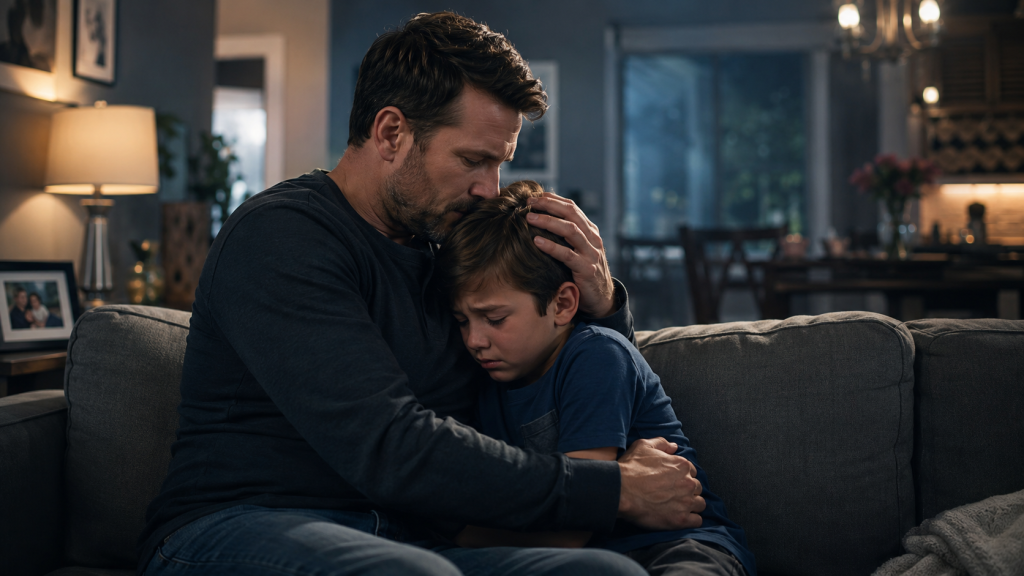
I leaned closer.
“You are my son. You are the best thing in my life. And adults are supposed to protect you, not scare you.”
He began to cry again.
This time, sound came out.
Small at first.
Then harder.
I held his hand and let him cry as loudly as he needed.
Nobody told him to stop.
Nobody told him he was dramatic.
Nobody told him to be quiet.
That night, a child protection investigator arrived.
Her name was Ms. Rivera.
She had a calm voice, gentle eyes, and the kind of patience that comes from seeing children carry secrets too heavy for them.
She spoke to Tommy only when he was ready.
She explained everything before she asked anything.
She told him he could pause.
She told him he could say he did not know.
She told him he was not in trouble.
I watched through a glass panel from the hallway, aching with helplessness.
Tommy held a stuffed bear a nurse had given him.
He did not look at Lauren.
Lauren sat two rooms away with an attorney on speakerphone, still insisting it was all misunderstanding.
But the story began to change as more people listened.
Tommy told them about punishments that were never supposed to leave the house.
He told them about being told not to cry.
He told them about threats.
He told them about Lauren’s boyfriend, Derek, who “got mad when Mom said I ruined things.”
My blood went cold when I heard Derek’s name.
I had complained about him before.
I had told Lauren I did not want him around Tommy until I knew him better.
She called me controlling.
The court said unless there was proof, I could not dictate her personal relationships.
Proof.
That word had followed me for two years like a locked door.
Now proof sat in a hospital bed wrapped in a blanket.
Ms. Rivera came out after the interview.
Her face was serious.
“Mr. Keller, Tommy will not be returning to his mother’s care tonight.”
I exhaled so sharply I almost collapsed.
“Where will he go?”
“With you, pending emergency review.”
I covered my face with one hand.
“Thank you.”
She looked at me kindly.
“This is not over. But tonight he is safe.”
Tonight he is safe.
Those four words became a lifeline.
By morning, an emergency custody hearing was scheduled.
Lauren appeared on video from her attorney’s office, polished again, crying at exactly the right moments.
She said I had poisoned Tommy against her.
She said he was clumsy.
She said the hospital overreacted.
She said she was a loving mother being punished by a bitter ex-husband.
Then the judge reviewed the hospital report.
The sealed evidence.
The EMT notes.
The police timeline.
The social worker’s preliminary statement.
Lauren’s crying stopped.
The judge’s voice was firm.
“Temporary sole custody is granted to the father pending full investigation. The mother shall have no unsupervised contact at this time.”
Lauren shouted, “You can’t do this.”
The judge replied, “I just did.”
Tommy was asleep when I got the news.
I stood beside his hospital bed and let myself cry quietly.
Not from victory.
There was nothing victorious about a child being harmed.
I cried because the door had finally opened.
Because someone finally believed what I had been trying to say without enough proof.
Because my son did not have to go back that Monday.
The next weeks were a blur.
Police interviews.
Medical follow-ups.
Therapy appointments.
Court filings.
Derek disappeared for two days, then was found at his brother’s apartment.
Lauren tried to claim he had nothing to do with anything.
Then investigators found messages on her phone.
Derek: He needs to learn not to run his mouth.
Lauren: Andrew is getting suspicious.
Derek: Then make the kid scared of him too.
Lauren: Already did.
I read those messages in my attorney’s office and felt something inside me turn to stone.
She had not only failed to protect Tommy.
She had helped teach him fear.
My attorney, Ms. Bennett, placed the printed pages in a folder and said, “This changes everything.”
Everything had already changed for me.
The legal system just needed time to catch up.
Tommy came home from the hospital two days later.
I had turned the guest room into his room months before, hoping one day he might spend more than weekends there.
Now I stood in the doorway watching him look around.
Blue comforter.
Space posters.
A lamp shaped like a rocket.
His dinosaur books on the shelf.
His favorite pajamas folded on the pillow.
He touched the blanket.
“Can I really stay?”
My heart twisted.
“Yes.”
“For how long?”
“As long as you need.”
“What if Mom gets mad?”
I knelt in front of him.
“Mom’s feelings are not your job.”
He looked at me.
Really looked.
Like that sentence had never occurred to him before.
That night, he slept with the hallway light on and my bedroom door open.
He woke twice from nightmares.
Both times, I went to him.
Both times, he apologized for waking me.
Both times, I said, “You never have to apologize for needing me.”
Healing did not happen quickly.
It came in tiny steps.
The first time he sat comfortably at the kitchen table.
The first time he laughed at a cartoon.
The first time he sang quietly in the car again.
The first time he left his backpack on the floor instead of clutching it like he might be forced to leave.
Therapy helped.
Routine helped.
Safety helped most of all.
At his first session, the therapist asked him to draw a safe place.
He drew my living room.
The sofa.
The television.
Me standing by the door.
When she asked why I was by the door, Tommy said, “Because Dad doesn’t let bad things come in.”
I went to my car after that appointment and sobbed into the steering wheel.
Lauren was charged months later.
Derek too.
The case was painful, but the evidence held.
The hospital documentation mattered.
The EMT’s observation mattered.
The timing of my 911 call mattered.
The fact that Lauren dropped him off and immediately left mattered.
Everything I had done in the first fifteen minutes mattered.
I think about that often.
How close I came to calling Lauren first.
How close I came to asking, “What happened?” and letting her prepare another explanation.
How close I came to waiting until morning.
Instead, I called 911.
That call saved my son from another night of silence.
In court, Lauren would not look at me.
She looked at Tommy only once.
He held my hand so tightly his fingers trembled.
The judge granted me full custody.
Lauren was given no contact until recommended by professionals and approved by the court.
Derek was ordered to stay away permanently.
After the hearing, Tommy asked one question.
“Does this mean I don’t have to go back?”
I swallowed hard.
“Yes, champ. You don’t have to go back.”
He leaned into me and cried.
I held him in the courthouse hallway while people walked around us.
I did not care who saw.
For two years, Lauren had convinced people that my son was dramatic.
Sensitive.
Confused.
That I was bitter.
Manipulative.
Obsessed with control.
But in the end, the truth did not need to be loud.
It needed to be protected before anyone erased it.
That became my message to every parent who later asked how I knew.
I tell them this:
Believe the change.
Believe the silence.
Believe the flinch.
Believe the child who asks if he can sleep standing up.
Do not wait for perfect evidence when your child’s body and fear are already telling you something is wrong.
Call for help.
Let professionals document.
Let the truth enter the room before the liar does.
Tommy is ten now.
He still has hard days.
Some memories do not disappear just because custody changes.
But he is stronger.
He plays baseball.
He sings in the car again.
He sits on the sofa with one leg tucked under him and complains about homework like any other kid.
Sometimes he still asks, “Dad, are you sure I’m safe?”
And I always answer the same way.
“Yes. You are safe here.”
One Sunday, almost two years after that night, we drove past the old drop-off curb.
He looked out the window quietly.
I waited.
Then he said, “I used to think you didn’t know.”
I felt the words hit my chest.
“I knew something was wrong,” I said. “I just didn’t know what.”
“You called the ambulance fast.”
“Yes.”
“Why?”
I looked at him in the rearview mirror.
“Because I finally understood that waiting was not protecting you.”
He nodded slowly.
Then he said, “I’m glad you came.”
I pulled over because I could not keep driving.
I turned around and looked at my son.
“I will always come.”
He believed me.
I could see it.
Not completely.
Not perfectly.
But more than before.
And that was enough.
My son came home from his mother’s house walking strangely, clenching his teeth, and unable to sit down.
I did not call a lawyer first.
I did not argue with my ex.
I called 911 before anyone could erase the evidence.
People later asked if I was scared of being wrong.
Of course I was.
But I was more scared of being too late.
And if I had to choose between being called dramatic and leaving my child unprotected, I would choose dramatic every single time.
Because my son’s pain was not a custody argument.
It was an emergency.
And the night I treated it like one was the night my child finally stopped having to say “nothing” when everything was wrong.
THE END! THANKS FOR READING!