 Reading Time: 12 minutes
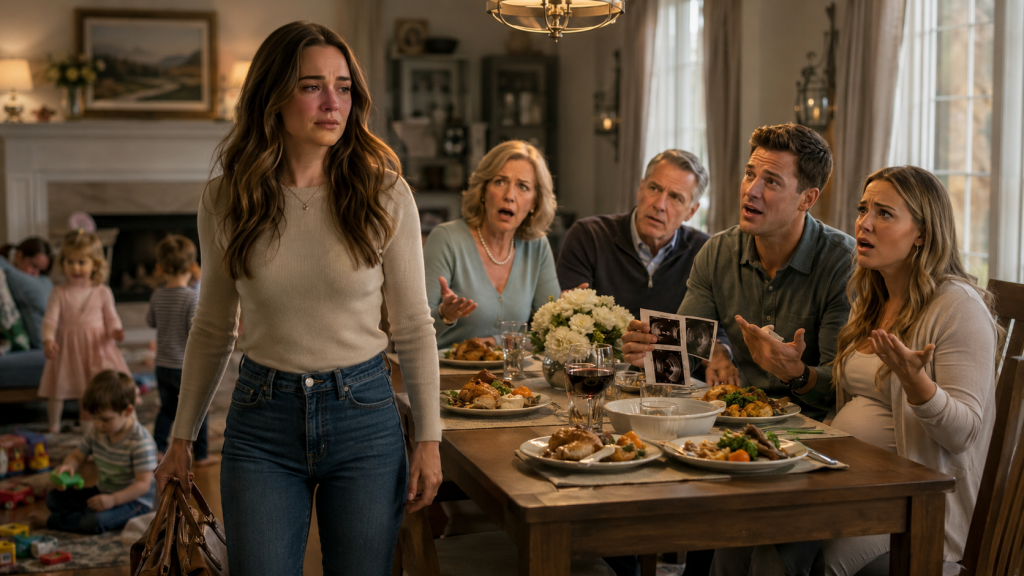
When my brother proudly announced that his wife was pregnant with baby number five, my parents cheered like the whole family had been blessed. Dad smiled and said, “Great job, son.”
But Mom’s eyes shifted straight to me. “You’ll handle the kids,” she said, as if my future belonged to them. I said, “Absolutely not.” That was when my sister-in-law snapped, “You have no family. This is your training.”
I walked out without saying another word and let them believe they had won.
But the next morning, I got a call from the police.
“Hello, ma’am,” the officer said. “This is Officer Daniels.”
When my brother, Ryan, announced baby number five at Sunday dinner, my parents acted like he had just been promoted to president.
Dad stood up first, clapping Ryan on the back.
“Great job, son,” he said, beaming across the dining room like Ryan had personally saved the family name.
Mom wiped her eyes with a napkin.
“Another blessing.”
Across the table, my sister-in-law, Madison, rested one hand on her stomach and smiled like a queen receiving applause.
Their four children were running through the hallway, screaming over a broken toy, while no one but me seemed to hear the crash from the living room.
Then Mom turned to me.
“You’ll handle the kids,” she said.
Not asked.
Said.
I lowered my fork.
“Absolutely not.”
The room went quiet so fast I could hear the refrigerator humming.
Ryan frowned.
“Don’t start, Olivia.”
“I’m not starting anything,” I said. “I’m ending something.”
For eight years, I had been the emergency babysitter, weekend babysitter, unpaid tutor, school pickup, birthday planner, sick-day backup, and the person everyone blamed if one of Ryan’s kids missed a permission slip.
I was thirty-one, single, employed full time, and somehow still treated like spare furniture in my parents’ house.
Available.
Useful.
Expected.
Never considered.
Madison’s smile vanished.
“You have no family,” she said coldly. “This is your training.”
The words landed harder than I expected.
My mother looked away.
My father said nothing.
Ryan only sighed, like I was embarrassing him.
I stood up, placed my napkin beside my plate, and grabbed my purse.
Mom followed me to the door.
“Olivia, don’t be dramatic.”
I turned back and looked at the room.
At Ryan, glowing with pride over another child he expected everyone else to help raise.
At Madison, who had insulted me while her children climbed onto my mother’s sofa with dirty shoes.
At my parents, who saw my single life as a storage unit for everyone else’s needs.
“I’m not dramatic,” I said. “I’m done.”
I left without another word.
In the car, I sat for a full minute before starting the engine.
My hands were shaking.
Not because I regretted what I said.
Because saying no to my family felt like breaking a law they had written before I was old enough to read.
I had always been the dependable daughter.
The one who answered.
The one who rearranged work meetings.
The one who kept snacks in her car because Madison forgot to pack them.
The one who knew each child’s allergies, homework schedule, shoe size, and favorite bedtime song.
Sometimes I loved being needed.
That was the dangerous part.
They had wrapped exploitation in affection so tightly I did not know where one ended and the other began.
When Ryan’s first child, Emma, was born, I was twenty-three.
I adored her.
I would have done anything for her.
When their second child, Mason, arrived, I helped because they were overwhelmed.
When their third, Noah, came along, I stepped in because Madison had postpartum exhaustion.
When their fourth, Ava, was born, I told myself the chaos would settle eventually.
It never did.
Every baby became another reason my time mattered less.
Every favor became a responsibility.
Every boundary became selfishness.
If I said I had plans, Mom would sigh.
“Plans? Olivia, they’re children.”
If I said I was tired, Dad would say, “Your brother works hard.”
If I said Madison needed to organize childcare, Ryan would snap, “You don’t understand parenting.”
And I would think, no, I understand it better than you think because half the time I’m doing it.
That night, my phone exploded.
Mom: You hurt your brother.
Ryan: You embarrassed Madison.
Dad: Family helps family.
Madison: Don’t worry. We won’t forget this.
I opened the family group chat and typed one message.
I am not babysitting anymore. Not tomorrow. Not weekends. Not emergencies. Do not list me, call me, or assume me. My answer is no.
Ryan replied with a thumbs-up emoji.
That was it.
A small, smug little symbol that said he did not believe me.
Mom wrote:
Olivia will calm down and come by in the morning.
I replied:
No. I am not babysitting.
Then I muted the chat.
For the first time in years, I slept with my phone on silent.
The next morning, my phone rang at 7:42.
I almost ignored it, but the number was local and unfamiliar.
“Hello?”
A calm male voice answered.
“Ma’am, this is Officer Daniels with the Brookhaven Police Department. Am I speaking with Olivia Carter?”
My stomach tightened.
“Yes.”
“Your brother and sister-in-law listed you as the responsible caregiver for four minor children this morning.”
I sat up in bed.
“They what?”
There was a pause.
“Ma’am,” he said carefully, “we need you to come to the station and make a statement. The children were found alone.”
For a moment, I could not move.
Found alone.
The words repeated in my head while my feet hit the floor.
“Are they okay?”
“They appear unharmed, but they were frightened. A neighbor called after seeing two of the children outside crying and two younger ones inside the house without an adult present.”
I pressed one hand to my chest.
“Where are Ryan and Madison?”
“They are here now.”
Of course they were.
Not home with their children.
At the station, angry.
Ready to explain why this was somehow my fault.
I threw on clothes and drove with my hands shaking against the wheel.
Every red light felt endless.
I kept seeing Emma’s face.
Mason’s little glasses.
Noah’s missing front tooth.
Ava’s tiny hand grabbing mine whenever she was scared.
The children were not the problem.
They had never been the problem.
That was why this hurt so much.
Ryan and Madison had always known I would worry about the kids.
They counted on it.
When I arrived at the station, Ryan and Madison were already in the lobby.
Madison was crying, but not like a mother terrified for her children.
She was crying like someone furious she had been caught.
The second she saw me, she pointed.
“There she is. She was supposed to watch them.”
I stopped walking.
“I never agreed to anything.”
Ryan snapped, “You’re family. You don’t need to agree.”
Officer Daniels turned to me.
He was middle-aged, serious-faced, with kind eyes that had probably seen too many families mistake excuses for explanations.
“Ms. Carter, did you consent to supervise the children this morning?”
“No,” I said clearly. “I told them yesterday I would not be responsible for their kids.”
Madison’s face twisted.
“She’s lying. She always helps.”
That sentence said more than she intended.
She always helps.
Not she agreed.
Not we asked.
Just she always helps.
I opened my phone and pulled up the family group chat from the night before.
My mother’s message appeared at the top.
Olivia will calm down and come by in the morning.
Then my reply.
No. I am not babysitting.
I handed the phone to Officer Daniels.
He read it once.
Then again.
His expression changed.
“So they left four children alone and listed you without permission.”
Madison went pale.
Ryan finally stopped talking.
Then Officer Daniels said, “Mrs. Carter, Mr. Carter, we’ll need full statements. This is being documented as child neglect.”
Madison gasped.
“Neglect? We were gone for twenty minutes!”
Officer Daniels looked down at his notes.
“According to the neighbor, the children were alone for at least an hour and fifteen minutes.”
Ryan muttered, “We had an appointment.”
“What appointment?” I asked.
Madison looked away.
Ryan’s jaw tightened.
Officer Daniels answered before they did.
“They stated they were attending an early ultrasound appointment.”
The room went silent.
They had gone to see baby number five.
And left the first four children alone.
Because they assumed I would come running.
I felt something cold settle inside me.
Not rage.
Clarity.
“You went to an ultrasound and left them alone?” I said.
Madison snapped, “It was supposed to be quick.”
“Emma is seven.”
“She knows how to use a phone.”
“Ava is two.”
Ryan stepped forward.
“Don’t act superior. You love playing mom when it makes you feel important.”
I looked at him, and for the first time in my life, I did not feel small beside my older brother.
I felt done.
“No, Ryan. I loved your children. You confused that with permission to use me.”
His face flushed.
Before he could answer, Officer Daniels asked me to step into another room for my statement.
I told him everything.
Not dramatically.
Not with revenge.
Just facts.
Eight years of unpaid childcare.
Repeated assumptions.
Last night’s conversation.
Madison’s insult.
My written refusal.
The group chat.
Officer Daniels listened carefully.
When I finished, he said, “Do you feel pressured by your family to provide care?”
I almost laughed.
Then I realized he was serious.
“Yes,” I said. “Constantly.”
“Have they listed you as caregiver with schools or doctors?”
My mouth opened.
Then closed.
Because yes.
They had.
Ryan once told me he put me down as emergency contact “just in case.”
Madison had given my number to the daycare.
My mother had told teachers to call me if Ryan or Madison did not answer.
I had never thought about what that meant legally.
Officer Daniels took more notes.
“You may want to notify those institutions in writing that you are no longer an authorized caregiver unless you specifically consent.”
I nodded slowly.
“Okay.”
When I came back into the lobby, my parents were there.
Mom looked terrified.
Dad looked angry.
“There she is,” Dad said. “You happy now?”
I stared at him.
“Am I happy that four children were left alone? No.”
“You called the police on your own brother.”
“No,” Officer Daniels said from behind me. “A neighbor called. Ms. Carter is here because your son listed her without consent.”
Dad’s face tightened.
Mom looked at Ryan.
“You said Olivia was coming.”
Ryan said nothing.
Madison wiped her eyes.
“She should have known.”
I turned to her.
“Known what?”
“That we needed help.”
“You needed childcare. You chose neglect.”
Madison flinched like I had slapped her.
Good.
Some words should hurt because truth should reach places excuses cannot.
Mom reached for my arm.
“Olivia, please. This is serious.”
I pulled away gently.
“Yes, Mom. It is.”
“They could lose the children.”
“Then maybe all of you should stop worrying about how this looks and start worrying about why it happened.”
Her eyes filled.
“You’ve always been so hard.”
That was when I laughed.
Not loudly.
Just once.
A tired, broken sound.
“I have been soft for years. You just called it hard when I finally protected myself.”
The children were placed temporarily with my parents while the investigation continued.
Not with me.
That was important.
Madison demanded I take them “since this was my fault.”
Officer Daniels shut that down immediately.
“No one is placing children with a person who has not consented to care for them.”
I could have kissed him for that sentence.
Consent.
Such a simple word.
One my family had never used when it came to me.
That afternoon, I went home and did something I should have done years earlier.
I emailed the school.
The daycare.
The pediatrician.
The soccer coach.
The dance studio.
Any place that had my name attached to Ryan’s children.
I wrote:
I am not an authorized guardian or standing caregiver. Do not release children to me or contact me for routine care unless I provide written consent for a specific date.
My hands shook when I sent the first email.
By the last one, they were steady.
Then I blocked Madison.
I did not block Ryan yet.
I wanted documentation.
He gave me plenty.
Ryan: You ruined us.
Ryan: Madison can’t handle this stress while pregnant.
Ryan: You better fix it.
Ryan: You wanted attention, now you got it.
I forwarded everything to Officer Daniels.
Then I blocked him too.
For three days, my family tried every route.
Mom called from different numbers.
Dad left voicemails about loyalty.
Hailey, my cousin, texted that I was tearing the family apart.
Madison’s mother sent a long message about how hard parenting is.
I saved everything.
I answered nothing.
On the fourth day, Emma called me from my mother’s phone.
I answered immediately.
“Aunt Liv?”
My heart squeezed.
“Hi, sweetheart.”
“Are you mad at us?”
I closed my eyes.
“No. Never.”
“Mommy said you don’t want us anymore.”
There it was.
The cruelty I had been waiting for.
Using the children as messengers.
I kept my voice steady.
“Emma, listen to me. I love you very much. But adults have to make safe plans. It is never a child’s fault when adults don’t make safe plans.”
She was quiet.
“Are we bad?”
“No, baby.”
“Then why did police come?”
“Because grown-ups made a wrong choice, and other grown-ups had to make sure you were safe.”
“I was scared.”
“I know.”
I wanted to drive over and hold her.
That was the old trap.
The moment love became a leash.
So I said, “Can you put Grandma on the phone?”
Mom came on, crying.
“Olivia—”
“If any of you tell those children I abandoned them again, I will send the recording of this call to the caseworker.”
Silence.
Then Mom whispered, “Recording?”
I had not been recording.
But the fear in her voice told me enough.
“Do not use them to punish me.”
“I didn’t know Madison said that.”
“Then start knowing.”
I hung up.
A week later, the family meeting happened at my parents’ house with a caseworker present.
I attended because the caseworker asked me to clarify my role.
Ryan looked exhausted.
Madison looked angry.
My parents looked like they had aged ten years.
The children were upstairs with my cousin.
The caseworker was a calm woman named Ms. Reed.
She asked Ryan and Madison what their childcare plan was going forward.
Ryan said, “We have family support.”
Ms. Reed looked at her notes.
“Which family members have agreed in writing?”
Ryan glanced at me.
I smiled politely.
No one spoke.
Madison snapped, “Olivia is being vindictive.”
Ms. Reed turned to me.
“Ms. Carter, are you willing to be part of their childcare plan?”
I looked at my brother.
My sister-in-law.
My parents.
All waiting.
All expecting guilt to do what it always had.
“No,” I said.
Madison burst into tears.
Mom covered her mouth.
Ryan cursed under his breath.
Ms. Reed simply wrote it down.
“Thank you for being clear.”
Clear.
Not selfish.
Not cruel.
Clear.
That one word felt like sunlight.
Ryan was required to enroll the younger children in daycare, confirm after-school care for the older two, complete parenting classes, and submit a written emergency plan that did not include me.
Madison had to attend the classes too.
They were furious.
But fury does not supervise toddlers.
Planning does.
Over the next month, everything changed.
Not peacefully.
Not cleanly.
But completely.
My evenings became mine.
The first Friday I did not pick up anyone from soccer, I sat in my apartment and listened to the quiet.
At first, it felt wrong.
Then it felt beautiful.
I cooked dinner for one.
Opened wine.
Watched a movie without pausing for homework questions.
On Saturday, I slept until nine.
Nine.
It felt illegal.
Then I cried because I realized how exhausted I had been for years.
My parents struggled the most.
Without me filling every gap, they finally saw the scale of what Ryan and Madison had dumped on everyone.
After two weeks of helping with school pickups, Mom called me.
Her voice was tired.
“I didn’t realize how much you were doing.”
I sat on my balcony, looking at the sunset.
“No. You didn’t want to realize.”
She was quiet.
“You’re right.”
That surprised me.
“I’m sorry,” she said.
I did not rush to comfort her.
I let the apology sit there, uncomfortable and unfinished.
“Thank you for saying that.”
“Can we fix this?”
“Not by going back.”
“I know.”
“Do you?”
She sighed shakily.
“I’m learning.”
Dad took longer.
He sent one text.
Your mother says I owe you an apology. I don’t know how to say it.
I replied:
Start with the words.
Three hours later, he wrote:
I’m sorry. We treated your life like it was less important because you didn’t have children.
I read that message several times.
Then I cried again.
Not because it fixed everything.
Because finally, someone had named the wound.
Ryan did not apologize for months.
Madison never truly did.
She once sent a message through Mom saying, “I’m sorry things got out of hand.”
I sent back:
Things did not get out of hand. You left children alone and blamed me.
She did not respond.
The children adjusted.
Daycare helped.
After-school programs helped.
Actual schedules helped.
Imagine that.
I still saw them sometimes.
On my terms.
Planned visits.
Saturday park days when I chose them.
Birthday gifts I wanted to give.
Movie nights once a month.
The first time Emma came over after everything, she looked around my apartment.
“Do we sleep here now?”
“No, sweetheart. This is just a visit.”
She seemed confused.
“Then who takes care of us?”
“Your mom and dad.”
She thought about that.
Then she said, “Good.”
Children want parents more than backup plans.
They want the people who chose to have them to choose them again and again.
Not pass them off to whoever feels too guilty to say no.
Months later, Ryan and Madison announced the gender of baby number five in the family group chat.
A boy.
This time, nobody looked at me.
Nobody said training.
Nobody said I would handle anything.
Mom simply wrote:
Congratulations. What is your childcare plan?
I stared at that message for a long time.
Then I laughed.
Real laughter.
Free laughter.
The kind that leaves the body lighter.
Ryan did not answer for several hours.
Then he wrote:
We’re figuring it out.
Good.
They should.
Because I finally understood something my family had spent years trying to make me forget.
Being single does not make a woman available.
Being childless does not make her time communal property.
Being loving does not mean being endlessly usable.
And being an aunt does not mean becoming the emergency exit for other people’s choices.
I love those children.
I always will.
But loving them never meant I had to disappear into their parents’ responsibilities.
The morning Officer Daniels called me, I thought my life was about to be ruined by another family demand.
Instead, it saved me.
It made the truth official.
It placed my no on paper where nobody could twist it into attitude.
It showed my parents what they had helped create.
It forced Ryan and Madison to face the difference between support and entitlement.
And it taught me that a boundary is not real until you let people be angry about it without running back to soften the consequences.
When my brother announced baby number five, everyone cheered.
When my mother said I would handle the kids, everyone expected me to bow my head like always.
When Madison told me, “You have no family. This is your training,” she thought she had exposed my weakness.
She was wrong.
She exposed theirs.
Because I do have a family.
I have the one I am building from honesty.
From peace.
From friends who ask before assuming.
From nieces and nephews who are learning that love is not the same as obligation.
From parents who may finally understand that I was never spare furniture.
And from myself.
The woman who walked out of Sunday dinner without arguing.
The woman who answered the police calmly.
The woman who finally said no and let it stay no.
That was the call they never expected.
And the freedom I never knew I needed.
THE END! THANKS FOR READING!