
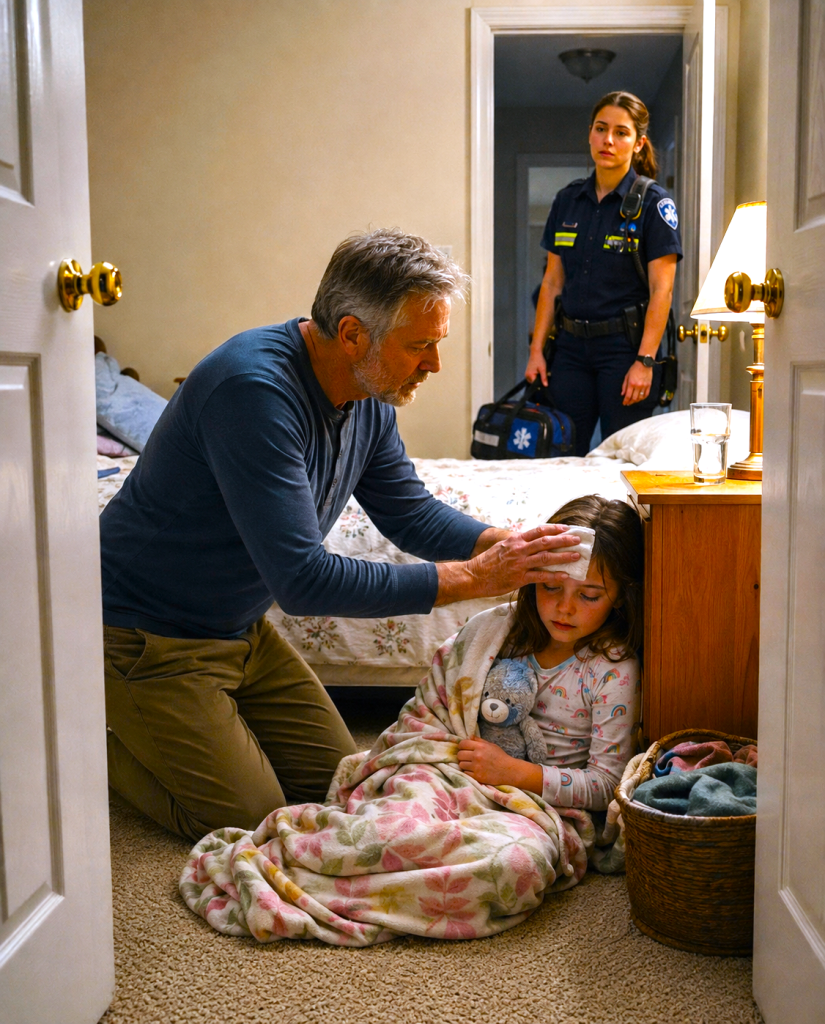
My phone lit up at 1:58 in the morning with the name of my eight-year-old granddaughter. Sadie almost never called me that late. For second, I wondered whether she had tapped my name by mistake while playing with the phone under her blanket.
Then I answered and heard her breathe. “Grandpa Harlan?” she whispered. “I feel so hot. And when I close my eyes, the room moves.” Her voice sounded thin and dry, as though every word scraped its way out.
Between short coughs, she paused to pull in air.I sat upright and turned on the lamp beside my bed.“Where’s your dad?” I asked. “Where’s Maren?”Sadie did not answer immediately.That silence told me more than a sentence could have.“They took Carter to Florida for his birthday,” she finally said. “Mom said I had to stay because I make sick days into a problem. She said Carter deserved one trip nobody ruined.”I was already reaching for my jeans.

My son Wesley and his wife, Maren, had flown their biological son to Florida for a birthday weekend.They had left their adopted daughter behind because she was sick.“Are you alone in the house?”“They left medicine on the counter,” Sadie said. “And a note.”I pulled on my shoes without bothering with socks.Then she said the sentence that changed the fear moving through me into something colder and more controlled.“Please don’t tell Mom I bothered you. I promise I wasn’t trying to make it worse.”
A child with a dangerous fever was apologizing for asking an adult to keep her alive.I wanted to call Wesley immediately.I wanted him to hear exactly what his daughter sounded like while he sat in a Florida hotel celebrating the child he had decided deserved the family’s attention.But rage would not lower Sadie’s temperature or help her breathe.A child needed motion, not anger.I put the phone on speaker, grabbed my keys, and told her to keep talking to me.The streets were nearly empty as I drove toward Wesley’s house outside Lake Oswego.
Whenever Sadie’s breathing became too quiet, I asked her a question.I asked what blanket she was using.“The yellow one,” she murmured. “The one with moons.”“It looks like space, doesn’t it?”“Yeah.”“Tell me how many moons you can see.”
She tried.She reached three before another cough took over.The coughing became so violent that the phone struck something beside her.“Sadie?”For several seconds, I heard only the faint scrape of fabric.Then she whispered, “I’m here.”I pressed harder on the gas while keeping my voice steady.“You did the right thing by calling me,” I said. “You hear me? You did exactly the right thing.”
She did not answer.
I repeated her name until I heard her breathe again.
For nearly thirty years, I had helped build child-protection cases.
I had interviewed frightened children, reviewed emergency calls, read medical reports, and watched adults explain away decisions that should never have required an explanation.
The most damaging cases rarely began with strangers.
They began inside ordinary homes, with adults who believed they controlled the story because the child had been trained to doubt her own pain.
I had learned not to argue with evidence.
I had also learned that evidence could disappear once the responsible adult realized anyone was looking.
When I reached the house, no lights were on downstairs.
The driveway looked exactly as it always did, which made the situation feel even worse.
There was no broken window, no open door, and no visible sign that an eight-year-old child was struggling to breathe inside.
I entered and called Sadie’s name.
The air felt stale and heavy.
The thermostat was glowing in vacation mode.
They had lowered the house into an energy-saving setting before leaving for the airport, as though nobody would be living there while they were gone.
On the kitchen counter sat a bottle of children’s fever medicine, a measuring cup, a sleeve of crackers, and a folded page torn from Maren’s pastel planning pad.
Everything had been arranged neatly.
The neatness disturbed me more than disorder would have.
This had not been a rushed mistake made by parents who misunderstood how sick their daughter was.
They had prepared for leaving her.
I unfolded the page.
Maren’s handwriting was clean and careful.
“Sadie, take one dose before bed and stop worrying yourself into a scene. We are taking Carter to Orlando because he earned a happy birthday weekend. Do not call the neighbors unless it is a real emergency, and do not make your brother feel guilty.”
The note did not sound like concern.
It sounded like instructions given to someone whose illness was considered an inconvenience.
Beside the paper was a digital thermometer.
I pressed the memory button.
The screen displayed 103.7.
They had checked Sadie’s temperature.
They had seen the number.
They had placed medicine beside a note telling her not to cause trouble, adjusted the thermostat to vacation mode, and boarded a plane.
I folded the note and placed it in my pocket with the thermometer.
Then I photographed the medicine bottle, the measuring cup, the crackers, the empty kitchen, and the thermostat display.
Anger forgets details.
Evidence does not.
Upstairs, Sadie’s bedroom door was partly closed.
Behind it, I heard one weak cough followed by something scraping against the floor.
I pushed the door open.
Sadie was lying beside her bed, tangled in the yellow blanket covered with moons.