
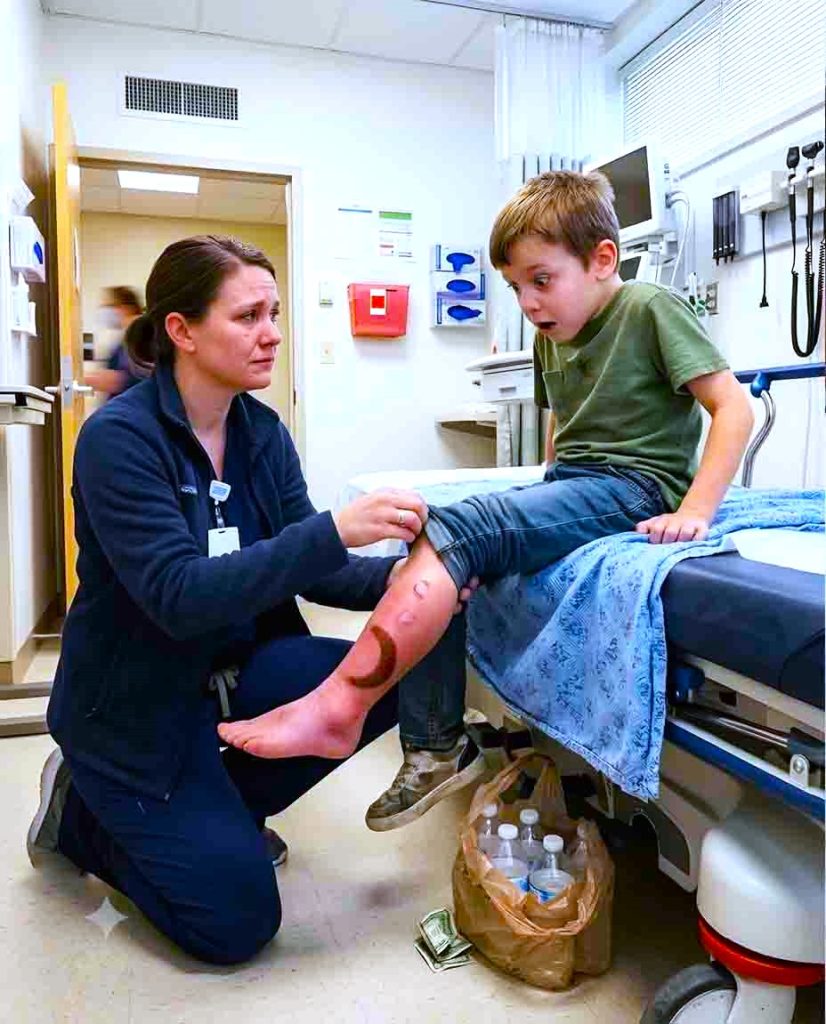
Please don’t hurt me—I’ll be good,” the little boy whispered when I lifted his torn pant leg, revealing an untreated fracture and the crescent-shaped birthmark of the son stolen from me five years earlier. For a moment, every sound in the hospital room seemed to move farther away.
The monitor beside the gurney continued its steady beeping. Rubber soles squeaked somewhere beyond the closed door. A cart rattled down the corridor, followed by the low murmur of nurses changing shifts.
But all I could see was that birthmark.
A pale crescent curved above the boy’s ankle, exactly where I remembered it. I had traced that mark with my thumb while rocking my son to sleep. I had kissed it after his bath and joked that the moon had left a piece of itself on him.

My son’s name was Owen.
He had been two years old when he disappeared from a neighborhood playground.
The child in front of me looked about seven now.
He was thin beneath an oversized sweatshirt, and one sleeve had been pulled down over his hand. Dirt darkened the knees of his jeans. His hair had been cut unevenly, as though someone had used household scissors and stopped caring halfway through.
At his feet sat a grocery bag containing six empty plastic bottles.
In his fist were twelve crumpled dollars.
He had walked into the hospital alone carrying everything he believed he needed to purchase medical care.
He had no idea that the woman standing beside him directed the hospital’s child-protection unit.
He had no idea that she might be his mother.
I forced myself to lower his pant leg carefully. The movement made him flinch, and the fear in his face pulled me back into the room.
Whatever that mark meant, I could not turn him into evidence while he was still asking permission to exist.
“You’re not in trouble,” I said.
His fingers tightened around the money.
“I didn’t steal it.”
“I believe you.”
“I brought enough.”
Before I could answer, the door opened.
Police Chief Mark stepped inside, closed it behind him, and gave me a sharp nod. He had come without an announcement and without the cluster of uniforms that usually followed a police chief into an emergency department.
He looked first at the boy, then at the swollen leg, and finally at me.
He recognized my expression.
Mark had been there five years earlier when my life split into before and after.
He had led the search for Owen. He had stood beside me under parking-lot lights while volunteers unfolded maps across the hood of a patrol car. He had watched me hand out flyers until the ink stained my fingers and the paper edges cut the skin beneath my nails.
Now he waited for instructions because he understood that one careless move could send this frightened child running—or warn whoever had brought him here.
“Which exits do you want sealed first?” he asked.
“Parking garage first,” I said. “Then the ambulance lobby. Quietly. No uniforms near this room unless I ask.”
Mark nodded once and stepped into the hallway.
The boy watched the door close.
“Am I arrested?”
“No.”
“Is it because of the bottles?”
His voice was so small that I had to lean closer to hear him, but I stopped myself before entering his space.
“No one is going to arrest you for bringing bottles,” I said. “What is your name?”
He hesitated.
“Ben.”
“Okay, Ben. My name is Claire.”
His eyes moved to the identification badge clipped to my jacket and then returned to my face.
He did not trust names merely because adults offered them.
That was understandable.
A nurse entered carrying pain medication and supplies for an IV. She knew me well enough to notice that something was wrong, but she did not ask questions in front of him.
Instead, she crouched where Ben could see her hands.
“I’m going to explain everything before I touch you,” she said. “First, I’ll put this soft band around your arm. It may feel tight, but it won’t hurt you.”
Ben glanced at me.
I stayed beside the wall rather than crowding him.
“You’re in charge of your body,” I told him. “You can ask her to stop.”
His brow furrowed, as though the idea itself made no sense.
The nurse reached toward the grocery bag to move it away from the gurney.
Ben lunged for it.
“No. Those are mine.”
The sudden movement pulled at his injured leg. He gasped and folded over, clutching the bag against his chest.
The empty bottles crackled loudly inside it.
“Leave the bag,” I said.
The nurse withdrew her hand immediately.
Ben watched both of us, waiting for anger.
When none came, he loosened his grip just enough to look inside. He counted the bottles under his breath, touching each cap with one finger.
Then he flattened the bills against his thigh.
Two fives and two ones.
Twelve dollars exactly.
“Who gave you the money?” I asked.
“No one.”
“Did you earn it?”
He nodded toward the bag.
“Deposits.”
“You collected the bottles?”
“Some were by the trash cans. Some were behind the gas station.”
He said it without pride or complaint. It was simply the work he had done to reach this room.