 Reading Time: 7 minutes
My Son Hadn’t Spoken a Single Word Since His Twin Sister Died Eight Years Ago—Then, on the Anniversary of Her Death, He Raised His Finger, Pointed Straight at His Father, and Spoke the First Words That Shattered Our Family Forever.
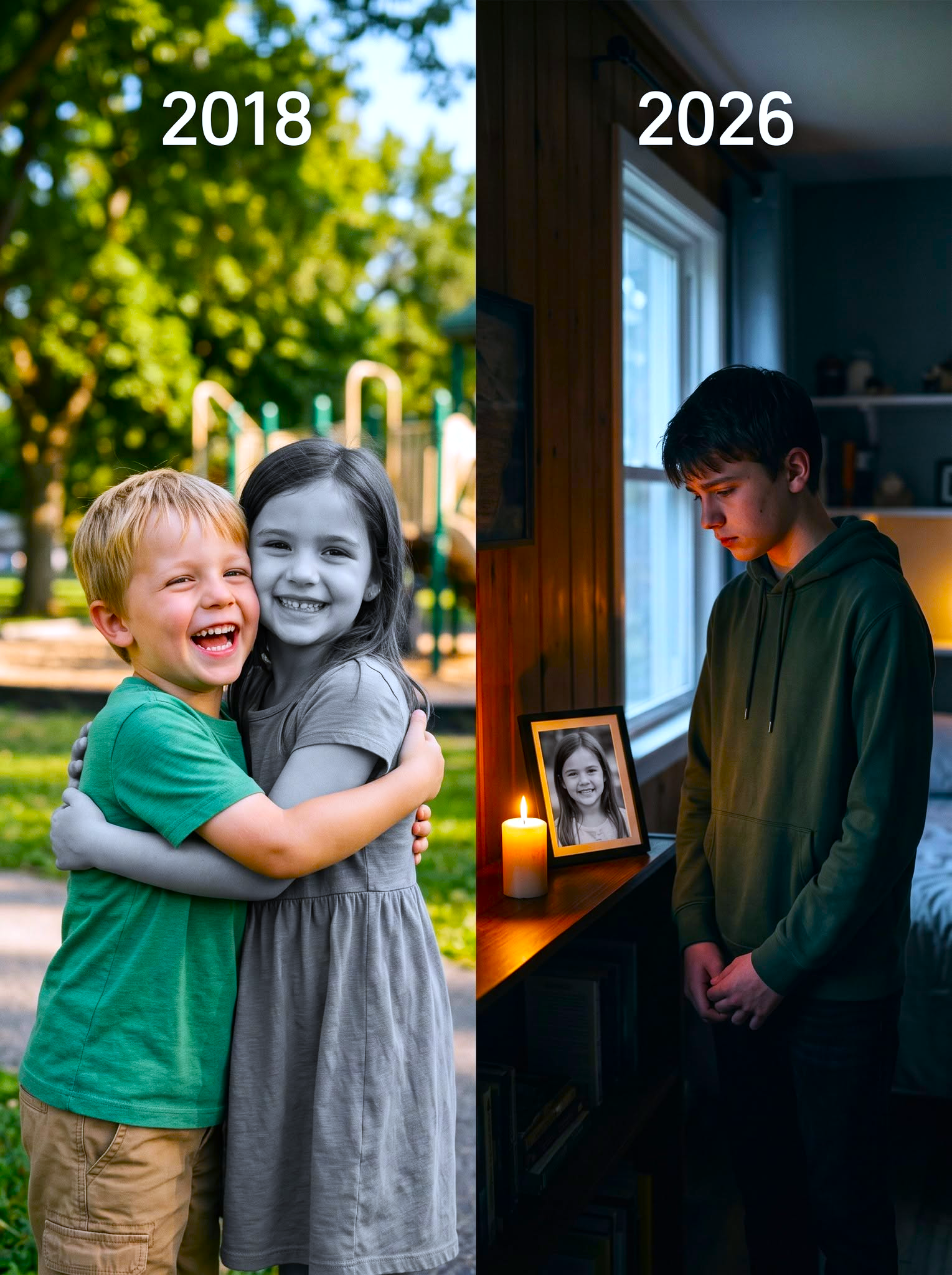
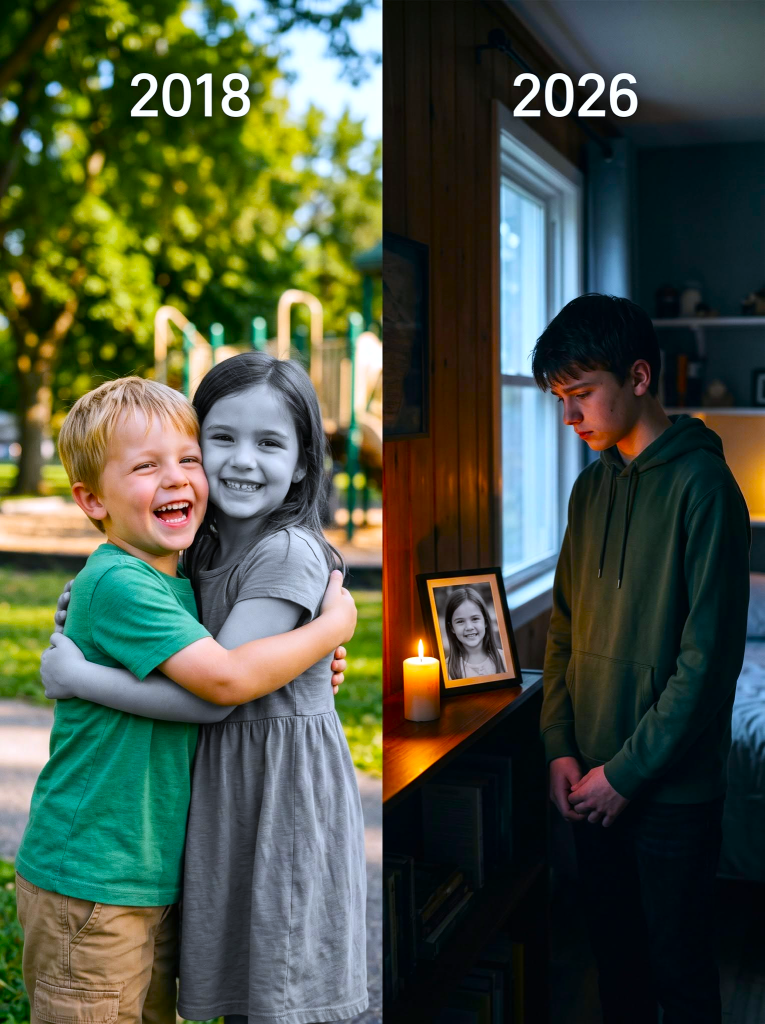
Part 1 — Eleven Minutes: Jeremy came first. Janice came eleven minutes later, already reaching — her tiny hand extended like she was looking for him before she had opened her eyes.
For five years they were inseparable in the way that twins sometimes are — finishing each other’s sentences, sleeping better in the same room, having entire conversations with their eyes that the rest of us could never decode.
My husband took them to the lake on a Saturday in August.

Only Jeremy came back.
My husband told me that she had slipped and the current had taken her. He had swum after her but could not catch her. Her body was never found.
The police called it a tragic accident.
Jeremy stopped speaking the day of Janice’s funeral.
Not gradually.
He stood at her graveside holding my hand and after that day — nothing.
Selective mutism triggered by acute grief trauma, the doctors said.
I tried everything.
Therapy. Art. Music. A dog named Pepper after Janice’s favorite cartoon character. I read to him every night even when he stared at the ceiling.
He communicated with nods and gestures.
He turned thirteen in March.
He was tall now and quiet in the way that fills a room rather than empties it. His teachers said he was the most attentive student they had ever had.
He just never spoke.
Part 2 — The Anniversary
Every year on the anniversary I host a small gathering at the house.
Janice’s photograph on the mantelpiece. Her favorite flowers on the table. The people who had loved her, together.
My husband comes every year.
He sits at the far end of the table. He does not make eye contact with Jeremy. He leaves before dessert.
He has done this for eight years.
I had watched this pattern for eight years without naming it.
I had told myself it was guilt.
I had told myself it was grief.
I had not told myself what Jeremy’s therapist, Dr. Chen, had said to me in a session the previous spring in careful, considered language.
She had said: there are things Jeremy communicates nonverbally that suggest the mutism may not be purely grief-based. There may be something he witnessed or understood at the time that he has been unable to process verbally.
She had said: I want you to think carefully about whether Jeremy was fully alone with Janice in the moments before the accident.
I had thought about it.
I had not been ready to think about what I was thinking.
This year, Jeremy watched his father from the moment he walked in.
Not the unfocused watching of a child in a room.
The specific focused watching of someone who has been waiting.
My father-in-law said grace. My mother poured wine. The plates went around.
We were midway through dinner — the particular quiet of people being careful around grief — when Jeremy set down his fork.
He looked at me.
He looked at his grandparents.
He looked at his father.
He pointed.
He opened his mouth.
He said: you pushed her. I saw you.
Five words.
Then three more.
He said: I saw you.
The table went completely still.
My husband’s face went a color I had never seen on a person.
Part 3 — After The Words
The room was silent for a very long time.
Then my father-in-law said: Jeremy.
Jeremy did not look at him.
He was looking at his father.
My husband said: Jeremy, that’s—
Jeremy did not break the look.
My husband stopped speaking.
I looked at my son.
I looked at my husband.
I thought about eight years.
Eight years of silence.
Eight years of my husband arriving at these dinners and sitting at the far end of the table and not making eye contact and leaving before dessert.
Eight years of a small boy who had witnessed something at a lake and had not been able to speak about it and had stood at his sister’s graveside holding my hand and after that day — nothing.
I said: everyone. I need a moment.
My mother started to speak.
I said: please. Everyone.
The room cleared.
Jeremy and his father and I sat at the table.
I said to my husband: I need you to tell me what happened at the lake.
He said: she slipped. I told you—
I said: Michael.
He stopped.
I said: your son just spoke for the first time in eight years and the first words he chose to say were you pushed her I saw you.
I said: I need you to tell me what happened at the lake.
My husband’s face was the color it had been when Jeremy pointed at him.
He said: I didn’t mean—
He stopped.
He said: it was an accident. I didn’t mean for her to fall that far. I was—
He stopped again.
I stood up from the table.
I said: Jeremy, come with me.
I took my son’s hand.
I walked to the kitchen and I called Detective Rosa Chen — a different Rosa than the therapist, a name I had looked up three days earlier when I had finally understood what I had been not-understanding for eight years.
I said: my son just spoke for the first time in eight years. He witnessed his sister’s death. He has something to say. I need to know what to do next.
Part 4 — Detective Chen
She came to the house within an hour.
She was patient and specific and she understood, from the first five minutes, what she was sitting in the middle of.
She spoke with Jeremy separately, with his therapist Dr. Chen present at Jeremy’s request — he had pointed at the phone and then at Dr. Chen’s name in my contacts, which was how he had always communicated what he needed.
Dr. Chen arrived twenty minutes after Detective Chen.
They were in the room with Jeremy for ninety minutes.
My husband sat in the living room with my father-in-law.
I sat in the kitchen.
When Detective Chen came out she sat across from me.
She said: your son is a very clear communicator.
She said: he has been carrying this for eight years.
She said: what he describes — and I want to be measured about this because these are early days and there is a process — what he describes is consistent with something other than the accident that was reported.
She said: I need you to understand that this is going to be a difficult process. Eight years have passed. The investigation will need to be reopened. It will require Jeremy to participate in formal interviews through the appropriate child forensic process.
She said: how is he?
I said: he spoke tonight. He spoke for the first time in eight years.
She said: yes.
She said: I think he has been waiting for the right moment. I think he understood, at some level, that this anniversary was the time.
She said: Mrs. Harmon. Your son is extraordinarily strong.
I said: I know.
She said: the next steps are going to be hard for him and for you.
I said: we’ve had eight years of hard. We know how to do hard.
She said: yes. I can see that.
Part 5 — What Came After
I will not describe the legal proceedings in detail because they are ongoing and because they belong to a process that has its own timeline and its own requirements.
What I will tell you is that the investigation was reopened.
What I will tell you is that Jeremy participated in the formal interviews through the child forensic process, with Dr. Chen present and with the specific support of people who understood how to help a child who had not spoken in eight years find the words for what he had seen.
He found the words.
He was very clear.
He had always been very clear.
He had simply been waiting.
Jeremy started speaking again in the weeks after the anniversary.
Not all at once.
Not the way he had spoken before, which I did not remember clearly enough — he had been five years old and I had not known then that I was saving up memories of his voice for a drought.
But in small things.
He said Pepper’s name when she came to the door.
He said goodnight.
He said thank you when I handed him his breakfast.
He said Mom once, in the middle of a Tuesday afternoon, for no particular reason except that it was a Tuesday afternoon and it seemed like the right time to say it.
I was at the kitchen sink.
I turned around.
He was standing in the doorway.
He said: I’ve been thinking about Janice.
I said: yes.
He said: I think she knew I was watching.
I said: what makes you say that?
He said: because she turned and looked at me right before. Like she wanted me to see.
I said: she was reaching for you.
He said: yes.
He said: that’s what twins do.
I sat down on the kitchen floor.
He came and sat beside me.
He said: I’m sorry I didn’t tell you sooner.
I said: Jeremy.
He said: I didn’t know how.
I said: I know.
I said: you told me when you could. You have been telling me for eight years in the only way available to you.
He said: the pointing.
I said: the pointing. The watching. The way you were at that table.
He said: I needed everyone to hear it.
I said: yes.
He said: I needed you to hear it.
I said: I heard it.
He said: I love you, Mom.
That was the sentence I had not heard in eight years.
I held my son on the kitchen floor for a long time.
He held back.
He was thirteen years old and he had carried something for eight years that should never have been his to carry.
He had found the moment.
He had chosen his words.
He had spoken.
Some silences end when the right moment comes.
Some children wait until the table is full and the room is listening and the person who needs to be named is present.
Some first words in eight years are the truest words ever spoken.
Janice reached for him eleven minutes after he arrived.
He was still reaching back.
He always had been.
Even in the silence.
He was always reaching back.
THE END! THANKS FOR READING!