 Reading Time: 11 minutes
My husband called crying in the middle of the night and asked for fifty thousand dollars to save his father’s life. I almost sent the money. Then I drove to the hospital and accidentally heard the conversation that changed everything.
By sunrise, the family that had spent years using me had no idea their perfect plan was already falling apart. At 12:43 a.m., my husband called me crying hard enough that I almost believed the sound before I believed the words.
“Evelyn, my father had a stroke,” Michael Carver said, his voice cracking through the phone. “He is in intensive care at St. Gabriel Medical Center, and they need a deposit tonight before the specialist begins the emergency procedure.”
I sat up in bed so quickly that the room tilted around me.
The winter rain tapped against the windows of our brownstone in Brookline, and for several seconds I could hear nothing except Michael breathing raggedly on the other end of the line.
“How much?” I asked.
He hesitated just long enough for fear to become calculation.
“Fifty thousand dollars.”
The number struck me more sharply than the word stroke.
It was not because I lacked the money.
I had exactly that amount sitting in a certificate of deposit at a local credit union, a private account I had opened six weeks earlier after my mother-in-law, Helen Carver, touched my wrist during Thanksgiving dinner and whispered, “Always keep one door that only you can open.”
I thought she meant emotional independence.
Now Michael read the account number aloud.
Every digit.
Even the access code.
My mouth went dry.
“How do you know that code?”
He began sobbing harder.
“Evelyn, please. This is not the time. My father may not survive the night, and I need you to transfer the money immediately.”
I swung my legs over the side of the bed.
“Why would a hospital need a private transfer before emergency treatment?”
“Because Dad wants a specialist outside network. It has to be handled now.”
His voice cracked again.
Then came the sentence that saved me.
“Do not come to the hospital. The family is overwhelmed, and Dad would not want you seeing him like this.”
That final sentence sounded wrong.
Gerald Carver would have wanted every person he knew to see him suffering if suffering gave him power over the room.
He was a man who converted discomfort into obedience.
He could turn a mild headache into a family meeting.
He once made Helen cancel a charity luncheon because he claimed his blood pressure rose whenever women enjoyed themselves too visibly.
Gerald Carver did not hide weakness.
He staged it.
I told Michael I would handle it.
Then I hung up, dressed, and drove through the rain to St. Gabriel Medical Center.
I did not transfer a cent.
On the fifth floor neurological wing, the hallway was quiet except for distant monitors and the soft squeak of nurses’ shoes.
Room 512 had a light beneath the door.
It was cracked open about four inches.
Before I could raise my hand to knock, I heard Gerald Carver laughing.
Not weakly.
Not bravely from a hospital bed after surviving a stroke.
He was laughing with his mouth full.
“She will send it,” he said. “That girl has been trained for five years to believe whatever Michael tells her.”
I stepped closer.
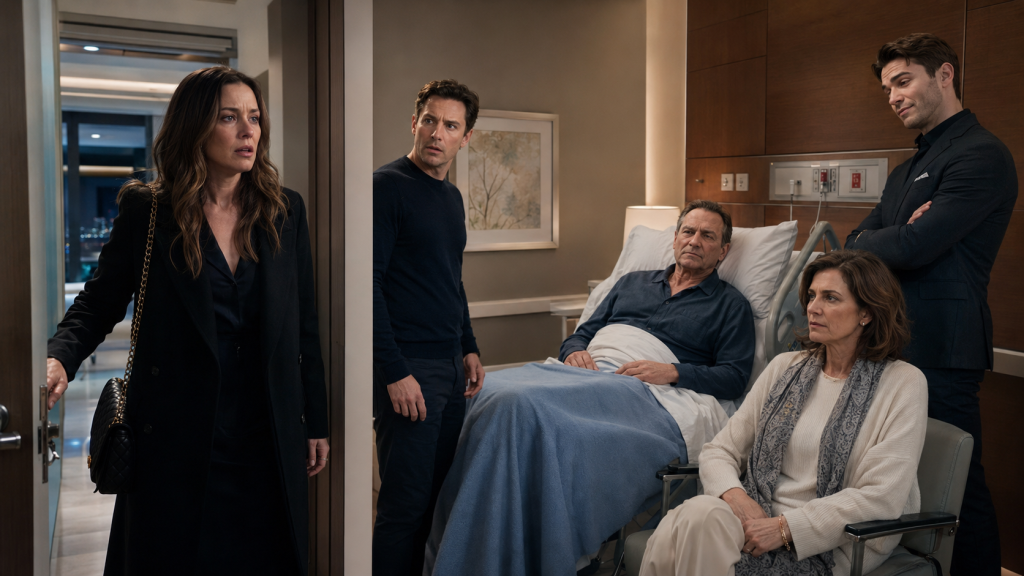
Inside, Gerald sat upright in bed wearing a hospital gown over his pressed pajama pants, eating apple slices from a plastic tray.
Helen sat near the window, thin and silent beneath a navy shawl.
Michael stood beside the sink, still holding the phone he had used to call me.
His older brother, Grant, lounged on the visitor sofa with one ankle crossed over his knee.
“She is sharp with spreadsheets,” Grant said, grinning. “But emotionally, she signs whatever paper gets handed to her.”
Gerald chewed slowly.
“The certificate of deposit is only the first step. Michael, once she sends the fifty, you tell her the clinic is short on operating cash. Then you get her to sign the home equity line on the Brookline property.”
My hands went cold.
The Brookline property was mine.
Not ours.
Mine.
My grandmother had left it to me before I ever met Michael.
I had paid the taxes, the renovations, the mortgage balance, every inch of that brick house with its narrow staircase and old brass doorknobs.
Michael had moved into it after we married and began calling it “our family home” whenever his relatives visited.
At first, I thought it was sweet.
Then it became convenient.
Then it became dangerous.
Gerald continued.
“Once the equity line is open, we move the money through Grant’s company. By the time she realizes, it will look like a marital loan.”
Michael laughed nervously.
“Evelyn won’t fight me.”
Helen’s voice cut through the room for the first time.
“Yes, she will.”
Everyone went silent.
Gerald turned toward her.
“What did you say?”
Helen slowly lifted her eyes.
“I said she will fight you, because I already told her where to look.”
My heart stopped.
Michael’s face twisted.
“Mom, what did you do?”
Helen reached into her purse and placed a small recorder on the tray table.
“What I should have done years ago.”
I stepped into the doorway then.
Four faces turned toward me.
Michael went white.
“Evelyn—”
I held up my phone.
“Don’t worry,” I said calmly. “I didn’t send the fifty thousand.”
Gerald’s face darkened.
“What are you doing here?”
“Saving your life, apparently,” I said. “Though you look remarkably healthy for a man needing emergency specialist care.”
Grant stood so fast the sofa scraped the wall.
“This is a private family matter.”
I smiled.
“That’s what people say when they want crimes handled quietly.”
Michael moved toward me.
“Evelyn, please, let me explain.”
I looked at him.
For five years, I had loved that man.
Or at least the version of him he had performed well enough to sell.
Michael had come into my life after my father died.
He was gentle then.
Patient.
He listened when I talked about grief.
He sent flowers to my office.
He said he admired that I managed my own finances.
He called me brilliant.
Then after the wedding, admiration slowly became access.
Could he be added to one account for convenience?
Could he review my investment files because “married couples should not have secrets”?
Could his father borrow my lake house for a weekend?
Could Grant use my business contact to land a contract?
Could I please not make things awkward by saying no?
Each favor was small enough to excuse.
Together, they became a cage.
And I had helped build it.
I looked at Michael and said, “You read me my own private account number.”
His mouth opened, then closed.
“How did you get it?”
Grant’s eyes flicked toward Helen.
Helen did not look away.
“I gave Evelyn the advice,” she said quietly. “I did not give them the code.”
Gerald slammed the plastic tray with his palm.
“Helen.”
She flinched.
Then straightened.
That small movement told me more about their marriage than years of dinners ever had.
Michael whispered, “Grant found the paperwork.”
I turned to him.
“What paperwork?”
His face crumpled.
“In your desk.”
A cold calm settled over me.
“You went through my locked desk?”
Grant scoffed.
“You act like a husband needs permission to know family finances.”
“My husband needed my permission,” I said. “And you are not my husband.”
Gerald leaned back against the pillows, eyes narrowed.
“You are being dramatic.”
There it was.
The Carver family anthem.
Dramatic.
Emotional.
Difficult.
Words they used whenever someone resisted being used.
Helen stood then.
Slowly.
Her hands trembled, but her voice did not.
“No, Gerald. You are being caught.”
He looked at her as if she had slapped him.
Helen turned to me.
“I am sorry, Evelyn.”
That nearly undid me.
Not Michael’s betrayal.
Not Grant’s smirk.
Not Gerald’s cruelty.
Helen’s apology.
Because she had lived with these men longer than I had.
She knew exactly what their kindness cost.
“I tried to warn you,” she said.
“I know.”
“I should have done more.”
Gerald barked, “Sit down.”
Helen did not sit.
The nurse appeared behind me then.
She looked from Gerald to me to the room full of tension.
“Is everything all right?”
I turned.
“Could you please call hospital security? There appears to have been fraudulent use of this room connected to an attempted financial scam.”
Gerald exploded.
“This is my hospital room.”
Grant snapped, “She has no proof.”
I held up my phone again.
“I have the recording. So does my attorney. So does my bank. So does the fraud investigator at the credit union.”
Michael looked as if he might be sick.
“You already sent it?”
“Yes.”
“When?”
“When your father said I had been trained.”
His eyes filled.
“Evelyn, I didn’t want it to go this far.”
I laughed once.
The sound was small and sharp.
“You called me at midnight pretending your father might die.”
“I was pressured.”
“By whom? The family you chose over your wife?”
He said nothing.
That was answer enough.
Security arrived.
Then an administrator.
Then, because attempted fraud involving a hospital lie tends to interest people, the police.
The Carvers began changing their story immediately.
Gerald claimed I had misunderstood.
Grant said they had been “speaking hypothetically.”
Michael said he had panicked and exaggerated because he was under stress.
Helen stood beside me and said, “No. They planned it.”
The officers separated us for statements.
I sat in a small waiting room with fluorescent lights humming overhead, my wet coat folded across my lap, and told the truth from beginning to end.
The midnight call.
The account number.
The request not to come.
The overheard conversation.
The home equity plan.
The recorder.
The attorney.
Everything.
At 3:36 a.m., I called my lawyer, Denise Albright.
She answered on the third ring, voice thick with sleep.
“This better involve either blood or fraud.”
“Fraud,” I said.
She sighed.
“Of course. Send me everything.”
By sunrise, my life looked nothing like it had at midnight.
My credit union froze the certificate of deposit.
My bank locked every joint access point connected to Michael.
Denise filed emergency paperwork to protect the Brookline property.
My accountant began reviewing every transfer Michael had touched.
The hospital filed its own report after confirming Gerald had been admitted only for observation after dizziness, not an emergency stroke.
And Helen came home with me.
That surprised both of us.
When the police finished questioning her, she stood near the hospital entrance looking small beneath her navy shawl.
Rain had softened to mist.
She clutched her purse with both hands.
“Do you have somewhere safe to go?” I asked.
She looked at the parking lot.
Then back at the hospital.
“My house has never been safe. Only familiar.”
So I took her to Brookline.
The brownstone was dark when we arrived.
For the first time in years, I was grateful Michael was not inside.
Helen stood in the foyer, looking at the old staircase and framed photographs.
“This house feels like you,” she said.
I removed my wet gloves.
“I almost let them take it.”
“No,” she said. “You were about to find out who they were.”
We sat in the kitchen until morning.
I made tea.
She held the cup with both hands.
For a long while, neither of us spoke.
Then Helen told me things.
How Gerald had controlled every account in their marriage.
How Grant learned entitlement by watching his father.
How Michael had once been softer, but softness in the Carver house was treated like a defect.
How she had seen the change in him after our wedding.
“He loved what you represented,” she said sadly. “Security. Respectability. A door into a life he could not build alone.”
I stared into my tea.
“Did he love me?”
Helen’s eyes filled.
“I think he loved you as much as he knew how. But that was never going to be enough to protect you from what he wanted.”
That hurt because it sounded true.
Michael called eighty-seven times before noon.
I did not answer.
He texted.
Please.
I messed up.
Dad pushed me.
Grant said it was just temporary.
We can fix this.
I forwarded every message to Denise.
Then I blocked him.
By afternoon, Grant’s company accounts were under review.
The supposed “clinic operating cash” turned out to be connected to a failing investment scheme he had hidden from lenders.
The fifty thousand dollars was meant to cover an urgent repayment.
The home equity line would have been their next lifeline.
My house.
My grandmother’s house.
My life.
Converted into oxygen for their greed.
Gerald tried to leave the hospital before signing discharge paperwork.
Security stopped him until officers finished taking a supplemental statement.
That detail made Helen laugh for the first time.
Not happily.
But freely.
“He hates being told to wait,” she said.
“Good.”
At four that afternoon, Michael came to the house.
I saw him through the front window.
He looked soaked, exhausted, and terrified.
He knocked.
I did not open the door.
He called through it.
“Evelyn, please. I know I ruined everything. Just talk to me.”
Helen stood behind me in the hallway.
Her face was pale, but steady.
I opened the door only as far as the chain allowed.
Michael’s eyes moved from me to his mother.
“Mom?”
Helen lifted her chin.
“I am staying here tonight.”
His face crumpled.
“Because of me?”
“Because of all of you.”
He looked back at me.
“Evelyn, I didn’t know Dad would say all that.”
“You knew enough to call me crying.”
“I was desperate.”
“So was I when I married you. I was grieving. Lonely. Easy to convince.”
He flinched.
“I loved you.”
“Then why was my private account number in your mouth?”
He had no answer.
He looked past me toward the house.
“Can I come in?”
“No.”
“This is my home too.”
That was the last door closing inside me.
“No, Michael,” I said. “It never was. It was the place I let you live while you forgot who owned the key.”
His expression changed.
Anger finally pierced the regret.
“You’re going to let one mistake destroy our marriage?”
“One mistake?” I repeated.
I unhooked the chain and opened the door wider.
“Your father faked a medical emergency. Your brother planned to move money through his company. You searched my locked desk, stole private banking information, and tried to manipulate me into draining my savings. Then you planned to push me into borrowing against my house.”
His mouth tightened.
“I was going to pay it back.”
“No. You were going to make sure I felt too ashamed to ask.”
He stared at me.
I saw it then.
The calculation had not left.
It had only changed clothes.
Now it wore tears.
“I filed for emergency separation,” I said.
His face drained.
“Evelyn.”
“Denise will contact your attorney.”
“I don’t have an attorney.”
“You should get one.”
I closed the door.
This time, I locked it.
The divorce was ugly.
Men like Michael do not release comfort willingly.
He claimed marital rights to the Brookline property.
Denied intent to defraud.
Suggested I was emotionally unstable.
Said Helen was confused.
That last part ended any remaining softness I had for him.
Helen gave a sworn statement.
So did the nurse.
So did the hospital administrator.
So did the credit union fraud investigator, who confirmed no legitimate medical provider had requested money.
Denise was merciless.
In court, she played the recording.
Gerald’s voice filled the room.
That girl has been trained for five years to believe whatever Michael tells her.
Michael stared down at the table.
Grant turned red.
Gerald looked furious, not ashamed.
Helen sat beside me, her hand resting lightly over mine.
When the judge issued temporary orders protecting the property and freezing disputed accounts, I finally breathed.
Not fully.
But enough.
Grant’s company collapsed three months later.
Gerald blamed everyone except himself.
Michael tried apology letters.
Then angry emails.
Then silence.
The silence was my favorite.
Helen filed for legal separation from Gerald after forty-six years of marriage.
She moved into a small apartment twelve minutes from me.
We had dinner every Thursday.
At first, people thought it was strange that I stayed close to my former mother-in-law.
But Helen had been the first Carver to tell me the truth.
Sometimes family is not who marries you.
Sometimes family is the woman who slips you a warning at Thanksgiving and finally presses record.
One year later, I woke at 12:43 a.m.
The same time Michael had called.
For a moment, panic tightened my chest.
Then I heard only rain against the window.
The brownstone was quiet.
Mine.
My certificate of deposit remained untouched.
My house remained protected.
My life, though scarred, belonged to me again.
I walked downstairs and made tea.
On the kitchen counter sat a small brass key Helen had given me for Christmas.
She said it was symbolic.
A reminder.
One door only I could open.
I keep it beside my grandmother’s old sugar bowl now.
People ask if I regret going to the hospital that night.
Never.
If I had stayed home, I might have sent fifty thousand dollars.
Then signed one document.
Then another.
By the time I understood, my house could have been tangled in their debt and my future tied to their lies.
Instead, I heard the laughter.
The plan.
The truth.
And sometimes truth does not arrive gently.
Sometimes it waits behind a cracked hospital door while the people using you forget to lower their voices.
My husband called crying in the middle of the night and asked for money to save his father’s life.
But his father was not dying.
Their plan was.
And by sunrise, so was the version of me who would have paid anything just to be loved by people who only valued what they could take.
THE END! THANKS FOR READING!