 Reading Time: 7 minutes
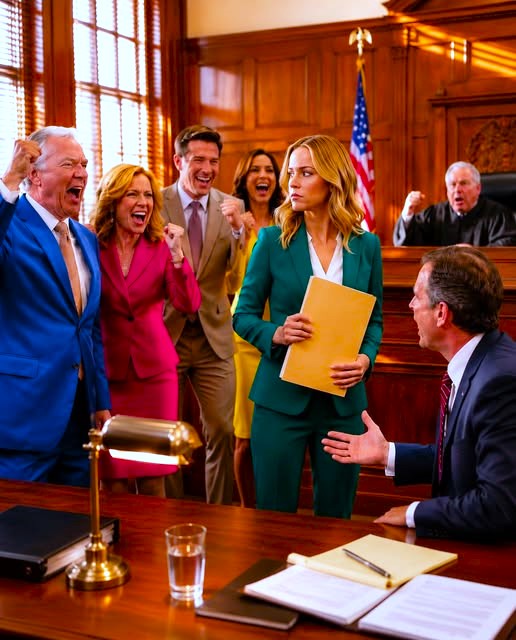
The Will They Thought Would Destroy Me “The will is clear,” my father’s lawyer declared. “She gets nothing.” The words echoed through the courtroom like they had been rehearsed a hundred times. Maybe they had.
Mr. Vance stood confidently behind his table, adjusting the expensive suit my father probably paid for years ago. He looked like a man who had already won.
And judging by the reactions around me, everyone else thought so too.
My stepmother Elaine covered her mouth with one hand.
At first glance, anyone would have believed she was holding back tears.
But I knew better.
I had spent twenty years learning the difference between her fake sadness and real emotion.
Behind her fingers was a smile.
A small one.
A victorious one.
The same smile she wore the night she told me my childhood bedroom was being converted into Lucas’s gaming room.
The same smile she wore when she handed me a cardboard box filled with my mother’s belongings and said, “You’re old enough to understand that not everything belongs to you.”
Across the courtroom, my half brother Lucas leaned back in his chair.
He looked comfortable.
Almost entertained.
Like this was a movie and he already knew the ending.
My aunt Margaret sat beside him, whispering something under her breath.
I didn’t need to hear the words.
I already knew.
Finally.
That was what she said.
Finally.
Finally, the unwanted daughter was getting what everyone believed she deserved.
Nothing.
I stood alone at the defendant’s table.
No family.
No friends.
No one holding my hand.
Just a thin brown folder pressed against my chest.
A folder that everyone in that room had underestimated.
My father, Richard Whitman, had been dead for three months.
To the outside world, he was a legend.
A successful hotel developer.
A businessman who turned small properties into luxury resorts.
His name was attached to charity foundations, university buildings, and hospital donations.
Newspapers called him generous.
People praised his vision.
They talked about how many lives he changed.
But they never talked about the one life he abandoned.
Mine.
I was Richard Whitman’s daughter.
His first child.
The daughter he had with the woman he once claimed was the love of his life.
My mother, Claire.
She died when I was eleven.
And after that, my father became a different man.
At first, I thought he was grieving.
I understood.
I missed her too.
I waited for him to come back.
I waited for the father who used to make pancakes on Sunday mornings.
The father who carried me on his shoulders during baseball games.
The father who told me I was the most important person in his world.
But grief changed into distance.
Distance became silence.
And silence became abandonment.
Six months after my mother died, my father met Elaine.
Everyone said he deserved happiness.
Everyone said he needed someone.
I tried to be happy for him.
I really did.
I remember standing at the wedding reception, wearing a dress my aunt chose for me, watching my father dance with his new wife.
He looked happy.
I walked toward him.
I wanted him to introduce me.
I wanted him to say, “This is my daughter.”
But instead, Elaine placed a hand on his shoulder and whispered something.
My father looked at me.
Then looked away.
That was the first moment I realized I was no longer part of his new life.
After the wedding, everything changed.
My room became the guest room.
My mother’s pictures disappeared from the walls.
My clothes were moved into a smaller closet.
Elaine called it “making adjustments.”
I called it disappearing.
She never yelled at me.
That would have been easier.
Instead, she used quiet cruelty.
“You need to stop acting like the world owes you something.”
“You’re too sensitive.”
“You always make things about yourself.”
And my father?
He always stayed silent.
That silence hurt more than anything Elaine ever said.
Then Lucas was born.
My half brother became the center of everything.
The family celebrated every achievement.
Every birthday.
Every little accomplishment.
When he learned to walk, there was a party.
When he scored a goal, my father bought him a new car.
When I graduated high school, my father sent a short message.
“Congratulations. Proud of you.”
That was it.
Six words.
I saved that message for years.
Not because it meant something.
Because it showed how little he had left to give me.
When I turned eighteen, Elaine sat me down at the kitchen table.
I remember that day clearly.
The sunlight was coming through the windows.
There was coffee in front of her.
She looked calm.
Almost kind.
That made it worse.
“Your father and I think it’s time you become independent,” she said.
I stared at her.
“Independent?”
She nodded.
“You’re an adult now.”
I laughed quietly.
I was eighteen.
Not sixty.
I still needed help.
I still needed a family.
“What about college?” I asked.
She smiled.
“You’ll figure it out.”
“What about insurance?”
“You can get a job.”
“What about living here?”
She looked around the kitchen.
Then back at me.
“This house belongs to this family.”
That sentence stayed with me.
This family.
Not our family.
This family.
I packed two suitcases.
My father watched from the doorway.
I waited.
I waited for him to stop me.
I waited for him to say, “You’re my daughter. You belong here.”
But he didn’t.
He just said:
“Take care of yourself, Emma.”
And then the door closed.
I built my life from nothing.
I worked during the day.
Studied at night.
I slept in a tiny apartment where the heating barely worked.
I learned how to survive.
And slowly, I learned something important.
I didn’t need the family who abandoned me.
Years passed.
I became successful.
Not rich like my father.
Not famous.
But stable.
I built a career.
I bought my own home.
I created friendships with people who actually cared about me.
And for the first time, I stopped waiting for my father to choose me.
Then came the phone call.
“Your father passed away.”
I sat silently after hearing those words.
I thought I would feel anger.
Maybe relief.
Maybe sadness.
But mostly, I felt empty.
Because I had already mourned my father years earlier.
The man who died three months ago was someone I barely knew.
Two weeks after the funeral, Mr. Vance contacted me.
“The family meeting regarding the estate has been scheduled.”
Family meeting.
I almost laughed.
There had never been a family.
But I went.
Because a small part of me still hoped.
Maybe my father had left a letter.
Maybe he had something to say.
Maybe after death, he finally found the courage he never had while alive.
I was wrong.
The will reading lasted less than twenty minutes.
Everything went to Elaine and Lucas.
The hotels.
The investments.
The properties.
The accounts.
Everything.
Then Mr. Vance looked at me.
“There is one final statement regarding Ms. Whitman.”
I sat up.
My heart moved slightly.
Then he read:
“My daughter Emma has chosen to live independently and has not maintained a meaningful relationship with me. Therefore, I leave no inheritance to her.”
No inheritance.
No apology.
No explanation.
Nothing.
Elaine looked at me with sympathy.
Fake sympathy.
Lucas avoided looking at me because he was smiling.
I left without saying a word.
But something bothered me.
The sentence didn’t sound like my father.
Not the father I remembered.
Not the man who wrote contracts worth millions.
Not the man who protected every business decision with documents.
It sounded incomplete.
Like something was missing.
That was when I started looking.
And what I found changed everything.
Because my father had not forgotten me.
He had protected something for me.
Something Elaine and Lucas never knew existed.
Something that would destroy the entire story they had built.
And that was why, three months later, I stood inside that courtroom.
Watching them celebrate my loss.
Watching them believe they had erased me forever.
Until Mr. Vance said:
“She gets nothing.”
And I opened my folder.
I placed the first document on the table.
“My father didn’t own half of what he left them.”
The courtroom went silent.
And for the first time in years…
Everyone finally looked at me.
Mr. Vance stared at the document in front of him.
For several seconds, he didn’t move.
The confidence he had carried into that courtroom slowly disappeared.
“What exactly is this supposed to prove?” he asked.
His voice was different now.
Less certain.
I looked at the judge.
“Your Honor, this document proves that several major assets listed in Richard Whitman’s will were never personally owned by my father.”
A quiet murmur spread through the courtroom.
Elaine immediately leaned forward.
“What are you talking about?”
I turned toward her.
For years, she had spoken to me like I was a child who didn’t understand anything.
Now, for the first time, she looked at me like an equal.
“Before my mother died, she created a family trust.”
Elaine’s face changed.
Only slightly.
But I noticed.
Because I had spent my entire life watching her reactions.
“She transferred several assets into that trust,” I continued. “The properties, investment accounts, and certain business shares were protected under specific conditions.”
Lucas frowned.
“That’s impossible.”
I looked at him.
“No, Lucas. What’s impossible is believing my father would build an entire business empire without protecting his assets.”
The judge picked up the papers.
“Mr. Vance, are you familiar with this trust?”
The lawyer hesitated.
That hesitation told everyone in the room what they needed to know.
“I was aware of a previous trust,” he admitted.
“But I was informed that it was no longer relevant.”
I almost smiled.
No longer relevant.
That was the phrase they used when they wanted something buried.
The judge continued reading.
“These documents appear legitimate.”
Mr. Vance stepped forward.
“Your Honor, even if the trust exists, we need time to verify—”
“No,” I interrupted.
Everyone looked at me.
Including the judge.
“I understand needing time. But I don’t understand how a lawyer representing my father’s estate failed to mention that the largest assets were not part of the estate.”
Mr. Vance’s jaw tightened.
The judge looked at him.
“That is a serious concern.”
The room became uncomfortable.
The same people who had been celebrating ten minutes earlier were now sitting silently.
Elaine looked angry.
Not sad.
Not confused.
Angry.
“You knew about this,” she whispered.
I looked at her.
“No.”
.THE END! THANKS FOR READING!